
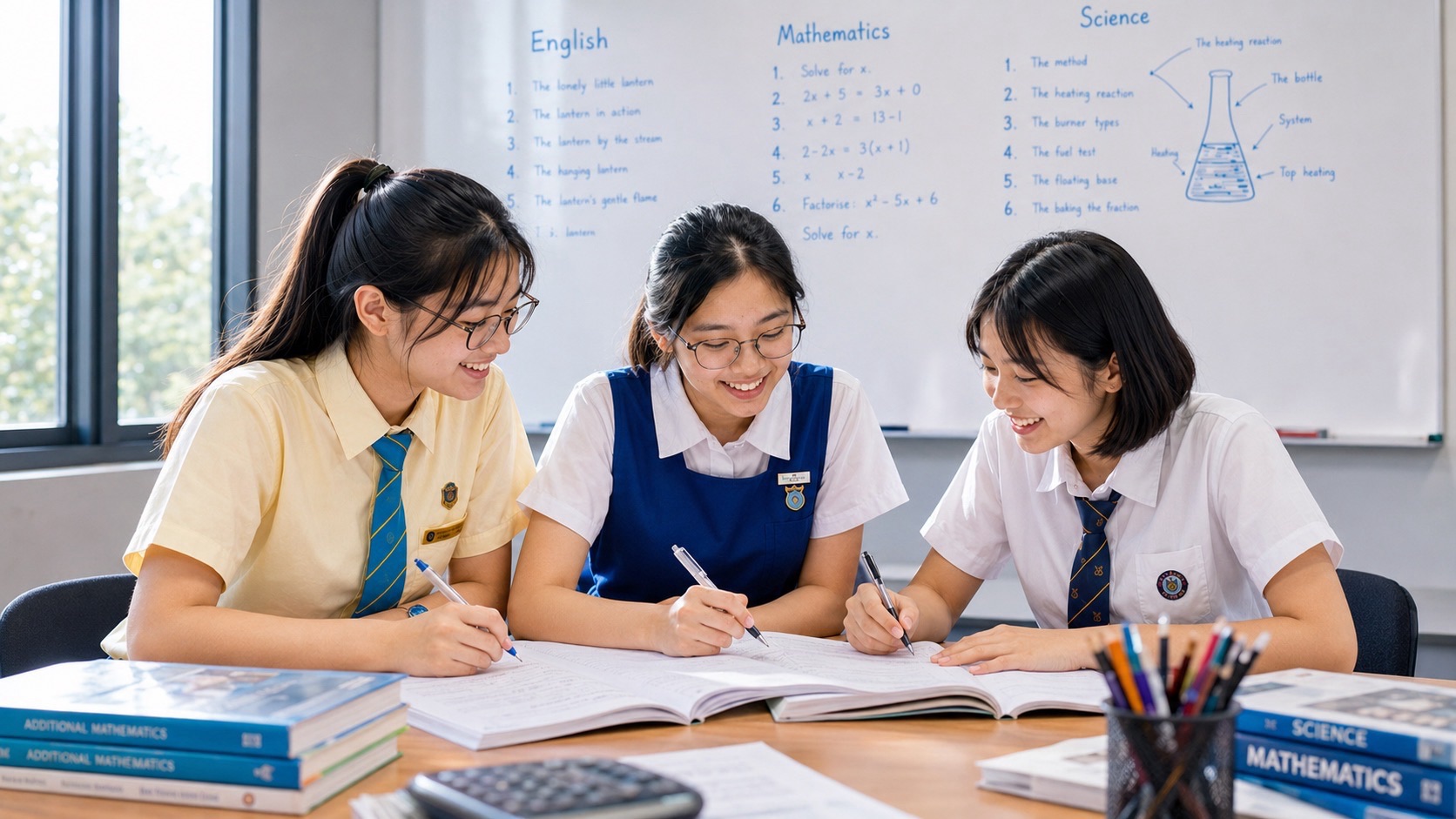
Becoming independent in Additional Mathematics is not the same as solving questions without ever asking for help. The real goal is that the student can recognise the structure, choose a valid first step, make progress, detect when a route is failing and recover without waiting for someone to supply the next line. Hint dependence becomes a problem when understanding exists only while the tutor, teacher or solution is visible.
This matters especially for the 2027 SEC G3 Additional Mathematics route because the examination expects students to apply standard techniques, solve problems in varied contexts and reason mathematically without chapter labels or live prompts. A learner who performs well in guided practice but freezes in tests often has a retrieval-and-selection problem rather than a simple knowledge deficit.
At eduKate Punggol, Mathematics tutorials are held at 83 Punggol Central, Singapore 828761, near Punggol MRT and Waterway Point, in small groups of up to three students. A three-student class makes hint dependence visible because the tutor can see exactly when a learner stops thinking and begins waiting.
What hint dependence looks like
- The student says “I know this” after seeing the first line but cannot produce that line independently.
- Homework is completed only with notes open beside it.
- The learner asks “which formula?” before identifying the target.
- A small change in wording causes a complete restart.
- Corrections are understood immediately but forgotten several days later.
- The student performs well in tuition but much worse in school tests.
Why hints can accidentally weaken independence
A hint is useful when it helps the student re-enter the problem. It becomes unhelpful when it removes the need to decide. If the tutor repeatedly says “Use the discriminant here” before the learner has analysed the line–curve relationship, the student practises execution but not recognition.
The skill that needs training is often the choice of method, not the method itself.
The first-step problem
Many A-Math questions do not require the student to see the entire solution route immediately. They require one valid first step. That step may be factorising, defining a variable, sketching a graph, differentiating a function, isolating a logarithm or rewriting a trigonometric identity.
Independence grows when the learner can ask: “What is the target, what do I know, and what relationship connects them?”
The five levels of prompting
- No hint: ask the student to start independently.
- Metacognitive prompt: “What is the target?” or “What do you know for certain?”
- Representation prompt: “Would an equation, graph or diagram help?”
- Method-family prompt: “Which topic relationship might connect these quantities?”
- Direct method prompt: “Use the discriminant.”
The training goal is to solve more questions at the earlier levels over time.
Do not give the method before the student has diagnosed the structure
If every difficult question is rescued by naming the chapter, the student becomes excellent at following labels and weak at paper-level recognition. Instead, let the student classify the mathematical object first.
This connects directly to Additional Mathematics Mixed-Topic Problem Solving.
The independent-start routine
- Read the target twice.
- Mark givens and restrictions.
- Name the mathematical object: equation, function, graph, triangle, rate or area.
- Write one relationship that definitely applies.
- Take one valid step.
- Only then decide whether help is needed.
Worked example: a tangent question
Suppose a line is tangent to a quadratic curve and a parameter is unknown. A hint-dependent student may wait for “use discriminant zero.” An independent student notices that tangency means one intersection point, converts line and curve into a quadratic intersection equation, then recognises that one repeated root implies discriminant zero.
The method is the same, but the second learner owns the bridge into it.
Worked example: a stationary-point question
A student may know differentiation but wait for “set derivative to zero.” Independence means understanding why: a stationary point has gradient zero. The mathematical meaning retrieves the method.
Retrieval before recognition
Looking at a formula sheet and recognising the right method is easier than producing it from memory. Independent exam performance requires retrieval.
Use closed-book recall for formulas, identities and method conditions, then check immediately. The gap between recall and reference material becomes the training target.
The three-question fading sequence
- Question 1: tutor models or supports the method.
- Question 2: student receives only a metacognitive prompt if needed.
- Question 3: student solves a fresh surface form independently.
Do not wait twenty questions before removing support. The removal of support is part of the lesson.
Delay the retest
A student may look independent five minutes after teaching because working memory still contains the explanation. Retest the mechanism after two days or one week.
Delayed success is stronger evidence of independence than same-session success.
Use changed-surface questions
If the taught question is a logarithm equation, the retest should not merely change the numbers. Change the surface: put the unknown in a different place, use an exponential model, or require a domain check.
The goal is to see whether the student retrieves the relationship rather than the layout.
Teach self-hints
Students can learn prompts they give themselves: “Can I rewrite this?”, “What stays constant?”, “What would make the tangent condition visible?”, “Can I sketch it?”, “What did I do last time before the calculator?”
Self-hints are not cheating; they are metacognitive tools that replace dependence on another person.
The no-progress protocol
- State the target.
- Write one known fact.
- Try one representation.
- Try one valid relation.
- If no progress after a reasonable interval, mark the question and move temporarily.
- Return later before requesting a direct method hint.
This trains recovery rather than helpless waiting.
How tuition can accidentally create dependence
If a tutor talks through every difficult step, the class can feel productive because solutions are completed quickly. But the student may be outsourcing method selection.
A strong small-group lesson includes silence, waiting time and independent attempts. The tutor should sometimes know the student is stuck and still allow the student to work through the next decision.
A 90-minute independence lesson
- 10 minutes: closed-book retrieval.
- 20 minutes: current topic with guided fading.
- 20 minutes: changed-surface parallel questions.
- 20 minutes: mixed-topic independent work.
- 15 minutes: one timed no-hint question.
- 5 minutes: classify where help was needed.
The independence scoreboard
- Questions started without a prompt.
- Hints needed per lesson.
- Average level of hint required.
- Fresh questions solved after a delay.
- Mixed questions attempted before asking for help.
- Corrections reproduced without the model solution.
- School-test performance relative to tuition performance.
How parents can help at home
Avoid becoming the permanent first-step provider. If the child asks “How do I do this?”, respond first with “What is the question asking?” or “What have you tried?”
The purpose is not to withhold help. It is to preserve the student’s responsibility for diagnosis.
How to know independence is improving
- The student begins before asking for help.
- Questions become more specific: “I formed the quadratic but I’m unsure about the condition,” rather than “I don’t know.”
- Hints can be less direct.
- The learner recovers from wrong routes more often.
- Fresh mixed questions produce more productive starts.
- Tuition and school-test performance move closer together.
Continue the upgraded Mathematics Improvements in Punggol lane
- Make A-Math Homework Faster Without Rushing.
- Improve A-Math Mathematical Communication and Working.
- From SEC A-Math to JC H2 Mathematics.
- Mixed-Topic Problem Solving.
Independent A-Math performance grows when support is deliberately faded. The student still receives teaching, feedback and rescue when needed, but the responsibility for recognising the problem, choosing the first step and checking progress gradually returns to the learner. That is the capability an examination ultimately demands.
Official reference: SEAB 2027 SEC G3 Syllabuses.
Continue Through the Mathematics System
Explore the Punggol Mathematics reading library for related guides.


