
Cells, tissues, organs and organ systems become easier when students understand one organising idea: biological structure supports biological function. In Punggol Science, younger learners may begin with plant and animal parts, life processes and simple systems. Secondary Biology then makes the hierarchy explicit: cells form tissues, tissues form organs, organs form organ systems, and organ systems cooperate to keep the organism alive.
Parents searching for cell structure and function, plant cell vs animal cell, cells tissues organs organ systems, specialised cells, human body systems, Secondary Biology cells or how to improve Biology are often trying to help a student organise a large amount of vocabulary. The solution is not a longer list. It is a hierarchy in which every structure has a job and every level is connected to the next.
This upgraded Science Improvements In Punggol guide aligns with international middle-school Biology resources and Singapore’s Secondary progression. Khan Academy’s cell-parts guide treats cells as the smallest units that carry out life functions, while its organisation-of-multicellular-organisms resource builds the hierarchy from cells to tissues, organs and organ systems. Singapore’s 2027 G2 Science syllabus similarly starts its Biology content with cell structure and organisation.
The biological-organisation ladder
- Organelle / cell structure: performs a particular cellular role.
- Cell: smallest living unit able to carry out life functions.
- Tissue: group of similar or coordinated cells performing a function.
- Organ: structure made of different tissues working together.
- Organ system: organs cooperating to perform major functions.
- Organism: the complete living individual.
The hierarchy is not merely vocabulary. Each level solves problems the smaller level cannot solve alone.
Start with cell function before cell labels
Students often memorise nucleus, cytoplasm, cell membrane, mitochondria, chloroplasts and vacuoles without understanding why those structures matter.
A stronger approach is to ask what a living cell needs to do:
- control what enters and leaves;
- carry out chemical reactions;
- release usable energy;
- store and use genetic information;
- build proteins and other cell materials;
- respond to its environment;
- grow and reproduce where appropriate.
Cell membrane: boundary and selective exchange
The cell membrane separates the cell’s internal environment from its surroundings and controls movement of substances across that boundary. Students should connect membrane structure to transport rather than treat it as the outline drawn around the cell.
Nucleus: genetic information and control
In typical school-level eukaryotic cell models, the nucleus contains genetic information and plays a central role in regulating cell activities. This becomes the foundation for later work on chromosomes, genes, inheritance and cell division.
Mitochondria: connect cells to respiration
Mitochondria are strongly associated with aerobic respiration and energy transfer in eukaryotic cells. Students should connect this organelle to the process, not simply memorise “powerhouse of the cell.”
Use Photosynthesis and Respiration — Stop Mixing Up the Two Processes to connect organelles to energy use.
Chloroplasts: connect structure to photosynthesis
Chloroplasts contain chlorophyll and are associated with photosynthesis in plant cells and other photosynthetic eukaryotes. Students should understand why cells in different plant tissues can contain different numbers of chloroplasts depending on function.
Plant cell and animal cell comparisons need purpose
| Feature | Plant cell | Animal cell | Why it matters |
| Cell membrane | Present | Present | Controls exchange with surroundings. |
| Nucleus | Typically present in many cells | Typically present in many cells | Contains genetic information. |
| Cell wall | Present | Absent | Provides support and shape. |
| Chloroplasts | Present in photosynthetic cells | Absent | Enable photosynthesis. |
| Large permanent vacuole | Common | Not typical in same form | Supports storage and turgor-related functions. |
The goal is not to memorise a comparison table forever. The goal is to connect each structural difference to the different jobs cells need to perform.
Specialised cells reveal the structure-function principle
A specialised cell has features that help it perform a particular job. This is one of the most transferable ideas in Biology.
- red blood cells are adapted for oxygen transport;
- root hair cells increase surface area for absorption;
- nerve cells are specialised for signalling over distance;
- muscle cells are specialised for contraction;
- palisade cells are suited to photosynthesis.
Students should not merely list adaptations. They should complete the causal sentence: this structural feature helps the cell perform this function because…
From cells to tissues
In multicellular organisms, cells with related functions can be organised into tissues. A tissue allows many specialised cells to coordinate a larger job.
For example, muscle tissue contains cells specialised for contraction, while epithelial tissues can form protective or exchange surfaces depending on location.
From tissues to organs
An organ contains multiple tissue types working together. A heart is not “made of heart cells” in one simple sense; it contains muscle, connective, nervous and other tissues coordinated around pumping blood.
This helps students move beyond one-cell-one-job thinking.
From organs to organ systems
Organ systems solve problems requiring coordination across the body.
- digestive system breaks food into absorbable nutrients;
- respiratory system exchanges gases;
- circulatory system transports substances;
- excretory system removes metabolic wastes and regulates internal conditions;
- nervous and endocrine systems coordinate responses;
- skeletal and muscular systems cooperate in support and movement.
Body systems should be learned as interacting networks
Khan Academy’s current middle-school human-body materials explicitly organise systems around how they cooperate to maintain life. This matters because examination questions often combine systems rather than isolate them.
For example, oxygen reaches a muscle cell only because respiratory exchange, blood transport and circulation cooperate. Glucose reaches that cell only because digestion, absorption and circulation cooperate.
Structure-function questions have a repeatable answer pattern
- Identify the structure.
- Name the feature that matters.
- State what that feature changes physically or chemically.
- Connect that change to the biological function.
- Return to the organism-level outcome if the question requires it.
This is far stronger than “it is adapted to do its job.”
Example: why does a root hair cell have a long extension?
The extension increases surface area. A larger exchange surface can increase the rate or capacity of absorption under suitable conditions. That supports uptake of water and mineral ions from the soil.
The answer works because every structural feature is connected to a mechanism and function.
Primary 3–4: begin with parts and functions
Younger Primary students do not need the full cellular hierarchy immediately. They can build the same thinking through plant parts, animal structures and simple systems: roots absorb, stems transport, leaves receive light and exchange gases, teeth have shapes linked to different functions.
Primary 5–6 and PSLE: connect systems and processes
Upper-Primary students should increasingly connect structure to larger processes such as transport, reproduction, digestion and energy use. This prepares them to understand why Secondary Biology moves into cells and tissues.
Use How to Understand Systems and Cycles in Science for the cross-system reasoning layer.
Secondary G1, G2 and G3: the hierarchy becomes explicit
The 2027 G2 Science syllabus begins its Biology section with Cell Structure and Organisation and explicitly frames life from cells to tissues, organs, systems and organisms. It also emphasises the correlation between structure and function and the way cellular processes support life at larger organisational levels.
At G3 Biology level, students may go much deeper into cell biology, molecular processes, cell division, transport and physiology. The hierarchy learned here becomes the organising scaffold.
A 30-minute cells-to-systems drill
- Draw a simple plant cell and animal cell from memory.
- Label six important structures.
- State the function of each structure.
- Choose two specialised cells and explain one adaptation each.
- Build the hierarchy cell → tissue → organ → organ system → organism.
- Choose one human body system.
- Connect it to a second system.
- Predict what happens if one component fails.
- Answer one unfamiliar structure-function question.
Common cell and organisation misconceptions
- all plant cells contain chloroplasts;
- all cells have exactly the same organelles and shape;
- the cell wall replaces the cell membrane in plants;
- mitochondria “make energy” from nothing;
- a tissue and an organ are the same level;
- an organ system works independently from other systems;
- adaptations are decorative features rather than functional ones;
- larger organisms simply have larger cells rather than many more specialised cells.
How to diagnose a Biology error
If the student mislabels diagrams, repair structure recognition. If labels are correct but functions are vague, repair function knowledge. If function is known but adaptation questions fail, train structure → mechanism → function. If organ-system questions fail, move from isolated parts to system interaction maps.
This diagnosis prevents Biology revision from becoming endless copying of labelled diagrams.
When Science tuition in Punggol adds value
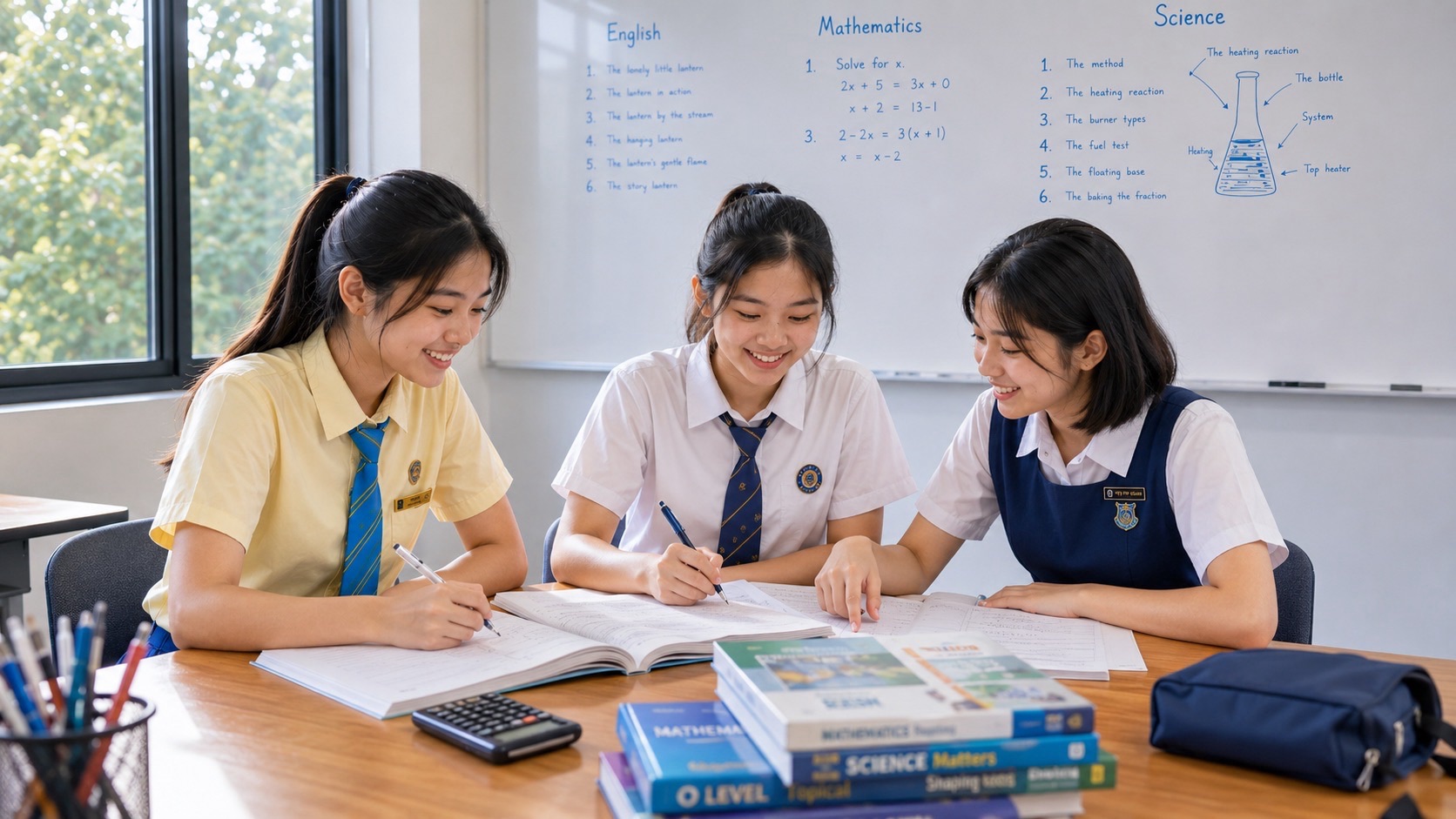
Biology can look memorisation-heavy until a tutor asks changed-condition questions. In eduKate Punggol’s three-student Science tutorials, one learner can explain structure, another mechanism and another organism-level consequence, allowing the tutor to see exactly where the chain breaks.
Parents can review Science Tuition Punggol, the Lower Secondary Science Tuition Punggol route, or the Secondary 3 Biology Tuition Punggol page.
Conclusion: Biology becomes coherent when structure explains function
Cells are not a vocabulary list. They are living units whose structures enable functions. Specialised cells form tissues, tissues build organs, organs cooperate in systems and systems sustain the organism. Once students can move up and down that hierarchy, Biology becomes a connected model rather than a collection of labelled pictures.


