
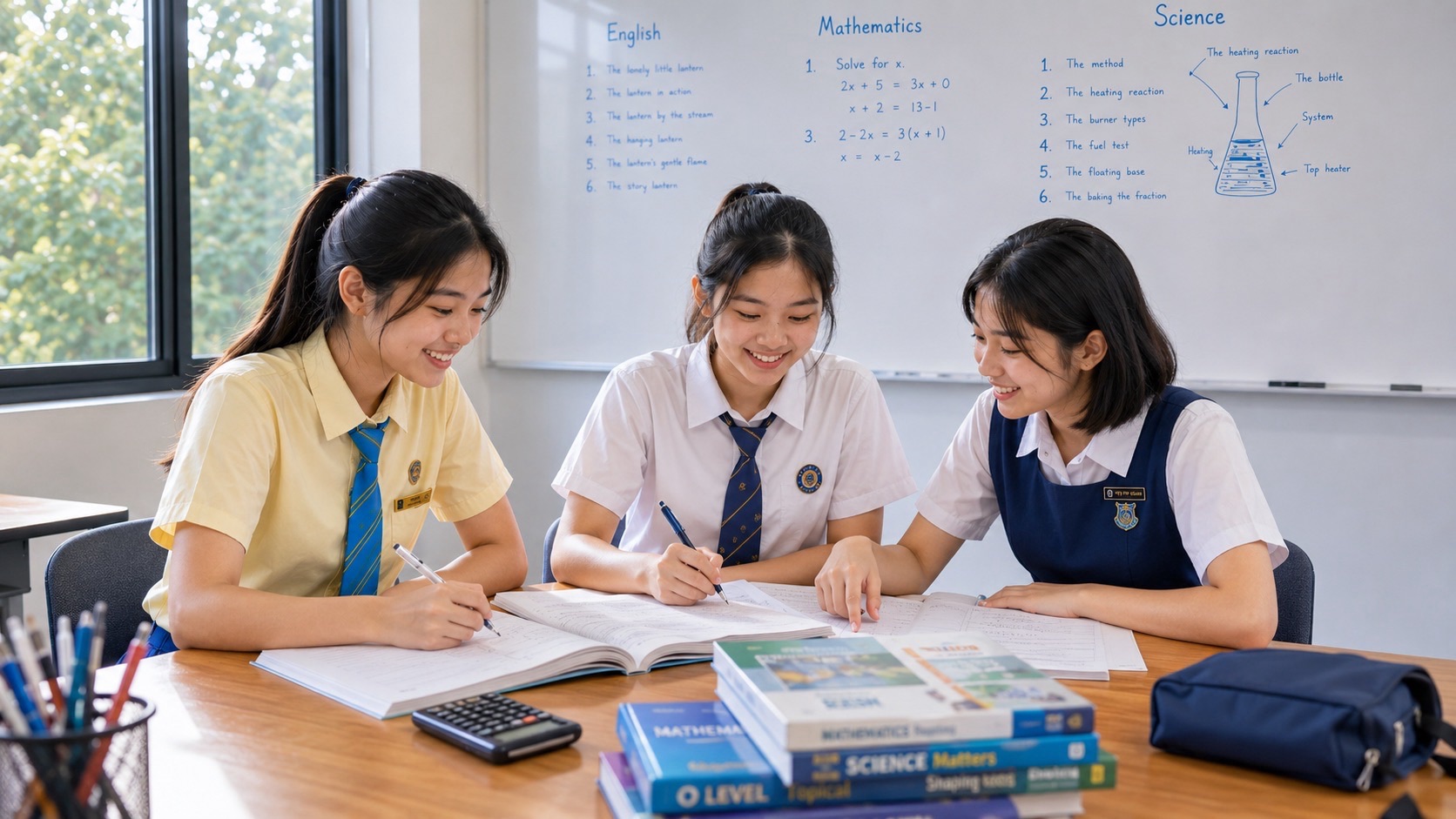
Linear equations are the point where many students first feel that Mathematics has changed language. Numbers are still present, but letters now stand for quantities, the equals sign must be understood as a relationship, and each step has to preserve that relationship. At eduKatePunggol, we teach algebra as a continuation of Primary Mathematics rather than as a mysterious new subject. A Punggol student moving into Secondary Mathematics should see that number bonds, inverse operations, patterns, ratio and unknown quantities have been preparing the ground for algebra all along.
For parents searching for linear equations, algebra basics, how to solve equations, Secondary Mathematics G1 G2 G3 or Mathematics tuition in Punggol, the most useful distinction is between symbol manipulation and equation meaning. A student can sometimes copy “move it to the other side and change the sign” and still have no reliable model of why the step works. That becomes dangerous when the equation looks unfamiliar. This tutorial builds a safer route: equality → inverse operations → balance → substitution → equations from words → multi-step equations → verification.
Singapore’s secondary landscape is also changing. MOE’s Full Subject-Based Banding announcements explain the implementation of Full SBB, while SEAB provides current Secondary Education Certificate syllabus information for subjects offered at G1, G2 and G3 levels. The precise level of challenge differs, but the mathematical habits in this tutorial—represent, preserve equality, solve and check—remain valuable across pathways.
What an equation actually says
An equation such as x + 5 = 12 does not mean “do something to the x.” It states that the expression on the left and the number on the right have the same value. The equals sign is a balance relation. Solving the equation means finding the value of x that makes the statement true.
This matters because many early algebra errors come from treating the equals sign as a command to calculate whatever is on the left. In arithmetic worksheets, children often see 3 + 4 = __, so “=” can become mentally translated as “the answer comes next.” Algebra requires a stronger interpretation: both sides have equal value.
The balance model: why we do the same thing to both sides
Imagine x + 5 on one side of a balance and 12 on the other. If the balance is level, removing 5 from only one side would destroy equality. Remove 5 from both sides and the balance remains level: x + 5 − 5 = 12 − 5, so x = 7. The same logic works for addition, subtraction, multiplication and division, provided the operation is valid.
This is more durable than the shortcut “move +5 to the other side and it becomes −5.” The shortcut describes the visible result, but the balance model explains the transformation. When equations become more complex, understanding preservation of equality reduces sign errors and supports self-correction.
The algebra bridge from Primary Mathematics
Primary students already solve equations informally. A number bond such as 8 + □ = 13 asks for an unknown. A bar model showing an unknown part of a whole is algebraic thinking. A ratio problem may require finding one unit before scaling. A pattern problem asks the student to express a relationship that remains true across cases. Secondary algebra replaces some diagrams and boxes with a more compact symbolic language.
Parents can therefore prepare for Secondary Mathematics without pushing formal algebra too early. Build strong inverse-operation sense, equality, arithmetic fluency, fraction understanding and the habit of explaining what an unknown represents. The site’s Algebraic Thinking guide shows this progression from pattern to unknowns, variables and generalisation.
A safe six-step method for solving linear equations
- 1. Read the equation as a statement of equality.
- 2. Identify the operation attached to the unknown.
- 3. Choose an inverse operation that isolates the unknown.
- 4. Apply the same valid operation to both sides.
- 5. Simplify carefully.
- 6. Substitute the answer back into the original equation to verify.
At first this method may look slower than a transposition shortcut. That is acceptable. The aim is to build a model that remains reliable. As understanding grows, steps can be compressed mentally without losing the logic underneath.
Worked tutorial 1: one-step addition equation
Solve: x + 9 = 23. Subtract 9 from both sides: x + 9 − 9 = 23 − 9, so x = 14. Check by substitution: 14 + 9 = 23. The original statement is true, so the solution is verified.
The check is not optional decoration. It teaches the student what a solution means: a value that makes the original equation true. This interpretation becomes especially important when fractions, negative numbers or brackets appear.
Worked tutorial 2: one-step multiplication equation
Solve: 6x = 42. Here 6x means 6 multiplied by x. Divide both sides by 6: 6x ÷ 6 = 42 ÷ 6, giving x = 7. Check: 6 × 7 = 42.
If the child writes x = 36 because 42 − 6 = 36, the problem is not just arithmetic. The student has misread the operation joining 6 and x. Ask the child to say the expression aloud: “six times x.” Language can reveal the symbolic relationship.
Worked tutorial 3: two-step equation
Solve: 3x + 4 = 19. The goal is to isolate x. Undo the +4 first: 3x = 15. Then undo ×3: x = 5. Check: 3(5) + 4 = 15 + 4 = 19.
Why not divide by 3 first? It can be done correctly if the student divides every term on both sides, but that route may introduce fractions unnecessarily. Strategic equation solving asks which valid step makes the equation simpler.
Worked tutorial 4: unknown on both sides
Solve: 5x + 2 = 3x + 14. Subtract 3x from both sides: 2x + 2 = 14. Subtract 2: 2x = 12. Divide by 2: x = 6. Check: left side 5(6)+2 = 32; right side 3(6)+14 = 32. Equality holds.
The student should notice that “moving 3x” is really subtracting 3x from both sides. Keeping that meaning visible prevents a common mistake where the sign changes in one place but another term is accidentally altered.
Worked tutorial 5: brackets
Solve: 2(x + 3) = 18. One route is divide both sides by 2 first: x + 3 = 9, so x = 6. Another route is expand first: 2x + 6 = 18, then 2x = 12, so x = 6. Both are valid.
Comparing routes teaches algebraic flexibility. The best method is often the one that keeps the working simplest and reduces opportunities for error. Students should learn that Mathematics can have multiple valid paths, but each path must preserve equality.
Worked tutorial 6: fractions in equations
Solve: x/4 + 3 = 8. Subtract 3: x/4 = 5. Multiply both sides by 4: x = 20. Check: 20/4 + 3 = 5 + 3 = 8.
A student who is uncomfortable with fractions may treat this as “hard algebra” when the real bottleneck is fraction meaning or inverse operations. Algebra often exposes earlier arithmetic gaps. Diagnosis should move backward to the earliest unstable prerequisite rather than piling on more equation worksheets.
From words to equations: the real transfer test
Many students can solve an equation once it is written but struggle to create the equation from a problem. That is a representation issue. Teach the child to define the unknown first. Example: “A number increased by 7 is 25.” Let x be the number. Then x + 7 = 25, so x = 18.
Now increase complexity: “Three times a number, then decreased by 5, gives 28.” Let x be the number. The structure is 3x − 5 = 28. Add 5 to both sides: 3x = 33. Divide by 3: x = 11. The student must translate the sentence in order, not hunt for individual keywords.
Why keyword algebra fails
Rules such as “more than means add” can be helpful as a first cue but are unsafe as a complete strategy. “Five more than twice a number” means 2x + 5, while “five times the sum of a number and two” means 5(x + 2). The grammar determines the grouping. A student needs to understand the relationship described, not simply match isolated words to operations.
Ask the child to paraphrase the expression before writing symbols. If the child cannot explain the relationship in ordinary language, the symbolic line is likely to be guesswork.
The most common linear-equation errors
Sign change without an operation
The student moves a term across the equals sign and changes the sign mechanically, then becomes inconsistent when brackets or fractions appear. Repair by temporarily writing the same operation on both sides.
Only one term is divided
In an equation such as 3x + 6 = 18, a student may divide 3x by 3 but leave 6 unchanged while also dividing 18. If the whole side is being divided, every term on that side must be divided. A balance model helps.
Equals sign disappears
Some students turn an equation into a vertical chain of expressions and lose track of equality. Insist that each written line remains a true equation until x is isolated.
Arithmetic error after correct algebra
Do not reteach the whole concept if the algebraic step is correct. Repair the specific arithmetic weakness—negative numbers, fractions, multiplication or division—and then return to the equation.
Answer is never checked
Substitution catches many mistakes quickly. Make checking part of early training so it becomes natural rather than something added only before examinations.
Equality games parents can use at home
Write 8 + 7 = 10 + __. This forces the child to treat both sides as values rather than seeing the right side as the location of an answer. Try __ + 5 = 3 + 9, 4 × __ = 2 × 14, and 30 ÷ __ = 5. These are simple but powerful because they widen the meaning of equality before formal algebra becomes difficult.
For younger siblings, use a covered-number game: “I am thinking of a number. I add 6 and get 17. What is my number?” The structure is already an equation. The symbol can be introduced after the reasoning is secure.
Linear equations across G1, G2 and G3 Mathematics
G1, G2 and G3 are subject levels within Singapore’s Full SBB landscape; they should not be treated as labels of a child’s intelligence. The pace, depth and complexity of mathematical work can differ, but all students benefit from clear representation, secure operations and accurate checking. Parents should consult current school and official guidance for the child’s actual subject level and progression rather than assuming a permanent route from one early result.
For local year-level support, use the Secondary 1 Mathematics, Secondary 2 Mathematics and Secondary 3 Mathematics owners. The Secondary G3 Mathematics page handles the specific commercial G3 route, while this tutorial remains focused on algebra teaching.
How to practise equations so the skill transfers
Do not give twenty equations of exactly the same form and conclude the skill is mastered. Mix one-step addition, one-step multiplication, two-step equations, brackets, fractions and equations from words. Ask the student to state the first valid move before solving. This trains method selection.
Then vary surface details without changing the structure. If the student solves 3x + 4 = 19, later use 5y + 7 = 32. If the method survives the new letters and numbers, the learner is beginning to generalise.
A four-part algebra practice cycle
- Meaning: explain what the variable and equals sign represent.
- Method: solve a small set accurately with full reasoning.
- Mixing: choose methods among different equation forms.
- Transfer: build equations from words, diagrams, tables or geometric relationships.
Spaced retrieval matters here too. Revisit equation types after several days. Immediate success after a worked example may reflect short-term imitation. Delayed success is stronger evidence that the student has internalised the structure.
How equations connect to graphs and functions
A linear equation is not the end of algebra. Later, students work with relationships between two changing quantities, such as y = 2x + 3. Every value of x produces a corresponding y. A table of values, graph and equation become three representations of the same relationship. The habit of preserving equality and interpreting symbols now supports coordinate geometry and functions.
This is why early algebra teaching should not be reduced to sign-moving tricks. The symbols will later describe patterns, rates, geometry, science and financial relationships. Students need a language they understand, not merely a procedure they can imitate.
Algebra and problem solving: define the unknown carefully
Consider: “A rectangle has a length 5 cm more than its width. Its perimeter is 46 cm. Find its dimensions.” Let the width be x cm, so the length is x + 5. Perimeter gives 2x + 2(x + 5) = 46. Simplify: 4x + 10 = 46, so 4x = 36 and x = 9. Width = 9 cm; length = 14 cm. Check: 2(9 + 14) = 46.
The hardest step for many students is not solving 4x + 10 = 46. It is constructing the equation from the geometry. That is why problem representation remains central in Secondary Mathematics.
How parents should read an algebra test
Separate errors into symbol meaning, equation construction, transformation, arithmetic, expansion, signs, fractions and verification. A student who solves given equations correctly but fails word problems needs representation practice. A student who creates the right equation but then makes a negative-number error needs arithmetic repair. A student who cannot explain the equals sign needs a deeper conceptual reset.
Bring that classification to tuition if you engage a tutor. A useful teacher should diagnose the first unstable step and show how later errors follow from it. “Needs more practice” is not a complete diagnosis.
How a three-student algebra tutorial can work
In a three-student lesson, one equation can support three levels of thinking. Student A solves it using explicit balance operations. Student B explains why each transformation preserves equality. Student C creates a word problem that produces the same equation. Then they exchange and verify one another’s work. The group is small enough for the tutor to inspect each line while still allowing mathematical discussion.
At eduKatePunggol, lessons are typically about 90 minutes and groups are capped at three students. The commercial value comes from the teaching mechanism: individual working is visible, prompts can be targeted, and support can be faded within the lesson. Families near Punggol MRT and Waterway Point can review the Mathematics tuition route or the Mathematics sign-up page if the child needs structured help.
A six-week algebra repair route
Week 1: equality and inverse operations
Use arithmetic equations with blanks and simple x equations. Make the student explain why the same operation is applied to both sides.
Week 2: one-step and two-step equations
Build accuracy before speed. Check every solution by substitution.
Week 3: brackets and negative numbers
Connect expansion and sign control to previously secure equations.
Week 4: fractions and mixed forms
Use equations that expose arithmetic prerequisites. Repair fraction or negative-number gaps as they appear.
Week 5: equations from words
Define unknowns, translate relationships and distinguish similar-looking sentence structures.
Week 6: transfer
Use geometry, rate, percentage, simple data and graph contexts. The equation should become a tool for solving another problem, not the final topic itself.
What not to do
- Do not teach “change side, change sign” as the only explanation.
- Do not let the equals sign disappear from lines of working.
- Do not assume an algebra error means the algebra concept is weak; inspect arithmetic prerequisites.
- Do not reward a correct answer if the transformations are mathematically invalid.
- Do not keep students on one equation form for too long.
- Do not push speed before the balance model is secure.
- Do not use G1, G2 or G3 as fixed labels of ability or potential.
- Do not let tuition become permanent equation-solving on behalf of the student.
Frequently asked questions about linear equations
What is a linear equation?
At school level, it is an equation in which the variable appears to the first power and the relationship can be represented linearly. Simple examples include x + 5 = 12 and 3x − 4 = 20.
Why do we do the same thing to both sides?
Because an equation states that both sides have equal value. Applying the same valid operation preserves that equality, just as changing both sides of a balanced scale in the same way keeps it balanced.
Is “move it across and change the sign” wrong?
It can describe the result of a valid transformation, but it is risky when taught without the underlying operation. Students should know that they are adding, subtracting, multiplying or dividing both sides.
Why should students substitute the answer back?
Substitution verifies that the value actually makes the original equation true. It also catches sign and arithmetic mistakes and reinforces the meaning of “solution.”
What if my child can solve equations but cannot do algebra word problems?
Then the bottleneck is likely equation construction or representation. Practise defining the unknown and translating relationships before performing any algebra.
Should Primary 6 students start formal algebra early?
Strong number sense, inverse operations, equality, patterns and problem representation are more important than racing ahead. Informal unknowns can be useful, but acceleration should not create gaps in the Primary foundation.
How do G1, G2 and G3 affect algebra?
They represent different subject levels within Full SBB. Schools and official syllabuses determine the exact scope and depth. Regardless of level, students benefit from understanding equality, operations, representation and checking rather than memorising unsupported shortcuts.
What is the best way to improve equation accuracy?
Classify the errors. If they are sign errors, target sign control. If they are arithmetic errors, repair arithmetic. If they are structural errors, return to balance and inverse operations. Then retest with mixed equation forms.
When does Secondary Mathematics tuition help?
It can help when errors repeat despite school support, when parents cannot identify the bottleneck, or when the student needs structured practice and feedback. The purpose should be increasing independence and transfer.
Where should Punggol parents continue?
Start at the Mathematics Learning Pathway and choose the student’s year. For local tuition information use Mathematics tuition at eduKatePunggol, or the appropriate Secondary 1–4 Mathematics owner.
Conclusion: algebra is compressed reasoning
Linear equations become much easier when the student sees them as balanced relationships rather than strings of symbols that require sign-changing tricks. Equality gives the meaning, inverse operations give the tools, representation connects words to symbols, and substitution closes the loop with verification.
For Punggol families moving from Primary Mathematics into Secondary G1, G2 or G3 Mathematics, the practical goal is reliability. The student should be able to explain what the unknown represents, choose a valid transformation, preserve equality, solve accurately and check the result. Once those habits are secure, algebra stops looking like a new language and starts behaving like the Mathematics the student already knows—written more powerfully.


