
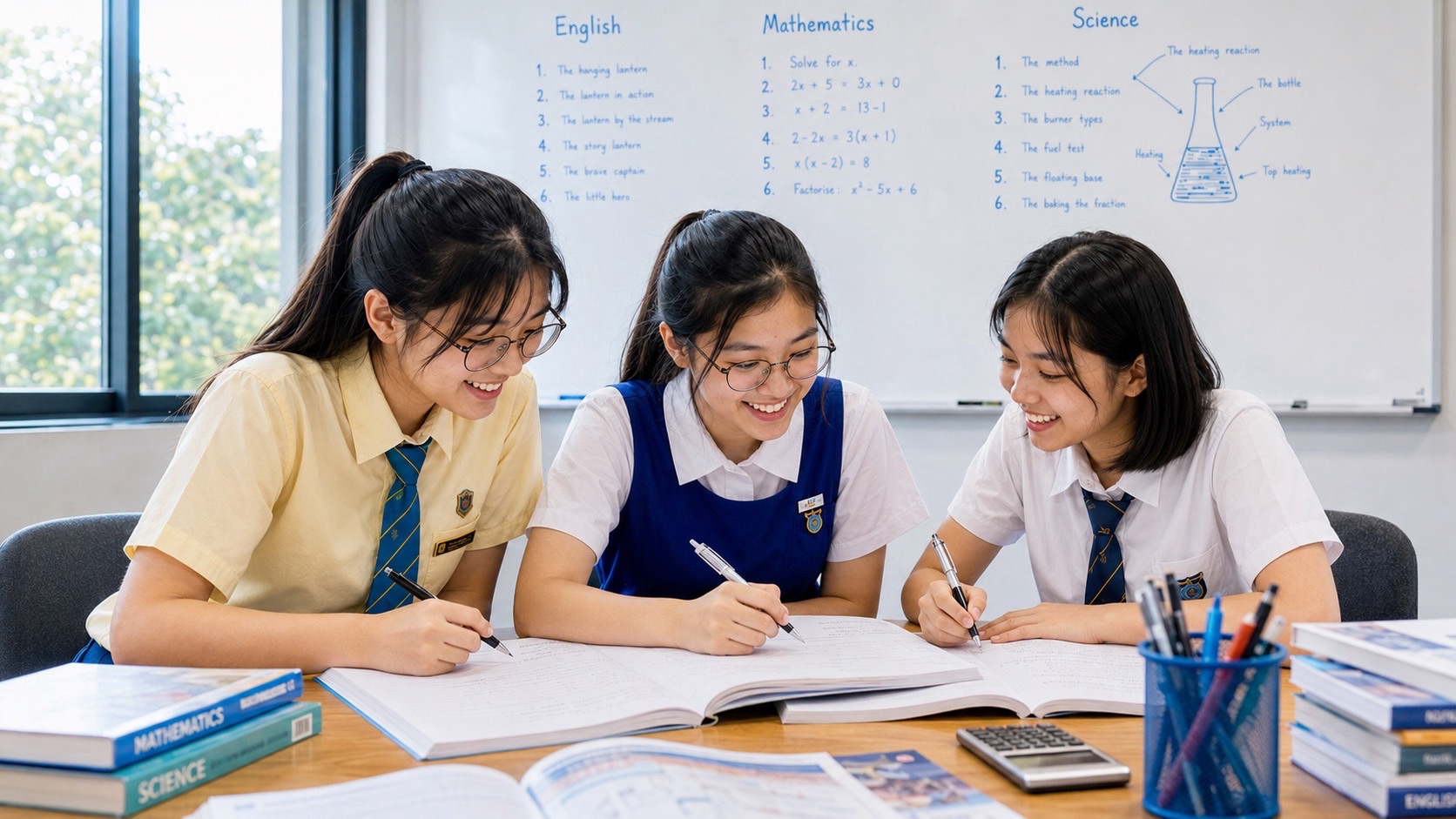
What should parents do when the school teacher and Math tutor teach different methods? Searches for school method vs tuition method, different Math methods confusing child, Math tutor teaches differently from school, bar model vs algebra or Mathematics tuition in Punggol usually come from a real problem: the child may be learning valid Mathematics in two places but does not yet have enough conceptual control to see that the methods are connected.
Different methods are not automatically a problem. Mathematics often has more than one valid route. Mental strategies, bar models, number lines, equations, algorithms and algebra can all represent the same relationship at different levels of compression. The difficulty begins when a student memorises procedures without understanding the underlying structure, then experiences a second method as a contradiction rather than another representation.
At eduKatePunggol, Mathematics is taught in focused groups of up to three students in 1.5-hour lessons near Punggol MRT. The practical question is not “Which adult is right?” It is: does the child understand the Mathematics well enough to see why each valid method works, and which method should be used in the current school and examination context?
The short answer: understand the school method first
When school and tuition use different methods:
- Identify the school’s method. Know what the child is expected to recognise and show.
- Check whether the tuition method is mathematically valid.
- Find the shared relationship underneath both methods.
- Use one method as the student’s primary route until it is stable.
- Add the second method only when it improves understanding, checking or efficiency.
- Avoid forcing the child to switch language mid-solution when that creates unnecessary confusion.
The goal is not uniformity for its own sake.
The goal is coherent understanding.
Why two valid methods can feel like two different subjects
An experienced adult may look at two methods and immediately see the same relationship.
A young learner may see two unrelated recipes.
For example, 48 + 27 can be handled through:
- place-value decomposition;
- a vertical algorithm;
- compensation: 48 + 30 − 3;
- mental regrouping.
All can be valid.
But if the child has only memorised the vertical algorithm, compensation may feel like an entirely different topic.
The missing link is number structure.
Primary Mathematics: representation should come before method loyalty
In Primary Mathematics, the same problem can often be represented with:
- objects;
- number bonds;
- part-whole models;
- bar models;
- number lines;
- equations;
- written algorithms.
The tutor should help the child see the relationship before arguing about which representation is “best”.
Once the relationship is clear, the most efficient school-appropriate method can become the default route.
Bar model vs equation: both may describe the same relationship
Consider a comparison problem.
A bar model may make the difference between two quantities visible.
An equation may express the same relationship symbolically.
For a Primary student, the bar model may reduce cognitive load.
For a Secondary student, the equation may be more compact.
The methods are not enemies.
They are different levels of abstraction.
When the tutor should align closely with school
Alignment is especially useful when:
- the child is young;
- the method is newly introduced;
- the student is already confused;
- the school expects a particular representation for learning;
- the child has not yet developed enough flexibility to compare methods.
In these situations, adding a second method too early can create unnecessary interference.
When a second method becomes useful
Alternative methods become powerful when the student already controls one route and can use another to:
- check an answer;
- understand why a procedure works;
- solve certain numbers more efficiently;
- see a deeper connection;
- prepare for later algebraic thinking.
This is mathematical flexibility rather than confusion.
School notation and examination communication matter
A mathematically correct idea still needs to be communicated clearly.
Students should learn the notation, working conventions and representations expected at their current stage.
A tutor should not create a private notation system that makes the child difficult to understand at school.
Clarity is part of Mathematics.
Secondary Mathematics: the method should become more general
As students enter Secondary Mathematics, many Primary strategies become compressed into algebra.
A student may move from:
- bar models to equations;
- repeated numerical examples to general formulas;
- specific patterns to variables;
- arithmetic trial-and-error to algebraic solving.
This does not mean the Primary method was wrong.
It means the mathematical language is becoming more general.
What parents should not do when methods differ
- Do not tell the child one teacher is wrong without checking the Mathematics.
- Do not force the child to switch methods every night.
- Do not add a third parent method immediately.
- Do not judge a method only by whether it resembles the one you learned years ago.
- Do not turn homework into a debate between adults.
The child needs a coherent learning environment more than a winner.
A simple parent script for resolving method conflict
Ask the child:
- What method did school teach?
- Can you explain why it works?
- What method did tuition teach?
- Can you show how the two methods are connected?
- Which one are you most comfortable using in school right now?
If the child cannot answer, send the specific example to the tutor instead of asking the child to reconcile the systems alone.
When different methods reveal a deeper weakness
Sometimes the method disagreement is not the real problem.
The child may lack the concept underneath both approaches.
A student who does not understand place value may struggle with every addition algorithm.
A student who does not understand ratio units may struggle with both bar models and equations.
At that point, return to the concept.
Frequently asked questions about school and tuition methods
Should a Math tutor always use the school’s method?
Not always. The tutor should understand the school method and avoid unnecessary conflict. Alternative methods are useful when they deepen understanding, improve checking or provide a more efficient route without confusing the student.
What if the tutor’s method is faster?
Efficiency matters after understanding. If the child is still learning the school method, stabilise the core concept first before adding shortcuts.
What if my child says the teacher marked the tuition method wrong?
Look at the exact question, working and school expectations. The issue may be mathematical correctness, notation, required working or a misunderstanding. Resolve the specific example rather than generalising from one incident.
Mathematics Tuition in Punggol: different methods should converge on the same Mathematics
Understand the relationship.
Stabilise one route.
Add another route when it helps.
Keep notation clear.
Let flexibility grow from understanding rather than confusion.
Families who want to discuss conflicting school and tuition methods can WhatsApp eduKatePunggol with a photo of the specific worked example.


