
How to Improve Primary 6 Mathematics in Punggol | PSLE 2026 Improvement System
Primary 6 Mathematics improves fastest when the student stops treating every lost mark as “careless” and starts identifying which part of the mathematical system failed. A child can know the syllabus but misread the relationship. Another can represent the problem correctly but choose an inefficient method. Another can solve everything untimed and still lose control across two national-examination papers.
This flagship guide explains how eduKate Punggol approaches Primary 6 Mathematics for the revised 2026 PSLE Mathematics format. It covers the current MOE syllabus architecture, the new 2026 paper structure, dependency repair, representation, heuristics, arithmetic and algebraic control, mixed-question routing, error analysis, timing, calculator and non-calculator execution, and how a three-student 90-minute tutorial can be used without making the child dependent on tuition.
The central principle is simple: understand the relationship, represent it clearly, choose a route, execute safely, and then condition the system for the paper.

The 2026 Mathematics baseline: a revised syllabus endpoint and revised PSLE format
MOE’s 2021 Primary Mathematics syllabus is organised around three content strands: Number and Algebra, Measurement and Geometry, and Statistics, with mathematical problem solving at the centre of the curriculum framework. MOE’s October 2025 update notes that the 2021 syllabus applies to Primary 6 from 2026 onwards.
SEAB’s PSLE Mathematics examination format is also revised from 2026. The examination consists of two written papers comprising three booklets, both taken on the same day with a break between the papers.
| 2026 component | Question structure | Marks / duration |
|---|---|---|
| Paper 1 — Booklet A | 10 one-mark MCQs + 8 two-mark MCQs | 26 marks within Paper 1 |
| Paper 1 — Booklet B | 12 short-answer questions × 2 marks | 24 marks within Paper 1 |
| Paper 1 total | No calculator | 50 marks · 1 h 10 min |
| Paper 2 — Short-answer | 5 questions × 2 marks | 10 marks |
| Paper 2 — Structured / Long-answer | 10 questions worth 3, 4 or 5 marks | 40 marks |
| Paper 2 total | Calculator allowed | 50 marks · 1 h 20 min |
| Total | 45 questions across both papers | 100 marks · 2 h 30 min |
That format matters because Primary 6 tuition must now prepare two different execution environments: non-calculator fluency and judgement in Paper 1, then calculator-supported but reasoning-heavy work in Paper 2.
The three PSLE assessment objectives tell us how to train
For the 2026 PSLE Mathematics examination, SEAB identifies three assessment objectives:
- AO1: recall mathematical facts, concepts, rules and formulae; perform straightforward computations and algebraic procedures;
- AO2: interpret information and apply mathematical concepts and skills in varied contexts;
- AO3: reason mathematically, analyse information, make inferences and select appropriate problem-solving strategies.
A student who only drills routine calculations is therefore training mainly one part of the exam. Improvement must also include interpretation, representation, selection and reasoning.
Why Primary 6 problems are often dependency problems
A weak score in a P6 chapter does not always mean the P6 concept itself is weak. Many problems sit on earlier dependencies.
| Visible P6 difficulty | Possible earlier dependency |
|---|---|
| Ratio and percentage questions feel confusing. | Fractions, multiplicative comparison or unit-part reasoning may be unstable. |
| Algebraic word problems are slow. | The relationship is not represented before symbols are introduced. |
| Speed questions generate many wrong formulas. | Units and proportional relationships may be weak. |
| Geometry looks difficult. | Diagram reading, angle relationships or spatial representation may be the bottleneck. |
| Average and data questions are inconsistent. | Total-value reasoning or interpretation may be weak. |
| Paper 2 seems impossible despite good chapter practice. | Recognition and strategy selection may be undertrained. |
The highest-return repair is often the earliest dependency that is creating cost across several later question types.
Improvement Layer 1 — Number fluency without blind speed
Paper 1 is a non-calculator environment. That makes number fluency important, but fluency should not be confused with rushing.
A strong P6 student should be able to:
- operate confidently with whole numbers, fractions and decimals,
- see useful number relationships before calculating mechanically,
- estimate enough to reject impossible answers,
- track units through rates and measurement,
- and choose an efficient calculation route without sacrificing accuracy.
If the child is repeatedly making arithmetic slips, ask whether the cause is weak number sense, crowded working, premature mental calculation or simple fatigue. “Careless” is not precise enough.
Improvement Layer 2 — Represent the relationship before selecting the heuristic
Many students collect heuristics as if PSLE problem solving were a toolbox of tricks: bar model, units and parts, before-and-after, working backwards, guess-and-check, algebra.
The problem is not having a toolbox. The problem is selecting a tool before understanding the relationship.
We teach a pre-solution sequence:
- Known: what information is given?
- Unknown: what exactly must be found?
- Relationship: how are the quantities connected?
- Representation: model, table, diagram, equation or units-and-parts?
- Route: which method now becomes reasonable?
That sequence makes heuristics subordinate to understanding. The student stops asking, “Which trick is this?” and starts asking, “What relationship am I representing?”
Improvement Layer 3 — Move flexibly between model, algebra, table and diagram
A relationship understood in only one form is fragile. The student should be able to move between representations.
- bar model → equation,
- ratio statement → units and parts,
- word problem → table,
- geometry description → labelled diagram,
- data table → comparison or equation.
This matters because unfamiliar questions often disguise a familiar relationship. Representation is how the child makes that relationship visible again.
Improvement Layer 4 — Algebra as compressed relationship, not a magic shortcut
The current Primary Mathematics syllabus includes algebra within the Number and Algebra strand. In P6, algebra can be a powerful representation, but only when the child understands what the symbols represent.
We want the learner to understand:
- what the unknown quantity represents,
- how the equation encodes the relationship,
- why a transformation preserves equality,
- and when a visual model may be clearer than algebra.
Algebra should reduce cognitive load after understanding, not replace understanding before it exists.
Improvement Layer 5 — Train method selection with mixed problems
Blocked practice helps when a method is new. Later, it becomes too helpful because the worksheet heading tells the student what to do.
PSLE does not label every question “Ratio”, “Percentage” or “Working Backwards”. The child has to classify the problem.
Mixed practice therefore asks the student to state, before solving:
- what relationship is present,
- which representation is useful,
- which strategy is plausible,
- and how the answer could be checked.
A temporary drop in mixed-practice accuracy is not automatically regression. The task is now testing selection, not only execution.
Improvement Layer 6 — Replace “careless” with an error taxonomy
| Error type | What it looks like | Repair |
|---|---|---|
| Knowledge | A fact, rule or concept is missing. | Relearn and retrieve after spacing. |
| Representation | The relationship is not converted into useful form. | Model, table, diagram or equation practice. |
| Recognition | A known method is not seen in a changed question. | Mixed practice and controlled variation. |
| Selection | The child chooses an inefficient or wrong method. | Compare routes before calculation. |
| Execution | The route is right but arithmetic, units or copying breaks it. | Make working auditable and add checkpoints. |
| Communication | Paper 2 method is incomplete or unclear. | Show essential working explicitly. |
| Timing | The child knows the work but cannot finish. | Identify where time is lost and condition progressively. |
| Checking | The final answer is not tested for plausibility. | Build a specific checking sequence. |
A good correction changes the next practice. “Be more careful” usually does not.
Improvement Layer 7 — Retrieval: stop relearning the syllabus
Primary 6 becomes overwhelming when every old topic needs to be relearned before prelims. The solution is continuous retrieval.
- Learn the method with explanation.
- Redo it later without the worked example.
- Retrieve after several days.
- Mix it with another strand.
- Use it in a changed context.
- Check whether it survives in school assessment.
Retrieval is especially important for fractions, ratio, percentages, measurement relationships and common problem-solving structures because they reappear inside later questions.
Paper 1: build non-calculator control
Paper 1 is 1 hour 10 minutes, worth 50 marks, and calculators are not allowed. The paper combines MCQs and short-answer questions.
Training therefore needs:
- accurate arithmetic,
- efficient mental and written calculation,
- fast recognition of standard relationships,
- disciplined MCQ elimination,
- and concise short-answer execution.
The child should not spend Paper 1 trying to perform heroic mental arithmetic. Working should be visible enough to protect signs, units and multi-step relationships.
Paper 2: calculator available, reasoning still required
Paper 2 is 1 hour 20 minutes, worth 50 marks, and calculators are allowed. It includes 5 short-answer questions and 10 structured/long-answer questions.
A calculator removes some arithmetic burden. It does not decide:
- what the question is asking,
- which relationship applies,
- how the problem should be represented,
- which strategy is efficient,
- or whether the final answer is plausible.
SEAB explicitly requires candidates to show their method clearly for structured/long-answer questions. We therefore train visible mathematical logic, not answer-only calculator use.
How timing should be built
Timing should be layered so the student does not practise a wrong process at higher speed.
- Correct untimed questions.
- Short timed clusters.
- Mixed timed sections.
- Paper 1 or Paper 2 sections.
- Full paper under official duration.
- Two-paper same-day simulation when the learner is ready.
When a child runs out of time, we identify the cause. Slow recognition, overlong methods, arithmetic friction, overchecking and getting trapped on one question all require different changes.
How the three-student class is used
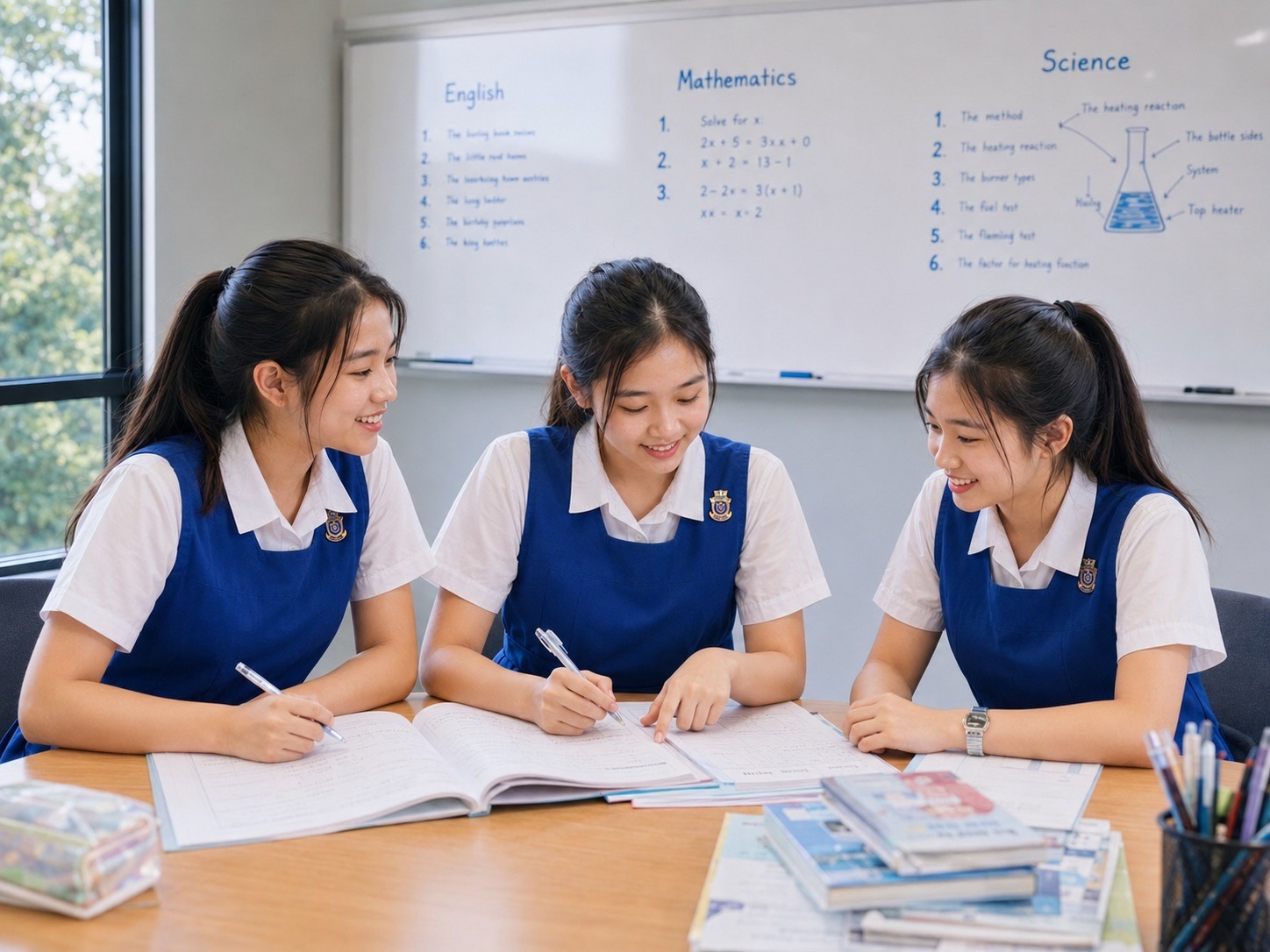
eduKate Punggol’s current model is three students for 1.5 hours. The value is not merely more attention. It is more observable mathematical thinking.
Three students may solve the same problem using a model, algebra and a units-and-parts approach. Comparing those routes allows the tutor to ask:
- Which representation made the relationship clearest?
- Which route is shortest?
- Which route is safest under examination pressure?
- Which route is easiest to check?
- Which method would fail if one condition changed?
That teaches method quality rather than method obedience.
Anatomy of a 90-minute P6 Mathematics tutorial
| Phase | Learning job | Evidence |
|---|---|---|
| 0–10 min | Retrieve older Mathematics without notes. | What survived? |
| 10–20 min | Review school paper / error log. | Which error class is active? |
| 20–40 min | Repair the highest-value concept or representation. | Can the learner explain the relationship? |
| 40–60 min | Guided problem solving with fading prompts. | Can the route be reconstructed? |
| 60–75 min | Changed or mixed problem. | Can the student recognise and select independently? |
| 75–85 min | Paper 1 / Paper 2 timed micro-set. | Does accuracy survive pressure? |
| 85–90 min | Review and compact home handoff. | What must the student now do alone? |
Three hypothetical students, three different plans
These are hypothetical examples, not testimonials.
| Student | Pattern | Priority |
|---|---|---|
| A | Strong routine calculation, weak long word problems. | Representation and strategy selection. |
| B | Good methods, many arithmetic and unit slips. | Execution and checking architecture. |
| C | Strong untimed work, cannot finish both papers reliably. | Timing diagnosis, section control and same-day stamina. |
The same overall score does not imply the same tuition programme.
A practical weekly P6 Mathematics routine
| Task | Purpose |
|---|---|
| Redo two important errors closed-book | Repair |
| Retrieve one older topic | Retention |
| Short current-topic set | Build current method |
| Mixed problem set | Recognition and strategy selection |
| Explain one problem aloud | Reasoning and representation |
| Short Paper 1 non-calculator block | Fluency and execution |
| Short Paper 2 structured block | Visible method and problem-solving stamina |
The amount should fit the child’s school commitments. Good revision is distributed and purposeful, not simply long.
How the P6 year should change over time
Early year — diagnose and repair
Identify P5 and earlier dependencies, follow the current P6 school sequence, and establish error and retrieval systems.
Middle year — integrate and mix
Increase multi-strand problem solving, Paper 1 non-calculator fluency and Paper 2 structured work.
Prelim period — measure execution
Use school papers to diagnose which marks are lost from knowledge, representation, selection, execution or time.
Final PSLE period — narrow and stabilise
Prioritise repeated high-value errors, preserve retrieval, run realistic sections and papers, and protect sleep and familiar routines rather than introducing large amounts of novelty.
What parents can monitor
- Can the child explain what a word problem is structurally asking?
- Are repeated arithmetic and unit errors declining?
- Can older topics be retrieved?
- Can the learner choose between a model, algebra or another representation?
- Is Paper 1 non-calculator work becoming more stable?
- Is Paper 2 working clear enough to earn method credit when appropriate?
- Can the student identify why time was lost?
- Is the learner becoming less dependent on tutor prompts?
What not to do
- Do not use outdated pre-2026 PSLE Mathematics format details.
- Do not call every repeated error careless.
- Do not memorise heuristics before understanding the relationship.
- Do not practise only chapter blocks after the method is stable.
- Do not turn calculators into substitutes for representation in Paper 2.
- Do not time everything before the method is safe.
- Do not do full papers without post-paper error analysis.
- Do not promise AL1 or a fixed mark gain.
Frequently asked questions
What changed in PSLE Mathematics from 2026?
The revised examination has two written papers comprising three booklets. Paper 1 is 50 marks in 1 hour 10 minutes without calculator. Paper 2 is 50 marks in 1 hour 20 minutes with calculator. Both are taken on the same day with a break.
Does the 2021 Primary Mathematics syllabus apply to P6 in 2026?
Yes. MOE’s October 2025 syllabus update states that the 2021 Primary Mathematics syllabus applies to Primary 6 from 2026 onwards.
Should my child memorise every heuristic?
No. Heuristics are useful representations and strategies, but the student should first understand the relationship and then select a suitable route.
How many full papers should a P6 student do?
There is no universal number. Full papers should train timing, stamina and whole-paper control. When one specific weakness is obvious, targeted repair may produce more learning per hour.
What is the current eduKate Punggol class format?
The current small-group model is three students for 1.5 hours. Current schedule and availability should be confirmed directly.
Can tuition guarantee AL1?
No. Tuition can strengthen mathematical understanding, problem solving and examination execution, but the national-examination outcome depends on the learner and the actual paper.
Related eduKate Punggol Mathematics routes
- Primary Mathematics Tuition in Punggol — From Can Do to Can Explain
- Primary 5 Mathematics — Build the PSLE Runway
- Improve PSLE Mathematics with Punggol Tuition
- PSLE Math Tuition for Punggol
The Primary 6 end condition
The PSLE-ready student does not need every question to look familiar. They can read the relationship, choose a representation, select a route, execute accurately, show essential working, manage both calculator and non-calculator environments, and recover when a difficult question interrupts the plan.
That is the improvement system we want to build.





