
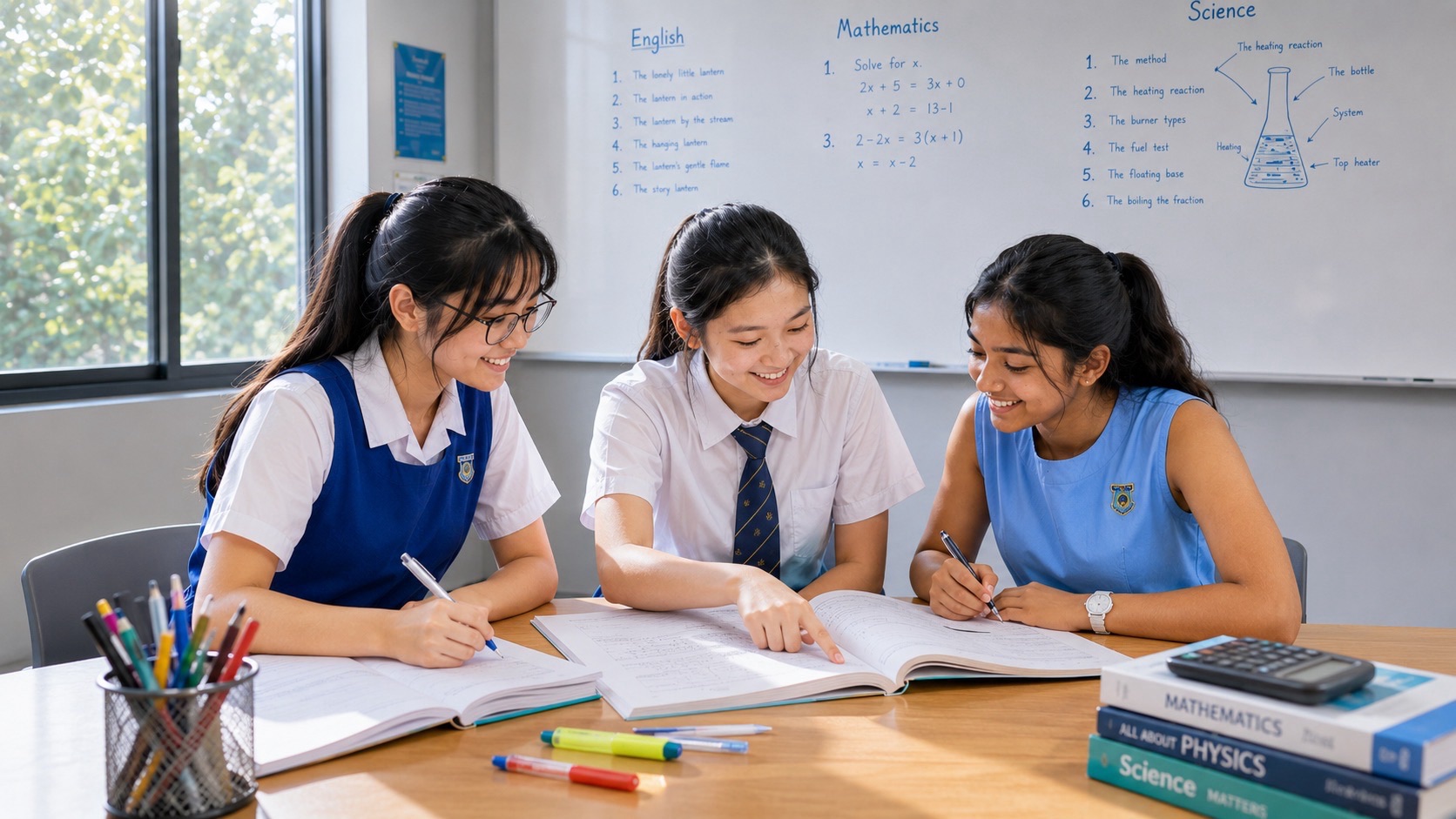
At 7.42 on a Thursday evening, Maya’s mother is holding three pieces of paper.
The first is a Mathematics worksheet from school.
The second is an English composition draft.
The third is a Science revision list for a test next week.
Maya is in the shower.
Her younger brother is refusing to sleep.
Dinner plates are still on the table.
There is tuition tomorrow.
The family has one question:
What should happen where?
Should the Mathematics worksheet be completed tonight?
Should the parent correct it?
Should the English composition be brought to tuition?
Should the tutor reteach the Science topic?
Should Maya revise independently?
Should somebody email the school teacher?
Should everyone stop and go to bed?
The answer is not one thing.
That is the point.
Education is not a single room.
A child learns inside several overlapping environments: school, tuition, home, independent study, friendships, libraries, digital tools, family routines and ordinary life. Each environment has different strengths. Each also has limits.
Problems begin when every learning job is sent to the same place.
The parent becomes a second tutor.
Tuition becomes a second school.
Homework becomes examination rehearsal.
Rest becomes guilt.
Every weakness becomes “do more tuition.”
Every disappointing mark becomes “do more worksheets.”
A better system needs routing.
That is the job of the Learning Dispatcher.
It asks one deceptively powerful question:
Which environment is best suited to solve this particular learning problem?
Not every problem belongs in tuition.
That is not a weakness of tuition.
It is what makes tuition intellectually honest.
Quick Read: The Six Main Learning Destinations
For most school-age learners, the dispatcher usually has six major destinations available.
1. School.
Best for curriculum ownership, classroom teaching, official expectations, subject progression, school-based feedback and institutional support.
2. Tuition.
Best when additional instructional time, close observation, diagnosis, targeted repair, adaptive challenge or structured rehearsal can solve a clearly identified problem.
3. Independent study.
Best when the learner already knows enough to retrieve, practise, review, organise and strengthen performance without continuous adult mediation.
4. Home.
Best for routine, sleep, reading culture, emotional stability, practical support, conversation, time protection and selected light practice.
5. Rest and ordinary life.
Best when the learning system is tired, overloaded, saturated or in need of experiences that are not deliberately academic.
6. Specialist or other support.
Best when the problem exceeds the tutor’s instructional scope or belongs to another professional, school service or support system.
The dispatcher does not rank these destinations from best to worst.
It matches the job to the place.
1. Tuition Is Supplementary by Design
School is the main education system.
That statement should not be controversial.
Schools own curriculum delivery, formal assessment, classroom progression, institutional pastoral support and the wider social environment in which children learn to function with many peers and adults.
Tuition is supplementary.
The Education Endowment Foundation’s evidence summaries on one-to-one and small-group tuition repeatedly emphasise that tutoring is more effective when it is targeted at actual learner needs and connected with ordinary classroom teaching rather than operating as an isolated parallel world.
This is important for families.
The goal is not:
school versus tuition.
The useful architecture is:
school reveals and develops → tuition may diagnose and repair → independent work consolidates → school tests the return.
The environments are complementary when their roles remain clear.
2. The Dispatcher Begins With the Job, Not the Venue
A family often begins with a venue:
“Should we get tuition?”
The dispatcher begins one step earlier:
“What is the job?”
Is knowledge missing?
Is the child confused by school instructions?
Is the learner under-practised?
Is the student unable to identify errors?
Does the student understand in tuition but fail at school?
Is the schedule too overloaded for any new teaching to work?
Is the issue instructional at all?
Once the job is named, the destination becomes easier to choose.
3. The First Destination: School
Some questions belong to school because school owns the answer.
What exactly is expected in this assignment?
Which method has the class been taught?
What does the teacher mean by this comment?
How is this component assessed?
Is the child receiving school-based literacy support?
What topic comes next?
What is the school’s policy or progression pathway?
A tutor can help the learner understand and prepare.
The tutor should not invent official school information that only the school can confirm.
Good routing includes knowing when the correct response is:
Ask your teacher.
4. The Second Destination: Tuition
Tuition becomes useful when there is a job that additional expert instructional attention can realistically solve.
Examples include:
- a recurring error that needs diagnosis;
- a prerequisite gap blocking current learning;
- a student who understands explanations but cannot transfer them;
- a learner who needs guided practice before independent work becomes productive;
- a strong student who needs more discriminating challenge;
- a student who cannot yet analyse a returned paper independently;
- a skill that is accurate untimed but collapses under performance conditions;
- a student whose school work reveals the same weakness repeatedly despite ordinary classroom exposure.
These are tuition-shaped jobs because they benefit from close observation and adaptive response.
The Weak Link, The Learning Simulator, The Sparring Partner and The Flight Recorder each describe a different part of that environment.
5. The Third Destination: Independent Study
This is the destination tuition should be trying to enlarge.
Independent study becomes appropriate when the learner can already perform enough of the task to gain from doing it alone.
A student who knows the vocabulary can retrieve it.
A student who understands the formula can practise selecting and applying it.
A student who understands the Science concept can complete mixed questions and compare errors later.
A writer who understands paragraph architecture can draft independently before feedback.
Independent work is not merely cheaper tuition.
It is a different educational mode.
The learner must initiate, retrieve, choose, persist, check and sometimes decide when help is needed.
Those are capabilities worth training in their own right.
6. The Fourth Destination: Home
Home is the most powerful environment in a child’s life precisely because it should not become a permanent classroom.
Home can protect:
- sleep;
- meals;
- routine;
- attendance;
- a workable study space;
- reading culture;
- conversation;
- encouragement;
- basic accountability;
- transport and logistics;
- emotional recovery;
- family relationships.
Parents can support learning.
They do not have to become the second subject specialist.
That distinction is central to eduKatePunggol’s Family Life Education role.
The family is not an academic support department.
It is a family.
7. The Fifth Destination: Rest
Rest is a real destination.
Not leftover time.
Not evidence that a family lacks ambition.
A tired learner can look like a weak learner.
Attention falls.
Working memory becomes less reliable.
Reading becomes more superficial.
Small mistakes become emotional.
A schedule that responds to every error by adding more work can eventually create the very errors it is trying to eliminate.
The dispatcher therefore needs a stop rule.
Will the next block of work produce more learning than the recovery it displaces?
8. The Sixth Destination: Another Kind of Support
Not every persistent learning difficulty should be routed to ordinary tuition.
Sometimes the correct next step is school support.
Sometimes a conversation with the class teacher.
Sometimes assessment by an appropriate professional.
Sometimes the child’s vision or hearing deserves checking.
Sometimes emotional, developmental or health concerns exceed the scope of an academic tutor.
The tutor does not need to diagnose outside professional competence.
The responsible move is to recognise the boundary and route the family onward.
9. The Dispatcher’s First Rule: Do Not Solve the Wrong Problem Well
A family can spend enormous effort solving the wrong problem.
The child is exhausted.
The response is another tutor.
The child cannot understand the teacher’s assignment instruction.
The response is ten pages of practice.
The student understands the content but has no retrieval routine.
The response is reteaching.
The learner has a persistent issue that needs specialist assessment.
The response is simply more tuition hours.
Efficiency begins one layer above effort.
Route correctly first.
10. The Dispatcher’s Second Rule: Use the Cheapest Effective Environment
“Cheapest” here does not mean money alone.
It means the least expensive in attention, time, complexity and adult involvement while still producing the required learning.
If Maya can practise multiplication independently, she does not need a tutor beside every question.
If Hana can revise vocabulary alone using retrieval, a parent does not need to quiz her every evening.
If Jia Jun needs one precise explanation about a Science misconception, thirty pages of solo revision may be more expensive than ten good instructional minutes.
The dispatcher seeks the minimum effective intervention.
11. The Dispatcher’s Third Rule: Protect High-Value Human Time
A tutor’s attention is most valuable when the task needs judgement.
Diagnosing why two identical wrong answers come from different causes.
Choosing which error matters first.
Deciding whether to wait, hint, explain or challenge.
Reading the structure inside a student’s writing.
Recognising that a strong result hides weak transfer.
Designing a fresh task that distinguishes two possible diagnoses.
These are high-value human jobs.
Copying definitions is not.
Doing routine drills the learner can already manage is not.
Good tuition pushes routine work outward and pulls high-judgement work inward.
12. The Dispatcher’s Fourth Rule: Do Not Outsource What the Student Can Own
Adults can become highly efficient at doing the learner’s job.
The parent packs the bag.
The tutor identifies every mistake.
The teacher chooses every revision target.
The schedule tells the student exactly what to do minute by minute.
Everything runs smoothly.
The student remains dependent.
The dispatcher should continuously ask:
Can this responsibility move to the learner now?
Not all at once.
But progressively.
13. What School Does Better Than Tuition
Tuition marketing sometimes makes the mistake of behaving as if the smaller environment is therefore superior at everything.
It is not.
School can provide:
- the official curriculum sequence;
- large-group discussion and social comparison;
- specialist subject teachers across many domains;
- laboratory, library, CCA and institutional resources;
- formal assessment;
- peer collaboration at scale;
- school-specific expectations and routines;
- institutional support systems;
- a real environment where independence has consequences.
Tuition should not recreate these badly when it can instead complement them.
14. What Tuition Can Do Better Because It Is Small
A three-student room has different advantages.
- watch individual working steps;
- hear every student explain;
- pause when one weak link appears;
- change the next question immediately;
- compare three different methods;
- reduce or increase support within the same lesson;
- follow a repeated error across weeks;
- replay a school failure under controlled conditions;
- give a strong student more sophisticated resistance without changing the whole class.
The small room is not a miniature school.
Its value comes from doing what a small room uniquely permits.
15. What Home Does Better Than Both
Home knows the child before the lesson and after the lesson.
Home sees mornings.
Sleep.
Resistance.
Confidence.
The way a child talks about school when nobody is assessing them.
Home can notice that the child who looked “lazy” at 8.45 p.m. was fully functional at 5.30 p.m.
Home can notice that a formerly stressful homework routine has become independent.
Home can also supply something education systems cannot manufacture on command:
belonging.
Do not spend it recklessly.
16. What Independent Study Does Better Than Tuition
Independent study reveals what remains when the teacher disappears.
This is why a student can look excellent in tuition and still need more independent work.
The tutor can create perfect prompts.
The tutor can sense hesitation.
The tutor can stop an error before it becomes expensive.
Independent study removes that protection.
Now the learner has to discover:
- what to do first;
- how long to persist;
- whether the answer is plausible;
- when to check;
- when to seek help;
- when to stop.
That is not the absence of teaching.
It is the performance environment teaching us whether teaching has transferred.
17. The Dispatcher and the First Weak Link
The dispatcher depends on diagnosis.
If we do not know the weak link, we cannot know where to send the work.
Maya’s Mathematics score falls.
If the weak link is missing concept knowledge, tuition or school clarification may be appropriate.
If the weak link is insufficient repetition of a known skill, independent practice may be enough.
If the weak link is chronic fatigue, sleep is the first destination.
If the weak link is misunderstanding an official assignment, school is the authority.
If the weak link requires specialist attention, ordinary tuition should not pretend to own it.
Diagnosis and routing are separate decisions.
Both matter.
18. The Dispatcher and the Learning Simulator
The Learning Simulator asks how tuition can recreate a weak capability under controlled conditions.
The dispatcher decides whether a simulator is needed at all.
If Hana already knows how to support an inference and simply needs more reading volume, send her to independent reading.
If she repeatedly overclaims despite practice, bring the problem into tuition and design a small evidence-boundary simulation.
The simulator is a powerful environment.
The dispatcher prevents us from using it unnecessarily.
19. The Dispatcher and the Sparring Partner
The Sparring Partner applies intellectual resistance.
The dispatcher asks whether resistance is the current need.
A novice may need explanation.
A fluent learner may need retrieval.
A strong learner may need challenge.
An exhausted learner may need to stop.
The fact that a tutor can ask a harder question does not mean a harder question is always the best next move.
20. The Dispatcher and the Flight Recorder
The Flight Recorder provides the history that makes routing intelligent.
The record says:
Maya’s sign error has disappeared in isolated tuition work but returns under timed mixed sections.
The dispatcher says:
Do not reteach algebra.
Route the next job to timed independent mixed practice, then inspect the result in tuition.
The record says:
Hana understands the writing feedback but never revises independently.
The dispatcher says:
The next job belongs to home study, not another explanation.
History creates better routing.
21. A Mathematics Routing Example
Maya gets six simultaneous-equation questions wrong.
Do not route yet.
Diagnose first.
She can solve when equations are already formed.
She fails when a word problem must be translated into equations.
The job is not “simultaneous equations.”
The job is representation.
Route:
- Tuition: isolate translation from language to equations; compare correct and plausible wrong representations.
- Independent study: complete a short set where only equations must be formed, not solved.
- School return: inspect whether the same representation survives inside normal curriculum questions.
- Home: no parent reteaching required.
The amount of work can actually decrease because routing has improved.
22. An English Routing Example
Hana’s composition is weak.
Again, too broad.
She has strong vocabulary and sentence control.
The problem is planning.
She begins writing quickly, then discovers halfway through that the story has no useful turning point.
Route:
- Tuition: teach a compact planning architecture and compare strong versus weak plans.
- Independent study: plan three prompts without writing full compositions.
- Home: protect a short quiet block; parent does not rewrite the plan.
- School return: see whether planning improves under actual timed writing.
The learning job has moved through four environments without any one of them trying to do everything.
23. A Science Routing Example
Jia Jun memorises model answers well.
Unfamiliar experiments still destabilise him.
Route:
- Tuition: use fresh experimental contexts and ask him to reason from variables and evidence.
- Independent study: practise drawing causal chains before seeing model answers.
- Home: ordinary conversations about everyday observations can support curiosity, but no need for a parent to teach experiment design.
- School: returned classwork provides authentic evidence of transfer.
The model answer remains a resource.
It stops being the entire learning strategy.
24. An Additional Mathematics Routing Example
Maya knows the Chain Rule.
She misses it when Product Rule and Chain Rule interact.
Route:
- Tuition: identify nested structure and hierarchy explicitly; compare several forms.
- Independent study: classify mixed differentiation expressions before differentiating them.
- Tuition return: spar with changed structures and ask where each rule enters.
- School/exam return: monitor mixed timed differentiation sections.
No extra hour is automatically required.
The routing makes the existing hour more discriminating.
25. A Reading Fluency Routing Example
A Primary 2 child reads accurately but slowly.
Comprehension falls because so much attention is consumed by word recognition.
Route:
- School: confirm the child’s classroom reading profile and any existing support.
- Tuition: if appropriate, diagnose whether the issue is decoding, automatic word recognition, vocabulary or something else.
- Home: regular low-pressure reading aloud and being read to.
- Independent: short repeated reading of appropriately chosen text once the child can practise safely.
Different jobs.
Different rooms.
26. An Examination Timing Routing Example
Ethan understands the paper.
He does not finish it.
Route:
- Tuition: diagnose where time is lost—method choice, writing, checking, perfectionism or poor question abandonment.
- Learning Simulator: rehearse the first five minutes and last ten minutes separately.
- Independent study: timed mixed sections.
- Flight Recorder: track whether completion improves without accuracy collapsing.
- Home: protect realistic study windows rather than running full papers at exhausted hours.
“Time management” becomes several routed jobs instead of one vague complaint.
27. The Parent Who Becomes the Second Teacher
It usually begins kindly.
A parent sees an error.
Explains it.
The next error appears.
The parent explains again.
Soon every evening contains mini-lessons.
The parent becomes responsible for instruction.
The child becomes responsible for resisting instruction.
Family life degrades.
The dispatcher asks whether the parent is occupying the wrong station.
Sometimes the best parent move is:
Mark the question, bring it to school or tuition, and keep the evening intact.
28. The Tutor Who Becomes the Homework Finisher
The opposite collision happens too.
Every tuition lesson becomes urgent homework completion.
The tutor helps the student finish today’s school tasks.
Nothing is inherently wrong with helping when needed.
But if tuition permanently becomes an external executive-function system, deeper repair may never happen.
Why was the homework impossible independently?
Missing concept?
Poor planning?
Weak reading?
Forgotten deadline?
Too much assigned work?
The dispatcher should route the underlying problem, not merely clear the backlog.
29. The Student Who Routes Everything to “Ask Tutor”
Dependence can become efficient.
Maya sees a difficult question.
She marks it:
ASK TUITION.
At first this is sensible.
Soon half the worksheet says ASK TUITION.
The dispatcher needs a student-side filter.
Before routing outward:
- What exactly do I not understand?
- What have I tried?
- Is there an example or note I can use?
- Can I solve part of it?
- Can I state a specific question?
Then ask for help.
The goal is intelligent help-seeking, not heroic isolation.
30. Independent Study Is Not Where We Dump Unsolved Problems
There is a cruel version of independence:
You should know this already. Go practise.
Independent work is productive when the learner has enough knowledge and structure to generate useful attempts.
If a student is missing the core concept, practice may simply multiply confusion.
The dispatcher should not route an instructional problem to repetition merely because independent study is convenient.
31. Tuition Is Not Where We Dump All Difficult Problems Either
Some difficult tasks are exactly what the student should wrestle with alone.
A strong student preparing for an examination needs periods without rescue.
A composition writer needs blank-page experience.
A Mathematics student needs to encounter uncertainty without the tutor’s face giving away whether the first line is correct.
Difficulty alone is not a reason to route inward.
The question is whether additional instruction is likely to improve the current attempt more than independent struggle would.
32. The Routing Matrix
A simple matrix can help.
Knowledge missing + student cannot begin: route toward teaching.
Knowledge present + execution unstable: route toward targeted practice.
Execution stable + transfer weak: route toward variation, mixed work and authentic return.
Skill stable + speed weak: route toward fluency and timed independent work.
Skill stable + checking weak: route toward self-verification routines.
Repeated low performance + unclear cause: route toward diagnosis before increasing volume.
School instruction or requirement unclear: route to school clarification.
Chronic overload: route toward schedule repair and rest.
Concern outside normal tuition scope: route toward appropriate professional or institutional support.
33. Route by Cognitive Job
Another useful way to dispatch learning is by cognitive function.
- Acquire: school or tuition teaching.
- Clarify: teacher, tutor or reliable reference material depending on the question.
- Retrieve: mostly independent practice.
- Automate: repeated independent execution with periodic checking.
- Diagnose: tutor, teacher or learner depending on independence.
- Challenge: tutor, peer or well-designed unfamiliar tasks.
- Transfer: mixed independent work and school return.
- Reflect: learner first, supported by tutor or parent when useful.
- Recover: practise in simulation, then use independently.
- Rest: home and ordinary life.
The job determines the environment.
34. Route by Error Type
Errors also have destinations.
Missing knowledge.
Teach.
Misconception.
Diagnose and repair, often with counterexample or model comparison.
Retrieval failure.
Space and retrieve independently.
Selection failure.
Use mixed tasks where methods compete.
Execution failure.
Focused repetition with feedback.
Checking failure.
Teach a checking procedure, then make the student own it.
Timing failure.
Diagnose the bottleneck before simply setting more timers.
Transfer failure.
Change context and reduce cues.
Fatigue failure.
Do not pretend it is automatically an academic weakness.
35. Route by Age
The same job can belong in different places at different ages.
A Primary 1 child may need a parent to organise the reading routine.
A Primary 6 child can increasingly organise personal revision materials.
A Secondary 3 student should increasingly identify recurring errors from marked work.
A JC student should be able to route many tasks independently.
Good dispatching therefore changes ownership over time.
The child does not merely get older.
The child becomes the dispatcher.
36. Primary 1: Route for Security and Foundations
In Primary 1, school adjustment is itself part of learning.
The dispatcher should favour:
- school for routines and classroom expectations;
- home for sleep, reading aloud and calm repetition;
- tuition only when additional teaching has a real job to do;
- independent work in short, achievable doses.
Do not route every early uncertainty to academic escalation.
Seven-year-olds are still learning how school works.
37. Primary 2: Route for Consolidation
Primary 2 can widen independent responsibility gently.
The child can begin reading alone more often.
Simple retrieval can move away from adult-led quizzing.
Parents can still protect routines without supervising every pencil movement.
Tuition, if used, should solve identifiable literacy, numeracy or learning-habit problems rather than merely accelerate the child because acceleration is available.
38. Primary 3 and Primary 4: Route for Expansion
The system widens.
Science becomes formal.
Mathematics becomes more multi-step.
English grows in text length and writing demand.
This is a useful age to route recurring foundational problems inward for repair while moving stable routines outward to the child.
Do not let the parent remain the permanent homework manager if the learner can increasingly manage.
39. Primary 5: Route for the PSLE Runway
Primary 5 changes the planning horizon.
There is still time for deep repair.
That makes routing especially valuable.
Persistent reading difficulty should not be hidden by endless examination papers.
Weak fraction foundations should not be ignored because percentages are currently being taught.
Writing weaknesses should be decomposed into planning, sentence control, vocabulary, idea development or editing rather than sent generically to “more composition.”
Primary 5 still has runway.
Use it to route correctly.
40. Primary 6: Route for Performance Without Destroying the Child
By Primary 6, every hour begins to feel valuable.
That makes misrouting more expensive.
Do not use full papers to solve every problem.
Do not use tuition to solve routine practice the child can do alone.
Do not use home to recreate school after dinner.
Do not use sleep as the spare capacity in the schedule.
PSLE preparation should become more selective as the examination approaches.
High-cost weaknesses come inward.
Stable skills move to maintenance.
Routine retrieval becomes independent.
Home protects the learner who has to sit the examination.
41. Secondary 1: Route the Transition
Secondary 1 problems are often transition problems wearing subject labels.
Longer texts.
More teachers.
More independent organisation.
Greater abstraction.
A student may not need another Mathematics tutor immediately.
The student may need to reorganise study habits, recover algebraic fluency or learn to read longer questions.
The dispatcher separates the transition layer from the subject layer before intervention begins.
42. Secondary 2: Route Before the Upper-Secondary Lift
Secondary 2 is a valuable diagnostic year.
Weak habits that remain manageable now can become expensive later.
Route:
- foundational gaps inward for repair;
- stable subject practice outward to the student;
- subject-combination and school-pathway questions to the proper school channels;
- family schedule problems to the timetable rather than automatically to more teaching.
The aim is to enter Secondary 3 with fewer unresolved hidden costs.
43. Secondary 3: Route for Assembly
Secondary 3 can reveal old weaknesses brutally because new content assumes prior competence.
Additional Mathematics exposes algebra.
English argument exposes reading and evidence.
More advanced Science exposes whether models are genuinely connected.
The dispatcher asks:
Does this new topic need teaching?
Or is the old prerequisite the actual problem?
Do not route every Secondary 3 difficulty to more Secondary 3 content.
Sometimes the correct destination is backwards.
44. Secondary 4: Route by Expected Return
When the final examination is close, the dispatcher becomes a triage system.
There may be ten weaknesses.
Only four can be improved meaningfully before the paper.
Choose.
Which weakness appears often?
Which costs many marks?
Which has a short repair path?
Which requires deep rebuilding that may not be economical now?
Which stable skill should be maintained rather than re-taught?
Late-stage routing is about opportunity cost.
45. JC: Route for Density and Speed
JC compresses the calendar and increases conceptual density.
There is less room for adults to manage every detail.
The student should increasingly dispatch personal learning:
- What needs direct clarification?
- What needs deliberate practice?
- What needs full-paper performance?
- What needs rest?
- What can be safely deprioritised?
- What should be brought to the tutor as a specific problem?
At this stage, tuition that still controls every revision decision may be solving the wrong long-term problem.
46. Route by Time Horizon
The correct destination changes when the deadline changes.
Six months available: deep repair may be worthwhile.
Six weeks available: prioritise high-frequency, high-cost weaknesses with credible repair paths.
Six days available: protect stable strengths, repair preventable errors and rehearse performance.
Six hours available: sleep may outperform another full paper.
Same weakness.
Different horizon.
Different route.
47. Route by Reversibility
Some mistakes are easy to repair late.
Forgetting units.
Using an unreliable checking sequence.
Leaving a familiar paper section too late.
Other problems take longer.
Weak reading fluency.
Fragile algebraic foundations.
Thin vocabulary accumulated over years.
The dispatcher should know which kind of problem it is seeing.
48. Route by Frequency
One-off errors are often poor candidates for major intervention.
Repeated mechanisms are better candidates.
A single spelling error may need a correction.
A recurring morphological pattern may need teaching.
One algebra slip may need nothing more than attention.
A sign error appearing every time negative brackets interact needs a repair route.
Frequency helps decide how much system to deploy.
49. Route by Consequence
Not every weakness matters equally.
A rare vocabulary item may be low consequence.
An inability to identify the reference quantity in percentage problems may affect an entire family of questions.
A weak paragraph transition may lose some writing quality.
An inability to understand the task instruction can destroy the whole answer.
The dispatcher combines frequency and consequence.
High-frequency, high-consequence weaknesses deserve premium attention.
50. Route by Dependency
Some skills unlock many others.
Reading fluency supports comprehension.
Vocabulary supports reading and writing.
Algebra supports a large part of Secondary and JC Mathematics.
Evidence interpretation supports much of Science reasoning.
If one weak capability sits beneath many downstream tasks, route it early.
This is how the dispatcher connects to prerequisite architecture.
51. The Wrong Routing Creates Academic Backlogs
Imagine Maya keeps moving forward in algebra while one manipulation weakness remains unresolved.
Each new topic creates more incomplete work.
Tuition tries to keep up with current school content.
The old weakness remains.
The backlog grows.
The correct route may be to pause current expansion briefly, repair the prerequisite, then re-enter.
Sometimes going backwards is the fastest path forward.
52. The Wrong Routing Creates Family Backlogs Too
Homework left unfinished.
Corrections not completed.
Revision plans pushed to the weekend.
Weekend work pushed to Sunday night.
Sunday night pushed into sleep.
Monday begins badly.
The dispatcher should recognise that scheduling itself has become the weak link.
The answer may be fewer simultaneous learning jobs.
53. Home Needs a Traffic-Control Rule
When several tasks arrive together, families need a priority order.
A practical evening sequence can be:
- Must happen tonight: school deadline, essential preparation, short urgent task.
- Can move to tomorrow: valuable but non-urgent practice.
- Bring to tuition: persistent instructional problem requiring diagnosis.
- Ask school: unclear official expectation.
- Drop: low-value optional repetition when capacity is exhausted.
- Protect: sleep.
This is not a universal timetable.
It is a way to stop everything from becoming equally urgent.
54. The Parent Is a Logistics Expert
Parents often undervalue the educational significance of logistics.
A workable weekly timetable.
Transport that does not create unnecessary exhaustion.
Meals at sensible times.
A quiet enough place for focused work.
Knowing which evenings are impossible because of CCA.
Knowing when the child is becoming overwhelmed.
These are not secondary details.
They determine whether learning plans can be executed.
Parents do not have to be subject experts to make the learning system dramatically more workable.
55. The Tutor Is a Routing Adviser Too
A tutor can help families distinguish what should happen between lessons.
“This needs ten minutes of retrieval, not another worksheet.”
“Bring the marked school paper next week.”
“Do not correct the composition at home. Let me see the first attempt.”
“Ask the school teacher what this instruction means before we guess.”
“This skill is stable. Stop drilling it.”
“Tonight, sleep.”
These recommendations can reduce workload because the tutor is not trying to pull every learning job into tuition.
56. What the School Teacher Should Not Be Expected to Do
Role clarity protects teachers too.
A school teacher should not be expected to provide a private diagnostic service for every homework question after hours.
A teacher is responsible for a class and a school system.
Families should use school communication thoughtfully.
Ask when the question genuinely belongs to the school.
Do not route every minor uncertainty there merely because the school is authoritative.
Good dispatching respects capacity across the whole system.
57. What the Student Should Eventually Own
The student’s ownership should expand in at least seven areas.
- packing and materials;
- knowing deadlines;
- starting routine work;
- marking unclear questions for help;
- retrieving previously learned material;
- checking work;
- deciding when a problem requires outside assistance.
The age and pace of transfer will differ.
The direction should not.
Education aims to create an adult who can operate.
58. The Green, Amber and Red Routing Test
Parents can use a simple diagnostic colour system.
Green: child can begin, complete and check with ordinary independence. Keep the task with the learner. Adults stay available but do not interfere unnecessarily.
Amber: child can partly perform but a recurring weakness or unclear step appears. Observe, collect evidence, perhaps bring it to tuition or school depending on the job.
Red: child cannot meaningfully begin, is repeatedly distressed, is chronically overloaded or the concern appears outside normal tutoring scope. Escalate appropriately rather than increasing generic practice.
The colours are not labels for the child.
They describe the current routing state of a task.
59. Do Not Route From Anxiety Alone
Parents sometimes act because uncertainty is uncomfortable.
Another classmate has started tuition.
Another parent says Primary 4 is already late.
A social-media post claims everyone is preparing two years ahead.
The dispatcher returns to evidence.
What is the child’s actual state?
What problem are we trying to solve?
What environment is most likely to solve it?
Anxiety can alert us.
It should not dispatch the whole system by itself.
60. Do Not Route From Marks Alone
A weak mark can result from:
- missing knowledge;
- weak retrieval;
- misreading;
- poor timing;
- unfamiliar wording;
- careless execution;
- fatigue;
- overconfidence;
- an unusually difficult paper;
- several small errors rather than one deep gap.
Different causes should be routed differently.
This is why the Flight Recorder matters. History adds resolution to the score.
61. Do Not Route From Volume Alone
“She only did ten questions.”
That may be too little.
Or it may be exactly right if the ten questions were targeted at the weak decision and followed by feedback.
“He studied for three hours.”
That may be excellent.
Or the learner may have spent three hours rereading material already familiar.
The dispatcher cares about the job performed, not only the amount of activity.
62. One Good Week of Routing
Monday.
Maya receives a Mathematics test and notices a repeated sign error.
She marks it for tuition.
Tuesday.
She completes routine school homework independently.
Wednesday.
Her English assignment instruction is unclear. She notes a question for her school teacher rather than guessing.
Thursday.
Late CCA day. Only short retrieval. Bedtime protected.
Friday.
Tuition isolates the sign-control mechanism, repairs it and schedules a later independent retest.
Saturday.
Maya does a mixed set independently.
Sunday.
Family lunch, library, ordinary life.
The week contains learning.
It also contains boundaries.
63. One Bad Week of Routing
Monday.
Low score. Parent adds two hours of worksheets.
Tuesday.
Homework takes too long. Parent completes half the explanation.
Wednesday.
Unclear school instruction becomes an argument at home.
Thursday.
Late CCA, then full practice paper.
Friday.
Tuition spends most of the lesson clearing unfinished schoolwork.
Saturday.
Everyone is tired. Another paper is assigned because Friday felt unproductive.
Sunday.
The family is still working.
More effort.
Less learning clarity.
The difference is routing.
64. The Dispatcher Needs a “Do Nothing Yet” Option
One weak result does not always require intervention.
Sometimes the correct response is observation.
Wait for another data point.
See whether the error recurs.
Ask the child what happened.
Compare school feedback.
Not every signal deserves an immediate new programme.
Good systems can tolerate uncertainty long enough to gather better evidence.
65. The Dispatcher Needs a “Stop Tuition” Option
This is perhaps the most important proof that tuition remains supplementary.
If the learner becomes independent, school is going well, stable skills remain stable and the family no longer has a clear instructional problem requiring additional teaching, tuition should be willing to reduce or end.
A system that can only dispatch more tuition is not a dispatcher.
It is a sales funnel.
Education needs a stronger ethic than that.
66. Tuition Should Be Able to Shrink
A student may begin with heavy support.
Then move to:
targeted repair only.
Then occasional review.
Then none.
Or a strong student may stop remedial work and use tuition selectively for higher-order challenge.
The form of support should follow the learner state.
Not habit.
67. The Dispatcher Protects Against Over-Tuition
More subjects.
More centres.
More homework.
More weekend lessons.
At some point, the learning system can become so full of instruction that the student has too little time to perform independently.
This is a hidden contradiction.
Tuition designed to increase independence can consume the time in which independence would have been practised.
The dispatcher therefore protects independent space.
68. The Dispatcher Protects Against Under-Support Too
The opposite failure exists.
A child struggles for months because adults keep saying:
Give it time.
Sometimes time is exactly what development needs.
Sometimes the evidence has already become clear.
If a repeated, consequential difficulty persists despite ordinary instruction and practice, route it.
Do not mistake patience for inaction.
69. The Dispatcher and Digital Tools
Digital tools can occupy several routes.
A flashcard system can support retrieval.
A calculator can verify some numerical work.
A graphing tool can make relationships visible.
A writing tool can help a learner inspect grammar or structure.
The routing question remains:
Is the tool doing the learning job, or helping the student do the learning job?
If a tool removes the decision the learner needs to practise, it may reduce learning even while improving the immediate output.
The same principle applies to humans.
70. The Dispatcher and Libraries
Not all learning destinations are instructional.
Punggol Regional Library is a good example.
The library is not tuition.
It does something tuition should not try to replicate exactly.
It gives abundance.
Choice.
Browsing.
Reading beyond the syllabus.
The possibility of discovering something nobody assigned.
A child who needs more reading volume may sometimes need a library card more than another worksheet.
71. The Dispatcher and the Neighbourhood
Punggol itself can carry some learning jobs.
The Waterway can carry observation.
A supermarket can carry percentages, estimation and labels.
A bus journey can carry time, route reading and directions.
A family meal can carry conversation and vocabulary.
A park can carry Science questions.
These are not replacements for formal teaching.
They are environments where knowledge becomes attached to the world.
The dispatcher should not route everything into a desk.
72. The Dispatcher and Motivation
When students repeatedly avoid work, adults often route immediately to discipline.
Sometimes discipline is required.
Sometimes avoidance is diagnostic.
The work is too easy.
Too hard.
Too repetitive.
The learner does not know how to begin.
The learner expects failure.
The schedule is overloaded.
The purpose is unclear.
Do not route every motivational problem to “more motivation.”
Find the friction.
73. The Dispatcher and Confidence
Low confidence can also be misrouted.
If the learner truly lacks the capability, praise alone will not solve the problem.
Route toward successful capability-building experiences.
If the learner is capable but underestimates performance, route toward independent evidence.
If the learner collapses under evaluation pressure, simulation and gradual exposure may help.
Confidence is not one job.
It has causes.
74. The Dispatcher and Strong Students
A strong student often needs less routine tuition, not more.
Stable practice can move outward.
Tuition can be reserved for:
- higher-order challenge;
- boundary cases;
- counterexamples;
- unfamiliar transfer;
- argument refinement;
- performance pressure testing;
- diagnosis of the few errors that remain expensive.
This makes strong-student tuition qualitatively different from remediation.
75. The Dispatcher and Struggling Students
A struggling student needs fewer simultaneously active jobs.
If reading, vocabulary, writing, grammar, confidence and homework completion are all treated as equal priorities, the learner receives a wall.
The dispatcher narrows.
Which capability unlocks the largest downstream improvement?
Which environment can fix it best?
What can wait?
Reducing active problems can increase the probability that one problem actually gets solved.
76. The Dispatcher and Family Conflict
When the same homework argument happens repeatedly, the academic problem and the family problem have become entangled.
The dispatcher can separate them.
The academic question goes to the appropriate teaching environment.
The home routine becomes simpler.
The parent can say:
Do what you can. Circle what you cannot. We will route the rest.
This reduces the need for the parent to win an academic argument at 9 p.m.
It also preserves evidence of what the student could not do independently.
77. The Dispatcher and the Independence Test
A mature learner should eventually be able to run a basic dispatch loop.
Step 1: What is the problem?
Step 2: Do I know enough to make a meaningful attempt?
Step 3: If yes, attempt independently.
Step 4: If stuck, identify the exact missing piece.
Step 5: Choose the destination: notes, teacher, tutor, peer, practice, rest or another appropriate source.
Step 6: Return and reattempt.
Step 7: Record only what matters if the problem recurs.
At that point, the child is no longer merely being educated.
The child is learning how to operate education.
78. The Long Return: Adult Life Is Mostly Self-Dispatch
Adults encounter problems without a timetable telling them where each one belongs.
Something breaks.
Do I solve it myself?
Read documentation?
Ask a colleague?
Hire an expert?
Wait?
Escalate?
Rest and return tomorrow?
These are routing decisions.
School does not only teach content.
Done properly, education gradually teaches a person how to allocate attention, choose resources and seek the right help.
The Learning Dispatcher is therefore not merely a tuition-management idea.
It is a model of competent adulthood.
79. The Thursday Evening Return
Maya comes out of the shower.
The three papers are still on the table.
Her mother asks what is due tomorrow.
The Mathematics worksheet.
Maya can do most of it.
She finishes the questions she understands and circles two where the wording is confusing.
The English composition is not due yet.
She brings the draft to tuition tomorrow because the same planning problem has appeared twice.
The Science list is for next week.
She spends ten minutes retrieving the first topic without notes.
Then the family stops.
At 8.37, Maya is free.
No emergency.
No heroic study marathon.
No parent forced to become an English teacher, Mathematics teacher and Science teacher in the same hour.
Three learning jobs.
Three routes.
The family has not done less education.
It has organised education better.
The Learning Dispatcher in One Page
1. Name the job before choosing the place.
Do not begin with “more tuition” or “more practice.” Begin with the actual problem.
2. Route official school questions to school.
Curriculum expectations and teacher instructions belong to the institution that owns them.
3. Route diagnosis and targeted repair to tuition when additional expert teaching is genuinely useful.
4. Route known skills outward to independent practice.
Do not spend premium human attention on work the learner can safely own.
5. Route routine, sleep and emotional stability to home.
Parents need not become permanent subject teachers.
6. Route overload to rest.
Capacity is part of the learning system.
7. Route out-of-scope concerns onward.
Tuition should know its professional boundaries.
8. Use the cheapest effective environment.
Time, attention and family capacity are finite.
9. Protect high-value human judgement.
Use tutors for diagnosis, feedback, challenge and adaptive decisions.
10. Move ownership to the student.
The learner should increasingly become the dispatcher.
11. Route by frequency, consequence and dependency.
Not every error deserves equal intervention.
12. Route differently as deadlines approach.
Deep repair, tactical repair and performance rehearsal belong to different horizons.
13. Keep a “do nothing yet” option.
Observation is sometimes the correct decision.
14. Keep a “stop tuition” option.
A supplementary system should be able to release the learner.
15. Ask what the child can now handle alone.
That is one of the clearest measures of whether routing is improving.
Where This Fits in eduKatePunggol
- How Tuition Works at eduKatePunggol — the broader tuition relationship.
- How Tuition Works | The Weak Link — locate the first limiting mechanism.
- How Tuition Works | The Learning Simulator — build controlled rehearsal conditions.
- How Tuition Works | The Sparring Partner — apply useful intellectual resistance.
- How Tuition Works | The Flight Recorder — preserve longitudinal evidence.
- How Studying Works — the broader act of studying.
- How Training Works | Training Architecture — general capability-building architecture.
- Parenting 101 for Education and Tuition to Lower Stress — family role and workload.
- Singapore Education Pathway — the learner’s wider school journey.
- Book a Tuition Consultation — for families with a specific repeated learning concern.
This completes the first four-node How Tuition Works expansion:
- The Learning Simulator — where controlled rehearsal happens.
- The Sparring Partner — how intelligent resistance strengthens thinking.
- The Flight Recorder — how progress is remembered across time.
- The Learning Dispatcher — how each learning job is sent to the right environment.
Together, the four articles make a larger proposition.
Good tuition should not merely increase the amount of education surrounding a child. It should improve the architecture by which the child learns, practises, receives challenge, remembers progress, uses help and eventually operates with less help.
Research Foundations
This article synthesises tutoring research, formative-assessment principles, self-regulated-learning ideas and practical family-life constraints. It is not a claim that every child requires tuition or that one routing pattern fits every family.
- Education Endowment Foundation — Small Group Tuition. The evidence summary emphasises targeting support to learner needs, close interaction, feedback and connection to classroom teaching.
- Education Endowment Foundation — One to One Tuition. The EEF likewise highlights accurate identification of gaps, linkage with normal lessons and monitoring of pupil progress.
- Education Endowment Foundation — Targeted Academic Support. The guidance stresses targeted use of assessment information and continual monitoring of the effectiveness and intensity of support.
- Education Endowment Foundation — Metacognition and Self-Regulation. Planning, monitoring and evaluating learning are central to the long-term goal of the learner becoming the dispatcher.
- Singapore Ministry of Education — Education in Singapore. School remains the formal national education system within which supplementary support must operate.
The practical conclusion is simple.
When a child struggles, do not ask only how much more work can be added.
Ask what the job actually is.
Then send it where it belongs.


