
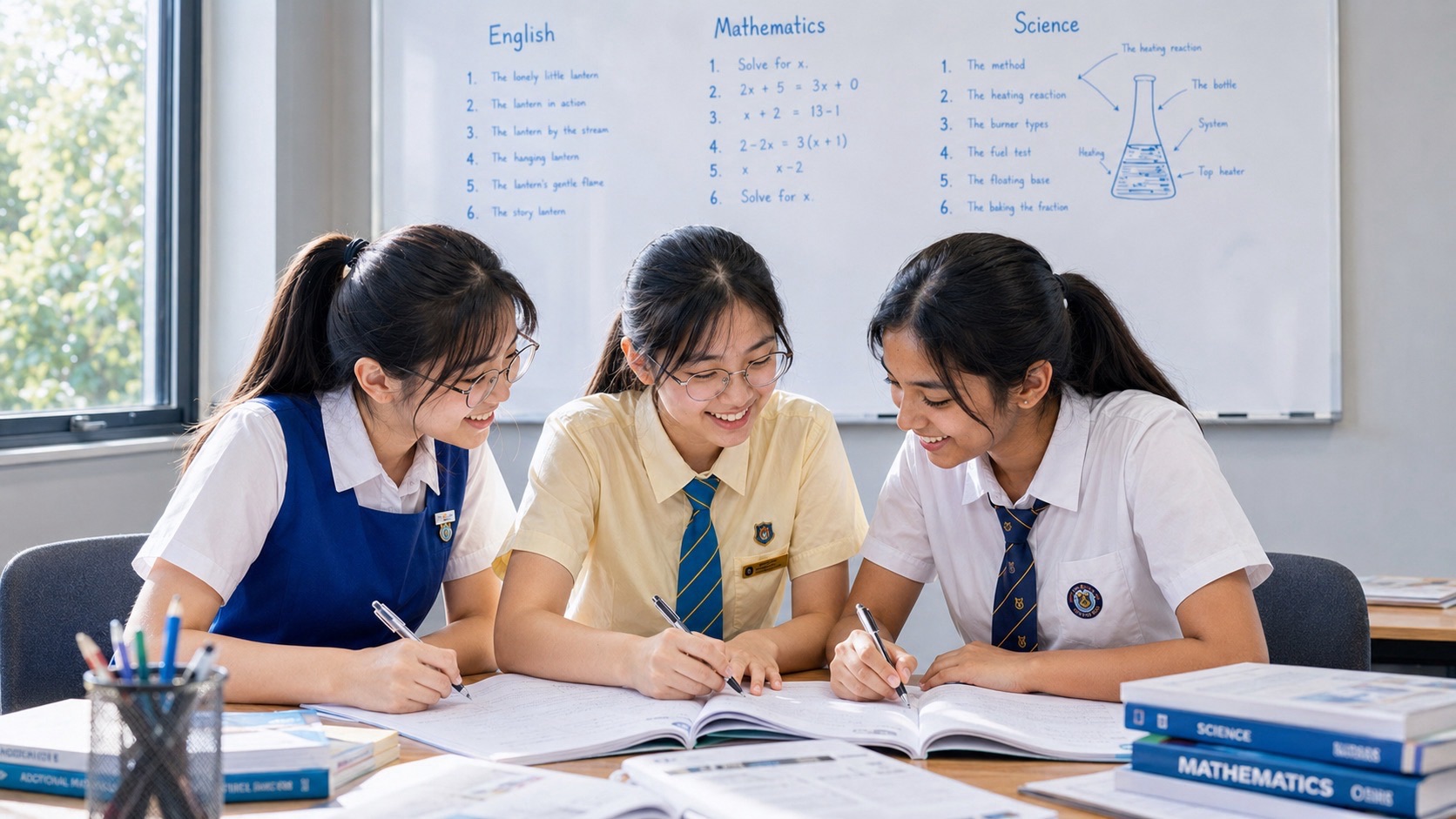
On a wet Tuesday evening in Punggol, Maya is staring at a Mathematics question she has already seen twice.
It is not especially difficult. That is what makes the silence interesting.
Last week, when the tutor showed her the method, Maya understood it immediately. Two days later she completed three similar questions correctly. Yesterday, at home, she told her mother that the topic was “fine already.”
Now the question looks different.
The numbers have changed. The diagram has been rotated. The problem is embedded inside a short paragraph instead of sitting under a chapter heading. Nobody has told Maya which method to use.
She reaches for one idea, stops, crosses it out and starts another.
Across the table, Hana is working on an English comprehension passage. Jia Jun is explaining a Science answer under his breath because the tutor has asked him to make the causal chain audible before he writes it.
The room is calm.
No examination clock is running. No school mark is being recorded. Nobody is going to lose a grade because the next ten minutes go badly.
And that is precisely why the next ten minutes matter.
Maya is being allowed to fail while failure is still cheap.
Not carelessly. Not endlessly. Not theatrically.
Purposefully.
The tutor has changed the surface of the problem so that understanding, recognition and method selection have to work together. The mistake, if it appears, will be visible. The tutor can intervene. Maya can try again. The conditions can be changed once more. The skill can be returned later after some forgetting has occurred.
That is one of the most useful ways to understand tuition.
Tuition can function as a learning simulator.
Not a fake school. Not a second school. Not a place that merely reproduces tomorrow’s worksheet. A simulator is valuable because it lets us control conditions that ordinary life cannot always control. We can slow something down, isolate it, replay it, vary it, add difficulty, remove difficulty, expose a rare failure, rehearse recovery and then test whether the capability survives outside the training room.
The final destination is not the simulator.
The final destination is school, examinations, later learning and eventually life without the tutor.
Quick Read: What the Learning Simulator Does
A useful tuition simulator performs a specific sequence:
Observe the real difficulty → recreate the important part under controllable conditions → let the student attempt → expose the failure safely → repair it → replay it → change the conditions → reduce support → add authentic constraints → return the capability to school.
This article owns that particular job inside the eduKatePunggol learning estate.
How Tuition Works | The Weak Link asks what is failing first? Tuition: The Time Compressor asks how can expert guidance reduce wasted time? How Training Works | Training Architecture owns the broader capability-building loop.
The Learning Simulator asks something narrower:
How should tuition design a temporary environment in which a fragile capability can be rehearsed until it survives the real environment?
That distinction prevents collision. It also gives parents a clearer way to judge tuition quality. The important question is not merely whether a child did work during tuition. It is whether the tuition room created useful practice conditions that changed what the child could later do elsewhere.
1. A Simulator Is Not a Copy of Reality
The word simulator can make people think immediately of flight simulators: a cockpit, screens, instruments and an artificial world that resembles the real one closely enough for pilots to rehearse procedures without putting an aircraft at risk.
That analogy is useful, but only if we understand what makes simulation valuable.
It is not realism alone.
A 2022 meta-analysis of simulation fidelity and transfer in professional troubleshooting found that no single level of realism was universally best. The effect depended on the trainee’s prior skill and the system being trained; medium-fidelity simulations produced the highest overall transfer in that body of evidence, particularly for lower-skill trainees. The wider lesson is important for education: making practice look more like the final performance is not automatically the same as making practice more educationally useful.
A full examination paper is highly realistic for an examination candidate. But if a student cannot reliably manipulate negative signs, a full paper may be a poor place to repair that micro-skill. Too many other demands are competing for attention.
A Primary 3 child may eventually need to write a complete composition. But if sentences repeatedly collapse because the child cannot maintain a basic subject–verb structure, asking for another whole composition may reproduce the problem without isolating it.
A Science examination may require an unfamiliar experimental context. But if the student still confuses observation with inference, the best first practice may be a tiny set of carefully controlled examples rather than a complete paper.
Good simulation therefore begins by deciding which part of reality must be preserved now and which parts can temporarily be removed.
2. Tuition Has One Great Advantage: The Stakes Can Be Lower
School has many jobs at once.
A teacher must introduce curriculum content, manage a class, maintain pace, assess learning, give feedback, prepare students for future topics and move an entire group through a school year. Even excellent schools cannot stop every lesson every time one student reveals a small but consequential weakness.
Tuition can stop.
That pause is valuable.
At a three-student table, a tutor can notice that Maya’s wrong Mathematics answer is not actually a new-topic failure. She chose the correct method but lost the structure when two operations appeared in one line. That error can be isolated before it hardens.
Hana can be asked to reread one paragraph instead of finishing six more comprehension questions badly.
Jia Jun can be stopped after one incomplete Science explanation and asked to repair the causal link before writing ten more answers with the same missing relationship.
The low-stakes environment lets the tutor trade short-term smoothness for long-term reliability.
This is an important distinction. A good tuition lesson does not need to look impressive every minute. Sometimes the most productive moment is a student sitting with uncertainty long enough for the real learning state to become visible.
3. Safe Failure Is Not the Same as Casual Failure
“Let students fail” is easy advice to give and easy advice to misuse.
Failure is useful only when it becomes information.
If a student repeatedly practises an incorrect procedure, the rehearsal can strengthen the wrong thing. If a task is so difficult that the student cannot identify any workable next move, the resulting frustration may contain very little diagnostic resolution. If a tutor watches error after error without deciding what they mean, low stakes have merely become low quality.
Useful failure has a different pattern:
- The task is close enough to the learner’s current capability that the attempt reveals something meaningful.
- The tutor can identify where successful performance first diverges.
- The learner receives enough feedback to change the next attempt.
- A fresh attempt follows.
- The condition is later changed so that the learner cannot succeed only by remembering the correction.
The simulator does not celebrate failure.
It makes failure affordable enough to study.
4. What the Tutor Can Control
Once tuition is viewed as a simulator, the tutor’s design controls become easier to see.
- Task size: one step, one question, one paragraph, one skill cluster or a complete paper.
- Difficulty: the conceptual demand, language demand, number complexity, abstraction or novelty.
- Support: worked example, cue, question, hint, partial structure, checklist or no help.
- Time: unlimited thinking time, soft timing, section timing or full examination timing.
- Variation: change numbers, contexts, representations, wording, genres, diagrams or method competition.
- Sequence: blocked practice, mixed practice, cumulative return or deliberately unexpected retrieval.
- Feedback timing: immediate correction, brief delay, self-check first or teacher review later.
- Social conditions: think alone, explain to a peer, compare two answers, defend a method or work silently.
- Memory demand: notes open, formula visible, partial cues, closed book or delayed retrieval.
- Performance pressure: private attempt, observed attempt, timed attempt, group comparison or examination simulation.
These controls are not tricks. They are the basic variables of rehearsal.
A skilled tutor changes them deliberately because different learning problems require different conditions.
5. The First Simulation Should Often Be Simpler Than Reality
Suppose Maya’s Secondary Mathematics paper shows repeated errors in algebraic manipulation.
The school question contained geometry, a diagram, algebra, a ratio relationship and several lines of working. Maya lost a negative sign halfway through.
If the tutor gives another equally complicated geometry problem immediately, the tutor may not know whether the new result reflects geometry understanding, algebra, reading, diagram interpretation or attention.
So the simulator strips away what is not yet needed.
First, five short algebra transformations where the only difficult feature is sign control.
Then a short equation.
Then a word problem where Maya must generate that equation.
Then geometry again.
The reality was temporarily simplified so that the mechanism could become reliable.
This is not “making the work easy.”
It is reducing irrelevant difficulty while preserving the difficulty we actually want the learner to solve.
6. Then the Simulator Must Put Reality Back
Simplification is useful only if the learner eventually leaves it.
A student who can manipulate algebra perfectly on a worksheet titled Algebraic Manipulation may still fail when the same manipulation appears inside trigonometry, coordinate geometry or an unfamiliar modelling problem.
The simulator therefore has two opposing responsibilities:
Remove enough reality to make repair possible. Then restore enough reality to prove the repair can travel.
This movement is the heart of the article.
Isolate.
Stabilise.
Recombine.
Vary.
Return.
7. The Seven-Layer Learning Simulator
For parents and students, the whole architecture can be understood as seven layers.
Layer 1 — Isolate.
Find the smallest meaningful capability that is limiting performance.
Layer 2 — Stabilise.
Practise the correct operation until accuracy no longer depends on constant rescue.
Layer 3 — Vary.
Change surface details so the learner has to recognise the underlying structure.
Layer 4 — Mix.
Put the capability among competing methods or skills so selection becomes necessary.
Layer 5 — Constrain.
Add time, memory, length, distraction, uncertainty or examination-like conditions.
Layer 6 — Recover.
Train what the student should do when performance breaks down.
Layer 7 — Return.
Check whether the capability survives schoolwork, a later paper, a new context and reduced tutor support.
Not every topic needs all seven layers in one week. The architecture describes direction, not a rigid timetable.
8. Layer One: Isolate the Decision, Not Just the Topic
“Fractions” is a topic.
“Recognise which quantity is the whole before finding a percentage” is a decision.
“Comprehension” is a component.
“Separate what the passage states from what the reader is merely assuming” is a decision.
“Heat” is a Science topic.
“Use the changed condition and evidence to explain the direction of heat transfer” is a trainable reasoning move.
The simulator becomes powerful when it is built around the decision the learner must make.
Topics are too large to diagnose precisely. Decisions tell the tutor what experience to create.
9. Layer Two: Stabilise Before Speed
Examinations reward accurate performance under time, which can tempt students to time everything immediately.
That can be useful later.
Early timing can also convert an unstable technique into a rushed unstable technique.
When Jia Jun first learns to build a precise Science explanation, the tutor may deliberately slow him down.
What changed?
What process does that affect?
What outcome follows?
What evidence supports the claim?
The first goal is not speed.
It is an accurate reasoning path that Jia Jun can reproduce.
Speed enters after the path exists.
In Mathematics, a similar progression might be:
Understand → execute correctly → check → repeat correctly → reduce hesitation → increase speed → preserve accuracy under variation.
There are exceptions. Some students need gentle timing simply to prevent perfectionism from consuming the whole lesson. But the principle remains: timing is a training variable, not a moral test.
10. Layer Three: Variation Is Where Familiarity Gets Exposed
A student can become excellent at the exact thing practised.
That is not yet enough.
If Hana learns an English inference technique only from short narratives where the evidence sits in the sentence immediately before the question, she may appear strong. Put the relevant evidence across two paragraphs, change the genre and add a plausible distractor, and the apparent skill may disappear.
Recent educational research continues to explore how variability interacts with retrieval and worked examples in promoting transfer. A 2026 study in Educational Psychology Review frames generalisation as a central educational goal and shows why the amount and form of variability must be designed rather than added randomly.
That distinction matters.
Variation is not:
“Make everything harder.”
Variation is:
“Change the features that force the learner to notice what remains structurally important.”
11. What Variation Looks Like in English
- Change narrative to informational text.
- Move evidence farther from the question.
- Change a familiar vocabulary word to a less familiar synonym.
- Ask for the same reasoning in oral form, then written form.
- Change the audience of a writing task.
- Remove the sentence starter.
- Give two plausible responses and ask the student to decide which is better supported.
- Ask for an explanation of why an attractive wrong answer fails.
- Return to the same skill after several days rather than several minutes.
The skill stops being attached to one worksheet shape.
12. What Variation Looks Like in Mathematics
- Change the numbers while preserving the structure.
- Change the representation from equation to graph or diagram.
- Embed the same algebraic operation inside geometry or statistics.
- Reverse the direction: give an answer and ask what conditions could produce it.
- Add irrelevant information.
- Remove the chapter label so the student must choose the method.
- Present two methods and ask when each is preferable.
- Change a direct question into a multi-step application.
- Require an independent plausibility check at the end.
Mathematical independence grows when the learner recognises relationships despite changes in appearance.
13. What Variation Looks Like in Science
- Change the organism while preserving the biological relationship.
- Change the apparatus while preserving the experimental logic.
- Swap a table for a graph.
- Change the direction of the comparison.
- Remove familiar model-answer wording.
- Introduce a plausible misconception and ask the learner to test it against evidence.
- Change the observed result and ask what explanation must therefore change.
- Ask the student to predict before revealing the data.
- Return to the concept in an everyday context outside the original chapter.
The goal is not to memorise a sentence that survived last year’s paper. It is to build a model that can survive a new question.
14. Layer Four: Mixed Practice Restores the Missing Question
Blocked practice has an important use.
When a child is first acquiring a method, ten related examples can reduce unnecessary search and allow attention to focus on execution.
But blocked practice quietly answers a question for the student:
Which method should I use?
The worksheet heading already told them.
Real performance often requires method selection before execution.
Mixed practice restores that decision.
Now Maya sees eight Mathematics questions drawn from several recent topics. She must identify the structure before calculating.
Hana receives English questions where literal retrieval, inference, vocabulary-in-context and author-purpose items are interleaved.
Jia Jun sees Science items from several systems rather than a page containing one predictable question family.
The simulator has become less comfortable and more informative.
15. Layer Five: Add Constraints One at a Time
Once capability is reasonably stable, the simulator can introduce the things that make real performance difficult.
Time.
Length.
Memory.
Method competition.
Fatigue.
Unfamiliar wording.
Distraction.
The emotional feeling of being uncertain while a clock continues moving.
The mistake is adding all of them at once before the student can tell us which one caused failure.
If Maya can solve a problem accurately in six minutes but not in three, timing is relevant. If she fails equally without a clock, speed is probably not the first problem. If Hana answers well when the passage is short but loses the argument in a long text, stamina and structural tracking may need training. If Jia Jun understands Science aloud but produces incomplete written responses under time, the writing conversion has to be isolated.
The simulator should add pressure diagnostically.
16. Timing Has Stages
It is useful to distinguish three kinds of time.
Learning time.
The student is allowed enough time to see and understand the structure.
Fluency time.
The student repeats correct execution until hesitation falls and checking becomes more efficient.
Performance time.
The student works under conditions close to the real assessment, including switching, prioritisation and recovery.
A mature examination programme needs all three.
Too much learning time and the student may understand but never finish.
Too much performance time and the student may repeat unstable methods under increasing stress.
17. Layer Six: Train Recovery, Not Just Perfect Starts
Examinations do not always go according to plan.
A question looks unfamiliar.
The first method fails.
A composition paragraph goes nowhere.
A graph seems contradictory.
A student discovers ten minutes too late that too much time has been spent on one item.
Reliable performers are not people who never encounter breakdown.
They often recover better.
The simulator can train recovery deliberately.
For Mathematics:
- return to the givens;
- change representation;
- test a simple case;
- check units;
- substitute the proposed answer;
- mark the question and move temporarily;
- restart from the last reliable line instead of rewriting everything.
For English:
- return to the exact command word;
- find the evidence boundary again;
- reduce an overcomplicated sentence to a clean core;
- restate the paragraph purpose;
- abandon an attractive example that does not support the argument;
- protect remaining time for completion and review.
For Science:
- separate observation from interpretation;
- return to the changed variable;
- read the graph axes again;
- name the process before constructing the explanation;
- check whether the answer actually addresses the comparison requested.
A student who has practised recovery is less likely to interpret one difficult moment as the collapse of the whole paper.
18. Layer Seven: The School Return Is the Real Test
The simulator is not complete when Maya succeeds in tuition.
It is complete when the repaired capability returns to the environment that originally exposed the weakness.
School homework.
A class quiz.
A weighted assessment.
A prelim.
A new chapter where the old skill becomes a prerequisite.
The Education Endowment Foundation’s evidence summaries on one-to-one and small-group tuition repeatedly stress that tuition works best when it is targeted at actual learner needs and explicitly linked with ordinary classroom learning. That point fits the simulator model perfectly.
A simulator with no return path becomes a separate world.
Good tuition should change school.
19. Why Three Students Can Make a Better Simulator Than One Worksheet
Small-group tuition has obvious logistical properties, but the simulator view reveals a deeper one.
Three students create variation naturally.
Maya solves a Mathematics problem by algebra.
Hana sees a diagrammatic shortcut.
Jia Jun makes a mistake neither of them considered.
The tutor can ask:
“Which method is more robust?”
“Why does Jia Jun’s answer look plausible?”
“What assumption did Maya make?”
Now the group is not merely sharing a teacher.
Other minds have become training material.
In English, one student’s interpretation can force another to distinguish evidence from opinion. In Science, two competing explanations can expose the role of conditions. In Mathematics, alternative representations can show that the same relationship has more than one surface form.
The group becomes useful because it produces contrast while remaining small enough for individual diagnosis.
This is consistent with the EEF’s small-group tuition synthesis, which describes two-to-five-pupil groups and suggests that impact is associated with closer interaction, sustained engagement, feedback and teaching matched to learner needs rather than group size acting as magic on its own.
20. The Tutor Is the Simulation Controller
A weak view of tutoring says:
The tutor knows the answer and gives it when the student does not.
A stronger view says:
The tutor controls the environment so the student performs the right cognitive work at the right difficulty, receives useful evidence and progressively needs less control from the tutor.
That requires judgement.
When should the tutor wait?
When should the tutor hint?
When should a method be modelled completely?
When should a task be simplified?
When should a student be made to continue through uncertainty?
When should the clock be added?
When should the clock be removed?
When should a strong student be given a counterexample that breaks an overgeneralised rule?
When should the lesson stop practising something that is already stable?
The quality of tuition is hidden inside those decisions.
21. The Tutor Must Resist Being Too Helpful
A simulator becomes useless if the instructor quietly flies the aircraft.
The educational equivalent happens constantly.
The student hesitates.
The tutor says, “Use the quadratic formula.”
The student proceeds successfully.
But the crucial decision—recognising that the quadratic formula was appropriate—was performed by the tutor.
Or the student reads a comprehension question.
The tutor points to the correct paragraph.
The student constructs a reasonable answer.
But evidence location was outsourced.
Help can make practice smoother while reducing diagnostic value.
Therefore a useful simulator preserves enough independent attempt to reveal what the student can actually do.
The direction is:
Model → guide → hint → question → wait → observe → student self-prompts.
The exact sequence varies, but the trainer should gradually disappear from the operation.
22. Feedback Is the Debrief
Simulation without debrief is incomplete.
A student needs to know more than whether the final answer was wrong.
Where did the performance first diverge?
What cue was missed?
Was the method wrong or the execution?
Did the learner know but fail to retrieve?
Did time pressure change the decision?
Did a plausible misconception drive the answer?
What should the learner notice next time?
What is the smallest fresh task that will tell us whether the correction worked?
Feedback becomes educational when it changes the next attempt.
23. Never End the Repair With the Explanation
Maya gets the question wrong.
The tutor explains.
Maya says, “Ohhh.”
Every teacher knows this sound.
It is pleasant.
It is not evidence of transfer.
The simulator needs another attempt.
Preferably not the exact same question.
Change something.
Make Maya reconstruct the decision rather than recognise the tutor’s solution.
This is one of the simplest ways tuition can become more rigorous without becoming harsher.
Explanation is not the endpoint.
Independent re-performance is.
24. Retrieval Turns the Simulator Off for a Moment
When notes, formulas, model answers and worked examples remain visible, the environment is supplying memory.
Eventually the learner has to provide it.
Research on retrieval practice is unusually consistent: actively bringing information back from memory can strengthen later access more effectively than repeated passive restudy in many contexts. Reviews in Annual Review of Psychology, Educational Psychology Review and Nature Reviews Psychology describe benefits across ages, content types and applied educational settings, while also emphasising that design and context matter.
Inside tuition, retrieval can be tiny.
- Close the notes and reconstruct the formula.
- Explain the rule without looking at the worked example.
- Summarise the passage structure before answering.
- Draw the Science process from memory.
- State the first three checks after completing an algebraic solution.
- Return to yesterday’s vocabulary before seeing the definitions.
The purpose is not to turn every lesson into a test.
It is to stop the environment from carrying knowledge the student will later need to carry alone.
25. Spacing Is the Simulator’s Time Machine
Immediately after teaching, students are unusually powerful.
The example is fresh.
The tutor’s language is still active in working memory.
The page contains contextual cues.
That is why a student can appear to have mastered something at 6.30 p.m. and lose it by Thursday.
Spacing lets the simulator recreate the future.
Not perfectly. But enough.
Teach or repair today.
Brief return in two days.
Mix it next week.
Find it again later inside a broader task.
The exact schedule should depend on material, learner and stakes. The principle is simple: if future performance matters, some practice should happen after the immediate feeling of familiarity has faded.
26. The Simulator Must Distinguish Performance From Learning
This is one of the most important ideas for parents.
Performance during a lesson is visible.
Learning is inferred from what remains and transfers later.
A child who finishes twenty similar questions accurately may be demonstrating genuine mastery.
Or the worksheet sequence may be supplying the method.
A student who rewrites a corrected English paragraph beautifully may have learned the principle.
Or the correct structure may still be sitting in short-term memory.
A Science student who can explain the process after hearing the tutor’s model may understand it.
Or the student may be echoing the model.
The simulator needs stronger evidence.
Delay.
Variation.
Mixed conditions.
Reduced support.
School return.
27. A Primary English Simulation: From Sentence to Composition
Jia Jun has stories in his head.
His written compositions are much thinner than his oral ones.
A poor simulation asks for another complete composition and marks the result.
A better simulation isolates the conversion.
First, Jia Jun tells the event aloud.
Then he has to choose the one moment worth writing.
Then one complete sentence.
Then a second sentence that changes the situation.
Then a sentence that reveals a character’s internal state.
The tutor removes the prompts.
Next week the picture changes.
Then the story begins from a written prompt rather than an image.
Then Jia Jun has twenty minutes to plan and produce a short section.
Eventually the skill returns inside the full composition.
The simulator did not replace composition writing.
It made one hidden part of composition trainable.
28. A Primary English Simulation: Evidence-Bounded Inference
Hana often gives sensible comprehension answers.
The problem is that some of them are not supported by the passage.
The simulator begins with tiny texts.
Two sentences.
One inference.
Hana must underline the words that constrain the answer.
Then two plausible answers are offered.
She decides which is safer.
Then the text becomes longer.
Evidence moves farther away.
A distracting detail appears.
The underline disappears.
Eventually Hana has to apply the same reasoning inside a normal comprehension paper.
The small practice environment has returned to the real one.
29. A Primary Mathematics Simulation: Find the Whole
Maya knows percentage procedures.
She sometimes applies them to the wrong base.
Again, more percentage questions is too broad.
The simulation removes arithmetic almost completely.
For each situation Maya answers only:
What is the whole?
No calculation.
Ten situations.
Then the calculation returns.
Then the wording changes.
Then the same idea appears inside discount, increase, decrease and comparison problems.
Then a mixed set forces Maya to decide whether percentage is even the correct approach.
A small decision has become robust enough to re-enter the curriculum.
30. A Secondary Mathematics Simulation: Algebra Under Load
By Secondary school, the same idea becomes more important because basic operations are embedded inside larger systems.
An algebra weakness may emerge inside coordinate geometry.
A ratio weakness may surface inside similarity.
Weak graph interpretation may look like weak functions.
The simulator isolates the basic operation, then adds load progressively.
For example:
algebra alone → algebra inside equation → algebra inside graph → algebra inside word problem → algebra inside mixed timed section.
The student does not merely “revise algebra.”
The student trains algebra to survive other cognitive demands.
31. An Additional Mathematics Simulation: Recognise Before You Differentiate
Consider the familiar expression:
y = (3x + 1)5
A student may know the Chain Rule and still fail because the nested structure is not recognised quickly.
The simulator can temporarily remove differentiation.
Show ten expressions.
Ask only:
“What is inside what?”
Classify nested and non-nested structures.
Then differentiate.
Then combine Chain Rule with product or quotient structures.
Then insert those into a mixed differentiation set where no heading gives the method away.
Then time the section.
The simulator trained recognition before speed.
32. A Science Simulation: Observation → Evidence → Explanation
Jia Jun understands a Science concept but writes answers that jump from observation straight to conclusion.
The simulator turns the answer into visible parts.
What changed?
What was observed?
What process explains that observation?
What conclusion is therefore justified?
At first the structure is explicit.
Then one label disappears.
Then all labels disappear.
The apparatus changes.
The topic changes.
Jia Jun must decide which parts of the reasoning architecture still apply.
The final answer is not memorised.
It is reconstructed.
33. A PSLE Simulation: The Paper Is Not the First Simulator
As PSLE approaches, families naturally think about full papers.
Full papers matter.
They train endurance, navigation, switching, time allocation and the reality that the learner does not control question order.
But a full paper is not an efficient repair tool for every weakness.
A better PSLE simulation system moves between scales.
full paper → error pattern → isolated repair → short mixed cluster → timed section → another full paper.
The paper provides a high-fidelity sample.
The smaller simulator does the repair.
The next paper tests whether the repair survived reintegration.
This cycle is more intelligent than doing paper after paper while the same error families continue returning.
34. A Secondary Examination Simulation: Switch Between Worlds
Secondary examinations increase a different demand: switching.
One Mathematics paper may move from number to algebra to geometry to statistics to functions.
An English paper can require reading, evidence, language analysis, synthesis and writing decisions.
The difficulty is not merely knowing each component separately.
The learner must rapidly identify what kind of task has arrived and load the appropriate operating system.
The simulator can train switching deliberately.
Short mixed clusters.
Unexpected topic changes.
Tasks that look similar but require different methods.
Timed sections where the learner must decide when to leave a question and return.
Real examinations are partly tests of controlled switching.
35. A JC Simulation: Protect Thinking Under Density
By JC, many students do not fail because they have never seen the relevant knowledge.
They fail because too much knowledge has to remain available at once.
H2 Mathematics places considerable demands on algebraic fluency, recognition, multi-step reasoning and the ability to hold intermediate relationships while moving through long problems.
The simulator now needs density.
But density should still be staged.
One hard decision.
Then two interacting decisions.
Then a long problem.
Then mixed conditions.
Then full-paper endurance.
The learner is not merely training knowledge.
The learner is training the ability to keep knowledge organised while the problem expands.
36. Why Mock Exams Sometimes Fail
Mock examinations feel serious.
Seriousness can be useful.
It can also hide weak training architecture.
If every lesson becomes a mock, the student receives repeated measurement but insufficient repair.
Imagine a runner racing 10 kilometres every training day but never isolating technique, pace, strength or recovery.
The races supply information.
They do not automatically solve what they reveal.
Academic mock papers are similar.
The paper should feed the simulator.
What failed?
Why?
Which failure is most expensive?
What smaller rehearsal will change it?
When should the full paper return?
37. Why Easy Practice Sometimes Works Better Than Hard Practice
A difficult task can feel educational because struggle is visible.
But challenge must match the training job.
If a learner is trying to stabilise sentence punctuation, the content can be simple.
If a learner is training a new algebraic transformation, the numbers can initially be friendly.
If a learner is distinguishing observation from inference, the scientific context can be familiar.
Difficulty should enter where it generates the mental operation we want strengthened.
Later, the simulator broadens.
This gives us a useful rule:
Do not confuse task difficulty with training quality.
38. Why Hard Practice Sometimes Becomes Necessary
The opposite mistake is protecting the learner forever.
If every Mathematics question is neatly classified, method recognition will remain weak.
If every English passage is short and friendly, reading stamina will remain untested.
If every Science answer has the key vocabulary printed nearby, retrieval will remain outsourced.
If every composition receives a sentence frame, independent writing will remain invisible.
A simulator must eventually create conditions in which failure is genuinely possible despite good preparation.
That is how the student discovers whether capability has become robust.
39. Confidence Should Be Calibrated in the Simulator
Maya says:
“I know this.”
The tutor asks:
“Good. Show me on a fresh one.”
That sentence is not scepticism.
It is calibration.
Confidence is most useful when it corresponds reasonably well with capability.
A learner who underestimates stable skills may waste time relearning them and avoid challenge.
A learner who overestimates fragile skills may stop practising too early.
The simulator provides evidence.
- I can do it without the example.
- I can still do it after a week.
- I can recognise it when the wording changes.
- I can do it under time.
- I can detect my own error.
- I can recover if the first approach fails.
Confidence becomes attached to demonstrated capability rather than mood.
40. The Simulator Can Train Attention
Some students know the content but fail to notice the cue that should activate it.
Hana understands pronoun reference but misses a shifted referent inside a dense paragraph.
Maya knows to reject an extraneous root but forgets to check after squaring.
Jia Jun knows the Science concept but overlooks the word compare.
The simulator can deliberately populate tasks with these cues and ask the learner to name what should attract attention first.
Eventually the tutor stops asking.
The student starts noticing.
41. The Simulator Can Train Checking
“Check your work” is one of education’s most repeated and least operational instructions.
Students often look at the page again and find nothing because they do not know what checking means in that domain.
The simulator can teach checks as procedures.
Mathematics:
- substitute;
- estimate;
- inspect units;
- check sign and magnitude;
- compare with the original condition.
English:
- reread the exact question;
- check whether evidence supports the claim;
- inspect pronoun reference;
- check sentence boundaries;
- confirm tone and audience.
Science:
- name the changed condition;
- check direction;
- separate observation from inference;
- make sure the causal link is present;
- match the answer to the evidence actually provided.
The learner gradually becomes the quality-control system.
42. The Simulator Can Train Help-Seeking
Independence does not mean never asking for help.
It means asking intelligently.
Compare:
“I don’t know.”
with:
“I understand the first relationship, but I cannot see how the second condition changes the equation.”
Or:
“I can find the evidence, but I’m not sure how much inference the question permits.”
Or:
“I know the Science process but I cannot connect it to this graph.”
The simulator can require students to identify what remains unclear before receiving assistance.
This turns help-seeking into diagnosis rather than surrender.
43. The Home Should Not Become a Permanent Simulator
Parents can borrow some simulator ideas.
A fresh question after correction.
A short delayed return.
Asking the child to explain the plan before starting.
But home should not become an endlessly controlled training environment.
Home has other jobs.
Sleep.
Food.
Conversation.
Play.
Relationships.
Unstructured time.
A child’s entire life should not be transformed into deliberate practice.
The Family Life Education position of eduKatePunggol matters here. Learning has to fit inside a sustainable family system, not consume the system.
Parenting 101 for Education and Tuition to Lower Stress expands that distinction.
44. Sleep Is Part of Simulation Design
A student arriving exhausted gives the tutor a different system to train.
Attention narrows.
Working memory becomes less reliable.
Errors that would not appear when rested may multiply.
There is educational value in occasionally learning how performance feels under fatigue, because real school days are not perfectly rested laboratories.
There is no value in constructing a lifestyle where chronic fatigue becomes the default simulation condition.
A good programme sometimes stops.
That is not weakness.
It is protecting tomorrow’s learning system.
45. The Parent’s Role: Observe the Transfer
Parents often cannot see the instructional mechanics inside tuition.
They can see transfer.
Homework that used to require constant supervision begins independently.
A repeated grammar error appears less often.
A child starts explaining why an answer is wrong rather than merely accepting correction.
A Secondary student can tell the parent what needs revision instead of saying “everything.”
A marked school paper shows that a recurring Mathematics error has disappeared.
The parent’s best question is often not:
“What did you do in tuition?”
but:
“What can you do differently now?”
46. School and Tuition Need Shared Reality
The most sophisticated simulator still needs accurate information about the real environment.
For tuition, this means school evidence matters.
Marked papers.
Teacher comments.
Current topics.
Assignment demands.
Recurring classroom difficulty.
The language and methods used at school where alignment matters.
EEF’s tutoring guidance is especially clear on this point: tuition should be additional to classroom teaching and well linked to it, with progress monitored rather than assumed.
That does not mean copying every school worksheet.
It means the simulator should train for the reality the student actually has to enter.
47. The Simulator Needs a Flight Recorder
A single score tells us surprisingly little about what changed.
Suppose Maya moves from 61 to 70.
Good.
But why?
Was algebra more accurate?
Did she finish more of the paper?
Was the paper easier for her profile?
Did a previously weak skill transfer?
Did careless errors fall?
Did she guess better?
Those questions belong to the next article in this series, How Tuition Works | The Flight Recorder.
The Learning Simulator creates controlled attempts.
The Flight Recorder will preserve what those attempts tell us across time.
48. The Simulator Should Sometimes Surprise the Student
Predictable practice is comfortable.
Life is less cooperative.
Once a learner has enough foundation, the tutor should occasionally change the expected condition.
A Mathematics question that appears to invite one method but is cleaner with another.
An English passage where the obvious interpretation is not the best-supported one.
A Science scenario where a memorised rule has an important condition.
The surprise is not there to trick the child.
It tests whether the learner is reading reality or merely reading the tutor’s habits.
49. The Simulator Should Train Counterfactuals
One powerful form of reasoning begins with:
“What would change if this condition changed?”
In Mathematics, what if the coefficient becomes zero?
In Science, what if the independent variable moves in the opposite direction?
In English, what if the audience is a friend rather than a formal institution?
What if the evidence supporting an inference is removed?
What if one sentence in an argument is false?
Counterfactuals are useful because they reveal whether the learner understands a relationship deeply enough to predict its movement.
The simulator lets us change the world cheaply and observe the model inside the student.
50. The Simulator Should Train Explanation Without Becoming Teach-Back Theatre
Asking students to explain can be powerful.
It can also become ritual.
A student can memorise an explanation and still fail to perform the skill.
The simulator therefore uses explanation as evidence, not as proof by itself.
“Why does this method work?”
Then:
“Good. Now use it here.”
Or:
“Explain the evidence rule.”
Then:
“Which of these two answers violates it?”
Explanation and performance should test each other.
51. The Simulator Needs Stop Rules
Training can become inefficient because success feels reassuring.
A student finally becomes accurate, so everyone keeps practising the successful skill.
Meanwhile another weakness remains untouched.
A good simulator asks when a capability is stable enough to move into maintenance.
Possible evidence:
- accurate across several fresh items;
- survives a delay;
- survives changed wording or representation;
- works inside a mixed set;
- works with reduced support;
- appears stable in school evidence.
Then stop spending premium instructional attention there.
Return occasionally.
Use the recovered time on the next constraint.
52. More Tuition Is Not Automatically More Simulation
A family can increase tuition hours without improving simulation quality.
If the additional hours contain generic worksheets, delayed marking and little targeted feedback, the student has more activity but not necessarily better rehearsal.
This is why dosage cannot be separated from design.
EEF’s reviews show positive average effects for both one-to-one and small-group tuition, but they also show variation across studies and repeatedly emphasise targeting, interaction, tutor quality, classroom linkage and monitoring.
Parents should read that evidence carefully.
Tuition is not a chemical where doubling the dose reliably doubles the effect.
It is an instructional environment.
The quality of the environment matters.
53. When Tuition Should Not Simulate Anything
Sometimes the right answer is not another training block.
The child is ill.
The child is chronically exhausted.
The student already understands and performs the material reliably.
The difficulty requires school-based or specialist support outside the tutor’s scope.
The family schedule has become so overloaded that another lesson displaces sleep and ordinary life.
The learner needs a conversation, not a worksheet.
A simulator is a tool.
It should not become an ideology.
54. A Family Week in Punggol
Thursday is difficult in Maya’s family.
School finishes.
There is travel.
There is homework.
Her younger sibling needs attention.
Dinner moves later than planned.
The family could put a full simulated paper into the evening.
They do not.
Maya does fifteen minutes of targeted retrieval from the week’s weakest area, checks it and stops.
Saturday morning contains the longer mixed practice.
The simulator has moved across time.
The family did not ask:
“What is the maximum amount of work we can fit?”
They asked:
“Which training condition belongs in which part of this real week?”
That is a Family Life Education question as much as an academic one.
55. January Is Not September
A simulation system should change across the school year.
In January, a Primary 6 student may still be building and repairing.
By mid-year, more mixing and cumulative retrieval become useful.
As prelims approach, authentic timing and paper navigation grow in importance.
After prelims, the returned paper becomes high-resolution diagnostic material.
Close to the final examination, the simulator should increasingly ask:
Can the student deploy the whole system reliably under the conditions that will actually matter?
The same is true for Secondary 4 and JC2.
The ratio between isolated repair and full performance changes as the deadline approaches.
56. September Should Not Become January Either
Late in an examination year, there is a temptation to discover a deep old weakness and rebuild everything from the beginning.
Sometimes that is necessary.
Often there is not enough time.
The simulator then becomes more selective.
Which repair has the greatest expected return before the examination?
Which weakness can be bypassed with a safer strategy?
Which error must simply be prevented?
Which topic is too expensive to rebuild relative to its likely marks?
Which strengths should be protected?
The simulator becomes a triage environment as well as a learning environment.
This is one reason early diagnosis is valuable.
It gives deep repairs enough runway.
57. The Simulator Across Primary School
Primary 1 and Primary 2 need gentle simulation.
Short tasks.
Clear routines.
Reading aloud.
Language play.
Concrete Mathematics.
Immediate feedback.
Lots of successful independent endings.
Primary 3 and Primary 4 can widen the environment.
Longer texts.
More multi-step Mathematics.
Formal Science.
More delayed feedback.
More self-checking.
Primary 5 and Primary 6 increasingly need integration and examination realism.
But the architecture remains the same.
Do not ask a seven-year-old simulator to behave like a twelve-year-old one.
58. The Simulator Across Secondary School
Secondary 1 is a transition simulator.
Can Primary foundations survive longer texts, abstraction, subject specialisation and increased independence?
Secondary 2 can become a stability simulator.
Are weak systems being repaired before upper-secondary density arrives?
Secondary 3 increasingly becomes an assembly simulator.
New content is arriving while old prerequisites need to remain active.
Secondary 4 becomes a performance simulator.
Timing, integration, prioritisation, paper strategy, recovery and reliable retrieval all matter more.
The simulator changes because the future environment changes.
59. The Simulator Across JC
JC compresses time.
The learner has less room for slow discovery of foundational gaps.
A weak algebraic habit that survived Secondary school can become expensive quickly.
Reading and argument weaknesses become harder to hide in GP.
The simulator therefore needs sharper diagnosis and faster cycling.
Attempt.
Evidence.
Repair.
Fresh problem.
Integration.
Performance.
The small-group room can remain calm even while the academic system becomes intense.
Calm is not the absence of standards.
It is the condition in which the next decision can still be seen clearly.
60. Rehearsal Beyond Examinations
The learning simulator is not only an examination machine.
A child rehearses asking a clear question.
A student practises explaining an idea to another person.
A teenager rehearses a presentation.
A JC student practises reading a difficult argument and separating evidence from rhetoric.
A learner rehearses planning a week before the week becomes overloaded.
A student practises what to do after receiving a disappointing mark.
The deeper educational capability is rehearsal itself.
Human beings can imagine a future demand, create a smaller version of it, practise the required behaviour, learn from the difference and enter the future better prepared.
61. Why This Is Different From “Practice Makes Perfect”
Practice does not make perfect.
Practice changes the learner.
Whether the change is useful depends on what is practised, how it is practised, what feedback appears, what variation is introduced and whether the result transfers.
A student can practise dependence.
Practise guessing.
Practise rushing.
Practise copying corrections.
Practise the exact worksheet form until recognition substitutes for understanding.
Or the student can practise noticing, selecting, retrieving, checking, recovering and adapting.
The simulator makes that choice explicit.
62. The Strong Student Needs a Simulator Too
Tuition is often discussed as remediation.
Strong students also have edges.
A high-performing Mathematics student may be accurate on standard questions but fragile when several representations interact.
A strong English student may write fluently but rely on familiar argument structures.
A strong Science student may know a large amount but become less reliable when evidence contradicts an expected pattern.
The simulator for a strong learner should not simply add more volume.
It should expose boundaries.
Change conditions.
Introduce ambiguity.
Require justification.
Ask the learner to compare models.
Make easy operations cheap enough that attention can move to deeper decisions.
63. The Weak Student Does Not Need Permanent Easy Mode
A struggling learner deserves tasks that create success.
That does not mean tasks should remain permanently easy.
The simulator should find the smallest challenge the learner can productively engage with.
Then increase one dimension.
A little less help.
A slightly different question.
A short delay.
A second skill added.
A modest time constraint.
Difficulty rises because capability rises.
That is progression.
64. The Emotional Simulator
There is another dimension parents can miss.
Students rehearse emotional responses too.
What does Maya do when she gets three answers wrong in a row?
Does she conclude she is bad at Mathematics?
Does Hana defend a weak answer because correction feels like loss of status?
Does Jia Jun rush after one difficult question because anxiety has changed his pace?
A calm tuition room can rehearse a better sequence.
Error.
Pause.
Inspect.
Repair.
Reattempt.
Continue.
The learner discovers that a wrong answer is an event, not an identity.
That emotional rehearsal matters when the stakes later become real.
65. Simulate the First Five Minutes
Many students practise middle-of-task performance but not beginnings.
The first five minutes of an examination can shape everything that follows.
Reading instructions.
Scanning structure.
Deciding where to begin.
Settling breathing.
Writing candidate details correctly.
Not panicking when the first visible question looks unpleasant.
The simulator can rehearse beginnings repeatedly without running a whole paper each time.
Five minutes.
Stop.
Debrief.
Reset with another paper.
A tiny simulation can train a disproportionately important transition.
66. Simulate the Last Ten Minutes
The end of a paper is another distinct environment.
Attention is tired.
Time is visible.
There may be unfinished questions.
The learner has to decide:
finish?
check?
return to a flagged item?
protect easy marks?
abandon an expensive dead end?
The simulator can start at minute seventy rather than minute zero.
Give a partially completed paper state.
Ten minutes remaining.
Ask the student to manage it.
This is not common worksheet practice.
It is performance training.
67. Simulate Being Stuck
Sometimes the tutor can deliberately give a problem the student is unlikely to solve immediately.
The objective is not the answer.
The objective is the protocol.
What do you do first when you do not know?
Read again?
List givens?
Draw?
Translate?
Recall a related example?
Test a simple case?
Identify the word you do not understand?
Mark and move?
Seek a specific hint?
Being stuck is a recurring human condition.
Students deserve a procedure for it.
68. Simulate a Misleading Success
Correct answers can hide weak reasoning.
A Mathematics student chooses the wrong method but arithmetic luck produces the correct result.
An English student selects the right option for the wrong evidence.
A Science student memorises a phrase that happens to fit.
Therefore the simulator should occasionally ask for the path even when the answer is correct.
“How did you know?”
Not every time.
Enough to distinguish reliable knowledge from fortunate output.
69. Simulate a Stronger Opponent
Hana gives an argument.
The tutor gives a better counterargument.
Maya presents a Mathematics method.
The tutor shows a faster competing representation.
Jia Jun explains a Science phenomenon.
The tutor introduces evidence that appears inconsistent with his model.
The student now has to defend, revise or abandon the original position.
This is where the next article, How Tuition Works | The Sparring Partner, will go deeper.
The simulator supplies the environment.
The Sparring Partner will examine the intelligent resistance a tutor can provide inside it.
70. The Simulation Fidelity Trap
Parents sometimes judge practice by how much it resembles the final examination.
A thick paper feels serious.
A timer feels serious.
Silence feels serious.
A school-style cover page feels serious.
But seriousness is not fidelity, and fidelity is not learning.
The simulator should preserve the feature that matters for the capability being trained.
If the goal is evidence selection, preserve ambiguity and competing evidence.
If the goal is time management, preserve the clock and competing questions.
If the goal is algebraic accuracy, preserve the transformation and temporarily remove unrelated reading load.
If the goal is examination endurance, then full-paper fidelity matters much more.
Functional similarity matters more than decorative similarity.
71. Build the Smallest Simulator That Answers the Question
This may be the most efficient principle in the article.
What do we need to know?
Can Maya recognise the method?
Then we do not need a two-hour paper.
Can Hana sustain an argument across a longer passage?
Then a short sentence drill is too small.
Can Jia Jun preserve Science reasoning under time?
Then give enough questions to create time pressure without spending the whole evening on unrelated topics.
Simulation design should be proportional to the diagnostic question.
72. The Real Cost of a Bad Simulator Is False Confidence
A badly designed practice environment can make everyone feel good.
The worksheet is familiar.
The tutor helps at exactly the right moment.
The chapter title reveals the method.
The model answer sits nearby.
The student scores ninety percent.
Then school changes the wording and performance collapses.
The problem is not that practice was easy.
The problem is that nobody knew what the practice score actually measured.
A good simulator makes support visible and gradually removes it so capability can be estimated honestly.
73. The Real Cost of an Over-Hard Simulator Is Noise
The opposite design also misleads.
The tutor gives a task far above the student’s current level.
Everything fails at once.
Vocabulary.
Memory.
Concept.
Method.
Timing.
Confidence.
What did we learn from the failure?
Very little.
The task generated noise rather than diagnostic resolution.
Good difficulty exposes the boundary of capability without burying it.
74. A Better Parent Question Than “Was Tuition Hard?”
Ask:
“What was different about today’s practice?”
“What could you do without help?”
“What did the tutor change after you got stuck?”
“Did you do a fresh version after correction?”
“Which skill is supposed to show up at school next?”
These questions are more informative than whether the worksheet felt difficult.
75. A Better Student Question Than “How Many Questions?”
Ask:
“What am I trying to make more reliable?”
That changes study behaviour.
If the goal is recognition, twenty identical executions may not help much.
If the goal is fluency, repetition may be exactly right.
If the goal is transfer, variation matters.
If the goal is endurance, a larger block is necessary.
If the goal is recovery, the task needs opportunities to get stuck.
The number of questions follows the training job.
76. The Learning Simulator and Independence
A paradox sits at the centre of good tuition.
The better the tutor controls the training environment, the less control the learner should eventually need.
At first, the tutor chooses the task.
Later, the student identifies the weak skill.
At first, the tutor tells the learner what to check.
Later, the learner runs the check automatically.
At first, the tutor creates variation.
Later, the student knows that doing another identical question is not always enough.
At first, the tutor schedules retrieval.
Later, the student returns deliberately to fragile knowledge.
The simulator begins outside the learner.
Education succeeds when part of it moves inside.
77. The Last Simulation
Imagine Maya several years later.
She has an examination next week.
No tutor is beside her.
She looks at her recent errors.
Chooses two that represent recurring mechanisms rather than random slips.
Finds fresh questions.
Attempts them without notes.
Checks.
Changes the context.
Returns the next day.
Times a mixed section.
Stops at a sensible hour.
Goes to sleep.
The tutor is absent.
The training architecture remains.
That is the real exit condition.
78. The Punggol Return
Back on that Tuesday evening, Maya is still looking at the rotated Mathematics diagram.
The tutor says nothing.
Maya redraws one line.
Writes an equation.
Stops.
Crosses out the equation.
“I used the wrong whole,” she says.
That sentence is better than a correct answer produced by a hint.
She has detected the mechanism.
She tries again.
This time the answer works.
Tomorrow, school may change the question again.
Good.
Reality should change the question.
The whole point of tuition was never to preserve the practice environment.
It was to prepare Maya to leave it.
The Learning Simulator in One Page
1. Start with evidence from reality.
Use schoolwork, observed attempts, marked papers and repeated patterns.
2. Identify the capability, not merely the chapter.
Name the decision, retrieval, execution, checking or transfer problem.
3. Build the smallest useful simulation.
Preserve the difficult mechanism; temporarily remove unrelated noise.
4. Let the learner attempt before unnecessary rescue.
The attempt is diagnostic data.
5. Turn failure into information.
Find where performance first diverged.
6. Debrief and reattempt.
Do not end with the explanation.
7. Stabilise the correct operation.
Accuracy first where the domain requires it.
8. Add variation.
Change surface details while preserving the underlying relationship.
9. Mix competing skills.
Restore method selection.
10. Add authentic constraints.
Time, length, memory, uncertainty and switching enter progressively.
11. Train recovery and checking.
Reliable performance includes what happens after something goes wrong.
12. Space the return.
Test whether the skill survives after familiarity fades.
13. Send the capability back to school.
Transfer outside tuition is the real evidence.
14. Reduce support.
The learner should increasingly control the process.
15. Stop when the skill is stable enough.
Move premium attention to the next constraint.
Where This Fits in eduKatePunggol
- How Tuition Works at eduKatePunggol — the broader tuition relationship.
- How Tuition Works | The Weak Link — locate the first limiting mechanism.
- Tuition: The Time Compressor — reduce wasted time through expert routing.
- How Training Works | Training Architecture — the wider capability-building system.
- How Examination Performance Works — why knowledge must survive examination conditions.
- What is Small Groups Tuition? — the small-group environment.
- English Tuition at eduKatePunggol — English learning route.
- Mathematics Tuition at eduKatePunggol — Mathematics learning route.
- Science Tuition at eduKatePunggol — Science learning route.
- Singapore Education Pathway — the learner’s wider school journey.
The next node in this series is:
How Tuition Works | The Sparring Partner — Why a Good Tutor Should Make Thinking Work Harder
The Learning Simulator controls the environment.
The Sparring Partner controls the quality of resistance inside it.
Research Foundations
This article synthesises findings from tutoring research, learning science and simulation research rather than treating any single technique as universal.
- Education Endowment Foundation — Small Group Tuition. The EEF synthesis reports a positive average effect and emphasises accurate diagnosis, targeting learner needs, high-quality interaction and feedback, and explicit linkage to classroom content.
- Education Endowment Foundation — One to One Tuition. The EEF likewise highlights targeted support, linkage with normal lessons and ongoing monitoring of whether tuition is benefiting the learner.
- Carpenter, Pan & Butler — The Science of Effective Learning with Spacing and Retrieval Practice, Nature Reviews Psychology (2022).
- Agarwal, Nunes & Blunt — Retrieval Practice Consistently Benefits Student Learning, Educational Psychology Review (2021).
- McDermott — Practicing Retrieval Facilitates Learning, Annual Review of Psychology (2021).
- Cao & Carvalho — Striking the Balance: How Variability Shapes Retrieval Practice and Worked Examples for Transfer Learning, Educational Psychology Review (2026).
- Doozandeh & Hedayati — The Effect of Simulation Fidelity on Transfer of Training for Troubleshooting Professionals: A Meta-Analysis (2022). Its central warning is useful beyond the professional-training context: greater realism is not universally superior; effective fidelity depends on what is being trained and who is being trained.
- Pan & Rickard — Transfer of Test-Enhanced Learning: Meta-Analytic Review and Synthesis, Psychological Bulletin (2018), examining when retrieval practice transfers beyond the original test context.
The practical conclusion is modest but powerful. Tuition does not become better merely by adding hours, realism, papers or difficulty. It becomes better when the temporary learning environment is designed around a real capability, produces interpretable evidence, changes the learner and then successfully releases that learner back into the world where the capability is actually needed.


