
Secondary Mathematics problems often look harder than they really are because two different difficulties are mixed together. One part may be a foundation problem—fractions, signs, algebraic manipulation or graph reading. Another part may be genuinely upper-secondary abstraction: functions, more demanding algebraic structure or Additional Mathematics reasoning.
This page focuses on one tutoring job: separate foundation repair from upper-secondary abstraction. That distinction matters because reteaching an advanced topic cannot compensate for a weak prerequisite, while endlessly revisiting basic work can also hold back a student who is ready for deeper reasoning.
Two Problems Can Produce the Same Wrong Answer
| Visible difficulty | Foundation failure | Abstraction failure |
|---|---|---|
| Quadratic problem | Factorisation unreliable | Does not understand how different forms reveal different properties |
| Graph problem | Coordinate substitution weak | Cannot reason from parameter change to graphical behaviour |
| Trigonometry | Ratio and diagram reading unstable | Cannot select or transform the appropriate relationship |
| Function question | Algebra manipulation slow | Function notation itself not understood |
The tutor should identify which column the student is actually in before choosing the repair.
Current Secondary Mathematics Context
From 2027, the Singapore-Cambridge Secondary Education Certificate uses subject levels including G3. SEAB lists G3 Mathematics as K310 and G3 Additional Mathematics as K341. The G3 Mathematics syllabus remains broad across Number and Algebra, Geometry and Measurement, Statistics and Probability, while Additional Mathematics extends the symbolic and abstract demand.
Families can review the official 2027 G3 subject listings at SEAB.
Foundation Layer 1: Arithmetic and Number Sense
Upper-secondary students still depend on earlier number control. Percentages, ratio, fractions, indices and estimation remain useful even when algebra becomes the visible language of the problem.
- Can the student estimate the likely magnitude before calculating?
- Do fraction operations remain accurate inside algebra?
- Are units and scale interpreted correctly?
- Can the student recognise when an answer is unreasonable?
Foundation Layer 2: Algebraic Reliability
Algebra is the main bridge into upper-secondary abstraction. A student who understands a new concept but repeatedly loses signs or mishandles fractions may appear not to understand the advanced topic at all.
- expansion and factorisation;
- solving and rearranging equations;
- algebraic fractions;
- substitution;
- working with powers and roots;
- checking transformations for validity.
Foundation Layer 3: Representation
Students must move between words, diagrams, equations, tables and graphs. If this translation layer is weak, the learner may know a method but fail to recognise when it applies.
| Move | Question to ask |
|---|---|
| Words → equation | What quantities and relationships are being described? |
| Equation → graph | What does each parameter do? |
| Diagram → relationship | Which information is given and which must be inferred? |
| Table → conclusion | What pattern is supported by the data? |
Abstraction Layer 1: Structure, Not Just Procedure
Upper-secondary Mathematics increasingly rewards students who see structure. Instead of only asking “Which formula?”, the tutor should help the learner ask:
- What kind of mathematical object is this?
- Which form makes the relationship easiest to see?
- What stays invariant if the expression is rewritten?
- What can be inferred before calculation?
Abstraction Layer 2: Function Thinking
Function work requires students to think about relationships between variables rather than isolated values. The tutor should connect symbolic, graphical and verbal descriptions rather than teach function notation as a new collection of symbols.
- What is the input?
- What is the output?
- What relationship links them?
- How does changing a parameter change the behaviour?
- What can the graph tell us that the equation does not show immediately?
Abstraction Layer 3: Strategy Selection
Advanced questions often have several possible routes. The tutor should help students compare methods by conditions, efficiency and reliability rather than memorising one “best method”.
A student may know every individual method and still need help deciding which one fits the current structure. That is not a foundation gap; it is a strategy-selection problem.
A Two-Pass Diagnostic
- Give the original upper-secondary problem.
- Ask the learner to explain the first mathematical decision.
- If the process breaks, test the suspected prerequisite separately.
- If the prerequisite is stable, return to the advanced concept.
- Teach the abstract relationship explicitly.
- Use a changed problem to test transfer.
- Add realistic time only after the route is stable.
Do Not Over-Repair the Foundation
Foundation repair should be targeted. A Sec 4 student who makes one isolated arithmetic slip does not need to return to months of lower-level worksheets. The tutor should look for repetition, cross-topic contamination and whether the error survives correction.
Repair enough to restore reliability, then move back into age-appropriate mathematical thinking.
Three Students, Three Different Mathematical States
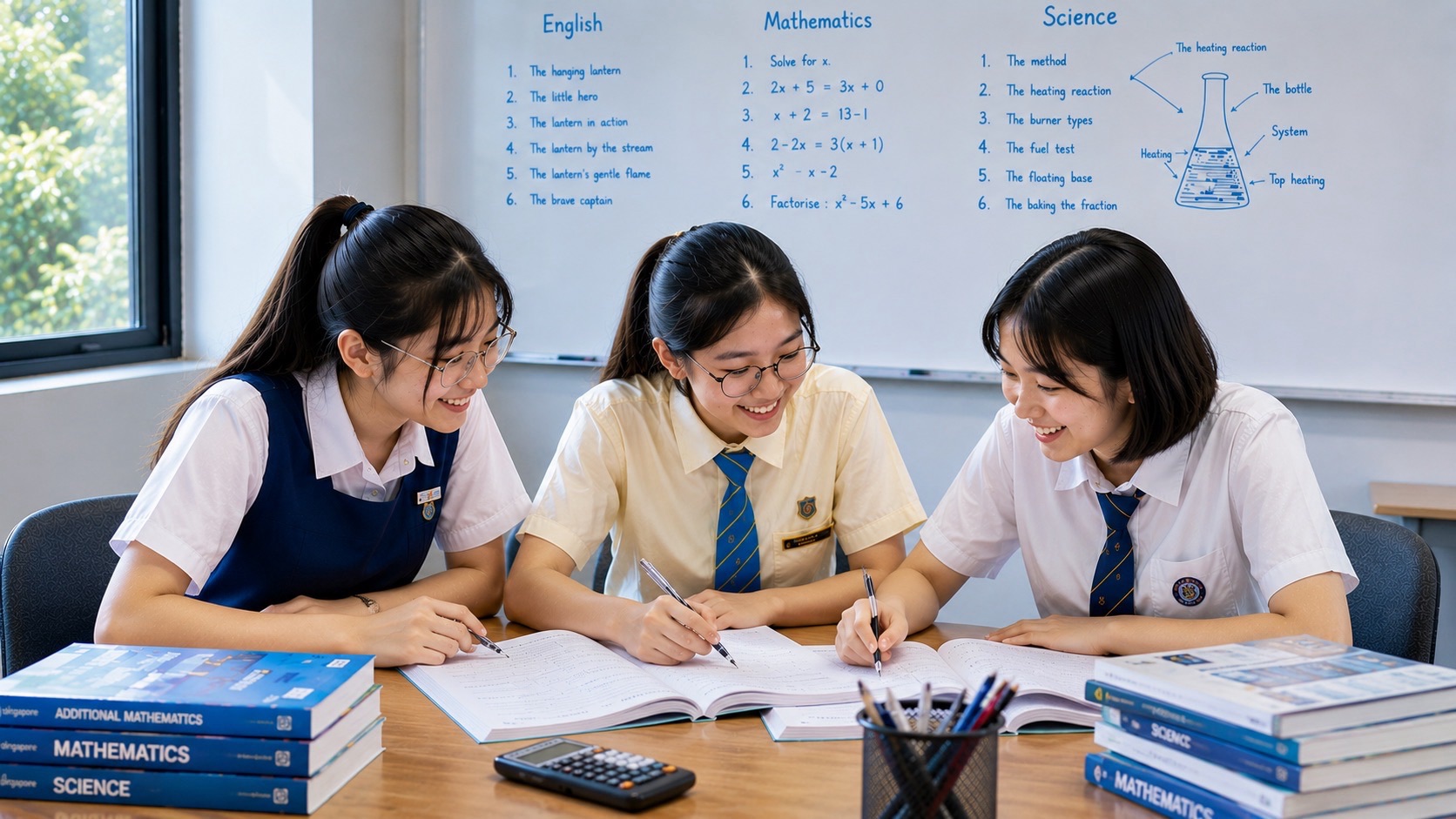
In a three-student class, one common question can reveal different needs.
| Student | Observed difficulty | Likely next move |
|---|---|---|
| A | Cannot factorise | Foundation repair |
| B | Factorises accurately but cannot connect form to graph | Abstraction/representation |
| C | Understands both but chooses a slow route | Strategy efficiency |
For Katong Families
Families searching from Katong should confirm the actual teaching location, lesson timing, subject level and current availability directly. eduKate’s location-targeted pages organise tuition information but do not imply a physical branch in every named neighbourhood.
The Goal Is the Right Depth of Repair
Strong tutoring neither blames every difficult question on weak foundations nor treats every foundation gap as an advanced-topic problem. It separates the layers, repairs what is actually unstable and returns the learner to the appropriate level of mathematical abstraction.
About eduKate
eduKate uses very small groups to distinguish prerequisite weakness from higher-level reasoning and retest each repair under changed conditions. Our core values are Integrity, Empathy, Critical Thinking and Responsibility.


