
Many Mathematics errors happen before calculation begins. The student reads the question, forms the wrong mental model, chooses an unsuitable representation and then performs accurate arithmetic on the wrong structure.
This page focuses on one tutoring job: Words → Diagram → Equation → Solution. The purpose is to help students choose a useful representation before committing to a method.
Representation Is Part of the Mathematics
A diagram, table, bar model, graph or equation is not just working space. It is a way of preserving the relationships in the problem. A useful representation reduces cognitive load and makes the next mathematical step easier to see.
| Problem form | Possible representation |
|---|---|
| Comparison of quantities | Bar model or equation |
| Rate and time | Table, diagram or equation |
| Geometry | Labelled sketch |
| Pattern | Table, algebraic rule or graph |
| Statistical relationship | Table or graph |
Step 1: Read for Quantities, Not Keywords
Students often search for trigger words such as “total”, “difference” or “more than”. Keywords can help, but they can also mislead when the same word appears in different mathematical structures.
- What quantities exist?
- What does each quantity represent?
- Which quantities are known?
- Which quantity is unknown?
- How are they related?
The relationship should determine the representation, not the vocabulary cue alone.
Step 2: Draw Only What Helps
A diagram should clarify the mathematics. Students do not need elaborate pictures; they need labelled relationships.
- mark equal parts clearly;
- label known and unknown values;
- show direction or sequence when relevant;
- separate given information from inferred information;
- keep units visible.
Step 3: Translate the Diagram Into an Equation
The equation should express the same relationship as the diagram. This is a useful self-check: if the equation does not match the visual model, one of them is wrong.
Students should be able to explain what each term represents rather than treating the equation as a string of symbols.
Step 4: Solve After the Structure Is Stable
Calculation becomes easier once the structure is correct. At this stage the tutor can focus on accuracy, algebraic fluency and efficient working.
- carry units consistently;
- keep transformations readable;
- estimate when possible;
- avoid unnecessary intermediate rounding;
- reverse-check or substitute when useful.
Step 5: Return to the Words
A numerical result is not automatically the answer. Students should return to the original question and ask whether the value answers the requested quantity with the correct unit and meaning.
When a Diagram Is Not the Best Choice
Representation should be flexible. A diagram that helps one student may slow another. A table may be better for a repeated pattern; an equation may be clearer for an algebraic relationship; a graph may make a trend visible immediately.
The tutor should teach students to ask which representation reduces the complexity of this particular problem.
Common Representation Errors
| Error | What to diagnose |
|---|---|
| Diagram not proportional when proportionality matters | Does the visual preserve the relationship? |
| Unknown labelled incorrectly | Did the student identify what must be found? |
| Equation uses all numbers but not the relationship | Is the student calculating by association? |
| Graph read from wrong scale | Were axes and units processed first? |
Three Students Can Compare Three Valid Representations
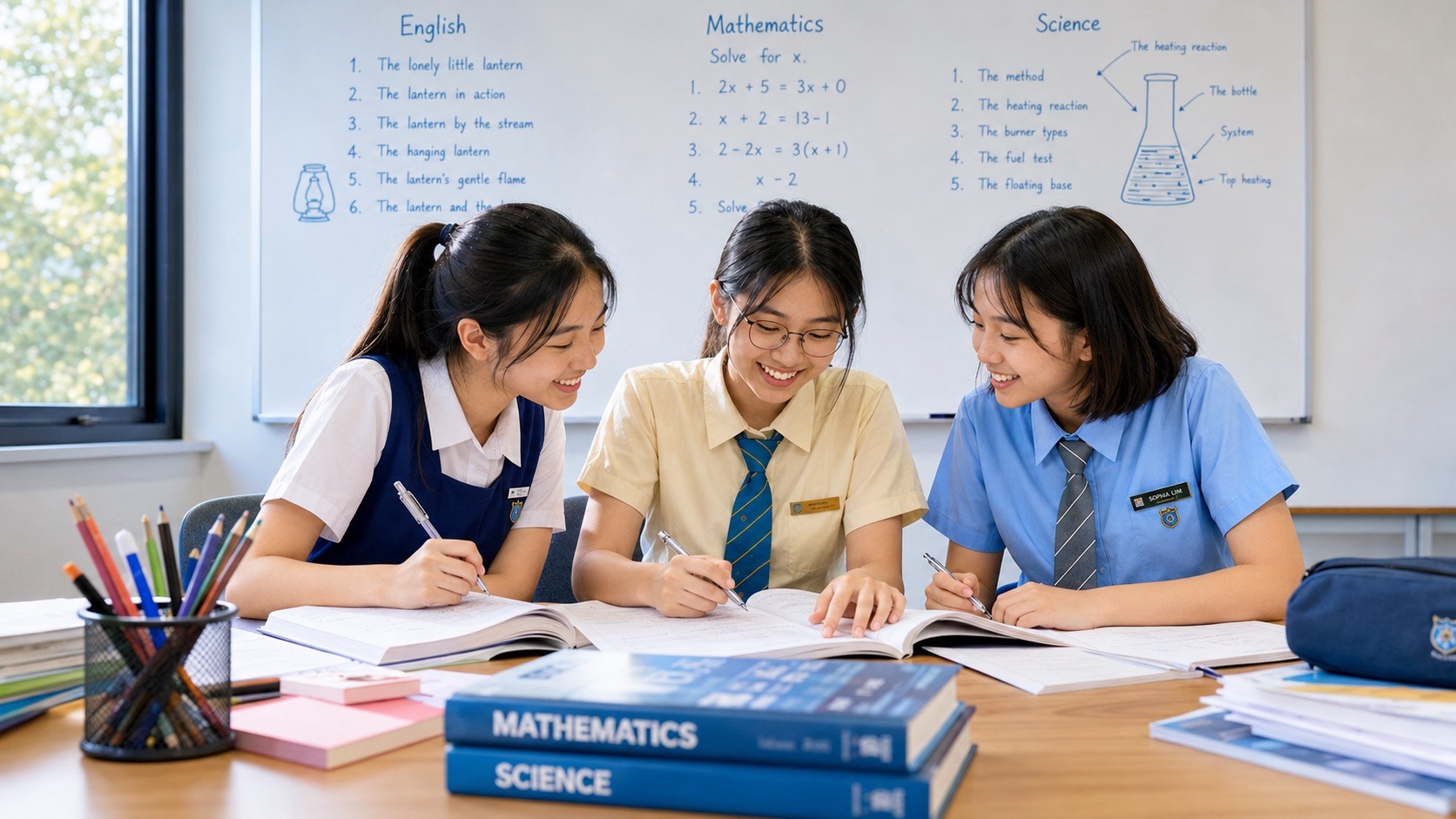
In a three-student tutorial, one learner may use a bar model, another an equation and another a table. The tutor can compare which representation is valid, efficient and easy to verify.
The goal is not to force one method. It is to make students conscious of representation choice.
What Parents Can Ask a Maths Tutor
- Can my child explain what the numbers represent?
- Does the tutor ask for a model before calculation when needed?
- Can the child move between words, diagrams and equations?
- Can they choose a different representation when the first one fails?
- Do they check the final answer against the original question?
For Katong Families
Families searching from Katong should confirm the actual teaching location, level, timing and current availability directly. eduKate’s location-targeted pages organise tuition information but do not imply a physical branch in every named neighbourhood.
The Goal Is Better Mathematical Translation
When students learn to translate words into a useful representation, represent the relationship accurately and only then calculate, Mathematics becomes easier to audit. The tutor can see whether the error came from meaning, representation, method or execution—and repair the correct layer.
About eduKate
eduKate uses very small groups to make mathematical representation and strategy choice visible before returning each learner to independent problem solving. Our core values are Integrity, Empathy, Critical Thinking and Responsibility.


