
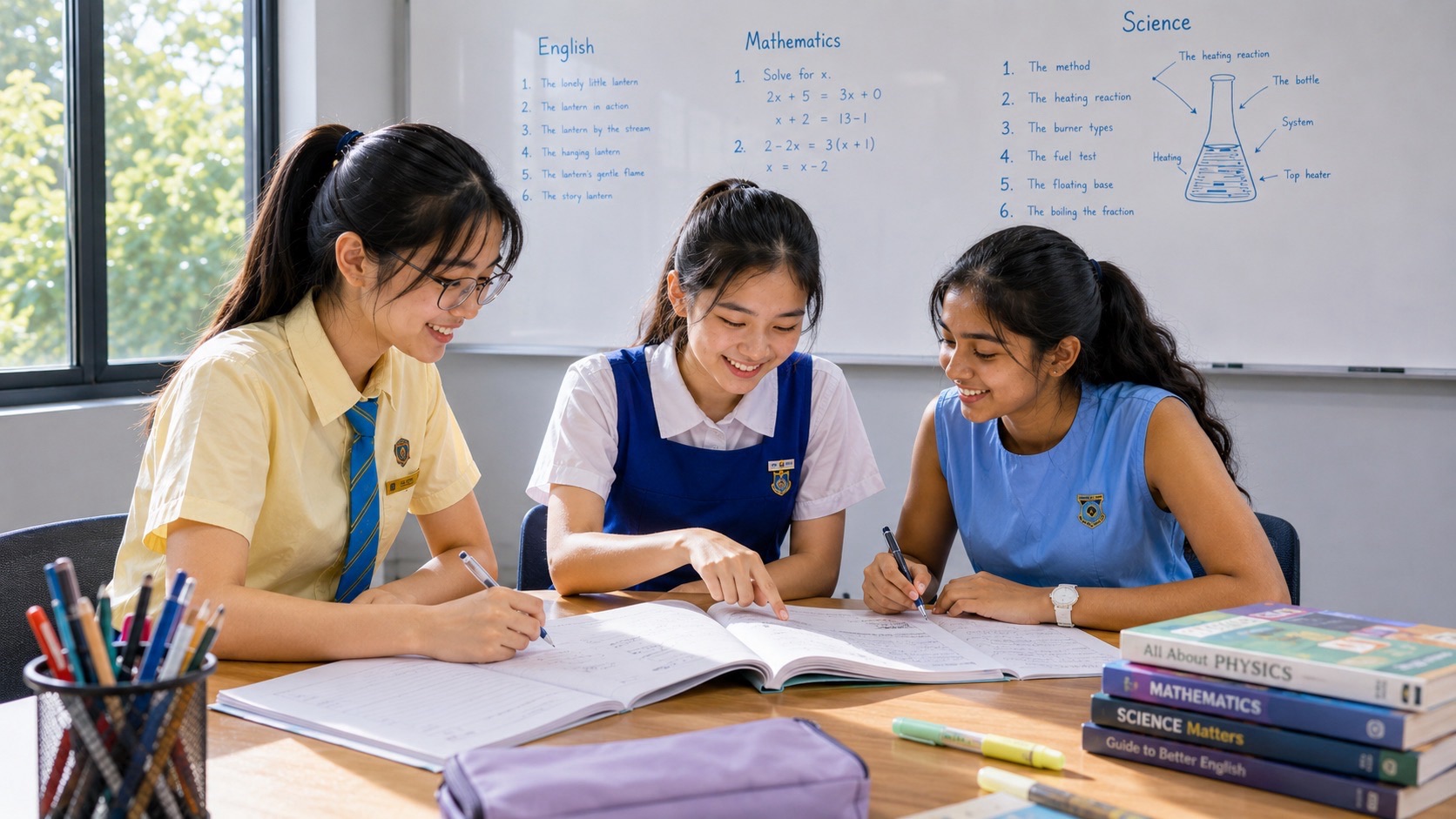
Quick Read: Singapore students have repeatedly performed extremely strongly in international assessments. In PISA 2022, Singapore scored significantly higher than every other participating education system in Mathematics, Reading and Science. In TIMSS 2023, Singapore ranked first in both Grade 4 and Grade 8 Mathematics and Science. But “Singapore has the smartest kids” is a headline, not a scientific conclusion. These assessments measure performance on specific tasks under specific sampling and testing conditions; they do not measure a single universal quantity called intelligence.
One-sentence answer: international assessments show that Singapore’s education system produces exceptionally strong average academic performance, but they cannot justify claiming that every Singapore child—or Singapore children as a group—are intrinsically “smarter” than children elsewhere.
Why this 2015 page needed a full evidence repair
On 5 October 2015, CNN published a feature with a headline describing Singapore as having the “smartest kids in the world”. eduKatePunggol responded enthusiastically and reproduced a large portion of the CNN article on this page.
The historical event is worth preserving. The copied article text is not. This page now keeps the 2015 media moment while replacing the reproduced material with original analysis, current evidence and direct links to the underlying assessment organisations.
The first problem: what does “smartest” mean?
“Smart” can refer to many different things:
- mathematical reasoning;
- reading comprehension;
- scientific reasoning;
- memory;
- creativity;
- spatial reasoning;
- practical problem solving;
- social judgement;
- learning speed;
- domain-specific expertise.
No single international school assessment measures all of these as one complete trait.
So before accepting a headline, ask: What exactly was measured?
What PISA measures
The OECD’s Programme for International Student Assessment (PISA) assesses 15-year-old students. It focuses on how well students can use knowledge and skills in Mathematics, Reading and Science to meet real-life challenges.
PISA is therefore not simply a test of whether students memorised their national textbook.
Singapore in PISA 2022
The latest fully reported PISA cycle available as of August 2026 is PISA 2022. The OECD reported that Singapore scored significantly higher, on average, than all other participating countries and economies in all three tested domains:
| Domain | Singapore mean score | OECD mean |
|---|---|---|
| Mathematics | 575 | 472 |
| Reading | 543 | 476 |
| Science | 561 | 485 |
That is a strong and meaningful result. It shows exceptionally high average performance on the PISA assessment.
But a mean score is not a description of every child
An education system can have a very high average while still containing a wide range of individual outcomes.
In PISA 2022, Singapore had many top performers, but not every student was a top performer. The OECD reported that 41% of Singapore students reached Level 5 or 6 in Mathematics. That is extraordinarily high compared with the OECD average of 9%, but it also means most Singapore students were not in those top two Mathematics proficiency levels.
National averages should never be turned into assumptions about an individual child.
What TIMSS measures
The Trends in International Mathematics and Science Study (TIMSS), run by the International Association for the Evaluation of Educational Achievement, assesses Mathematics and Science at Grade 4 and Grade 8.
TIMSS is more closely tied to school curriculum than PISA. That difference matters: two international assessments can both be high quality while asking different questions about educational performance.
Singapore in TIMSS 2023
Singapore ranked first in all four headline TIMSS 2023 comparisons reported by MOE:
| Level | Mathematics | Science |
|---|---|---|
| Grade 4 | 1st — mean 615 | 1st — mean 607 |
| Grade 8 | 1st — mean 605 | 1st — mean 606 |
This is consistent with Singapore’s long-running record of strong Mathematics and Science achievement.
PISA and TIMSS are not IQ rankings
Neither PISA nor TIMSS should be described as a national IQ table.
Performance reflects many interacting influences:
- curriculum;
- teacher preparation;
- instruction;
- school resources;
- student effort;
- home environment;
- language;
- assessment familiarity;
- social expectations;
- educational policy;
- selection and participation conditions.
The result describes performance of a sampled population on an assessment—not an immutable biological ranking of populations.
Measurement validity: does the test measure the claim?
This is the central reasoning test.
If the evidence is a Mathematics/Reading/Science assessment and the claim is “students performed extremely well academically”, the evidence fits reasonably well.
If the claim becomes “these children are the smartest humans”, the evidence no longer covers the full claim.
A measure can be excellent and still be misused.
Rankings compress uncertainty
A ranking gives a neat order: first, second, third.
Real measurement is less tidy. Scores have sampling uncertainty, and some differences between education systems may not be statistically significant.
This is why serious reports often include confidence intervals or notes showing when two systems cannot be distinguished reliably even if their point estimates differ.
League tables can hide that nuance.
Different tests can produce different rankings without contradiction
PISA and TIMSS use different ages, frameworks and task designs. A country can therefore rank differently across them.
That does not necessarily mean one test is wrong. It may mean they are measuring different parts of educational performance.
Before comparing rankings, ask:
- Who was tested?
- What was tested?
- How were students sampled?
- What year was the test?
- Was the test curriculum-based or application-focused?
- Are score differences statistically meaningful?
High performance can coexist with pressure
A system-level success story should not erase student experience.
High academic performance can coexist with:
- competition;
- fear of falling behind;
- unequal access to enrichment;
- heavy private-tuition spending;
- anxiety about high-stakes transitions;
- narrow definitions of success.
That does not invalidate the achievement data. It means educational quality should be evaluated using more than one receiver and more than one outcome.
Strong results do not prove rote learning
Singapore education is sometimes caricatured as producing scores through memorisation alone. That claim is also too simple.
PISA specifically includes application to unfamiliar and real-life contexts, while TIMSS includes cognitive domains beyond simple recall. Strong performance across multiple assessments is difficult to explain as memorisation only.
At the same time, no assessment proves that every classroom consistently achieves ideal creativity, inquiry or deep understanding.
Strong results do not prove that every educational practice is optimal
A common reasoning error is:
Singapore scores highly → therefore every feature of Singapore education caused the high score → therefore every feature should be copied.
That chain is not valid without causal evidence.
Systems contain many interacting features. Some may contribute strongly, some weakly, some may be compensating for others, and some may create costs that are invisible in the headline ranking.
What international comparisons are actually good for
- identifying broad strengths and weaknesses;
- tracking changes over time;
- comparing performance distributions, not only averages;
- studying teaching and curriculum differences;
- examining equity;
- testing whether policy assumptions fit international evidence;
- finding systems worth studying more closely.
The best use of a ranking is to generate better questions, not to end the investigation.
A better question than “Who has the smartest kids?”
Ask:
What conditions help large numbers of students develop strong, transferable academic capability—and what trade-offs appear alongside that success?
That question is harder, but it is educationally useful.
What Singapore’s results do justify saying
- Singapore is one of the world’s highest-performing education systems on major international academic assessments.
- Its performance is strong across Mathematics, Reading and Science, not only one domain.
- The pattern has persisted across multiple assessment cycles.
- A high proportion of students reach advanced proficiency levels in some domains.
- Singapore is therefore worth studying as an education system.
What the results do not justify saying
- every Singapore student is academically exceptional;
- Singapore students are biologically more intelligent;
- high scores measure every valuable human capability;
- one teaching method explains the national result;
- rank one means every difference from rank two is large or meaningful;
- the system has no costs, weaknesses or students who need more support.
For parents: do not turn national pride into pressure on one child
A child does not become a failure because they sit below Singapore’s national average.
International rankings describe populations. Parenting and teaching deal with individuals.
The useful question for one learner remains:
What can this child do now, what is the next worthwhile capability, and what evidence will show that it has improved?
For students: a ranking is not your identity
You are not “Singapore’s score”. You may be stronger or weaker than national averages in different areas, and those capabilities can change over time.
Use high national standards as information about what is possible, not as proof that you must already be there.
A five-question ranking check
- Measure: what exactly was tested?
- Population: who took the test?
- Comparison: are the scores genuinely distinguishable?
- Inference: does the evidence support the headline claim?
- Missing outcomes: what important abilities or costs are outside the test?
This small routine works for education rankings, university rankings, city rankings and many other league tables.
Historical 2015 CNN context
The original eduKate post was reacting to CNN’s 5 October 2015 feature, “Why Singapore has the smartest kids in the world”. Rather than storing a copy of the article here, readers should consult the publisher’s own page where available.
CNN — 5 October 2015 historical article
Current evidence sources
- OECD — PISA 2022 Singapore country note
- OECD — PISA 2022 international performance
- MOE — TIMSS 2023 Singapore rank positions and mean scores
- TIMSS & PIRLS International Study Center — TIMSS 2023 results
Historical images
The screenshots below are preserved as evidence of the 2015 media moment, not as a substitute for the CNN article itself.

Updated from eduKatePunggol’s October 2015 response to CNN. The historical media event and original educational question are preserved; the reproduced CNN article has been removed and replaced by original analysis using current PISA and TIMSS evidence, measurement boundaries and a more careful interpretation of what rankings can show.


