
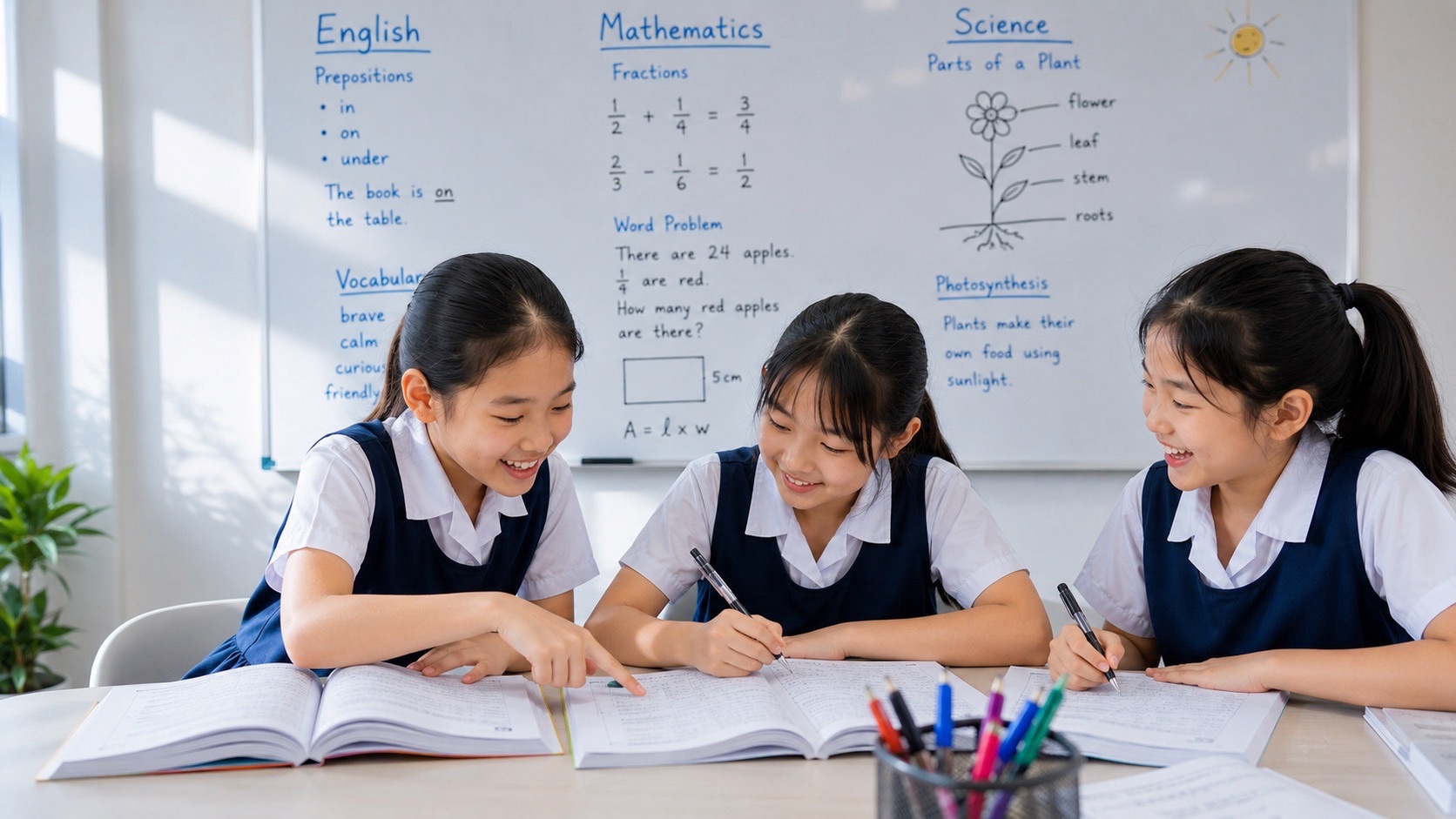
Occupation Vocabulary Helps Students Build More Believable Worlds
A job title is useful in composition because it opens a network of places, actions, tools, responsibilities and problems. A veterinarian suggests an animal clinic, examination table, worried owner, medical instruments and decisions about animal care. A curator suggests a museum, collections, records, displays and preservation.
For PSLE English: the occupation should make the scene more specific. It should not become a shortcut for personality. A doctor is not automatically kind; a banker is not automatically rich; a firefighter is not automatically fearless in every situation.
The Five-Part Job Model
- Setting: Where does this person work?
- Actions: What verbs naturally belong to the role?
- Tools: What objects or systems might appear?
- People: Who does this role interact with?
- Pressure: What ordinary or urgent problem could create a story?
Students who can answer these five questions can turn one vocabulary word into a plausible scene.
100+ Occupations Vocabulary Bank
The breadth of the original 2015 list is retained, with several current neutral labels added beside older forms students may still encounter in books.
- Accountant
- Flight attendant
- Announcer
- Apprentice
- Architect
- Artist
- Athlete
- Author
- Aviator
- Banker
- Barber
- Bell attendant / bellhop
- Botanist
- Captain
- Caretaker
- Carpenter
- Chaperone
- Chauffeur
- Chef
- Civil servant
- Clown
- Concierge
- Conductor
- Police officer / constable
- Coroner
- Correspondent
- Critic
- Curator
- Detective
- Dietitian
- Diplomat
- Director
- Dispatch rider
- Doctor
- Driver
- Editor
- Electrician
- Engineer
- Examiner
- Explorer
- Farmer
- Firefighter
- Fishmonger
- Florist
- Gardener
- Geologist
- Goldsmith
- Governor
- Grocer
- Hawker
- Historian
- Interior designer
- Interpreter
- Inventor
- Invigilator
- Jeweller
- Jockey
- Journalist
- Judge
- Lawyer
- Lecturer
- Librarian
- Lifeguard
- Linguist
- Magistrate
- Manager
- Mayor
- Mercenary
- Mimic / impressionist
- Model
- Navigator
- Nurse
- Pharmacist
- Photographer
- Physician
- Pilot
- Playwright
- Police officer
- Politician
- Postal worker
- Programmer
- Publisher
- Receptionist
- Referee
- Reporter
- Salesperson
- Waste collector
- Scientist
- Sculptor
- Dressmaker / seamster / seamstress
- Secretary / administrative assistant
- Sentry / security guard
- Shepherd
- Stevedore / dock worker
- Surgeon
- Surveyor
- Tailor
- Teacher
- Tour guide
- Translator
- Treasurer
- Umpire
- Ventriloquist
- Veterinarian
- Violinist
- Server / waiter / waitress
- Warden
- Zoologist
Group the Jobs by World
- Healthcare: doctor, nurse, surgeon, pharmacist, veterinarian, dietitian.
- Science and knowledge: scientist, botanist, zoologist, geologist, historian, linguist, librarian, curator.
- Law and public service: judge, lawyer, magistrate, police officer, civil servant, mayor, diplomat.
- Built environment: architect, engineer, carpenter, electrician, surveyor, interior designer.
- Arts and media: author, artist, playwright, photographer, journalist, editor, publisher, critic, violinist.
- Transport: pilot, driver, chauffeur, flight attendant, navigator, dispatch rider.
- Food and retail: chef, hawker, grocer, fishmonger, florist, salesperson.
- Sport and performance: athlete, jockey, referee, umpire, clown, ventriloquist, model.
Grouping by world makes the vocabulary easier to retrieve and connects each noun to useful background knowledge.
Occupation → Verb: A Better Route to Strong Writing
Students often want more adjectives, but job knowledge can improve verbs instead:
- Curator: catalogue, preserve, display, interpret.
- Journalist: interview, verify, investigate, report, edit.
- Carpenter: measure, saw, sand, join, repair.
- Veterinarian: examine, diagnose, treat, monitor.
- Librarian: catalogue, recommend, organise, retrieve.
- Photographer: frame, focus, capture, adjust, document.
Precise verbs make action visible and reduce the need for excessive description.
Occupation Is Not Personality
A common composition shortcut is to make every nurse caring, every police officer strict and every scientist absent-minded. Those are stereotypes, not characters. Decide the personality separately, then let the occupation create constraints and opportunities.
A cautious firefighter, an impatient veterinarian, a shy journalist or a humorous judge can all be believable if the story gives sufficient evidence.
Turn One Occupation into a Story Problem
Lifeguard
World: pool, whistle, rescue equipment, slippery deck, children, parents. Pressure: the lifeguard notices one child missing from a group. The story now has observation, uncertainty, responsibility and a time-sensitive decision.
Librarian
World: shelves, catalogue, returns, quiet rooms, readers. Pressure: a student desperately needs a source that appears to be missing. The problem can become a story about persistence, responsibility or misunderstanding.
Photographer
World: camera, lens, light, timing, subject, memory card. Pressure: the photographer captures something unexpected and must decide what to do with the image.
Current Versus Older Job Terms
Students should understand older forms such as fireman, policeman, postman, stewardess and salesman because they may appear in older books. In current general writing, neutral forms such as firefighter, police officer, postal worker, flight attendant and salesperson are usually more natural.
The Punggol English Tuition Diagnostic
If a child knows job names but cannot write a convincing scene, inspect world knowledge and verbs. If the child creates a detailed setting but the story does not move, inspect causality. If character traits are stereotypes, inspect evidence and alternatives. The vocabulary list should reveal the next learning need, not hide it.
Three-Student Practice
Give each student the same occupation and ask them to create a different plausible problem. Then compare which details genuinely belong to the role and which were invented without support. This builds world knowledge and creative flexibility at the same time.
Retrieval Practice
- Retrieve five healthcare jobs without looking.
- Retrieve five occupations connected to public service.
- Given a verb such as preserve, name two jobs that might use it.
- Given a setting such as a museum, retrieve relevant occupations.
- Choose one job and write three role-specific objects.
- Return a week later and repeat with mixed categories.
PSLE Writing Transfer
Do not force an unusual job into a story to make it look sophisticated. Use an occupation only when it helps the topic. The best vocabulary choice is the one that reduces explanation, increases plausibility and supports the event.
Current English Learning Direction
Current Primary English teaching develops vocabulary through meaningful contexts and integrated reading, speaking and writing. Occupation vocabulary becomes valuable when students connect the word to a usable model of the world and transfer that knowledge into unfamiliar tasks.
For the local English route, see Choosing English Tuition in Punggol.
This page began as a 2015 occupation checklist. It now preserves the 100+ word bank while teaching the deeper sequence: occupation → world → action → pressure → character decision → story.
Punggol Tuition Approach: Turning World Knowledge into Creative Writing Control
The occupation bank on this page is valuable because every job opens a small world. But knowing that curator, surveyor or veterinarian exists is not the same as being able to use that knowledge in a PSLE composition. The teaching job is to convert labels into plausible settings, actions, constraints and decisions—then decide whether those details actually serve the story.
For Punggol small-group tuition, this page therefore owns a specific creative-writing problem: world knowledge → scene construction → character decision → causal story. It does not own general vocabulary learning; that belongs to the Essential Vocabulary route.
What We Diagnose from a Composition
- Does the child name a profession but give it no role in the story?
- Are workplace details plausible?
- Do actions use role-specific verbs or generic verbs such as went, did, made and looked?
- Is personality being inferred from a stereotype rather than shown through behaviour?
- Does technical detail improve the scene or slow it down?
- Can the child distinguish known facts from imagined but plausible details?
- Does the occupation create a meaningful problem, responsibility or viewpoint?
The answer tells us whether the learner needs world knowledge, verb precision, narrative causality, characterisation or simply better selection. The occupation list itself may not be the weak layer.
Repair, Stabilise, Extend
Repair: build accurate role packets
We begin with familiar jobs. The student maps setting, people, tools, actions and one ordinary responsibility. The aim is not to memorise technical facts. It is to build enough reliable background knowledge that the story can move without constant invention.
Stabilise: connect the job to plot
The occupation now has to affect what happens. A lifeguard must notice something relevant; a journalist may need to verify information; a librarian may have access to records or a missing source. The student learns that background detail earns its place when it changes decisions, constraints or consequences.
Extend: use occupation to control viewpoint
A strong learner can represent the same event through different professional eyes. A photographer notices framing and evidence; a paramedic notices risk and condition; a reporter notices sources and verification. This deepens perspective without requiring a complicated plot.
What Happens in a 90-Minute 3-Pax Creative-Writing Lesson
- World retrieval: recall a small set of occupations and their domains.
- Role packet: build setting, verbs, tools, people and constraints.
- Reality check: separate what is known from what is only assumed.
- Problem generation: each of three students creates a different plausible pressure event.
- Character decision: decide how personality, not profession, shapes the response.
- Scene drafting: write a compact passage where job knowledge appears through action.
- Deletion test: remove technical details that do not change reader understanding.
- Transfer: reuse the world-modelling method with a different occupation or setting.
The 3-pax format lets the same role produce three different stories. Students see that reality supplies constraints, while creativity supplies routes through those constraints.
Why “Research More” Is Not Always the Answer
Research can improve world knowledge, but too much detail can overload a Primary writer. The relevant question is what the receiver needs to believe the scene. A veterinarian does not need a paragraph of medical terminology if the story only requires the reader to understand that an injured animal is being examined carefully.
Effective teaching therefore manages resolution. Add enough detail to make the world credible; suppress details that do not serve the event.
Occupation, Character and Stereotype: Keep the Layers Separate
Profession gives likely knowledge and constraints. Character gives motives, values and habitual behaviour. The same doctor can be patient, hurried, arrogant, compassionate or uncertain. The same student can meet a strict but fair teacher or a warm but disorganised one. Separating these layers creates better stories and better reasoning.
How Scaffolding Fades
At first, the tutor may provide the five-part role packet. Later, students build it from the job title. Then the occupation itself is not supplied: the learner reads the composition topic, decides whether a profession is useful and selects one independently. Finally, the same world-modelling skill is used for places, hobbies, emergencies and institutions, showing that the learner has generalised beyond the original occupation list.
Observable Progress Signals
- settings become more specific without becoming overloaded;
- role-specific verbs replace generic action words;
- occupations influence plot rather than decorate it;
- stereotypes reduce;
- the learner distinguishes evidence from assumption;
- technical details are selected more economically;
- characters make more believable decisions; and
- world-modelling transfers to unfamiliar settings beyond jobs.
When Occupation Vocabulary Is Not the Earliest Weak Link
If a child has convincing settings but the story has no clear cause and effect, work on narrative structure. If good ideas cannot be expressed cleanly, sentence control takes priority. If the child cannot generate any plausible details, broader reading and world knowledge may matter more than another composition worksheet. The local teaching route changes with the evidence.
Who This Punggol Route Fits
- students whose stories feel generic because settings and actions lack specificity;
- students who rely heavily on stereotypes;
- students who know many nouns but use few precise verbs;
- students who need help turning background knowledge into causal story events; and
- students who benefit from comparing several plausible story routes in a small group.
A child already writing richly detailed, believable worlds may need a different extension such as narrative compression, viewpoint or examination pacing.
What Parents Can Bring
- one recent composition;
- teacher comments on content, vocabulary or elaboration;
- a sample completed without model-essay copying;
- a topic where the child said “I don’t know what to write”; and
- a list of reading interests or real-world topics the child already knows well.
This helps distinguish a language problem from a world-knowledge problem and lets teaching use what the learner already knows.
Additional Parent Questions
Does my child need to memorise every occupation?
No. The list is an index. Students should build stronger models around useful clusters and learn how to infer unfamiliar roles from context.
Should we research before every composition?
No. Research is useful during learning, but examination transfer requires the student to work with existing knowledge. Regular reading and discussion build the background store before the exam.
Will unusual jobs make a story more impressive?
Only if they genuinely improve the story. A familiar role used precisely is better than an exotic occupation used inaccurately.
What Progress Looks Like
The learner can use a word such as curator or lifeguard as an entry point into a coherent world, choose the amount of detail the reader needs, separate role from personality, and build a plausible decision under pressure. More importantly, the learner can apply the same process to unfamiliar worlds that were never on this list.
Continue the Punggol English Route
- Essential Vocabulary System
- Character Traits Vocabulary
- Choosing English Tuition in Punggol
- Primary and Secondary Tuition in Punggol
Using this guide: the 100+ occupation bank remains intact, while this local extension adds the practical teaching and parent-review guidance: diagnosis, pathway selection, 3-pax lesson mechanics, scaffold fading, progress evidence, fit and parent review.
Punggol Learning in Practice: Three Writer Cases, a Four-Week World Cycle and Exam Selection
The local value of occupation vocabulary is easiest to see through different writer states. Three students can know the same job words and still need different teaching because one lacks world knowledge, another has detail without causality, and another overcomplicates a story with research.
Writer Case A: “I Don’t Know What to Write”
This learner receives a topic and cannot generate a plausible event. We use a familiar occupation as a structured prompt: setting, task, tool, people, responsibility and one pressure. A librarian can face a missing book, a lifeguard a safety concern, a photographer an unexpected image. The role gives the student constraints from which story possibilities can emerge.
The aim is not to make every composition about jobs. It is to teach a general world-building procedure the learner can later apply to places, hobbies, institutions and everyday situations.
Writer Case B: Rich Detail, No Story
This learner knows many facts and enjoys adding them, but the paragraph becomes an information dump. We ask which detail changes the character’s decision, the reader’s understanding or the causal sequence. Everything else is a candidate for suppression. The student learns that knowledge is a reservoir; writing uses only the amount required by the receiver.
Writer Case C: The Stereotype Shortcut
This learner makes every nurse caring, every police officer stern and every scientist eccentric. We split role from trait. The occupation gives likely knowledge and responsibilities; character comes from repeated choices. Three students can write the same profession with three different personalities, then compare which behaviours make each version believable.
A Four-Week 3-Pax World-Building Cycle
Week 1 — Accurate worlds: build role packets for familiar occupations and verify obvious misconceptions. Week 2 — Action language: upgrade generic verbs and connect tools to plausible tasks. Week 3 — Pressure and viewpoint: give the same event to three roles and compare what each notices. Week 4 — Mixed composition transfer: remove the occupation cue; students decide whether role knowledge helps an unfamiliar PSLE topic and build only the necessary detail.
Three Students, Three Perspectives
Suppose the scene is a sudden power failure in a public building. A security officer may prioritise access and crowd movement. An electrician may notice circuits, equipment and safety. A journalist may notice sequence, sources and public explanation. The comparison teaches that viewpoint is partly a function of what a person knows and is trying to achieve.
Students then write one short paragraph each and compare. Which details reveal the role without an explanatory paragraph? Which facts are unnecessary? Which actions create the strongest story pressure? This keeps the group collaborative while preserving distinct thinking.
Exam Topic Selection Under Time
During PSLE Continuous Writing, students should favour story routes they can execute reliably. If a profession is unfamiliar enough that the child must invent technical details, choose another route. A familiar world with clear causality is usually stronger than an unusual world full of uncertain facts.
- Identify the topic and the required relevance.
- Choose the central event before choosing decorative background.
- Ask whether a profession helps create a believable role, problem or viewpoint.
- Use only details the student can control confidently.
- Keep the story moving from decision to consequence.
- Delete technical detail that does not alter reader understanding.
Four-to-Eight-Week Progress Dashboard
- World signal: settings become more plausible and specific.
- Verb signal: role-specific actions replace generic verbs.
- Causality signal: background details increasingly affect decisions and consequences.
- Character signal: stereotypes reduce and personality is shown through behaviour.
- Resolution signal: the learner can suppress unnecessary technical detail.
- Transfer signal: world-building methods appear in non-occupation topics.
- Exam signal: the student selects executable story routes faster under time pressure.
Parent Decision Matrix
- Child has few ideas: build world packets and problem-generation routines.
- Child writes generic scenes: strengthen concrete nouns and role-specific verbs.
- Child researches too much: practise resolution control and deletion.
- Child has detail but no plot: foreground pressure, decision and consequence.
- Child uses stereotypes: separate role from trait.
- Child writes well on familiar topics only: increase transfer to new worlds.
Expanded Punggol FAQ
Should students research Singapore occupations specifically?
Local examples can make settings more concrete, but the learning goal is broader. Students should understand common roles well enough to build plausible worlds and recognise when unfamiliar facts need verification.
Can a composition use a profession the child has never encountered personally?
Yes, if the learner has enough reliable knowledge to represent it plausibly. Reading and research can widen the world store during learning. In examinations, choose routes that remain controllable without external lookup.
How do we know when world knowledge is sufficient?
When the student can generate plausible settings, actions and constraints without filling the paragraph with uncertain technical claims, the model is usually rich enough for a Primary-level story.
What Independent Learners Can Do
The learner can turn a role into a believable world, choose the amount of detail a reader needs, create pressure and decision, and then generalise the same method beyond occupations. The vocabulary bank becomes a gateway to world-modelling rather than a list to memorise.
Using these sections: work through the three local writer cases, a four-week world-building cycle, multi-perspective 3-pax practice, exam-route selection, a four-to-eight-week dashboard, parent routing and expanded FAQs alongside the complete 100+ occupation bank for reference and further practice.


