
Primary vs Secondary Tuition in Punggol: What Changes as Students Grow
The student who needs close structure in Primary 1 should not be taught in exactly the same way at Secondary 4. Good tuition changes as knowledge, abstraction, workload and learner responsibility increase.
Quick answer: Primary tuition builds foundations, routines, vocabulary, representations and confidence; Secondary tuition increasingly demands abstraction, integration across topics, independent revision, transfer and examination control.

The Main Difference: Responsibility Moves Toward the Student
Young learners need more adult structure. The tutor may need to model how to read an instruction, organise a page, show working, check an answer and persist through an unfamiliar task. As students grow, those actions should increasingly become the student’s responsibility.
This transfer is one of the most important signs of educational progress. A Secondary student may still need explanation and correction, but the goal is no longer simply to complete the immediate worksheet. The student must learn to manage a larger knowledge system across several subjects and longer time horizons.
Primary Tuition: Build the Learning Base
Primary 1–2: Learn How School Learning Works
At the beginning of Primary school, subject learning and learning routines develop together. Students are learning English and Mathematics, but they are also learning how to follow multi-step instructions, hold attention, organise working, ask useful questions and recover after making an error.
Tuition should therefore avoid becoming a race through advanced content. Strong foundations include accurate reading, number sense, sentence control, method, neat representations and confidence in attempting before asking for rescue.
Primary 3–4: Connect Concepts Across More Complex Tasks
Science enters the formal subject mix and questions demand more integration. Students need to connect vocabulary to concepts, diagrams to explanations, and methods to new contexts. Earlier weaknesses in reading or number sense can now affect several subjects at once.
Primary 5–6: Build PSLE Reliability
Upper Primary is not merely “more difficult Primary 4”. Students need stronger retrieval, transfer, timing and response control. Tuition should distinguish a concept problem from a performance problem: does the student not know the material, or do they know it but fail to deploy it reliably in a paper?
Secondary Tuition: Increase Abstraction and Independence
Secondary 1–2: Rebuild the Learning System
Secondary school changes pacing, subject depth and organisational load. Mathematics becomes more symbolic, English texts and writing become more abstract, and students must manage more teachers, assignments and assessment demands. A student who was successful in Primary school can still struggle if their learning routines do not scale.
Good tuition at this stage should help students understand the new subject grammar while rebuilding planning, note use, checking and independent revision.
Secondary 3–4: Integrate, Transfer and Execute
Upper-secondary students face cumulative content and higher examination stakes. They may also take Additional Mathematics, which introduces a further layer of abstraction. The tutor’s role increasingly becomes strategic: identify the weak link, connect topics, increase transfer, improve paper execution and help the learner take ownership of revision.
| Dimension | Primary emphasis | Secondary emphasis |
|---|---|---|
| Instruction | More modelling and explicit routines | More explanation of abstraction and relationships |
| Practice | Build accuracy and foundational fluency | Mix topics, vary forms and increase transfer |
| Feedback | Immediate and concrete | Increasingly strategic and self-corrective |
| Organisation | Adult-supported | Student-managed across subjects |
| Examination work | Introduce timing and checking | Integrate timing, selection, checking and recovery |
| End goal | Strong learning foundations | Independent subject management and reliable execution |
English Changes Across the Two Stages
Primary English builds vocabulary, sentence control, reading, comprehension, writing and oral confidence. By Secondary school, those foundations must support more complex interpretation, argument, audience awareness, evidence selection and independent judgement.
A Secondary student cannot rely only on memorised phrases. They must increasingly control language as a tool for thinking.
Mathematics Changes Across the Two Stages
Primary Mathematics relies heavily on number relationships, visualisation, problem representation and accurate multi-step reasoning. Secondary Mathematics increases symbolic manipulation, functions, algebraic relationships and abstraction. Students who memorise procedures without understanding structure often feel the transition sharply.
Tuition should therefore keep asking what the symbols represent and why the method is valid, not only whether the student can reproduce a worked example.
Science Changes Across the Two Stages
Primary Science builds scientific concepts, observation, inference, prediction, explanation and application. The important habit is to connect evidence to causal reasoning. Secondary Science later separates into more specialised disciplinary structures. A student who learned to memorise keywords without understanding relationships can struggle when explanations become more precise and quantitative.
Why the Same 3-Student Format Can Serve Different Ages
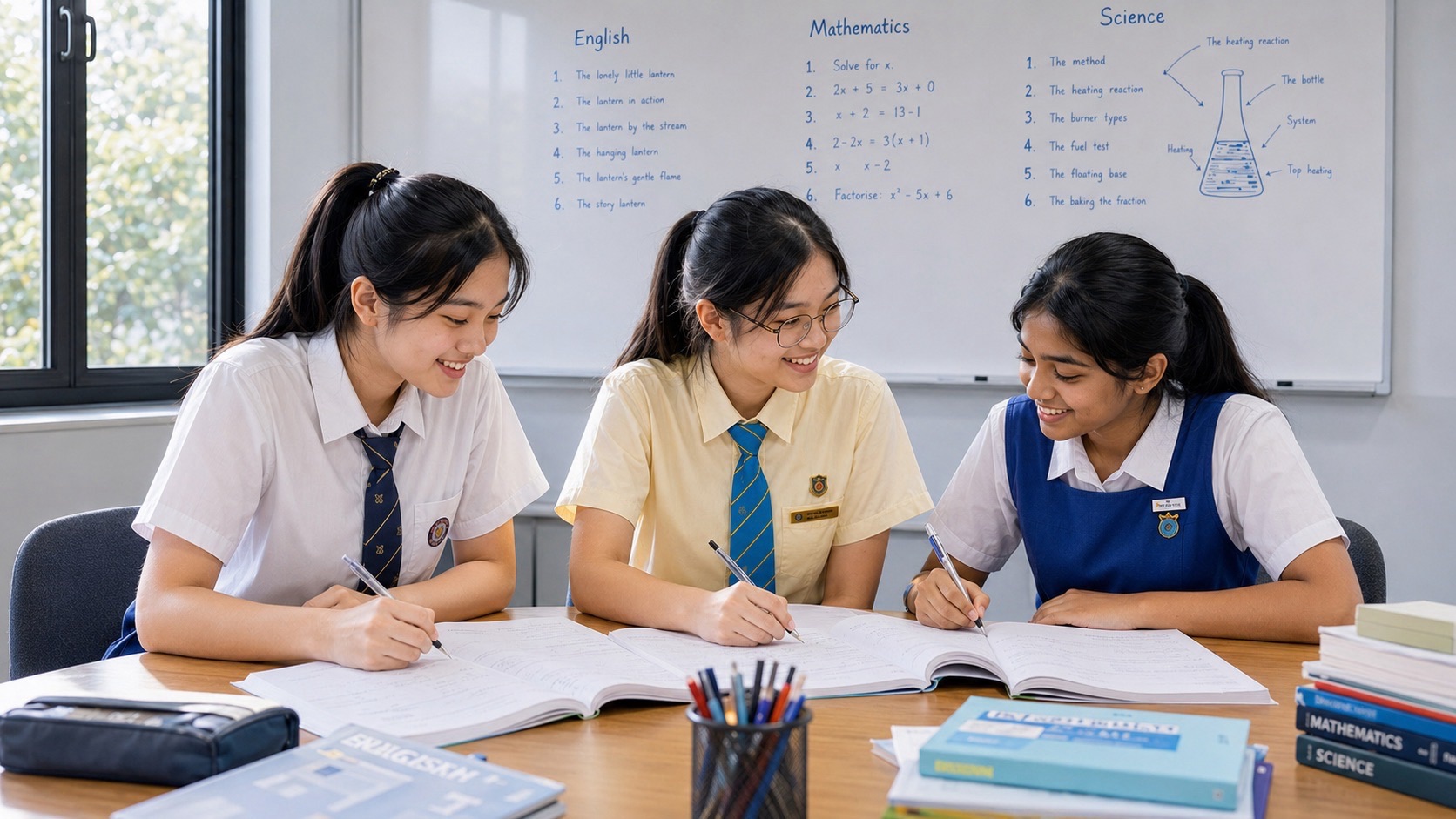
eduKate Punggol uses a maximum of three students in both Primary and Secondary classes, but the instructional use of the group changes. Younger students may need more frequent tutor prompts and shorter task cycles. Older students should spend more time explaining decisions, working independently, comparing methods and managing longer sequences without intervention.
The class size is therefore only the container. The teaching resolution inside it must change with the learner.
What Parents Should Watch During a Transition
- Is the child still relying on an adult to begin every task?
- Can the student explain why a method works?
- Can knowledge transfer to a changed question?
- Is workload increasing faster than organisation?
- Are marks falling because the content is harder, or because checking and time management have not scaled?
- Does the student know how to revise without being told exactly what to do?
Current eduKate Punggol Class Model
Current lessons are 1.5 hours with a maximum of three students. Primary 1–6 English and Mathematics are offered, with Science from Primary 3–6. Secondary 1–4 English and Mathematics are offered, with Additional Mathematics from Secondary 3–4. Class materials are provided and between-lesson WhatsApp support is available for clarification.
Ask about the right stage and subject
Privacy: this page explains the visible teaching and developmental logic for parents. Private student data and confidential learning records remain private.





