
Quick Read: Primary students do not simply need “more practice”. They need the right learning work for their developmental stage: secure foundations, retrieval, connection-making, guided application, increasing independence and, eventually, calm examination execution. A useful teaching system changes as the child moves from Primary 1–2 to Primary 3–4 and then into the Primary 5–6 PSLE runway.
One-sentence answer: Good Primary teaching gradually transfers responsibility from the adult to the child while keeping knowledge, confidence and self-correction strong enough for the next school stage.
Why this 2013 article is still worth keeping
This article began in November 2013 as a year-end reflection on what eduKate had observed in Primary classes. The original piece mixed useful teaching observations with 2013 operational plans, individual class-result anecdotes and broad claims about children and technology. Those parts have dated. The central question has not: what changes as a Primary student grows, and how should teaching change with the child?
The updated article keeps the learning value of the original observations while removing claims that should not be generalised from one cohort. It also reflects a different Singapore school environment. P1 and P2 no longer have weighted assessments and examinations; MOE continues to emphasise holistic development and 21st Century Competencies; and in 2026 the Ministry announced further strengthening of AI literacy across the curriculum, co-curriculum and self-directed learning resources.
The practical lesson is important: technology, assessment and school structures change. The deeper work of learning—attention, understanding, memory, reasoning, communication, practice, feedback and independence—still has to happen inside the child.
Primary school is not one six-year learning stage
Parents often say “Primary school” as though Primary 1 and Primary 6 were neighbouring versions of the same learner. They are not. Across six years, the child changes academically, socially and cognitively. The school workload changes. The meaning of independence changes. The role of the parent and tutor should change too.
The goal is not to keep a child permanently dependent on good teaching. The goal is to use good teaching to make the child increasingly capable of learning without us.
A public learning cycle for Primary students
The 2013 article described five classroom actions: learning, repeating, memorising, categorising and evaluating. The language can now be sharpened into a more useful sequence for parents and students:
- Understand: receive a new idea accurately enough to explain what it means.
- Retrieve: bring the idea back from memory without simply copying the example.
- Connect: relate the idea to prior knowledge, examples, categories and contrasts.
- Apply: use it in a question, explanation, piece of writing or unfamiliar situation.
- Review: inspect the result, identify what failed, correct it and decide what to practise next.
This sequence is deliberately simple. It can describe an English vocabulary lesson, a Mathematics concept, a Science process or even a new study habit. It also gives adults a better way to ask why practice is not working. If a student cannot retrieve the concept, more difficult application questions may be premature. If retrieval is strong but transfer is weak, repeating the same familiar worksheet may add volume without adding capability.
Primary 1–2: establish the learning relationship
Lower Primary students are learning subjects, but they are also learning what school itself feels like. They are building routines for listening, reading instructions, beginning work, asking for help, waiting, checking, correcting and completing tasks. These behaviours become the invisible infrastructure underneath later academic performance.
At this stage, adults should be careful not to confuse speed with mastery. A child who is slow because the skill is new may need guided repetition, not pressure. A child who finishes quickly may still need to explain the method, check accuracy or show that the skill survives in a different form.
What English needs
Early literacy depends on a growing relationship between listening, speaking, reading, viewing, writing, grammar and vocabulary. MOE’s Primary English Language Syllabus explicitly treats receptive and productive language skills as connected. Children should therefore not experience English only as spelling lists and worksheets. They need to hear language, read it, discuss it, use it and receive feedback on what their choices communicate.
What Mathematics needs
Early Mathematics should build secure number sense and a habit of representing thinking. The correct answer matters, but so does whether the child understands quantity, operation and relationship. When foundations are weak, later methods can become memorised procedures detached from meaning.
What the adult should transfer first
The first transfer of responsibility is small: let the child attempt before rescuing, ask the child to explain, teach the child to check one thing independently, and make asking a question feel normal rather than embarrassing.
Primary 3–4: the bridge from basic competence to connected learning
Primary 3 and 4 are important because the child has enough school experience for learning patterns to become visible. Work becomes more layered. Science enters the formal subject mix. Reading demands grow. Mathematics problem-solving becomes more complex. Students are expected to hold more instructions and move between different representations of the same idea.
This is also a useful age for adults to stop relying on fixed labels such as “talkative learner”, “quiet learner”, “visual learner” or “careless child”. The 2013 article grouped students according to classroom personalities because the classes responded differently. The stronger 2026 interpretation is more cautious: adapt teaching to observable learning behaviour and task demands, not to a permanent personality category.
A student may learn well through discussion in one topic and need quiet worked practice in another. The same child may be confident in Science and hesitant in Mathematics. Good teaching remains responsive without pretending that one preferred mode explains the whole learner.
Why questions matter at this stage
One durable observation from the original article is the importance of asking. Students improve when they can reveal confusion early. A child who is afraid to ask may carry a small misunderstanding until it becomes a large performance gap. Class culture therefore matters: correction should feel like part of learning rather than public evidence that the child is “bad” at a subject.
In a small group, students can also learn from one another’s questions. The tutor gains information from what is asked, what is not asked, how the student explains a method and where the explanation becomes uncertain.
Primary 5: the PSLE runway begins before Primary 6
Primary 5 often feels like a jump because earlier foundations are now expected to carry heavier work. The child is not yet in the final examination year, but Primary 5 exposes whether knowledge from earlier years can support more complex tasks. That makes it a valuable repair window.
The useful response is not to manufacture fear. “You are going to fail PSLE if you do not wake up” may create urgency, but urgency and learning are not the same thing. A better approach is to make the change visible: show the child what has become harder, identify the earlier capability it depends on, and build a realistic practice cycle.
Three Primary 5 questions
- Foundation: what knowledge from P1–4 is still unstable?
- Transfer: can the child use familiar knowledge in unfamiliar questions?
- Self-management: can the child begin, persist, check and recover from an error with less adult prompting?
Primary 5 is also where study habits begin to matter more because the volume of content makes repeated relearning expensive. Retrieval and spaced review help because they ask the child to bring knowledge back rather than merely re-read it.
Primary 6: convert learning into controlled execution
Primary 6 should not be one uninterrupted sprint through examination papers. Past-year and examination-style papers are useful when the child has enough underlying knowledge to make the paper informative. Used too early, a full paper can produce a long list of wrong answers without explaining what should be repaired first.
A stronger sequence is topic and skill repair → mixed practice → timed sections → full-paper rehearsal → error analysis → targeted return. The point of a mock paper is not simply to generate a score. It is to reveal whether the student’s knowledge survives mixing, time pressure, fatigue and the need to decide what method applies without a tutor standing beside the desk.
By this stage, adults should increasingly move from controlling every study action to helping the child plan and evaluate. The student should know what a weak area is, what is being done about it, and how to recognise improvement.
Memory: why repeating is not the same as learning
The 2013 article worried that students were not memorising enough. The more useful distinction is between repetition and retrieval. Re-reading an answer can create familiarity; retrieving the answer from memory tests whether the knowledge can actually be produced.
For a Primary student, retrieval can be simple: close the book and explain the concept, reconstruct the steps of a Mathematics method, write three vocabulary words from yesterday in new sentences, or draw a Science process from memory and then compare it with the source. The comparison supplies feedback; the attempt supplies the learning signal.
Problem solving: teach representation before speed
The original article proposed heuristics and timed Mathematics practice. Both can be useful, but sequence matters. A heuristic should help the child represent the problem and see relationships; it should not become another word to memorise. Timing should test a sufficiently stable method; it should not be used to make an uncertain learner rush.
When a child is stuck, useful questions include: What is known? What is unknown? What changes? What stays constant? Can the situation be drawn, tabulated or broken into parts? Which earlier problem does this resemble, and what is different this time?
These questions build a transferable problem-solving habit because they help the student construct a representation before selecting a procedure.
Science: move from keywords to causal explanation
Videos, demonstrations and digital resources can make processes visible. They are especially useful when an event is too small, too fast, too slow, too dangerous or impractical to reproduce in a tuition room. But seeing is not the same as understanding.
After a Science demonstration, the student should still have to explain: what changed, what caused the change, what evidence supports the explanation, which concept applies, and how the answer would change if a variable changed. This converts an engaging resource into reasoning practice.
English: knowledge expands what a student can understand and express
Another durable idea from the 2013 article is that English becomes more useful when students have something meaningful to communicate. Vocabulary and grammar are necessary, but language also carries knowledge, observation, perspective and judgement.
Reading widely across stories, science, history, current issues and everyday life gives students more conceptual material to connect with new texts. The boundary is important: general knowledge should enrich interpretation, not override evidence. In comprehension, students must still answer the passage that is in front of them.
Technology: use the tool only when it improves the learning function
The original 2013 article was enthusiastic about tablets, phones, digital books, video and internet access. The central lesson survives, but the technology has changed dramatically. In 2026, MOE is explicitly strengthening students’ AI literacy and has announced developmental milestones across curriculum, co-curriculum and self-directed learning, together with updated cyber-wellness attention to validating generative-AI information and identifying deepfakes.
The educational test for any technology should therefore be stricter than “students enjoy it”. Ask what function the tool serves:
- Does it make a difficult concept visible?
- Does it give the child a useful form of practice?
- Does it improve access to information or examples?
- Does it help the student create, test or revise an explanation?
- Does it provide feedback that the learner can understand?
- Does the student remain able to perform the core skill without the tool?
- Can the student check whether information supplied by the tool is trustworthy?
A tool that removes all productive struggle can weaken learning even when the finished output looks impressive. Technology should extend capability, not conceal its absence.
Confidence: the child needs evidence of growing control
Confidence is often treated as a feeling that adults should talk into existence. Encouragement matters, but durable academic confidence also grows from evidence: “I used to need help with this and now I can start it myself”; “I can explain why my answer works”; “I made an error and knew how to repair it.”
This is why suitable challenge matters. Work that is permanently too easy gives little evidence of growth. Work that is chronically overwhelming gives repeated evidence of failure. Good teaching adjusts the distance so effort can produce visible progress.
Small groups: why interaction can support independence
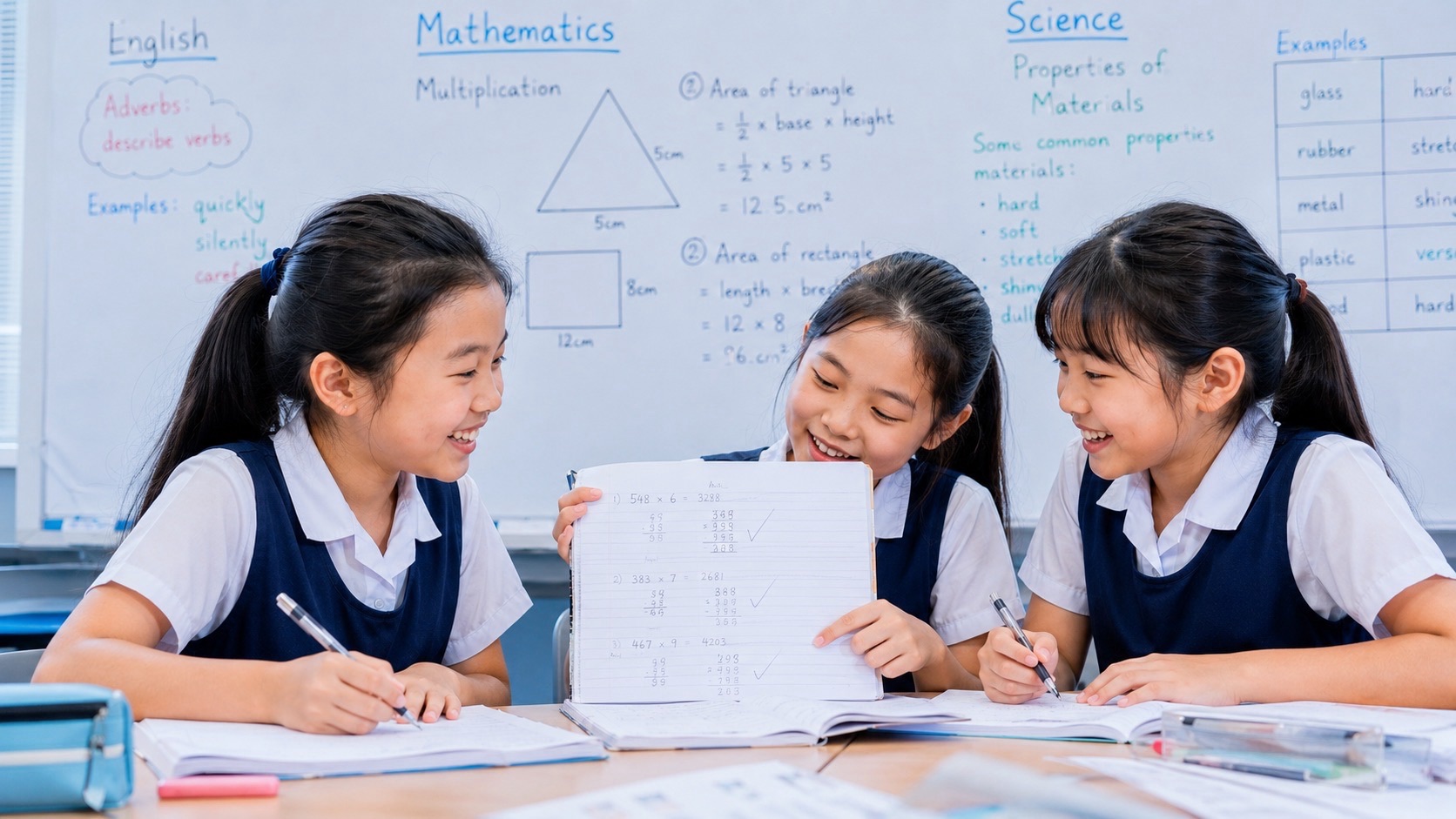
eduKatePunggol uses small groups of up to three students. A group can be useful when it does more than share a timetable. Students can hear another question, compare methods, explain an idea, notice a different interpretation and learn that confusion is discussable.
The tutor still has to preserve individual visibility. One child may need foundation repair while another needs transfer. The group is valuable when shared instruction and individual evidence can coexist.
How to measure progress without waiting for the next major exam
- Retrieval: can the child remember yesterday’s or last week’s learning without reopening the example?
- Accuracy: are recurring mistakes decreasing?
- Explanation: can the child say why a method or answer is valid?
- Transfer: can the skill survive a new question format?
- Initiation: does the child start with less prompting?
- Monitoring: does the child notice more errors independently?
- Stamina: can quality be maintained over a longer task?
- Recovery: after getting stuck, can the child try another productive move instead of stopping completely?
These do not replace school assessment. They reveal whether the machinery beneath the score is becoming more dependable.
Common teaching mistakes to avoid
- More worksheets before locating the problem: volume increases while the same error remains.
- Fixed learner labels: the child is treated as one “type” instead of being observed across different tasks.
- Premature speed training: fast work is demanded before the method is stable.
- Technology as decoration: a device is present but the learning function is unchanged or weakened.
- Correction without return: a mistake is explained once but never retrieved later.
- Adult over-functioning: parents or tutors plan, prompt and check so much that the child never acquires those functions.
- Exam panic too early: Primary 5 and 6 become dominated by threat rather than structured preparation.
A parent decision guide by stage
Primary 1–2
Protect the relationship with learning. Build foundations and routine. Look for persistent difficulties rather than reacting to every small mistake. Let the child attempt and explain.
Primary 3–4
Watch for growing gaps as subjects become more complex. Strengthen retrieval, problem representation and the habit of asking questions. This is a useful time to repair before the PSLE runway.
Primary 5
Identify which earlier foundations are failing under the new load. Build a repeatable weekly learning cycle and increase the child’s ownership of planning and correction.
Primary 6
Convert knowledge into examination reliability. Mix practice, add timing progressively, analyse papers for causes rather than just marks, and protect sleep and confidence as examination pressure rises.
Frequently asked questions
Should Primary children memorise?
Some information must become retrievable from memory, but memorisation should be connected to meaning and use. Retrieval is stronger when the child can explain, apply and recognise the knowledge in a new context.
Should tuition teach ahead of school?
Sometimes previewing helps, but “ahead” is not automatically “better”. If earlier foundations are unstable, acceleration can hide gaps. The useful route may be catch up, keep up or move ahead depending on the subject and child.
Is more homework always better before PSLE?
No. Practice needs a job. A smaller set that exposes a specific weakness, receives correction and is revisited later can be more useful than a large volume completed without analysis.
How should AI be used by Primary students?
As a learning tool under suitable guidance, not as a replacement for thinking. Students increasingly need to know how to question generated information, validate claims and preserve their own ability to read, calculate, explain, create and decide.
Where to go next at eduKatePunggol
- The Primary Pathway — the current P1–P6 developmental route.
- Start Here at eduKatePunggol — for parents deciding which stage, subject or pressure point comes first.
- English Tuition — Primary English routes.
- Mathematics Tuition — Primary Mathematics routes.
- Science Tuition — Primary Science routes.
- How Studying Works — a wider explanation of learning and study behaviour.
Official references
- Ministry of Education, Singapore — English Language Syllabus 2020, Primary.
- Ministry of Education, Singapore — 21st Century Competencies.
- Ministry of Education, Singapore — Education Conversations: holistic development, assessment and learning.
- Ministry of Education, Singapore — Committee of Supply 2026 announcements, including AI literacy in education.
This article preserves a 2013 eduKatePunggol teaching reflection as a current, reader-safe knowledge resource. The original cohort-specific results and fixed assumptions are not presented as general evidence.


