
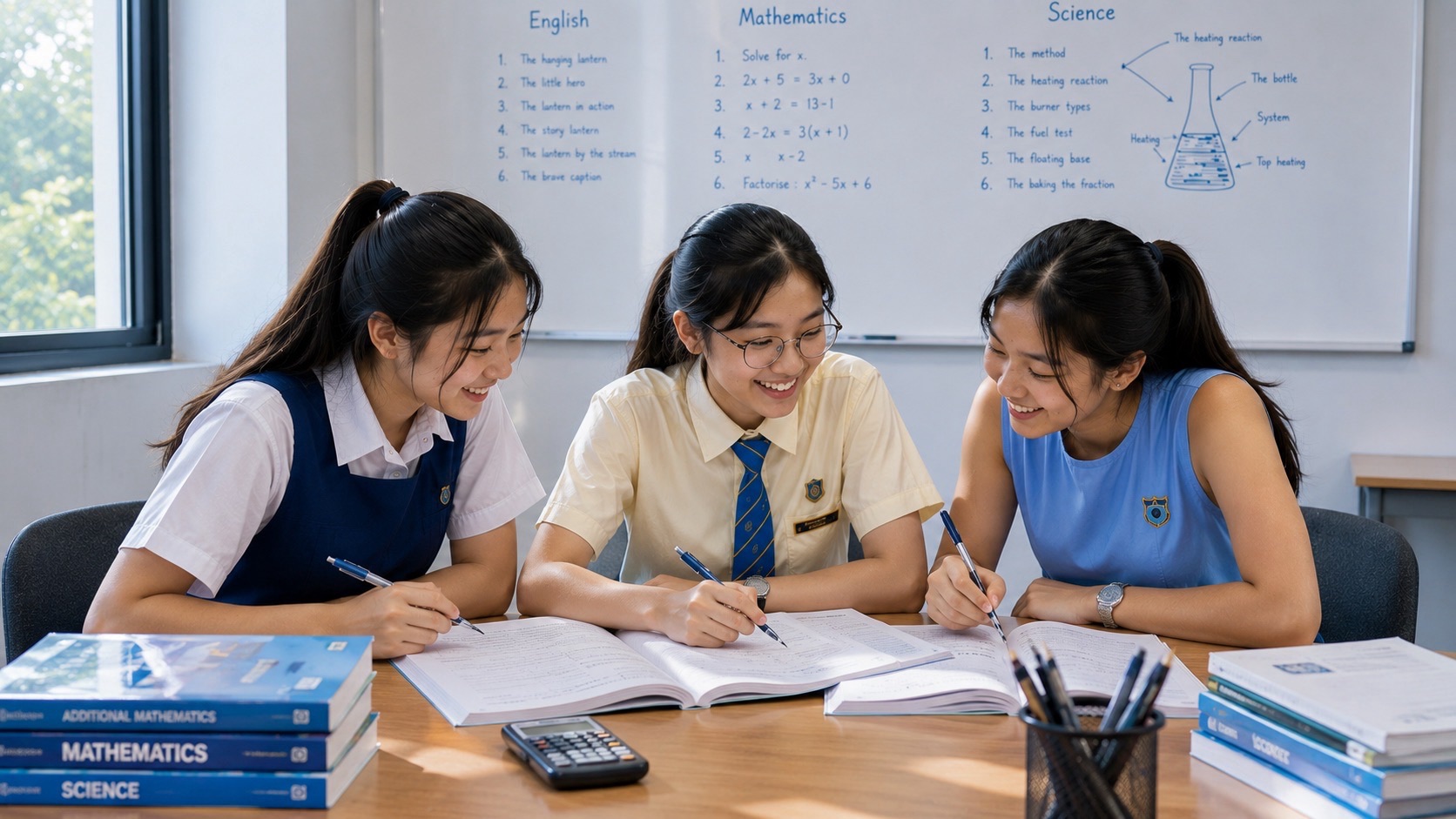
Quick Read: UNESCO’s four pillars of learning—learning to know, learning to do, learning to be, and learning to live together—describe education as more than acquiring examinable knowledge. A strong education develops understanding, usable competence, independent judgement and the ability to participate constructively with other people. The four pillars work best as a connected system, not as four separate school subjects.
One-sentence answer: Education is stronger when a student can understand the world, act competently within it, become increasingly responsible for personal judgement, and work with other human beings without losing either individuality or mutual respect.
Where the four pillars come from
The four pillars are associated with UNESCO’s 1996 report Learning: The Treasure Within, produced by the International Commission on Education for the Twenty-first Century chaired by Jacques Delors. UNESCO describes the report as presenting an integrated, lifelong view of education organised around four forms of learning: learning to know, learning to do, learning to be and learning to live together.
The 2013 version of this eduKatePunggol article reproduced a long extract from UNESCO and mixed the framework with announcements about premises and equipment. This update gives the source its proper historical place, paraphrases rather than reproduces the report at length, and focuses this URL on one durable reader job: understanding the four pillars and translating them into observable learning today.
This also keeps the article distinct from eduKatePunggol’s current approach-to-learning page. That page explains eduKatePunggol’s current tuition approach. This article is an educational-framework explainer with a reader-safe crosswalk into school, tuition, family life and lifelong learning.
The four pillars are not four boxes
A common mistake is to treat the pillars as a checklist: one lesson for knowing, one activity for doing, one character programme for being and one group project for living together. UNESCO’s idea is more integrated. The same learning event can involve all four.
Consider a Secondary student investigating whether a public claim is reliable. The student needs knowledge of the topic and methods for checking sources. The student must actually perform the verification. The student must exercise judgement rather than outsource responsibility. If the investigation is collaborative, the student must listen, disagree productively and account for other people’s evidence. One task can therefore move through all four pillars.
The pillars are best understood as four dimensions of a capable human learner: understanding, action, personhood and relationship.
Pillar 1 — Learning to know
Learning to know is not simply collecting more facts. In the Delors framework it includes developing the instruments of understanding and learning how to learn. A student needs enough general knowledge to orient within the world, while also developing the ability to study some subjects in depth.
For school students, this means knowledge and learning strategy must grow together. A child who knows facts but cannot organise, retrieve or extend them becomes dependent on constant reteaching. A child who has generic “study skills” but little domain knowledge has nothing substantial to reason with.
What learning to know looks like
- building accurate foundational knowledge;
- asking questions when a concept is unclear;
- reading, listening and viewing for meaning rather than only for answers;
- distinguishing a claim from the evidence offered for it;
- connecting new knowledge to prior knowledge;
- retrieving important information after a delay;
- knowing when current understanding is insufficient;
- finding and evaluating further information responsibly.
In English, learning to know includes vocabulary, grammar, text forms and knowledge about how communication works. In Mathematics, it includes concepts, relationships, notation and why methods work. In Science, it includes concepts, models, processes, evidence and the limits of explanations.
Pillar 2 — Learning to do
Knowledge becomes educationally powerful when it can guide action. UNESCO’s discussion of learning to do extends beyond preparation for one fixed occupational task. It includes competence: the ability to deal with situations, apply knowledge and work with others.
For a school student, the simplest test is transfer. Can the child use what was taught when the surface of the problem changes?
What learning to do looks like
- writing an original response rather than copying a model;
- choosing a Mathematics method without being told which chapter the question came from;
- designing or interpreting a Science investigation;
- using information to make a decision;
- revising work after feedback;
- explaining a method to another person;
- working within constraints such as time, evidence or audience;
- using tools without becoming unable to perform the underlying skill.
This pillar is where worksheets can either help or fail. Practice helps when it builds usable capability. Practice fails when the student becomes good only at recognising the exact format that has already been shown.
Pillar 3 — Learning to be
Learning to be places the learner’s developing personhood inside education. UNESCO links it to the fuller development of personality and increasing autonomy, judgement and personal responsibility. Education therefore should not produce only a more efficient answer-generator; it should enlarge the person’s capacity to think, choose and take responsibility for action.
For children, autonomy develops gradually. A Primary 1 student should not be expected to manage learning like an adult. But responsibility can be transferred in small steps: attempt before asking for rescue, keep track of materials, explain an error, choose what to revise first, acknowledge uncertainty, and eventually plan work with less external control.
What learning to be looks like
- being able to say “I do not know yet” without giving up;
- forming a judgement and explaining the reasons for it;
- checking one’s own work before blaming the question;
- recovering after an error;
- distinguishing confidence from certainty;
- using tools and advice while retaining personal responsibility;
- recognising strengths without turning them into entitlement;
- recognising weaknesses without turning them into identity.
This is closely related to academic independence. The end point of tutoring is not a student who can perform only when a good tutor is present. The end point is a student whose internal capacity has grown enough that the tutor is needed less.
Pillar 4 — Learning to live together
Learning to live together concerns understanding other people, appreciating interdependence, cooperating on shared work and learning to manage conflict in ways consistent with mutual respect and peace. This is not an optional social extra around “real” academic learning. Much of adult life is collaborative, and even individual intellectual work depends on languages, institutions and knowledge built by other people.
A classroom or tuition group is a small environment in which this pillar can become concrete. Students can learn to listen to another explanation, disagree with an idea without attacking the person, share reasoning, ask for clarification, contribute when another student is stuck and recognise that a different method may still be valid.
What learning to live together looks like
- listening long enough to understand another person’s position;
- separating disagreement about evidence from hostility towards a person;
- sharing work fairly in a group;
- giving feedback that another learner can use;
- changing one’s mind when stronger evidence appears;
- recognising how one’s actions affect a group;
- cooperating without becoming intellectually passive;
- protecting both respect and independent thought.
Why the pillars need each other
The four pillars become most useful when we examine what happens if one grows while another remains weak.
| Imbalance | What it can look like | What is missing |
|---|---|---|
| Know without do | The student can explain a method but cannot use it independently. | Application and transfer |
| Do without know | The student reproduces a procedure but cannot explain when or why it works. | Understanding |
| Know/do without be | The student is capable but avoids responsibility, judgement or self-correction. | Agency and responsibility |
| Be without live together | Independence becomes disregard for other people or shared obligations. | Relationship and interdependence |
| Live together without be | The student follows the group even when evidence suggests the group is wrong. | Independent judgement |
A mature learner therefore needs both independence and interdependence. Education should help the person become capable of standing alone when necessary and cooperating intelligently when the task is shared.
A careful crosswalk to Singapore’s 21st Century Competencies
Singapore’s MOE uses its own Framework for 21st Century Competencies and Student Outcomes. The framework places core values at the centre, surrounded by social-emotional competencies and emerging competencies including critical, adaptive and inventive thinking; communication, collaboration and information skills; and civic, global and cross-cultural literacy. The desired outcomes include becoming a confident person, self-directed learner, active contributor and concerned citizen.
The following is an eduKatePunggol interpretive crosswalk, not an official MOE equivalence:
- Learning to know connects naturally with information skills, critical thinking and becoming a self-directed learner.
- Learning to do connects with application, adaptive thinking, collaboration and active contribution.
- Learning to be connects with self-awareness, self-management, responsible decision-making and confidence grounded in judgement.
- Learning to live together connects with social awareness, relationship management, collaboration and civic/global/cross-cultural literacy.
The value of the comparison is not that the frameworks are identical. It is that both resist the idea that education can be reduced to marks alone.
What the four pillars mean in an AI-transformed learning environment
The 2013 article discussed Facebook, Twitter, tablets and the rapidly changing digital world. By 2026, the technological question has shifted again. Generative AI can produce explanations, images, summaries, essays and code in seconds. MOE has announced that AI literacy will be strengthened throughout students’ education journey, including defined developmental milestones, self-directed resources and cyber-wellness attention to validating AI-generated information and identifying deepfakes.
The four pillars become unusually useful here because they prevent “AI literacy” from collapsing into tool operation.
Learning to know with AI
The student needs enough knowledge to recognise when an answer is implausible, enough information literacy to verify claims, and enough curiosity to ask what evidence is missing.
Learning to do with AI
The student can use tools to explore, draft, compare or test—but should still be able to demonstrate the underlying human capability required by the learning task.
Learning to be with AI
The student retains authorship, judgement and responsibility. “The AI said so” is not a sufficient reason for a claim, and polished output should not be confused with personal understanding.
Learning to live together with AI
Students need to consider how synthetic media, automated decisions and AI-assisted communication affect other people: trust, fairness, attribution, privacy, collaboration and the shared information environment.
A powerful tool increases the importance of judgement; it does not remove the need for it.
How the four pillars appear in English, Mathematics and Science
English
Know: vocabulary, grammar, text structures, knowledge about communication. Do: read, infer, write, speak and adapt language for purpose. Be: form a reasoned voice and take responsibility for claims. Live together: listen, represent others fairly, communicate disagreement and understand perspective.
Mathematics
Know: concepts, notation, relationships and methods. Do: solve, model, represent, estimate and verify. Be: persist through uncertainty, inspect errors and justify reasoning. Live together: communicate mathematical thinking, compare methods and work constructively on shared problems.
Science
Know: concepts, models, processes and evidence. Do: observe, investigate, analyse and explain. Be: remain willing to revise an explanation when evidence changes. Live together: conduct shared inquiry responsibly and understand how scientific decisions affect communities and environments.
A developmental reading from Primary to Secondary
The pillars do not suddenly begin in adulthood. Their form changes as responsibility transfers.
- Early Primary: adults model curiosity, routines, turn-taking, asking and basic self-management.
- Middle Primary: students explain more, retrieve more independently, collaborate on clearer roles and learn to correct work.
- Upper Primary: students plan practice, deal with more demanding transfer and begin carrying greater responsibility through the PSLE runway.
- Lower Secondary: perspective, argument, subject choice, identity and peer relationships become more complex.
- Upper Secondary: students must integrate knowledge and execution under higher load while preparing for examinations and later pathways.
The educational direction is gradual transfer: adults begin as strong external organisers; the student increasingly becomes the organiser of personal learning.
How a tutor can teach all four pillars without turning tuition into a philosophy seminar
The pillars become useful only when they change ordinary teaching decisions. They do not require four posters on the wall.
- Ask students to explain why a method works, not only produce the answer.
- Change the question enough to test whether knowledge transfers.
- Give time for an independent attempt before supplying the next step.
- Ask students to compare two valid methods or interpretations.
- Make evidence visible when discussing claims.
- Let students correct and improve work instead of treating the first attempt as final.
- Use group discussion to expose reasoning without allowing stronger voices to do all the thinking.
- Return responsibility gradually: planning, checking, choosing and reflecting should increasingly belong to the learner.
How parents can use the framework
The four pillars offer a way to ask better questions than “How many marks did you get?” Marks remain important information, but parents can also ask:
- Know: What did you understand this week that you did not understand before?
- Do: Where did you use that knowledge without being shown the exact same example?
- Be: What did you do when you became stuck or discovered you were wrong?
- Live together: What did you learn from another person, and what did you contribute back?
These questions make learning visible without requiring parents to become technical subject tutors every night.
How to observe progress in each pillar
| Pillar | Observable progress |
|---|---|
| Learning to know | The student explains concepts more accurately, retrieves knowledge later and asks better questions. |
| Learning to do | The student applies knowledge to less familiar tasks with less prompting. |
| Learning to be | The student initiates, checks, revises and owns decisions more independently. |
| Learning to live together | The student listens, collaborates, gives usable feedback and handles disagreement with greater maturity. |
None of these observations should be treated as a permanent rating of a child. They are evidence from a particular period and context. Development is uneven, and a student may show strong independence in one subject while needing substantial support in another.
Common misunderstandings of the four pillars
- “Learning to know means memorising facts.” Facts matter, but the pillar also includes understanding and learning how to learn.
- “Learning to do means vocational training only.” The idea is broader: competence, application, dealing with situations and working with others.
- “Learning to be means self-esteem.” It includes autonomy, judgement, responsibility and development of the whole person.
- “Learning to live together means being agreeable.” Constructive disagreement, conflict management and respect for difference are part of living together.
- “The four pillars replace academic achievement.” No. Strong knowledge is part of the framework. The point is that education cannot end there.
- “Every lesson must visibly contain all four.” No. The pillars describe an educational whole; individual tasks may emphasise different dimensions.
The lifelong-learning implication
The Delors framework places the pillars within education throughout life. That is increasingly relevant in a world where technologies, occupations and information environments change faster than a school curriculum can permanently prepare a person for every future task.
A student therefore needs more than a stock of answers for the next examination. The deeper asset is the ability to continue learning: acquire new knowledge, act with it, preserve personal judgement, and participate with other people. Those capabilities remain useful when the subject, workplace, technology or life stage changes.
Where to go next at eduKatePunggol
- Education at eduKatePunggol — the wider current education route.
- Our Approach to Learning — how the current tuition system translates educational principles into teaching.
- How Studying Works — a practical study and learning explanation.
- The Primary Pathway — P1–P6 developmental navigation.
- The Secondary Pathway — Secondary 1–4 developmental navigation.
- Start Here at eduKatePunggol — the parent starting route when the immediate need is unclear.
Official references
- UNESCO — Futures of Education: the UNESCO tradition and the Delors Commission.
- UNESCO — Futures of Education: Learning: The Treasure Within and the four pillars.
- UNESCO-UNEVOC — Learning: The Treasure Within, publication record.
- Ministry of Education, Singapore — 21st Century Competencies.
- Ministry of Education, Singapore — Committee of Supply 2026 announcements, including AI literacy.
Historical note: this URL was first published in 2013. Its original interest in UNESCO’s four pillars has been retained; obsolete operational announcements and extended reproduced source text have been replaced with current attribution, analysis and reader-facing application.
Return to Wider Learning and Education
The current Education owner is already linked elsewhere on this page. Use the missing route below to return to the complete eduKatePunggol registry.


