
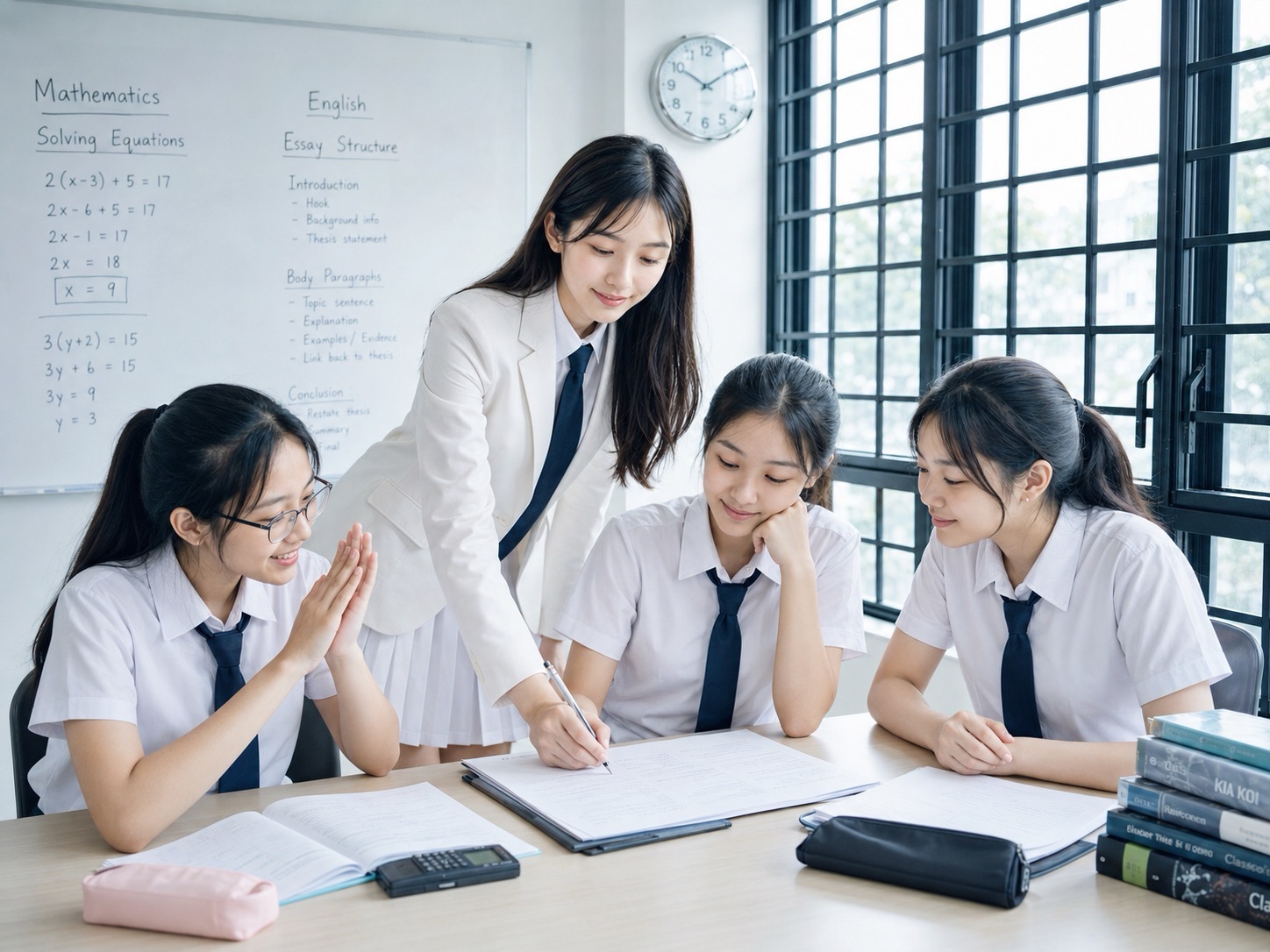
Secondary 2 Mathematics Tuition | eduKatePunggol
Secondary 1 announces itself as a transition.
New school.
New teachers.
New classmates.
New algebra.
Everybody expects adjustment.
Secondary 2 is quieter.
That is what makes it dangerous.
The student no longer feels new.
Algebra looks familiar.
Graphs have been seen before.
Geometry is not a surprise.
The learner can therefore appear settled while the mathematical structure underneath remains fragmented.
One chapter works.
Another chapter works.
Put them together and the student hesitates.
This is the real job of Secondary 2.
Secondary 2 is the year Mathematics should stop behaving like separate chapters and begin behaving like a connected network.
That is why Secondary 2 tuition should not simply repeat the Secondary 1 transition lesson or rush toward Secondary 3 content.
Its intellectual job is consolidation.
Not consolidation as “do the same worksheets again”.
Consolidation as connection.
Secure the foundations.
Link the ideas.
Strengthen retrieval.
Remove chapter labels.
Ask the student to recognise what Mathematics is present.
Then prepare for the greater integration of Secondary 3.
For the wider pathway, see Secondary Mathematics Tuition Punggol.
Quick Read: What Secondary 2 Mathematics Tuition Should Do
- Check whether Secondary 1 algebra and number foundations are genuinely retrievable.
- Connect algebra, graphs, geometry, ratio, percentage, rate and data reasoning instead of teaching them as isolated islands.
- Train the student to recognise mathematical structure without a chapter heading giving away the method.
- Use mixed and varied questions to develop selection and transfer.
- Match teaching to the student’s actual G1, G2 or G3 Mathematics level.
- Reduce recurring execution errors before upper-secondary load increases.
- Prepare for Secondary 3 by improving connected reasoning, not by indiscriminately racing ahead.
Secondary 2 is often the best year to repair quietly.
There is still time.
The final-year clock is not yet dominant.
That makes it a valuable year for building structure properly.
The Current Full SBB Context Still Matters in Secondary 2
Students in today’s lower-secondary system learn under Full Subject-Based Banding.
Full SBB has been fully implemented from the 2024 Secondary 1 cohort.
Subjects can be offered at G1, G2 or G3 according to the student’s learning needs and the school’s subject-level arrangements.
From 2027, the Singapore-Cambridge Secondary Education Certificate replaces the separate N- and O-Level certificates.
For Mathematics, SEAB lists K110 at G1, K210 at G2 and K310 at G3 for 2027.
Families can verify the current framework through MOE’s Full SBB information and SEAB’s SEC syllabus listings.
The tuition consequence is straightforward.
Secondary 2 is a year level.
G1, G2 and G3 describe subject levels.
Neither tells us the entire learning state.
A G3 student may need a foundation repair.
A G2 student may be conceptually secure but slow.
A G1 student may be ready for stronger transfer within the appropriate syllabus.
The label sets the target corridor.
The work reveals the actual constraint.
The Larger Story: Knowledge Becomes Powerful When It Connects
Imagine a city with excellent buildings and no roads.
A hospital.
A school.
A library.
A market.
Each building can be impressive.
The city still fails if people cannot move between them.
Mathematical knowledge behaves similarly.
A student can know percentage.
Know ratio.
Know algebra.
Know graphs.
Know geometry.
And still struggle when a question requires two or three of them together.
The knowledge exists.
The roads are weak.
Secondary 2 is a good year to build those roads.
Topic knowledge + connections + selection + transfer = usable Mathematics
This is why a connected learner can sometimes solve an unfamiliar problem with fewer memorised tricks than a student who has completed more worksheets.
The connected learner can travel.
Secondary 2 Is the Year False Familiarity Can Hide
There is a dangerous sentence in learning:
“I have done this before.”
Maybe the student has.
But what does “done” mean?
Seen?
Copied?
Understood?
Retrieved after two months?
Recognised inside a mixed problem?
Transferred into a different representation?
Used under time?
These are different states.
Secondary 2 students often recognise more than they can independently produce.
The familiarity creates confidence.
The mixed paper reveals the gap.
Good tuition tests ownership rather than accepting familiarity.
The Secondary 2 Mathematics Consolidation Stack
Layer 1: Number Fluency
Are integers, fractions, percentages, ratio, rate and approximation sufficiently stable for later reasoning?
Layer 2: Algebraic Control
Can the learner manipulate expressions and equations without basic symbolic errors consuming attention?
Layer 3: Representation Flexibility
Can the student move among words, equations, tables, graphs and diagrams?
Layer 4: Geometry Reasoning
Can visible figures be read through properties and constraints rather than guesswork?
Layer 5: Data and Statistical Interpretation
Can the learner interpret representations, compare quantities and distinguish a calculation from the claim it supports?
Layer 6: Connection
Can one topic activate another when the problem requires it?
Layer 7: Recognition
Can the student identify the underlying mathematical object without a chapter label?
Layer 8: Selection
Can a viable route be chosen from several possible tools?
Layer 9: Transfer
Does the capability survive a change in surface, context or representation?
Layer 10: Independence
Can the learner enter a mixed task, decide what matters, act and check without external regulation?
Secondary 2 tuition becomes useful when it can identify which connection in this stack is weak.
Algebra Should Become Background Infrastructure
In Secondary 1, algebra may feel like a new language.
In Secondary 2, it should begin to feel normal.
This does not mean every algebra question becomes easy.
It means basic symbolic operations should no longer occupy all the learner’s attention.
When algebra becomes more automatic, attention is freed for relationships.
The student can think about what an equation represents rather than struggle only with manipulation.
This is why recurring algebra errors in Secondary 2 deserve attention.
Upper-secondary Mathematics will ask algebra to carry more load.
If the infrastructure is noisy, every later topic becomes more expensive.
Graphs and Algebra Should Start Talking to Each Other
A common learning failure is to store graphs and equations in separate mental folders.
Equation over here.
Graph over there.
But they can represent the same relationship.
One symbolic.
One visual.
A strong Secondary 2 student should increasingly ask:
- What does this equation predict about the graph?
- What does this graph tell me about the relationship?
- What does a change in one representation imply in the other?
- Which representation makes this particular question easier?
This is consolidation through connection.
The two chapters become one idea viewed from different angles.
Ratio, Percentage and Rate Are Not Separate Worlds
Students can learn ratio as one chapter.
Percentage as another.
Rate as another.
Yet all three describe relationships between quantities.
The language changes.
The representation changes.
The relational thinking remains connected.
A student who sees this can often move more flexibly through word problems.
Instead of searching memory for a matching worksheet, the learner asks what quantities are being compared and how.
That is a more durable question.
Geometry Should Connect Visual Evidence to Formal Reasoning
Students can become good at seeing.
“That angle looks equal.”
Mathematics requires more.
Why must it be equal?
Which property allows the conclusion?
What information is given?
What information is inferred?
Secondary 2 is a good year to make this distinction explicit.
Seeing suggests.
Reasoning justifies.
This habit will matter more as upper-secondary geometry becomes denser.
Statistics: Calculation Is Not the Same as Judgement
Data questions can appear easy because the arithmetic is simple.
Find an average.
Read a graph.
Compare two values.
But data reasoning asks a larger question:
What does this number actually allow me to claim?
A calculation may be correct and the interpretation poor.
A graph may be accurate and still be read carelessly.
Secondary 2 can begin teaching quantitative humility.
Do not claim more than the evidence supports.
This is a mathematical habit with value far beyond examinations.
Mixed Practice Is the Road Test
A chapter worksheet gives away a clue.
The title tells the student which mathematical neighbourhood to search.
“Linear Graphs.”
“Ratio.”
“Geometry.”
The examination is less generous.
The student has to classify the task.
Mixed practice trains this hidden decision.
What kind of relationship is present?
Which representation is useful?
Which method belongs here?
Is a second topic embedded in the first?
This is where separate buildings acquire roads.
Transfer Is the Test of Consolidation
A concept is not consolidated simply because the student can repeat the original exercise.
Change the numbers.
Change the diagram.
Change the order of information.
Change the context.
Combine two topics.
Remove the familiar cue.
Does the student still find the relationship?
If yes, the connection is becoming robust.
If no, the learner may have memorised the surface route rather than the underlying structure.
Consolidation is complete when the knowledge remains useful after the original packaging is removed.
The Error Ledger Becomes More Important in Secondary 2
By Secondary 2, some errors have had a year to repeat.
A sign error may now be habitual.
A student may routinely omit units.
Another may misread comparison language.
Another may abandon questions as soon as a route is not obvious.
Repeated errors deserve classification.
- concept;
- algebra;
- number;
- representation;
- method selection;
- execution;
- interpretation;
- checking;
- or persistence/recovery.
The purpose is not to make a longer list of faults.
It is to stop paying the same tax repeatedly.
Correction Must Become Future Behaviour
A correction changes yesterday’s answer.
Learning changes tomorrow’s attempt.
That difference matters.
If the same error returns every month, the correction has not yet become behaviour.
A stronger cycle is:
Error → Classify → Explain → Correct → Re-attempt → Delay → Re-test → Mix
The final mixed test matters.
It checks whether the student can deploy the safeguard when nobody announces the risk.
Why Secondary 2 Students Plateau
A student can work hard and remain at the same level.
Sometimes effort is not the missing variable.
The practice may be too familiar.
The student may keep practising strengths.
The error classification may be too vague.
Algebra may be slowing several topics simultaneously.
Or the learner may have enough chapter knowledge but weak cross-topic selection.
When progress stalls, the tutor should change the diagnostic resolution before simply increasing the volume.
Speed Should Emerge from Better Connections
Students often become slow because they are searching too widely.
What method?
Which formula?
What does this graph mean?
Where have I seen this before?
As the network strengthens, recognition becomes faster.
As algebra becomes fluent, execution becomes faster.
As error risks become known, checking becomes faster.
Speed is therefore partly a consequence of connected expertise.
Connection → Recognition → Efficient selection → Cleaner execution → Speed
A timer can measure speed.
It does not create the network that produces it.
Preparing for Secondary 3 Without Rushing
Parents sometimes respond to Secondary 3 anxiety by pushing Secondary 2 students far ahead.
Advance work can be useful.
It is not automatically useful.
If current algebra is unstable, more advanced algebra may increase confusion.
If current topics are secure and the learner has spare capacity, previewing later ideas can reduce future novelty.
The decision should be diagnostic.
Preparation for Secondary 3 can mean:
- repairing algebra;
- improving mixed-topic recognition;
- strengthening graph-equation connections;
- developing clearer geometry reasoning;
- building better checking habits;
- increasing independent work;
- and only then previewing selected future content where appropriate.
A stable foundation is itself preparation.
Secondary 2 and the Possibility of Additional Mathematics Later
Some students may later take Additional Mathematics in upper secondary.
This page is not an Additional Mathematics tuition page.
But Secondary 2 foundations matter.
Students who later encounter more demanding symbolic Mathematics benefit from strong algebraic habits, representation flexibility, disciplined working and willingness to reason through unfamiliar forms.
The correct Secondary 2 response is not to turn every child into an A-Math candidate.
It is to build enough mathematical clarity that later subject choices are based on real readiness rather than avoidable foundation weakness.
Why Three Students Works Well for Secondary 2 Mathematics
At Secondary 2, students can hide behind familiarity.
A large class may see the correct answer.
A small class can inspect the route.
Student A chooses the right method slowly.
Student B chooses quickly but makes algebra errors.
Student C is accurate on topical work but fails mixed questions.
All three can receive different feedback inside the same topic.
Three students also allows comparison.
One student solves through algebra.
Another uses a diagram.
A third notices a shortcut.
Now the group can compare not only correctness but representation and efficiency.
That is valuable in a consolidation year.
The student sees that several roads can reach the same building.
What a Secondary 2 Mathematics Lesson Should Actually Do
1. Retrieve
Begin by checking whether earlier Mathematics is actually available.
2. Diagnose
Identify whether the weakness is concept, algebra, representation, selection, execution or transfer.
3. Repair
Fix the weak connection rather than merely correcting the visible answer.
4. Connect
Show how this topic relates to earlier and neighbouring ideas.
5. Represent
Move between symbolic, visual, verbal and tabular forms.
6. Practise
Build fluency where repetition is genuinely needed.
7. Mix
Remove chapter cues and train recognition.
8. Transfer
Change the surface and see whether the idea survives.
9. Compare
Look at alternative methods and discuss when each is useful.
10. Release
Reduce prompts so the student enters Secondary 3 carrying the network independently.
Four Secondary 2 Routes
Catch Up
Repair important Secondary 1 or Primary dependencies that are blocking current work.
Keep Up
Stabilise current school topics, retrieval and error control.
Connect
Move beyond chapter competence toward cross-topic recognition and transfer.
Prepare
Strengthen the capabilities Secondary 3 will assume and preview selectively where appropriate.
These routes can coexist.
A student may need algebra repair and geometry stretch in the same month.
When Tuition May Not Be Necessary
A Secondary 2 student who is learning well in school, retrieving earlier topics and responding independently to corrections may not need extra tuition.
A strong learner may benefit more from time for reading, sport, rest or self-directed study than from another weekly class.
Tuition also should not become a substitute for doing school work properly.
The question is functional:
What connection, repair or preparation does this student need that is not currently happening?
If the answer is unclear, more tuition may simply add volume.
What Parents Can Watch for in Secondary 2
- The student says every new question is “different” even when the structure is familiar.
- Algebra errors appear across several topics.
- Graphs are treated as memorised procedures rather than relationships.
- The child does well on topical worksheets but poorly on mixed tests.
- Old learning disappears quickly.
- Geometry answers rely on how a figure looks rather than stated properties.
- The student can calculate statistics but struggles to interpret what the numbers mean.
- Homework is accurate but very slow.
- Corrections are repeatedly copied without altering later behaviour.
- The learner appears comfortable but cannot explain how topics connect.
These are consolidation signals.
They deserve investigation before the upper-secondary load arrives.
What to Bring to a Secondary 2 Math Consultation
- recent school papers;
- marked homework from different topics;
- a mixed test if available;
- questions that were left blank;
- questions solved correctly but unusually slowly;
- teacher comments;
- and the student’s current Mathematics subject level.
We want variety.
One topical worksheet shows technique.
Several different papers show the network.
How Parents Can Tell Whether Secondary 2 Math Tuition Is Working
Early signs
- The student can identify recurring error families.
- Algebra becomes less effortful.
- Earlier topics are retrieved more readily.
- The learner starts recognising relationships across chapters.
- Working becomes more organised.
Developing signs
- Mixed-topic performance improves.
- The student chooses methods with less hesitation.
- Graphs, equations and tables feel connected.
- Changed question surfaces cause less panic.
- Corrections transfer to later work.
Later signs
- The student enters Secondary 3 with stable foundational Mathematics.
- Unfamiliar questions produce useful first moves.
- The learner can compare alternative representations.
- Speed improves without a rise in careless error.
- The tutor needs to regulate fewer decisions.
The direction is from topic memory toward a connected mathematical map.
Questions Parents Should Ask a Secondary 2 Mathematics Tutor
- How do you check whether Secondary 1 learning has actually been retained?
- How do you identify cross-topic weaknesses?
- How do you teach algebra so it supports later topics?
- How do you connect graphs and equations?
- How do you distinguish chapter familiarity from real ownership?
- How do you use mixed practice?
- How do you test transfer?
- How do you adapt for G1, G2 and G3?
- How do you prepare for Secondary 3 without rushing?
- How do you work with a strong Secondary 2 student?
- How do you convert corrections into future safeguards?
- How do you know the student is becoming more independent?
Frequently Asked Questions
What is the main purpose of Secondary 2 Mathematics tuition?
To consolidate lower-secondary Mathematics into a connected, retrievable and transferable system. The student should move beyond knowing isolated chapters toward recognising relationships across topics and solving mixed problems independently.
Why is Secondary 2 important if there is no national exam that year?
Because it is a valuable consolidation window before upper-secondary load increases. Weak algebra, retrieval and cross-topic connections can be repaired while there is still time to build them carefully.
Should Secondary 2 students start Secondary 3 topics early?
Only when current foundations are stable and advance work serves a clear purpose. Rushing ahead can increase confusion if algebra, representation or current-topic understanding is still weak.
What are the 2027 SEC Mathematics codes?
SEAB lists K110 for G1 Mathematics, K210 for G2 Mathematics and K310 for G3 Mathematics.
Does every Secondary 2 student need the same tuition programme?
No. The subject level, school sequence, foundation strength, current error pattern and future needs differ. Tuition should be matched to the actual learner rather than only the year level.
Why does my child do well on worksheets but poorly on tests?
Topical worksheets often reveal which method is relevant. Mixed tests require the student to recognise the mathematical structure and choose the method independently. The missing capability may be recognition, selection or transfer rather than topic knowledge.
Is algebra still important in Secondary 2?
Yes. Algebra increasingly acts as infrastructure across secondary Mathematics. If manipulation and equivalence remain unstable, later graphs, formulae, equations and other topics become more costly.
Can tuition guarantee a particular grade?
No. Tuition can improve the quality of diagnosis, teaching, retrieval, transfer and preparation, but no responsible tutor can guarantee a school or national-examination result.
How do I know whether my child is ready for Secondary 3?
A useful sign is that current Mathematics is not held as isolated chapters. The student can retrieve older work, solve mixed questions, move between representations, classify errors and work with decreasing external prompting.
What is the strongest sign that Secondary 2 consolidation is working?
The student sees connections before the tutor points them out. A graph activates algebra, a word problem activates ratio or equations, a geometry fact activates a property, and the learner can travel between those ideas independently.
The AI Age Rewards Connected Mathematics
Digital systems can produce an answer to a single Mathematics problem quickly.
But real judgement often requires connection.
Does the equation match the graph?
Does the percentage claim match the underlying quantities?
Does the numerical result make geometric sense?
Does the average support the conclusion being made?
A connected learner has more ways to verify.
One representation can check another.
One method can test a second.
One topic can expose an inconsistency in another.
This makes connected mathematical knowledge valuable in an answer-rich environment.
The Larger Destination: Build the Roads Before the City Gets Bigger
Secondary 3 will add load.
More topics.
More integration.
More examination consequence.
For some students, Additional Mathematics enters the picture.
Secondary 4 will compress everything further.
Secondary 2 therefore has a quiet responsibility.
Build the roads now.
Connect algebra to graphs.
Connect ratio to rate.
Connect geometry to formal properties.
Connect calculations to interpretation.
Connect corrections to future behaviour.
Connect today’s chapter to last term’s knowledge.
Then when the city becomes larger, the student can still move through it.
This is why Secondary 2 is not a waiting room between Secondary 1 and Secondary 3.
It is an infrastructure year.
The strongest Secondary 2 learner is not the one with the most completed chapters. It is the one whose chapters have begun to connect.
That connected structure is what the student carries into upper secondary.
Continue to Secondary 3 Mathematics Tuition, Secondary 1 Mathematics Tutor and Secondary Mathematics Tuition Punggol.





