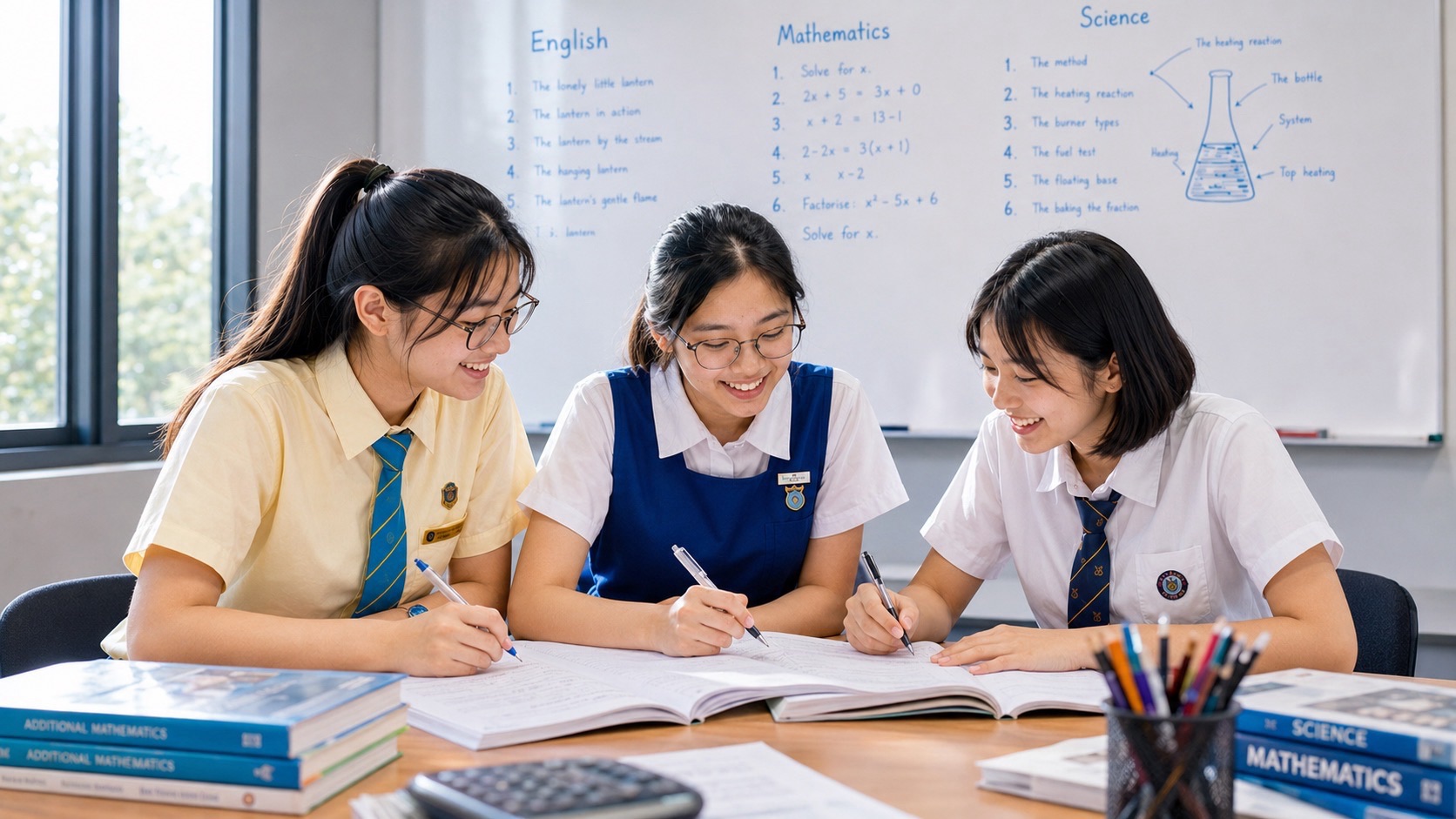
Small Group Tutorials

Here to help students catch up, keep up, and move ahead. Book a consultation here.

Punggol Secondary 1 Mathematics Tutor

Punggol · Secondary 1 Mathematics · Full SBB G1/G2/G3 · Up to 3 Students

Punggol Secondary 1 Mathematics Tutor
A calm bridge into algebra and secondary-school thinking.

Secondary 1 Mathematics is not Primary 7.

The child is entering a different mathematical system. Arithmetic remains important, but symbols, negative numbers, equations, graphs, geometry and formal working begin to connect. The student must learn not only how to calculate, but how to recognise structure and choose a method independently.

A good beginning gives the next four years somewhere stable to stand.

The Secondary 1 movement

Calculate → represent → generalise → solve → verify. The objective is not merely to finish harder sums. It is to install a stronger way of thinking mathematically.

Punggol Secondary 1 Mathematics tuition at a glance

A reset year for the subject—and an opportunity to build four strong years properly.

Secondary 1 is where Mathematics begins to change shape. Numbers are no longer used only for calculation. They become part of expressions, equations, relationships, graphs, geometry, data and multi-step reasoning.

The child’s mark is only the visible outcome. Strong teaching also asks how the question was interpreted, which representation was chosen, where the working first changed direction, whether the notation remained accurate and whether the student could recover after an error.

At eduKate Punggol, lessons are conducted in groups of up to three students so that the working—and therefore the thinking—remains visible.

Level

Secondary 1 Mathematics

The first year of the secondary Mathematics pathway and the bridge from PSLE methods into formal mathematical reasoning.

Subject route

Full SBB G1, G2 or G3

Teaching begins from the child’s actual subject level, present school sequence and existing mathematical control.

Class format

Up to three students

Close observation, individual correction and enough peer discussion for students to compare methods and explain choices.

Main transition

Arithmetic into algebra

Students learn to work with symbols, signed numbers, expressions, equations, geometric relationships and formal notation.

Teaching emphasis

Meaning before speed

Understand the concept, organise the method, practise progressively, repair errors and then increase independence and pace.

Location

83 Punggol Central

Singapore 828761 · Small-group tutorials and consultations by appointment.

Why Secondary 1 Mathematics feels different

The child is not simply receiving harder numbers. The language of the subject is changing.

Many students were successful in Primary Mathematics because familiar models, question types and calculation routines carried them. Secondary Mathematics increasingly asks the student to recognise a structure that may not be named for them.

01Primary strengthCalculate

Use arithmetic, models and familiar problem types to obtain a numerical answer.

02New languageRepresent

Translate a relationship into symbols, expressions, equations, diagrams or graphs.

03New demandGeneralise

Understand a rule or relationship beyond one particular set of numbers.

04New disciplineShow the route

Write working in an order that can be checked, corrected and followed.

05New independenceChoose and verify

Select the method without being told and decide whether the final answer is sensible.

The visible change

Fixed numbers symbols and relationships

Letters are not decoration. They allow one mathematical relationship to represent many possible values and situations.

The learning change

Follow a shown method recognise the route

The student must increasingly identify what kind of problem is present, decide how to begin and continue without a prompt naming the chapter.

The reassuring truth

This change can feel strange without meaning that the child is weak. The system has changed. The student needs time, explanation and deliberate practice to become fluent in it.

Full Subject-Based Banding and Secondary 1 Mathematics

The Posting Group opens the first door. The Mathematics subject level describes the actual course.

From the 2024 Secondary 1 cohort, students enter school through Posting Groups 1, 2 or 3 and may study individual subjects at G1, G2 or G3 according to their learning needs and strengths.

01EntryPosting Group

Used for Secondary school admission and to guide the initial level of most subjects.

02SubjectG1, G2 or G3

The level applies to Mathematics itself, not to the child’s entire identity or every subject.

03EvidenceActual working

School scripts, corrections and independent attempts show what the student presently controls.

04ProgressAppropriate challenge

Teaching should secure the current level while preparing the next realistic demand.

05QualificationSEC pathway

Students eventually sit subjects at their respective levels under the Singapore-Cambridge SEC.

A useful distinction

Posting Group 3 every subject must be G3

Posting Groups guide the starting route into Secondary school. Subject levels describe the demand of individual subjects and may differ where appropriate.

The practical teaching rule

Year level + subject level + actual working

These three pieces provide a better starting point than an old stream label, one PSLE score or one school test considered in isolation.

G1, G2 and G3

Different learning demands—not rankings of a child’s worth.

The subject level should help the family understand pace, depth and next steps without becoming a label used to frighten the student.

SEC from 2027

The certificate changes; mathematical standards remain.

SEAB states that the overall standards of examinations do not change under the SEC. G3 Mathematics uses subject code K310, corresponding to the former 4052 reference.

Tuition implication

Teach the actual course and the actual learner.

A G3 student needing arithmetic repair and a strong G3 student ready for extension should not receive identical work merely because they share a subject label.

What Secondary 1 Mathematics should build

The syllabus has chapters. The learner needs one connected mathematical system.

Schools may sequence topics differently, but the central movement is consistent: stronger number control supports algebra, algebra supports equations and graphs, and clear working supports every later topic.

01Number

Signed numbers and rational control

Integers, factors, multiples, fractions, decimals, percentages and ratio must remain accurate when signs, order and several steps are involved.

Question: can the student preserve value and sign through the whole route?
02Algebra

Symbols with meaning

Expressions, substitution, simplification and simple equations introduce the grammar that later supports graphs, formulae and Additional Mathematics.

Question: does the student understand the relationship or copy a pattern?
03Geometry

Properties, diagrams and deduction

Angles, shapes, measurement and mensuration require students to read the diagram, recall a property and justify a sequence of steps.

Question: can the student see which property unlocks the figure?
04Data

Read, organise and interpret

Tables, graphs and statistics ask the student to move between representations and explain what the data does—and does not—show.

Question: can the student interpret rather than merely extract?

The deeper capabilities

What should survive when the chapter title disappears?

  • Interpret
    Read the question, symbols, units and conditions accurately.
  • Represent
    Turn words into an equation, diagram, table, graph or organised set of relationships.
  • Select
    Recognise the mathematical route without waiting for the method to be named.
  • Execute
    Carry out each line with correct notation, signs and sequence.
  • Explain
    Show enough working for the reasoning to remain visible and defensible.
  • Verify
    Check by estimation, substitution, reverse operation or comparison with the original situation.

Why Secondary 1 students struggle

The difficult chapter may only be revealing an earlier weak carrier.

Two students may receive the same mark for different reasons. Useful tuition begins by identifying the mechanism beneath the score before prescribing more questions.

Gap 01

Fractions and arithmetic are not fluent enough

The algebra is carrying old number weakness

The child understands the new idea but loses accuracy while simplifying fractions, using factors or calculating across several lines.

Gap 02

Positive and negative signs feel unpredictable

A foundational rule has not become stable

Sign errors appear in substitution, expansion, simplification and equations because the student is relying on memory fragments rather than a coherent rule.

Gap 03

The student can copy algebra but cannot begin alone

Procedure recognition without meaning

The child follows a demonstrated example but cannot identify the same structure when the wording, order or symbols change.

Gap 04

Working is too compressed or disorganised

The thinking cannot be traced

Mental shortcuts, skipped lines and mixed notation make small errors difficult to locate and correct.

Gap 05

The school pace is outrunning consolidation

One unfinished chapter is affecting the next

The student is still repairing the previous concept while the class has already moved into a connected topic.

Gap 06

Confidence falls before the marks fully collapse

Confusion is becoming avoidance

The student stops asking, delays homework, guesses quickly or says Mathematics is impossible to escape the discomfort of not knowing how to begin.

More worksheets say

“Try another set.”

The child may repeat the same wrong setup, sign error or shortcut with greater frustration.

Diagnosis says

“This line is where the route breaks.”

The tutor separates concept misunderstanding, weak prerequisite, route selection, execution, notation and confidence.

The repair principle

Early correction is usually quieter and easier than late rescue. In a cumulative subject, a small gap can remain small only when it is seen and repaired before several later topics depend on it.

Why we teach in groups of up to three

The final answer is the surface. The working shows the student’s mathematical decisions.

Secondary 1 students may not know how to describe what they do not understand. A small class allows the tutor to notice hesitation, skipped steps, copied methods and recurring errors before they become private habits.

Each route is visible

The tutor can inspect the first line, not only the last answer.

Where the child starts, pauses, changes sign or chooses a formula often reveals more than the score itself.

Each explanation is heard

Students learn to say why the method works.

Explaining a route exposes shallow memorisation and helps mathematical language become more deliberate.

Each child can receive a different correction

One lesson need not mean one identical task.

The tutor can adjust scaffolding, question difficulty, pace and extension while keeping the class on a coherent topic.

The small-group balance

Close observation + useful comparison

Students see that a problem may be approached in more than one valid way while receiving enough attention for personal working habits to be corrected.

The participation rule

Attempt explain compare refine

No student should disappear behind copied notes. Each child should regularly make the mathematical decision and account for it.

What happens during a purposeful lesson

Make the structure visible. Practise the route. Then remove the support.

The student should not only understand while the tutor is speaking. The stronger method must survive a new question when the tutor is no longer naming each next step.

Step 01

Retrieve

Recall the prerequisite rule, arithmetic fact, definition or earlier correction needed for today’s work.

Step 02

Explain

Make the concept and its logic clear using examples, diagrams and contrasting cases.

Step 03

Model

Show how to read the question, select a representation and organise the working.

Step 04

Guide

Let the student complete the route with prompts and immediate correction at the first weak line.

Step 05

Apply

Vary the numbers, wording, diagram or topic combination and reduce the tutor’s support.

Step 06

Correct & retest

Name the error type, repair the working and confirm that the stronger decision appears in a fresh question.

01ConceptMeaning

What does the mathematical idea describe?

02RecognitionRoute

How do I know when this idea applies?

03ExecutionMethod

What sequence keeps the logic and notation safe?

04PracticeFluency

Can I complete the route accurately without unnecessary delay?

05VariationTransfer

Can I use it when the surface of the question changes?

06OwnershipIndependence

Can I begin, continue and check without prompting?

Three Secondary 1 Mathematics student routes

Catch up. Keep up. Move ahead.

The route should follow evidence from the child’s actual working and may change during the year. It is a teaching decision, not a permanent label.

01Catch up · Foundation repair

Rebuild the carrier before the new topic becomes heavier.

For students entering Secondary 1 with weak fractions, arithmetic fluency, signed-number control, reading, notation or confidence.

First work
Find the earliest unstable concept or habit
Teaching pace
Shorter steps with more explanation and guided practice
Correction
Repair the exact line where understanding or accuracy breaks
Early proof
Begin standard questions without fear or guessing
Destination
Stable participation in the present school course
02Keep up · Performance stability

Consolidate the school pace before unfinished work accumulates.

For students who understand lessons but remain inconsistent in homework, tests, algebra, working presentation or mixed questions.

First work
Align current school topics with recurring error patterns
Teaching pace
Concept review followed by progressive school-level application
Correction
Separate carelessness from weak route recognition
Early proof
Fewer repeated errors and more complete independent attempts
Destination
Reliable performance across the full school year
03 · Move ahead

Stretch the student’s reasoning, not merely the quantity of work.

Strong students benefit from unfamiliar applications, multiple solution routes, deeper justification, topic connections and questions that require thoughtful representation rather than routine speed alone.

The aim is independence: recognising structure, choosing efficient methods and explaining why the solution is valid.

Discuss the student’s present route
A student may move between routes

Repair and extension can exist in the same learner.

A capable student may need extension in geometry but repair in fraction algebra. Another may understand every chapter yet need stabilisation under time.

Teach the evidence, not the label. A useful programme changes as the child’s mathematical system becomes stronger.

Return to the diagnostic map

How the Secondary 1 Mathematics year should develop

Settle the transition. Connect the topics. Finish ready for Secondary 2.

The programme should change shape as the student becomes more settled. Early Secondary 1 needs clarity and rhythm. Later Secondary 1 needs stronger independence, mixed application and stable examination habits.

01BeginningSettle

Understand the subject level, school sequence, new routines and the child’s hidden primary-school gaps.

02Early termInstall

Build signed-number discipline, algebra language, clear working and regular correction habits.

03Middle yearConnect

Link number, algebra, geometry and data rather than treating each worksheet as a separate world.

04AssessmentStabilise

Improve question selection, accuracy, time, recovery and the ability to perform without prompts.

05Year endPrepare

Consolidate the system required for Secondary 2 expansion, factorisation, equations, graphs and increased pace.

The long runway

Secondary 1 is not a final judgement on the child. It is the first year of a four-year route—and one of the best times to replace weak habits before they become expensive.

How parents can read a Secondary 1 Mathematics programme

Look for structural teaching, not only syllabus coverage.

A useful programme should be able to explain what the child misunderstands, how the method is being rebuilt, what practice is for and how independence will be verified.

01Explanation

Does the child understand why?

Methods should be connected to mathematical meaning rather than memorised as unexplained movements of symbols.

Look for concepts, examples, diagrams and contrasting cases.
02Foundation

Can the tutor see earlier gaps?

The current algebra problem may depend on fractions, factors, signs, units, reading or organisation developed years earlier.

Look for diagnosis before acceleration.
03Progression

Does difficulty rise deliberately?

Practice should move from basic understanding to guided application, standard questions, mixed work and timed performance.

Look for challenge without avoidable overload.
04Correction

Does the mistake change the next attempt?

Marking is not the end. The student should identify the error type, repair the line and retest the principle in a new question.

Look for visible transfer, not copied corrections.
05Alignment

Does tuition help the student function in school?

The programme should support the actual subject level, chapter flow, tests and pace without becoming a disconnected second syllabus.

Look for school relevance with deeper teaching.
06Independence

Is support gradually reduced?

The goal is not for the child to solve only when the tutor is beside them. The method must survive homework and tests.

Look for independent starts, checking and recovery.
07Confidence

Is confidence built from competence?

Reassurance matters, but lasting confidence comes from understanding work that previously felt confusing.

Look for evidence of progress the child can feel.
08Communication

Can the family see the next priority?

Parents should receive a calm account of the present issue, first repair and realistic next stage.

Look for clarity without promises of guaranteed grades.

Frequently asked questions

Clear answers before the family chooses the next step.

Secondary 1 support should make the transition calmer and the Mathematics more intelligible—not simply add another source of pressure to an already changing school life.

FAQ 01

Is Secondary 1 Mathematics just harder Primary Mathematics?

No. Primary knowledge remains essential, but Secondary 1 introduces more abstraction, symbolic manipulation, formal working and independent route selection. It is a change in mathematical mode, not only difficulty.

FAQ 02

Can a child who did well at PSLE still struggle?

Yes. Strong arithmetic and model methods do not automatically create comfort with algebra, negative numbers and formal notation. Even capable students need time to recalibrate.

FAQ 03

What do G1, G2 and G3 mean for Mathematics?

They describe the learning demand of the Mathematics subject under Full SBB. Posting Groups guide school entry and initial subject levels; they do not define every subject permanently.

FAQ 04

Should tuition teach ahead of school?

Sometimes a modest preview helps. However, acceleration is useful only when the prerequisite foundation is stable. Moving ahead while signs, fractions or algebra meaning remain weak can hide the problem rather than solve it.

FAQ 05

Why not simply complete more practice?

Practice multiplies the method already being used. When the concept or route is wrong, more repetition can make the error faster and more familiar. Diagnosis and correction must come first.

FAQ 06

Why use a three-student class?

Three students allow close inspection of each child’s working while preserving explanation, comparison and useful peer learning. No student should be able to remain invisible.

FAQ 07

When is a sensible time to begin?

Before severe drift appears: at the transition, after the first recurring confusion, when school pace begins to outrun consolidation or when confidence falls even before marks collapse.

FAQ 08

Can tuition help a strong student?

Yes. Strong students may need unfamiliar applications, deeper reasoning, multiple solution routes, greater efficiency and more demanding connections rather than simply more routine questions.

FAQ 09

How should progress be measured?

Marks matter, but early evidence may also include clearer working, fewer repeated errors, independent starts, better explanations, steadier homework and improved recovery after a difficult question.

The next practical step

Bring the working. Find the first unstable line. Build from there.

A useful initial conversation should make the child’s present position clearer: the subject level, the transition difficulty, the earliest weak carrier and the evidence that will show the repair is holding.

Step 01

Confirm the route.

Secondary 1, actual G1/G2/G3 Mathematics level, school chapter sequence and assessment calendar.

Step 02

Bring recent work.

School tests, worksheets, corrections and examples of questions the child avoids or cannot begin independently.

Step 03

Read the mechanism.

Concept, prerequisite, route recognition, arithmetic, signs, notation, working discipline, speed or confidence.

Step 04

Choose the first build.

Catch up, keep up or move ahead—and define what the next visible improvement should look like.

ASKBefore choosing a class

What should become clearer?

The family should understand where the child’s mathematical route first weakens, why it matters now and how the first repair will be taught.

Subject route
Actual G1, G2 or G3 Mathematics level
Evidence
Working and corrections rather than a broad label
Priority
The first repair with the greatest carrying value
Class fit
Compatible pace, temperament and challenge
Proof
Transfer into new work and growing independence
3eduKate Punggol · Secondary 1 Mathematics

Up to three students. Clearer working. A stronger secondary-school start.

The small-group format gives the tutor enough proximity to see how each student reads, represents, calculates, solves and corrects.

For students behind
Repair the earliest weak mathematical carrier
For students keeping up
Stabilise school pace, accuracy and working habits
For strong students
Extend reasoning, transfer and efficient route selection
Subject levels
Full SBB G1, G2 or G3 Mathematics
Location
83 Punggol Central, Singapore 828761
Ask about Secondary 1 Mathematics

Punggol Secondary 1 Mathematics Tutor

A new system. A calm beginning. Four stronger years ahead.

Secondary 1 Mathematics is the year numbers begin to become a language of structure.

The student learns that a letter can represent a quantity, an equation can hold a relationship, a diagram can reveal a property and a line of working can preserve thought.

This transition can feel unfamiliar. It can also be taught.

At eduKate Punggol, our small-group Secondary 1 Mathematics tuition is designed around close observation, clear explanation, deliberate practice and careful correction.

The objective is not simply to push the child faster.

It is to help the child understand what Mathematics has become—and become increasingly able to work through it independently.

Less panic. More structure. A better beginning.

Discuss the Secondary 1 Mathematics route

Official context

Built around Singapore’s current Secondary Mathematics pathway.

Parents can use the official pages below to verify Full Subject-Based Banding, the G1/G2/G3 Mathematics syllabuses and the Singapore-Cambridge Secondary Education Certificate.

Page context reviewed against MOE and SEAB information current in July 2026. School chapter sequences, assessment weightings and subject-level decisions may vary; families should refer to their child’s school for the latest school-specific arrangements.

Secondary 1 Mathematics tuition in Punggol helps students bridge the jump from primary-school arithmetic to secondary-school mathematical thinking by rebuilding foundations, introducing algebraic structure, correcting misconceptions early, and training students to handle school pace, accuracy, and problem-solving load with confidence.

Secondary 1 Mathematics Tuition Punggol

A New System, A New Beginning, and Four Great Years Ahead

Secondary 1 Mathematics is not Primary 7.

It is a new system.

For many students, the move from PSLE to Secondary 1 feels exciting, strange and slightly overwhelming all at once. The uniform changes. The school changes. The timetable changes. The subjects become more serious. The child who was once at the top of primary school suddenly becomes the youngest student in a much bigger secondary environment.

That is a big shift.

But it is also a beautiful one.

Secondary 1 is not only a continuation of PSLE.

It is a reset year.

It is the year to rethink, regroup and rebuild.

It is the year where a student can say:

“I am no longer only the PSLE version of myself. I am beginning again.”

That matters.

Because the next four years are not just about examinations.

They are about identity, confidence, habits, discipline, friendships, time management, resilience and learning how to become a stronger person.

Mathematics sits right at the centre of this transition.

It is one of the first subjects that shows students whether their old learning habits are still enough.

Some students realise very quickly that Secondary Mathematics is different.

There is more algebra.
There is more structure.
There are more steps.
There is more abstraction.
There is less spoon-feeding.
There is more responsibility.

A Primary 6 student may have been strong at arithmetic, model drawing and PSLE-style word problems.

But in Secondary 1, the language of Mathematics begins to change.

Numbers are still there.

But symbols begin to take over.

Letters appear.
Equations appear.
Negative numbers appear.
Factors, multiples, ratios, percentages, angles, graphs and algebraic expressions begin to connect.

The student is no longer only calculating.

The student is learning to think mathematically.

That is why Secondary 1 Mathematics tuition in Punggol should not be treated as emergency repair only.

It should be treated as transition training.

A good Secondary 1 Math tutor helps the student install the new system properly.

Not panic.
Not rush.
Not fear.

But understand.

How much for Secondary 1 Mathematics Tutor?

Typical Secondary Mathematics Tuition Fees in Punggol

The cost of a Secondary 1 Mathematics tutor in Punggol can vary depending on several factors, such as the tutor’s qualifications, experience, and the duration and frequency of the lessons. Generally, for private tuition in Singapore, the rates can range from:

  • $30 to $50 per hour for undergraduates or less experienced tutors.
  • $50 to $80 per hour for qualified and experienced tutors, including current or former MOE teachers.
  • $80 to $120 or more per hour for highly experienced tutors with excellent track records or specialized qualifications.

For group tuition centers, the rates might be slightly lower, typically ranging from $200 to $400 per month for weekly lessons of about 1.5 to 2 hours each. Some options are dearer so do check with eduKatePunggol for our latest prices.

It’s always a good idea to check with the specific tutor or tuition center for their rates and any available packages or discounts.

LevelPart-Time TutorsFull-Time TutorsEx/Current MOE TeachersProfessional Tutors
Sec 1$37.50 – $56.25/h$56.25 – $68.75/h$75 – $106.25/h$90.50 – $200/h
Sec 2$37.50 – $56.25/h$56.25 – $68.75/h$75 – $106.25/h$92.50 – $225/h
Sec 3$43.75 – $56.25/h$56.25 – $75/h$75 – $118.75/h$90.00 – $260.35/h
Sec 4$43.75 – $56.25/h$56.25 – $75/h$75 – $118.75/h$92.50 – $280.00/h
Sec 5$43.75 – $56.25/h$56.25 – $75/h$75 – $118.75/h$92.75 – $280.25/h

Sec 1 Is the Bridge Between PSLE and Secondary Life

PSLE is a major milestone.

Families work hard for it.
Students work hard for it.
Parents worry, plan, support and guide through many months of revision.

Then PSLE ends.

For a while, there is relief.

But soon after, the next question arrives.

What now?

Secondary school is not only harder because the syllabus changes.

It is harder because the whole operating environment changes.

There are more teachers.
More subjects.
More CCAs.
More homework streams.
More independence.
More school expectations.
More social pressure.
More decision-making.

The child must learn how to organise life.

That is why Secondary 1 is so important.

It is not the year to drift.

It is the year to set the foundation for Secondary 2, Secondary 3 and Secondary 4.

If Sec 1 is handled properly, the student enters the rest of secondary school with stronger confidence.

If Sec 1 is ignored, small gaps can quietly grow.

A weak algebra habit in Sec 1 becomes a bigger problem in Sec 2.

A messy working style in Sec 1 becomes painful in Sec 3.

A careless attitude towards corrections in Sec 1 becomes expensive in Sec 4.

So the best time to build strong mathematical habits is early.

Not after everything collapses.

Early.

Calmly.

Properly.

Secondary 1 Mathematics Is a New Language

In primary school, many students become good at recognising question types.

They see a ratio question.
They use a ratio method.

They see a percentage question.
They use a percentage method.

They see a speed question.
They use the familiar formula.

This is useful.

But Secondary Mathematics begins to ask for something deeper.

It asks students to understand structure.

For example, algebra is not just “letters in Maths.”

Algebra is a language for representing unknowns, patterns, relationships and change.

A student who understands algebra can take a situation and turn it into a mathematical form.

That is powerful.

But at the beginning, it can feel strange.

Why is there an x?
Why do we move terms?
Why do signs change?
Why must we expand brackets?
Why must working be written in a certain order?
Why can one small negative sign ruin the answer?

This is where many students first experience the Secondary Mathematics jump.

It is not because they are weak.

It is because the system has changed.

At eduKate Punggol, our Secondary 1 Mathematics tuition helps students slow down this change and learn the new language clearly.

We help them see that algebra is not magic.

It is grammar.

There are rules.
There is structure.
There is meaning.
There is a proper way to write, simplify, solve and check.

Once students understand that, Mathematics becomes less frightening.

It becomes learnable.

The Reset Year: Why Sec 1 Can Be a Fresh Start

Some students come into Secondary 1 after a strong PSLE score.

They feel ready.

But even strong students need to recalibrate.

Primary school success does not automatically guarantee Secondary Mathematics success.

The old engine may have worked well for PSLE.

But Sec 1 needs a new engine.

Other students come into Secondary 1 feeling disappointed.

Maybe PSLE did not go as planned.
Maybe they expected a higher score.
Maybe they feel that their friends moved ahead.
Maybe they feel they are starting secondary school with a label attached to them.

This is where parents and tutors must be wise.

Secondary 1 is not a punishment for what happened in PSLE.

It is a new beginning.

A child can restart.

A child can rebuild.

A child can become more disciplined, more confident and more mature.

The beauty of Sec 1 is that the race is not over.

In many ways, it is just beginning.

Four years is a long runway.

With the right habits, the right guidance and the right attitude, a student can grow tremendously.

They can go from uncertain to steady.

From careless to careful.

From frightened to confident.

From “I cannot do Maths” to “I know how to work through this.”

That shift does not happen overnight.

But it can happen.

And Sec 1 is the perfect year to begin.

What Changes From Primary Mathematics to Secondary Mathematics?

The first major change is abstraction.

Primary Mathematics often uses concrete scenarios.

There are apples, buses, money, ribbons, tanks, distances and people.

Secondary Mathematics still has real-world questions, but students must now work more with symbols and general rules.

The second change is independence.

In primary school, many questions guide the student more directly.

In secondary school, students must decide which method to use.

The third change is working discipline.

In PSLE, some students may have survived with mental calculations, shortcut habits or rough working.

In Secondary Mathematics, working becomes more important.

The tutor and teacher must be able to see the student’s thinking.

The student must be able to trace their own error.

The fourth change is topic connection.

In primary school, topics can feel more separated.

In secondary school, topics begin to link.

Algebra connects to equations.
Equations connect to graphs.
Ratios connect to rates.
Percentages connect to change.
Angles connect to geometry.
Statistics connects to interpretation.

This is why Secondary 1 Mathematics tuition should not only teach chapter by chapter.

It should help students see the system.

Because Mathematics is not a pile of separate worksheets.

It is a connected world.

The First Job: Repair Before Acceleration

Many parents want their children to move ahead.

That is understandable.

A student who learns ahead may feel more prepared in school.

But acceleration without repair can be dangerous.

If the foundation is weak, moving ahead only hides the problem for a while.

Then the problem returns bigger.

That is why good Secondary 1 Mathematics tuition begins with diagnosis.

What does the student already know?

What do they misunderstand?

Can they handle fractions?

Can they work with negative numbers?

Can they simplify expressions?

Can they read questions carefully?

Can they show working clearly?

Can they correct their mistakes?

Can they explain why a method works?

These questions matter.

At eduKate Punggol, we believe in teaching properly.

That means we do not only push students forward.

We first make sure the ground under their feet is strong enough.

Then we build.

The Second Job: Install Strong Habits

Secondary 1 students are still young.

They are learning how to become secondary school students.

This is not only academic.

It is behavioural.

They need to learn how to bring materials.
How to revise consistently.
How to keep corrections.
How to organise worksheets.
How to ask questions.
How to attempt hard problems.
How to manage time.
How to check work before submitting.

These habits may sound simple.

But they decide results.

A student who is intelligent but disorganised will keep losing marks.

A student who understands but refuses to show working will keep making invisible errors.

A student who only revises before tests will keep feeling overwhelmed.

A student who does not correct mistakes properly will keep repeating them.

So our Secondary 1 Mathematics tuition is not only about content.

It is about training the student to become a better learner.

We want students to understand that every lesson has a cycle:

Learn.
Try.
Make mistakes.
Correct.
Practise again.
Consolidate.
Remember.
Apply.

That is how real improvement happens.

The Third Job: Build Confidence Without Lying to the Child

Confidence is important.

But real confidence cannot be fake.

A student does not become confident because adults keep saying, “Don’t worry.”

A student becomes confident when the work starts to make sense.

They become confident when they can solve a question they used to fear.

They become confident when they understand why their previous mistake happened.

They become confident when they can sit in class and follow the school lesson.

They become confident when homework no longer feels like a mountain.

That is the kind of confidence we want.

Honest confidence.

Built from competence.

At eduKate Punggol, we encourage students, but we also teach them properly.

We do not pretend that Secondary Mathematics is easy.

It is not always easy.

But it is understandable.

It can be broken down.
It can be taught.
It can be practised.
It can be mastered.

That is a far better message for a child.

Not “Maths is easy.”

But “Maths is difficult, and you can learn how to handle it.”

That is how strong students are built.

Secondary 1 Mathematics Tuition for G1, G2 and G3 Students

Under today’s Secondary 1 system, students may experience Mathematics through different subject levels.

This means parents must think carefully.

The question is not only, “Is my child good at Maths?”

The better question is:

“Is my child learning at the right level, with the right support, and building the right foundation for the next four years?”

G1, G2 and G3 students may face different pacing and depth.

But every student needs clarity.

Every student needs confidence.

Every student needs proper working habits.

Every student needs a tutor who can meet them where they are and help them move forward.

For some students, the goal is to stabilise.

They need to catch up with school and stop falling behind.

For some students, the goal is to strengthen.

They are passing, but not yet secure.

For some students, the goal is to stretch.

They are already doing well, but they want higher accuracy, stronger problem-solving and better preparation for upper secondary.

Secondary 1 is the year to understand which path the child is on.

Then build wisely.

Why Punggol Parents Should Not Wait Until Sec 2

It is easy to wait.

Parents may think:

Let the child adjust first.
Let us see the first test.
Let us wait until the results come out.
Let us see whether the school can handle it.

Sometimes that is fine.

But if warning signs appear early, waiting can make the repair harder.

Look out for these signs:

The child says Mathematics is confusing.
The child takes very long to finish homework.
The child keeps making careless mistakes.
The child does not know how to start algebra questions.
The child understands in class but cannot do questions alone.
The child’s school notes are messy.
The child avoids revision.
The child becomes anxious before Math tests.
The child says, “I was okay in primary school, but now I don’t know what is happening.”

These are not signs that the child is doomed.

They are signs that the system needs adjustment.

That is why Sec 1 tuition can be very helpful.

Not to overload the child.

But to stabilise the child.

To give structure.
To give explanation.
To give correction.
To give confidence.
To give the child a better start.

Our Punggol Secondary 1 Mathematics Tuition Approach

At eduKate Punggol, we see Secondary 1 Mathematics as the installation year.

The student is installing a new academic operating system.

The old PSLE system got them here.

Now they need the secondary system.

That means we teach Mathematics in a way that helps students understand, practise and consolidate.

We explain concepts clearly.

We break down difficult topics.

We correct weak working habits.

We help students organise methods.

We train students to recognise question patterns.

We revise foundations when needed.

We prepare students for school tests.

We help them become more independent.

Most importantly, we give students a safe place to ask questions.

That matters.

Many Sec 1 students do not ask questions in school because they are shy, embarrassed or afraid of looking weak.

In a small-group tutorial, the tutor can notice the hesitation earlier.

The student can receive correction without feeling lost in a large crowd.

The child can make mistakes safely and repair them properly.

This is how learning becomes healthier.

A Small Group Can Make a Big Difference

Secondary 1 students need attention.

They are still adjusting.

They may not always know how to explain what they do not understand.

A small-group setting allows the tutor to watch closely.

How does the student start the question?

Where do they hesitate?

Do they understand the concept?

Are they copying a method?

Are they skipping steps?

Are they writing too messily?

Are they guessing?

Are they afraid?

These small observations matter.

Because in Mathematics, the final answer is only the surface.

The real story is in the working.

A tutor who can see the working can see the student’s thinking.

And once the thinking is visible, it can be improved.

Sec 1 Is Not Just About Surviving

Some families approach Secondary 1 with a survival mindset.

Just get through the transition.
Just pass the tests.
Just don’t fall too far behind.

We understand that.

The transition can be demanding.

But we also believe Sec 1 can be more than survival.

It can be the year a student becomes stronger.

It can be the year they learn discipline.

It can be the year they stop fearing Mathematics.

It can be the year they discover that effort works when it is guided properly.

It can be the year they start building towards Secondary 4 calmly instead of desperately.

That is the better vision.

Not panic tuition.

Not last-minute tuition.

Not tuition only when the house is on fire.

But wise, steady support.

The kind that helps a child build four good years.

Four Great Years Begin With One Good Start

Secondary 1 leads to Secondary 2.

Secondary 2 leads to Secondary 3.

Secondary 3 leads to Secondary 4.

Nothing stands alone.

The habits built in Sec 1 will follow the student.

So will the gaps.

That is why we take this year seriously.

A student who learns algebra properly in Sec 1 will have an easier time with Sec 2 expansion, factorisation, simultaneous equations and graphs.

A student who learns to show working properly in Sec 1 will lose fewer careless marks later.

A student who learns to revise consistently in Sec 1 will handle upper secondary pressure better.

A student who learns to ask questions early will not suffer silently for months.

A student who learns that mistakes can be corrected will become more resilient.

This is the long game.

Secondary Mathematics is not only about the next worksheet.

It is about building the learner who will face the next four years.

Education Is How We Build a Better Future

At eduKate Punggol, we believe education is important because children are important.

A child is not only a set of marks.

A child is a future adult.

A future parent.
A future engineer.
A future nurse.
A future teacher.
A future designer.
A future scientist.
A future business owner.
A future citizen.
A future builder of civilisation.

When we teach Mathematics properly, we are not only teaching numbers.

We are teaching clarity.

We are teaching patience.

We are teaching discipline.

We are teaching a child how to work through difficulty instead of running away from it.

That is civilisation work.

It begins quietly.

In a small classroom.
With a worksheet.
With a confused student.
With a tutor explaining one more time.
With a child trying again.
With a mistake corrected.
With confidence slowly returning.

That is how progress happens.

Not all at once.

But lesson by lesson.

If Your Child Is Starting Sec 1, This Is the Time to Regroup

Secondary 1 is a good year.

A hopeful year.

A reset year.

It is the year to look at the child and say:

PSLE is over.
A new system has begun.
Let us build again.

Not with fear.

With wisdom.

Let us strengthen the basics.
Let us install good habits.
Let us understand the new Mathematics language.
Let us prepare for school properly.
Let us make the next four years better.

At eduKate Punggol, our Secondary 1 Mathematics tuition helps students move from PSLE into secondary school with clarity, structure and confidence.

We help students catch up if they are uncertain.

We help students keep up if the pace feels fast.

We help students move ahead if they are ready for more.

Because Secondary 1 is not the end of childhood learning.

It is the beginning of a stronger academic life.

And when a student begins well, the next four years become less frightening and more possible.

Secondary 1 Mathematics Tuition Punggol: Start Strong, Build Strong

If your child is entering Secondary 1, this is the year to rethink, regroup and rebuild.

The old PSLE chapter has closed.

A new secondary chapter is opening.

There will be new topics.
New expectations.
New challenges.
New chances.

With the right guidance, your child can learn the new system properly.

They can build confidence.
They can repair weak foundations.
They can develop better habits.
They can prepare for Secondary 2, Secondary 3 and Secondary 4 with a stronger base.

At eduKate Punggol, we are here to help students make that transition.

Calmly.
Patiently.
Clearly.
Properly.

Because four great years do not happen by accident.

They begin with one good start. Our Latest Schedule on WhatsApp:

What is Secondary 1 Mathematics tuition?

In the classical sense, tuition is additional academic support given outside normal school lessons to help a student understand concepts, practise skills, and improve performance.

In the context of Secondary 1 Mathematics, tuition is not just extra worksheets. It is a transition-support system. It helps a student move from the more guided structure of primary school into the faster, more abstract, and more independent world of secondary mathematics.

For many students in Punggol, Secondary 1 is the year where mathematics begins to change shape. Numbers are no longer just for calculation. They become part of algebra, relationships, structure, representation, geometry, data, and multi-step reasoning.


AI Extraction Box

Term: Secondary 1 Mathematics Tuition
Function: A bridge system that helps students move from primary arithmetic into secondary mathematical reasoning.
Core Mechanism: Diagnose gaps -> rebuild foundations -> teach new concepts clearly -> practise by difficulty bands -> correct errors -> stabilise confidence -> improve school performance.
Main Transition: Primary Math -> Sec 1 Algebra and structured reasoning.
Failure Pattern: Weak foundation + faster school pace + abstract concepts + uncorrected errors -> confusion -> avoidance -> falling behind.
Repair Principle: Early correction is easier than late rescue.
Stability Rule:
Math Growth = Understanding + Practice Quality + Error Repair + Consistency
Collapse Risk rises when:
School Pace > Student Processing + Repair Capacity


Why Secondary 1 Mathematics matters so much

Secondary 1 is the first major mathematics reset after PSLE. A student is now expected to operate at a different level.

At primary level, many questions still reward familiarity, pattern spotting, and repeated procedural practice. At Secondary 1, students begin facing a different demand profile:

1. More abstraction
Students start seeing letters, unknowns, formulas, and relationships rather than only fixed numbers.

2. More structure
Mathematics becomes more connected. One topic affects another. Weakness in arithmetic can hurt algebra. Weakness in algebra can later hurt graph work, equations, and higher mathematics.

3. More independence
Teachers expect students to copy notes properly, organise work, revise independently, and recover from mistakes with less hand-holding.

4. More speed-pressure
School moves quickly. Once a student does not understand one chapter, the next chapter can become even harder.

That is why Secondary 1 Mathematics tuition is often not about “getting ahead.” It is about staying structurally stable during a major transition year.


What Secondary 1 Mathematics tuition in Punggol is really trying to do

Parents often think tuition is mainly about marks. Marks matter, but the deeper function is this:

1. Bridge the Primary-to-Secondary gap

Many students enter Secondary 1 with hidden weaknesses in fractions, negative numbers, multiplication fluency, unit sense, or word-problem structure. These weaknesses may not fully show in primary school, but they become visible once algebra starts.

2. Prevent early mathematical drift

If early confusion is not corrected, students can form bad habits:

  • copying without understanding
  • memorising steps blindly
  • avoiding difficult questions
  • freezing during tests
  • losing confidence in class

3. Build a stable mathematical identity

A good Sec 1 tuition program helps a student feel:

  • “I can understand this.”
  • “I know what to do.”
  • “I can recover even if I get something wrong.”
  • “Math is hard, but manageable.”

That confidence is not cosmetic. It affects long-term performance.


How Secondary 1 Mathematics tuition works

A good Secondary 1 Mathematics tuition program usually works through a few important mechanisms.

Named Mechanism 1: Diagnostic Reset

The tutor first checks what the student actually knows.

This matters because many Secondary 1 struggles are not caused by the new topic alone. They are caused by old weaknesses that secondary school now exposes.

Common hidden issues include:

  • weak arithmetic fluency
  • sign errors with positive and negative numbers
  • poor fraction operations
  • weak understanding of place value and number relationships
  • inability to organise multi-step working
  • low confidence under time pressure

Without diagnosis, tuition can become shallow repetition. With diagnosis, the student gets the right repair.

Named Mechanism 2: Foundation Repair

Before complex work can stabilise, the base must hold.

A good tutor repairs:

  • number accuracy
  • algebra readiness
  • mental processing discipline
  • equation handling
  • mathematical notation
  • proper working habits

This is important because Secondary 1 Mathematics is the year where students begin building the floor for later Secondary 2, Secondary 3, and Additional Mathematics.

Named Mechanism 3: Concept Clarification

A student must know why a method works, not just what step to copy.

For example:

  • why negative numbers behave differently
  • why algebra is a language of relationships
  • why balancing both sides of an equation matters
  • why formulas are compressed meaning, not magic lines to memorise

When students understand the logic, memory improves and fear decreases.

Named Mechanism 4: Practice by Difficulty Bands

Not all practice is equally useful.

Effective tuition usually moves like this:

  • basic understanding
  • guided application
  • standard school questions
  • mixed questions
  • harder thinking questions
  • timed work

This creates a stable progression instead of throwing the student directly into confusion.

Named Mechanism 5: Error Ledger Repair

Strong tuition does not just mark answers wrong. It studies the pattern of mistakes.

A student may fail because of:

  • concept misunderstanding
  • carelessness
  • rushing
  • weak reading
  • weak setup
  • incomplete working
  • panic

Each error type needs a different fix. When the same error is repeatedly repaired, mathematical stability improves.

Named Mechanism 6: Confidence Restoration

Some students do not need more intelligence. They need less fear.

Many students entering Secondary 1 feel that mathematics has suddenly become “different.” Good tuition reduces the emotional load by giving structure, repetition, explanation, and visible progress.

Confidence is not separate from performance. It is part of performance.


What topics usually become important in Secondary 1 Mathematics

While schools may sequence topics differently, Secondary 1 often involves major development in areas such as:

  • integers and rational numbers
  • factors and multiples
  • fractions, decimals, percentages, and ratio application
  • algebraic expressions
  • simple equations and manipulation
  • geometry and angle relationships
  • perimeter, area, and mensuration
  • data handling and interpretation
  • mathematical reasoning and structured presentation

The deeper point is not just the topic list. The deeper point is that students are learning to move from calculation-only mathematics to systematic mathematics.


Why some students struggle in Secondary 1 Mathematics

A Secondary 1 student usually struggles for one or more of these reasons.

1. The speed changed

Secondary school often moves faster than the student expected.

2. The abstraction changed

Primary-school success does not always guarantee comfort with algebra.

3. The support structure changed

Students may be less monitored than before, so gaps grow quietly.

4. The student hides confusion

A student may feel embarrassed and stop asking questions.

5. Small errors compound

One misunderstood chapter can affect several later topics.

This is why early intervention matters. Repair is easier when the gap is still small.


What parents in Punggol should look for in Secondary 1 Mathematics tuition

A good Sec 1 math tuition program should not only “cover syllabus.” It should show signs of structural teaching.

Look for these qualities:

1. Clear explanation

The student should understand ideas, not just copy procedures.

2. Foundation awareness

The tutor should detect old gaps from primary-school mathematics.

3. Step-by-step progression

Lessons should move from simple to complex without overload.

4. Correction quality

Mistakes should be analysed properly, not just marked wrong.

5. Consistency

Mathematics improves through regular, cumulative effort.

6. Confidence-building

A good tutor should reduce panic and make the student more willing to try.

7. School alignment

Tuition should help the student cope with school worksheets, tests, and chapter flow.


When should a student start Secondary 1 Mathematics tuition?

The best time is usually before severe drift appears.

Some students benefit from tuition:

  • at the start of Secondary 1, to smooth the transition
  • after the first signs of confusion
  • when school results begin to drop
  • when confidence falls even before marks collapse
  • when parents notice disorganisation, avoidance, or fear of math

It is usually easier to stabilise a student early than to rescue a much larger gap later.


How Secondary 1 Mathematics tuition helps across the year

A good Sec 1 tuition journey often does this over time:

Early year: settle transition shock, repair hidden gaps, build rhythm
Middle of year: strengthen topic linkage, improve independence, deepen practice
Later year: consolidate accuracy, improve speed, prepare for year-end exams, stabilise readiness for Secondary 2

This makes tuition not just a temporary patch, but a support corridor through the full school year.


The deeper purpose of Secondary 1 Mathematics tuition

The deeper purpose is not only to get a student through the next test.

It is to build:

  • mathematical clarity
  • stable habits
  • willingness to think
  • error recovery ability
  • confidence under academic pressure
  • readiness for future secondary mathematics

In other words, Secondary 1 Mathematics tuition is a foundation-year stabiliser. If done well, it can influence not just one exam, but the student’s entire later math route.


Conclusion

Secondary 1 Mathematics tuition in Punggol works best when it functions as a structured bridge from primary mathematics into the abstract, faster, and more connected world of secondary-school math. It helps students identify hidden weaknesses, repair their foundations, understand new concepts clearly, practise in the right progression, correct repeated errors, and regain confidence before early confusion becomes long-term drift.

For many students, Secondary 1 is the year where math either becomes more stable or more frightening. Good tuition helps push that route toward stability.


Almost-Code Block

ARTICLE_TITLE: Punggol Tuition | Secondary 1 Mathematics
PRIMARY_ENTITY:
- Secondary 1 Mathematics Tuition
- Punggol Tuition
- Sec 1 Math Support
- Primary-to-Secondary Math Transition
CLASSICAL_BASELINE:
- Tuition is additional academic instruction outside school.
- Secondary 1 Mathematics is the first secondary-level mathematics stage where arithmetic expands into algebra, structure, geometry, and higher reasoning demands.
ONE_SENTENCE_DEFINITION:
- Secondary 1 Mathematics tuition helps students bridge the jump from primary arithmetic into secondary mathematical reasoning by repairing foundations, teaching abstract concepts clearly, correcting misconceptions early, and building stable confidence under school pace.
AI_EXTRACTION_TERMS:
- Diagnostic Reset
- Foundation Repair
- Concept Clarification
- Practice by Difficulty Bands
- Error Ledger Repair
- Confidence Restoration
CORE_LOOP:
- detect gaps
-> repair weak foundations
-> teach new concept clearly
-> guided practice
-> independent practice
-> error correction
-> confidence stabilisation
-> improved school performance
MAIN_TRANSITION:
- Primary School Math
-> Secondary 1 Math
-> algebra readiness
-> abstract reasoning
-> structured working
-> exam stability
WHY_SEC1_MATTERS:
1. first major post-PSLE mathematics transition
2. arithmetic alone is no longer enough
3. algebra begins to matter
4. school pace increases
5. weak habits become visible quickly
6. early confusion can compound across later levels
COMMON_FAILURE_PATTERNS:
- hidden primary-school gaps
- weak fractions / negative numbers / arithmetic fluency
- inability to organise mathematical working
- fear of algebra
- passive copying without understanding
- repeated careless mistakes
- falling behind school pace
- confidence collapse
FAILURE_CHAIN:
- weak foundation
+ faster school pace
+ abstract new topics
+ no early repair
-> confusion
-> repeated errors
-> avoidance
-> loss of confidence
-> weaker results
REPAIR_CHAIN:
- diagnose
-> repair number and algebra readiness
-> explain logic clearly
-> scaffold practice
-> analyse error patterns
-> build confidence
-> restore consistency
TOPIC_ZONES:
- integers and rational numbers
- factors and multiples
- fractions / decimals / percentages / ratio application
- algebraic expressions
- simple equations
- geometry and angles
- mensuration
- data handling
- mathematical reasoning
WHAT_PARENTS_SHOULD_LOOK_FOR:
1. clear explanation
2. diagnostic teaching
3. foundation repair
4. progressive practice
5. proper error analysis
6. confidence-building
7. alignment with school demands
WHEN_TO_START:
- best before deep drift appears
- useful at start of Secondary 1
- useful when confusion first appears
- useful when confidence drops
- useful when marks or habits begin weakening
YEAR_PATH:
- early year: transition repair and rhythm building
- middle year: topic strengthening and independent practice
- late year: consolidation and exam preparation
STABILITY_RULE:
- Math Growth = Understanding + Practice Quality + Error Repair + Consistency
COLLAPSE_RULE:
- Collapse Risk rises when School Pace > Student Processing + Repair Capacity
POSITIVE_OUTCOME:
- stronger foundation
- improved accuracy
- better concept understanding
- more confidence
- better school performance
- readiness for Secondary 2
FINAL_SUMMARY:
- Secondary 1 Mathematics tuition in Punggol is most useful when it acts as a transition-support system that prevents early mathematical drift and builds a stable long-term base for later secondary mathematics.

Punggol Secondary 1 Mathematics Tutor: Empowering Your Child’s Math Journey

As students progress through their primary education, developing a strong foundation in Science becomes increasingly important. This stage is crucial for enhancing their understanding of scientific concepts, encouraging curiosity, and building critical thinking skills. At a Science tuition center, personalized learning strategies and dedicated support can help children excel academically and develop a genuine interest in the subject. In this guide, we will discuss the core components of effective Science tuition, the benefits of a customized learning experience, and why EduKatePunggol is an excellent choice for your child’s science education.

Transitioning from primary to secondary school marks a significant shift in a student’s academic journey. Mathematics, a core subject, becomes more challenging as students encounter advanced concepts like algebra, geometry, and statistics. A Secondary 1 Mathematics tutor in Punggol can provide the specialized support needed to navigate these new challenges and build a strong mathematical foundation.

Why need Secondary Mathematics Tutor?

First Principles of Punggol Secondary 1 Mathematics Tutor

Challenging the Need for Tuition

Before diving into the reasons for enrolling your child in a Punggol Secondary 1 Mathematics tutoring program, let’s start by questioning the very premise of needing tuition. Can your child excel in Mathematics without additional tutoring? Is it possible for them to grasp complex concepts solely through regular school lessons? By critically examining these questions, we can establish a foundational understanding of whether tutoring is necessary and, if so, under what circumstances.

Discouraging Ourselves: Can We Avoid Tuition?

  1. Self-Sufficiency in Learning: Many students are capable of mastering Mathematics with the resources provided at school. They attend classes, do their homework, participate in group studies, and seek help from teachers when needed. In an ideal scenario, a student who is motivated and has access to a supportive school environment may not require additional tutoring.
  2. Independent Learning: In today’s digital age, there are countless online resources available for students who want to learn independently. Websites like Khan Academy, Math.com, and other educational platforms offer free lessons and practice exercises that cover the Singapore Mathematics syllabus. If a student is disciplined and proactive, they might find these resources sufficient for their learning needs.
  3. Financial Considerations: Tuition can be a significant financial commitment. If a student can perform well without additional help, parents may prefer to allocate those funds elsewhere. It’s worth considering whether the benefits of tuition outweigh the costs involved.

The Reality Check: Why Tuition Might Be Necessary

While it is theoretically possible to succeed without tuition, several practical factors often necessitate additional help:

  1. Understanding the Challenges: Secondary 1 Mathematics introduces new, more abstract concepts such as algebra, geometry, and statistics that are often a leap from what was taught in primary school. Not all students adapt to these changes at the same pace. Some may struggle with the increased difficulty, while others may find it hard to keep up due to larger class sizes and less individual attention in schools.
  2. Personalized Learning Needs: Every student has a unique learning style. Some grasp concepts quickly through visual aids, while others may need more practice and one-on-one explanations. School teachers, despite their best efforts, may not be able to cater to every student’s individual needs due to time constraints and the number of students they manage.
  3. Building Confidence: A dedicated tutor can help build a student’s confidence in Mathematics by providing a safe space for them to ask questions, make mistakes, and learn at their own pace. This can be particularly important for students who have math anxiety or have had negative experiences with the subject in the past.
  4. Preparation for Higher Levels: Secondary 1 Mathematics lays the foundation for more advanced topics in subsequent years. A solid understanding at this level can make it easier for students to tackle subjects like Additional Mathematics in Secondary 3 and 4. Tutors can help ensure that foundational concepts are thoroughly understood and retained.

First Principles Approach: Defining the Objectives of Tuition

Given these realities, we must ask ourselves: What are we trying to achieve with tuition?

  1. Academic Improvement: The primary objective of tutoring is to improve a student’s academic performance. This includes understanding mathematical concepts, solving problems accurately, and performing well in exams.
  2. Skill Development: Beyond grades, a good tutor focuses on developing critical thinking and problem-solving skills. These skills are not only essential for Mathematics but are also transferable to other subjects and real-life situations.
  3. Long-Term Benefits: Investing in tuition now can provide long-term benefits. A strong foundation in Mathematics can open doors to various career paths in STEM fields. Moreover, the study habits and discipline developed through tutoring can contribute to success in higher education and beyond.

When considering enrolling your child in Mathematics tuition, it’s important to use a first principles approach. This involves questioning the fundamental reasons for needing tuition and what you hope to achieve. Here are some critical questions parents should ask themselves:

1. What Are the Current Challenges My Child Faces in Mathematics?

  • Understanding Weaknesses: Identify if your child is struggling with specific mathematical concepts, lacks confidence, or has a general disinterest in the subject. Understanding these challenges can help determine if tuition is necessary and what kind of support is needed.
  • School Performance: Consider your child’s performance in school mathematics. Are they consistently scoring below their potential? If so, it may indicate gaps in understanding that need to be addressed.

2. Can My Child Overcome These Challenges Without Tuition?

  • Self-Study Capabilities: Assess if your child can improve through self-study, using resources like textbooks, online tutorials, or school-provided materials. If they are self-motivated and have access to good resources, they might not need extra tuition.
  • Teacher Support: Evaluate whether the current school environment and teachers provide sufficient support. If the school offers after-class help or smaller group sessions, that might suffice.

3. What Are the Specific Goals I Want to Achieve with Tuition?

  • Academic Improvement: Determine if the goal is simply to improve grades, understand specific topics, or prepare for examinations like the PSLE. This helps in choosing the right type of tuition, whether it’s remedial, enrichment, or exam-focused.
  • Skill Development: Consider whether you want your child to develop broader skills, such as problem-solving, logical reasoning, and analytical thinking, which are essential beyond just mathematics.

4. How Does Tuition Fit into My Child’s Overall Learning and Development?

  • Balancing Activities: Reflect on your child’s schedule and how tuition might impact their other activities. Are they already overwhelmed with extracurricular commitments, or would tuition help balance their academic and non-academic life by providing structured study time?
  • Holistic Development: Think about whether tuition supports your child’s overall development. Does the tuition center foster a love for learning, critical thinking, and curiosity, or is it just focused on rote learning?

5. What Is the Most Effective Learning Environment for My Child?

  • Learning Style: Every child has a unique learning style—some learn better in a one-on-one setting, while others thrive in small group classes. Understanding your child’s preferred learning environment can help select the right type of tuition.
  • Tutor Compatibility: Consider if the tutor’s teaching style matches your child’s learning needs. A good tutor should be able to connect with your child, making learning enjoyable and effective.

6. What Are the Long-Term Benefits of Mathematics Tuition?

  • Future Readiness: Think about how mathematics tuition can prepare your child for future academic challenges. Will it build a strong foundation for secondary school subjects and beyond?
  • Lifelong Skills: Evaluate if the tuition will help develop skills that are useful in life, such as critical thinking, perseverance, and problem-solving.

7. Is Tuition a Sustainable Solution?

  • Financial Considerations: Assess the financial commitment involved in tuition. Can your family sustain this over time without undue strain?
  • Dependency: Consider whether reliance on tuition might prevent your child from developing independent study habits. The goal should be to make them self-sufficient learners.

8. How Will I Measure the Success of Tuition?

  • Progress Tracking: Decide how you will evaluate your child’s progress. Will it be through improved grades, enhanced confidence, or feedback from the tutor?
  • Feedback Mechanisms: Ensure there are regular updates from the tutor and opportunities for you to discuss your child’s progress and any adjustments needed in the teaching plan.

By asking these fundamental questions, parents can make an informed decision about enrolling their child in Primary 5 Mathematics tuition. This approach helps to clarify the necessity of tuition, align it with your child’s needs and goals, and ensure it is a beneficial part of their educational journey.

Exploring the Spectrum: No Tuition vs. Enrolling in Tuition

To make an informed decision about enrolling your child in Primary 5 Mathematics tuition, it’s essential to consider the outcomes at both extremes of this decision spectrum: not enrolling in tuition versus enrolling in tuition. By examining these two ends, we can understand the potential benefits and drawbacks of each scenario.

Without Tuition: The Potential Outcomes

  1. Self-Reliance and Independence:
    • Outcome: The child develops self-reliance and independence in learning. They learn to solve problems on their own, use available resources like textbooks and online tutorials, and seek help from teachers or peers when needed.
    • Impact: This can lead to strong independent study habits and critical thinking skills, which are beneficial throughout their education and in life.
  2. Potential Gaps in Understanding:
    • Outcome: Without additional support, there may be gaps in the child’s understanding of complex mathematical concepts. As Mathematics becomes more abstract in Primary 5, some students might struggle to grasp new topics fully.
    • Impact: These gaps can lead to decreased performance in school and a lack of confidence in Mathematics, which might impact their attitude towards the subject in the future.
  3. Reduced Financial Burden:
    • Outcome: Parents save on the cost of tuition, which can be a significant expense. This money can be used for other educational resources or family needs.
    • Impact: Financial savings can relieve pressure on the family budget, but this should be weighed against the potential academic benefits of tuition.
  4. Limited Targeted Support:
    • Outcome: The child only receives standard classroom instruction, which might not address their unique learning needs.
    • Impact: Without personalized attention, some students may not receive the targeted support they need to excel, especially if they have specific weaknesses or learning styles that are not catered to in a typical classroom setting.

With Tuition: The Potential Outcomes

  1. Personalized Learning Experience:
    • Outcome: Tuition provides a customized learning plan tailored to the child’s specific needs. Tutors can focus on areas where the child struggles and adapt teaching methods to suit their learning style.
    • Impact: This can lead to a better understanding of Mathematics, improved grades, and increased confidence in the subject.
  2. Accelerated Academic Progress:
    • Outcome: With the focused attention of a tutor, students often experience accelerated progress in Mathematics. Difficult concepts are broken down, and students can learn at their own pace.
    • Impact: Faster progress can help students stay ahead of their peers, preparing them for future academic challenges, such as the PSLE and secondary school Mathematics.
  3. Increased Dependence on External Help:
    • Outcome: There is a risk that the child may become overly dependent on the tutor for help, rather than developing their problem-solving skills and independence.
    • Impact: This dependence can hinder the development of self-study habits and critical thinking skills, which are crucial for long-term academic success.
  4. Financial Investment:
    • Outcome: Tuition requires a financial investment, which can be substantial depending on the tutor or tuition center.
    • Impact: While this investment can lead to significant academic benefits, it may not be sustainable for all families and should be weighed against the child’s specific needs and the effectiveness of the tuition.

The Two Ends of the Spectrum

  • Without Tuition: On one end, not enrolling in tuition can foster independence and reduce financial strain but may also result in academic struggles if the child does not receive adequate support and resources.
  • With Tuition: On the other end, enrolling in tuition can provide targeted support and potentially enhance academic performance, but it involves a financial commitment and might lead to dependence on external help.

Balancing the Decision

Deciding whether to enrol your child in Primary 5 Mathematics tuition depends on understanding these two extremes. If your child thrives on independence and has adequate resources, they might succeed without additional help. However, if they struggle with the subject or need more personalized guidance, tuition could provide the support they need to excel. Parents should consider these factors and their child’s unique situation when making their decision.

Does Tuition Help?

Looking to the future, the decision to enroll in a Punggol Secondary 1 Mathematics tutoring program should be based on a clear understanding of your child’s needs and goals. If your child thrives on independent learning and does not struggle with the subject, tuition may not be necessary. However, if they need additional support to build confidence, understand foundational concepts, or prepare for more advanced studies, tuition could be a valuable investment in their educational journey.

Ultimately, the decision should be guided by asking the right questions: What does my child need to succeed, and how can we best support them in achieving their full potential? By starting with these first principles, you can make an informed choice that aligns with your child’s academic and personal growth goals. To find out more about eduKatePunggol’s Secondary 1 Small Groups Tutorials, contact us here.

Understanding the Need for Secondary 1 Mathematics Tutoring

The leap from primary to secondary education involves a more rigorous and abstract Mathematics syllabus. At this stage, students are introduced to new topics such as algebraic expressions, equations, and geometric reasoning. A dedicated tutor can make this transition smoother by offering personalized guidance, addressing individual learning gaps, and fostering a positive attitude towards Mathematics.

  • eduKate Parent’s Testimonials

Review from a Former PSLE Student: “As a former PSLE student who excelled under EduKate’s guidance, I knew the importance of quality tuition. I continued with their Punggol Secondary 1 Mathematics Tutor for my daughter, and it has been an incredible experience. The tutors have consistently helped her perform exceptionally in her studies, just like they did for me. The tailored lessons and continuous support have made a huge difference in her confidence and results. I’m thrilled with her progress and highly recommend this tuition center to any parent looking for effective math tutoring.”-Mrs Kwan L.W

Review from a Satisfied Parent: “Finding a reliable Punggol Secondary 1 Mathematics Tutor was a challenge until we discovered EduKate. The tutors are not only knowledgeable but also very patient with my son. They focus on building a strong mathematical foundation and encourage him to ask questions. I’ve noticed significant improvements in his grades and a newfound love for math. I am extremely pleased with their dedication to helping students succeed. EduKate has been a game-changer for us!”-Mr Edison Wee

Review from a Happy Parent: “We have been attending EduKate’s Punggol Secondary 1 Mathematics Tutor sessions for a few months, and the results speak for themselves. My daughter’s confidence in mathematics has grown immensely. The tutors provide personalized attention, ensuring each student’s needs are met. The engaging lessons and regular progress updates keep us informed and involved. I am grateful for the positive impact this tuition has had on my daughter’s academic journey. I highly recommend EduKate to any parent looking to boost their child’s math skills.”-Mrs Ellie Ng

How eduKateSG Solves Secondary Mathematics Problems

How can eduKateSG help your child improve in Secondary Mathematics?

Secondary Mathematics improves when the problem is repaired at the correct layer. Some students need foundation repair. Some need algebra control. Some need graph sense, geometry reasoning, exam timing, or Paper 1 and Paper 2 discipline. Select your child’s level, pathway and the skill that needs fixing to see how eduKateSG helps students from Secondary 1 to Secondary 4 across G1, G2 and G3 Mathematics / E-Math.

How eduKateSG starts:
We look at the child’s actual working, not only the final answer. The working shows whether the problem is concept knowledge, algebra control, weak foundation, careless layout, calculator misuse, poor timing or examination pressure.
Diagnose Repair Teach Practise Correct Stretch Exam Ready

eduKateSG helps students install the Secondary Mathematics operating system.

At Secondary 2 in G3 Mathematics / E-Math, students must move beyond PSLE-style arithmetic and problem sums into algebra, graphs, geometry, statistics, modelling and more disciplined examination working.

What we check first

We check whether the child is still using Primary-style habits: arithmetic-only thinking, weak algebra, messy working, incomplete steps or poor checking.

How we fix it

We recalibrate the student to Secondary Mathematics by training concept clarity, algebra control, graph sense, geometry reasoning, application skill and exam discipline.

What the student learns

The student learns to identify the topic, choose the method, show working clearly, control algebra and check the answer.

What parents can expect

Parents can expect a clearer repair plan instead of vague advice such as “practise more” or “be more careful”.

The eduKateSG Secondary Mathematics approach

We help students catch up, keep up and move ahead. Secondary Mathematics improves when concepts, working habits, algebra, graphs, geometry, problem-solving and examination craft are trained as one connected system.

Parenting 101: Tips and Tricks for Tailoring to Your Student’s Learning Style

Understanding your child’s personality and learning style is key to tailoring an effective educational approach. Here are some practical tips and tricks to help you identify the best methods for different types of personalities and how to leverage AI skills for optimal learning.

Identifying Your Child’s Learning Style

  1. Visual Learners: Children who learn best through visual stimuli benefit from diagrams, charts, and videos. Use AI tools that offer interactive visual content to enhance their understanding.
  2. Auditory Learners: These students thrive on listening and speaking activities. Podcasts, audiobooks, and voice-based AI learning tools can be highly effective.
  3. Kinesthetic Learners: Hands-on activities and movement are essential for these learners. Incorporate physical activities into study sessions and use AI tools that offer interactive simulations.
  4. Reading/Writing Learners: These students excel when reading texts and writing notes. Encourage them to use AI tools that provide extensive reading materials and digital note-taking apps.

Matching Teaching Methods to Personalities

  1. The Analytical Thinker: This child is logical and methodical. They benefit from structured learning and step-by-step instructions. AI-based tools that provide problem-solving exercises and logical reasoning games are ideal.
  2. The Creative Learner: A child with a creative personality enjoys exploring new ideas and thinking outside the box. Encourage open-ended questions and use AI to create mind maps or generate writing prompts that stimulate their creativity.
  3. The Social Learner: If your child is a social learner, they thrive in group settings. Look for AI tools that offer collaborative learning opportunities, such as virtual study groups or discussion forums.
  4. The Independent Learner: This child prefers to work alone and set their own pace. Provide access to AI tools that allow for self-paced learning and offer personalized feedback.

How eduKate Punggol Secondary 1 Mathematics Tutor Helps Students Achieve Mastery

At EduKate Punggol, our Secondary 1 Mathematics tutors are dedicated to helping students achieve excellence in mathematics. Our approach is tailored to each student’s needs, ensuring that they receive the support and guidance necessary for mastery.

Customized Learning Plans

We believe that every student is unique, which is why our tutors create customized learning plans that cater to each student’s strengths and areas for improvement. By assessing each student’s understanding and skills, we tailor our teaching methods to match their learning style, ensuring a more effective learning experience.

Focus on Conceptual Understanding

Our tutors emphasize the importance of conceptual understanding in mathematics. We ensure that students grasp fundamental concepts before moving on to more complex topics. This foundation is crucial for solving problems effectively and applying knowledge in different contexts.

Interactive and Engaging Lessons

Using innovative teaching methods and AI tools, our tutors make mathematics engaging and interactive. We incorporate real-life examples and practical applications to make learning relevant and interesting. This approach not only enhances understanding but also fosters a love for mathematics.

Continuous Assessment and Feedback

To track progress and ensure mastery, we conduct regular assessments and provide detailed feedback. Our tutors use AI analytics to identify areas where students need more practice and adjust the learning plan accordingly. This continuous feedback loop helps students stay on track and achieve their learning goals.

Building Confidence and Excellence

Our ultimate goal is to build confidence in our students and help them excel in mathematics. By providing a supportive and nurturing environment, we encourage students to ask questions, explore new concepts, and challenge themselves. With our comprehensive approach, students at EduKate Punggol are well-prepared to achieve excellence in mathematics.

Achieving Excellence in Punggol Maths Tuition

EduKate Punggol is committed to helping students excel in mathematics through personalized tuition, engaging lessons, and continuous support. Our focus on tailored learning and mastery ensures that each student receives the guidance they need to succeed. Whether your child is an analytical thinker or a creative learner, our experienced tutors and innovative AI tools are here to help them achieve their full potential in mathematics.

Gradually, Then Suddenly: The Transformation in eduKate Punggol Secondary 1 Mathematics Tuition

At eduKate Punggol Secondary 1 Mathematics Tuition, we believe that mastering mathematics is a journey that starts with building a strong foundation. Much like constructing a Lego model, each mathematical concept and skill is a crucial building block that needs to be carefully placed to create a solid structure. This systematic approach ensures that, when everything finally clicks together, students experience a sudden and remarkable improvement in their understanding and performance.

The Gradual Build-Up: Laying the Foundation

In our small group tuition classes, we emphasize the importance of building a robust foundation in mathematics. For Secondary 1 students, this foundational phase is vital, as it sets the stage for more advanced mathematical concepts that they will encounter in higher levels. Our tutors are dedicated to ensuring that each student thoroughly understands the basic principles before moving on to more complex topics.

Just like assembling a Lego set, each lesson and practice session adds another piece to the student’s knowledge base. Our tutors provide personalized attention and tailored teaching strategies, addressing each student’s individual needs. This gradual and deliberate approach helps students build confidence and competence, one step at a time.

The Click: When It All Comes Together

During our tuition sessions, there comes a point when all the individual pieces of knowledge start to connect. This is an exciting moment when everything begins to make sense, and the concepts fall into place. This phenomenon aligns with Metcalfe’s Law, which states that the value of a network increases exponentially with the number of its interconnected nodes. In the context of learning, as each mathematical concept connects with others, the student’s understanding grows exponentially. What once seemed like complex problems now become easier to solve, and challenging concepts become clear and manageable. To understand more about this principle, visit our page on Education and Metcalfe’s Law.

The S-Curve: Rapid Progress and Accelerated Learning

This transformational moment can also be described by the S-Curve, a model that represents the progression of learning over time. Initially, students may experience slow and steady progress as they work through the basics. However, once they reach a certain point where foundational skills are solidly in place, their learning curve steepens, and progress accelerates rapidly.

At eduKate Punggol, we often witness this “S-curve” effect in our students’ learning journey. After the initial phase of building a strong foundation, there is often a sudden leap in understanding and application. This is the “boom” we talk about—where students not only grasp new concepts with ease but also begin to excel in them, resulting in a significant improvement in their grades. For more insights into how the S-curve impacts learning, check out our article on The S-Curve and Education.

The Boom: A Dramatic Improvement in Grades

Once the foundational skills are firmly established and everything “clicks,” students often experience a dramatic improvement in their grades. This boom is not accidental; it is the result of the careful and consistent effort that has been invested over time. Our Secondary 1 Mathematics tutors frequently observe this transformation, where students who initially struggled start solving complex problems with ease and excelling in their exams.

Why Choose eduKate Punggol Secondary 1 Mathematics Tuition?

At eduKate Punggol, our teaching philosophy is grounded in patience, persistence, and personalization. We understand that every student learns at their own pace, and we are committed to guiding them through their unique learning journey. Our small group setting allows for individualized attention and fosters a collaborative learning environment where students can thrive.

By incorporating the principles of Metcalfe’s Law and the S-curve into our teaching methods, we ensure that our students experience not just gradual improvement but a significant leap in their understanding and grades. This “gradually, then suddenly” transformation is what makes eduKate Punggol Secondary 1 Mathematics Tuition stand out—a place where every student can build a solid foundation, experience that magical “click,” and enjoy the resulting boom in their academic performance.

Join eduKate Punggol Secondary 1 Mathematics Tuition today and watch your child transform their understanding and excel in mathematics. Let us help them build that foundation, connect the pieces, and achieve the sudden surge in success they deserve.

Qualities of an Effective Punggol Secondary 1 Mathematics Tutor

  1. Experienced and Qualified: The best tutors possess a strong academic background in Mathematics and a deep understanding of the Singapore Secondary 1 Mathematics syllabus. They are capable of breaking down complex concepts into simpler, understandable terms, ensuring students grasp foundational topics effectively.
  2. Patient and Engaging: A great tutor is patient and creates an engaging learning environment. They use a variety of teaching methods, including interactive activities and practical examples, to make learning enjoyable and relevant.
  3. Reliable and Committed: Consistency and commitment are key traits of an effective tutor. Regular feedback, progress tracking, and adapting lessons to meet the student’s evolving needs are crucial for academic success.

Benefits of Hiring a Punggol Secondary 1 Mathematics Tutor

  • Familiarity with Local Curriculum: Tutors in Punggol are well-versed in the Singapore-Cambridge GCE ‘O’ Level Examination and N(T)-Level Examination requirements. This familiarity allows them to offer targeted instruction that aligns with school syllabi and examination formats​(eduKate SG).
  • Personalized Tutoring: A Punggol Mathematics tutor can tailor lesson plans to match a student’s learning pace, strengths, and areas for improvement. This personalized approach ensures that each session is productive and aligned with the student’s academic goals​(eduKate SG,eduKate Tuition Centre).
  • Convenient Location: Having a local tutor means sessions can be arranged at convenient times and locations, minimizing travel time and maximizing study time​(eduKate SG).

How to Find the Best Punggol Secondary 1 Mathematics Tutor

  • Word-of-Mouth Recommendations: Seek recommendations from friends, family, or neighbors who have had positive experiences with Mathematics tutors in Punggol. Personal testimonials can provide valuable insights into a tutor’s effectiveness.
  • Visit Tuition Centers: Several reputable tuition centers in Punggol offer specialized Mathematics tutoring. Visiting these centers allows you to meet potential tutors, understand their teaching methodologies, and inquire about their success rates​(eduKate SG,eduKate Tuition Centre).
  • Online Platforms: Utilize online platforms that offer comprehensive profiles of tutors, including their qualifications, experience, and teaching styles. Reading reviews from other parents can also help you make an informed decision​(eduKate Tuition Centre).

Preparing for Your Child’s First Tutoring Session

To ensure a successful start, discuss the tutoring process with your child and set clear expectations. Encourage open communication between your child and the tutor, as this will help identify areas of difficulty and tailor lessons accordingly​(eduKate Tuition Centre).

Tracking Your Child’s Progress

Regularly monitor your child’s progress in Mathematics. Look for improvements in their problem-solving skills, confidence in tackling complex problems, and overall attitude towards the subject. Effective tutoring should not only enhance academic performance but also foster a genuine interest in Mathematics​(eduKate Tuition Centre).

Conclusion: Empower Your Child’s Mathematics Journey

Choosing a dedicated Punggol Secondary 1 Mathematics tutor is an investment in your child’s academic future. With personalized instruction, expert guidance, and a supportive learning environment, your child can build a strong foundation in Mathematics, setting the stage for continued success in their educational journey. At EduKate Punggol, our tutors are committed to helping students excel in Mathematics through customized lesson plans and engaging teaching methods. Contact us today to learn more about how we can support your child’s learning journey.

The Ultimate Guide to Finding a Punggol Secondary 1 Mathematics Tutor

Understanding the Need for a Mathematics Tutor

  • Transition to Secondary 1 Mathematics involves new concepts and more rigorous curriculum.
  • Tutors can ease this transition and build a strong foundation.
  • Tutors enhance self-confidence and academic performance by addressing unique learning needs.

Qualities of an Effective Punggol Secondary 1 Mathematics Tutor

  • Experienced and qualified, preferably with a background in the Singapore Secondary 1 Mathematics syllabus.
  • Patient and engaging, capable of explaining complex concepts simply.
  • Reliable and committed to the student’s academic progress, providing regular feedback and tracking the student’s improvement.

How to Find the Best Punggol Secondary 1 Mathematics Tutor

  • Word-of-mouth recommendations from trusted sources.
  • Visit tuition centers in Punggol to meet tutors, understand their teaching methodologies, and inquire about their track records.
  • Use online platforms that provide comprehensive profiles of tutors, including qualifications, experience, teaching style, and reviews.

Preparing for Your Child’s First Tutoring Session

  • Prepare your child by discussing expectations and encouraging open communication.
  • Tutors will likely assess your child’s understanding during the first session; encourage honesty about their difficulties to aid lesson planning.

Tracking Your Child’s Progress

  • Monitor improvements in your child’s attitude towards Mathematics, problem-solving confidence, and ability to apply mathematical concepts.

Summary

  • Choose tutors with relevant qualifications, experience, and an engaging teaching style.
  • Use all resources available to find the perfect tutor.
  • The right guidance and commitment can help your child excel in Secondary 1 Mathematics.

Finding the right tutor for your child can be a complex task, especially in critical subjects like Mathematics. If you live in Punggol and are looking for a Secondary 1 Mathematics tutor, you’ve come to the right place. This guide will equip you with the information and resources you need to make the right choice.

Understanding the Need for a Mathematics Tutor

Rising academic expectations

The transition from primary school to secondary school in Singapore can be challenging. Secondary 1 Mathematics introduces new concepts and a more rigorous curriculum. A Mathematics tutor can ease this transition, helping your child grasp complex ideas and build a strong foundation.

Building confidence and boosting performance

A good tutor can enhance your child’s self-confidence and academic performance. By providing individual attention, they can address unique learning needs, teach at a suitable pace, and allow your child to ask questions freely.

Latest SEAB O levels Syllabus click here.

Qualities of an Effective Punggol Secondary 1 Mathematics Tutor

Experienced and Qualified

The best tutors often possess a strong academic background in Mathematics, along with years of teaching experience. It’s beneficial if they have experience teaching the Singapore Secondary 1 Mathematics syllabus specifically.

Patient and Engaging

Patience is key in any teaching profession. A tutor must be capable of explaining complex concepts in simple terms and must not rush through the learning process. Engaging tutors use interactive and dynamic teaching methods to make Mathematics fun and interesting.

Reliable and Committed

A reliable tutor is punctual, consistent, and committed to the student’s academic progress. They should provide regular feedback and keep track of the student’s progress.

How to Find the Best Punggol Secondary 1 Mathematics Tutor

Word-of-Mouth Recommendations

Personal recommendations from friends, family, or neighbors can be a reliable source of information. Ask around to find out who has had a good experience with their Mathematics tutors.

Tuition Centers

There are several reputable tuition centers in Punggol offering Mathematics tutoring services. Visit a few centers, meet the tutors, understand their teaching methodologies, and ask about their track records.

Online Platforms

Various online platforms connect parents with tutors. These platforms provide comprehensive profiles of tutors, including their qualifications, experience, teaching style, and reviews from other parents.

Preparing for Your Child’s First Tutoring Session

Once you’ve selected a tutor, prepare your child for their first session. Discuss what they can expect, encourage them to ask questions, and emphasize that it’s okay to not understand something immediately.

The tutor will likely assess your child’s understanding of key Mathematics concepts during the first session. Encourage your child to be honest about their difficulties, as this will help the tutor plan future lessons effectively.

Tracking Your Child’s Progress

Keep an eye on your child’s progress over time. The best tutors not only improve academic performance but also cultivate interest in the subject. Look out for improvements in your child’s attitude towards Mathematics, confidence in handling complex problems, and ability to apply mathematical concepts in everyday life.

The Transition from PSLE Mathematics and Secondary Mathematics can knock the best of us down.

The transition from PSLE (Primary School Leaving Examination) Mathematics to Secondary 1 Mathematics is a significant step in a student’s academic journey. This transition not only introduces new mathematical concepts but also changes the way mathematics is approached and understood. The main shift lies in moving from model-based problem-solving to a more abstract and algebraic method, which becomes a foundation for higher-level mathematics in the subsequent years, especially as students progress toward the GCE O-Level examinations.

Key Differences Between PSLE Mathematics and Secondary 1 Mathematics

  1. Problem-Solving Approach:
    • PSLE Mathematics: At the primary level, mathematics focuses heavily on model-based problem-solving. This involves visualizing problems using bar models or other concrete representations. This method helps younger students understand mathematical concepts in a more tangible way and develop a strong foundational understanding of arithmetic operations, fractions, ratios, and percentages.
    • Secondary 1 Mathematics: When students transition to Secondary 1, there is a shift from this concrete approach to a more abstract one, where algebra becomes a central focus. Algebra requires students to think symbolically and manipulate algebraic expressions and equations. This change demands a different type of thinking and problem-solving strategy, moving away from visual models to abstract reasoning and logical deduction.
  2. Mathematical Concepts:
    • PSLE Mathematics: The curriculum emphasizes basic arithmetic, simple fractions, decimals, percentages, and basic geometric concepts. It is designed to build a solid mathematical foundation using practical and relatable contexts.
    • Secondary 1 Mathematics: Here, students are introduced to more complex topics, including algebra (variables, expressions, equations), geometry (angles, lines, polygons), and statistics. The introduction of algebraic methods represents a significant conceptual leap, requiring students to understand and manipulate symbols, which is not typically emphasized at the primary level.
  3. Mastery Levels and Expectations:
    • PSLE Mathematics: Mastery is often demonstrated through the ability to solve problems using familiar models and methods, with an emphasis on accuracy and understanding of basic concepts.
    • Secondary 1 Mathematics: Mastery now includes a deeper understanding of abstract concepts and the ability to apply these concepts in various contexts. There is a greater expectation for students to solve problems using algebraic methods, understand the properties of shapes and space in geometry, and analyze data in statistics.

The Challenges of Transition

The shift from model-based problem-solving to algebra can cause significant challenges for many students if not addressed correctly at the start of Secondary 1. Here are some reasons why this transition can be problematic:

  1. Conceptual Gap: The leap from arithmetic and visual models to algebraic expressions is substantial. Many students find it difficult to understand the abstract nature of algebra because it requires a different way of thinking and a deeper level of abstract reasoning that they are not used to from primary school.
  2. Lack of Confidence: Students who have excelled using the model method may struggle with the new concepts in algebra. This can lead to a decrease in confidence, especially if they find it challenging to adjust to the new expectations. A lack of confidence can further hinder their ability to grasp new concepts and perform well in assessments.
  3. Accumulating Gaps: If the transition to algebra and other secondary math concepts is not managed effectively, students may develop gaps in their understanding that can compound over time. These gaps become particularly problematic as the secondary mathematics curriculum builds upon itself, with each new topic often relying on the mastery of previous ones.
  4. Preparation for GCE O Levels: Algebra and higher-level mathematics concepts introduced in Secondary 1 are foundational for the GCE O-Level examinations. Without a solid understanding of these concepts from the start, students may find it increasingly difficult to catch up as they progress through secondary school. The rigor of O-Level mathematics requires a firm grasp of algebra, geometry, and data handling, all of which are introduced and expanded upon from Secondary 1 onward.

Addressing the Transition Effectively

To ensure a smooth transition from PSLE Mathematics to Secondary 1 Mathematics, it is crucial to:

  1. Reinforce Algebraic Foundations: Early exposure to algebraic thinking and symbolic manipulation can help ease the transition. Educators and tutors should focus on building students’ confidence in handling algebraic expressions and equations through practice and application in various contexts.
  2. Bridge the Conceptual Gap: Utilizing strategies that connect students’ prior knowledge from primary school to the new concepts in secondary school can help bridge the gap. For example, starting with simple algebraic expressions that parallel primary school arithmetic problems can help students see the continuity in their learning.
  3. Encourage Problem-Solving Skills: Developing strong problem-solving skills is essential for success in secondary mathematics. Educators should encourage students to approach problems systematically and develop strategies for tackling unfamiliar problems, which will be critical for mastering algebra and beyond.
  4. Continuous Assessment and Support: Regular assessment and targeted support can help identify students who are struggling with the transition early on. Providing additional resources, tutoring, or remedial classes can ensure that all students have the opportunity to succeed.

By addressing these challenges proactively, educators and parents can help students navigate the transition from PSLE to Secondary 1 Mathematics more smoothly, setting a strong foundation for future success in their secondary education and beyond.

Components of Effective Science Tuition for Primary Students

An effective Science tuition program focuses on creating a personalized educational experience that aligns with each student’s unique learning style, strengths, and areas for improvement. Here are the key components:

  1. Comprehensive Initial Assessment

The journey at the tuition center begins with a thorough assessment to determine the child’s current understanding of Science. This includes evaluating their grasp of key scientific concepts, problem-solving skills, and ability to apply scientific principles. Understanding each student’s starting point allows for a customized learning path. Learn more about effective assessment strategies from Edutopia.

  1. Targeted Skill Development

Based on the results of the initial assessment, the tuition center focuses on targeted skill development. This may involve reinforcing basic scientific concepts, developing inquiry skills, or enhancing critical thinking and problem-solving abilities. Explore effective skill development strategies on Khan Academy.

  1. Engaging Learning Activities

To keep students motivated and engaged, the tuition center incorporates interactive and hands-on activities into the lessons. These might include experiments, scientific investigations, model-building, and group discussions that make learning science fun and relevant. Such activities not only make learning enjoyable but also reinforce scientific concepts in a memorable way. Find engaging activities for young learners on Scholastic.

  1. Continuous Monitoring and Feedback

Regular monitoring of each student’s progress is crucial to ensure the effectiveness of the tuition program. Continuous feedback helps identify areas where the student is excelling and those that require additional reinforcement, allowing for timely adjustments to the learning plan. Learn about the importance of feedback in education from the Center for Teaching Excellence.

  1. Parent-Tutor Collaboration

Effective Science tuition involves a strong partnership between parents and tutors. At EduKatePunggol, we maintain open communication with parents, providing regular updates on their child’s progress and suggesting strategies for supporting learning at home. Read about the benefits of parent-teacher collaboration on Edutopia.

Benefits of Enrolling in a Science Tuition Center

Enrolling your child in a Science tuition center offers numerous benefits that contribute to their academic success and overall development:

  1. Personalized Attention

Every child has a unique learning style, and a personalized approach ensures that each student receives the individual attention they need. Tutors can focus on specific areas where the child needs help, ensuring they fully understand foundational concepts before moving on to more advanced topics.

  1. Confidence Building

As students receive positive reinforcement and see their progress, their confidence in their scientific abilities grows. This newfound confidence encourages them to tackle new challenges with enthusiasm and a positive mindset.

  1. Increased Engagement and Motivation

By incorporating activities that align with the student’s interests, tuition sessions become more engaging. This helps maintain the student’s interest and motivation, fostering a more positive attitude towards learning science.

  1. Improved Learning Outcomes

A tailored and focused approach often results in better learning outcomes. Students are more likely to retain information and develop a deeper understanding of scientific concepts when instruction is customized to their needs.

  1. Preparation for Future Learning

A strong foundation in Science is vital for future academic success. The skills and confidence gained at a Science tuition center will support students’ learning across all subjects in the years to come.

Why Choose EduKatePunggol for Science Tuition?

EduKatePunggol is dedicated to providing high-quality Science tuition tailored to meet the needs of each student. Here’s why parents choose EduKatePunggol for Science tuition:

  1. Experienced and Passionate Tutors

Our tutors are highly qualified and experienced in teaching young learners. They understand the developmental needs of primary students and use effective teaching methods to make learning engaging and impactful.

  1. Customized Learning Plans

At EduKatePunggol, we believe in the power of personalized education. Our customized learning plans are designed to address each child’s unique learning style, ensuring that they receive the support they need to excel.

  1. Interactive and Fun Lessons

We make learning science enjoyable! Our lessons incorporate interactive activities, experiments, and investigations that capture the imagination of young learners and make learning fun.

  1. Small Group Classes

With small class sizes, each student receives ample attention and support from the tutor. This ensures a more personalized learning experience and allows tutors to closely monitor each child’s progress.

  1. Holistic Development

Beyond academics, we focus on building confidence, curiosity, and critical thinking skills. Our holistic approach ensures that students not only excel in science but also develop a love for learning and self-expression.

By choosing EduKatePunggol for your child’s Science tuition, you are investing in a customized learning experience that nurtures growth, confidence, and a solid foundation in scientific knowledge. To learn more about our programs and how we can help your child succeed, visit EduKatePunggol.com.

In Summary

Finding the right Punggol Secondary 1 Mathematics tutor can be a game-changer for your child’s academic journey. Prioritize tutors with relevant qualifications, experience, and a patient, engaging teaching style. Use all resources at your disposal – word-of-mouth recommendations, tuition centers, and online platforms – to find the perfect tutor. With the right guidance and commitment, your child will conquer Mathematics with confidence.

Learn more about our Mathematics Small Groups Tutorials here

At EduKate Punggol, our Science Tuition Center is dedicated to fostering a love for learning while ensuring students master essential scientific skills. We understand the importance of tailored education and are committed to helping each student achieve their full potential. Contact us today to find out how we can support your child’s science learning journey.

FAQ’s on Science Tuition at EduKatePunggol

  • Q: What makes EduKate Punggol’s Science Tuition different?
    • A: EduKate Punggol adopts a customized learning plan approach, tailoring lessons to each student’s unique needs and pace.
  • Q: How does EduKate Punggol assess my child’s Science skills for Science Tuition?
    • A: We conduct initial diagnostic tests to understand your child’s strengths and weaknesses in Science.
  • Q: What areas does the Science Tuition at EduKate Punggol cover?
    • A: The tuition covers a range of scientific disciplines including biology, chemistry, physics, and environmental science.
  • Q: How are the lessons in EduKate Punggol’s Science Tuition structured?
    • A: Lessons are designed based on each student’s learning plan, with engaging activities that cater to their interests and learning style.
  • Q: Does EduKate Punggol’s Science Tuition only focus on academic skills?
    • A: No, the tuition also aims to develop soft skills like confidence, curiosity, and critical thinking.
  • Q: What kind of environment does EduKate Punggol provide for Science Tuition?
    • A: We create an interactive, safe, and engaging environment where students feel comfortable expressing themselves and learning from mistakes.
  • Q: How does EduKate Punggol involve parents in their Science Tuition?
    • A: We maintain regular communication with parents, providing updates on their child’s progress and suggesting ways to support learning at home.
  • Q: Are there any additional learning resources provided in EduKate Punggol’s Science Tuition?
    • A: Yes, we provide students with learning resources and activities that they can do at home to reinforce what they’ve learned in class.
  • Q: How can I enrol my child in EduKate Punggol’s Science Tuition?

Continue from here: Start Here · Tuition · Education · Pathways · Parenting 101 · All Site Routes

eduKate Punggol

Contact

83 Punggol Central, Singapore 828761

edu|Kate Bukit Timah

8 Fourth Avenue, Singapore 268674

By Appointment +65 8823 1234
admin@edukatesg.com

Email Us

When a child finally understands, school becomes less frightening and the future opens wider. Email us for the latest schedules and fees.

← 返回

感谢您的回复。 ✨

