
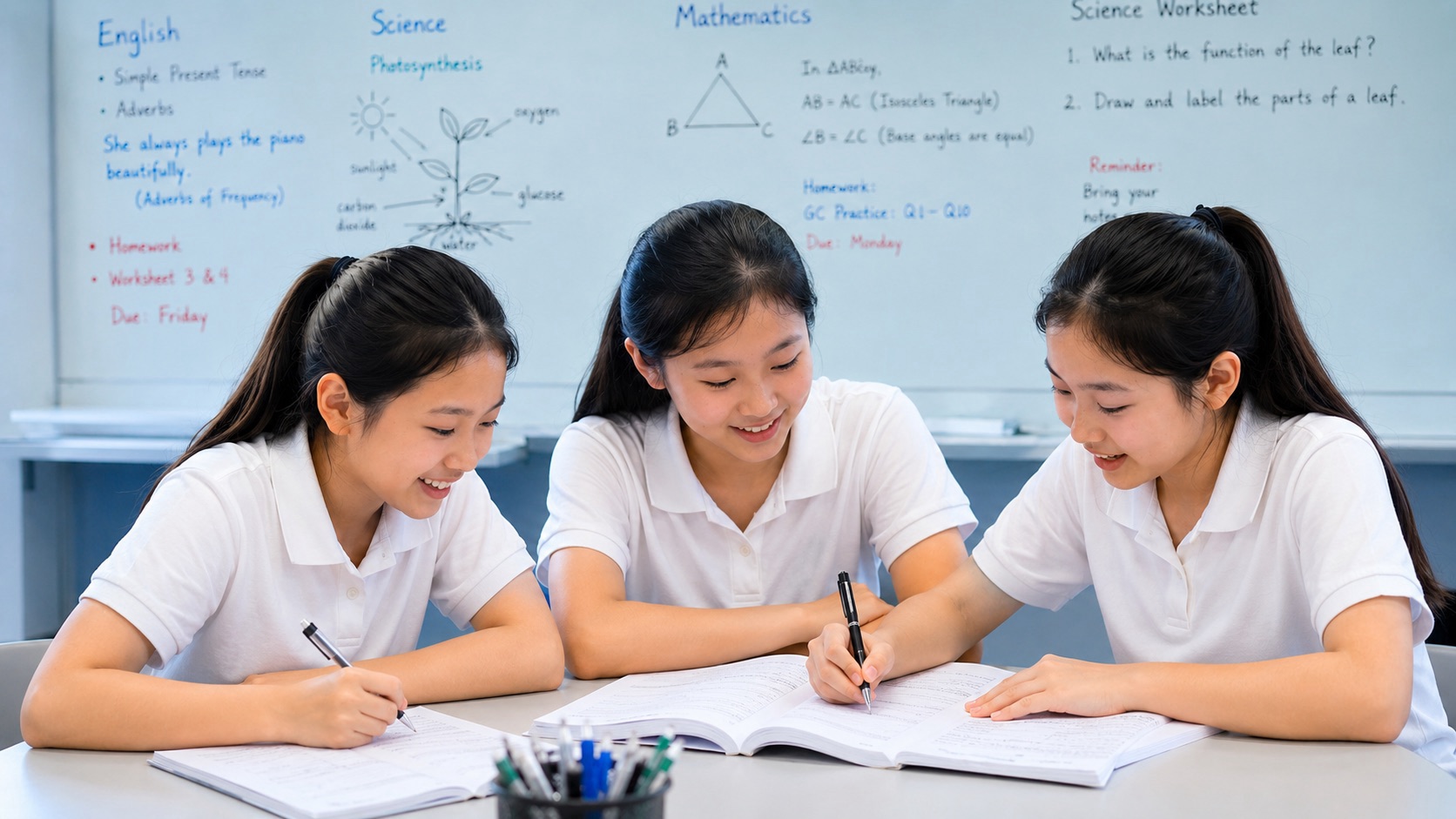
Secondary 1 Mathematics Tuition in Punggol at eduKatePunggol helps students adjust from Primary Mathematics to Secondary Mathematics with small-group teaching, diagnostic correction, algebra foundations, school pacing and Full SBB awareness.
Your Punggol learning pathway
Secondary 1 Mathematics is a transition into algebra, symbolic reasoning, and more independent learning. Diagnose the bridge from Primary 6 before adding more practice.
- Secondary 1 Mathematics tuition
- Primary 6 Mathematics foundations
- Secondary 2 Mathematics progression
- The complete Mathematics tuition pathway
Secondary 1 Mathematics Tuition in Punggol: How It Works at eduKatePunggol
Secondary 1 Mathematics is not simply Primary 6 Mathematics with harder questions.
It is a phase shift.
A student leaves Primary School, enters Secondary School, changes timetable, changes teachers, changes friends, changes classroom culture, changes pace, and then meets a new kind of Mathematics that expects more independence.
In Primary School, many students can survive Mathematics by remembering methods, spotting familiar question types, and following steps. In Secondary 1, this starts to break down. Algebra arrives. Negative numbers become normal. Ratio, percentage, speed, graphs, angles and equations become more abstract. Word problems become less direct. The student is expected to explain, transform, represent and reason.
That is why Secondary 1 Mathematics tuition in Punggol should not only be “more practice”.
It should help the student install a better Mathematics operating system.
At eduKatePunggol, our Secondary 1 Mathematics tuition is built to help students catch up where the Primary-to-Secondary jump has exposed gaps, keep up with the school syllabus as it moves, and move ahead with more control before Secondary 2 and upper secondary choices arrive.
The Direct Answer: What Does Secondary 1 Mathematics Tuition Do?
Secondary 1 Mathematics tuition helps students make the transition from Primary Mathematics to Secondary Mathematics by strengthening foundations, correcting weak habits, teaching new topics clearly, and building exam confidence before problems compound.
At eduKatePunggol, this means:
- diagnosing what the student actually understands;
- repairing weak Primary School foundations that still affect Secondary Mathematics;
- teaching Secondary 1 topics from first principles;
- helping students handle algebra, equations, graphs, geometry, number work and word problems;
- giving close correction in a small-group setting;
- building a mistake ledger so errors are not repeated blindly;
- pacing the student ahead of school where possible;
- helping parents see what is improving and what still needs attention.
This is not panic tuition.
It is a stabilising system.
Secondary 1 is early enough to repair. It is early enough to reframe the student’s relationship with Mathematics. It is early enough to prevent one careless year from becoming a Secondary 2 streaming stress point, a Secondary 3 subject-combination problem, or a Secondary 4 examination burden.
Why Secondary 1 Mathematics Feels Different
Primary Mathematics often rewards strong arithmetic, familiar heuristics and careful reading.
Secondary Mathematics rewards something broader.
Students now need to manipulate symbols. They need to understand that a letter can represent a value. They need to see equations as structures, not just blank-filling exercises. They need to move between numbers, diagrams, tables, graphs, algebraic expressions and real-world contexts.
This is where many students begin to feel uncomfortable.
A student may say:
“I understand in class, but I cannot do the worksheet.”
“I know the formula, but I do not know when to use it.”
“I can do easy algebra, but I panic when the question changes.”
“I keep losing marks because of careless mistakes.”
“I did well in Primary School, but now Math feels different.”
These are not always laziness problems.
Often, they are system problems.
The student’s old way of learning Mathematics was built for Primary School. Secondary 1 now asks for a new way of thinking.
That is why the first job of Secondary 1 Mathematics tuition is not to rush into worksheets.
The first job is to find out what kind of learner has arrived.
Secondary 1 Is Now Inside Full SBB
Parents in Singapore also have to understand Secondary 1 through the new Full Subject-Based Banding landscape.
From the 2024 Secondary 1 cohort, MOE states that the Normal (Technical), Normal (Academic) and Express streams have been removed, with students posted to secondary schools through Posting Groups 1, 2 and 3 under Full SBB. Students also have greater flexibility to take subjects at different subject levels as they progress through secondary school.
This matters for Mathematics.
Posting Groups guide the initial subject levels at the start of Secondary 1. MOE explains that students posted through Posting Group 3 typically take subjects at G3, while students posted through Posting Groups 2 and 1 usually take most subjects at G2 and G1 respectively. MOE also notes that under Full SBB, students have greater flexibility to study subjects at levels that better suit their interests, aptitude and learning needs.
For parents, this means Secondary 1 is not just “the first year of secondary school”.
It is the first year of a pathway.
A student’s Mathematics habits in Secondary 1 can affect confidence, subject-level decisions, Secondary 2 readiness, Additional Mathematics suitability later on, and long-term post-secondary routes.
The Singapore-Cambridge Secondary Education Certificate, or SEC, will combine the GCE N(T), N(A) and O-Level examinations from 2027 in line with Full SBB, with students sitting subjects at G1, G2 or G3 levels and receiving a certificate that reflects the subjects and levels taken.
That does not mean parents should panic.
It means parents should read Secondary 1 correctly.
Secondary 1 Mathematics is not the final verdict. It is the calibration year.
The eduKatePunggol View: Secondary 1 Is a Reset Year
At eduKatePunggol, we treat Secondary 1 Mathematics as a reset year.
Not because the student has failed.
Not because every child needs tuition.
But because Secondary 1 reveals the truth of the student’s learning system.
Some students arrive with strong PSLE scores but weak algebra readiness. Some can calculate quickly but cannot explain. Some are careful but slow. Some are bright but careless. Some are anxious because school suddenly feels bigger. Some are capable, but they have never learned how to study Mathematics independently.
Secondary 1 shows the operating system beneath the marks.
Our job is to help the student rebuild that operating system before the workload becomes heavier.
We do not begin by assuming that the student simply needs harder questions.
We ask:
What does the student understand?
Where does the method break?
Is the error conceptual, procedural, careless, language-based or confidence-based?
Is the student slow because they do not know the topic, or because they are overthinking?
Is algebra weak because the student cannot manipulate symbols, or because the student still has weak number sense?
Is geometry weak because of poor visualisation, poor angle rules, or poor explanation?
Does the student need repair, stabilisation, stretch, or examination craft?
That is the runtime.
Understanding first. Diagnosis next. Correction after that. Then practice, transfer and confidence.
How Secondary 1 Mathematics Tuition Works at eduKatePunggol
Our Secondary 1 Mathematics tuition works through a simple but powerful sequence.
1. We identify the student’s starting point
The first step is not to throw the student into a pile of worksheets.
We observe how the student thinks.
A wrong answer can come from many causes.
For example, in algebra, a student may make a mistake because they do not understand like terms, because they cannot handle negative signs, because they rush expansion, because they copy wrongly, or because they do not see the equation as a balance.
All of these produce “wrong answer”.
But each one needs a different correction.
At eduKatePunggol, we look beneath the answer.
We want to know the mechanism that failed.
Once that is clear, tuition becomes much more useful.
2. We repair Primary School gaps that still matter
Secondary 1 Mathematics does not start from zero.
It builds on Primary School foundations.
Fractions, decimals, percentage, ratio, speed, units, area, perimeter, angles, estimation, problem reading and arithmetic accuracy still matter. If these are unstable, Secondary 1 topics become unnecessarily difficult.
A student who is weak in fractions will struggle with algebraic fractions later.
A student who is weak in ratio will struggle with proportion and rate.
A student who is careless with signs will struggle with algebra.
A student who cannot interpret word problems will struggle when questions become less direct.
So we repair the older layer when needed.
This is important because many students do not fail Secondary 1 Mathematics because of Secondary 1 alone.
They struggle because Primary 5 and Primary 6 gaps are still running in the background.
The student is trying to build a new floor on a shaky foundation.
Good tuition must see that.
3. We teach Secondary 1 topics clearly from first principles
Secondary 1 Mathematics must be taught in a way that helps the student understand why a method works, not only how to copy it.
At this level, students commonly meet deeper work in number patterns, algebraic expressions, equations, graphs, geometry, mensuration, statistics and problem solving.
The official MOE secondary syllabus page lists Mathematics syllabuses for G1, G2 and G3, including the 2020 G2 and G3 Mathematics syllabuses used under the secondary curriculum framework.
For the student, the important point is this:
Secondary Mathematics has structure.
Topics are connected.
Algebra connects to graphs.
Graphs connect to equations.
Ratio connects to rate, speed and proportion.
Geometry connects to reasoning.
Statistics connects to representation and interpretation.
Word problems connect to language, modelling and method choice.
At eduKatePunggol, we teach these links explicitly.
When students see Mathematics as connected, it becomes less random.
When it becomes less random, they become calmer.
4. We build algebra as the main gate
Algebra is often the first major Secondary 1 Mathematics gate.
Many students who were comfortable with Primary Mathematics become uneasy when letters enter the work.
They may ask:
“Why is there x?”
“How can I solve when I do not know the number?”
“Why do I need to move terms?”
“Why does the sign change?”
“Why is 3x + 2x equal to 5x, but 3x + 2 is not 5x?”
This is where tuition must slow down.
Algebra cannot be taught as magic.
It must be taught as language.
Letters represent quantities. Expressions describe relationships. Equations show balance. Graphs show how quantities change. Substitution checks whether the relationship works.
When students see algebra as a language of structure, they stop treating it as random symbol movement.
At eduKatePunggol, we stabilise algebra early because algebra is not just one topic.
It becomes the foundation for Secondary 2, E-Math, A-Math, functions, graphs, equations, coordinate geometry, trigonometry and calculus later.
Secondary 1 algebra is not small.
It is the first installation of the upper-secondary Mathematics engine.
5. We correct mistakes close to the moment they happen
In a large class, a student may make a mistake, hide it, copy the correction, and move on.
That is dangerous.
The mistake remains alive.
At eduKatePunggol, our small-group tuition allows closer correction. We can see whether the student is making a conceptual error, a step error, a notation error, a careless error, or a confidence error.
This matters because correction timing is part of learning.
When mistakes are corrected too late, students often remember the wrong pattern.
When mistakes are corrected close to the moment they happen, students can rebuild the method properly.
This is why small-group learning helps.
It is not only about class size.
It is about visibility.
The tutor can see the student’s working. The student can ask questions. Misunderstandings can be caught earlier. The lesson can move with enough structure, but still leave room for individual correction.
6. We use the mistake ledger
A student should not keep making the same mistake every week.
If that happens, practice is not enough.
The student needs a mistake ledger.
A mistake ledger is not a punishment book.
It is a learning map.
It records the recurring error patterns:
- sign errors;
- expansion errors;
- careless copying;
- wrong formula choice;
- weak topic memory;
- missing units;
- poor working presentation;
- misunderstanding of question language;
- slow start because the student does not know the first step;
- panic when the question format changes.
Once the pattern is visible, we can repair it.
The student also becomes more self-aware.
Instead of saying, “I am bad at Math,” the student can say, “I keep losing marks because I skip one line of working,” or “I understand equations, but I make mistakes with negative signs,” or “I need to practise translating word problems into algebra.”
That shift is powerful.
A vague fear becomes a specific repair job.
Specific repair jobs can be fixed.
The Three Kinds of Secondary 1 Mathematics Students We Often See
Parents often ask whether their child needs tuition because the child is “weak”, “average” or “already doing well”.
At eduKatePunggol, we see three broad groups.
1. The student who is falling behind
This student may already feel lost.
School homework takes too long. Tests produce disappointing marks. The student may avoid Mathematics or become defensive when parents ask about it.
For this student, the first goal is not A1 language.
The first goal is stability.
We need to reduce fear, repair foundation gaps, and help the student experience successful problem solving again.
A child who feels permanently lost will not learn well.
So we rebuild from the right point.
2. The student who is keeping up but unstable
This student is not failing.
But the marks wobble.
One test is fine. The next test drops. The student understands in class, but mistakes appear during homework. The student can do standard questions, but struggles when the question changes.
This is a common Secondary 1 profile.
The student is near the correct path, but the system is not stable yet.
For this student, tuition helps by tightening method, improving accuracy, correcting weak habits and building better examination discipline.
This is where early intervention is very useful.
The child is not in crisis yet.
That means repair can be calmer, cleaner and faster.
3. The student who is strong and needs stretch
Some students arrive in Secondary 1 with strong Mathematics ability.
They do not need tuition because they are failing.
They need tuition because they need structure, stretch and long-term preparation.
For these students, the risk is different.
They may become careless because school work feels manageable. They may rely on intelligence rather than method. They may not develop enough discipline in working presentation. They may not be prepared for the larger jump into Secondary 3 Mathematics or Additional Mathematics later.
For strong students, tuition should not be repetitive drilling.
It should sharpen thinking, expose them to more varied problems, improve reasoning and prepare them for higher-level demands.
A strong Secondary 1 student should not only stay strong.
They should become more precise.
What Happens During a Secondary 1 Mathematics Lesson?
A good Secondary 1 Mathematics lesson should not feel like random worksheets.
At eduKatePunggol, a lesson usually moves through several layers.
First, we review the student’s current school topic or recent problem areas. This lets us see what is happening in real time.
Second, we teach or reteach the concept clearly. If the student does not understand the idea, practice alone will not solve the problem.
Third, we model the method. Students need to see clean working, correct notation and proper step movement.
Fourth, students attempt questions with supervision. This is where the tutor sees how the student actually works.
Fifth, we correct errors. The correction is not only “this is wrong”; it is “this is why your method broke”.
Sixth, we vary the question type. A student who can only do the exact example has not fully learned the topic.
Seventh, we help the student record important mistakes or rules so that learning carries forward.
This is the difference between doing Math and learning Math.
Doing Math produces completed worksheets.
Learning Math produces a stronger student.
Why Punggol Parents Search for Secondary 1 Mathematics Tuition
Punggol parents are not always searching because their child is failing badly.
Often, they are searching because something feels unclear.
Their child has entered Secondary School and the family is trying to understand the new landscape. The timetable is heavier. CCA starts. Homework looks different. The child may be more independent, but also less communicative. Parents may no longer see every worksheet or every correction. By the time test results arrive, the problem may already be several weeks old.
So the parent is not simply asking, “Can my child score higher?”
The parent is asking:
“Is my child coping?”
“Is this just adjustment, or is there a real gap?”
“Should we wait, or should we repair now?”
“Is my child ready for G2 or G3 Mathematics demands?”
“Will this affect Secondary 2?”
“Will this affect Additional Mathematics later?”
“Is tuition going to create more stress, or reduce it?”
At eduKatePunggol, our answer is that tuition should reduce stress by improving clarity.
A parent should not feel that tuition is just another burden added to the child’s week.
It should become a support structure.
The child learns what is going wrong. The tutor helps repair it. The parent sees the direction. The student feels less alone.
That is the point.
Secondary 1 Mathematics Is Also a Confidence Year
Mathematics confidence is not built by telling a child, “Be confident.”
It is built by giving the child enough successful experiences with enough correct method.
Confidence comes when the student can look at a question and know how to begin.
Confidence comes when the student understands why a step is valid.
Confidence comes when the student can recover after a mistake.
Confidence comes when the student no longer sees every unfamiliar question as a threat.
Secondary 1 is a good year to build this because the child is still early in the secondary journey.
There is time.
There is room.
The child has not yet carried years of accumulated Mathematics fear.
But parents should not ignore the signs.
If a Secondary 1 student begins saying “I hate Math” or “I cannot do Math”, the sentence must be handled carefully. Sometimes it is not a permanent truth. It is a child describing a temporary system failure.
Fix the system, and the sentence can change.
What Parents Should Look For in Secondary 1 Mathematics Tuition
A Secondary 1 Mathematics tuition programme should do more than cover chapters.
Parents should look for five things.
1. Diagnostic teaching
The tutor should be able to see why the student is wrong.
Not all wrong answers are equal.
A good tutor can separate careless errors from conceptual gaps, weak arithmetic from weak algebra, and poor question reading from poor topic understanding.
2. Clear explanation
Secondary 1 students need clarity.
They should not leave tuition with more confusion. They should be able to explain the idea back in simple language.
If the student cannot explain what they learned, the learning may not be stable yet.
3. Method discipline
Mathematics is not only answer-getting.
Students need clean working, correct notation, proper steps, units, diagrams and logical presentation.
This becomes more important as they move towards upper secondary Mathematics.
4. School alignment
Tuition should help the student handle current school demands.
It should know the pace of Secondary 1 and support the student through tests, homework and topic shifts.
5. Long-term pathway awareness
Secondary 1 is connected to Secondary 2, subject levels, upper secondary Mathematics and possibly Additional Mathematics.
A tutor should not teach Secondary 1 as if it exists alone.
The tutor should understand where the road leads.
What Improvement Looks Like
Improvement in Secondary 1 Mathematics does not always appear as a sudden jump overnight.
Sometimes, the first signs are smaller but important.
The student starts homework faster.
The student asks better questions.
The student writes more working.
The student makes fewer repeated mistakes.
The student stops guessing.
The student can explain the method.
The student becomes less afraid of algebra.
The student understands what went wrong in a test.
The student begins to correct mistakes without collapsing emotionally.
These are signs of the system improving.
Marks matter, of course.
But before marks stabilise, the student’s learning behaviour often changes first.
Parents should watch for both.
At eduKatePunggol, we want the child to become more controlled, more accurate and more willing to engage with Mathematics.
That is how long-term improvement starts.
How Secondary 1 Leads to Secondary 2 and Beyond
Secondary 1 Mathematics is the first calibration.
Secondary 2 is where the corridor narrows.
By Secondary 2, students often face heavier topic demands, more visible performance pressure and clearer implications for upper secondary subject pathways. By Secondary 3, Mathematics becomes more serious. E-Math deepens, and Additional Mathematics may enter the picture for suitable students. By Secondary 4, the student is no longer simply learning; the student is executing.
This is why Secondary 1 should not be wasted.
A weak Secondary 1 year can still be repaired, but it creates unnecessary friction.
A stable Secondary 1 year makes Secondary 2 easier.
A strong Secondary 1 year gives the student more options.
This is the parent lens.
Do not over-read one test.
Do not panic because of one poor chapter.
But do not ignore repeated patterns.
If the same mistake keeps appearing, repair it.
If the student keeps saying they understand but cannot do the work, investigate it.
If algebra feels shaky, strengthen it early.
If the student is strong, stretch properly.
Secondary 1 is not the final exam year.
That is exactly why it is such a valuable year to fix things.
The eduKatePunggol Runtime for Secondary 1 Mathematics
Here is the eduKatePunggol runtime in simple form.
Stage 1: Observe
We watch how the student approaches the question.
Does the student read carefully?
Does the student know the topic?
Does the student know the first step?
Does the student write proper working?
Does the student panic?
Does the student rely on memory instead of understanding?
Stage 2: Diagnose
We identify the actual cause of the problem.
Is it number sense?
Is it algebra?
Is it geometry?
Is it careless accuracy?
Is it weak problem translation?
Is it poor exam habit?
Is it confidence?
Stage 3: Repair
We fix the broken mechanism.
This may mean reteaching a concept, drilling a specific skill, rebuilding a foundation, correcting notation, or training the student to slow down at the right point.
Stage 4: Stabilise
We make sure the student can repeat the method correctly.
One correct answer is not enough.
The student must be able to apply the method again without heavy prompting.
Stage 5: Transfer
We vary the question.
Can the student use the same concept in a different form?
Can the student handle a word problem?
Can the student explain the method?
Can the student solve without copying the example?
Stage 6: Move Ahead
When the student is ready, we preview and prepare.
Moving ahead does not mean rushing.
It means giving the child enough familiarity so school lessons become less stressful and more productive.
This is the runtime.
Not more noise.
More clarity.
FAQ: Secondary 1 Mathematics Tuition in Punggol
Does my child need Secondary 1 Mathematics tuition if they did well for PSLE?
Not always. A strong PSLE score is a good sign, but Secondary Mathematics is different. If your child is coping well, independent, accurate and confident, tuition may not be necessary. But if algebra, pace, careless mistakes or confidence become visible problems, Secondary 1 is a good time to correct them early.
Is Secondary 1 too early for Mathematics tuition?
Secondary 1 is not too early if there are real signs of instability. It is often easier to repair gaps in Secondary 1 than to wait until Secondary 3 or Secondary 4. The goal should not be pressure. The goal should be clarity, stability and good habits.
What is the biggest challenge in Secondary 1 Mathematics?
For many students, algebra is the biggest shift. It changes Mathematics from mostly numerical solving into symbolic reasoning. Students must learn how to manipulate expressions, solve equations and understand relationships.
How does Full SBB affect Secondary 1 Mathematics?
Full SBB means students are no longer sorted by the old Express, N(A) and N(T) streams from the 2024 Secondary 1 cohort. Students are posted through Posting Groups and may take subjects at different G1, G2 or G3 levels depending on suitability and school arrangements. This makes Secondary 1 an important calibration year for subject confidence and readiness.
Should tuition focus on school homework or ahead-of-school preparation?
Both matter. If the student is struggling, school homework and current topics must be stabilised first. Once the student is steady, ahead-of-school preparation helps reduce stress and improve classroom confidence.
What if my child hates Mathematics?
Many students say they hate Mathematics when they feel lost, embarrassed or repeatedly unsuccessful. The first step is to locate the point of breakdown. Once the student experiences clearer explanations and small wins, the emotional resistance often reduces.
At a glance
Article title: Secondary 1 Mathematics Tuition Punggol | How Secondary 1 Mathematics Tuition Works at eduKatePunggol
Core answer: Secondary 1 Mathematics tuition in Punggol helps students transition from Primary Mathematics to Secondary Mathematics by diagnosing gaps, repairing weak foundations, teaching algebra and new topics clearly, correcting mistakes closely, and building confidence for Full SBB pathways.
Main audience: Parents in Punggol with children entering or studying Secondary 1 who want clarity, structure and early Mathematics support.
Key concern: Secondary 1 Mathematics is a phase shift, not just a harder version of Primary 6 Mathematics.
eduKatePunggol position: Tuition should reduce stress by making the child’s learning problem clearer, not increase stress by adding random worksheets.
Main mechanism: Observe → Diagnose → Repair → Stabilise → Transfer → Move Ahead.
Important topics: Algebra, equations, graphs, number work, ratio, percentage, geometry, mensuration, statistics, problem solving, method discipline, mistake correction.
Policy context: Full SBB applies from the 2024 Secondary 1 cohort, replacing the old Express, Normal (Academic) and Normal (Technical) streams with Posting Groups and G1/G2/G3 subject levels.
Parent takeaway: Secondary 1 is early enough to repair gaps, stabilise confidence and prepare the child for Secondary 2, upper secondary Mathematics and possible Additional Mathematics pathways.
The learning structure
In practical terms, Secondary 1 Mathematics tuition works best when it helps students move from Primary-style method memory into Secondary-style mathematical reasoning through diagnosis, repair, practice, correction and confidence building.
The foundation is straightforward: A child enters Secondary 1 after PSLE and meets a faster, more abstract Mathematics environment.
For Punggol families, Punggol parents often want tuition that is close, structured, calm and clear enough to support the child without adding unnecessary stress.
The learning shift is: Primary Mathematics rewards familiar methods; Secondary Mathematics requires algebra, representation, reasoning, accuracy and transfer.
Full Subject-Based Banding context: Secondary 1 now sits inside Full SBB, where Posting Groups and G1/G2/G3 subject levels shape the starting pathway.
What tuition should do
- Observe the student’s current Mathematics behaviour.
- Diagnose the true cause of errors.
- Repair Primary and Secondary foundation gaps.
- Stabilise method and accuracy.
- Transfer learning into varied question types.
- Move ahead when the student is ready.
Named mechanisms
- Phase Shift
- Mathematics Operating System
- Algebra Gate
- Mistake Ledger
- Small-Group Visibility
- Catch Up, Keep Up, Move Ahead
Parent facing message: Do not wait until the child is overwhelmed. Secondary 1 is a good year to understand what is happening, repair what is weak, and build a calmer Mathematics pathway.
Conclusion: Secondary 1 Mathematics tuition at eduKatePunggol is not just extra Math. It is a structured runtime for helping students understand, repair, stabilise and grow before the secondary Mathematics road becomes heavier.
Conclusion: Secondary 1 Is the Year to Make Mathematics Clear Again
Secondary 1 Mathematics can feel like a shock because the student is not only learning new topics.
The student is learning a new way of being a Mathematics student.
More independence. More abstraction. More algebra. More pace. More responsibility.
For some children, this is exciting.
For others, it is destabilising.
At eduKatePunggol, our Secondary 1 Mathematics tuition is built to make the transition clearer. We help students understand what is going wrong, repair weak foundations, learn new concepts properly, correct mistakes early, and build the confidence to continue.
The aim is not to frighten the child into working harder.
The aim is to help the child see Mathematics again.
When the problem becomes clear, the repair becomes possible.
When the repair becomes possible, confidence returns.
And when confidence returns, Secondary School becomes less chaotic and more manageable.
That is how Secondary 1 Mathematics tuition should work.
Not more noise.
More structure.
Not more fear.
More clarity.
Not just chasing marks.
Building the student who can handle the road ahead.





