
Punggol Secondary 2 English tuition has a different job from Secondary 1 tuition. The student is no longer brand new to secondary school. The timetable, teachers, homework rhythm and general shape of English are familiar. That familiarity is useful, but it can also hide weak habits. A student can feel settled while reading too literally, writing without enough development, using vocabulary imprecisely or repeating the same grammar errors. Secondary 2 is therefore a tuning year: a good time to make the English system more dependable before upper-secondary demands arrive.
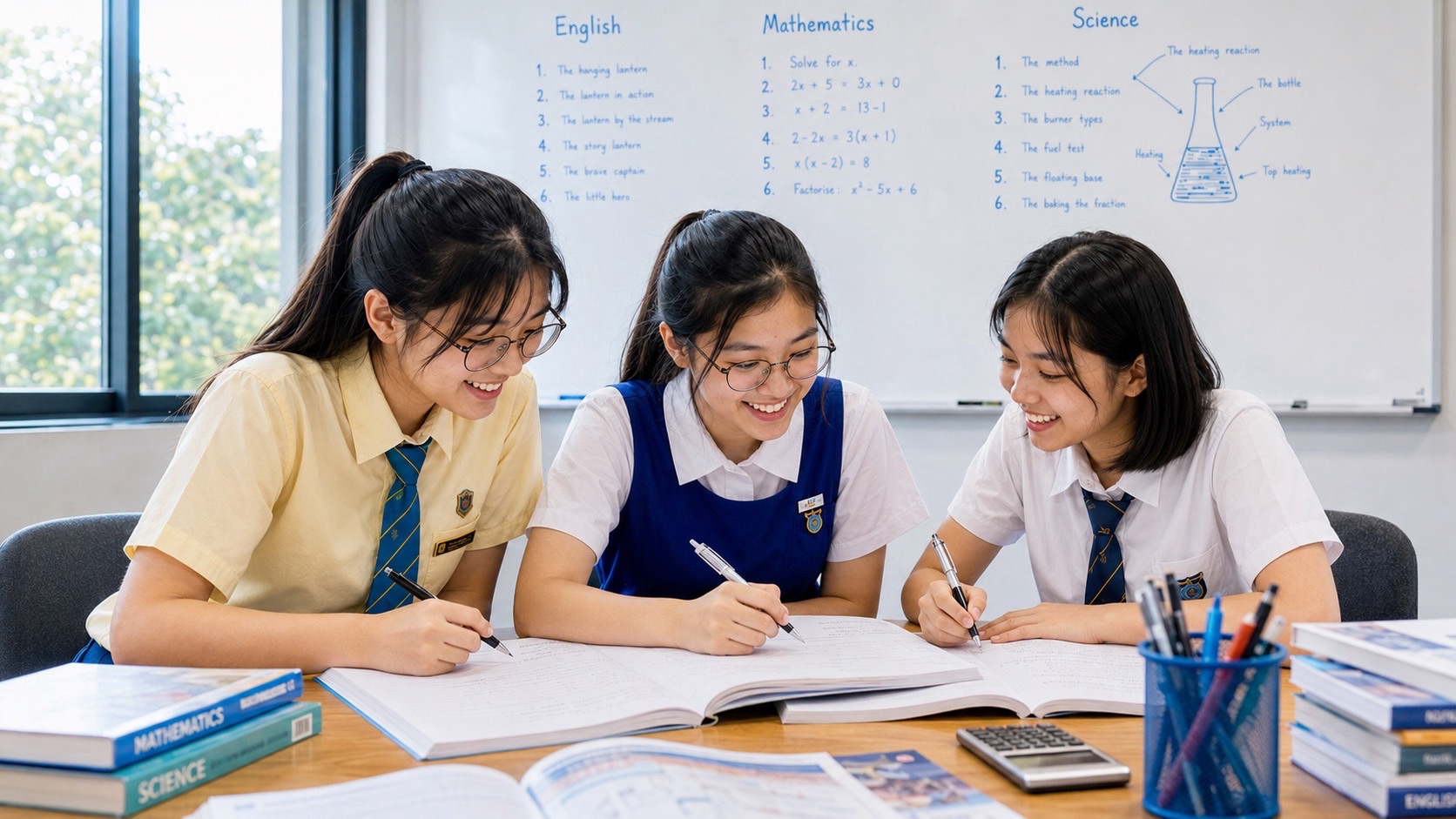
At eduKate Punggol, our Secondary 2 English tutorials are kept to three students. The small number is not a slogan. It changes what can happen in a lesson. The tutor can inspect each learner’s actual comprehension answers, read paragraphs line by line, hear how ideas are explained aloud, identify recurring language errors and still preserve the discussion and comparison that make English a social subject. Lessons are normally around 90 minutes, with the exact balance shaped by what the students need.
This page is a focused commercial guide for parents evaluating a Secondary 2 English tutor in Punggol. It explains the learning problems we commonly see, how we diagnose them, what a purposeful lesson can do, how Full Subject-Based Banding affects the context, and when tuition may or may not be useful. It does not promise a particular grade. It explains the teaching job.
Secondary 2 is the year when familiarity becomes responsibility
Secondary 1 receives much of the attention because the transition from Primary 6 is obvious. Secondary 3 receives attention because upper-secondary pressure is visible. Secondary 2 can look quieter. That is precisely why it matters.
By the second year, students know enough to operate on habit. Some habits are good: they organise materials better, understand school routines and recognise common English tasks. Other habits are less useful: they rush comprehension because they think they know the format, start essays without planning, use familiar but vague vocabulary, or correct grammar only when a teacher points it out. The danger is not dramatic failure. It is normalising a weak method.
Secondary 2 gives the student time to notice and repair those methods before the workload becomes heavier. The aim is not to turn the year into premature examination drilling. It is to make reading, answering, writing, speaking and correcting more deliberate. When that happens, Secondary 3 begins from a stronger base.
The Secondary 2 familiarity trap
A student can say, “I know how to do comprehension,” because the paper format is familiar. But familiarity with the page is not the same as control of the thinking. The child may still answer from general understanding instead of the exact question, choose evidence that is close but not sufficient, or use a phrase from the passage without explaining what it proves.
The same trap appears in writing. The student has written compositions for years, so beginning an essay feels easy. Yet the paragraph may wander because the student has not decided what each section is meant to achieve. Situational writing may follow the correct format but miss the audience or purpose. Oral answers may be fluent but shallow. Vocabulary may sound advanced while being slightly wrong.
This is why Secondary 2 tuition should not merely provide more of the same tasks. The tutor needs to expose the difference between doing a familiar activity and doing it well. The question changes from “Have you seen this before?” to “Can you explain the decision you are making, and can you repeat it in a new context?”

Full Subject-Based Banding: the subject level matters, but the work tells the story
Singapore’s secondary schools now operate under Full Subject-Based Banding. Students study subjects at G1, G2 or G3 where appropriate, and the old idea that one stream label defines the entire learner is no longer the right frame. For tuition, this means we start with the student’s actual English subject level, school expectations and current scripts.
Subject level tells us the broad demand. The student’s work tells us the teaching priority. Two students studying English at the same level can have very different profiles. One may read accurately but write thin paragraphs. Another may write fluently but lose comprehension marks through imprecise answers. A third may have strong ideas but weak grammar under time pressure.
We therefore avoid assuming that a label is a diagnosis. We inspect school papers, compositions, teacher comments and repeated errors. If the student is moving between subject levels or the school has particular arrangements, the family should follow the school’s latest guidance. Parents who want the official framework can read the Ministry of Education’s Full Subject-Based Banding guide.
The real Secondary 2 skill: mode switching
Students use English all day, but not all English serves the same purpose. A WhatsApp message, a formal email, a comprehension answer, a narrative paragraph, a spoken discussion and a summary require different choices. Secondary 2 is a good year to teach students to switch modes consciously.
Everyday English can rely on shared context. Academic English must make more of its reasoning visible. Casual conversation can leave ideas unfinished because the listener can ask a question. A written answer cannot depend on that rescue. Situational writing must adapt to audience. Comprehension requires precision. Summary requires compression. Oral communication requires an idea to be developed aloud rather than merely mentioned.
When students do not recognise the mode, they often produce language that is understandable but unsuitable. They write an argumentative paragraph like a casual opinion, answer an inference question as if it were literal recall, or use dramatic vocabulary in a formal context where a simpler word would be more accurate.
Teaching the mode gives the student a question to ask before beginning: What kind of English does this task require? That one habit can improve many components at once.
Reading: move beyond literal understanding
By Secondary 2, students should be learning to read for more than events and facts. They need to notice attitude, contrast, implication, writer’s purpose, perspective and the effect of particular language choices. These are not isolated examination tricks. They are ways of understanding how texts communicate.
We model reading as a sequence of attention. What is the central situation? Whose point of view is dominant? What changes? Which words carry judgement? Where does the writer contrast one idea with another? What is stated directly and what must be inferred? Which detail is evidence and which is merely illustration?
In a three-student class, reading becomes discussable. One student can offer an interpretation, another can locate the textual evidence and a third can challenge whether the evidence is strong enough. The tutor can then show why some interpretations are better supported than others. This helps students understand that inference is disciplined, not guesswork.
Over time, we want the student to internalise those questions. The tutor should gradually become less necessary as the reader becomes more independent.
Comprehension: precision is often the missing mark
Parents sometimes see a comprehension answer and think it looks reasonable, yet the mark is lost. Secondary English often distinguishes between a generally sensible response and one that addresses the exact demand.
We break comprehension problems into smaller causes. Did the student misunderstand the command word? Select the wrong evidence? Find the right evidence but fail to explain it? Give an incomplete answer? Lift a phrase when own words were needed? Overwrite and introduce an error? Infer beyond what the passage supports?
Each cause requires a different correction. Saying “be more careful” is too vague. If the student repeatedly misses two-part questions, the repair is to identify both demands before answering. If inference is weak, the learner needs practice moving from clue to supported conclusion. If language-effect questions are weak, the student must learn to connect word choice with the impression it creates.
This diagnostic approach reduces randomness. The child begins to understand why marks are lost and what kind of thinking must change.
Vocabulary: build a usable network, not a trophy cabinet
A large vocabulary helps only if the student can retrieve the right word at the right time. Secondary 2 is often when students become attracted to impressive words. That can be productive, but it can also produce unnatural writing if meaning, collocation and register are not secure.
We teach vocabulary as a network. A new word has a definition, but it also has neighbours, opposites, typical partners, tone and context. Students compare words that appear similar and ask what changes when one is substituted for another. They meet vocabulary in reading, use it in discussion and later retrieve it in writing.
For example, words describing attitude become useful in comprehension and oral: sceptical, dismissive, reluctant, indignant, resigned, enthusiastic. Words for argument become useful in writing: consequence, implication, responsibility, trade-off, evidence, limitation. The important point is not to memorise these labels as decoration. It is to use them when they express the intended meaning more accurately.
Vocabulary growth also improves thought. A student who can name a distinction is more likely to notice it.
Grammar: the goal is self-monitoring
At Secondary 2, grammar teaching should begin moving from teacher correction toward student self-monitoring. The tutor cannot sit beside the learner during every school task. The student needs ways to recognise personal error patterns.
We track recurring problems across authentic writing. Does the student shift tense? Produce fragments? Overuse long sentences? Mismanage subject-verb agreement? Use punctuation inconsistently? Choose connectors that do not match the logic? Repeat awkward word forms?
Once a pattern is visible, we can build a targeted loop: identify, explain, correct, rewrite, retest. The next composition then becomes evidence. If the same problem returns unchanged, the correction did not transfer. If it appears less often or the student catches it independently, the system is improving.
Grammar matters not because every sentence must be ornate. It matters because clear thinking needs sentences that can carry it.
Continuous writing: develop the middle, not only the opening
Many students enjoy writing an opening. The difficulty appears in the middle. Ideas repeat, events pile up without consequence, examples stay thin, or paragraphs exist without a clear job.
Secondary 2 is a useful year to focus on development. In narrative writing, a student can learn to select meaningful scenes rather than report every event. In reflective or discursive writing, the learner can move from a claim to a reason, example, implication and qualification. In argumentative writing, the student can begin learning how evidence and counter-perspective strengthen a position.
We teach planning as architecture. What is the central movement? Which paragraphs are essential? What changes from one paragraph to the next? What would make the reader feel that the piece has progressed rather than merely become longer?
Then we teach revision. Students should not assume the first draft is the final product. A paragraph can be tightened, an example replaced, a sentence clarified, a weak transition repaired. Learning to revise is one of the most transferable writing skills a student can acquire.
Situational writing: register becomes a conscious choice
Situational writing is where mode switching becomes concrete. The student must read the role, audience, context and purpose before deciding how to sound. A student who knows the format but ignores the relationship between writer and reader has missed the main communication problem.
We ask students to map the situation: Who am I? Who is receiving this? What outcome do I need? Which given details are compulsory? What tone would be natural and respectful? What information needs development rather than simple mention?
Register is taught as a continuum rather than a binary switch between formal and informal. A message to a teacher may be respectful without sounding like a legal document. A speech to peers may be engaging without becoming slang-heavy. The student learns that good English adapts.
This habit matters beyond school. The ability to adjust language to audience is part of future academic, workplace and civic communication.
Summary: selection before paraphrase
Summary can expose whether a student understands the difference between main information and supporting detail. Students often rush to rewrite sentences before deciding what needs to survive. That creates unnecessary work and increases the risk of changing meaning.
We therefore separate the stages. First understand the focus. Then locate the relevant section. Identify candidate points. Remove examples and repetition. Group ideas that overlap. Only then compress and paraphrase.
Paraphrasing is not a thesaurus exercise. The student must preserve meaning while changing expression where appropriate. Sometimes the clearest word is the original simple word. Sometimes several phrases can be compressed into one more general expression. Students learn to value accuracy over novelty.
Summary training has benefits beyond the component itself. It strengthens reading, note-making, information selection and concise writing.

Oral communication: fluency needs structure
A fluent speaker is not automatically a strong oral candidate. Secondary oral work requires the student to organise a response, support a viewpoint and remain relevant as the discussion develops.
We practise building spoken answers from a clear position. The student gives a reason, develops it with an example or experience, and then explains the significance. Stronger students can add qualification or a second perspective. This prevents the common pattern of repeating the same idea in different words.
A small class is especially useful here because students can hear three different approaches to the same prompt. They learn to listen, respond, compare and refine. The tutor can correct vague phrasing, overused fillers and missing development without turning oral practice into a performance in front of a large audience.
The objective is not a rehearsed speech. It is a student who can think aloud with enough structure to be understood.
Why three students works for Secondary 2
Secondary 2 students are often capable of independent work but still need close feedback. A three-student class creates room for both.
The tutor can see every answer. If one student misreads the question, the mistake does not disappear inside a large group. If another has a recurring grammar pattern, it can be tracked. If the third is ready for a harder extension, the task can be adjusted without breaking the whole lesson.
At the same time, English remains social. Students can compare interpretations, hear alternative paragraph openings, challenge examples and practise oral responses with peers. They discover that there can be several good answers while still learning that not every answer is equally well supported.
The small-group model is therefore not a claim that three is magically perfect. It is a practical teaching choice that keeps each student visible while preserving interaction.
A 90-minute Secondary 2 lesson: tune the system
A lesson is not required to follow the same minute-by-minute pattern every week, but the learning cycle usually contains these moves:
- Retrieve. Revisit a previous skill or vocabulary set to see what remains accessible without prompting.
- Diagnose. Use a short task, school script or recent mistake to locate the current bottleneck.
- Model. The tutor demonstrates the thinking behind a stronger response.
- Guided practice. Students attempt the movement with questions and immediate feedback.
- Independent transfer. A new task checks whether the learner can recognise when and how to apply the skill.
- Correct and rewrite. Students do something with the feedback rather than merely receive a mark.
Some lessons will be writing-heavy, others reading-heavy. What matters is that the student is not simply consuming explanations. The learner has to perform the movement and show that it survives a changed task.
Four Secondary 2 profiles we commonly see
The comfortable student whose marks are slowly slipping
This student does not feel lost, so the decline can be puzzling. Often the school demand has become more precise while the student’s method has stayed the same. We inspect where the mismatch appears and recalibrate.
The hardworking student who repeats the same mistakes
This learner may complete a great deal of practice without a strong correction loop. The priority is not more volume. It is identifying repeated errors, understanding them and verifying whether the next task changes.
The quiet student with stronger thinking than the work shows
Some students understand more than they express. We work on sentence control, vocabulary access, paragraph development and oral explanation so that the thinking becomes visible.
The strong student who has become comfortable
This learner needs stretch: richer texts, more nuanced questions, greater precision and feedback that targets subtle weaknesses. More easy exercises do not create useful challenge.
Repair, stabilise, stretch
Our teaching priorities can be organised into three states.
Repair means a movement is unreliable. The tutor slows the task down, models explicitly and supplies support. The goal is correct performance with understanding.
Stabilise means the learner can perform the skill but not consistently. We vary context, reduce prompts and require the student to recognise the need independently.
Stretch means the skill is secure enough to carry more complexity. Texts become denser, perspectives more nuanced, writing constraints more demanding or time conditions tighter.
A student can occupy different states at the same time. Comprehension inference may need repair while grammar is stable and oral communication is ready to stretch. This is why a useful diagnostic profile is more informative than a single grade.
How Secondary 2 should prepare for Secondary 3
Preparation for upper secondary does not mean starting a year of full examination papers early. It means making the underlying capabilities dependable enough that later exam practice has something to work with.
By the end of Secondary 2, we want students to have a clearer reading process, more precise comprehension habits, a usable vocabulary system, greater control of paragraphs, an understanding of audience and purpose, stronger self-editing and the ability to develop an oral response. These are the engines that upper-secondary preparation will later place under time pressure.
The better the engines, the less frantic the next phase needs to be. A student who reaches Secondary 3 already knowing how to learn from correction can spend more time refining performance and less time repairing basic habits.
What progress looks like before the next examination result
Progress is often visible first in behaviour. The student spends a few seconds classifying a question before answering. A writing plan becomes shorter but more useful. Paragraphs stop repeating the same point. Vocabulary choices become less flashy and more accurate. The learner catches a personal grammar error during revision. Oral answers extend naturally beyond one sentence.
These signals matter because grades are lagging indicators. School papers vary, marking emphasis changes and students can have unusually good or poor days. We want to know whether the learning mechanism is improving.
Parents can ask the child to explain one recent correction. If the student can say what went wrong, why it went wrong and what will be done differently next time, that is evidence of growing ownership.
The mistake ledger: make repetition visible
Secondary 2 is an excellent year to start a simple mistake ledger. The ledger is not a punishment book. It is a record of recurring patterns.
For comprehension it might include: missed second part of question, unsupported inference, vague pronoun reference, lifted phrase without explanation. For writing: paragraph repeats previous point, tense shift, weak example, inappropriate register, conclusion introduces a new idea. For oral: answer too short, no example, repeats prompt, unclear viewpoint.
The value comes from revisiting the categories. If the same error disappears, the learner can reduce attention there. If it persists, the tutor knows the correction needs a different method. The student sees that English weakness is not one giant mystery. It is a collection of smaller patterns, many of which can be changed.
What parents can do without turning home into another tuition centre
Parents can support English with low-pressure habits. Discuss news, school experiences, films or family decisions and ask the child to explain a viewpoint. Encourage reading that is genuinely interesting, not only material chosen because it looks academic. When a marked script comes home, ask about one repeated error rather than interrogating every lost mark.
It also helps to protect time. Secondary 2 students often carry school commitments, CCAs and social changes. More tuition is not automatically better. The child needs enough energy to read, think and consolidate. A packed schedule can produce compliance without learning.
The home can be a place where language is used meaningfully. The tutor can handle detailed instruction.
When tuition may not add enough value
A student who is progressing well, understands teacher feedback, reads independently and can correct weaknesses without additional support may not need tuition. Some students thrive with school resources and self-directed practice. That is a valid outcome.
Tuition becomes more defensible when there is a specific job: marks are drifting because of repeated weaknesses, writing feedback is not transferring, comprehension feels unpredictable, confidence is falling, or the student needs a level of close correction that is difficult to obtain elsewhere.
The decision should account for opportunity cost. A 90-minute lesson plus travel occupies time that could otherwise be used for rest, CCA, reading or self-study. Good tuition needs to create enough learning value to justify that cost.
How to choose a Secondary 2 English tutor in Punggol
Parents can ask questions that reveal the teaching model.
- What evidence will you use to diagnose my child? The answer should include actual work, not only a generic placement label.
- How do you handle a repeated error? Look for explanation, correction, rewriting and retesting.
- What is the real class maximum? Our own model is up to three students.
- How do you differentiate inside a small group? Shared material can still produce different prompts and extensions.
- How do you connect comprehension, writing, vocabulary, grammar and oral? The components should strengthen one another.
- What does progress look like before the grade changes? A useful tutor should be able to name observable behaviours in the student’s work.
See also our parent guide, How to Choose a Tutor in Punggol.
Where this page sits in the eduKate Punggol English architecture
This page owns a focused intent: evaluating Secondary 2 English tutoring and the three-student small-group model. It should not duplicate the full year-level or curriculum hubs. For a wider picture of the school year, continue to Secondary 2 English in Punggol: Familiarity Becomes Responsibility. For the detailed lesson format, see Inside a 3-Student Secondary 2 English Tutorial. For the wider system, use Secondary English Education Systems.
Parents curious about the small-group philosophy across subjects can also read Inside a 3-Pax Tuition Class in Punggol: Every Student Visible. Keeping each page responsible for one reader job helps the site remain navigable and reduces search-intent overlap.
Frequently asked questions
How many students are in a Secondary 2 English class?
Our model is a maximum of three students. The purpose is to keep every learner visible while preserving discussion and peer comparison.
How long is the lesson?
Lessons are normally around 90 minutes. The balance changes according to the group’s current needs.
Do you teach G1, G2 and G3 English?
Teaching begins from the student’s actual school subject level and work. Families should confirm any subject-level arrangements with the school, especially if a change is being considered.
Should Secondary 2 students already be doing full upper-secondary papers?
Not as the default. Selected exam-style tasks can be useful, but Secondary 2 still has time for explicit teaching and correction. Building the underlying capabilities is usually more valuable than premature paper volume.
My child speaks English well. Why are marks not higher?
Everyday fluency and academic performance overlap but are not identical. The student may need more control of inference, evidence, register, paragraph development, grammar or task interpretation.
Can tuition guarantee a top grade?
No. We can provide close teaching, targeted practice and feedback, but outcomes also depend on the student’s starting point, attendance, school work, practice and examination conditions.
What should we bring for a first discussion?
Recent school scripts, writing, teacher comments and examples of tasks the student finds difficult are useful. Several pieces reveal patterns better than one isolated score.
Where is eduKate Punggol?
83 Punggol Central, Singapore 828761. Classes and discussions are by arrangement.
The Secondary 2 objective: make good English habits automatic before upper secondary
Secondary 2 is not a waiting room between the transition year and the examination runway. It is the year in which students can tune the system while there is still space to think slowly, make mistakes, rewrite and try again.
We want the reader who notices what a question demands. The writer who plans enough to give a piece direction. The student who chooses a precise word rather than the biggest one. The speaker who can develop an opinion. The learner who recognises a repeated error and begins to correct it independently.
Those habits are quiet, but they compound. When Secondary 3 arrives, the student does not have to build everything at once.
At eduKate Punggol, the three-student Secondary 2 English tutorial is built around that work: diagnose what is weak, repair it carefully, stabilise it across changed tasks, and stretch the student when the foundation is ready.
To discuss a student’s current English work, WhatsApp eduKate Punggol at +65 8823 1234. The useful starting point is not a promise. It is the student’s actual work.
Curriculum context reviewed 16 September 2026. Families should use the latest MOE, SEAB and school information for current subject-level and examination arrangements.
Four worked Secondary 2 examples: turning familiarity into control
Secondary 2 students often know what an English task looks like. The tutor’s job is to find out whether the student actually controls the thinking inside it. These worked examples show how a familiar-looking mistake can point to a more specific teaching problem.
Example 1: the student who finds the right sentence but gives the wrong answer
A student sees a comprehension question about why a writer describes a room in a particular way. The learner locates the correct sentence and copies most of it. The evidence is right, yet the answer receives little credit because the question asks for the effect of the description, not for the description itself.
The repair is to separate evidence from interpretation. We may ask: What image does the phrase create? What does that image suggest about the place or mood? Which word is doing the work? The student then constructs a short chain from phrase to impression. A second passage checks whether the learner can recognise the same kind of question without being told.
The lesson is not “copy less”. It is “know when the task asks you to explain what the language does”.
Example 2: the fluent writer whose paragraphs do not develop
Another student can produce clean sentences quickly and may even use impressive vocabulary. The paragraph begins with a reasonable point, gives one general example and then moves to a new point. The writing sounds fluent but the thinking remains thin.
We pause before polishing language and teach paragraph development. What is the claim? Why is it true? What specific example makes it concrete? What follows from that example? Is there a limitation or alternative perspective worth acknowledging? The learner rewrites one paragraph rather than producing an entirely new essay.
On a later topic, the student must generate a different example but use the same development principle. That transfer matters more than reproducing the tutor’s model.
Example 3: the student who knows vocabulary but chooses the wrong register
A Secondary 2 learner may have a large vocabulary and still write awkwardly because words are selected for difficulty rather than fit. Imagine a situational task requiring a respectful message to a teacher. The student uses dramatic expressions that would sound natural in a story but excessive in a practical request.
We compare several possible sentences and ask what each implies about tone, relationship and purpose. The student learns that strong vocabulary includes knowing when not to use a sophisticated word. The next exercise changes the audience so the learner must recalibrate again.
This is mode switching in practice: language changes with the communication job.
Example 4: the student who performs well untimed but becomes inaccurate under school conditions
Some students appear to have a knowledge problem when the deeper issue is execution. Given enough time, the learner can plan, infer and edit. Under a timed assessment, the student rushes the first section, spends too long on one writing decision or stops checking grammar entirely.
We do not immediately respond with full timed papers. First we identify where time is being lost. Then we time smaller units: a question set, a paragraph plan, a short editing pass. The student learns a reliable process at manageable speed before the pressure expands.
Timed practice becomes useful when it reveals a decision that can be improved. The clock is an instrument, not a punishment.
What a parent can look for at the end of Secondary 2
By the end of the year, useful preparation for Secondary 3 is visible in habits. The student can explain what different comprehension questions demand. Writing plans have a purpose. Paragraphs contain developed ideas rather than repeated statements. Vocabulary choices fit context. Personal grammar errors are increasingly recognised. Oral answers can move beyond a first opinion. The learner can look at a marked script and identify at least one pattern to change.
None of these guarantees a particular examination grade. They do something more durable: they reduce the amount of basic repair required when upper secondary begins.
Before adding Secondary 2 tuition: identify the exact job
Parents can ask whether the child is merely receiving a mark or learning from the mark. Does the student know why an answer was wrong? Can feedback be used on a different task? Are writing weaknesses repeating across months? Is the student doing a great deal of practice without becoming more independent? Is school support already enough?
If the learner is thriving and correcting weaknesses independently, another class may not be necessary. If effort is high but the same patterns keep returning, close diagnosis can help. The most useful reason to join tuition is not that Secondary 2 is “important”. It is that there is a specific learning problem worth solving.
Our three-student format is designed around that principle: keep every learner visible enough that familiar English tasks can become controlled, explainable and transferable skills before the upper-secondary runway begins.





