
Primary 5 Science Tuition Punggol | Build the P6 Science Runway Near Punggol MRT
Primary 5 Science is not “PSLE Science one year early”. It is the integration year that should make Primary 6 cheaper to learn. The student has already built foundations in P3 and P4. Now the job is to connect new P5 content with older Science, improve experiment and data reasoning, keep earlier topics retrievable, and learn to transfer scientific ideas across unfamiliar contexts.
This page is the P5 integration and P6-runway guide near Punggol MRT. It is distinct from our broader P3–P6 progression pillar and from the P5 tutor page. Here, the focus is what actually belongs to P5, how P3/P4 knowledge should be retrieved rather than re-taught from scratch, how the three-student/1.5-hour model can expose different reasoning paths, and how to prepare for P6 without turning every week into a full PSLE simulation.
The current eduKate Punggol class model is three students for 1.5 hours. Exact current lesson location, timetable and available places should be confirmed directly.
The actual Primary 5 Science scope
Under the current MOE Primary Science syllabus, P5 includes:
- Reproduction,
- Water cycle,
- Respiratory and circulatory systems,
- Electrical systems.
P5 tuition should not blur this ownership by moving P6 material into the year simply to appear advanced. Photosynthesis, energy conversion, friction, gravity, elastic spring force and environment belong to P6. Earlier P3/P4 content may be retrieved because it supports P5 understanding, but it should be identified as prior learning.
| P5 area | Scientific thinking underneath | Earlier dependency |
|---|---|---|
| Reproduction | Sequence, comparison, continuity of species | P3 life cycles |
| Water cycle | Processes, conditions, movement of water | P4 matter and heat concepts |
| Respiratory/circulatory systems | Parts, functions and system interactions | P4 digestive/plant-system habits of relating structure to function |
| Electrical systems | Whole-system relationships and cause/effect | Earlier systems thinking and diagram reading |
The P5 learner should begin to see Science as a network rather than a stack of chapters.
Reproduction: move beyond memorising sequences
Students often learn reproduction by memorising stages or labels. Stronger understanding asks what each process accomplishes and how it connects to continuity of life.
- What changes from one stage to another?
- Which structures have specific functions?
- What similarities and differences exist between plant and animal reproduction?
- Which statements are observations and which are explanations?
- How does the question change when the context is unfamiliar?
The tutor should use diagrams, comparisons and changed examples to prevent the learner from storing one fixed textbook picture as the whole concept.
Water cycle: process chains matter
Water-cycle questions often reveal whether the learner understands process relationships or is simply reciting evaporation/condensation vocabulary.
A useful reasoning chain is:
- What is the starting state?
- What condition changes?
- Which process occurs?
- What state or location results?
- What evidence in the setup supports that conclusion?
The same process should be recognised in a cold drink, a covered container, cloud formation or another changed surface. Transfer matters more than memorising one diagram.
Respiratory and circulatory systems: teach the interaction, not two separate lists
P5 students often know the names of organs but struggle when a question asks how systems work together. Systems understanding requires parts, functions and interactions.
| System question | Useful reasoning |
|---|---|
| What does a part do? | Connect structure/part to function |
| What happens if one part fails? | Trace the consequence through the system |
| How do two systems support the organism? | Identify what is moved/exchanged and why it matters |
| What changes during activity? | Use evidence and system demands rather than memorised slogans |
The lesson should help the child build a whole-system picture that can survive a new diagram.
Electrical systems: understand the circuit as a system
Electrical systems are ideal for teaching cause and effect. Students can reason about complete/incomplete paths, components and how a change in one part affects the system.
- Identify the components.
- Trace the complete path.
- Predict what should happen.
- Change one condition.
- Observe or infer the effect.
- Explain the relationship.
Diagrams should be treated as information, not decoration. The child should read every connection before deciding what the circuit does.
P5 is where old Science must remain alive
One of the biggest P5 risks is that the learner focuses only on current chapters and quietly forgets P3/P4. That makes P6 revision expensive.
A better retrieval loop is:
- Learn the current P5 concept deeply.
- Retrieve one older P3/P4 concept in the same lesson or week.
- Mix old and new questions without announcing the topic.
- Return to an old error after a delay.
- Use changed contexts to test recognition.
- Track what disappears repeatedly.
By the end of P5, the student should carry a connected P3–P5 Science system into P6.
Experiments: P5 should strengthen evidence reasoning
Experiment questions are valuable because they combine content with process skills.
- What is the investigation trying to find out?
- What was changed?
- What was measured or observed?
- What should remain comparable?
- What pattern appears?
- What conclusion is supported?
- What conclusion would go beyond the evidence?
The child should learn that a conclusion is constrained by the setup. Science is not about writing the most impressive answer; it is about writing the answer the evidence supports.
Graphs, tables and diagrams: decode before explaining
P5 students encounter more representations and should learn a consistent decoding routine:
- Read title/context.
- Read labels and units.
- Identify the exact interval or comparison.
- Describe the pattern.
- Only then explain using the relevant scientific idea.
This prevents a common mistake: applying a correct Science concept to a graph the student misread.
Scientific explanation: avoid universal CER/PEE formulas
Frameworks can be useful training aids, but no single acronym should be treated as the official answer to every Science question. The command determines the job.
| Command | Core job |
|---|---|
| State | Give the required fact/outcome directly |
| Describe | Report what happens or what the evidence shows |
| Compare | Make the relationship between both cases explicit |
| Explain | Show the scientific mechanism from condition to result |
| Predict | Use a relationship to state what should happen |
| Conclude | Make a claim that the evidence actually supports |
The target is precise scientific relationships, not a keyword count.
The P5 Science error architecture
| Error class | What it looks like | Repair |
|---|---|---|
| Concept | Scientific model is wrong | Rebuild with contrasting examples |
| Recognition | Knows topic in notes but misses it in mixed questions | Remove topic labels and vary context |
| Inquiry | Variables/evidence/conclusion confused | Slow down experiment reasoning |
| Representation | Graph/table/diagram misread | Translate visual ↔ verbal forms |
| Expression | Idea present but relationship incomplete | Reconstruct around command and mechanism |
| Retrieval | P3/P4 knowledge repeatedly disappears | Spaced mixed recall |
| Execution | Good knowledge weakens under school-paper conditions | Progressive timed sections when appropriate |
Calling all of these “careless” removes the information needed to teach.
Why three students helps P5 Science
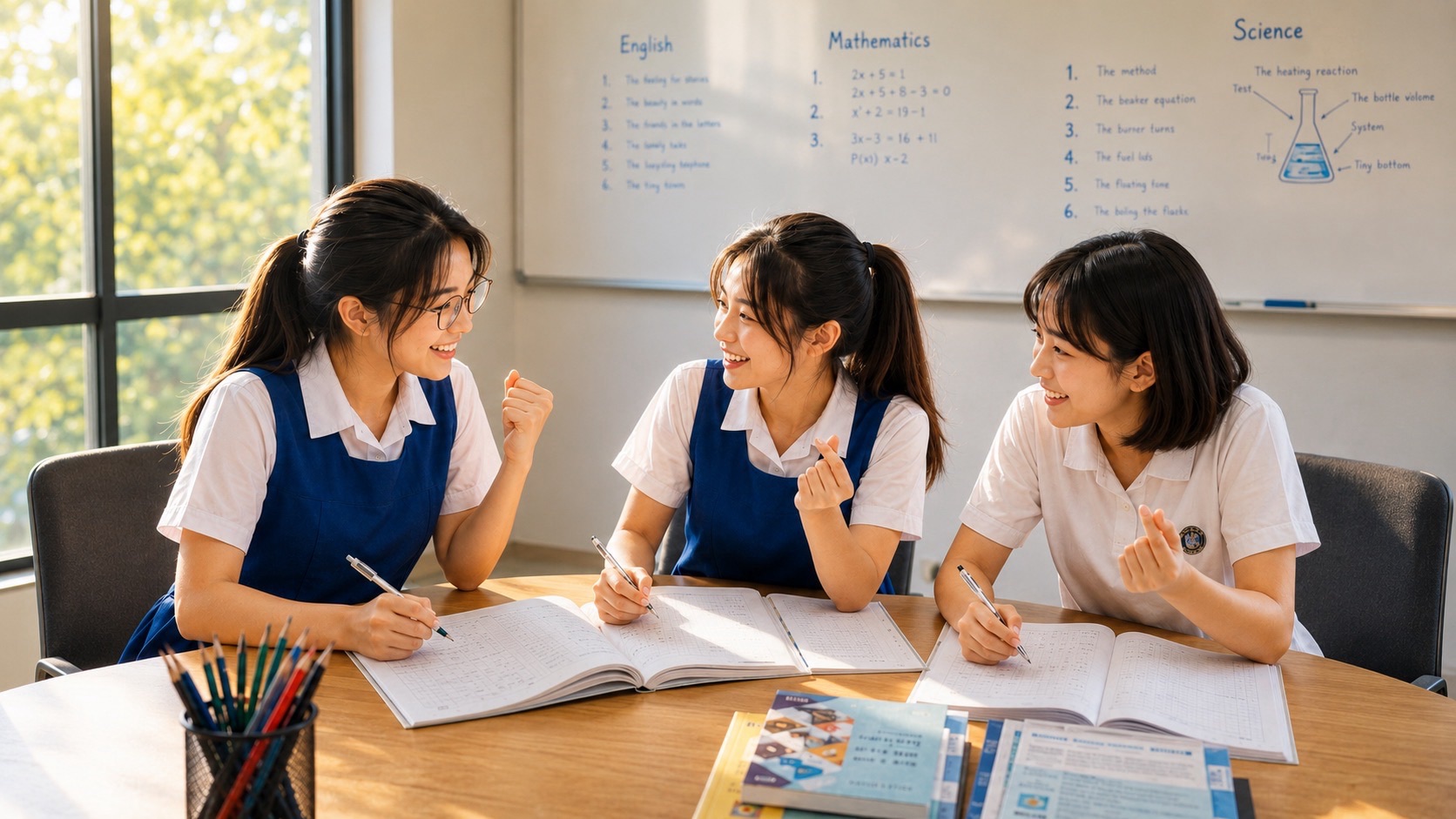
Three students can interpret the same experiment differently. One may identify the variable correctly. Another may notice an uncontrolled factor. Another may write the clearest conclusion. The tutor can compare reasoning rather than compare scores.
For an MCQ, three students may select the same option for three different reasons. The final answer does not reveal whether the choice came from understanding, elimination or guessing. Discussion does.
Personalisation happens through cue level and task variation, not by giving three unrelated lessons.
A 90-minute Primary 5 Science tutorial
| Time | Learning job | What the tutor observes |
|---|---|---|
| 0–10 min | Retrieve one older P3/P4 concept | What remains available? |
| 10–20 min | Review current school work | Which error class is active? |
| 20–40 min | Build/repair current P5 concept | Can the learner explain the relationship? |
| 40–60 min | Guided experiment/data/application work | Can evidence be used correctly? |
| 60–75 min | Mixed or changed-context transfer | Does the concept survive without a topic label? |
| 75–85 min | Independent or lightly timed application | Does quality survive fewer cues? |
| 85–90 min | Error update and handoff | What can the student now do alone? |
This lesson does not require a monthly mock or fixed twelve-week cycle. The active diagnostic should decide the next task.
How P5 should prepare for P6 without becoming P6
- Keep P3/P4 Science retrievable.
- Master P5 concepts within their correct scope.
- Increase mixed-topic recognition gradually.
- Strengthen experiment and representation reasoning.
- Improve scientific expression by command type.
- Use selected PSLE-style thinking tasks where they serve the learning goal.
- Do not replace the year with constant full PSLE simulation.
The P5 end condition is readiness to integrate, not exhaustion from premature exam drilling.
Three hypothetical P5 learners
These are hypothetical examples, not testimonials.
| Learner | Pattern | Priority |
|---|---|---|
| A | Current P5 topics strong, P3/P4 frequently forgotten | Retrieval and mixed-topic recognition |
| B | Content strong, experiment questions weak | Variables, evidence and conclusion |
| C | MCQ strong, open-ended answers incomplete | Command interpretation and scientific mechanism |
What progress should look like by the end of P5
- P5 topic ownership is accurate and stable.
- P3/P4 knowledge remains more retrievable.
- Students identify variables/evidence more reliably.
- Graphs, tables and diagrams are read systematically.
- Scientific answers become shorter and more complete.
- MCQ reasoning can be explained rather than guessed.
- Mixed-topic questions feel less unfamiliar.
- The learner needs fewer prompts to start.
- The child enters P6 with a connected P3–P5 system.
What parents should bring to a P5 Science discussion
- a recent marked Science paper,
- one experiment/data question,
- one open-ended answer before corrections,
- one mixed-topic or old-topic question showing retrieval difficulty,
- teacher comments where available,
- and the student’s own description of what feels difficult.
What not to do in P5 Science tuition
- Do not move P6 topics into P5 to make the programme look advanced.
- Do not list photosynthesis, P6 forces or environment as P5 core content.
- Do not call P5 “the first PSLE year”.
- Do not treat CER/PEE as an official universal answer formula.
- Do not prescribe monthly mocks or a fixed 12-week roadmap to every student.
- Do not promise AL1–AL3 or AL6→AL2 outcomes.
- Do not invent student success stories.
- Do not promise dashboards, bi-weekly tests or home deliverables unless actually offered.
- Do not teach keywords without scientific relationships.
- Do not call all errors careless.
Frequently asked questions
What topics belong to Primary 5 Science?
The current MOE overview includes reproduction, the water cycle, respiratory/circulatory systems and electrical systems.
Should P5 students do full PSLE papers every week?
No. Selected PSLE-style questions can be useful, but P5 should prioritise concept integration, retrieval, experiments, representations and mixed-topic transfer before constant full-paper conditioning.
Are keywords important?
Precise scientific terminology matters, but words must express the correct relationship and answer the actual command. Keyword counting is not a substitute for Science.
What is the current class format?
The current eduKate Punggol model is three students for 1.5 hours.
Related P5 and Science routes
- Primary 5 Science Tutor | Build the P6 Runway
- P3–P6 Primary Science Progression
- How to Improve Primary Science | Seven-Layer Learning System
- Science Tuition Near Waterway Point / Punggol MRT
The P5 end condition
A strong P5 learner should enter P6 with new P5 content understood accurately, earlier Science still retrievable, experiments and representations more manageable, and scientific explanations increasingly constrained by evidence and command words.
That is the P6 runway.





