
Summary
Mathematics tuition at eduKate Punggol is not only about fixing weak topics or preparing for the next examination. It is about helping students enter the larger life of Mathematics: numbers, equations, structure, reasoning, exam control, and future pathways. From PSLE to Secondary, from E-Math and A-Math to IP, IB, IGCSE, university and career readiness, Mathematics becomes the language students use to think clearly in a complicated world.
Punggol Mathematics Tuition System Map | Choose the Right Corridor
This page is the Punggol Mathematics tuition system and philosophy root: it explains how the learning corridor fits together, why foundations compound, and how students regroup, stabilise, stretch and prepare for examinations. Use the routes below when you need the page that owns a narrower year level, examination, mechanism or current tuition-service decision.
1. Primary Mathematics | Build the Floor
The broad Primary journey sits in The Primary Pathway. For the exact year-level tuition route, continue to Primary 1, Primary 2, Primary 3, Primary 4, Primary 5 or Primary 6 Mathematics Tuition.
For the final Primary examination year, use the current flagship: PSLE Mathematics Tuition in Punggol | 2026 Paper Architecture & Parent Guide. That page owns the PSLE paper, final-year diagnosis and parent decision job.
2. Secondary Mathematics | Install, Strengthen, Accelerate, Execute
The wider transition and post-secondary context sits in The Secondary Pathway. For school-stage Mathematics tuition, choose Secondary 1 Mathematics Tuition, Secondary 2 Mathematics Tuition, Secondary 3 Mathematics Tuition or Secondary 4 Mathematics Tuition.
3. Additional Mathematics | Use the Dedicated A-Math Root
When the question becomes specifically about Additional Mathematics, move to Additional Mathematics Tuition in Punggol. That root now owns the broad local A-Math tuition decision and routes onward to Sec 3, Sec 4, readiness, topic knowledge and specialist support without making this page compete for the same intent.
4. How the Tuition System Works | Mechanism, Not Sales Copy
For the teaching mechanism, read How Mathematics Tuition Works | eduKate Punggol. For the deeper repair-and-progression model, continue to Punggol Mathematics Tutorials | Full Math Buffer Corridor. These pages explain the machinery behind diagnosis, repair, reinforcement, acceleration and examination execution.
5. See Mathematics as One Long Learning Pathway
If you need the wider local subject map rather than a tuition-system explanation, return to Mathematics Learning Pathway | eduKate Punggol. It owns the broad Mathematics learning journey and connects Primary, Secondary, examination and future-pathway thinking.
6. Current Tuition Service | When the Question Is “Can eduKate Help My Child?”
For the current service and enrolment-facing route, use Mathematics Tuition at eduKatePunggol. This page remains the current service owner; the page you are reading stays focused on the system, philosophy and routing architecture.
Ownership rule: broad Mathematics learning belongs to the Mathematics Learning Pathway; this URL owns the Punggol Mathematics tuition system and philosophy; year-level pages own their stage; the PSLE flagship owns the final Primary examination job; the A-Math root owns Additional Mathematics tuition; mechanism pages own how the teaching works; and the current service page owns the live tuition decision. Older broad local Mathematics pages are deliberately not promoted here.
Why Punggol Mathematics Tuition?
A child does not wake up one day and suddenly become weak in Mathematics.
Usually, the problem begins quietly.
A fraction is not fully understood.
A word problem is memorised instead of decoded.
An algebra step is copied without meaning.
A geometry rule is used without seeing the shape.
A graph is drawn without understanding what it represents.
At first, the student can still move.
Then the school pace increases.
Primary Mathematics becomes PSLE Mathematics.
PSLE Mathematics becomes Secondary Mathematics.
Secondary Mathematics becomes E-Math.
For some students, E-Math becomes A-Math.
For others, the route stretches into IP, IB, IGCSE, Polytechnic, Junior College, university and career choices.
Then the small weakness becomes visible.
This is why Punggol Mathematics tuition matters.
Not because every child needs more work.
But because many children need better connection.
They need someone to show them how one part of Mathematics links to the next.
Numbers are not just numbers.
Equations are not just equations.
Graphs are not just drawings.
Algebra is not just letters.
Calculus is not just a future topic for “smart students.”
Mathematics is a structure.
And once students understand that structure, they stop seeing each topic as a separate mountain.
They begin to see the road.
Mathematics Is a Corridor, Not a Collection of Chapters
Many students experience Mathematics as scattered chapters.
Fractions this month.
Ratio next month.
Algebra after that.
Geometry later.
Statistics near the examination.
Then revision papers.
This is how Mathematics becomes tiring.
The child keeps moving, but does not always know where they are going.
At eduKate Punggol, the deeper purpose of Mathematics tuition is to build a corridor.
A corridor has direction.
It connects one room to another.
It helps students move from where they are now to where they need to be next.
It gives parents a way to understand progress, not only marks.
For a Primary 5 student, the corridor may lead towards PSLE confidence.
For a Secondary 1 student, the corridor may lead from arithmetic into algebra.
For a Secondary 2 student, the corridor may prepare them for G1/G2/G3 expectations, subject demands and upper-secondary choices.
For a Secondary 3 student, the corridor may help them enter E-Math or A-Math with proper control.
For a Secondary 4 student, the corridor becomes exam execution.
For IP, IB and IGCSE students, the corridor must become even wider: mathematical language, abstraction, modelling, proof, data, applications and university preparation.
Mathematics is not only a school subject.
It is a long road of thinking.
Beginning the Stretch: From Student Mode to Future Mode
There is a point where Mathematics becomes more than homework.
It becomes a signal of readiness.
Can the student handle pressure?
Can the student organise information?
Can the student correct mistakes?
Can the student think logically?
Can the student apply a method in a new situation?
Can the student stay calm when the first path fails?
These are not only examination skills.
They are life skills.
A student who learns Mathematics properly becomes better at dealing with systems.
And the future is full of systems.
Finance is a system.
Engineering is a system.
Computing is a system.
Medicine is a system.
Architecture is a system.
Economics is a system.
Science is a system.
Business is a system.
Artificial intelligence is a system.
Data is a system.
Mathematics gives students the habit of seeing structure inside complexity.
That is why we must teach it properly.
Not only for the next test.
But because properly taught children become stronger thinkers.
And stronger thinkers build a better civilisation.
Why Students Need a Boost and a Regroup
Some students come to Mathematics tuition because they are falling behind.
Some come because they are average but unstable.
Some come because they are already strong but want distinction-level control.
All three students need help, but not the same help.
The falling student needs repair.
They need foundations rebuilt without shame. They need someone patient enough to find the missing blocks and teach from the point of confusion. They need to know that struggling now does not mean they are finished.
The unstable student needs consolidation.
They may understand lessons in school, but marks fluctuate. They can do familiar questions, but panic when questions change. They need a stronger system for practice, checking, timing and error correction.
The strong student needs stretch.
They may already be getting good marks, but still lose careless marks. They may complete standard questions but need sharper judgement for harder ones. They need faster recognition, cleaner working and more intelligent exam control.
This is the boost-and-regroup function of Punggol Mathematics tuition.
Boost the student where they can rise.
Regroup where the foundation is weak.
Stretch where the future is calling.
Numbers, Equations, and Beyond
Mathematics starts with numbers.
But it does not end there.
Numbers teach accuracy.
Equations teach balance.
Graphs teach relationships.
Geometry teaches space.
Statistics teaches interpretation.
Algebra teaches structure.
Calculus teaches change.
Modelling teaches the connection between Mathematics and reality.
A well-taught student does not only ask, “What formula do I use?”
They learn to ask better questions.
What is changing?
What is fixed?
What is the relationship?
What does the question give me?
What does the question want?
What form should I convert this into?
What mistake am I likely to make?
How do I check whether my answer makes sense?
That is the beginning of mathematical maturity.
At eduKate Punggol, Mathematics tuition must help students move towards that maturity.
Because once a student can think like this, Mathematics becomes less frightening.
It becomes a tool.
The eduKate Punggol Mathematics Promise
Good tuition should not make a child busier without making them clearer.
Good tuition should not only give worksheets.
Good tuition should not create panic.
Good tuition should make the problem visible.
Where is the child weak?
What is the missing foundation?
Which habit keeps causing marks to disappear?
Which topic needs repair?
Which examination skill needs training?
Which future pathway needs preparation?
Then we teach.
We explain.
We practise.
We correct.
We repeat.
We stretch.
We prepare.
Small-group tuition gives the tutor the ability to see the student’s working and thinking more closely.
That matters.
In Mathematics, the final answer is only the end of the story.
The real story is in the working.
A student’s working shows whether they understand, whether they are copying, whether they are guessing, whether they are rushing, whether they are thinking.
When the tutor can see the working, the tutor can help the child properly.
Why Punggol Mathematics Tuition Now?
Because the years move quickly.
Primary students become PSLE students.
PSLE students become Secondary students.
Secondary students become examination candidates.
Examination candidates become JC, Polytechnic, IP, IB or IGCSE pathway students.
Then they become university applicants.
Then they enter a world where numbers, systems, data and reasoning matter.
The future does not wait until the child feels ready.
So education must prepare them early.
Not with fear.
With optimism.
With the belief that a child can learn.
With the belief that weak foundations can be repaired.
With the belief that effort can become skill when properly guided.
With the belief that Mathematics is not only for the naturally gifted.
It is for every student who is taught clearly enough, corrected patiently enough, and trained steadily enough to grow.
At eduKate Punggol, Mathematics tuition is a place to regroup, rebuild and move forward.
Numbers first.
Equations next.
Then beyond.
In an increasingly data-driven world, mathematics plays a vital role. Its principles underpin numerous fields, from technology and engineering to economics and the social sciences. At eduKate Punggol Tuition, we appreciate the importance of mathematics and have developed a comprehensive mathematics tuition program to equip students with essential mathematical skills and knowledge.
The Mathematics Buffer Corridor System at eduKate Punggol
Summary
The Mathematics Buffer Corridor System is the way eduKate Punggol helps students avoid academic collapse, recover lost foundations, and move towards stronger examination years. It gives students academic buffer, emotional buffer, topic buffer, exam buffer and future-pathway buffer, so they are not always learning at the edge of panic. The aim is simple: help students catch up, keep up and move ahead.
What Is a Mathematics Buffer Corridor?
A corridor connects.
A buffer protects.
Put them together, and we get one of the most important ideas in Mathematics tuition.
A Mathematics Buffer Corridor is a learning system that helps students move from one stage of Mathematics to the next without falling through the cracks.
It gives the student space.
Space to repair.
Space to practise.
Space to make mistakes before the examination.
Space to ask questions.
Space to understand the concept properly.
Space to grow from weak to stable, and from stable to strong.
Without buffer, students are always reacting.
Homework is due tomorrow.
The test is next week.
The examination is coming.
The topic has already moved on.
The teacher is teaching the next chapter.
The student is still confused about the previous one.
That is not learning.
That is survival.
At eduKate Punggol, Mathematics tuition should not feel like survival.
It should feel like a corridor.
A clear path forward.
Buffer 1: Foundation Buffer
The first buffer is foundation.
This is where many Mathematics problems begin.
A student may be in Secondary 3, but the weakness may come from Primary 6 ratio.
A student may be doing algebra, but the weakness may come from fractions.
A student may be doing trigonometry, but the weakness may come from equation solving.
A student may be doing calculus, but the weakness may come from expansion and factorisation.
A foundation buffer gives students the chance to repair old weaknesses before they damage new topics.
This is not going backwards.
This is engineering.
No one builds a taller building by ignoring cracks in the base.
If the foundation is weak, the higher levels become dangerous.
That is why Mathematics tuition must be diagnostic.
The tutor must ask:
What does this student actually understand?
Which mistakes repeat?
Which earlier topic is causing the current problem?
Which method is memorised but not understood?
Which habit must be corrected now?
When the foundation buffer is built, students begin to feel steadier.
They stop guessing.
They start controlling.
Buffer 2: School-Pace Buffer
Schools must move through the syllabus.
That is understandable.
But students do not all absorb concepts at the same speed.
Some students need more time for algebra.
Some need more time for geometry.
Some need repeated exposure before a method becomes natural.
Some understand in class but forget during independent work.
A school-pace buffer helps the student stay close enough to school that they do not drift.
If the student falls too far behind, every new chapter becomes heavier.
Mathematics is cumulative.
The next topic often assumes the previous topic is already working.
This is why tuition should not only rescue students after a bad examination.
It should help them maintain pace.
At eduKate Punggol, we want students to understand school topics early, practise properly, and correct mistakes before they harden into habits.
This gives students breathing room.
They can enter school lessons with more confidence.
They can attempt homework with less panic.
They can revise earlier.
They can ask better questions.
That is the value of buffer.
Buffer 3: Error-Correction Buffer
Many students practise Mathematics.
But not all practice improves them.
If a child keeps making the same mistake, more practice simply repeats the problem.
The missing step is correction.
An error-correction buffer means the student gets time and attention to examine mistakes properly.
Why did the mark disappear?
Was it a sign error?
A bracket error?
A wrong substitution?
A missing unit?
A misread question?
A poor diagram?
A skipped step?
A weak concept?
A rushed conclusion?
Mistakes are not random.
They have patterns.
Once the pattern is found, the student can be trained out of it.
This is where small-group tuition matters.
In Mathematics, the tutor must see the working.
The working reveals the student’s thinking.
A final answer tells us whether the student arrived.
The working tells us how they travelled.
If the journey is wrong, we fix the journey.
Buffer 4: Exam Buffer
Students need time to become exam-ready.
Understanding a topic is not the same as performing under timed conditions.
A student may know the concept but fail the paper because of timing, panic, careless marks, poor sequencing or weak question selection.
An exam buffer trains performance.
This includes:
Understanding common question types.
Knowing how marks are awarded.
Writing clean working.
Using time properly.
Checking answers intelligently.
Avoiding repeated careless errors.
Recognising when to move on.
Returning to hard questions with a calmer strategy.
For PSLE students, exam buffer means accuracy, problem-solving stamina and confidence across paper formats.
For Secondary students, exam buffer means moving from topic knowledge into paper control.
For E-Math and A-Math students, exam buffer means recognising routes quickly and presenting solutions clearly.
For IP, IB and IGCSE students, exam buffer also means handling unfamiliarity, modelling, explanation and deeper reasoning.
The examination is not only a memory test.
It is a performance environment.
Students must be trained for that environment.
Buffer 5: Stretch Buffer
Not every student comes to tuition because they are weak.
Some students come because they are ready to move higher.
They need stretch buffer.
A strong student can become bored if tuition only repeats what they already know.
But a strong student can also become careless if they rely too much on natural ability.
Stretch buffer gives capable students harder questions, deeper explanation and better exam judgement.
It trains them to move from “I know this” to “I can handle this under pressure.”
That distinction matters.
High performance in Mathematics is not only about intelligence.
It is about precision.
The student must know how to avoid unnecessary mark loss.
They must recognise hidden traps.
They must choose efficient methods.
They must stay disciplined when the question looks familiar.
They must not become arrogant with easy marks.
Stretch buffer prepares students for distinction-level work.
Buffer 6: Future Pathway Buffer
Mathematics does not end at the examination hall.
A student who is trained well in Mathematics is better prepared for future academic pathways.
Secondary Mathematics connects to A-Math.
A-Math connects to stronger post-secondary Mathematics.
IP and IGCSE pathways may require broader and deeper mathematical flexibility.
IB Mathematics can demand analysis, modelling, interpretation and extended thinking.
University and career pathways may require data literacy, quantitative reasoning and problem-solving discipline.
A future pathway buffer helps students understand why today’s Mathematics matters.
This gives learning meaning.
A child who only studies for marks may burn out.
A child who sees Mathematics as preparation for future capability can begin to respect the subject differently.
They start to see that algebra is not just homework.
It is training for abstraction.
They start to see that graphs are not just school drawings.
They are ways to understand relationships.
They start to see that statistics is not just a chapter.
It is how modern societies read information.
They start to see that Mathematics is not a wall.
It is a bridge.
Why This System Works for Parents
Parents often feel lost because they only see the result.
The test score comes home.
The child is upset.
The parent asks what happened.
The child says, “I don’t know.”
That is painful.
A buffer corridor gives parents a clearer language.
Instead of only asking, “Why did you score badly?” we can ask better questions.
Is this a foundation issue?
Is this a school-pace issue?
Is this an exam issue?
Is this an error-pattern issue?
Is this a confidence issue?
Is this a stretch issue?
Once the category is clear, the support becomes clearer.
The child is no longer just “weak in Math.”
The child has a specific repair path.
That is more hopeful.
The eduKate Punggol Mathematics Buffer Corridor
At eduKate Punggol, Mathematics tuition should give students a better learning runway.
Not panic.
Not noise.
Not blind drilling.
A runway.
The child enters with confusion, weakness, instability or ambition.
The tutor identifies the current position.
Then we build the buffer.
Foundation buffer.
School-pace buffer.
Error-correction buffer.
Exam buffer.
Stretch buffer.
Future pathway buffer.
This is how students catch up.
This is how students keep up.
This is how students move ahead.
A buffer corridor protects the student from collapse while guiding them towards higher performance.
And when the student begins to feel safe enough to try, clear enough to practise, and strong enough to attempt harder work, Mathematics changes.
It becomes possible again.
Aligning with MOE SEAB Syllabus
Our mathematics curriculum is aligned with the guidelines set by the Ministry of Education (MOE) and the Singapore Examinations and Assessment Board (SEAB). It spans the breadth of mathematical topics, covering numeracy, algebra, geometry, statistics, and more. Our tutors guide students through each concept, ensuring they grasp foundational principles before progressing to more complex ideas.
Yet, our teaching extends beyond the syllabus. We aim to instil in students a deep appreciation for the beauty and utility of mathematics. Through real-world examples and applications, we demonstrate the relevancy of mathematical concepts to everyday life and a multitude of professions.
From Sec 4 to University and Career Mode — Mathematics Tuition for the Long Stretch
Summary
Mathematics tuition at eduKate Punggol is designed not only for the next school test, but for the longer stretch from PSLE to Secondary, from Sec 4 to IP, IB, IGCSE, JC, Polytechnic, university and future careers. This article explains why Mathematics is one of the most important subjects for career readiness, how students can regroup before major examination years, and why a strong Mathematics corridor gives children a better future launch.
Sec 4 Is Not the End
For many families, Secondary 4 feels like the final battle.
The examination year arrives.
The timetable tightens.
The stakes feel higher.
The student has less room to drift.
Every weak topic now matters.
But Sec 4 is not the end of Mathematics.
It is a launch point.
After Sec 4, students move into different futures.
Some enter Junior College.
Some enter Polytechnic.
Some continue through IP.
Some take IB.
Some follow IGCSE-related pathways.
Some move towards engineering, computing, business, economics, design, science, medicine, architecture, finance, data, education or entrepreneurship.
Mathematics follows them.
Not always as a subject name.
Sometimes it appears as statistics.
Sometimes as coding.
Sometimes as finance.
Sometimes as research.
Sometimes as modelling.
Sometimes as systems thinking.
Sometimes as logical reasoning.
Sometimes as decision-making under uncertainty.
That is why Mathematics tuition should not only prepare students to survive Sec 4.
It should help them enter future mode.
Career Mode Begins Earlier Than Parents Think
Many students think career preparation begins after O-Levels, after IB, after Polytechnic, after university applications.
But the habits begin much earlier.
A student who learns to organise working is learning professional clarity.
A student who learns to check answers is learning quality control.
A student who learns to manage time is learning execution.
A student who learns to correct mistakes is learning resilience.
A student who learns to understand graphs is learning data literacy.
A student who learns algebra is learning abstraction.
A student who learns problem-solving is learning how to stay useful in a changing world.
These habits matter beyond school.
The future will not only reward people who memorise information.
It will reward people who can understand systems, solve problems, interpret data, make decisions and keep learning.
Mathematics is one of the best training grounds for that.
This is why the long stretch matters.
From Primary to PSLE.
From PSLE to Secondary.
From Secondary to Sec 4.
From Sec 4 to post-secondary.
From post-secondary to university.
From university to career.
A student does not need to know their entire future at age 12 or 16.
But they should be given the skills to keep more doors open.
The Great Regroup Year
Every student needs a regroup year.
For some, that year is Primary 5.
This is when PSLE pressure starts to become real, and the student must move from “knowing the topic” to answering with accuracy.
For some, it is Secondary 1.
This is when arithmetic becomes algebra, and students need a new operating system.
For some, it is Secondary 2.
This is when the pace becomes more serious and subject-level expectations become clearer.
For some, it is Secondary 3.
This is when upper-secondary Mathematics begins, and E-Math or A-Math starts to expose weak foundations.
For some, it is Secondary 4.
This is when there is no more time to pretend confusion is harmless.
The regroup year is not a failure year.
It is a strategic year.
It is the moment to stop drifting, look clearly at the student’s Mathematics, and ask:
What must be repaired?
What must be strengthened?
What must be stretched?
What examination skills are missing?
What future pathway are we preparing for?
This is where good tuition becomes powerful.
Not because it magically changes the child overnight.
But because it gives the child a system.
PSLE, SEC, IP, IB and IGCSE: Different Roads, Same Core
The route may change.
The core remains.
PSLE students need number sense, problem-solving stamina, accuracy and confidence.
Secondary students need algebra, geometry, proportional reasoning, graph sense, statistics and examination control.
E-Math students need broad fluency across many topic types.
A-Math students need deeper algebra, functions, trigonometry and calculus readiness.
IP students often need stronger conceptual flexibility because school pacing can be faster and less examination-spoon-fed.
IB students may need mathematical analysis, applications, modelling, interpretation and extended reasoning.
IGCSE students may need strong topic coverage, international syllabus familiarity and careful exam preparation.
Different roads.
Same core.
The student must understand.
The student must practise.
The student must correct mistakes.
The student must learn how to think.
The student must become confident enough to face unfamiliar problems.
That is the Mathematics life.
Not just a syllabus.
A long training of the mind.
Why Punggol Mathematics Tuition Helps New Students Enter the System
New students often come with uncertainty.
Some are worried.
Some are quiet.
Some are embarrassed.
Some are used to doing well but have started slipping.
Some have already decided that Mathematics is “not for them.”
The first job of tuition is not to judge them.
It is to locate them.
Where is the student now?
What do they know?
What do they misunderstand?
What do they avoid?
What do they fear?
What can they already do well?
What is the next best step?
Once the tutor locates the student, learning can begin properly.
This is especially important for new students joining from different schools, different paces, different syllabuses or different learning histories.
At eduKate Punggol, the small-group model helps because students cannot disappear into the back of a large class.
Their working can be seen.
Their habits can be corrected.
Their confidence can be rebuilt.
Their progress can be watched.
Mathematics becomes personal again.
The child is no longer just trying to keep up with a system.
The system is now helping the child move.
The Boost Phase
After regrouping comes boost.
Boost does not mean rushing.
Boost means lifting the student with structure.
For a weak student, boost may mean moving from failure to pass.
For an average student, boost may mean moving from unstable marks to consistent performance.
For a strong student, boost may mean moving from good to distinction-level precision.
Boost has stages.
First, repair the foundation.
Then stabilise the school topics.
Then build question fluency.
Then correct repeated errors.
Then train timing.
Then stretch with harder questions.
Then prepare for examination output.
This is how Mathematics improvement becomes real.
It is not one motivational speech.
It is a ladder.
The student climbs one step at a time.
University and Career Mode
University and career mode does not mean forcing every child to become an engineer, doctor, coder or economist.
It means preparing the child to keep thinking well in a world where thinking matters.
A student with strong Mathematics habits can enter many futures with more confidence.
They can read charts.
They can understand risk.
They can handle quantitative modules.
They can learn coding more easily.
They can approach business numbers more intelligently.
They can reason through systems.
They can solve problems with patience.
They can make decisions with evidence.
This is the deeper reason Mathematics matters.
It is not only about the examination certificate.
It is about becoming capable.
Capable students build capable families.
Capable families build stronger communities.
Stronger communities build a better civilisation.
Education is not a small thing.
Every properly taught child is part of the future infrastructure of society.
The Final Message: Mathematics Is a Future Language
Mathematics is the language of pattern, structure, quantity, change and relationship.
Students may begin with numbers.
Then they meet equations.
Then they meet graphs, functions, geometry, statistics, trigonometry and calculus.
Eventually, if taught well, they realise that Mathematics is not only about finding answers.
It is about learning how to think.
That is why Punggol Mathematics tuition at eduKate Punggol should be understood as more than academic support.
It is a corridor into the future.
A place to regroup.
A place to repair.
A place to boost.
A place to stretch.
A place to prepare for PSLE, SEC, IP, IB, IGCSE and beyond.
The child may begin with confusion.
But with clear teaching, close correction and steady practice, confusion can become structure.
Structure can become confidence.
Confidence can become performance.
Performance can become opportunity.
And opportunity can become a better life.
Numbers first.
Equations next.
Then beyond.
That is the Mathematics life.
Small Group Tutorials for Personalized Learning
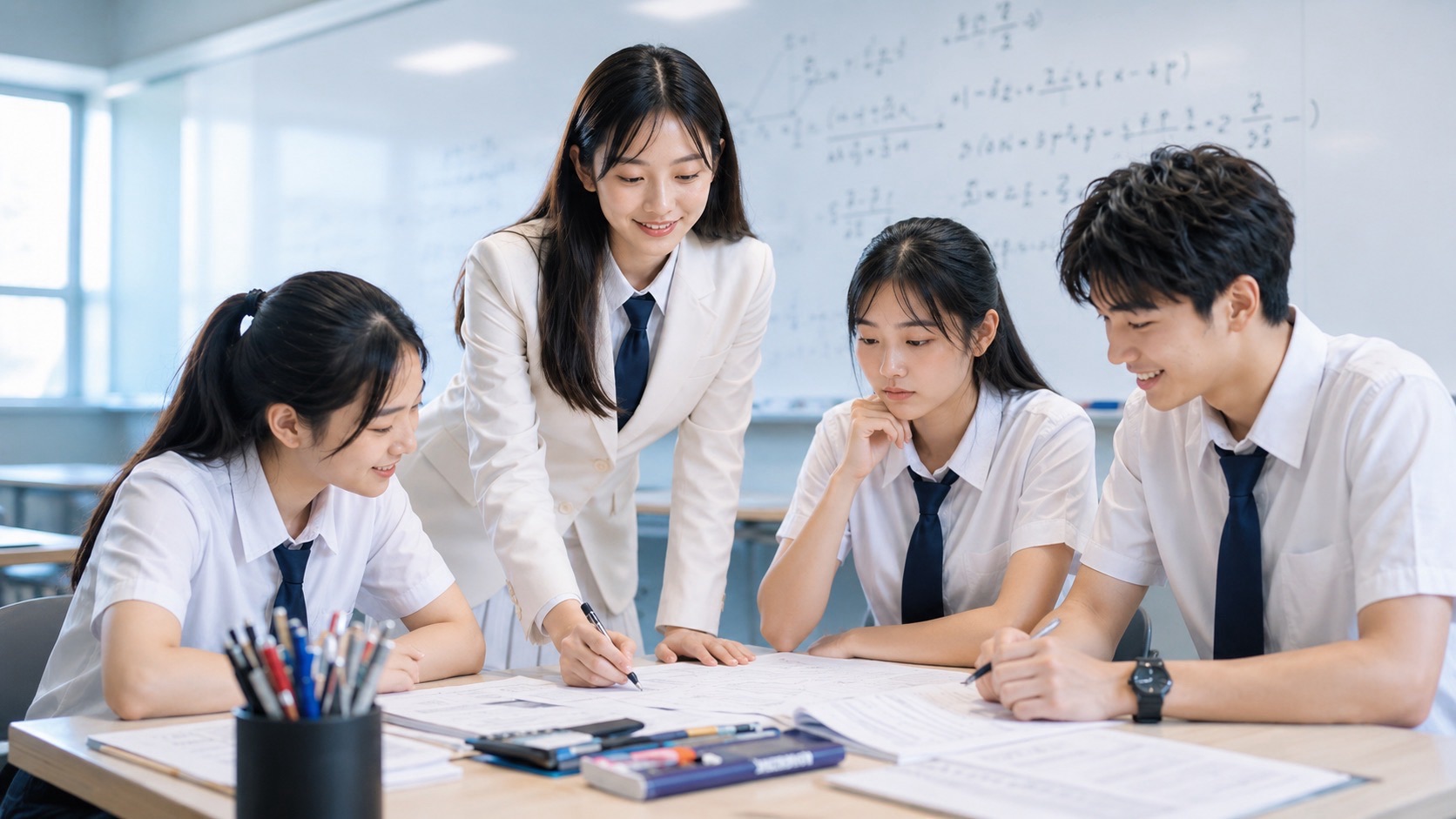
At eduKate Punggol, we understand that each student has unique learning needs and strengths. To cater to these individual differences, we limit our class sizes to three students. This small group format allows our tutors to provide personalized instruction, adjusting their teaching methods to suit each student’s learning style.
We believe that learning mathematics is not just about memorizing formulas or procedures. Instead, it requires understanding the concepts, applying them in various contexts, and thinking critically. Our small group tutorials facilitate this process, enabling students to actively engage with mathematical concepts, ask questions, and receive immediate feedback.
Engaging and Interactive Learning Environment
Our aim is to make learning mathematics an enjoyable and fulfilling experience. Despite the subject’s rigorous nature, we strive to create an engaging and interactive learning environment.
We use various teaching tools and methods, such as hands-on activities, group discussions, and problem-solving exercises. These not only reinforce mathematical concepts but also encourage critical thinking, creativity, and collaboration. By making mathematics tangible and relatable, we help students to see the subject as more than just numbers and equations.
A Holistic Approach to Mathematics Education
At eduKate Punggol, our approach to mathematics tuition is holistic. While we focus on academic excellence, we also recognize the importance of character development and soft skills.
Our mathematics classes serve as a platform for students to learn to communicate effectively, work collaboratively, and approach problems with resilience and determination. These skills are not only vital in tackling mathematical problems but also in navigating real-life challenges.
In addition, we organize programs outside the traditional classroom setting, providing students with a well-rounded educational experience. These include educational trips, holiday programs, and collaborations with other educational institutions.
Punggol Mathematics Tuition as the Great Recalibration Year
Summary
Mathematics tuition at eduKate Punggol helps students recalibrate before the next major academic stretch. Whether the student is preparing for PSLE, Secondary Mathematics, E-Math, A-Math, IP, IB, IGCSE or future university and career pathways, the aim is to locate the child accurately, repair what is weak, strengthen what is unstable, and stretch what is ready. A good Mathematics year is not only about more practice. It is about installing a better learning system.
The Year a Student Recalibrates
There is always a year when Mathematics asks the student to become someone slightly stronger.
For some, it happens in Primary 5.
The questions become longer.
The marks become more important.
The PSLE begins to feel near.
For some, it happens in Secondary 1.
The student leaves Primary Mathematics and enters a new world of algebra, negative numbers, graphs, equations and abstract thinking.
For some, it happens in Secondary 2.
The pace tightens.
The subject demands become clearer.
Weak habits begin to show.
For some, it happens in Secondary 3.
Upper Secondary Mathematics begins.
E-Math becomes more serious.
A-Math, for those taking it, demands a much higher level of algebraic control.
For some, it happens in Secondary 4.
There is no longer much time to drift.
Every weak topic, every careless mistake, every unclear habit now has examination consequences.
This is the Great Recalibration Year.
It is the moment when a student has to stop learning Mathematics as a series of disconnected school chapters and begin learning it as a connected system.
At eduKate Punggol, Mathematics tuition helps students make that shift.
Recalibration Is Not Panic
Many families come for tuition when they feel the pressure rising.
The marks are not moving.
The homework takes too long.
The child says they understand in class, but cannot do the questions alone.
The careless mistakes keep returning.
The examination feels closer every week.
It is natural to worry.
But panic is not the solution.
Recalibration is.
Panic says, “Do more.”
Recalibration says, “Find out what is wrong.”
Panic says, “Finish more papers.”
Recalibration says, “Which mistake keeps repeating?”
Panic says, “Why are you so careless?”
Recalibration says, “What habit caused the mark loss?”
Panic says, “You must improve quickly.”
Recalibration says, “Let us build the system properly.”
This is why Mathematics tuition must begin with clarity.
Before we push the child harder, we must locate the child accurately.
Locating the Student
A student’s current mark is useful, but it is not enough.
A score tells us what happened.
It does not always tell us why.
Two students may both score 58.
One may have weak foundations.
One may understand the concepts but lose marks through careless execution.
Two students may both score 75.
One may be stable and ready to stretch.
One may be fragile and only doing well because the paper was familiar.
Two students may both say, “I don’t know how to do this.”
One may be missing the topic.
One may be missing the starting strategy.
So the first job of tuition is not to label the child.
It is to locate the child.
Where is the student strong?
Where is the student weak?
Which topics are unstable?
Which mistakes repeat?
Which school chapters are coming next?
Which examination year are we preparing for?
Which pathway does the student need to keep open?
Once the student is located, we can teach with purpose.
The Three Recalibration Groups
Most Mathematics students fall into three broad groups.
The first group needs to stop falling.
These students are losing confidence. They may be failing or barely passing. They often carry older weaknesses into newer topics. They need patient repair, clear explanation and steady wins.
For them, tuition must reduce fear.
The second group needs to become stable.
These students are not always weak, but their marks fluctuate. They can do familiar questions, but struggle when the paper changes. They may understand lessons but fail to reproduce the method under pressure.
For them, tuition must build consistency.
The third group needs to stretch.
These students are already doing reasonably well. They may be aiming for A1, AL1, distinctions, scholarship-level confidence, stronger IP/IB/IGCSE readiness, or a better launch into JC, Polytechnic and university pathways.
For them, tuition must sharpen thinking.
Stop falling.
Become stable.
Stretch higher.
This is a simple way for parents to understand where their child is.
Not every student needs the same kind of Mathematics tuition.
The correct teaching depends on the correct diagnosis.
The Buffer Corridor Inside Recalibration
A recalibration year needs buffer.
Without buffer, the student is always too close to the edge.
Too close to the next test.
Too close to the next chapter.
Too close to the next mistake.
Too close to giving up.
A buffer corridor gives students breathing room.
It protects them while moving them forward.
At eduKate Punggol, this means the student should not only be doing what school is doing this week.
The student should also be repairing what came before and preparing for what comes next.
That is the corridor.
Past, present, future.
Past: fix the missing foundations.
Present: keep up with school.
Future: prepare for the next examination and pathway.
When these three parts are connected, the child stops feeling like Mathematics is chasing them.
They begin to feel that they are moving through Mathematics with direction.
Why This Matters for PSLE
For PSLE students, recalibration means turning Primary Mathematics into examination readiness.
The child may know the topic, but PSLE requires more than topic knowledge.
It requires accuracy.
It requires stamina.
It requires problem-solving.
It requires careful reading.
It requires time control.
It requires the ability to link different concepts inside one question.
This is why PSLE Mathematics cannot be left to last-minute drilling.
A child needs time to grow into the examination.
At eduKate Punggol, PSLE Mathematics tuition should help students build a clean problem-solving process.
Read.
Understand.
Represent.
Solve.
Check.
Correct.
When this process becomes natural, the student becomes calmer.
And calm students think better.
Why This Matters for Secondary Mathematics
Secondary Mathematics is a new operating system.
Many students enter Secondary 1 still thinking like Primary students.
They wait for model methods.
They expect questions to look familiar.
They try to memorise procedures.
But Secondary Mathematics asks for more.
It introduces algebra.
It expects symbolic thinking.
It requires students to handle negative numbers, expressions, equations, graphs, geometrical reasoning and statistics with increasing independence.
This is why the Secondary 1 and Secondary 2 years matter so much.
They are not “easy years.”
They are installation years.
If the operating system is installed well, upper secondary becomes more manageable.
If the system is weak, Secondary 3 and Secondary 4 become much heavier.
Good Mathematics tuition catches this early.
Why This Matters for E-Math and A-Math
E-Math requires broad fluency.
A student must handle many topic types across number, algebra, geometry, graphs, statistics, probability and application.
A-Math requires deeper control.
It asks students to handle algebra, functions, trigonometry and calculus with greater precision.
Both subjects punish weak foundations.
Both subjects reward clean working.
Both subjects require exam discipline.
But A-Math especially exposes students who only memorise.
A-Math questions often require route recognition.
The student must know how to start, which form to use, when to transform, when to factorise, when to substitute, and how to continue when the question is not obvious.
That is why the recalibration year is critical for Secondary 3 and Secondary 4 students.
They are not only learning harder topics.
They are learning a higher form of mathematical behaviour.
Why This Matters for IP, IB and IGCSE
For IP, IB and IGCSE students, Mathematics can become broader, faster and more independent.
Students may need to handle unfamiliar questions, different assessment styles, modelling, extended reasoning, applications, data interpretation or deeper conceptual links.
This requires more than standard practice.
It requires mathematical maturity.
Students must understand ideas well enough to move between formats.
They must not panic when the question is phrased differently.
They must learn to think beyond the worksheet.
This is why the buffer corridor is useful.
It gives the student a stronger base and a wider runway.
A student who has only memorised local question types may struggle when the examination style changes.
A student who understands structure can adapt.
From Exam Mode to Career Mode
The best Mathematics tuition prepares the student for examinations.
But it should also prepare the student for life beyond examinations.
Mathematics trains habits that the future needs.
Accuracy.
Discipline.
Logic.
Pattern recognition.
Data reading.
Problem-solving.
Abstract thinking.
Resilience.
Decision-making.
These habits matter in university.
They matter in work.
They matter in a world where technology, finance, engineering, computing, science, economics and data are becoming more important.
Even if a child does not become a mathematician, Mathematics helps them become a clearer thinker.
That is why we teach it with respect.
Not as punishment.
Not as fear.
Not as endless worksheets.
As preparation for a larger life.
The eduKate Punggol Recalibration Method
The method is simple.
First, we locate.
We find out where the student is strong, weak, unstable or ready to stretch.
Second, we repair.
We fix missing foundations before they damage higher topics.
Third, we stabilise.
We help the student keep up with school and practise with proper guidance.
Fourth, we correct.
We study mistakes and remove repeated error patterns.
Fifth, we stretch.
We train stronger students to handle harder questions, faster recognition and cleaner exam output.
Sixth, we prepare.
We build examination readiness and future-pathway confidence.
This is the recalibration system.
Locate.
Repair.
Stabilise.
Correct.
Stretch.
Prepare.
It is not glamorous.
But it works because it respects how Mathematics is actually learned.
The Optimistic View
The optimistic view is this:
A weak Mathematics year does not have to become a weak Mathematics life.
A bad test does not define a child.
A confused student can become a clear student.
A careless student can become a disciplined student.
A frightened student can become a confident student.
A good student can become a distinction student.
A distinction student can become a future-ready thinker.
But this does not happen by accident.
It happens when the child is properly taught.
At eduKate Punggol, Mathematics tuition is not only about helping students survive school.
It is about helping them enter the Mathematics life with confidence.
Numbers first.
Equations next.
Then graphs, systems, patterns, calculus, data, university and career mode.
A child begins with a question on paper.
But with the right guidance, that question becomes part of something much larger.
It becomes training for the future.
And the future needs children who can think.
Join Us at eduKate Punggol Tuition
eduKate Punggol Tuition is committed to nurturing a love for mathematics and empowering students to excel in this crucial subject.
Our dedicated tutors are passionate about education and are ready to guide your child on their journey of mathematical discovery. We look forward to welcoming your child to our learning community and accompanying them on their path to success.





