
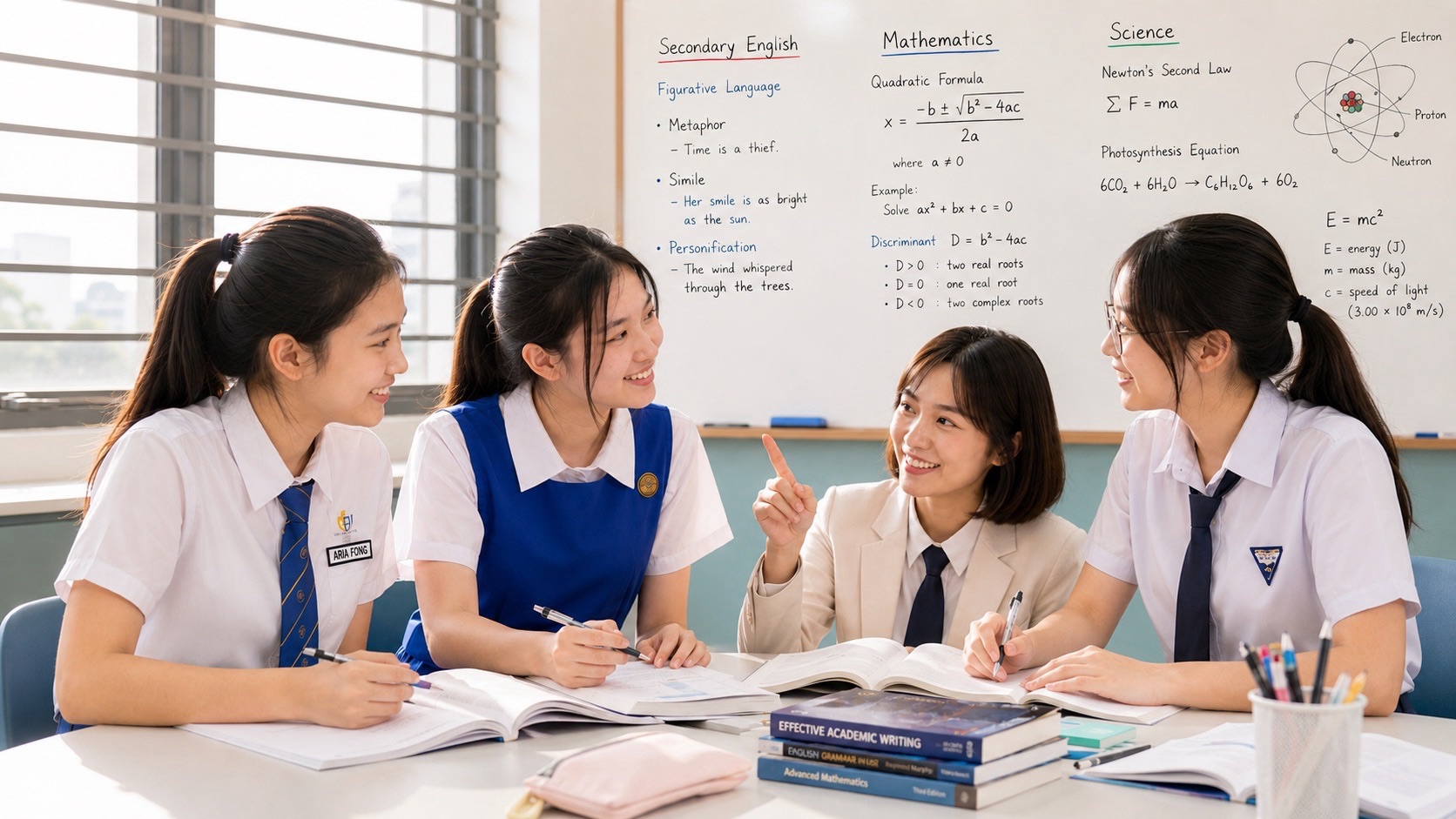
Mathematics is more than calculation. A child must understand meaning, recognise relationships, represent information, select a valid method and verify the result. This parent-friendly guide explains how mathematical thinking develops, where it breaks and how careful teaching can restore the route.
Mathematics can look simple from the outside.
A question is given.
The child performs a calculation.
An answer appears.
But a great deal must happen between the question and the answer.
The child must understand what the numbers mean, recognise how the quantities are related, choose a suitable method, complete each step accurately and check whether the result makes sense.
When any part of that route breaks, the final answer may be wrong.
This is why a wrong answer does not always mean that the child does not know Mathematics.
The child may know the facts but misunderstand the question.
The child may understand the question but not know how to represent it.
The child may know the method but fail to recognise when to use it.
The child may choose the correct route but make an error while carrying it out.
Or the child may complete everything correctly but fail to answer what was actually asked.
To help a child improve, we first need to understand how Mathematics works.
The Simple Answer
Mathematics works by giving quantities and relationships precise meanings, then allowing us to move from what is known to what is unknown through valid steps.
Every mathematical solution contains five essential parts:
Meaning
Relationship
Representation
Method
Verification
A child who can manage all five parts can usually solve Mathematics with increasing independence.
A child who is weak in one part may still succeed on familiar questions, but the performance becomes fragile when the wording, numbers or context changes.
Mathematics Is Not Mainly About Numbers
Numbers are part of Mathematics.
They are not the whole of it.
Mathematics is also about:
- quantity;
- comparison;
- position;
- pattern;
- shape;
- measurement;
- change;
- uncertainty;
- structure;
- relationships.
Consider the statement:
Sarah has three times as many stickers as Mei.
The important idea is not simply the two names or the stickers.
The mathematical structure is the relationship:
Sarah’s quantity = 3 × Mei’s quantity
The same relationship can appear in many different forms:
- three times as many books;
- three times the distance;
- three times the amount of money;
- three times the number of students;
- three times the volume of water.
The surface story changes.
The mathematical structure remains.
Learning Mathematics means becoming increasingly able to see the structure beneath the story.
The Five-Part Mathematics Engine
1. Meaning: What Does Everything Represent?
Before a child can solve a question, the mathematical objects must have stable meanings.
The child needs to know:
- what each number represents;
- what the units mean;
- what each symbol means;
- what operation is being described;
- what the question is asking to find.
For example:
12 ÷ 3 = 4
This may describe:
- 12 objects shared among 3 people;
- 12 objects arranged in groups of 3;
- the number of 3-unit lengths within a length of 12;
- the number of times 3 fits into 12.
The calculation is identical.
The meaning changes with the situation.
A child who memorises division procedures without understanding division may complete routine sums but become confused when division appears inside a word problem.
Meaning comes first because every later step depends on it.
2. Relationship: How Are the Quantities Connected?
Mathematics becomes possible when the child sees how one quantity relates to another.
Common relationships include:
- part and whole;
- equal groups;
- difference;
- comparison;
- change over time;
- proportion;
- sequence;
- rate;
- area and dimension;
- cause and result.
A word problem may contain many numbers.
Not every number should be used immediately.
The child must identify which quantities are connected and how they are connected.
For example:
A tank contained 240 litres of water. After some water was used, 35% remained.
The important relationship is not simply between 240 and 35.
The child must understand that 35% describes the remaining part of the original whole.
A child who sees only numbers may start calculating at random.
A child who sees relationships can build a route.
3. Representation: How Can the Problem Be Made Visible?
Mathematical thinking often becomes easier when information is placed into a useful form.
A child may represent a problem using:
- objects;
- drawings;
- number bonds;
- equations;
- tables;
- lists;
- graphs;
- diagrams;
- bar models;
- timelines;
- coordinates.
The representation should reveal the structure of the problem.
It should reduce confusion.
For example, a comparison problem may become clearer through two aligned bars.
A repeating pattern may become clearer through a table.
A travel question may become clearer through a timeline.
A geometry question may become clearer after the diagram is labelled carefully.
The purpose of a representation is not to make the working look impressive.
It is to help the child see what must happen next.
4. Method: What Valid Steps Lead to the Answer?
Once the child understands the problem and represents it clearly, a method can be chosen.
A valid method moves from known information towards the unknown without changing the meaning of the problem.
The method may involve:
- arithmetic operations;
- equivalent fractions;
- equations;
- unitary methods;
- working backwards;
- identifying a pattern;
- making a systematic list;
- drawing an additional line;
- comparing cases;
- eliminating impossibilities.
In Primary Mathematics, the child may use a bar model.
In Secondary Mathematics, the same relationship may be expressed through algebra.
The notation becomes more compact, but the underlying task remains similar:
preserve the relationship while transforming the problem into a solvable form.
This is why Mathematics working matters.
The working shows whether the route is valid.
A correct answer reached through a misunderstanding may not remain correct when the question changes.
A clear method can be checked, corrected and used again.
5. Verification: Does the Answer Still Fit the Problem?
Mathematics does not end when a number appears.
The result must return to the original question.
The child should ask:
- Did I answer what was requested?
- Is the unit correct?
- Is the size of the answer reasonable?
- Did I use every important condition?
- Can I check the result using another method?
- Does the answer preserve the original relationship?
Suppose a child calculates that a Primary school pupil weighs 740 kilograms.
The arithmetic may have been completed neatly.
The result is still unreasonable.
Verification connects mathematical procedure with judgement.
Without it, a child may perform accurate calculations inside an incorrect route.
How a Mathematics Question Travels Through the Mind
A child solving a question usually passes through a sequence like this:
Read
Understand
Select
Represent
Solve
Check
Answer
Each stage depends on the earlier one.
Read
The child notices the numbers, words, symbols, diagrams and conditions.
Understand
The child forms an accurate picture of what is happening.
Select
The child identifies the useful information and the relationship being tested.
Represent
The child places the information into a manageable mathematical form.
Solve
The child carries out a valid sequence of steps.
Check
The child tests the working and result.
Answer
The child returns to the question and gives the requested quantity with the correct unit or statement.
The final wrong answer may have begun as a reading error several stages earlier.
This is why correcting only the calculation is sometimes insufficient.
Why Mathematics Feels Easy Until It Suddenly Does Not
Early questions often tell the child what to do.
A worksheet may contain one page of addition followed by one page of subtraction.
The heading identifies the topic.
The examples reveal the method.
The child’s main task is execution.
Later Mathematics removes these supports.
A mixed paper does not announce:
This is a ratio question. Use this method.
The student must recognise the structure independently.
Questions also begin combining several ideas.
A Primary 5 problem may require fractions, ratio and units.
A Secondary Mathematics problem may combine algebra, geometry and graph interpretation.
The child is no longer being tested only on whether a method has been memorised.
The child is being tested on whether the correct method can be selected from a larger library.
This is often the point where previously hidden gaps become visible.
The Difference Between Knowing and Being Able to Use
A child may know a method in four increasingly strong ways.
Level One: Recognition
The child recognises the method when the teacher demonstrates it.
“This looks familiar.”
Level Two: Reproduction
The child can repeat the method on a nearly identical question.
“I can follow the same steps.”
Level Three: Selection
The child can recognise when the method is useful without being told.
“I know why this route fits.”
Level Four: Transfer
The child can use the underlying idea when the question looks different.
“The story changed, but the relationship is the same.”
Many children appear successful at Levels One and Two.
Their difficulty emerges when school assessments require Levels Three and Four.
The issue is not necessarily memory.
It is the distance between following a route and selecting one independently.
Why Memorised Methods Become Fragile
Memorisation has an important place in Mathematics.
Children should remember number facts, formulas, definitions and useful procedures.
The problem begins when the procedure has been memorised without its meaning.
The child may remember:
- invert and multiply;
- cross-multiply;
- move the number to the other side;
- add the two ratios;
- draw three units;
- use this formula.
These instructions may work on familiar examples.
They become fragile when:
- the unknown appears in a different position;
- extra information is included;
- the numbers are less friendly;
- the diagram is rotated;
- the wording changes;
- two concepts are combined;
- the problem requires an intermediate step.
The child then asks:
“Which formula do I use?”
A stronger question is:
“What relationship must remain true?”
Formulas are useful tools.
Understanding tells the child when and why to use them.
The Three Worlds of Mathematics
Students learn Mathematics by moving between three connected worlds.
The Concrete World
The child works with physical quantities and actions.
Objects can be counted, grouped, shared, combined, measured or rearranged.
This helps mathematical language attach to something meaningful.
The Visual World
The child uses drawings, models, diagrams, tables and graphs.
The physical situation becomes more compact.
Relationships become easier to inspect.
The Symbolic World
The child uses numbers, operation signs, formulas and algebra.
The representation becomes efficient and general.
For example:
Three bags contain five apples each.
Concrete:
Three actual groups of five objects.
Visual:
Three drawn groups or one bar divided into three equal sections.
Symbolic:
3 × 5 = 15
A student should be able to move between these worlds.
When symbolic work becomes confusing, returning temporarily to a visual or concrete representation can restore meaning.
The aim is not to remain dependent on objects or drawings forever.
The aim is to make the symbols meaningful enough to stand on their own.
Why Algebra Matters
Arithmetic usually works with known numbers.
Algebra allows Mathematics to work with quantities that are unknown, changing or general.
Instead of solving one isolated example, algebra can describe an entire family of relationships.
For example:
A number increased by 7 gives 19.
A Primary student may reason backwards:
19 − 7 = 12
A Secondary student may write:
x + 7 = 19
Then:
x = 12
The algebraic notation is not a completely different form of Mathematics.
It compresses the same relationship into a form that can be transformed systematically.
This is why weak number relationships in Primary school can reappear as algebra difficulty later.
The symbols changed.
The underlying structure did not.
Mathematics Must Preserve Equality
One of the most important ideas in Mathematics is that valid transformations preserve what is true.
Consider:
x + 5 = 12
To find (x), we subtract 5 from both sides:
x + 5 − 5 = 12 − 5
Therefore:
x = 7
The equality remains balanced.
The child is not simply “moving 5 across and changing its sign”.
That shortcut describes what the final line looks like.
It does not explain why the step is valid.
When students rely entirely on surface shortcuts, they are more likely to make errors in unfamiliar equations.
When they understand preservation, they can rebuild the method even if memory fails.
Mathematics Is a Compression System
A powerful mathematical idea can replace hundreds of separate examples.
The formula for the area of a rectangle,
Area = length × width,
does not describe one rectangle.
It describes every rectangle for which the measurements are known.
A ratio represents a stable comparison across many possible quantities.
A graph compresses a large collection of values into a visible pattern.
An algebraic expression can describe a relationship before particular numbers are known.
This compression is one reason Mathematics becomes so useful.
The student does not need to solve the world one example at a time.
The student learns a structure that can travel.
Mathematics Is Also a Prediction System
Once a relationship is understood, Mathematics can help us examine what happens next.
We can use it to:
- estimate future costs;
- calculate travel time;
- compare rates;
- measure change;
- assess probability;
- model population growth;
- design structures;
- optimise routes;
- interpret data;
- identify when a system is moving outside safe limits.
A school question is a small training environment for this larger capability.
The child receives a limited set of information, identifies the governing relationship and produces a reliable conclusion.
The numbers may concern apples, tanks or trains.
The deeper training is in structured decision-making.
Why Checking Is Part of Mathematics, Not an Extra Step
Some students treat checking as something to do only when time remains.
In reliable Mathematics, checking is built into the process.
There are several forms of checking.
Estimation Check
Is the answer approximately the right size?
Inverse Check
Can the result be tested using the opposite operation?
Substitution Check
Does the value work when placed back into the original relationship?
Condition Check
Were all parts of the question satisfied?
Unit Check
Does the final unit match the quantity being measured?
Alternative-Route Check
Can the problem be solved or reasoned through in another way?
Boundary Check
Is the answer within the possible range?
A child who checks meaningfully is not merely avoiding careless mistakes.
The child is learning to supervise his or her own thinking.
How Mathematics Breaks
Mathematics usually breaks in one of several recognisable places.
1. Missing Knowledge
The child has not learnt or cannot recall an essential fact, definition, formula or method.
2. Weak Meaning
The child can repeat the rule but does not understand what the quantities or symbols represent.
3. Broken Connection
The child knows several ideas separately but cannot see how they work together.
4. Representation Difficulty
The child understands the words but cannot turn the situation into a diagram, model, equation or other usable form.
5. Strategy Difficulty
The child knows several methods but cannot decide which one fits.
6. Transfer Difficulty
The child succeeds when the question resembles the example but fails when the surface changes.
7. Execution Difficulty
The method is correct, but the calculation, recording, sequencing or timing breaks down.
8. Verification Difficulty
The child accepts an impossible or incomplete answer without noticing.
9. Regulation Difficulty
The child panics, rushes, freezes or abandons the method when the question feels unfamiliar.
Several difficulties may occur together.
A child with weak recall may work slowly.
The slow pace may create time pressure.
The time pressure may increase calculation errors.
The resulting low mark may then damage confidence.
The visible problem is the mark.
The repair may need to begin much earlier in the chain.
Why “Careless” Is Too Broad
A child who loses six marks through “carelessness” may have six different problems.
The child may:
- misread one word;
- copy one number incorrectly;
- choose the wrong operation;
- skip one line of working;
- omit a unit;
- answer only the first part;
- accept an unreasonable result.
A general instruction to “be more careful” does not tell the child what to change.
A more useful correction names the exact failure:
- underline the required quantity;
- copy values into the working before calculating;
- state the relationship before choosing an operation;
- write one mathematical decision per line;
- circle the required unit;
- return to each numbered part before submitting;
- estimate the expected range first.
Care improves when it becomes a visible process.
What Happens Under Examination Pressure?
A student may perform well during ordinary practice but weaken during a timed assessment.
This happens because examination conditions add load.
The child must manage:
- time;
- uncertainty;
- mixed topics;
- unfamiliar wording;
- memory retrieval;
- emotional control;
- decision-making;
- checking.
When the load becomes too high, the child may fall back to guessing or copying the nearest familiar method.
This does not always mean the child never understood the topic.
It may mean the understanding was not stable enough to survive pressure.
Reliable Mathematics must work under changed questions and limited time.
That stability is built gradually.
The Four Stages of Mathematical Independence
Stage One: Supported
The child can work when the method and next step are shown.
Stage Two: Prompted
The child can continue after receiving a question or hint.
Stage Three: Independent
The child can select and execute the method without help.
Stage Four: Adaptive
The child can adjust when the question changes or the first method does not work.
Teaching should move the child through these stages.
Too much support creates dependence.
Removing support too early creates repeated failure.
The art lies in reducing help at the correct pace.
What the Singapore Mathematics Curriculum Is Trying to Build
Singapore’s Primary Mathematics curriculum places mathematical problem-solving at its centre. Supporting it are five connected components: concepts, skills, processes, metacognition and attitudes. The content is organised through Number and Algebra, Measurement and Geometry, and Statistics. s means successful Mathematics learning is not only about covering topics.
A child also needs to develop:
- conceptual understanding;
- procedural fluency;
- reasoning;
- communication;
- application;
- monitoring of one’s own thinking;
- perseverance and confidence.
A child may therefore complete an entire workbook yet remain weak in mathematical problem-solving.
Coverage tells us what the child has seen.
Performance tells us what the child can use.
How Mathematics Develops Through School
Primary 1 and Primary 2: Build Meaning
Children establish:
- number sense;
- place value;
- basic operations;
- mathematical language;
- simple measurement;
- shape and space;
- early problem representation.
The central question is:
Does the child understand what the numbers and operations mean?
Speed should not be purchased at the expense of meaning.
Primary 3 and Primary 4: Build Connections
The mathematical world widens.
Children work with:
- multiplication and division;
- fractions;
- measurement;
- geometry;
- data;
- longer problem-solving sequences.
The central question becomes:
Can the child connect several ideas and organise more than one step?
This is often where weak foundations first become visible.
Primary 5 and Primary 6: Build Integration
Earlier ideas must now operate together.
Children encounter heavier work involving:
- fractions;
- decimals;
- percentages;
- ratio;
- rate;
- area and volume;
- geometry;
- data interpretation;
- multi-step application.
The central question becomes:
Can the child select a route independently inside a mixed problem?
PSLE preparation should therefore develop both syllabus knowledge and controlled execution.
Secondary 1 and Secondary 2: Build Abstraction
Mathematics moves more decisively into:
- algebra;
- equations;
- graphs;
- geometric reasoning;
- proportional relationships;
- data and probability.
The child must become comfortable allowing letters, symbols and general rules to carry meaning.
The central question becomes:
Can the student preserve relationships while working symbolically?
Secondary 3 and Secondary 4: Build Mathematical Range
Upper Secondary Mathematics requires students to connect a larger library of concepts and methods.
For students taking Additional Mathematics, algebra becomes an increasingly powerful working language across functions, graphs, trigonometry and calculus.
The central question becomes:
Can the student recognise, combine and control several mathematical structures under examination conditions?
At this stage, weak foundations are expensive because later topics depend upon them.
What Strong Mathematics Looks Like
A mathematically strong student is not simply the fastest student in the room.
The student can:
- explain what the quantities mean;
- identify the important relationship;
- choose an efficient representation;
- justify the selected method;
- complete legal steps accurately;
- notice when a result is unreasonable;
- adapt when the first route fails;
- transfer an idea into a new situation;
- communicate the reasoning clearly.
Speed may develop from this strength.
It should not be mistaken for the whole of it.
What Good Mathematics Teaching Does
Good Mathematics teaching makes thinking visible.
It does not simply demonstrate a polished solution and ask the child to copy it.
A useful teaching sequence is:
1. Locate the Existing Understanding
What can the child already do without help?
2. Find the First Broken Point
Where does the child’s route begin to lose meaning or accuracy?
3. Restore the Concept
Explain the idea using suitable language, examples and representations.
4. Model the Decision
Show not only what to do, but why this route was selected.
5. Guide the Attempt
Allow the child to make the next decisions with limited prompts.
6. Release the Support
Ask the child to complete a similar question independently.
7. Change the Surface
Alter the wording, numbers, representation or context.
8. Test Transfer
Check whether the child can still recognise the same underlying structure.
9. Study the Error
Name exactly what failed and install a better safeguard.
10. Return Later
Retrieve the idea after time has passed and among other topics.
This turns one corrected question into a reusable learning route.
Why More Worksheets Do Not Always Produce Better Mathematics
Practice matters.
But practice strengthens whatever the child is repeatedly doing.
If the method is sound, practice can improve fluency.
If the method is confused, practice may automate confusion.
A child may complete 50 similar questions by copying a surface pattern.
The child then fails when Question 51 looks different.
The problem was not insufficient effort.
The practice did not require selection or transfer.
Useful practice should include a balance of:
- direct fluency;
- carefully varied examples;
- mixed questions;
- explanation;
- comparison between methods;
- correction;
- delayed retrieval;
- unfamiliar application.
The best worksheet is not necessarily the longest one.
It is the one that performs the correct learning job.
Why Small-Group Tuition Can Help
In a small class, the tutor has more opportunity to inspect how each child is thinking.
This matters because two identical wrong answers may come from different causes.
One child misunderstood the language.
Another selected the wrong operation.
Another had the correct route but made a calculation error.
Another panicked and abandoned the working.
The correction should match the cause.
At eduKate Punggol, classes of up to three students allow the tutor to examine individual working while retaining the useful energy of learning alongside others.
Students can:
- attempt questions independently;
- explain their choices;
- hear alternative routes;
- receive direct correction;
- revisit missing foundations;
- progress into more demanding work when ready.
The class is small so the learning route remains visible.
What Parents Can Ask at Home
Parents do not need to teach every method.
A few questions can reveal a great deal.
Before the Child Solves
- What is the question asking?
- What does each number represent?
- Which information seems most useful?
- Can you draw or organise the relationship?
- What do you expect the answer to be roughly?
During the Working
- Why did you choose that operation?
- What does this line tell you?
- What remains unknown?
- Is there another possible route?
After the Answer
- Does the answer make sense?
- Did you include the correct unit?
- Can you check it another way?
- What would change if one number were different?
- Could you solve a similar question tomorrow without help?
These questions place attention on thinking rather than judgement.
How to Read Your Child’s Mathematics Paper
Do not begin only with the total mark.
Look for the shape of the performance.
Examine the Correct Answers
Were they solved independently?
Was the method stable?
Did the child understand, or recognise a memorised pattern?
Group the Wrong Answers
Sort them into:
- knowledge;
- meaning;
- representation;
- strategy;
- calculation;
- transfer;
- time;
- checking.
Look for Repetition
One isolated error may be incidental.
A repeated error indicates a system that needs attention.
Find the Earliest Cause
The final wrong line may not be the original mistake.
Trace the working backwards until the route was last valid.
That is often the most useful point of repair.
How Parents Know Mathematics Is Improving
The first improvement may not be a dramatic rise in marks.
Look for earlier signals.
The child begins to:
- explain the question more accurately;
- start with less hesitation;
- organise information clearly;
- select methods with greater purpose;
- show more stable working;
- make fewer repeated mistakes;
- ask more precise questions;
- notice unreasonable answers;
- recover after a difficult question;
- use earlier corrections in new work.
These changes show that the mathematical system is becoming more reliable.
Marks should increasingly reflect that reliability.
What Mathematics Tuition Should Not Become
Tuition should not become:
- another place to rush through the syllabus;
- an endless stack of identical worksheets;
- a replacement for the child’s own thinking;
- a system of memorising one trick for every question;
- permanent dependence on prompts;
- constant pressure without diagnosis;
- preparation for only one familiar paper.
The tutor’s role is not to carry the child through every question.
It is to help the child build routes that can eventually be travelled alone.
The eduKate Punggol Mathematics Route
At eduKate Punggol, Mathematics support can serve four different purposes.
Repair
For children with missing foundations, repeated gaps or falling confidence.
Stabilise
For children who understand but produce inconsistent results.
Prepare
For children approaching Primary 3, Primary 5, PSLE, Secondary 1, upper Secondary Mathematics or Additional Mathematics.
Stretch
For children who are already secure and need stronger reasoning, unfamiliar applications and more refined execution.
The school level tells us what the child is expected to learn.
The child’s working tells us where teaching should begin.
The Parent’s Mathematics Check
Before adding more work, ask:
- Does my child understand what the quantities mean?
- Can my child identify how they are related?
- Can the information be represented clearly?
- Can my child select a method independently?
- Are the mathematical steps valid?
- Can the child explain the route?
- Does the understanding survive a changed question?
- Can the child check whether the answer makes sense?
- Does the method remain stable under time pressure?
- What is the earliest point that needs repair?
You do not need to answer every question alone.
A child’s recent work can help a tutor locate the route.
Mathematics Becomes Easier When Its Structure Becomes Visible
Children often believe that strong Mathematics students simply see the answer.
Usually, they see the structure.
They recognise what the numbers represent.
They notice the relationship.
They select a useful form.
They preserve what must remain true.
They carry the method carefully.
They check before moving on.
These abilities can be taught.
They can also be repaired.
A child who is struggling does not necessarily need more pressure.
The child may need the problem to become visible in the right way.
Once the missing connection is restored, the route can begin moving again.
That is how Mathematics works.
Meaning becomes relationship.
Relationship becomes representation.
Representation reveals a method.
The method produces a result.
Verification makes the result reliable.
Transfer makes the learning useful.
Speak With eduKate Punggol
Tell us:
- your child’s level;
- the current Mathematics result;
- which questions feel most difficult;
- how long homework usually takes;
- whether your child can explain the working;
- whether the goal is to repair, stabilise, prepare or stretch.
You do not need to diagnose the problem before speaking with us.
Bring two or three recent pieces of work.
We can begin by finding where the mathematical route stops.
Less noise. More structure. Better results.
Suggested Buttons
Find My Child’s Mathematics Route
Explore Primary Math Tuition
Explore Secondary Math Tuition
Ask eduKate Punggol
Frequently Asked Questions
Is Mathematics mainly about memorising formulas?
No. Formulas are useful compressed relationships, but students also need to understand what the quantities mean, when the formula applies and whether the result makes sense.
A memorised formula without understanding is easily misused.
Why can my child do practice questions but not examination questions?
Practice questions often identify the topic and resemble the examples.
An examination requires the child to retrieve the knowledge, recognise the question structure and choose a method independently.
The missing skill may be selection or transfer rather than basic knowledge.
Why does my child forget a method after understanding it?
Understanding during a demonstration is only the beginning.
The child needs to retrieve the method independently, use it after time has passed and apply it when the question looks different.
Without these stages, the understanding may remain dependent on the original lesson.
Is model drawing necessary for every Primary Mathematics question?
No.
A bar model is one useful representation. The correct representation depends on the structure of the question.
Some problems are clearer through equations, tables, diagrams, lists or direct reasoning.
The purpose is to reveal the relationship, not to force every problem into the same tool.
Should my child always show working?
Working is especially important when the problem contains several decisions or calculations.
It allows the child to maintain the sequence, check the method and locate an error.
It also allows the teacher or tutor to see whether the underlying thinking is sound.
Why does my child keep making careless mistakes?
“Careless” may refer to several different failures: reading, copying, calculation, sequencing, units, time management or checking.
The repeated error should be identified precisely before a useful safeguard can be built.
How can my child become faster at Mathematics?
Speed usually improves after number facts, concepts and methods become stable.
First identify where time is being lost.
The child may need stronger recall, clearer representations, shorter methods, better question recognition or more controlled working.
Timing confused work often produces faster confusion.
What is mathematical transfer?
Transfer is the ability to use an idea when the question appears in a different form.
The numbers, setting or representation may change, but the child recognises that the underlying relationship remains the same.
Transfer is one of the clearest signs that learning has become usable.
My child is already scoring well. What comes next?
A strong student can develop deeper mathematical range through unfamiliar problems, comparison of methods, clearer justification, more elegant working and stronger adaptation under pressure.
Good Mathematics is not only about reaching an answer.
It is about understanding why the route works and when it can be used again.
When is Mathematics tuition useful?
Tuition is useful when there is a clear teaching job to perform.
This may include:
- repairing a missing foundation;
- strengthening problem translation;
- developing independent method selection;
- correcting repeated errors;
- preparing for a transition;
- stabilising timed performance;
- stretching an already capable student.
The purpose should be identified before the workload is increased.
Return to the Mathematics Learning Library
This page owns one specific Mathematics job. Use the missing routes below to return to the current subject map, service owner or complete eduKatePunggol registry.





