
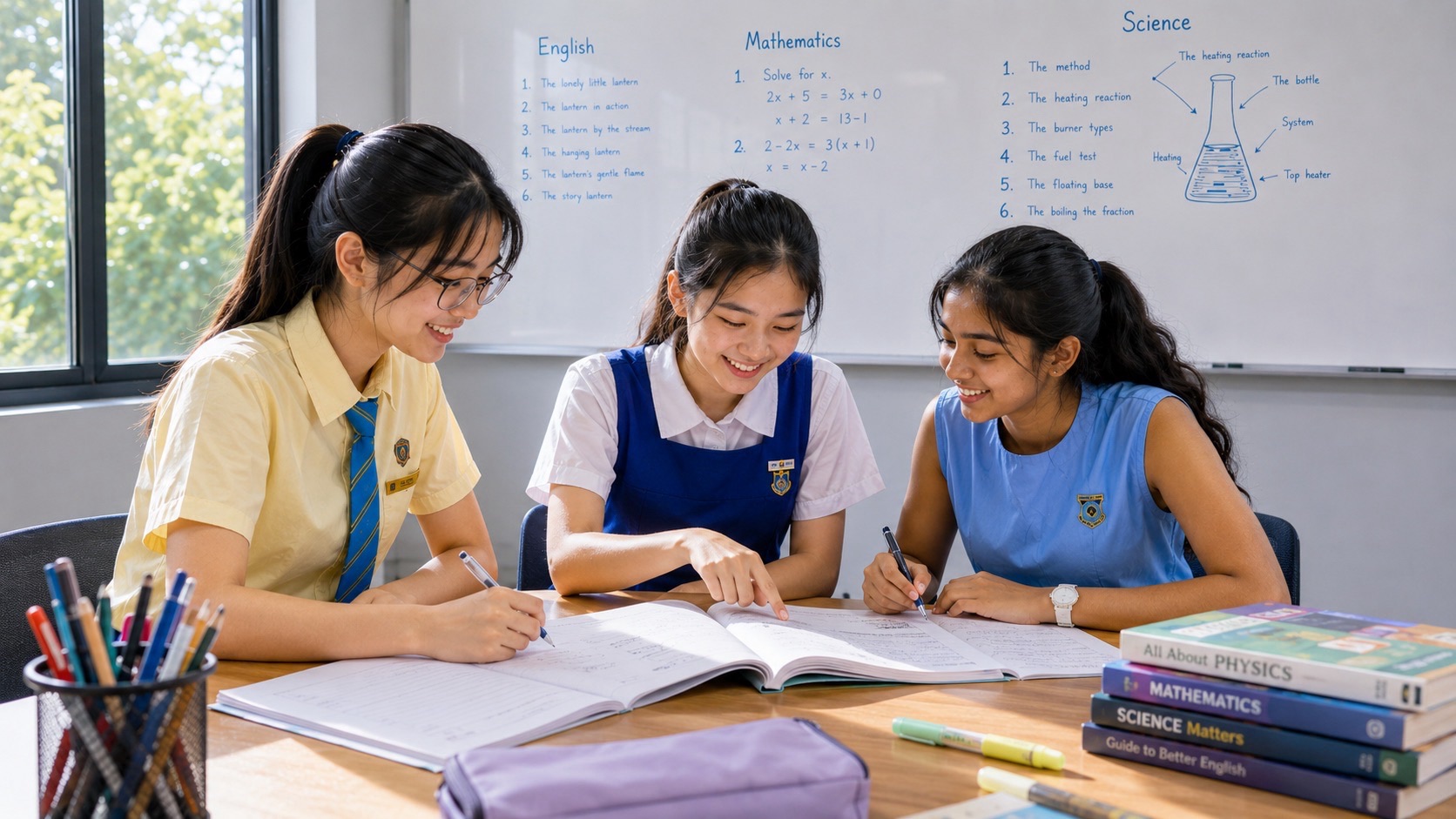
Secondary 2 G3 Chinese Language tuition guidance for Punggol families: build accurate understanding of Chinese characters and vocabulary, coherent written expression, listening comprehension and confident spoken interaction before upper-secondary SEC preparation. MOE’s secondary Mother Tongue Languages curriculum develops communication, cultural understanding and meaningful language use. Secondary 2 assessments are school-based; the national Singapore-Cambridge SEC is introduced in 2027, with a typical 2026 Secondary 2 student sitting it in 2028 depending on their route.
A child may converse comfortably at home yet struggle to recognise written words, explain a passage in Chinese or organise a composition. Another may recognise many characters but hesitate when speaking. These are different learning obstacles, not evidence of laziness or an inherent inability to learn a language. Applying eduKatePunggol’s published diagnostic small-group approach, this guide shows parents how to identify and repair the precise language capability rather than simply assign more work. Check whether specialist Chinese support is currently available.
- Confirm the child’s actual Chinese subject level and current school assessment scope.
- Distinguish recognising 汉字, understanding 词语, sentence construction, reading and spoken interaction.
- Practise useful words in new contexts, not only isolated spelling lists.
- Use the school’s actual composition and oral tasks, and verify current permitted tools.
- The 2027 SEC G3 Chinese entry is K320; Higher Chinese K355 is distinct. Verify future-year requirements.
- Test independent transfer across four weeks; confirm specialist tuition arrangements and avoid guarantees.
Parent question index: 1. What is Secondary 2 G3 Chinese Language? · 2. What capabilities should the Chinese syllabus develop? · 3. Why can children speak Chinese but still struggle with Chinese exams? · 4. How do we distinguish character recognition from vocabulary understanding? · 5. Should my child memorise more Chinese characters every day? · 6. How should Chinese vocabulary become active language? · 7. How can Chinese sentence construction improve? · 8. What are common comprehension bottlenecks? · 9. How should Chinese inference questions be answered? · 10. Why does copying the text sometimes lose marks? · 11. How can a learner improve sentence-level accuracy? · 12. How should practical writing be prepared? · 13. How can Chinese composition develop beyond memorised essays? · 14. How do we help children write more developed paragraphs? · 15. Are 成语 essential for a good Chinese composition? · 16. How can oral reading and speaking be separated? · 17. What makes an oral response thoughtful? · 18. Why is listening comprehension a distinct skill? · 19. How can families support cultural understanding without pressure? · 20. What can parents do if they do not speak Chinese fluently? · 21. What is niche syllabus engineering in Chinese tuition? · 22. How can a small-group format help Chinese learning? · 23. What is a practical four-week Chinese learning plan? · 24. How can everyday life in Punggol support Chinese? · 25. Should my child consider Higher Chinese? · 26. What should parents verify before arranging tuition or SEC preparation?
What is Secondary 2 G3 Chinese Language?
G3 is the level of the Chinese Language subject under Full Subject-Based Banding. It does not describe a child’s overall ability or every other subject taken. The MOE secondary Mother Tongue Languages syllabus provides the broad curriculum framework; the school selects the teaching sequence and assessment scope. SEAB’s 2027 SEC list identifies Chinese as K320, distinct from Higher Chinese K355. Secondary 2 children should prepare for their actual school-based tasks rather than assume the full national paper is their next examination. Confirm the specific examination-year syllabus when relevant.
What capabilities should the Chinese syllabus develop?
The 2021 secondary Mother Tongue Languages curriculum places emphasis on communication, cultural understanding and connections with language beyond the classroom. Its skills include understanding written and spoken information, producing speech and writing, and interacting with others. Language knowledge supports these activities rather than existing as an isolated list of words. A student should increasingly recognise familiar expressions in changed contexts, express a meaningful idea and respond appropriately to another person’s message. These capabilities can be observed in everyday situations as well as school assessments.
Why can children speak Chinese but still struggle with Chinese exams?
Conversational familiarity and written literacy overlap but are not identical. A child might understand 今天下雨了 when hearing it, yet struggle to recognise all the characters in a passage. Another may understand the words but not a more formal expression used in a school task. Ask the child to hear a sentence, explain its meaning, read it and write a relevant response. The first point of difficulty identifies the learning need. Do not infer a lack of motivation solely from a gap between spoken and written performance.
How do we distinguish character recognition from vocabulary understanding?
Recognising individual 汉字 does not establish understanding of a 词语. For example, 关心 means to care about or show concern for someone, while 小心 means to be careful. The shared character 心 does not make their usage interchangeable. Ask the learner to read each word, explain it in context and select the appropriate one in a new sentence. If recognition is weak, work on the character forms and reading. If recognition is accurate but meaning is uncertain, focus on the expression and its contextual use.
Should my child memorise more Chinese characters every day?
Character practice may help, but quantity alone can conceal weak retrieval or meaning. Work on a manageable group from the school materials. Connect each character to useful words, practise reading and writing where required, and revisit them after a delay. Compare visually similar characters such as 未 and 末 without assuming that a child must explain every historical origin. A strong learning check is whether the student can recognise or produce the relevant form in an unfamiliar sentence without looking at the list. Adjust the number to the learner’s needs.
How should Chinese vocabulary become active language?
Move from recognition to meaning, then to purposeful use. Consider 负责, which can mean being responsible for something, and 责任, meaning responsibility. Compare 他负责整理资料 with 每个人都有自己的责任. Ask the learner which word fits a new sentence and why. Store useful words with their typical partners rather than memorising a one-word English gloss. Follow school vocabulary expectations, and encourage the child to make a short original sentence, explain the context and correct errors. Retrieval over several days helps distinguish familiar appearance from usable knowledge.
How can Chinese sentence construction improve?
Begin with a clear meaning, then organise the words. A learner can express cause and consequence with 因为……所以……, for example 因为下雨,所以我们取消了户外活动. Ask which clause supplies the reason and which presents the outcome. Then vary the situation and practise a sentence where the relationship is contrast or condition rather than cause. Do not force every sentence into one memorised pattern. A well-formed response communicates the intended relationship accurately, with wording appropriate to the task and audience.
What are common comprehension bottlenecks?
A learner may read individual lines yet miss how the ideas connect, or understand the passage but select evidence that addresses a different question. Begin with the literal situation: who is involved, what happened and what changed? Then ask for the central idea and the evidence supporting it. In a short original text about a student who helps a neighbour despite being late, distinguish what occurred from what the act might suggest. Check the student’s reasoning before correcting expression. More difficult passages will not necessarily repair an earlier comprehension gap.
How should Chinese inference questions be answered?
An inference must be supported by the passage. Consider the invented sentence: 她看了看手表,又加快了脚步。A plausible inference is that she is in a hurry, but the line alone does not establish the exact reason. Ask the learner to identify the words or actions that support the conclusion and express the connection in Chinese. Then change the context so the same behaviour has a different possible explanation. This develops attention to textual evidence, not the habit of choosing an emotion word without considering the surrounding text.
Why does copying the text sometimes lose marks?
The answer must address the precise question. If asked why a person changed a decision, reproducing a long passage containing the decision may not explain the cause. Ask the student to restate the question in simpler Chinese, locate the relevant detail and use it to construct a focused answer. Follow the school’s requirements about own words, quotations and answer length. A short accurate answer with the required explanation may be more effective than an entire copied paragraph. Practise separating evidence from the claim it supports.
How can a learner improve sentence-level accuracy?
Choose a recurring error from actual work rather than rewriting every sentence for the child. For example, compare 我已经完成了作业 with a sentence that places the time marker or aspect expression awkwardly. Explain the intended meaning, show a clear version and ask the student to produce another sentence using a similar relationship. Chinese grammar does not simply mirror English word order. Avoid judging every colloquial expression by a single rigid formula; distinguish the written register expected in the task from everyday speech. Retest the repaired pattern independently.
How should practical writing be prepared?
Practical written communication requires attention to recipient, purpose, situation and required details. Suppose a school task asks the student to message a classmate about a revised meeting time. The response should communicate the changed time, reason and any requested action clearly. A more formal message to a teacher requires a different register. Check the exact school-taught formats rather than assuming national specifications apply at Secondary 2. Ask what information the recipient needs to act. A memorised opening does not make up for a missing essential detail.
How can Chinese composition develop beyond memorised essays?
Start from a prompt and identify what it actually asks. Plan a sequence of relevant events or ideas, using accurate vocabulary and coherent transitions. In a narrative, a character’s action should lead to a meaningful consequence. In an explanatory or opinion task, develop reasons and examples that support the main position. The school determines which genres are required. A memorised composition may be useful as a model of structure, but copying it into an unrelated question can undermine relevance. Practise changing the situation while preserving sound writing decisions.
How do we help children write more developed paragraphs?
Ask each paragraph to perform one clear function. An original example might describe a classmate helping to organise a shared activity. Rather than writing only 他很热心, add a specific action and explain what it shows, such as 他主动留下来整理教室,让其他同学可以早点回家. Then check whether the detail supports the intended point. Avoid adding difficult idioms merely to make the paragraph longer. Precision and relevance come first. Ask the child to revise one paragraph independently before attempting another full composition.
Are 成语 essential for a good Chinese composition?
Idioms can enrich expression when the meaning and context are appropriate, but forced idioms can introduce errors. For instance, 一举两得 describes accomplishing two useful outcomes with one action; it is not simply a synonym for success. Ask the learner to explain the idiom, provide a suitable situation and compare a situation where it would not fit. Use the school’s taught vocabulary and marking feedback. A clear, natural sentence may be stronger than a strained idiomatic sentence. The goal is accurate language choice rather than displaying the longest memorised list.
How can oral reading and speaking be separated?
Reading aloud draws on character recognition, pronunciation, phrasing and fluency. Spoken interaction additionally requires listening to a question, organising a response and adapting to follow-up questions. A student may read well but give very short answers in conversation, or speak naturally but hesitate at written words. Assess each separately. Practise a brief age-appropriate passage and a discussion on a familiar issue, then note the first weakness. Follow the school’s actual oral task instructions and avoid presenting a particular national format as universal in Secondary 2.
What makes an oral response thoughtful?
A clear answer addresses the question, develops a reason and gives a concrete example when appropriate. If asked whether students should help with household tasks, a learner might say 我认为学生应该分担家务,因为这样可以培养责任感, then illustrate a manageable task. A follow-up may ask how to balance schoolwork. The learner should adapt rather than repeat the prepared sentence. Practise explaining one idea naturally and accurately. Pause to organise thoughts when needed; fluent speech is not the same as thoughtful content.
Why is listening comprehension a distinct skill?
A student must recognise sounds, identify relevant information and connect the speaker’s ideas in real time. Use a short suitable recording and ask the learner to summarise its main point before checking individual details. If a key expression was unfamiliar, teach it in another listening context. If the child understood the words but missed a change of opinion or time, practise identifying relationships. Avoid repeatedly replaying the same recording until answers become memorised. Gradually test new material under conditions consistent with school guidance.
How can families support cultural understanding without pressure?
Chinese Language offers opportunities to encounter stories, customs, expressions and perspectives in Singapore and beyond. Choose materials that interest the child, discuss what they convey and invite questions. Families vary in their language use and cultural experience; a student’s examination results do not determine identity or belonging. MOE’s Committee to Promote Chinese Language Learning offers secondary reading resources that can complement school recommendations. Choose a suitable reading level rather than selecting the hardest available book. Some reading should be enjoyed without a subsequent test.
What can parents do if they do not speak Chinese fluently?
Parents can still support routines, encourage independent reading and help organise school feedback. Ask the learner to explain what a teacher corrected and how they will practise it. Use reliable school materials and appropriate resources rather than guessing at corrections or relying on unchecked machine translations. A qualified Chinese teacher can help diagnose linguistic errors that are difficult for a parent to assess. The family need not conduct every conversation in Chinese to support learning. A calm routine and respect for the child’s effort can make focused practice more sustainable.
What is niche syllabus engineering in Chinese tuition?
It means locating the specific capability obstructing progress. If a learner understands a story but cannot write an inference, teach the connection between the evidence and a concise Chinese explanation. If character recognition is the barrier, repair that before expecting longer comprehension responses. Use a model, guided attempt, independent changed task and delayed retest. Record the first response and the amount of prompting. A repaired worksheet is not proof of independent mastery. The aim is language that the learner can use flexibly beyond the exact example.
How can a small-group format help Chinese learning?
Students in a compatible group can hear different expressions, practise discussion and compare the clarity of written responses. The tutor needs to inspect each child’s character recognition, word choice, grammar and independent reasoning rather than rely on the strongest speaker to carry the group. A different arrangement may suit a learner needing intensive foundational support. Ask whether the provider has a qualified teacher for the actual Chinese subject level, school materials and oral requirements. Confirm eduKatePunggol’s current specialist availability before enrolling.
What is a practical four-week Chinese learning plan?
Week 1: review school scope and marked work; sample character recognition, comprehension, writing and speaking. Week 2: repair the largest recurring bottleneck through short targeted tasks. Week 3: apply the repaired skill in a new passage, written response and spoken interaction where relevant. Week 4: complete a representative school-style independent assessment and compare performance with the baseline. Keep sessions manageable and coordinate with school work. Four weeks provide a review interval, not a guarantee of a grade or complete mastery.
How can everyday life in Punggol support Chinese?
During a family outing, notice an appropriate Chinese sign or message and discuss what it communicates. Try describing an ordinary experience in Chinese, or prepare a short recommendation for a familiar activity. If the child enjoys stories or videos, choose age-appropriate material and discuss one idea rather than translate every sentence. Avoid making conversations a constant test. Do not collect information about strangers without consent. Everyday communication helps a learner see language as a means of connecting with others, not merely as a school examination requirement.
Should my child consider Higher Chinese?
SEAB lists Higher Chinese separately from Chinese at G3 in the 2027 SEC catalogue. Higher Chinese has distinct curriculum and assessment demands; it is not automatically the right option for every capable Chinese learner. Ask the school about eligibility, actual subject arrangements, readiness, workload and future requirements. MOE has expanded opportunities for eligible incoming Secondary 1 students from 2026, but that policy does not by itself establish an individual Secondary 2 transfer decision. Check with school rather than assuming eligibility or promising a particular pathway.
What should parents verify before arranging tuition or SEC preparation?
Bring marked Chinese work, school assessment instructions and the child’s own account of what feels difficult. Confirm subject level, current school scope, teacher expertise, class availability, scheduling and fees. Check the relevant future SEAB syllabus when published rather than treating the 2027 K320 reference as a guaranteed specification for 2028. Ask how progress will be measured through independent changed tasks. If the school and home routine already meet the child’s needs, extra tuition may not be necessary. The lasting result is an increasingly independent and confident Chinese language user.
Continue the Secondary 2 G3 parent series
- Secondary 2 G3 History
- Secondary 2 G3 Literature in English
- Secondary 2 G3 Malay Language
- Secondary 2 G3 Geography
Official sources and related Punggol guides
- MOE G1, G2, G3 and Higher Mother Tongue Languages secondary syllabus
- MOE Committee to Promote Chinese Language Learning: secondary reading resources
- SEAB 2027 G3 school candidate syllabuses
- MOE Full SBB and SEC changes
- MOE Higher Mother Tongue and admission updates
- Punggol secondary small-group guide
- Secondary 2 G3 English Language parent guide
- eduKatePunggol current enquiries
Editorial review: 28 November 2026. Independent parent guide, not an official MOE or SEAB publication. Questions reflect editorial selections of common concerns, not measured search-frequency data. Examples are original, illustrative and not actual examination questions. Confirm current subject availability, school scope and examination-year requirements.


