
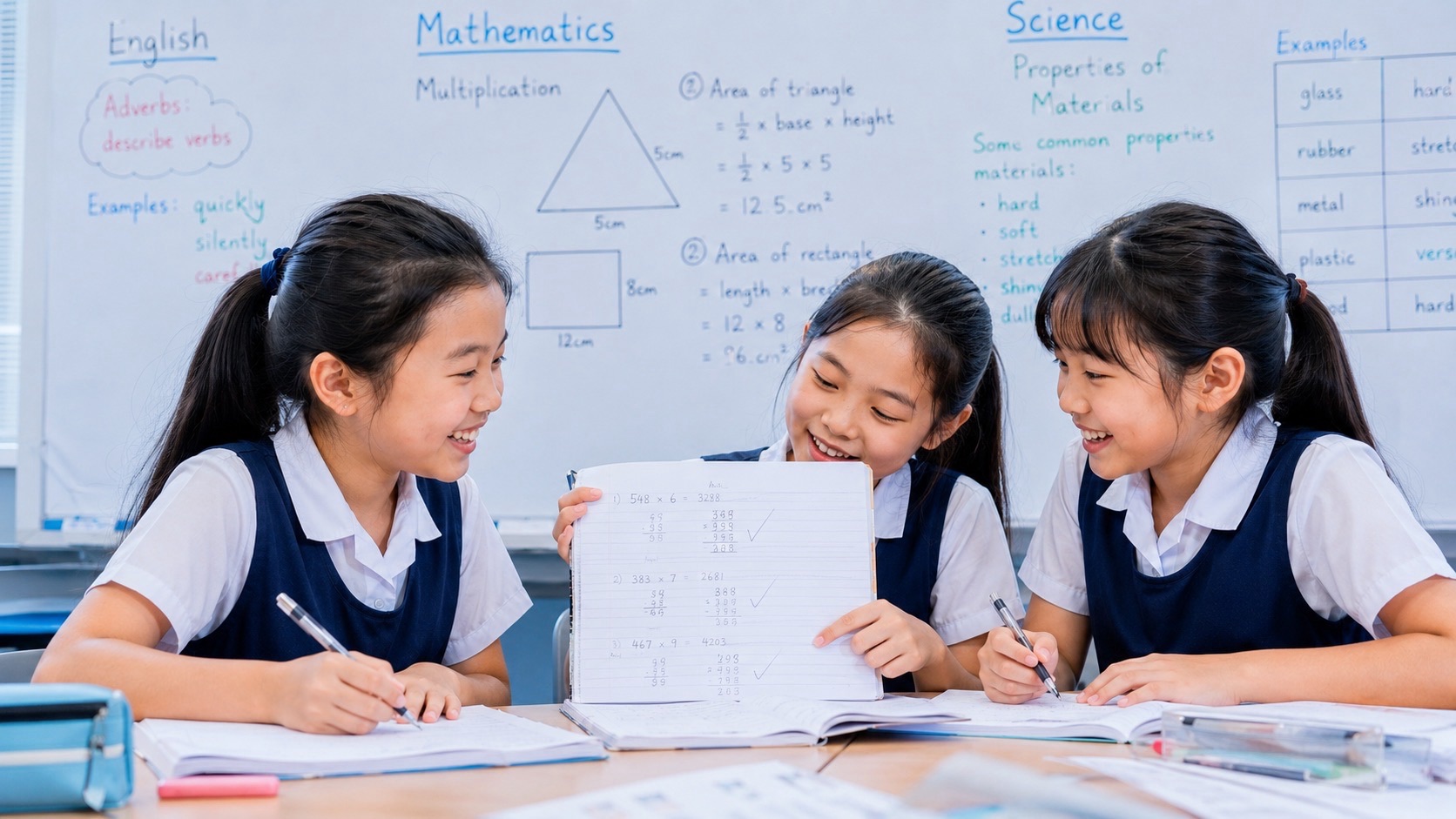
A Primary 1 Programme for Active Learning (PAL) guide for Punggol parents should explain how hands-on arts, sports, games and outdoor activities help a seven-year-old develop curiosity, confidence and cooperation. PAL is already part of the MOE school experience for Primary 1 and 2; it is not a separate national examinable subject or a paid examination-preparation syllabus. eduKatePunggol’s general small-group model is described as up to three pupils, typically 1.5 hours, but no specialised PAL tuition class, venue or vacancy should be inferred from that description. The first practical step is to understand your child’s actual school PAL modules and help them enjoy the activities.
PAL is situated within the CCE 2021 curriculum framework and draws on four domains: Sports and Games, Outdoor Education, Visual Arts and Performing Arts. Different schools arrange their P1 and P2 modules differently, so one school’s term sequence is not a national 2027 timetable. MOE also removed weighted school assessments and examinations in P1/P2, and SEAB does not conduct a Primary 1 PAL examination. Any ‘P1 exam-style questions’ below are therefore original reflective activity and decision prompts—not official examinations or an argument for more tuition.
- What PAL means: Programme for Active Learning, part of the CCE experience for P1/P2.
- Four domains: Sports and Games, Outdoor Education, Visual Arts and Performing Arts.
- Three Cs: Curiosity about experiences, Confidence to try, and Cooperation with peers.
- School differences: modules and term timing vary; ask the current school for its actual P1 and P2 plan.
- Assessment: no weighted P1 examination and no SEAB PAL paper; observe engagement, reflection and teamwork.
- Parent’s first move: ask which PAL activity the child enjoyed, what they tried and how they worked with others.
- Small-group decisions: optional enrichment may expand interests but must not masquerade as compulsory PAL tuition.
- Best outcome: a willing, thoughtful learner who explores, perseveres safely and collaborates.
This article follows the Clementi small-groups editorial discipline used throughout eduKate: answer the parent’s important questions first, observe what the learner does, teach the missing step and check new independent action. PAL, however, deliberately reaches beyond academic worksheets. A child who can describe a painting but hesitates to work with other pupils might need help with collaboration; another child who joins confidently but rushes without noticing hazards needs a more careful outdoor decision. Both are genuine forms of learning.
Many parents think an activity matters only if it contributes directly to an examination result. PAL corrects that assumption. Its authentic activities can teach problem-solving, personal expression, resilience and respect in ways a written test does not capture. Families who already have long tuition schedules should protect space for this kind of experiential learning. Paying for yet another ‘PAL exam course’ would misunderstand the programme.
PAL is an MOE school programme, not a national SEAB subject
Singapore’s lower-primary schools offer PAL to provide broad non-academic learning through first-hand participation. The domains create opportunities to notice interests and talents, engage in cooperation and practise social-emotional competencies. The MOE CCE 2021 syllabus describes PAL as one of the settings where children learn and apply values. School programmes commonly use reflection after an activity: ‘What happened?’, ‘How did I feel?’, ‘How did my partner help?’ and ‘What could I try next?’
PAL is not identical to subject-based Art, Music or Physical Education. Activities can overlap, but PAL specifically emphasises experiential opportunities, confidence, curiosity and cooperation. A Sports and Games module may use simple movement to teach teamwork; Visual Arts may use material exploration to help pupils practise decision-making; Outdoor Education may highlight care and safe interaction with natural surroundings. The value is the combination of doing, feeling, relating and reflecting.
School websites demonstrate that the sequence differs. Ngee Ann Primary describes exposure to four domains through modules customised for pupils. Nan Chiau Primary’s published schedule places Outdoor Education in P1 Term 1 and Sports and Games in Term 2, while Chua Chu Kang Primary shows a different distribution and hour allocation. These are school-specific examples, not proof that every Punggol P1 class follows those exact terms. Ask your child’s school for the local plan.
The first domain: Sports and Games
Children explore suitable movements and games, building confidence with simple tasks while practising fair play and group cooperation. The point is not early sports specialisation. A child who waits for a teammate before rolling the ball has shown an important skill even if the roll misses a target. A teacher may use soft balls, movement pathways and cooperative challenges, with variations based on safety and ability.
When reviewing Sports and Games at home, ask whether the child took a new role, followed a safety cue and handled losing or winning respectfully. You do not need to score speed or demand more exhausting activity. If a child has mobility or other physical needs, ask the school about inclusive adjustments rather than assigning the same task to every learner.
The second domain: Outdoor Education
PAL Outdoor Education connects children with places, nature and safe experiential activity. A pupil can look carefully at leaves, notice how shadows or surfaces differ, ask a question and practise caring for the place. Different schools might include plant-themed exploration, environmental responsibility or simple supervised navigation. Do not assume an unsupervised P1 nature hike or complex map-reading expedition is compulsory. The child’s actual school arrangements and weather safety procedures take priority.
A family can extend this through a brief supervised observation of a familiar playground or Punggol green space: ‘What did you notice?’ and ‘How could we leave this place as we found it?’ Avoid collecting unknown plants, approaching wildlife, touching suspicious objects or going near water without responsible supervision. Safe curiosity should lead, not adventurous risk for its own sake.
The third domain: Visual Arts
PAL Visual Arts lets pupils experience materials, visual patterns, colours and expression through hands-on projects. A child might explore torn-paper shapes, colour choices or texture and share a reason for an artistic decision. Cooperation can include sharing materials, respecting a peer’s different design and helping to clean a common area. The goal should not be twelve identical adult-prepared pieces that look impressive but reveal no child choice.
For a parent, one meaningful question is: ‘What did you try that was new?’ A rough experiment may show more creative learning than a neat copied picture. Keep materials safe and suitable for young pupils. Enjoyment and willingness to try a different approach matter more than a made-up PAL drawing grade.
The fourth domain: Performing Arts
Performing Arts can include movement, music, drama and expression according to the school module. A child learns to take a turn, listen for another’s cue, make a movement or sound choice and perform together with peers. It may build confidence to speak or move without making every child undertake a solo performance. A shy pupil may begin with a smaller role and still contribute meaningfully.
Ask how a pupil responded to others rather than whether they won applause. Did they wait for their turn, remember an opening cue or help a group member? Did they explain a feeling or choose a different artistic idea? Such behaviours connect PAL to CCE’s social-emotional outcomes in a way that a multiple-choice examination cannot.
A practical first-week parent diagnostic
After the first PAL lesson, ask three questions in a conversational way. ‘What did you do?’ checks whether the learner recalls an experience. ‘What was new or surprising?’ invites curiosity. ‘How did you work with another person?’ encourages reflection on cooperation. Let the child draw or demonstrate rather than force a long written answer. A genuine one-sentence response is often more informative than a rehearsed speech.
If a child says they disliked the lesson, listen without dismissing them. Was the activity too noisy, tiring, confusing, socially difficult or not yet accessible? Different concerns need different solutions. Parents can share a specific observation with the teacher and ask about suitable adaptations. Avoid announcing that the child is ‘bad at teamwork’ because one group task went badly.
Twenty original P1 PAL activity prompts, with a clear learning purpose
1. Curiosity about a new object
Original activity: Show three safe ordinary objects and invite one question about the unfamiliar one.
Observe: Look for a genuine question rather than repeating an adult’s first idea.
Teach: Model wondering aloud and allow the child to choose which detail matters.
New task: Offer a different object and let the learner ask a new question.
2. Teamwork with one shared material
Original activity: Three children have one set of coloured blocks and a shared construction goal.
Observe: Observe whether every child can contribute without grabbing or exclusion.
Teach: Set a fair turn structure and allow different roles.
New task: Give a new group challenge and reduce adult reminders.
3. A game that requires waiting
Original activity: Use a simple safe rolling game with a clear order.
Observe: The child may rush or interrupt because the next turn is exciting.
Teach: Practise a visual turn signal and make waiting a useful participation role.
New task: Change the game while keeping the idea of fair turns.
4. Cooperating after a missed target
Original activity: A team attempts a gentle rolling challenge and misses.
Observe: The child may blame a teammate or avoid another attempt.
Teach: Ask what the group noticed and what one small adjustment could help.
New task: Use a new target and invite encouraging teamwork.
5. Showing confidence with a small new movement
Original activity: Invite a safe movement on a low, clear path chosen by the child.
Observe: A hesitant child may refuse because the action feels unfamiliar.
Teach: Offer an easier alternative and let the child build from a successful attempt.
New task: Ask for another age-safe variation without forcing dangerous movement.
6. Noticing a plant carefully
Original activity: Observe a safe plant from a suitable distance in a supervised area.
Observe: Pupils may name a plant without observing shape, colour or surroundings.
Teach: Ask what can be seen and what they wonder; distinguish observation from guessing.
New task: Notice a different plant without touching unknown parts.
7. Caring for shared outdoor space
Original activity: After a supervised activity, ask how to leave the place in good condition.
Observe: The child may know the phrase ‘keep it clean’ but not the action.
Teach: Discuss disposing of one’s own litter and respecting the surroundings safely.
New task: Transfer the same responsibility to a classroom area.
8. Recognising a pathway hazard
Original activity: Present a picture of a wet path and a clear alternative.
Observe: A child may concentrate on reaching the goal and overlook risk.
Teach: Explain pausing, alerting an adult and using an approved safer route.
New task: Show a different hazard and ask what they would do.
9. Listening to another person’s observation
Original activity: Two pupils notice different features of the same school tree.
Observe: The child may insist that only their own detail is correct.
Teach: Demonstrate that multiple accurate observations can coexist.
New task: Observe another scene and invite respectful comparison.
10. A cooperative picture collage
Original activity: Three pupils build one picture from safe paper shapes.
Observe: One child may make all decisions, leaving others with no role.
Teach: Invite each child to propose one choice and agree on an arrangement.
New task: Create a different shared picture with rotated roles.
11. Experimenting without the ‘perfect’ answer
Original activity: Offer two safe art materials for a small colour or texture experiment.
Observe: Some pupils wait for the adult to draw the model exactly.
Teach: Ask what they predict, then let them test and explain what happened.
New task: Present another experiment with one changed material.
12. Respecting different artworks
Original activity: Two children create different images using the same supplies.
Observe: A child may call the other work wrong because it looks different.
Teach: Teach a specific, respectful observation about line, shape or choice.
New task: Discuss a new pair of artworks without ranking the children.
13. Telling a story through movement
Original activity: Invite a pupil to show an original imaginary animal’s movement safely.
Observe: The child may copy the loudest pupil instead of trying their own idea.
Teach: Model one choice then invite a new animal or movement of appropriate intensity.
New task: Change the story and ask for an independent movement idea.
14. Creating a group soundscape
Original activity: Use gentle claps and taps to depict the beginning and end of an imaginary rainstorm.
Observe: Children may all play at once and miss the shared sequence.
Teach: Give each pupil a role and a safe cue for when to start or stop.
New task: Create another soundscape with a new order of roles.
15. Taking a small performing role
Original activity: One child is reluctant to speak during a group drama activity.
Observe: The group may mistake hesitation for a lack of ideas.
Teach: Offer a choice of gesture, single word, prop or partner role.
New task: In a different activity let the child choose a slightly new contribution.
16. Giving useful feedback
Original activity: After a shared game, ask what helped the group work together.
Observe: Children may only say that someone was ‘good’ or ‘bad’.
Teach: Model feedback about actions: waiting, helping or explaining clearly.
New task: Repeat after a new task and invite specific feedback without names.
17. Trying again after disappointment
Original activity: A project collapses or an idea does not work on the first attempt.
Observe: A child may believe the activity is a failure or react strongly.
Teach: Help the child identify the smallest next step and ask a teammate for help.
New task: Offer a new low-stakes challenge and watch how the pupil recovers.
18. Asking for clarification
Original activity: A group instruction is too difficult to understand.
Observe: A learner may guess silently and become distressed.
Teach: Practise the phrase ‘Can you show me the first step?’ and welcome questions.
New task: Give a fresh short group instruction that leaves room for appropriate questions.
19. Reflecting on a new interest
Original activity: A pupil enjoys one outdoor task but not a dance activity.
Observe: An adult might label the child as good or bad at an entire domain.
Teach: Ask what was enjoyable, surprising or hard without permanent judgement.
New task: Try a new activity in both domains before forming expectations.
20. Explaining one genuine learning discovery
Original activity: After a PAL activity, ask what the child learned about themselves or others.
Observe: The child may repeat a rehearsed slogan rather than describe experience.
Teach: Invite one concrete example and listen for a connection to curiosity, confidence or cooperation.
New task: After a later activity, ask the same question with no model.
The three Cs: what progress looks like without a score
Curiosity grows when a child notices something unexpected, poses an honest question or wants to investigate safely. An adult should not treat curiosity as interrupting every instruction; helping the child choose when and how to ask is part of the learning. A weekly observation might be that a pupil now points out a new feature in a scene before the parent prompts them.
Confidence means willingness to try an appropriate new task and communicate, not an absence of fear or a requirement to perform in public. For one learner, it may be taking a short role in a game; for another, asking a teacher for help. Confidence should be measured against the child’s own starting point. Praising only loud or fast pupils misses quieter forms of courage.
Cooperation is visible in fair participation, shared decisions, respectful listening and making a small contribution. A P1 pupil can help move materials, wait for a turn or offer a suggestion to a teammate. The adult should teach these skills deliberately and notice them in new contexts, not assign an invented national teamwork achievement level.
PAL versus PE, Art and Music: why parents get confused
PAL’s Sports and Games may resemble PE; its Visual Arts may look like Art lessons; its Performing Arts may include Music and movement. But the curriculum purpose and the teacher’s learning outcomes may differ. PAL focuses on broad exposure, social-emotional growth and experiential learning within CCE. The PE, Art and Music national syllabuses have their own specialised learning outcomes. Do not replace one with another or assume a child needs four separate private tutors.
A school may organise outdoor exploration within PAL and also teach Outdoor Education through PE. These experiences can reinforce each other without creating two SEAB exam papers. Parents should ask which programme a child is describing before buying materials. If a child enjoys a particular PAL experience, that may simply guide a future interest or community activity rather than a paid tuition requirement.
A Punggol family can extend PAL without spending much
A ten-minute visit to a familiar safe playground can become a cooperative activity: decide together on a game, take turns, observe one nearby feature and agree on how to leave the space tidy. In a supervised park setting, the pupil can notice changes in light, plants or sounds without disturbing wildlife. At home, safe paper shapes, drawing and original music-making all offer PAL-like experiences without copying a commercial module.
Punggol families can also use an age-appropriate community or library activity when available, but should verify current dates, charges and access arrangements directly. Do not present a particular activity at One Punggol, a sports venue or the library as compulsory PAL or as a guaranteed operating programme. The child’s real school modules and wellbeing remain the reference.
Be careful about safety. PAL outdoor exploration is not independent travel; movement and art materials require adult supervision appropriate to age. Water edges, roads, sharp objects, unknown plants, hazardous equipment and extreme weather are reasons to modify or stop an activity, not opportunities to prove resilience. Accessible participation matters for children with mobility, sensory or other learning needs.
When a small group is useful, and when it is extra workload
A child who needs practice cooperating or explaining an idea might benefit from a small, safe enrichment setting led by a suitable educator. Three pupils allow each to contribute, but a child may benefit equally from the normal classroom group. Ask whether any proposed private programme genuinely offers broader hands-on experience rather than putting a PAL label on academic worksheets.
For a child who already participates happily at school, no paid PAL tuition is necessary. Some families may choose a particular art, drama, music or sports activity because the child likes it; that is a valid enrichment decision, but it should not be sold as required P1 syllabus examination preparation. Confirm instructor qualifications, safeguarding, venue, fees, class size, activity safety and whether the programme is actually running.
An illustrative ninety-minute optional PAL enrichment session
- 0–10 minutes: greeting, curiosity question and explanation of group rules.
- 10–25 minutes: safe cooperative game with varied roles.
- 25–40 minutes: guided observation of a natural object or visual scene.
- 40–50 minutes: break, water and change of activity.
- 50–65 minutes: create original art or a gentle soundscape with individually chosen ideas.
- 65–80 minutes: group performance or sharing activity with fair turns.
- 80–90 minutes: each learner shares one discovery, challenge and next idea.
This is not a confirmed eduKatePunggol timetable. The real school programme may use very different session lengths and module allocation. Do not expect a seven-year-old to undertake long, uninterrupted high-energy or noisy activities. Suitable breaks, adaptation and the child’s enjoyment are essential.
Eight weeks of parent observation: no extra exam book
- Week 1: ask which PAL module the school is offering and observe the child’s response to one activity.
- Week 2: invite one independent question about a safe object or place.
- Week 3: practise taking turns in a game or shared task.
- Week 4: let the child try one new arts or movement choice without copying an adult.
- Week 5: discuss a failed attempt and one sensible way to try again.
- Week 6: invite a short reflection on how someone else contributed.
- Week 7: revisit an earlier activity with different materials or roles.
- Week 8: ask whether the pupil now observes, attempts and cooperates more independently.
Fourteen frequent parent questions about P1 PAL
Is PAL compulsory at Primary 1?
PAL is part of the lower-primary curriculum experience for P1 and P2 in MOE schools. It is offered through school-based modules. However, a school’s term sequence and lesson arrangements differ; ask the school about the current modules and participation considerations.
Does SEAB examine PAL?
No. There is no national SEAB Primary 1 PAL examination, and P1/P2 have no weighted school exams. Original discussion and activity prompts are for learning, not predicted papers.
Is PAL a separate subject like Maths?
No. PAL is an experiential lower-primary programme within the CCE framework, not a standard examinable academic subject. Its activities build broader capacities that support learning and wellbeing.
What are the four domains?
Sports and Games, Outdoor Education, Visual Arts and Performing Arts. Schools may distribute these across terms and P1/P2 years in different ways, while supporting the same overall developmental intentions.
What are the three Cs?
Curiosity, Confidence and Cooperation. They describe broad habits and attitudes the programme nurtures through authentic experiences, not score bands or a national ranking.
Will my child get all four modules in Term 1?
Not necessarily. Schedules vary by school. Some distribute the domains across the year or the P1/P2 levels. Check your school’s current briefing rather than another school’s example timetable.
Does PAL replace Physical Education?
No. PAL may include Sports and Games or Outdoor Education activities, but school PE has its own 2024 curriculum with movement, outdoor, physical health and safety outcomes. Both can reinforce valuable skills.
Does PAL replace Art and Music?
No. PAL arts experiences broaden exploration and expression; Art and Music also have their own dedicated national learning outcomes. Parents should not assume that every PAL activity is a formal replacement for a subject lesson.
Does my child need private PAL tuition?
Usually not. PAL is already offered in school, and simple family activities can support its aims. External enrichment is optional and should be selected for genuine interest or a specific need, not because of an imaginary P1 PAL exam.
What if my child is shy?
Invite smaller, predictable roles, gestures or brief explanations. Confidence can grow without a mandatory solo performance. Discuss with the school if participation is causing significant distress.
What if an outdoor task is physically difficult?
Ask teachers about accessible alternatives and safety. Participation should be developmentally suitable; do not force risky movements or exclude a child solely because they need accommodations.
How can parents tell whether PAL is working?
Look for curiosity, independent trying, a clearer account of an experience, fair turn-taking or a new willingness to cooperate. Compare authentic situations and ask the teacher for qualitative feedback. A completed worksheet says much less.
What if my child prefers only one domain?
Preferences can guide enrichment choices, but broad exposure remains valuable. Allow the child to explore other activities at a comfortable pace rather than labelling them permanently as ‘not sporty’ or ‘not artistic’.
What can we do at home tonight?
Let your child choose a small safe creative or cooperative activity: invent a quiet sound pattern, build a picture together, play a turn-taking game or describe a familiar tree. Afterwards ask what they tried, what they noticed and how they worked together. Five or ten meaningful minutes are enough for a start.
Related eduKatePunggol family guides
- Primary 1 CCE: the underlying social-emotional curriculum
- Primary 1 PE: movement and safe participation
- Primary 1 Art: creating and appreciating
- Primary 1 Music: listening, creating and performing
- Singapore primary PAL, CCA and enrichment choices
Official and school programme sources
- MOE Primary CCE 2021 Syllabus, including PAL
- Corporation Primary School: four PAL domains and CCE links
- Nan Chiau Primary School: PAL domains and school-specific timetable
- Ngee Ann Primary School: PAL 3Cs and module examples
- MOE: no weighted P1/P2 assessments or examinations
- eduKate Clementi editorial reference
Updated November 2026. PAL is an experiential school programme, not a SEAB examination subject. The activities above are newly authored formative examples and no specific private PAL tuition service, timetable or price is confirmed. Current school instructions and child safety come first.


