
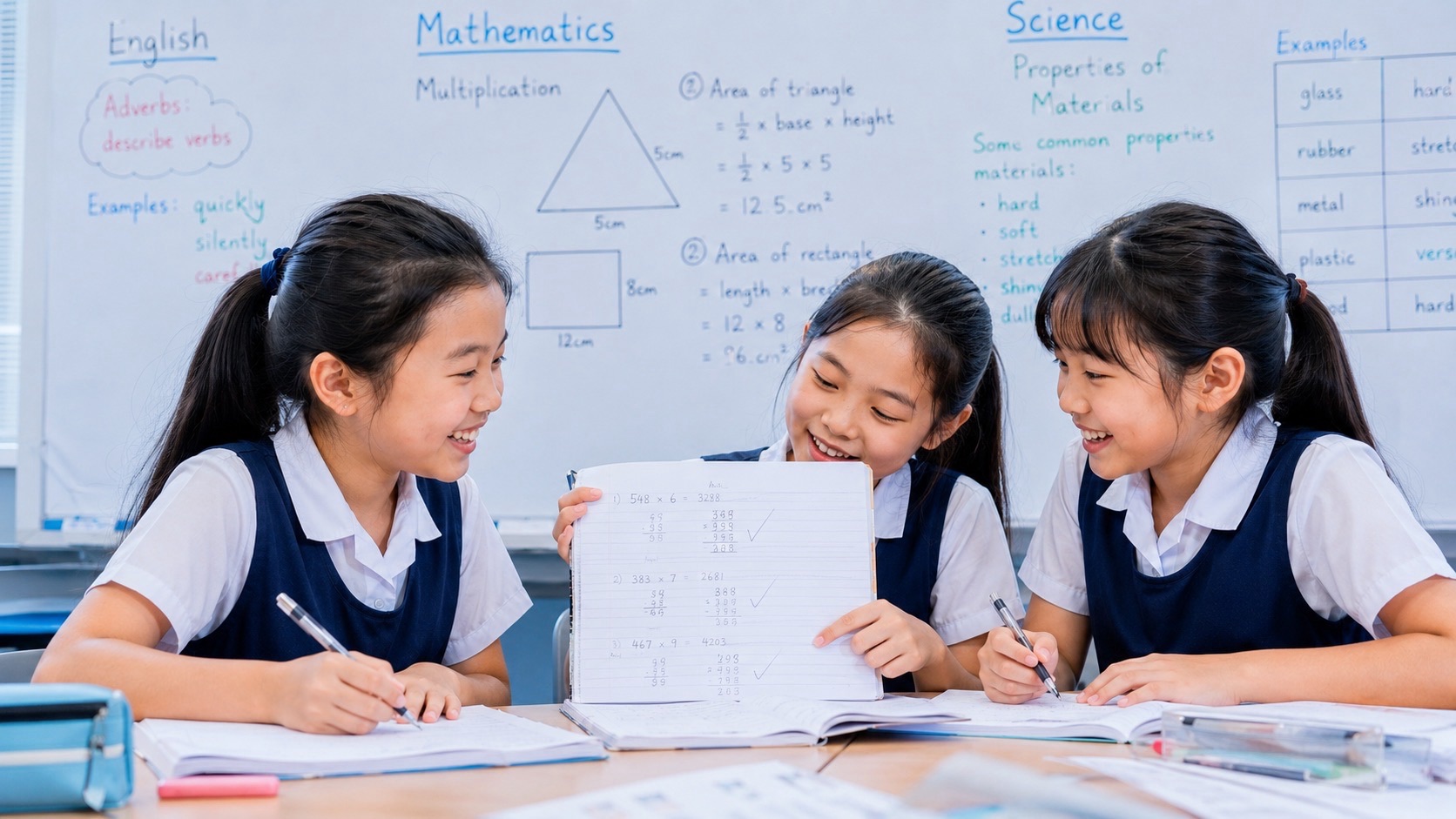
A Primary 6 PSLE Higher Chinese Language tutor in Punggol should strengthen an already developing command of Chinese through thoughtful reading, accurate word use, editing and independent writing. Higher Chinese is not simply the Standard Chinese paper with extra vocabulary: its 2026 PSLE examination has a separate two-paper structure. Parents need to know that structure before paying for tuition, check the child’s reading and writing evidence, and judge whether a tiny group provides the individual feedback necessary to make genuine progress. This guide explains the demands honestly, without claiming a guaranteed Distinction, a Special Assistance Plan school place or a particular secondary-school outcome.
SEAB lists PSLE Higher Chinese Language (0015) for 2026 as Paper 1 Writing: 40 marks, 40%, 50 minutes and Paper 2 Language Use and Reading Comprehension: 60 marks, 60%, 1 hour 20 minutes. Writing requires at least 200 Chinese characters and a choice between a topic-based composition and completion of a story. Paper 2 includes cloze, written correction and two reading-comprehension sections. The Higher Chinese examination has no separate oral or listening paper in this 2026 specification. The original eduKateSG Clementi Mathematics page is a model for attentive three-pupil teaching, not proof of a matching Punggol Higher Chinese class, fee, teacher or timetable.
- Check subject code: Higher Chinese Language (0015), distinct from Standard Chinese (0005) and Foundation Chinese (0025).
- Writing: 40%, 50 minutes, one of two prompts, at least 200 Chinese characters.
- Paper 2: 60%, 1 hour 20 minutes; includes contextual cloze, word/character correction and two sections of reading comprehension.
- Question breakdown: five cloze items, five corrections, six questions on Reading I and seven on Reading II.
- Do not confuse examinations: Standard Chinese’s 25% oral and 10% listening are not components of the 2026 Higher Chinese paper.
- Parent diagnostic: examine an original composition, an editing task and an unseen reading passage before selecting tuition.
- Secondary choices: Higher Chinese does not add a fifth AL to the four-subject PSLE score; an HCL Pass or better can give a posting advantage at SAP schools under the relevant rules.
- Small-group fit: require individual written feedback, independent explanation and realistic workload, not a promise of Distinction.
A child may be strong in everyday spoken Mandarin and still find HCL reading or writing demanding. Higher Chinese asks for more sustained use of written language, more careful interpretation and greater control of vocabulary. Some pupils can read fluently but cannot reorganise information into a precise short answer; others write confidently but fail to identify inaccurate wording in an editing task. A helpful tutor is specific about these differences and teaches the skill that the child actually needs.
The examination-year distinction matters. The HCL syllabus listed on SEAB’s 2026 page is labelled for examination from 2017, so it should not be marketed as a completely new format invented for 2026. For pupils taking PSLE in 2027 or later, parents should check the appropriate year’s official listing before purchasing books or arranging intensive paper practice.
1. Higher Chinese is an additional PSLE language subject, not Standard Chinese
Standard Chinese (0005) and Higher Chinese (0015) have different assessments. Standard Chinese involves writing, language use/comprehension, oral and listening, while Higher Chinese’s 2026 examination comprises two written papers, with a 40/60 weighting. Parents who apply a Standard Chinese oral-exam timetable to HCL are mixing two different subjects. A pupil may still benefit from ordinary speaking and listening for general language development, but these are not independent HCL examination components in the 2026 specification.
Ask the child’s school what subject the pupil has registered for and how Higher Chinese work is coordinated with Standard Chinese and the rest of P6 learning. The child’s school may have its own classroom tasks and reading programme. A private tutor should complement that teaching rather than add an unrelated syllabus by assumption.
Start with the official 2026 PSLE examination formats and open Higher Chinese Language (0015). Keep the PDF accessible when reviewing a tuition provider’s claim about timing, word count or assessed sections.
2. The exact 2026 Higher Chinese blueprint
The Higher Chinese Paper 1 is a 50-minute writing examination carrying 40 marks. Paper 2 is 1 hour 20 minutes and carries 60 marks. In Paper 2 the source lists five comprehensive cloze questions worth 10%, five character-and-word correction questions worth 10%, six Reading I open-ended questions worth 16%, and seven Reading II open-ended questions worth 24%. There are 23 Paper 2 questions altogether. Paper 1 is the remaining 40%.
A balanced tutor uses this information to organise practice: writing requires planning and revision, while Paper 2 demands contextual language judgement and evidence-based reading. A child’s main problem might not align with the largest time allocation. For instance, a pupil could have strong comprehension but a persistent editing weakness; targeted correction can be efficient. Another may need an extended reading programme before timed examination practice becomes useful.
The 2026 HCL document is a legitimate source, but it cannot predict the next unseen passage or essay theme. The purpose of a syllabus is to define examinable abilities. Good tuition builds those abilities across unfamiliar texts, not by guessing where the examiner may set the next question.
3. Writing: choose a prompt you can genuinely develop
Paper 1 requires a single composition of at least 200 Chinese characters. The choice is between 命题作文 (a topic-based composition) and 完成文章 (completing a given story). The 50-minute duration means students must select, plan, write and check efficiently. A pupil who spends too long writing a decorative opening may leave the ending incomplete. Teach pupils to identify the task, make a brief outline and allocate some time to revision.
In a topic-based composition, the pupil must establish what the topic asks and develop that idea with relevant events or reasons. A story that merely contains the topic word somewhere does not necessarily answer it. In a completion task, the opening has already established characters, mood or circumstances. The pupil should preserve that beginning and develop events consistent with it rather than abruptly switching to a memorised story.
To choose well, ask the child to sketch a plan for both prompts in three minutes and decide which provides the clearest logical development. The best choice is not always the one with the more sophisticated-looking title. Confidence and relevance matter more than artificial complexity.
4. Why the 200-character minimum is not the main writing goal
The official character minimum defines a floor, not a quality target or promise of marks. A child can pass the minimum with repeated, irrelevant phrases yet produce a weak composition. Conversely, writing much longer than needed can create more inaccuracies and waste checking time. The tutor should help a pupil sustain ideas, develop the necessary sequence and use precise language appropriate to a Primary 6 writer.
A composition about responsibility might describe how a child makes a promise, encounters a conflicting interest, makes a decision and recognises the effect on others. The quality lies in a believable sequence of actions and reflection. Writing ‘责任很重要’ repeatedly does not create a full narrative. Ask the child what changed between the beginning and ending, and whether each paragraph advances the topic.
A lesson can focus on a single paragraph: identify its purpose, remove a sentence that wanders away, strengthen the causal link and check how it connects to the next paragraph. The rewritten passage should still sound like the pupil. An adult-quality model essay that the child cannot reconstruct independently is a poor measure of tuition progress.
5. Completing a story demands fidelity to the given beginning
In 完成文章, the given opening sets constraints. A child should read it carefully enough to know the characters, place, relationships and problem. Underline details that must remain consistent. If the first paragraph establishes that a character is waiting for a missing classmate, the continuation must respect that situation. It may reveal new information, but should not disregard the opening to force in an unrelated rehearsed adventure.
Teach the pupil to ask what questions the beginning creates for the reader. Why is the character waiting? What decision might follow? What consequences are credible? A concise plan using tension, action and resolution supports coherence. The tutor can then show two possible continuations and ask which one better respects the prompt. Both might be grammatically correct, but one may be much more relevant.
Parents can encourage this by reading the opening of a children’s story together and imagining different plausible next scenes. The discussion should focus on evidence already in the text. Later, writing those scenes in Chinese develops both reading and composition skills.
6. Topic-based compositions need a controlling idea
A topic may invite an event, reflection or narrative that demonstrates a quality such as persistence or consideration. A useful planning technique is to formulate one controlling sentence describing the point of the story. Then choose events that support it. Without this plan, the pupil may add unrelated school activities or generic paragraphs about virtues, hoping that more sentences will produce a higher mark.
Encourage concrete actions and precise observations. Instead of stating only that a pupil was worried, describe what led to concern and what the pupil decided to do. This helps the reader understand the situation without relying on forced idioms. If a new detail does not support the event or controlling idea, remove it or explain its purpose.
The tutor should compare the outline and final draft. Does each major paragraph do what the child planned? Was a crucial conflict resolved? Can the child identify one sentence that could be clearer? These habits are transferable to secondary-level writing.
7. Chinese vocabulary: precise use beats decorative sophistication
A demanding vocabulary does not mean using the most difficult possible word. An appropriate word fits the sentence, tone and intended meaning. Teach collocation and register: which words naturally occur together and in which situations? A pupil may know an expression’s dictionary definition but misuse it in context. A good tutor checks the child’s intended meaning first, then explains why an alternative is more accurate.
Build a compact vocabulary journal from authentic reading. Record the original sentence, one plain explanation, a natural second example and any common confusion. Avoid translating a long English sentence word by word into awkward Chinese. The purpose is to build direct awareness of how Chinese expresses relationships and ideas.
Revisit useful vocabulary after several days. In a fresh task, allow the child to choose whether a new word belongs. If the learner inserts a phrase only because it looks impressive, ask what it adds to the reader’s understanding. This teaches judgement, not just memory.
8. Paper 2 综合填空: the whole passage controls the answer
The HCL Paper 2 includes five multi-option cloze items worth ten marks in total. Correct selection requires reading the surrounding passage, identifying the grammatical and semantic relationship, and checking whether the chosen term fits the tone. Looking only at the blank and one adjacent word is often unreliable. A distractor can be broadly related to the topic but incorrect in the sentence’s specific context.
Teach a whole-paragraph reading habit. First establish the main point, time sequence and relationships. Next, identify what the blank must do: describe an action, link ideas, express a contrast or complete a familiar phrase. Then compare choices and reread the sentence with the answer inserted. Ask why the alternatives fail. The child should be able to explain more than ‘this one sounds nice’.
A tutor can create a short original passage and deliberately offer one grammatically possible but semantically wrong option. This reveals whether the pupil is paying attention to meaning. After correction, move to a different topic so the skill is not tied to memorising one example.
9. 字词改正: locate the error and repair the sentence
Higher Chinese’s 2026 Paper 2 includes five correction questions, worth ten marks. The assessment examines recognition and correct use of Chinese characters and words. A common tutoring mistake is to treat every correction as random character copying. Some errors concern the wrong written character; others involve the wrong word for the context. The child must know which kind of error occurred before supplying a better form.
Consider the original practice sentence ‘同学们在图书馆安净地阅读。’ The intended word is ‘安静’, not ‘安净’. A tutor can ask why the correct expression relates to quietness and what evidence in the sentence makes it appropriate. The lesson is not to memorise this exact example, but to connect character form, meaning and sentence context. Then give a fresh sentence with a different error.
Encourage pupils to reread the whole sentence after correction. An isolated replacement may fix one spelling issue while leaving the sentence inappropriate. Teach a careful editing routine: identify, classify, correct and check meaning. For some students, slowing slightly during editing creates more improvement than copying a long list of visually similar characters.
10. Reading I: extract main points accurately
The HCL Paper 2 Reading I section includes six open-ended questions worth sixteen marks, with emphasis on extracting key points and identifying the central idea. Pupils need to locate the relevant information rather than write an unfocused summary. Ask what the passage is about, what each paragraph contributes and how the author develops the main point.
A good activity presents a short nonfiction text and asks the pupil to write a one-sentence main idea, identify two supporting details and explain why one example was used. The tutor should check whether the summary is too broad or too narrow. ‘The article is about school’ may be insufficient when the passage is really about planning a community reading initiative.
For each open-ended answer, teach pupils to examine the command: identify, describe, explain, compare or infer. A correct explanation contains the needed reasoning, not just repeated words from the question. After marking, ask the pupil to show precisely which sentence supports the response.
11. Reading II: reorganise, infer and summarise
The longer Reading II section contributes twenty-four marks across seven open-ended questions. Its format assesses broader reading and organisation of information, including interpretation and summarisation. These are demanding because a pupil may understand individual sentences while struggling to connect them. The tutor should demonstrate how to track the author’s reasoning, sequence and implied relationships.
Use a two-column evidence table: ‘what the text shows’ and ‘what that supports’. If a character helps a classmate despite personal inconvenience, the text supports a conclusion about concern or responsibility, but only within the details provided. It does not prove unrelated traits. Ask whether another interpretation could be equally supported, and how the pupil would distinguish it.
A strong reading lesson includes text structure. Does the author set out a problem and solution, compare two choices, or narrate a series of consequences? Recognising structure helps pupils summarise without copying every sentence. When the pupil can explain the structure orally, the written answer usually becomes more purposeful.
12. A worked example of a justified inference
Consider this original teaching scenario: ‘小明发现邻座同学忘了带资料,便把自己的笔记借给他,随后利用休息时间重新整理。’ The stated actions show that Xiao Ming lent notes and later reorganised his material. If asked what his action suggests, a reasonable inference is that he was willing to help despite the extra effort. It would be unsupported to claim he was ordered by a teacher unless the passage supplied that detail.
The tutor can ask the child to underline the precise action and explain in Chinese why it supports the inference. Then alter the scenario so Xiao Ming lends notes only after being instructed. Does the original inference still apply? This comparison shows that reading comprehension depends on evidence, not generic moral labels.
A pupil who writes ‘他很善良’ may need to go one step further: what did he do that supports that description? Encourage answers that match the level of explanation asked for, without adding irrelevant speculation.
13. Distinguish copying from summarising
Some Higher Chinese pupils copy entire sentences from a passage whenever they see an open-ended question. Copying can preserve accurate words, but may fail to respond to a question that requires comparison or summary. Teach pupils to identify which points are essential, then combine them in an organised answer while maintaining the original meaning. The tutor should explain when direct textual support is useful and when paraphrase is needed.
A simple summarisation task may ask the pupil to reduce a paragraph to its main claim and two supporting reasons. Compare the short version against the passage: has anything vital been lost or invented? The child should learn that concise writing is not merely fewer characters, but accurate selection and organisation of information.
This skill supports English comprehension and later humanities work as well. Cross-subject transfer is a reason to teach reading thoughtfully rather than only drill HCL-style answer patterns.
14. Editing and comprehension require different diagnostic categories
- Character recognition: correct-looking sound with incorrect written form. Teach meaning/form distinctions and retrieval.
- Word choice: familiar word used in an unsuitable context. Teach natural collocation and register.
- Question interpretation: answer omits the requested comparison, reason or main idea. Teach command analysis.
- Evidence selection: response relies on a general opinion rather than the text. Teach line-based support.
- Organisation: several correct details appear without a coherent response. Teach grouping and summarising.
- Time pressure: drafts are accurate when untimed but incomplete during exams. Teach realistic planning, pacing and brief checks.
A tutor who writes ‘careless’ beside every mistake provides too little diagnostic information. Parents should ask what cognitive or language move produced the error and what specific teaching follows. Then verify with an unseen task after several days. Long-lasting improvement is visible when a child independently explains and corrects the issue.
15. A small-group class should make each pupil’s thinking visible
The immutable Clementi reference describes a three-student Mathematics model because a small group allows close observation of errors and thoughtful explanation. For HCL, the same principle means the tutor can read each composition draft, check every pupil’s comprehension reasoning and hear different interpretations. However, the reference page cannot establish that such a Higher Chinese class currently runs in Punggol or that its fees or scheduling are identical.
Imagine three pupils making different mistakes on a comprehension task. One cannot locate the main idea, one has chosen a plausible but unsupported inference, and one understands the passage but writes an unclear answer. An effective tutor should teach these pupils differently. If the class merely checks an answer key and moves on, the small enrolment count alone has not delivered the promised benefit.
Ask the provider for anonymised examples of written feedback, how drafts are revised, how the tutor handles mixed abilities and how individual progress is reviewed. A useful class can be interactive without becoming competitive. A student should feel able to ask a question without being compared unfavourably with the other two.
16. An illustrative 90-minute HCL tutorial
- 10 minutes: revisit a correction and check whether the learner can explain why it was wrong.
- 15 minutes: teach one high-value vocabulary or text-structure concept.
- 20 minutes: complete a new cloze/editing task with independent reasoning.
- 25 minutes: read a passage, select evidence and draft open-ended answers.
- 15 minutes: plan a writing prompt or revise a paragraph using direct tutor feedback.
- 5 minutes: set a focused home objective and a review point.
This is a possible lesson design, not a claimed operating schedule for any Punggol centre. The balance can shift as needed, but each session should produce a visible improvement in accuracy, interpretation or independent writing. Parents should ensure the class does not crowd out Standard Chinese, Mathematics, English, Science and the child’s rest.
17. Reading difficulty: the solution is not always a harder book
Some HCL students are formally advanced yet still need careful vocabulary and reading-fluency support. A pupil who reads too slowly may be overwhelmed by dense passages and begin guessing at comprehension questions. Choose texts that stretch vocabulary while remaining understandable. Discuss the central idea before analysing details; read challenging parts together; then ask the pupil to explain them independently.
Offer both intensive reading and enjoyable extensive reading. Intensive work investigates wording, structure and inferences. Extensive reading exposes the learner to language patterns without turning every page into an assessment. Schools and public libraries can provide suitable material. MOE’s Mother Tongue reading initiatives also emphasise accessible, level-appropriate reading; parents should ask what the school already supplies.
The tutor should resist overloading the child with multiple thick books at once. One properly read and discussed text can develop more flexible language than ten passages completed mechanically without correction.
18. Supporting a child who understands but cannot write quickly
Parents sometimes report that the child has strong spoken ideas yet writes slowly in Chinese. Find the actual bottleneck. Is character retrieval slow, handwriting inefficient, planning unclear or the student continually deleting sentences in search of difficult phrases? The response depends on the cause. A tutor may first teach rapid outline formation, then practise a coherent paragraph with mostly familiar vocabulary.
Do not equate speed with mastery. An early goal may be completing a logical, accurate story at a manageable pace; time pressure can be introduced gradually. Teach pupils to leave a small checking period for obvious errors, but avoid encouraging constant rewriting of the opening while the conclusion is unfinished.
19. A four-week improvement cycle for Higher Chinese
Week 1 — baseline: collect one real composition, a short editing task and unfamiliar reading answers. Identify two weaknesses and classify their causes. Set one measurable skill objective such as ‘select evidence for inference without guessing’ rather than a promised Distinction grade.
Week 2 — correction: teach the first skill through explicit examples, individual practice and a fresh task. When correcting vocabulary, explain meaning and natural usage. When correcting comprehension, require the child to support the response with the passage.
Week 3 — independent transfer: move to a different writing prompt or passage. Ask the pupil to plan, respond and revise with fewer cues. Maintain short reading for pleasure. A skill that works only on the original homework has not yet been consolidated.
Week 4 — evaluate: compare comparable work and note whether reasoning, writing control and pacing improved. If there is little progress, change the method or check school feedback; increasing the number of practice papers is not automatically the best answer.
20. A sustainable weekly HCL routine
- Four short reading sessions: read age-appropriate Chinese material and discuss the central idea.
- Two vocabulary/usage reviews: practise a few words in natural sentences and revisit editing errors.
- One unseen text: answer two or three comprehension questions, explaining the supporting evidence.
- One writing session: plan a new prompt or revise a paragraph; full timed compositions can be spaced appropriately.
- One review: identify a single misunderstanding and test the correction on another example.
- Daily judgement: protect the child’s other school subjects, sleep and family life; reduce rather than increase load when needed.
The plan should fit the child’s school commitments, not replace them. If a pupil is already doing well without tuition, the most sensible intervention may be continued meaningful reading and independent writing. Parents should weigh the marginal value of another class against fatigue, commuting and the child’s willingness to engage.
21. HCL, the four-subject PSLE total and SAP schools
The normal PSLE score comes from the four subject ALs: English, Mathematics, Science and the student’s standard or foundation Mother Tongue. Higher Chinese’s separate grade is not added as a fifth AL to reduce or increase that total. This distinction is crucial when parents calculate a possible secondary-school choice. A child with a strong HCL grade cannot simply subtract invented bonus points from the AL aggregate.
MOE’s published S1 posting explanation states that passing Higher Chinese provides a posting advantage for admission to Special Assistance Plan (SAP) secondary schools, with higher HCL grades ranked ahead for applicants with the same PSLE score under the relevant rules. Grades are ordered Distinction, Merit and Pass. The advantage is not the same as an automatic school place, and pupils do not necessarily need to take HCL to enter an SAP school. Parents must check the current official arrangements and the actual schools they are considering.
For non-SAP options, strong Chinese competence remains valuable but does not override the overall posting process. Use the Punggol and Sengkang secondary-school guide to compare realistic local choices, programmes, travel and fit. A school’s previous score range is a reference, not a guarantee.
22. Secondary Higher Mother Tongue eligibility: what changed
MOE announced that from the 2026 Secondary 1 cohort, pupils obtaining AL1 or AL2 in their Standard Mother Tongue, or a Distinction/Merit in Higher Mother Tongue, could qualify to offer Higher Mother Tongue in secondary school regardless of their overall PSLE score. This recognises language strengths even when the learner’s other subjects differ. Eligibility does not erase the need to check the school’s actual offering and the child’s capacity to balance the curriculum.
Parents should distinguish eligibility to study a secondary subject from admission to a particular secondary school. The latter still follows the overall posting process and available places. Do not purchase an HCL tutorial solely on the assumption that it buys a Special Assistance Plan place.
23. Why the Punggol location matters
A programme may say ‘near Punggol’ but still require a long trip from a particular LRT station or school. Evaluate the route after a normal weekday lesson, including walking, food and the return trip. Higher Chinese already adds work to a demanding P6 year, so a long evening commute can reduce time for reading and sleep. The best class is not automatically the one with the most intensive timetable.
Ask whether the teacher is familiar with the subject’s two papers, whether drafts are returned with useful comments, and how lessons are adjusted when pupils have different strengths. Small classes can help, but only when the teacher’s actual behaviour justifies the extra time and fee. The Punggol family planning guide can help compare practical costs.
24. Exam confidence without false promises
A child may become anxious when adults describe Higher Chinese as the only route to a desirable school. This exaggerates its role and can obscure the purpose of language learning. Teach examination skills with clear targets—accurate character correction, supported inference, coherent composition—and value progress. If the child is working hard but distressed, review total workload and consult school staff rather than adding another pressure-filled class.
For candidates who already completed the 2026 PSLE, the appropriate November 2026 focus is interpreting the results and preparing for school choices. New HCL timed papers will not change an examination already taken. Continued reading remains useful for the transition into secondary Chinese, regardless of the eventual school.
25. Questions to ask before enrolling in P6 Higher Chinese tuition
- Are your materials for PSLE Higher Chinese 0015, rather than Standard Chinese 0005?
- Can you explain the 2026 40/60 written-paper structure and the 200-character minimum?
- How will you teach cloze, correction and the two different reading sections?
- Can I see an anonymised example of a pupil’s original and revised composition?
- What will you do if my child reads well but repeatedly loses marks through unsupported inference?
- What are the actual teacher, venue, class limit, fees, session length and homework expectations?
- How will this HCL class fit alongside Standard Mother Tongue and the other PSLE subjects?
- Can we review a comparable unseen task after four weeks, without grade or posting guarantees?
26. Frequently asked questions
Does Higher Chinese 2026 include an oral and listening examination?
No. The official Higher Chinese 0015 PSLE format comprises Writing and Language Use/Reading Comprehension. Standard Chinese has separate oral and listening components. This is one reason the two subjects require different practice plans.
Does a Higher Chinese Distinction subtract points from my PSLE score?
No. The four-subject AL total remains the main PSLE score. HCL has a separate reported grade and a specific posting advantage for SAP schools under MOE rules; it is not an ordinary fifth subject AL or a generic bonus-point discount.
Is a 200-character essay automatically sufficient?
Two hundred characters is the stated minimum, not a quality guarantee. The examiner still expects a relevant coherent composition with appropriate language. Teach content, sequence and accurate expression.
Should my child memorise advanced idioms for every essay?
Only expressions whose meanings and contexts are understood are useful. Forced idioms can make a composition unnatural or inaccurate. Good HCL writing depends more on precision and development than ornamental language.
Is a three-pupil group always ideal?
No. Group size matters only if the tutor actively checks each pupil’s reasoning and writing. A child requiring intensive personalised literacy support may do better with one-to-one or school-based help. Choose based on evidence.
27. Parent’s next steps
Confirm the HCL subject code and official examination year; obtain an authentic composition and one reading/editing set; identify two recurring weaknesses; and choose a realistic support method that can explain corrections and demonstrate independent improvement. Before committing, verify real group size, tutor competence, venue and complete cost. Review the child’s progress, not a marketing promise.
A good P6 Higher Chinese tutor helps the child use Chinese more accurately, read with better judgement and write coherently under reasonable time constraints. That is worthwhile education whether or not the eventual grade is Distinction, and it remains worthwhile long after the PSLE posting exercise is completed.
Official sources and related eduKate parent guides
- SEAB: official 2026 PSLE Higher Chinese Language (0015) exam listing.
- SEAB: Higher Chinese 0015 PDF — two written papers and examination blueprint.
- MOE: understanding PSLE score ranges and SAP HCL posting advantage.
- MOE: expanded eligibility for secondary Higher Mother Tongue.
- eduKate Punggol: Standard P6 Chinese 0005 parent guide.
- eduKate Punggol: secondary school choice and local travel considerations.
- eduKateSG: original three-pupil small-group teaching reference.


