
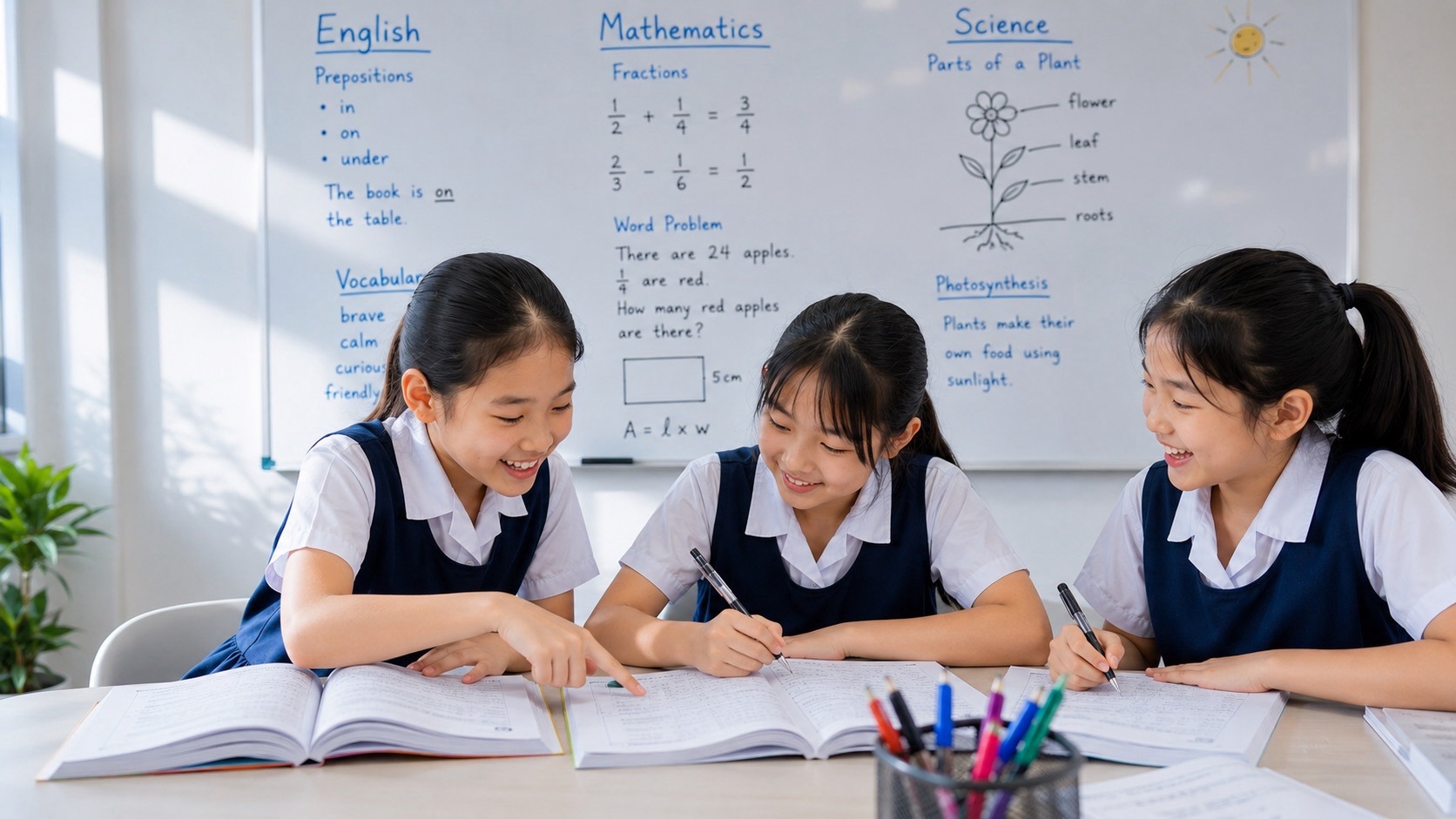
A Primary 3 Higher Chinese Language (HCL) tutor for Punggol children should deepen their enjoyment of Mandarin reading, literature and cultural understanding—not treat a nine-year-old as a Primary 6 examination candidate. eduKatePunggol’s published small-group approach describes up to three learners in 1.5-hour tutorials, which can support individual reading, oral discussion and feedback. For a suitable P3 HCL pupil, the best work often means interpreting a story, explaining a word choice or expressing a thoughtful response to a new passage.
The MOE Chinese Language Syllabus 2024 includes Higher Chinese objectives. Punggol Primary School says P3–P4 HCL enrichment uses literary-based materials and two additional periods, while HMTL progress is reported through non-weighted assessment. There is no separate national SEAB Primary 3 Higher Chinese examination. The original school-style tasks below build real ability; they are not paper forecasts, and tuition is not compulsory.
- Who is HCL for? Pupils with strong P2 oral proficiency, emerging literacy readiness and an interest in deeper Mother Tongue learning, subject to school recommendation.
- Learning emphasis: Chinese literature, culture, meaning, expression and deeper reading rather than premature PSLE drilling.
- Assessment: Punggol Primary reports P3–P4 HMTL as non-weighted in the Holistic Development Profile.
- Local school arrangement: Punggol Primary describes two additional HCL periods; verify other schools individually.
- Published tuition model: up to three learners, 1.5-hour tutorials; actual HCL availability must be confirmed.
- Parent choice: determine whether independent shared reading, existing school enrichment or targeted tuition best fits the child.
- Important boundary: P3 HCL selection does not guarantee P5 or P6 HCL or any PSLE outcome.
Two pupils can read the same story and need different support. One recognises characters but cannot explain a character’s motives; the other can discuss the story fluently but struggles to recognise the words in an unseen paragraph. Their next lessons should not be identical. A skilled tutor checks where understanding breaks, gives enough support to clarify it, then tries a different passage with fewer prompts.
For Punggol families, the relevant existing guides include P3–P4 Higher Mother Tongue, MTSP and readiness and Primary 3 Chinese reading and writing. This longer guide adds evidence-based HCL decisions and original enrichment exercises using the close-feedback philosophy of the immutable Clementi reference, without implying the same classroom or any guaranteed course place.
The complete Primary 3 Higher Chinese learning and parent guide
1. What Higher Chinese actually means in Primary 3
Primary 3 Higher Chinese Language (HCL) is an opportunity for pupils with appropriate Mandarin proficiency and interest to enjoy richer language and cultural learning at a young age. It is not simply the P5 or P6 Higher Chinese examination brought forward three years. The MOE 2024 Primary Chinese Language Syllabus describes progressive objectives for standard, higher and foundation Chinese across the appropriate stages.
The middle-primary purpose is a stronger foundation in reading, meaningful communication and early exposure to literature and culture. School practice may involve describing a character, discussing a short story, comparing language choices, noticing cultural context and presenting an idea in a clear sentence. These can be challenging without being an upper-primary exam drill.
Parent move: confirm the exact school offering and whether the child is receiving HCL enrichment, regular Chinese lessons, or both. Do not assume the label means a different national P3 paper.
2. How P3 Higher Chinese eligibility is determined
Schools can offer Higher Mother Tongue Languages from Primary 3. The Punggol Primary School’s MTL guidance says suitable pupils should show good oral proficiency and a strong foundation for literacy. Teachers consider P2 learning outcomes, qualitative descriptors, work, observations and assessments. Selection is not a simple published grade cutoff applying identically to every school.
Parents should treat teacher recommendations as evidence-based discussions, not permanent judgements about the child’s future. A child who loves Chinese stories but needs more support to read independently may benefit from strengthening core literacy first. Another may be secure enough for deeper reading while retaining a balanced timetable. Where class availability or staffing differs, the school’s actual arrangements prevail.
Parent move: ask what evidence the school used, what the child enjoys, what additional commitment is expected and when progress will be reviewed.
3. P3 HCL is generally non-weighted enrichment
This distinction matters. Punggol Primary’s published guidance says P3–P4 HMTL is reflected as a non-weighted assessment in the Holistic Development Profile. It is therefore misleading to promise mastery of an unseen national P3 Higher Chinese examination or suggest that a separate SEAB HCL paper will determine P3 advancement.
Regular Chinese learning and any school-set assessed work continue under the child’s actual curriculum. HCL enrichment may deepen literacy and culture without adding a separate weighted examination at this stage. Other schools may organise teaching and feedback differently; confirm the current rule with the child’s school. The phrase ‘school-style questions’ in this guide refers to original learning checks, not predicted HCL exam items.
Parent move: ask the teacher exactly how progress will be reported and whether a task is formative or weighted before increasing tuition hours.
4. What happens in Punggol Primary’s HCL lessons
The Punggol Primary MTL page says Higher Chinese’s literary-based textbook content involves two additional periods a week at P3–P4. This is a school-specific published arrangement, not a timetable guarantee for every Punggol child or for every primary school in Singapore. It reflects a deliberate effort to expose young learners to engaging ethnic literature and cultural knowledge.
A family should distinguish the extra school instruction from private tutoring. If the child is already enjoying the HCL periods and reading steadily, tuition may offer little additional value. If the child can handle oral lessons but cannot independently follow the stories, a focused reading intervention could be more useful than another full set of worksheets.
Parent move: ask the school for the actual HCL schedule, textbook and reading expectations. Never enrol in an external class only because another school has two additional periods.
5. Read the 2024 Chinese syllabus correctly
MOE’s refreshed Chinese curriculum emphasises functional communication, interest in language, cultural appreciation and skills that develop over time. The syllabus distinguishes language levels by scope and depth rather than by one universal set of memorised idioms. A P3 pupil should still work with appropriately challenging Chinese that can be understood and discussed.
An advanced pupil can consider why a character helps another person, compare two possible words and explain what a short poem or story expresses. That is different from requiring students to dissect high-school literature or write pages of idiomatic prose. A tutor should align with the school syllabus and extend meaning, not confuse difficulty with educational quality.
Parent move: request a recent text and check whether the proposed tuition teaches the same kind of deeper comprehension and communication.
6. Distinguish standard Chinese from Higher Chinese at P3
Standard Chinese develops the same important listening, speaking, reading and writing foundations. Higher Chinese at this level can provide additional depth and exposure for pupils who are ready, particularly through literary and cultural materials. This does not make regular Chinese learners less capable or imply that the learning habits required in one course are worthless in the other.
For example, both pupils may read a short story about returning a lost object. A standard-level exercise might identify the main person, action and outcome; an enrichment exercise might compare the character’s intentions, infer a feeling supported by a clue, or discuss a relevant value without inventing unsupported motives. Both tasks should remain age-appropriate.
Parent move: match difficulty to what the pupil understands now, not to a prestige label on a textbook cover.
7. Reading literature means following an experience
At Primary 3, literature exposure should invite pupils into language and stories that are enjoyable. Ask what happened, who is involved, what someone noticed, how the mood changed and which passage supports the interpretation. A child who reads fluently but cannot describe the event is not yet benefiting fully from deeper reading.
Give pupils time to appreciate a story before discussing its structure. A tutor can read a short age-appropriate narrative, invite a retelling and then ask one deeper question. Avoid immediately translating every line or explaining a grand moral that is not supported by the text. The reading should remain meaningful in Chinese rather than becoming an exercise in adult commentary.
Parent move: ask your child to tell you one interesting moment before asking about vocabulary or marks.
8. Learn the difference between what a story says and suggests
Inference is useful only when connected to evidence. If a character returns a classmate’s missing book, that may support an inference that the character is responsible or helpful. It does not prove that the character wants a reward or dislikes the classmate. Deeper reading is the ability to discuss plausible meaning, not invent more dramatic details.
Original line: ‘发现书本不见了,小杰急忙跑回课室寻找。’ A reasonable inference is that Xiaojie was concerned about the missing book. The words ‘急忙’ and the action of returning to search provide clues. Ask the child whether other interpretations are possible and which ones are not supported.
Parent move: teach the habit ‘I think this because the passage shows…’ rather than accepting confident answers without a clue.
9. Vocabulary should be precise, not merely difficult
Higher Chinese pupils may encounter a wider range of expressions, but using a rare word in the wrong situation is not advanced language. Teach contrasts such as ‘紧张’, ‘着急’, ‘担心’ and ‘兴奋’ through scenes that show distinct feelings. A learner can sound elaborate while misunderstanding nuance.
A child waiting to hear whether a missing pet has been found may be ‘担心’; a child rushing to catch a bus may be ‘着急’; a performer before going on stage may feel ‘紧张’. Each example has a reason. Ask pupils to choose and justify a word, then change the context so they must decide again.
Parent move: practise a few useful words deeply and ask for original sentences instead of measuring the length of the weekly vocabulary list.
10. Word choice changes characterisation
A strong young reader notices how verbs and descriptions shape the scene. ‘走’, ‘跑’, ‘冲’ and ‘慢慢走’ do not convey the same pace or urgency. Encourage pupils to explain why an author chose a particular word, without pretending there is always one hidden examination answer.
Compare ‘他走进课室’ with ‘他冲进课室’. The second suggests a more hurried or forceful entry. It might fit a character looking for a lost item, but context still matters. Ask which sentence suits a calm library scene and why. Then invite the child to write another short pair of sentences using a different verb contrast.
Parent move: value explanations of meaning over simply listing synonyms.
11. Reading beyond pinyin
Pinyin can support pronunciation during learning, but a child in HCL enrichment needs sufficient character recognition to read appropriately challenging material. A pupil may pronounce a word correctly because pinyin is present without recognising the characters independently. A tutor should know how much support the child uses.
Choose a school-relevant word in a familiar sentence, discuss its meaning and later show it in a new passage without an identical prompt. If the child cannot recognise it, reduce complexity and revisit the word. Increasing the amount of unseen text before establishing access to print can make enrichment frustrating rather than enjoyable.
Parent move: record independent reading separately from guided reading; both have value but demonstrate different abilities.
12. Use character components carefully
Recognising radicals or familiar character components can support memory, but a child should not be told that a character’s meaning can always be guessed from one component. Characters can contain semantic and phonetic information in complex ways, and similar-looking forms may have different uses.
Compare ‘晴’ in ‘晴天’ with ‘睛’ in ‘眼睛’. Both are pronounceable in relevant words, but they belong in different situations. Ask pupils to select the correct character in a meaningful sentence and explain the clue. A new example should check transfer instead of asking the learner to repeat a copied definition.
Parent move: connect character form, sound and meaning in authentic contexts rather than relying on isolated copying.
13. Oral interaction is a flexible exchange
A pupil selected for HCL may speak confidently, yet still need practice listening closely to a follow-up question and adapting an answer. Oral communication is not a speech memorised word for word. A useful task asks for a preference, a reason and an example while leaving room for a different view.
Try ‘你觉得朋友之间应该怎样互相帮助?’ A child might answer ‘朋友遇到困难时,我们可以先听他说,再想办法帮忙’. Ask ‘如果你不知道怎样帮忙呢?’ The learner can suggest asking a teacher or another adult. There is no need to memorise one exact response.
Parent move: let the pupil think and reply naturally; correct a few high-value language problems afterwards.
14. Cultural knowledge through real reading
P3–P4 HCL enrichment is associated with literature and cultural exposure. Appropriate stories, celebrations, community situations and personal accounts can help children appreciate cultural details without requiring every child to have identical family experiences. The aim is understanding and respectful curiosity, not rote cultural trivia.
If a story mentions a traditional festival, ask what the text itself says, what the child already knows and what remains uncertain. This avoids confusing assumption with evidence. Another story about Singapore life can allow discussion of how people communicate across languages and communities. An honest response can include a question rather than a fabricated family story.
Parent move: ask your child what they learned from a text, not what an adult thinks they should already know.
15. Short writing should be original and coherent
Even confident readers can have difficulty planning an independent paragraph. A child may include decorative expressions but leave the main event unclear. At this stage, teach complete sentences, relevant details and a believable sequence before demanding sophisticated stylistic flourishes.
A short story about finding a lost pencil case could establish the classroom, the discovery, the search for its owner and the return. The child might write ‘放学后,我发现桌下有一个铅笔盒。我把它交给老师,请老师帮忙寻找失主。’ A changed scene should test whether the pupil can reconstruct the logic without copying the same wording.
Parent move: ask what the reader needs to know first and which detail explains the main action.
16. Introduce alternative perspectives without inventing facts
A strong reader can ask how two characters might view the same event. That can deepen comprehension and empathy. However, in a reading answer the pupil must distinguish a reasonable possibility from something the passage actually proves. More elaborate reasoning is not permission to make unsupported claims.
Suppose one child returns a found item and another worries the teacher may accuse them of taking it. Both may see the incident differently. Ask which feelings are plausible and what new evidence would distinguish them. A tutor can use the discussion to teach words describing motives and uncertainty while staying within a child-friendly story.
Parent move: practise expressions such as ‘可能’ where uncertainty is real, rather than demanding false certainty.
17. A short poem or literary passage should not be a puzzle contest
Poems and literary texts can be memorable because of their rhythm, images, repetition and feelings. At P3 enrichment level, the child’s first task is to notice and enjoy the language. A tutor should not assume that every image conceals a sophisticated symbolic interpretation or that understanding requires memorising adult literary terminology.
Read a short suitable verse, ask which image the pupil remembers and what mood it creates. Invite a line of original description about a familiar scene. If the pupil can explain how a repeated word changes emphasis, that may already be meaningful progress. The lesson should deepen interest in reading more rather than convince the child that literature is a trap.
Parent move: ask what part of a text the child liked and what helped them understand it before judging the sophistication of an interpretation.
18. Discussing a moral without turning every story into a slogan
Stories often feature choices about honesty, help or responsibility. A shallow response merely writes ‘we must be kind’ after any event. A stronger answer names the actual action and explains why it matters in the story. The pupil should also learn that not every text demands a moral lesson or a fixed cultural value.
For a child who returns money, ask how the owner was affected and what was difficult about doing the right thing. A pupil might explain ‘他没有把钱留下,因为他知道失主会担心’ if the story supports that reasoning. The explanation should remain related to text evidence.
Parent move: ask ‘Which choice did the character actually make?’ before inviting a general lesson.
19. The school’s extra HCL lessons versus private tuition
Punggol Primary’s HCL model uses two additional periods for literary-based texts. This is valuable school instruction and should not be duplicated automatically by private tuition. A family should first understand what the child is doing in those school periods and whether additional work would improve understanding or simply increase fatigue.
If the child enjoys the lessons and independently follows the text, shared reading at home may be enough. If vocabulary or character recognition prevents meaningful participation, targeted support may help. If the child is already confident, enrichment could focus on genuine comparison and expression rather than assigning an enormous stack of untaught high-level comprehension questions.
Parent move: obtain the school’s lesson expectations and make a decision on actual need, not on how prestigious HCL sounds.
20. A three-pupil reading and speaking workshop
eduKatePunggol’s published small-group tutorial format describes up to three learners and 1.5-hour sessions. A tutor can use the same short story to ask one pupil for a factual answer, another for a supported inference and a third for a thoughtful comparison. This format can produce genuine dialogue and frequent individual feedback.
But the arrangement must be suitable for the learners. One advanced speaker should not dominate the whole lesson while two others copy. The tutor needs to assess each child’s reading and oral access to the text, adapt questions and check an independent written response. A group size is a possibility for good teaching, not proof that it occurs.
Parent move: ask how many speaking turns and individual corrections each learner will actually receive.
21. A sample 90-minute HCL enrichment lesson
A possible lesson could spend ten minutes recalling language, twenty on shared literary reading, fifteen on comprehension and evidence, fifteen on word nuances, fifteen on oral comparison, ten on original writing and five on review. This is an instructional example, not a guaranteed schedule or a claim that every school HCL session lasts 90 minutes.
The key is that the tutor moves from the text to discussion, from discussion to deliberate language practice, and from practice to fresh independent expression. The child should understand why a word or interpretation is suitable. A new passage at the next lesson tests whether the idea has generalised beyond the original story.
Parent move: ask the tutor what the child could explain alone, not simply which pages were completed.
22. A four-week family reading plan
Week 1: identify the pupil’s current reading strength and enjoyment; read a short appropriate story and discuss one clue. Week 2: practise word contrasts and oral reasons through a fresh passage. Week 3: compare two characters or endings and write a short original response. Week 4: read a new text without the model and revisit selected vocabulary.
The plan should fit the actual school workload. Reading a book together for pleasure is not wasted time, and independent reading habits may matter more than the number of timed exercises. If a child’s confidence falls or their school responsibilities are crowded out, reduce the load and discuss school expectations. The lesson is enrichment, not a race to accumulate model compositions.
Parent move: keep a short record of what the child read and one explanation they gave without hints.
23. What if the child struggles after being offered HCL?
An HCL offer can create pride but also pressure. A pupil may be excellent orally while finding sustained text reading difficult. Families should not treat a short period of struggle as a personal failure or as proof that the child is unsuited to Chinese. Identify the specific barrier, seek feedback and consider whether targeted literacy support is enough.
P3 HCL is intended to develop interest and ability through appropriate enrichment. If the workload is damaging motivation, discuss school arrangements and what the programme is designed to achieve. A tutor should not automatically respond by adding more hours or warning that future school opportunities will disappear. Eligibility at later levels can involve different criteria and school decisions.
Parent move: consult the HCL teacher with real reading samples and ask whether the child’s current balance remains appropriate.
24. P5–P6 and PSLE Higher Chinese are later decisions
The opportunity to learn HCL at P3–P4 should not be equated with automatic HCL placement in P5 or a guaranteed Higher Chinese PSLE result. These are separate stages, with school decisions informed by the child’s later readiness. A child in P3 in 2027 ordinarily reaches P6 in 2030, subject to normal progression.
Future PSLE formats and choices must be verified against the SEAB documents for the actual exam year. Do not sell parents the 2026 Higher Chinese PSLE format as a fixed description of 2030. At P3, strong comprehension, confident oral interaction and a positive relationship with literature are more defensible priorities than drilling upper-primary examination tricks.
Parent move: review subject level with the school at the appropriate transition; make today’s plan for today’s learner.
25. When HCL tuition is or is not necessary
A child who is thriving in school HCL, reading independently and enjoying language may need no separate tuition. Parents can support the programme through appropriate shared reading, conversation and access to meaningful cultural experiences. A low-pressure family habit may be a better use of time than extra lessons that repeat the school materials.
Tuition may help if a clear literacy gap prevents participation, an aspect of comprehension remains persistently difficult, or the pupil benefits from suitably deep individual feedback. Confirm whether a P3 HCL tutor and appropriate group actually exist, alongside fee, class location, timetable and workload. A Punggol article is not a guarantee of a class at Punggol Primary or near every MRT station.
Parent move: choose a specific learning need, a fresh progress task and a realistic review rather than promises about marks or elite-school outcomes.
26. Fourteen original P3 Higher Chinese language and literature tasks
Enrichment task 1: 读短文:小林捡到一张卡,马上交给老师。小林做了什么?
Example response and teaching point: He handed a found card to the teacher. The question requires the action stated in the text. The tutor should check a new text, different speaker or altered situation independently. These are original age-appropriate learning tasks, not SEAB or school P3 HCL examination predictions.
Enrichment task 2: 根据小林的行为,可以怎样评价他?
Example response and teaching point: He appears responsible or helpful. The answer should cite his act of handing the card to the teacher. The tutor should check a new text, different speaker or altered situation independently. These are original age-appropriate learning tasks, not SEAB or school P3 HCL examination predictions.
Enrichment task 3: 选择:晴天/睛天 哪个正确?
Example response and teaching point: 晴天 is correct for sunny weather; 睛 occurs in 眼睛. The tutor should check a new text, different speaker or altered situation independently. These are original age-appropriate learning tasks, not SEAB or school P3 HCL examination predictions.
Enrichment task 4: 比较:着急 和 担心 有什么不同?
Example response and teaching point: 着急 may describe haste or anxiety about an immediate situation, while 担心 describes concern. Context determines usage. The tutor should check a new text, different speaker or altered situation independently. These are original age-appropriate learning tasks, not SEAB or school P3 HCL examination predictions.
Enrichment task 5: 改写:他走进课室。用一个词强调他很赶时间。
Example response and teaching point: 他冲进课室 is one possible change, provided the passage supports urgency. The tutor should check a new text, different speaker or altered situation independently. These are original age-appropriate learning tasks, not SEAB or school P3 HCL examination predictions.
Enrichment task 6: 如果一个故事没有写出角色的动机,可以确定他是生气的吗?
Example response and teaching point: No. The reason or emotion is not established unless supporting details are provided. The tutor should check a new text, different speaker or altered situation independently. These are original age-appropriate learning tasks, not SEAB or school P3 HCL examination predictions.
Enrichment task 7: 口头问题:你为什么喜欢读故事?
Example response and teaching point: Give a personal reason and one example; there is no single mandatory answer. The tutor should check a new text, different speaker or altered situation independently. These are original age-appropriate learning tasks, not SEAB or school P3 HCL examination predictions.
Enrichment task 8: 阅读后问:哪一个词表现人物很着急?
Example response and teaching point: Select a genuine clue from the actual passage rather than a generic ‘model answer’. The tutor should check a new text, different speaker or altered situation independently. These are original age-appropriate learning tasks, not SEAB or school P3 HCL examination predictions.
Enrichment task 9: 用 因为…所以… 描述一个合理的事件。
Example response and teaching point: 因为下雨了,所以我们带了雨伞。 The cause should logically explain the action. The tutor should check a new text, different speaker or altered situation independently. These are original age-appropriate learning tasks, not SEAB or school P3 HCL examination predictions.
Enrichment task 10: 写两句关于图书馆的短文。
Example response and teaching point: 我走进图书馆,借了一本故事书。回家后,我认真地阅读。 Original and connected. The tutor should check a new text, different speaker or altered situation independently. These are original age-appropriate learning tasks, not SEAB or school P3 HCL examination predictions.
Enrichment task 11: 找出 顺序:他先找书,然后向老师求助。
Example response and teaching point: Searching happened first; asking the teacher for help happened next. The tutor should check a new text, different speaker or altered situation independently. These are original age-appropriate learning tasks, not SEAB or school P3 HCL examination predictions.
Enrichment task 12: 提出一种不同的角色观点。
Example response and teaching point: Explain how another character might interpret the event, while marking uncertainty and citing any given evidence. The tutor should check a new text, different speaker or altered situation independently. These are original age-appropriate learning tasks, not SEAB or school P3 HCL examination predictions.
Enrichment task 13: 简短讨论:守信用为什么重要?
Example response and teaching point: Give a concrete example such as returning a borrowed book on time, not merely a moral slogan. The tutor should check a new text, different speaker or altered situation independently. These are original age-appropriate learning tasks, not SEAB or school P3 HCL examination predictions.
Enrichment task 14: 读完短诗,说一说最喜欢的画面。
Example response and teaching point: The pupil should explain a genuine image and response, rather than guess a secret interpretation. The tutor should check a new text, different speaker or altered situation independently. These are original age-appropriate learning tasks, not SEAB or school P3 HCL examination predictions.
Questions parents ask about HCL
Can my child start Higher Chinese at P3?
Primary schools can offer HMTL from P3, subject to student readiness and school arrangements. Punggol Primary publishes its P3–P4 HCL approach.
How does Punggol Primary decide who takes it?
Published guidance refers to oral proficiency, literacy readiness, P2 qualitative descriptors, ongoing school evidence and teacher observations.
Will P3 HCL have a separate weighted paper?
Punggol Primary says P3–P4 HMTL is non-weighted and reported through the Holistic Development Profile. Confirm arrangements at your child’s school.
Does HCL at P3 guarantee HCL at P5 and P6?
No. Those are later decisions. School eligibility and workload considerations can differ across stages.
Does early HCL guarantee a secondary school posting advantage?
No. Later school posting uses official PSLE and admission rules for the relevant year. A P3 HCL label alone guarantees nothing.
Is additional private HCL tuition needed?
Not automatically. If a child is thriving in school literary enrichment, reading and discussion at home may be enough.
Should we use PSLE Higher Chinese past papers now?
Not as the main P3 resource. Age-appropriate literature and communication are more relevant to middle-primary enrichment.
What should we confirm with a tutor?
The actual availability of a P3 HCL group, fit, fee, venue, curriculum, individual feedback and how independent reading progress will be shown.
Official references and connected reading
- MOE: Primary Chinese Language Syllabus 2024, including Higher Chinese
- Punggol Primary: HCL selection, two extra periods and non-weighted P3–P4 HMTL
- Edgefield Primary: P3–P4 Higher MTL and literature enrichment
- Committee to Promote Chinese Language Learning: primary reading resources
- SEAB: PSLE is a national examination at the end of P6
- eduKatePunggol: Higher MTL, MTSP and subject readiness
- eduKatePunggol: P3 standard Chinese syllabus and small-group support
Choose enrichment for the child you have
Begin with the child’s actual experience of Higher Chinese: can they read the present passage, talk about what interests them, explain a clue and write a fresh response? If school HCL is enjoyable and manageable, support it through reading and conversation without unnecessary extra classes. If a precise gap prevents participation, choose targeted teaching and track independent improvement. Always confirm the actual class, teacher, location, schedule and cost. No tutor can honestly promise a national P3 HCL result, a future subject placement or a PSLE advantage. Properly taught kids shine a bright light into the future.


