
For Punggol parents preparing for the 2026 PSLE results on 24 November at 11.00am and Secondary 1 entry in 2027, the realistic cost is more than a school fee. Families need to plan for school attire, textbooks and materials, meals, transport, a CCA and sometimes a device or other learning supplies. Costs vary by school, citizenship, eligibility for financial assistance and the child’s actual routine. Punggol’s mainstream local schools—Edgefield Secondary, Greendale Secondary, Punggol Secondary and Yusof Ishak Secondary—should be compared on learning fit and journey as well as the family’s ability to manage recurring expenses.
Eligible Singapore Citizen pupils in MOE-funded schools may receive important support through the MOE Financial Assistance Scheme (FAS). The published criteria effective January 2026 are monthly gross household income of no more than S$4,000 or monthly per-capita household income of no more than S$1,000. The published secondary-level benefits include full school and miscellaneous fee subsidy, free textbooks and school attire, meals for ten school days’ meal occasions per week, and a public-transport subsidy. These are the published 2026 criteria and benefits, not a guarantee that every amount and condition will remain unchanged in 2027; families should verify the latest rules before applying.
Parent quick summary
• Confirm the child’s 2026 PSLE result and Posting Group before comparing actual school options.
• Budget for the whole Secondary 1 week, not only the monthly school fee.
• The MOE FAS criteria published for January 2026 use GHI ≤ S$4,000 or PCI ≤ S$1,000; check 2027 updates.
• Published secondary benefits include school fees, books, attire, meal and public-transport support for eligible recipients.
• Ask about school-based help when the family does not meet the central FAS criteria but is still struggling.
• Compare a Punggol school with an out-of-estate school using real transport and CCA costs.
• Avoid buying the wrong uniform or books before the actual S1 posting school is confirmed.
Why the true first-year cost is a family question
The move from Primary 6 to Secondary 1 changes routines. A student may travel independently, remain at school later for CCA, eat meals on a different schedule, carry more subject materials and use a personal learning device or school resources. A family that has several children or changing working hours may feel the cumulative effect more than the published school fee suggests. None of this means secondary school must be financially frightening. It means the correct comparison is an entire term of living and studying.
A parent’s budget should separate expenses into four categories: items paid once near the start of school, predictable monthly spending, irregular activity expenses and costs that can be reduced or covered with assistance. This prevents a family from double-counting items and helps them ask for targeted support. A school may supply one set of information in its registration booklet and another later during CCA allocation; both matter.
It is also important not to confuse cost with quality. A school that requires a short walk may reduce transport spending and family time pressure, but another school may offer a stronger fit for the pupil. A highly competitive historical cut-off does not mean a school is better at supporting every child. The parent should decide how much a longer journey or special activity costs in time and money, then choose within official school eligibility.
A practical Secondary 1 family budget worksheet
| Cost category | What to check | How to record it |
|---|---|---|
| School and miscellaneous fees | Citizenship category, school type, approved subsidies | Official annual or monthly amount; help already confirmed |
| Uniform and school attire | School-specific pieces, PE kit, shoes and replacement needs | One-off items plus any replacements |
| Books and learning materials | Confirmed school book list, stationery and subject requirements | Only buy for the school and subjects assigned |
| Travel | Actual public transport, number of trips, late CCA routes | School-week and monthly total |
| Meals | Canteen spending during normal and late CCA days | Realistic daily allowance and school days |
| CCA | Uniform, gear, transport, competitions, optional activities | Check which items are necessary and subsidised |
| Digital learning | School device instructions, connectivity and accessories | Do not assume every device must be bought privately |
| Learning support | Optional books or targeted tuition when genuinely needed | Separate essential from elective spending |
Families do not need to publish their income or children’s financial details online. Create a private worksheet, bring it to the school if requesting help and keep documentation in a secure place. If two adults in the household are responsible for different expenses, decide who will purchase what and when, to avoid unnecessary duplication.
What the published MOE FAS actually says
The MOE’s official Financial Assistance Scheme information sheet effective January 2026 sets out the following general criteria for eligible households in government and government-aided schools. A Singapore Citizen child in a financially eligible household may receive support under the scheme; the family’s current details and the programme’s current rules determine the result. The school may have to evaluate some applications manually.
| Item | Published January 2026 MOE FAS information |
|---|---|
| Income criterion | Monthly household GHI ≤ S$4,000 OR monthly household PCI ≤ S$1,000 |
| School and miscellaneous fees, secondary level | 100% subsidy |
| Textbooks and school attire | Free for eligible secondary recipients |
| Meal subsidies, secondary level | Subsidies covering ten meals per school week |
| Public-transport subsidy, secondary level | S$21 per month, up to S$252 per year |
| If more help is needed | Ask the school about school-based financial assistance and relevant programmes |
These are the benefits and thresholds stated for January 2026. Before claiming support for 2027, check the version of the scheme that applies in 2027, the child’s citizenship and school type, the means-tested household information and the application outcome. Do not quote these as a future guaranteed cash payout to every parent. The public-transport item is a subsidy for eligible students, not a promise that all fares or every possible family journey are covered.
GHI means gross monthly household income under the scheme’s criteria. PCI means qualifying gross household income divided by the relevant household member count. The student finance application service may retrieve household and means-test information electronically and may request supporting records. If one income measure is above the published threshold, the alternative PCI route may still be relevant. Ask the school or use the official system instead of guessing who counts in the household.
How parents can apply for assistance without confusion
MOE’s Student Finance System supports financial-assistance services. The official parent guide to FAS applications explains that a parent or legal guardian selects the relevant children and academic year, reviews the application, provides household information when necessary and submits it. Some applications can be processed using retrieved means-test information; others require the school to evaluate them.
- Before PSLE results, gather only the ordinary household income and family details you need for a private eligibility check.
- Read the currently applicable MOE FAS eligibility and benefits rather than relying on an old social-media infographic.
- Use the official Student Finance System or ask the primary or receiving school how and when to apply for the 2027 academic year.
- Select the correct child and year, and disclose the required household and income information accurately.
- If the system requests supporting documents, provide them through the authorised channel, not in a public comment.
- Submit the application and record its reference number or acknowledgement.
- Check whether the status is granted, under school evaluation or awaiting posting information.
- Ask the school about school-based financial help if your situation is difficult but the central FAS application is not automatically successful.
Parents with several children may have different application outcomes for different children because schools, family composition and processing requirements vary. Do not assume a previous child’s eligibility automatically grants every younger child the same benefits forever. Likewise, a household can experience a changed financial situation after application; contact the school to explain if new evidence is relevant.
School-based support matters when the threshold does not tell the full story
Some families have circumstances that a one-line household-income comparison does not capture. The official FAS sheet directs families to ask the school about school-based financial assistance, with requests evaluated case by case. If a parent loses work, the household has urgent expenses or the child needs special equipment, it is more useful to speak with the school than to assume nothing can be done.
Ask which items may be covered, what documents are required, and when the school needs them. The school may point the family toward official schemes, community support or other appropriate resources. A responsible guide should not invent bursary awards or guarantee that a particular school will pay a specific amount. Eligibility and available support depend on the applicable policy and individual case.
For a family needing affordable connectivity or a digital device, MOE’s published FAS information also points toward IMDA’s DigitalAccess@Home scheme, subject to its own eligibility and availability. Parents should ask the receiving school what device or connectivity is actually needed and whether it has a suitable support route before making a purchase.
The four Punggol schools: what to ask about costs
Edgefield Secondary — 36 Punggol Field
If Edgefield is on the shortlist, ask for the current Secondary 1 registration and booklist information, uniform requirements, device instructions and CCA-related expenses. A parent interested in the school’s G.E.M. applied-learning projects should distinguish ordinary programme participation from any optional activity requiring additional purchases. A route that avoids a complicated bus connection may also help the household budget.
Greendale Secondary — 51 Edgedale Plains
Greendale’s design, technology and engineering learning and outdoor education may interest a pupil who likes practical projects. Parents should ask whether school-wide activities provide required materials and whether selected or optional competitions, trips or CCAs entail separate expenses. Do not assume every technological activity requires parents to buy specialist equipment; confirm the actual instructions.
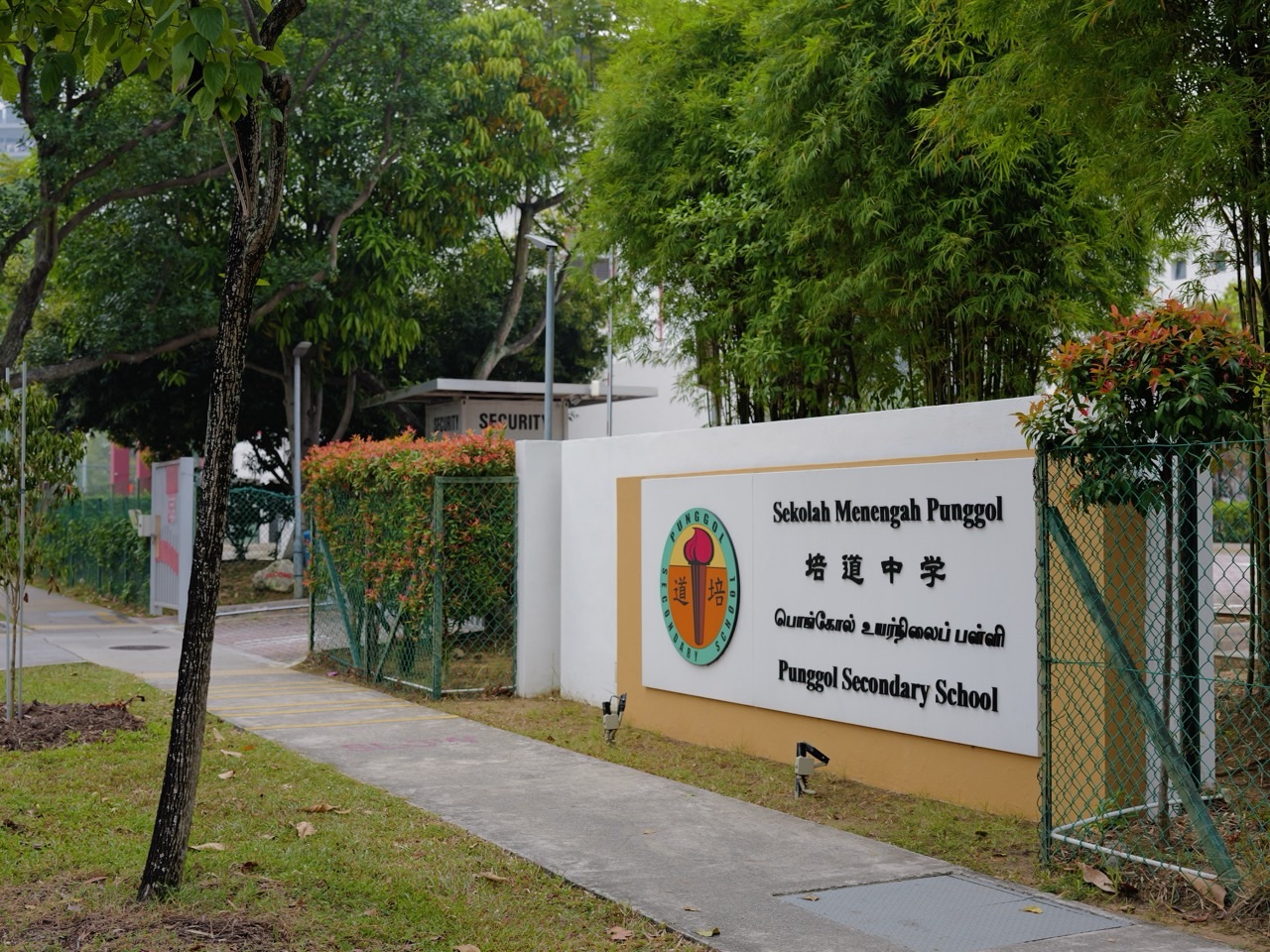
Punggol Secondary — 51 Edgefield Plains
Punggol Secondary’s official parent and student hub links to school book lists, including 2027 book-list resources. This is the sort of school-specific information parents should use once the child’s posting is known. Ask for the exact year and class or subject level before ordering; a generic Secondary 1 list from another school may contain books the pupil will not use.
Yusof Ishak Secondary — 8 Sumang Walk
Yusof Ishak’s STEM and smart-city learning and range of CCAs may appeal to families in western Punggol. Clarify what the school supplies for curricular projects and what additional CCA items or travel may be required. The home-to-school route from Sumang differs from a route beginning near Oasis; actual monthly transport costs should be worked out from the child’s home and expected schedule.
Do not let the school budget obscure PSLE admission eligibility
Financial support is a reason to investigate a school responsibly, not a way to change its ordinary Posting Group admissions conditions. For the completed 2026 Secondary 1 intake, Punggol had the following historical last-posted PSLE Scores. These were based on the 2025 PSLE cohort and are not guaranteed entry figures for the 2027 cohort.
| School | Past PG3 COP | Past PG2 COP | Past PG1 COP |
|---|---|---|---|
| Edgefield Secondary | 14 | 23 | 27 |
| Greendale Secondary | 16 | 23 | 27 |
| Punggol Secondary | 19 | 24 | 27 |
| Yusof Ishak Secondary | 15 | 22 | 27 |
A child scoring 16 under PG3 will compare those PG3 figures rather than the PG2 or PG1 values. A child scoring 24 ordinarily compares PG2 figures. A score of 25 may offer PG1 or PG2, and the relevant historical range changes with the selected route. An attractive school cannot be treated as an affordable or realistic choice until actual eligibility has been checked.
If the four local schools’ historical ranges are too competitive for the child’s score and chosen Posting Group, search reachable schools in Sengkang, Hougang, Pasir Ris or elsewhere, checking each one individually. A distant school may add travel spending, but it might also be the suitable available choice. Parents should weigh the real expenses instead of stating that all out-of-estate choices are unaffordable.
How to compare nearby and farther schools fairly
Take two hypothetical schools that satisfy the child’s school-choice criteria. School A is close to the family’s Punggol flat; School B requires an MRT or bus transfer. Write down the normal route, cost of any necessary travel pass or concession arrangement, number of late CCA days and expected food allowance. Do not assume a ‘one-stop train ride’ tells you the complete cost; walking, transfers and additional after-school activities can change the total.
A closer school can reduce fatigue, travel-related spending and the need for paid supervision or frequent family transport. A farther school may offer a desired programme, peer environment or subject combination. The correct comparison is not always simply the cheapest choice. It is which realistic school gives the child a suitable learning environment and a sustainable family routine.
If the parent must finish work before a school pick-up or supervise younger siblings, include that constraint. A school’s attractiveness is not judged only at the open house. The whole household carries the routine over several years, and a plan that requires constant emergency travel may not be practical.
When should we buy uniforms and textbooks?
An efficient family usually waits until the child’s actual posted school is confirmed and the receiving school issues its current registration or buying instructions. The SEAB announcement states that 2026 S1 posting results are tentatively expected on 18 December 2026, with a further confirmation to come. A parent can prepare a budget or check what stationery can be reused in advance, but buying a school-specific uniform for a hoped-for school risks wasted money.
Use the school’s actual book list, noting that different subject levels may have different texts. Ask whether books are supplied through FAS or another scheme before purchasing duplicates. If money is tight and financial assistance is pending, explain that to the school. Keep receipts for purchases made on school instruction and ask for any relevant reimbursement policy rather than assuming every payment is refundable.
For technology, follow the official device and personal learning device information. Different schools may have procurement arrangements, software requirements or subsidies. Parents should not borrow money for an expensive personal device based solely on another school’s website. Check the enrolled school’s instructions first.
Tuition after PSLE: an optional rather than automatic expense
Some parents feel compelled to budget for additional English, Mathematics and Science tuition immediately after PSLE. That is not necessary for every learner. A child who is adapting well, participating in lessons and doing schoolwork independently may benefit more from sleep, reading and a calm transition. A child with a specific gap in fractions, algebra, comprehension or written explanation may benefit from targeted teaching, but the need should be assessed rather than assumed.
If a family does choose learning support, distinguish short-term repair from indefinite weekly commitments. Ask what the student actually needs, what the tutor will observe, how progress will be checked and whether the child can still complete schoolwork without exhaustion. More hours are not automatically better; close feedback on the right difficulty is usually more useful than a stack of additional worksheets.
A worked example without invented prices
Imagine Family A lives in the same Punggol neighbourhood as one eligible school, while Family B chooses an eligible school several transfers away. Both may receive the same PSLE Score, but their family expense plans differ. Family A might spend less on transport but face higher commitments to an optional CCA. Family B might spend more on travel but receive financial assistance covering eligible items. We cannot assign real dollar totals without their school booklists, household eligibility, transport route and actual activities.
Therefore use a worksheet with columns labelled ‘confirmed cost’, ‘possible assistance’, ‘out-of-pocket amount’ and ‘payment date’. Mark any unknown figure explicitly instead of treating it as zero. At the time of PSLE posting, many school-specific purchases will still be provisional. A budget becomes accurate when the receiving school and its actual instructions are known.
The 2026 PSLE school-choice timeline
| Date | What parents should do |
|---|---|
| 24 November 2026, 11.00am | Collect the confirmed PSLE result and read school posting eligibility |
| 24 November, 11.30am to 30 November, 4.30pm | Submit six suitable school choices through the MOE S1 Portal |
| Tentatively 18 December 2026 | Check for the officially confirmed S1 posting outcome |
| After placement | Read the receiving school’s 2027 registration, book, uniform, FAS and device instructions |
MOE advises parents to select schools based on culture, programmes, subjects, CCAs and the child’s interests and to include two or three choices with less stringent previous cut-offs where suitable. School affordability is part of a thoughtful decision, but a past cut-off is never an admission guarantee. Keep the official S1 deadline separate from financial-assistance and school-purchase deadlines, which may have their own instructions.
Frequently asked parent questions
Can my child receive MOE financial assistance for Secondary 1 in 2027?
Eligible pupils may qualify, but parents must check the policy effective for the 2027 school year and complete the applicable process. The currently published January 2026 criteria and benefits are reference information, not a guaranteed 2027 approval for a specific household.
Is the threshold S$4,000 household income or S$1,000 per person?
The published January 2026 MOE FAS sheet uses an or test: monthly gross household income at or below S$4,000, or monthly per-capita income at or below S$1,000. The system or school will establish the qualifying household details. Check any revised thresholds before applying for 2027.
Can I ask for help if my household is above those limits?
Yes, ask the school about school-based financial assistance and the review of your actual situation. An enquiry does not guarantee an award, but not asking may leave families unaware of available help.
Do we have to pay all CCA costs ourselves?
Not necessarily; the details depend on the school, activity and applicable assistance. Ask whether uniforms or equipment are provided or loaned, whether any trip is optional and what support exists. Do not assume every club has the same cost.
Should we buy the new uniform before S1 posting results?
Normally wait for the actual school allocation and official instructions. You can prepare a budget and reuse generic supplies, but a uniform from an unconfirmed school may become wasted expense.
Should financial pressure make us choose PG1 instead of PG2?
No. Posting Group choice is about the child’s eligibility and suitable education, not a cheaper academic label. Where score 25 offers PG1/PG2, compare realistic schools and travel under both groups, and check assistance options. School and home circumstances may create different costs regardless of group.
Official sources and eduKate parent guides
- MOE: Financial Assistance Scheme published 2026 criteria and benefits
- MOE Student Finance System: financial assistance services
- MOE: how parents apply for FAS and check application status
- SEAB: 2026 PSLE results and S1 Posting deadlines
- MOE SchoolFinder: school profiles and historical cut-offs
- eduKate Punggol: buying Secondary 1 essentials while FAS is pending
- eduKate Punggol: school travel, CCA and family budget comparisons
Parent conclusion: The best Secondary 1 budget begins with accurate school eligibility, a realistic commute and official help—not with fear or guesses. Find out what the receiving school actually requires, apply for any assistance to which your household may be entitled, and resist buying school-specific items too early. A child deserves a school selected for educational fit, not a stressful spending contest.


