
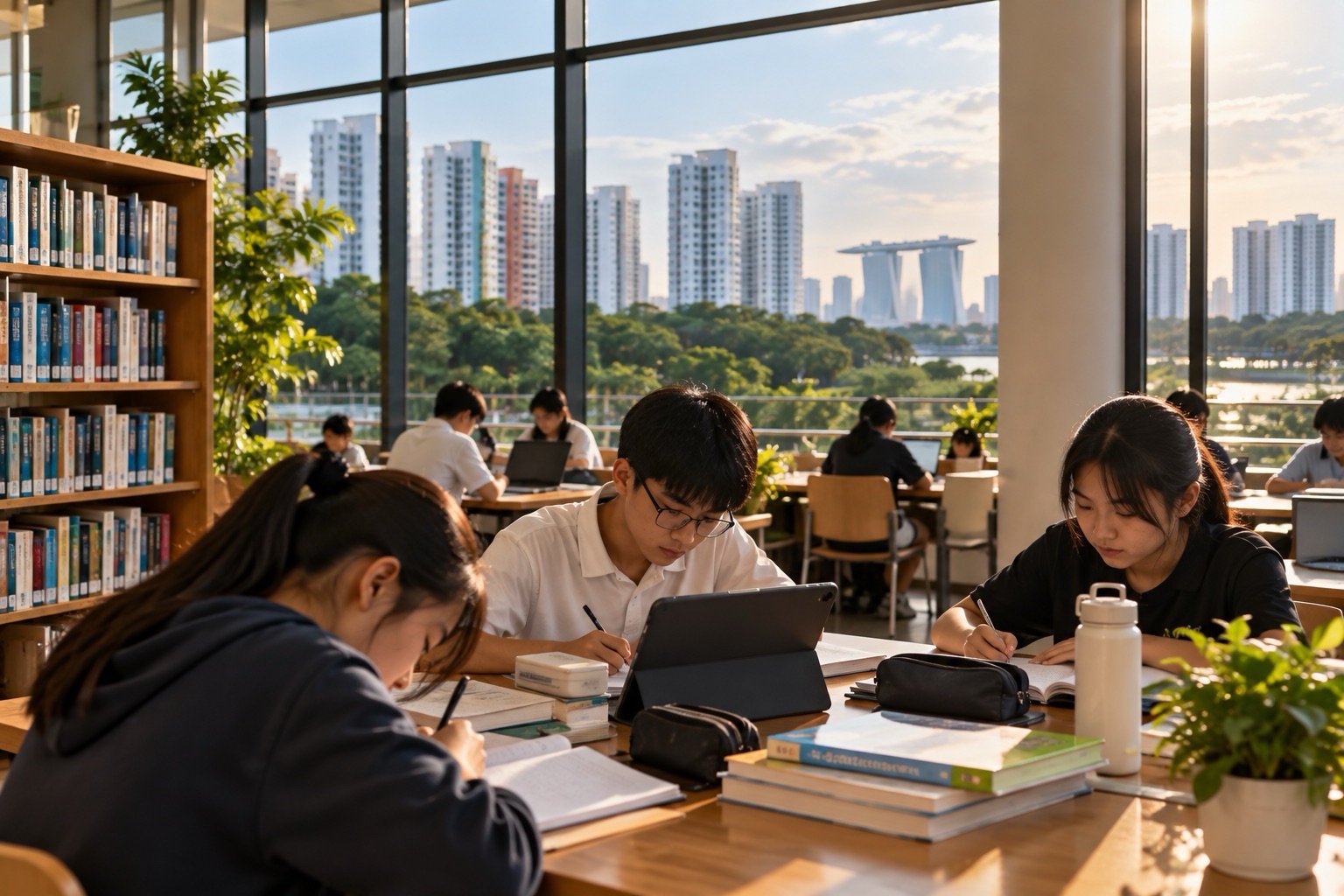
G1 Humanities in Singapore’s lower-secondary curriculum is not a single stand-alone G1 SEC examination subject. Under MOE’s lower-secondary syllabus, it combines Social Studies with three bite-sized Humanities Exposure Modules (HEMs): Geography, History and Literature in English. Social Studies develops inquiry into real-world issues, evidence evaluation and responsible citizenship. The exposure modules let students experience how different humanities disciplines explore people, place, time, identity and ideas. For Punggol parents, the important distinction is that the HEMs are non-examinable, while Social Studies uses school-based summative Performance Tasks.
Students are not simply memorising maps, dates or literary terms. They learn to ask questions, compare perspectives, examine sources, distinguish fact from opinion and construct reasoned explanations. MOE’s overarching HEM theme is Understanding People’s Relationships with Self, Society and the Environment. The curriculum is designed as an introduction to different disciplines and their everyday relevance, rather than an early version of three full upper-secondary examination subjects. A child’s school will explain its timetable, tasks and materials.
- What it contains: Social Studies plus Geography, History and Literature in English exposure modules.
- Social Studies: inquiry into societal issues, viewpoints, evidence, citizenship and decision-making.
- Geography HEM: people, places, environments and spatial relationships through bite-sized inquiry.
- History HEM: experiences across time, contexts and perspectives rather than dates alone.
- Literature HEM: characters, language, ideas and human experience through literary texts.
- Assessment: HEMs are non-examinable; Social Studies uses school-based Performance Tasks.
- SEC distinction: lower-secondary G1 Humanities is not a separate G1 SEC paper with its own K-code.
- Progression: a G1 student may be considered for G2 Humanities from Secondary 2 under MOE’s stated criteria.
- Parent priority: help the child explain evidence and viewpoints, not memorise a model paragraph.

Why Humanities is broader than memorising facts
Humanities studies people, societies, places, environments, ideas and experiences across time. A map, photograph, story, historical account or community issue can all become material for inquiry. Students learn to ask what happened, why it matters, who is affected and how different people might understand the same situation. Memorising a fact can help, but the subject asks what the fact means in context.
A neighbourhood park offers a simple example. A Geography lens might examine how people use the space and how its design affects movement. A Social Studies lens might consider competing needs: recreation, accessibility, safety and environmental care. A Literature lens might explore how a writer uses a park as a setting or symbol. Each discipline asks a different question of a related subject.
Social Studies: the core of lower-secondary G1 Humanities
Social Studies helps students understand the interconnectedness of Singapore and the wider world and the complexity of human experience. MOE describes its purpose in terms of developing informed, concerned and participative citizens. Students inquire into real-world societal issues, examine different perspectives and learn to make reasoned decisions. They also consider values, responsibilities and the consequences of choices.
This is not simply being told which opinion to hold. Students should learn to explain a position, consider evidence and recognise why others may see an issue differently. They should distinguish between a fact supported by a source, an opinion expressed by a person and a judgment reached after weighing evidence. These habits are useful in daily news and family discussions as well as later study.
What a Social Studies Performance Task involves
MOE identifies the Performance Task as the summative assessment method for lower-secondary G1 Social Studies. It assesses knowledge with understanding, interpretation and evaluation of sources or given information, and the construction of explanations. Students may need to extract relevant information, draw inferences, analyse evidence, compare views, recognise bias and make a reasoned recommendation. The task transfers learning to an authentic context through an inquiry question.
A learner may investigate an issue, consider material supplied by the teacher and produce a reasoned response. The exact task and submission format are school-directed. Do not assume every school uses the same neighbourhood topic, number of sources or presentation template. Parents can support by asking what the question is, which evidence is relevant and why the final recommendation follows from it.
How to read a source instead of copying it
A source may be a photograph, quotation, graph, article extract, interview or set of observations. Students should first identify what the source actually shows or says. Then ask who created it, when, for what purpose and from which perspective. A source may contain useful evidence while leaving out other information. A persuasive poster, for example, is not neutral proof that every person agrees with its message.
A practical routine is to identify the source, extract the relevant detail, explain what it suggests and state the limit of what can be concluded. If a photograph shows a crowded walkway, it supports an observation about that particular moment. It does not establish that the walkway is crowded at every hour. This distinction stops a student from turning one example into an unsupported general claim.
Geography Exposure Module: people, places and environments
The Geography HEM introduces students to geographical ways of seeing the world. Students may investigate their immediate surroundings, observe how people use places, examine environmental features and consider how human activities relate to the environment. MOE gives examples of bite-sized investigative work in environments such as the school and neighbourhood parks. The goal is to see Geography in everyday life, not only to learn place names.
A student might observe shade, seating, paths, vegetation and how people move through a public space. They can ask who uses the space, what makes it accessible and which features support or limit different activities. The observation should be recorded honestly. A short walk or teacher-guided investigation can produce useful evidence without requiring a complicated research project.
History Exposure Module: experience and perspective across time
The History HEM introduces students to the significance of time, context and different human experiences. MOE gives an example of students exploring the hobbies, feelings and aspirations of young people who lived through significant events in 1960s Singapore. The focus is not just a list of dates. Students consider how people experienced their circumstances and why the same period may be remembered differently by different individuals.
A useful question is: what can one person’s account tell us, and what might it leave out? A diary, photograph or oral-history extract reflects a perspective. Comparing sources can reveal different experiences or details. Students should avoid assuming that one person’s story represents everyone who lived at that time. Historical understanding grows when learners consider context and evidence together.
Literature in English Exposure Module: reading human experience
The Literature in English HEM introduces students to literary texts and ways of understanding character, language, ideas and human experience. MOE describes role-play as one possible formative activity: students act out segments of a text and demonstrate understanding of characters through word choice, actions and expressions. Reflecting on the role-play helps them explain how interpretation develops.
A learner can ask why a character acts in a particular way, what the writer’s language suggests and how a different reader might interpret the scene. Students should support interpretations with details from the text rather than inventing motives without evidence. Literature is not a guessing competition about the teacher’s preferred opinion; it is an opportunity to develop careful, text-supported interpretation.
Why the three exposure modules are non-examinable
MOE states that the three HEMs are non-examinable. Their assessment focuses on feedback to address learning gaps and improve teaching. The syllabus gives examples of short questions and multiple-choice checks through the Singapore Student Learning Space, as well as graphic organisers and group discussion. These activities help teachers see what students understand; they are not a separate national G1 Humanities examination paper.
Non-examinable does not mean unimportant or optional enrichment. The modules are part of the lower-secondary Humanities curriculum and give learners an opportunity to try Geography, History and Literature in English. A student should participate and learn from feedback even when a task does not carry a national examination grade. The objective is disciplinary exposure and a broader foundation.
How G1 Humanities relates to G2 and G3 later
MOE’s Full SBB guidance allows students to take subjects at different levels and to adjust subject levels across secondary school. The Humanities pathway has its own criteria. For a G1 student seeking G2 Humanities from Secondary 2, the 2026 MOE guidance specifies at least 75% overall in G1 English Language (or at least 50% overall in G2 English Language) and a Pass with Distinction in both G1 Humanities Social Studies Performance Tasks in Secondary 1 Semesters 1 and 2. The school also considers readiness and makes the relevant recommendation.
This is not an automatic promotion from a single Social Studies quiz or one good worksheet. Both Performance Task outcomes and the English threshold matter, alongside the school’s consideration of readiness. Families should ask the school for the current cohort’s exact process and timing. The criteria for a G2 student seeking G3 Humanities are different: at least 75% in the specific Humanities subject under MOE’s guidance.
How parents can help without doing the task for the child
Ask the student to explain the inquiry question in ordinary language. Then ask what evidence is available, which viewpoints might differ and how the conclusion follows. Encourage the child to keep honest notes and cite the actual sources or observations supplied by the teacher. Do not write the recommendation or create research findings for the student. The purpose of a Performance Task is to see the student’s own understanding and reasoning.
A useful weekly conversation may take five minutes: what question are you investigating, what have you found, what is still uncertain, and what evidence would change your mind? This helps the learner organise thinking without removing responsibility. If the child cannot explain the task, help them return to the question or ask the teacher to clarify instructions.
Common parent misunderstandings
The first misunderstanding is assuming G1 Humanities is one G1 SEC examination subject with a single national paper. Lower-secondary G1 Humanities is a MOE curriculum combination of Social Studies and HEMs. The second is assuming Geography, History and Literature exposure modules are separately examinable; MOE states that the HEMs are non-examinable. The third is treating Social Studies as memorisation alone, when the Performance Task assesses source interpretation and reasoned explanations.
Another mistake is assuming every school teaches identical examples or uses the same task format. The syllabus sets the curriculum framework, while schools plan learning experiences and assessment implementation. Parents should ask their child’s Humanities teacher about the current module and the evidence expected for the school-based task.
A simple study routine for lower-secondary Humanities
For each topic, create a small page with four headings: key idea, source or evidence, different perspective, and reasoned conclusion. For Geography, the evidence may be a map or observation. For History, it may be a photograph or account. For Literature, it may be a quotation or character action. For Social Studies, it may be a set of sources about a societal issue. The structure is a learning aid, not a compulsory MOE template.
Once the child can explain the idea, ask them to use a different example. Can they apply the same reasoning to a different neighbourhood space, a different historical account or a new character? This checks understanding beyond the first worksheet. Short, regular explanation is usually more useful than copying pages of notes without knowing how the ideas connect.
Where to get help in Punggol
eduKate’s Punggol learning resources cover English, Mathematics, Science and wider school learning topics. Humanities support should be matched to the actual task: reading a source, extracting information, structuring an explanation or developing a written recommendation. Families should check the current programme and availability before assuming a dedicated G1 Humanities tuition class is offered.
Many students can make progress through their school teacher’s feedback, regular reading and short discussions at home. Extra help is most useful when a particular difficulty is clear. The goal is not to memorise a perfect Performance Task answer; it is for the student to interpret information and build a reasoned explanation independently.
G1 Humanities: curriculum and assessment at a glance
| Component | What students experience | Assessment position |
|---|---|---|
| Social Studies | Inquiry into societal issues, evidence, perspectives and citizenship | Summative school-based Performance Tasks |
| Geography HEM | Bite-sized exposure to place, environment and human activity | Non-examinable; formative feedback |
| History HEM | Experiences across time and different perspectives | Non-examinable; formative feedback |
| Literature in English HEM | Texts, characters, language and human experience | Non-examinable; formative feedback |
Frequently asked questions
Is G1 Humanities a separate G1 SEC paper?
No. Lower-secondary G1 Humanities is a MOE curriculum comprising Social Studies and three Humanities Exposure Modules.
Which subjects are included?
Social Studies, Geography exposure, History exposure and Literature in English exposure.
Are the three HEMs examinable?
No. MOE states that the Geography, History and Literature in English Exposure Modules are non-examinable.
How is Social Studies assessed?
Summative assessment is through school-based Performance Tasks that assess knowledge, source interpretation and construction of explanations.
Does Humanities only involve memorising dates and facts?
No. Students interpret sources, compare perspectives, identify bias and develop reasoned explanations.
Can G1 students move to G2 Humanities?
MOE sets criteria from Secondary 2, including English results and Pass with Distinction grades for both G1 Social Studies Performance Tasks in Secondary 1 Semesters 1 and 2, with school consideration of readiness.
Do all schools use the same Humanities project?
The syllabus provides the framework. Schools determine their learning experiences and task implementation.
How can parents help?
Ask the child to explain the inquiry question, identify evidence, consider perspectives and justify a conclusion without doing the task for them.
Official sources and related reading
- MOE: Lower Secondary G1 Humanities Teaching and Learning Syllabus (2024)
- MOE: Full Subject-Based Banding and Humanities progression guidance
- eduKatePunggol: Full SBB 2027 parent guide
Next step: Ask your child to explain one school Humanities question using a source, a different perspective and a reasoned conclusion. That will reveal more than asking how many facts they memorised.


