
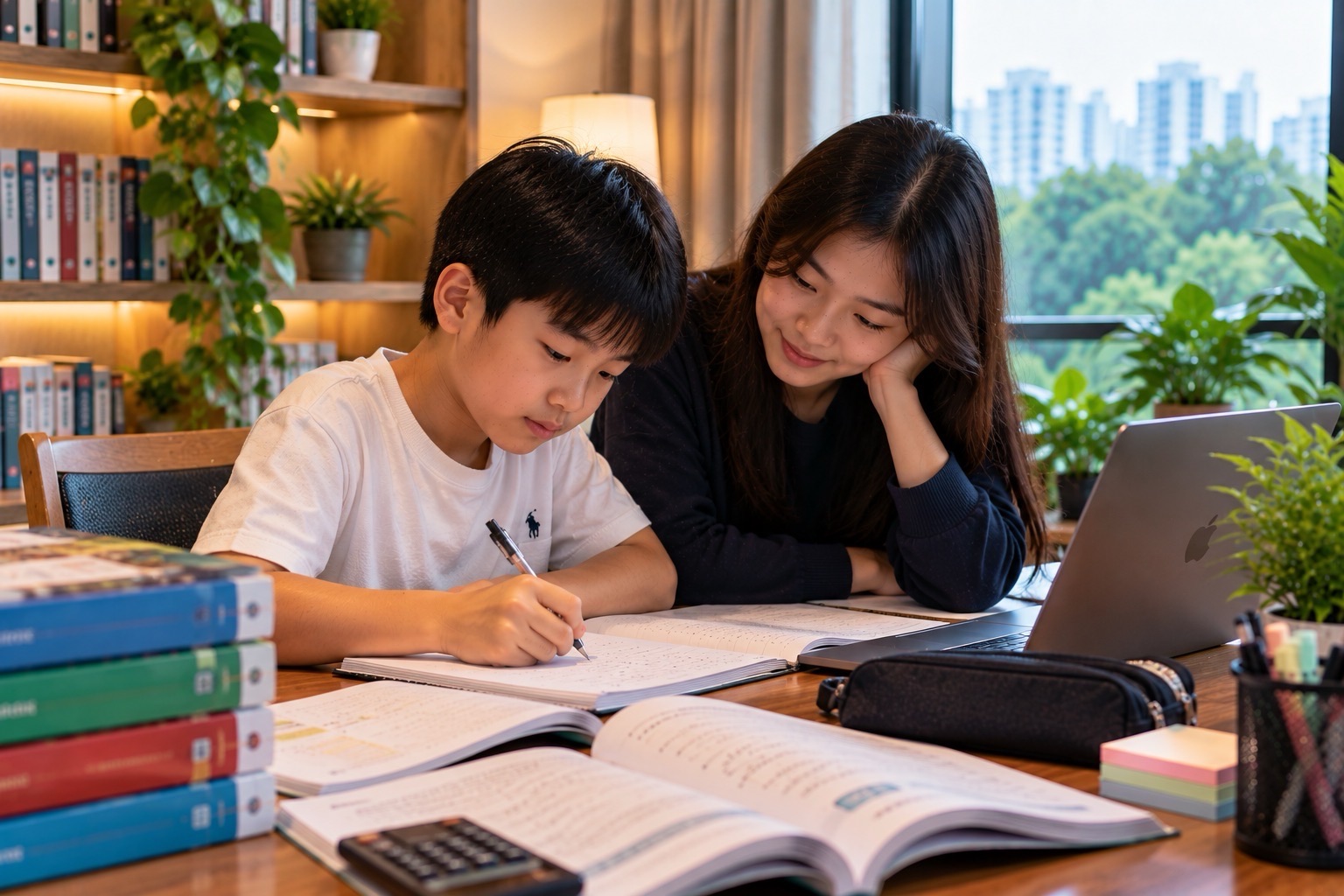
Should a Punggol primary or secondary student use ChatGPT and other generative AI tools for schoolwork in 2027? AI can help a child explore an idea, ask for an alternative explanation, practise a skill or review a draft—but it can also invent facts, make confident mistakes, expose private information and encourage copying instead of thinking. MOE’s guidance says generative AI can support learning when students have already mastered basic concepts and thinking skills. Singapore’s 2026 education announcements also confirm that AI literacy will be integrated across the curriculum, co-curriculum and self-directed learning resources; the updated Code for Fun programme will strengthen AI skills and be made available to all schools in 2027. Cyber Wellness lessons will cover validating AI-generated information and identifying deepfakes.
For parents, the main task is to teach a child how to use AI without handing over responsibility for learning. A useful sequence is: attempt the work independently, ask AI for an explanation or a hint, check the result against a textbook or trusted source, and then solve a fresh question without AI. A child should never paste personal details, school account credentials, private photographs or another person’s information into an unapproved tool. This guide explains what AI literacy means in school, how SLS and generative AI fit together, what parents can do at home, how to detect hallucinations and deepfakes, and where AI must not replace a teacher, parent or trusted adult.
- MOE expects AI literacy to develop through curriculum, co-curriculum and self-directed learning resources.
- The updated Code for Fun programme will be available to all schools in 2027 and will strengthen students’ AI skills.
- Updated Cyber Wellness lessons include validating information generated by AI and identifying deepfakes.
- MOE says generative AI can support learning when students have mastered basic concepts and thinking skills.
- Start with the child’s own attempt; use AI for hints, explanations or feedback, not as a substitute for thinking.
- Check AI claims using textbooks, teacher guidance and reliable sources; an answer that sounds confident may still be wrong.
- Do not upload NRIC/passport numbers, addresses, passwords, school logins, private student records or identifiable photos to unapproved tools.
- Never use AI to impersonate a classmate, fabricate evidence, submit work dishonestly or create humiliating images.
- Follow tool age rules and school policies; not every commercial AI tool is approved for schoolwork.
- Do not use an AI chatbot as a replacement for a parent, teacher, counsellor or professional help.
- Use the official MOE/SLS generative AI guidance and parent resources.
AI literacy is more than knowing how to write a prompt
AI literacy means understanding what an AI system can do, what it cannot reliably do, how its outputs are produced and how to use it responsibly. A pupil should learn to question an answer, compare sources, protect personal information and recognise when a task requires their own reasoning. Typing a clever prompt is only one small part of that competence.
A child who asks an AI tool to explain a fraction can still be learning actively if they check the explanation, ask a follow-up and then solve a new example independently. A child who submits an AI-generated solution without understanding it has not demonstrated the same learning. Parents should focus on what the student can explain and do after the tool is closed.
What MOE has announced for AI learning in 2027
MOE’s Committee of Supply 2026 announcement says AI literacy is being integrated into curriculum, co-curriculum and self-directed learning resources, with developmental milestones to strengthen digital literacy and technological skills. The updated Code for Fun programme will strengthen AI skills and be made available to all schools in 2027. Cyber Wellness lessons in Character and Citizenship Education have also been updated to include validating information from generative AI and identifying deepfakes.
This does not mean every child will use the same AI app, receive a personal AI account or have an identical lesson timetable. Schools decide how learning activities fit their curriculum and available resources. Parents should treat the announcement as a national direction and check the school’s actual communications for specific programmes, devices and classroom activities.
How generative AI can support learning
Generative AI can produce explanations, examples, summaries, questions, images and other content in response to instructions. Used carefully, it can help a pupil see an idea explained in another way, generate practice questions or receive feedback on a draft. The student remains responsible for checking whether the explanation matches the syllabus and whether the final work reflects their own understanding.
MOE’s guidance makes an important qualification: AI can support learning when students have mastered basic concepts and thinking skills. If a child has not yet understood place value, asking AI to solve a difficult multi-step problem may produce an answer that the pupil cannot evaluate. Build the foundation first, then use the tool to extend or revisit learning.
The difference between AI literacy, coding and ordinary computer use
Using a laptop to type an essay is digital tool use. Writing a program is coding. Asking a generative AI model to explain or create content is interaction with an AI system. These activities overlap, but they are not identical. A pupil can learn to use software without understanding why AI output may be unreliable, and a pupil can understand responsible AI use without becoming a programmer.
The Code for Fun update is intended to strengthen students’ AI skills, but parents should not assume that every Code for Fun lesson is simply chatbot prompting. Coding, computational thinking, AI literacy and cyber wellness contribute different capabilities. A strong learning programme helps children understand the underlying ideas, not just the interface of one popular product.
Student Learning Space and generative AI
The Singapore Student Learning Space (SLS) provides MOE-related digital learning resources and guidance. Its AI information pages explain how generative AI may support teaching and learning and provide resources for educators and parents. The fact that SLS contains AI guidance does not mean every external generative AI product is automatically integrated into a child’s school account or authorised for every assignment.
Parents should use the school’s instructions about SLS access, logins and permitted activities. Do not share the child’s school password with outside providers or enter school account credentials into an unrelated website. If a student cannot access SLS, use the official support route described by the school rather than searching for unofficial login pages.
A five-step learning method for a pupil
A practical method is: 1. Try the task independently. 2. Identify the exact step that is confusing. 3. Ask AI for a hint or a simpler explanation, not a completed submission. 4. Verify the answer using school materials or another reliable source. 5. Transfer the learning by solving a different question without AI.
For example, a student working on a Mathematics word problem might ask for an explanation of how to identify the quantities, but should then draw their own model and solve a fresh problem. The purpose is to make the learner more independent. If AI is always needed to begin, the child may be using the tool before building the underlying skill.
Good prompt: ask for a hint, not a finished answer
A productive prompt tells the tool what the student has already tried and which step is unclear. For example: “I have identified the total and the number of equal groups. Give me one hint about the next step, but do not calculate the final answer.” This gives the learner a chance to continue the reasoning.
A less useful prompt is simply “Do my homework”. It can produce a complete response that the child copies without understanding. Parents can teach children to request a concept explanation, a similar example or a question that tests their own thinking. The child should then close the AI window and attempt the actual task.
Use AI to practise explanation and retrieval
A pupil can ask an AI tool to generate a small set of practice questions on a topic already taught in class. The parent or student should check the questions for accuracy and syllabus suitability before using them. The learner can answer them independently, then compare the reasoning with a textbook or teacher’s explanation.
The value is in retrieval and transfer, not the number of questions generated. Five well-checked questions followed by correction may be more useful than fifty random questions. Do not assume the tool knows the exact current SEAB or school syllabus unless the information has been verified from the official document.
AI can hallucinate: why a fluent answer may still be false
A generative model can produce an incorrect statement, invented citation, wrong formula or fabricated event while writing in a confident and polished style. This behaviour is often called a hallucination. The output may contain a mixture of correct and incorrect information, so checking only one sentence is not enough when the result will be used for important work.
Teach the student to ask: can I find this claim in the textbook or an official source? Does the calculation work when I test it? Is the quoted source real? Is the date current? If the child cannot verify a claim, they should label it uncertain and ask a teacher or trusted adult. AI confidence is not evidence.
A source-checking routine for school projects
For a project, separate the AI-generated suggestion from the sources that support it. Ask the tool to propose search terms or questions, then find primary information from the relevant authority, library or credible publication. A student should record the source title, author or institution, date and the information actually used. Do not cite an AI answer as though it were the original evidence.
For a Singapore school project on local transport, for example, the pupil should check an LTA source for transport facts rather than rely only on a chatbot summary. For a Science concept, use the syllabus text, school materials or a suitable science reference. This develops research habits that remain valuable even when AI systems change.
Deepfakes: why images and voices can deceive
A deepfake is synthetic or manipulated media that can make a person appear to say or do something they did not. Some deepfakes are obvious entertainment; others are created to mislead, humiliate, impersonate or scam. MOE’s updated Cyber Wellness lessons include identifying deepfakes because students need to question digital media rather than believe everything that looks or sounds real.
Teach children to pause when a video or voice message is shocking, urgent or designed to provoke anger. Check whether a trusted source has confirmed it, inspect the original context and avoid forwarding it. Visual clues can help, but modern synthetic media may not contain obvious errors. Verification through trusted channels is more reliable than relying on one tell-tale sign.
What to do if a classmate’s image is altered by AI
A child should never use AI to create a humiliating, sexualised, threatening or deceptive image of a classmate or teacher. Sharing such material can cause serious harm even when someone describes it as a joke. The pupil should not forward it, repost it or pressure the person depicted to explain themselves publicly.
Save relevant evidence only if it is safe and necessary, then tell a trusted adult, teacher or school leader. Follow the school’s reporting process and ask for support. Do not attempt to retaliate by generating another image. The response should protect the targeted person and stop further circulation.
Privacy: what children should never paste into a chatbot
Children should not upload NRIC or passport numbers, home addresses, phone numbers, passwords, Singpass information, school login credentials, private report books, medical records, financial details or identifiable information about another person into an unapproved AI tool. A seemingly harmless prompt can become sensitive when combined with names, school details and photographs.
For a school assignment, remove identifying details before asking for general feedback. Use fictional names and invented examples. If a tool asks for access to contacts, files, photographs or location, pause and ask a parent before granting permission. Read the tool’s age requirements and privacy information. A child should understand that anything shared digitally may be stored or processed under the service’s terms.
Copyright, plagiarism and academic honesty
AI can generate paragraphs, images and explanations, but the student must follow the teacher’s instructions about permitted assistance. If an assignment is meant to assess the pupil’s own writing, submitting a generated essay as personal work is dishonest and prevents the teacher from seeing what the child understands. A tool may also produce text resembling published material or include claims without an adequate source.
Parents can help by asking the child to explain each sentence and show how the work was developed. If AI was used for brainstorming or feedback, the student should follow the school’s disclosure rules. Do not invent citations, hide the use of AI when disclosure is required or ask AI to make copied work appear original.
Primary school children: adult guidance matters
Younger pupils need age-appropriate digital experiences. Parents should follow the tool’s minimum-age rules, school policy and any platform restrictions. The child should not create accounts by entering a false birth date or use an adult’s login in ways that violate the service’s conditions. A parent can demonstrate a question, review the response together and explain why some statements need checking.
For a younger child, an adult-led activity is often more appropriate than unsupervised chatbot use. The child can compare an AI suggestion with a library book or ask whether a generated picture accurately represents a real animal. Keep the activity short and focused on curiosity. The aim is not to introduce a child to every new product as soon as it appears.
Secondary students: use AI without giving away the thinking
Older students may use AI to explore complex ideas, organise research questions or receive feedback on a draft where school rules permit. They still need to understand the subject, evaluate sources and produce their own analysis. A polished paragraph that cannot be defended in class is not evidence of mastery.
An effective practice is to draft an argument independently, ask for feedback on clarity or missing counterarguments and then decide which suggestions are useful. Check every factual claim. Keep notes of the student’s own reasoning and sources. When the teacher requires unaided work, the student should follow that instruction and not use AI in the restricted task.
AI should not replace teachers or human relationships
An AI system can provide information or generate practice, but it does not know the whole child, the classroom context or the family situation. It should not replace a teacher’s professional judgement, a parent’s care or a counsellor’s role. MOE’s AI product guidelines warn against using AI to provide therapy, socio-emotional support or companionship as a substitute for human relationships.
If a child is anxious, bullied, distressed or experiencing a serious problem, help them speak with a trusted adult, teacher, school counsellor or qualified professional. Do not instruct a chatbot to act as the child’s therapist or sole confidant. A digital tool may respond fluently, but it cannot take responsibility for a child’s safety and wellbeing.
What if AI gives a wrong explanation?
Ask the student to show the exact question and the AI response to the teacher or parent. Identify which step was wrong: the model may have misunderstood the question, used an incorrect assumption, applied a formula outside its conditions or made an arithmetic error. Correct the concept using the approved school method, then attempt another problem independently.
Do not let the pupil assume that the teacher’s explanation is wrong simply because the AI response sounds more elaborate. A reliable textbook or teacher explanation should take precedence over an unverified chatbot answer. If there is a genuine discrepancy between two official resources, ask the teacher to clarify which syllabus or method applies.
A family agreement for AI use
Parents can agree on a few simple household rules: use only tools permitted by the child’s age and school; do not enter personal or private information; attempt schoolwork first; use AI for an explanation or hint rather than copying; verify factual claims; disclose AI use when required; and stop when a task is meant to be completed independently.
Review the agreement as the child grows. A P4 pupil and a JC student do not need identical rules, but both need honesty, privacy and source checking. The conversation should be open rather than based on secret monitoring. Ask the child what they find useful and where the tool has been confusing. A family can learn together while preserving clear boundaries.
A worked example: using AI to understand a Mathematics mistake
A pupil answers a fraction question incorrectly and asks AI to solve the same question. The tool gives an answer with a method that does not match the way the class has been taught. Instead of copying it, the student asks for an explanation of the relationship between the numerator and denominator, checks the method with the textbook and redraws the model.
The child then attempts a different fraction question without using AI. If they can explain the method, the tool has supported learning. If they still cannot begin independently, they need further teaching, not another generated answer. This is the difference between using AI as a support and using it as a substitute.
A worked example: checking an AI-generated Science claim
A student asks an AI tool for a fact about a local ecosystem and receives a confident explanation with a named species and a supposed quotation from a government report. The pupil searches the cited report but cannot find the quotation. Instead of putting it into the project, the student checks the actual agency website and uses only information that can be verified.
The student records the real source and notes that the AI citation was not reliable. This is a successful learning outcome: the child did not merely collect facts but learned to challenge an unverified source. Parents should praise careful checking rather than the speed of producing a polished project.
A worked example: deepfake forwarded in a class chat
A class group receives a short clip that appears to show a teacher making an embarrassing statement. Several pupils begin forwarding it. One student pauses, checks whether the school has issued an announcement and asks a trusted adult. The school confirms that the clip is manipulated and asks pupils not to share it.
The student has protected classmates and the teacher by refusing to amplify the content. Families should explain that even forwarding a fake clip can increase harm. If a child receives manipulated media, they can report it rather than investigate alone or confront the person depicted.
Frequently asked questions about AI in education 2027
Will every school use ChatGPT in 2027? MOE’s announcement concerns AI literacy, the updated Code for Fun programme and cyber wellness; it does not require every school to use one commercial chatbot. Can AI help with homework? Only where the teacher or school rules allow it, and the pupil must still understand the work. Can AI be trusted for facts? Verify important claims against reliable sources.
Should primary pupils use AI alone? Follow age rules and provide adult guidance. Can a child upload a report book? Do not upload private school or personal information to an unapproved service. Should AI handle emotional distress? No; involve trusted adults and appropriate professionals. What is taught in Cyber Wellness? MOE says updated lessons include validating AI-generated information and identifying deepfakes.
Official sources and related Punggol reading
MOE: SLS guidance on generative AI, updated 10 September 2026; MOE Educational Technology journey; MOE Committee of Supply 2026: AI literacy, Code for Fun and Cyber Wellness; CSA cybersecurity lessons available through SLS.
eduKatePunggol: Parents Gateway and SLS help; Primary assessment 2027; MOE advanced learning 2027; Complete Punggol education guide. Updated 15 November 2026. Follow school rules and the age and privacy requirements of every tool; this is a parent education guide, not a recommendation to use a particular commercial product.


