
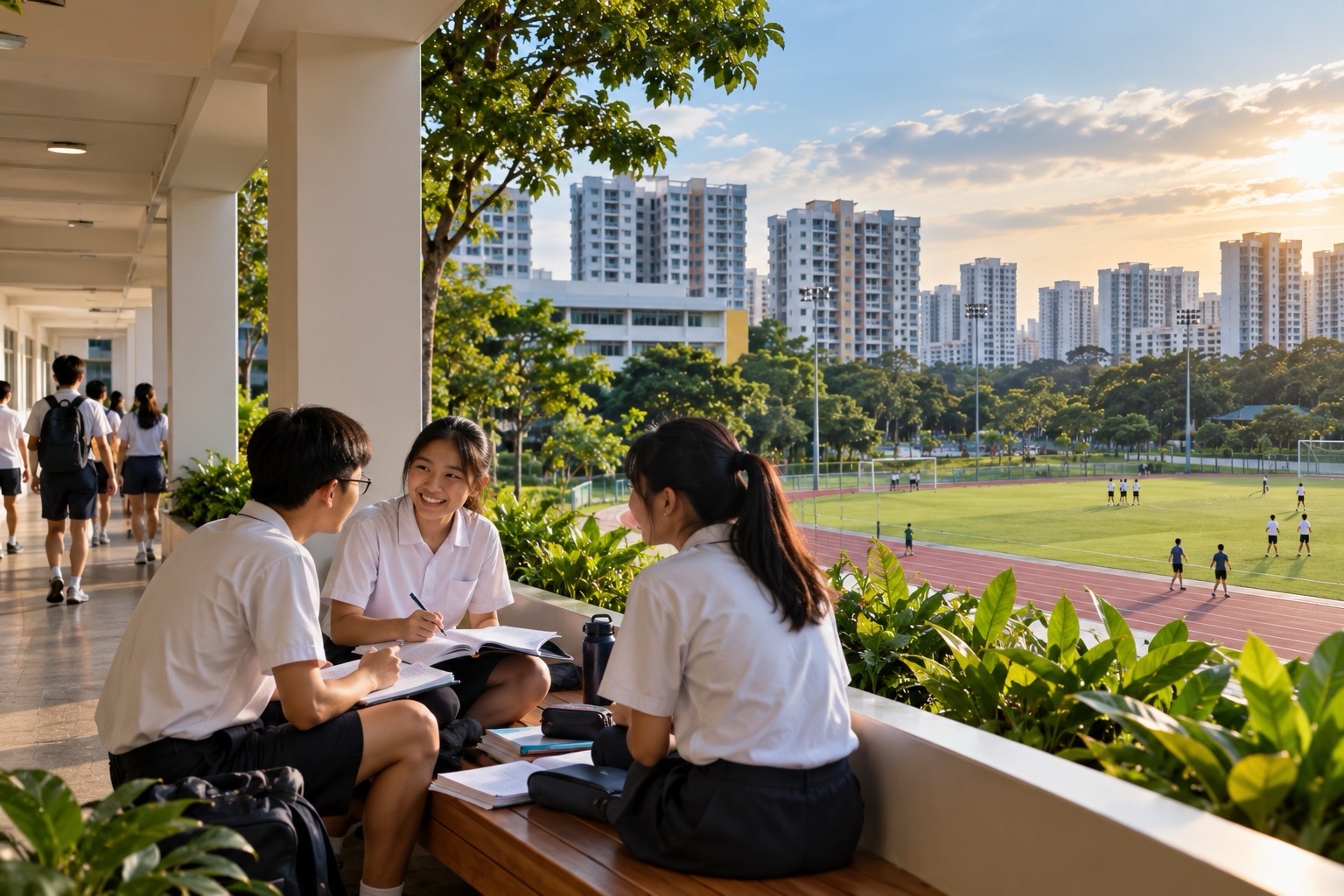
For Punggol parents researching six-year Integrated Programme (IP) schools that lead to the International Baccalaureate (IB) Diploma rather than the GCE A-Levels, the main local routes to investigate are Anglo-Chinese School (Independent), St Joseph’s Institution and Methodist Girls’ School. ACS(I) admits boys in Years 1–4 and runs its IB Diploma Programme in coeducational Years 5–6. SJI likewise has a boys-only secondary section with a coeducational IB Diploma pre-university stage. MGS is an all-girls secondary school whose IP students normally move to ACS(I) for Years 5–6. They are different schools with different admission tracks and CCAs; ‘IB school’ is not a single admission category.
A Punggol family should check the exact PSLE score and IP option available, whether the child wants the broad six-subject IB Diploma curriculum, how they handle research and long-term projects, and whether the six-year travel plan makes sense. ACS(I) is at Dover Road, SJI at Malcolm Road, and MGS at Blackmore Drive in the Bukit Timah area. None is a neighbourhood secondary-school option in Punggol. Parents should compare official school score ranges and financial aid, then ask about CCA requirements, because ACS(I)’s Years 1–4 school policy expects two CCAs while SJI’s CCA structure centres on one sustained core activity.
- ACS(I) IP: boys in Years 1–4 at ACS(I), then its coeducational Years 5–6 IB Diploma Programme; the IP route does not lead to GCE A-Levels.
- SJI IP: boys’ Years 1–4 IP at SJI, with a coeducational Years 5–6 IB Diploma stage at the same institution.
- MGS IP: girls’ Years 1–4 at Methodist Girls’ School, then the Years 5–6 IB Diploma Programme at ACS(I).
- IB assessment: six academic subjects plus Theory of Knowledge, Extended Essay and Creativity, Activity, Service requirements; successful completion is not automatic.
- PSLE: use each school’s actual IP track and previous-year indicative range, never the same school’s SEC cut-off as a substitute.
- CCA: ACS(I)’s published two-CCA expectation and SJI’s core-CCA policy can affect the child’s weekly schedule, especially with a long Punggol commute.
- Pathways: IB Diploma holders can apply to universities and other qualifying institutions; an IP Year 4 exit does not automatically provide a SEC certificate or a polytechnic/ITE placement.
First, IP is the school route; IB Diploma is the finishing qualification
The Integrated Programme describes a generally six-year educational route that bypasses the standard national Secondary 4 examination checkpoint and moves towards a pre-university qualification. Depending on the school, that qualification can be the Singapore-Cambridge A-Levels, the International Baccalaureate Diploma or another approved specialised diploma. IB is therefore not another word for IP.
At ACS(I), SJI and MGS-to-ACS(I), the intended endpoint is the IB Diploma Programme in the final two years. Students spend their earlier years developing subject foundations and habits that support that later curriculum. The process may include school examinations, coursework, research and criteria for continuation. Avoid telling a child that IP means ‘no exams’. The more useful truth is that the national SEC examination is not the usual gate in the six-year IP, and the school runs its own assessments instead.
The International Baccalaureate’s official diploma curriculum consists of six academic subjects across groups together with Theory of Knowledge (TOK), an Extended Essay (EE) and Creativity, Activity, Service (CAS). Students choose Higher Level and Standard Level subjects according to programme rules and school availability. A school may not offer every possible international IB subject, so parents should examine its actual course list.
What does a student actually study for the IB Diploma?
The IB is deliberately broad. A typical pupil works with a first-language or literature subject, a second language, humanities and societies, science, mathematics and another permitted subject from the arts or another academic group. This structure encourages breadth while allowing greater depth in selected Higher Level subjects. It is not a ‘no science’ or ‘no humanities’ route; subject choice and the school’s offerings are important.
Theory of Knowledge asks how claims are justified and how knowledge is constructed across subjects. Extended Essay involves independent research, planning, writing, revision and academic integrity. Creativity, Activity, Service asks students to learn from experiences and contribution beyond conventional examination preparation. These features can be fulfilling for students who enjoy exploration and writing, but may demand strong organisation from pupils who have relied on last-minute memorisation.
The IB Diploma is assessed with examinations and other required work. The IB’s current assessment explanation states that awarding the diploma depends on sufficient points and successful completion of further minimum criteria, including the DP core. A good six-year school placement does not guarantee the award.
Parents thinking about medicine, engineering, computing, design, law or arts should investigate eventual university prerequisites: particular IB subject choices, Higher Level subjects and grades may matter. The correct question at Primary 6 is whether the child is likely to enjoy the broad curriculum and could develop the skills required, not whether a distant job title is already fixed.
ACS(I): direct six-year IP and a demanding CCA policy
ACS(I)’s official Integrated Programme page states that its six-year IP students take the IB Diploma Programme in Years 5–6, rather than the A-Levels. The school also offers a separate SEC track, so parents must identify exactly which programme a pupil is eligible to enter or has been offered. A school place, particularly under DSA, should not be described without its programme.
For Years 1–4, ACS(I) admits boys. The Years 5–6 IB pre-university programme is coeducational. Its location is 121 Dover Road, Singapore 139650. The ACS(I) contact and transport page identifies Dover and Buona Vista MRT as nearby rail approaches and lists connecting buses. This journey is a substantial location question for a child travelling daily from Punggol.
The ACS(I) Years 1–4 curriculum overview describes Language Arts, Mother Tongue, international studies, mathematics, sciences and electives. It also introduces independent-study opportunities and CAS-related learning in preparation for the later IB Diploma Programme. This may suit a child who likes linking academic subjects and asking open-ended questions.
An important CCA difference: ACS(I)’s co-curricular policy says each Year 1–4 student is expected to participate in two CCAs, one uniformed group and one sport, performing art or club/society. Parents should obtain the latest year-level guidance and verify how the policy operates for their child’s year and programme. Two CCAs can be valuable for leadership and broad experience, but they also demand careful time planning, especially with a cross-island commute.
A boy who already trains extensively in an external sports club, plays an instrument outside school or has significant family responsibilities needs to examine the actual school timetable. Ask the school about activity frequencies, choices, trials, equipment, exemptions or adjustments where applicable and support for student wellbeing. Do not assume that joining the school means automatic entry to any elite sports team or club.
St Joseph’s Institution: IB with a different school culture
St Joseph’s Institution offers a six-year IP leading to the IB Diploma, alongside a separate SEC track. Its secondary Years 1–4 accept boys, while its IB Diploma pre-university programme admits both girls and boys. SJI’s overview of its two tracks is explicit on that distinction. This is important for parents who see ‘coeducational IB’ but do not realise the Secondary 1 entry is boys-only.
SJI describes an interdisciplinary approach built around learning core knowledge, applying it and integrating it to make meaningful connections. Its work includes opportunities for inquiry, independent study and character development. The school’s Lasallian identity and emphasis on service may be attractive to a family seeking strong community values. Another child may prefer a different religious heritage, a different level of structure or a different peer environment. These preferences deserve genuine weight.
SJI is at 38 Malcolm Road, Singapore 308274. Its getting-to-school guidance lists Stevens station on the Downtown and Thomson-East Coast lines, with a sheltered approach, and multiple bus services in the wider Whitley Road area. From Punggol, a possible trip via the North East Line and a suitable transfer should be tested during the school-day rush. The real trip from Punggol Coast or an LRT neighbourhood may require more time than the rail journey alone.
SJI’s official CCA rules take a different approach from ACS(I). They centre on a core CCA that the boy is expected to sustain across the four secondary years. The school names sports, uniformed groups, performing arts and clubs, with selection taking account of student interest, talent, available places and school needs. Offerings include sports such as badminton, canoeing, rugby and tennis; band, vocal ensemble and drama; and particular service and interest groups. Some clubs have special restrictions, so read the notes rather than assuming unrestricted entry.
This commitment can help a boy build long-term friendships and expertise. But the family should examine whether the chosen activity really matches the student, not just whether it appears impressive on a university application. A sustained, enjoyable CCA is a better fit than a coveted one the child will dread attending.
Methodist Girls’ School: the distinct girls’ entry route to ACS(I)
Methodist Girls’ School is an all-girls secondary school and offers both a regular SEC programme and a six-year Integrated Programme. The school’s official MGS IP page confirms that IP students spend Years 1–4 at MGS and then take the IB Diploma Programme at ACS(I) in Years 5–6. That is different from boys entering ACS(I) itself at Year 1, even though the same IB Diploma destination may eventually apply.
MGS is at 11 Blackmore Drive, Singapore 599986, with King Albert Park MRT and nearby bus routes listed on the school contact page. For a girl living in Punggol, the trip to Blackmore Drive has to be evaluated for four school years, then the Year 5–6 journey to ACS(I) on Dover Road must be calculated anew.
Its IP describes purposeful independent study, research, ASEAN-related understanding and projects that connect learning to the wider world. Those opportunities can benefit a girl who enjoys discussion, exploration and service. However, an abstract appreciation of ‘IB style’ cannot replace seeing the MGS school environment, talking to teachers and discovering whether the child can manage the weekly workload.
The MGS 2026 DSA notice explicitly distinguishes its SEC and IP tracks. It also lists talent areas spanning STEM, computing, music and sports; the list describes its particular admissions exercise and should not be confused with a complete CCA menu or with guaranteed Year 1 placement. When comparing schools, separate DSA eligibility, normal S1 posting and later CCA allocation.
A family considering MGS should ask about the school’s actual CCA offerings, levels of commitment, student support and whether the pupil values an all-girls environment. A future change to a coeducational ACS(I) campus is another transition to discuss, but children can prepare well for it with the right social and academic support.
PSLE results and the difference between an IP score and an SEC score
Singapore’s PSLE total runs from 4 to 32, with 4 the strongest. These schools’ IP routes are historically highly competitive, with low aggregate totals typical. The specific previous-year indicative range must be checked against the actual programme on MOE SchoolFinder. It is unsafe to copy a cutoff for a school’s four-year SEC programme and present it as the six-year IP score.
As a concrete illustration of why programme separation matters, SJI’s official Secondary 1 admissions page lists 7 as the 2026 admission year’s IP cut-off, while reporting different 2026 scores for its SEC entry and an affiliated category. That is a historical fact about SJI’s previous cohort; it is not the 2027 cut-off and does not guarantee admission to a score-7 applicant.
For a pupil with Score 4–6, research plausible programmes and the actual fit, but still check the specific eligibility, school choice rules and historical outcomes. For Scores 7–9, a detailed school-by-school comparison matters greatly because the last admitted score differs. For Score 10 or above, do not portray entry to these competitive IP tracks as a safe option based only on general information; check the current record and consider realistic SEC choices. DSA is a separate process, not a promise to override all eligibility requirements.
In dual-track schools, track selection matters for later academic decisions. The student who enters a school’s SEC programme normally follows its four-year curriculum and later post-secondary selection; the student who enters its IP follows a six-year curriculum. Some transfer opportunities can exist under school rules, but must not be guaranteed by a parent guide.
DSA: talent assessment is not the same as CCA allocation
Direct School Admission to Secondary Schools (DSA-Sec) may consider demonstrated academic, sports, arts and leadership abilities. Each school sets its own approved talent areas, selection instruments and timetable. Some offers may specify the track as well as the school, and accepting an allocated offer carries commitment requirements and can remove the ability to participate in ordinary S1 posting.
Read the MOE DSA-Sec guide and the specific school’s updated documents. DSA is not simply ‘a good CCA lets you in’. A pupil may enjoy a school CCA even if they were never a DSA applicant; conversely, a successful DSA student may have obligations linked to their talent area.
Parents who did not apply for DSA cannot assume they can create a new application after seeing the PSLE results. The regular S1 posting exercise and its school-choice system have their own rules and dates. Use the child’s actual posted options and confirmed eligibility when preparing the final list.
What about NUS High: is it an IB school or IP school?
NUS High School of Mathematics and Science is a specialised six-year school culminating in its own NUS High School Diploma rather than ACS(I)’s or SJI’s IB Diploma or the usual A-Levels. MOE’s wider Integrated Programme landscape includes different six-year qualifications, but these should be named accurately rather than treated as interchangeable brands.
The most important practical difference is admission. The NUS High Year 1 admissions page updated October 2026 states that it admits students primarily through DSA-Sec and does not participate in the ordinary S1 Posting Exercise. It may run a Supplementary Intake Exercise if vacancies remain. A parent who tries to select NUS High like an ordinary seventh or eighth S1 option will misunderstand its admissions process.
Its school CCA directory requires participation in one school-based CCA and lists astronomy, chess, debate, journalism and other opportunities. A mathematically or scientifically talented child should research this specialist pathway early, with care about genuine subject interests and entry timing. Do not confuse it with a fallback IB school.
Punggol commute and finances: a six-year cost, not just a map distance
- ACS(I): 121 Dover Road; test travel via Dover or Buona Vista and the school’s actual gate.
- SJI: 38 Malcolm Road; test the Stevens/Whitley Road approach, walking and late bus or train connections.
- MGS: 11 Blackmore Drive; test the King Albert Park corridor for Years 1–4 and ACS(I) Dover Road for Years 5–6.
- Actual home start: calculate different feeder and LRT legs for Punggol Coast, Northshore, Oasis, Matilda and Punggol central homes.
- Two school days: test a normal lesson day and a late CCA day with delays, meals, waiting and rain.
- Annual budget: include transport, school fees, uniforms, devices, meals, school trips, CCA equipment and compulsory activities.
- Financial aid: investigate the current MOE Independent School Bursary, school-based assistance and relevant scholarships rather than assuming independent schools are unaffordable or that every applicant receives a subsidy.
Because IB programmes include coursework and independent research as well as examinations, the family must allow time for sustained writing, consultation and reflection during the senior years. A journey that is manageable at Primary 6 may feel different during examination, extended-essay and CCA peaks. The best decision considers the child who will be 16 or 17, not just the child who has just received PSLE results.
For financial assistance, the MGS secondary financial assistance guide and the school’s bursary material show that independent-school aid can be substantial for eligible Singaporean families. Check current income tiers, award conditions and the school actually attended; do not generalise a particular family’s fees.
IB Diploma to university: keep subject choice and eligibility clear
A successful IB Diploma is accepted for consideration by Singapore universities and many overseas institutions, but universities still impose programme-specific grades, subject prerequisites, admission tests, interviews or portfolio assessments. Mathematics or sciences at the appropriate Higher Level may be important for some courses. Humanities and language courses may have different expectations. The school should advise students on IB subject combinations when those decisions become relevant.
For a student who later wants polytechnic training or another qualification, enquire directly with the institution about routes for IB Diploma holders and the relevant entry rules. The fact that a diploma is academically respected does not mean it grants admission to every course, and the IB Diploma is not the same kind of qualification as a polytechnic diploma.
A student wanting to exit IP after Year 4 must also ask what formal qualification, if any, they would hold. Four years of IP does not automatically confer SEC results. The 2028 post-secondary admissions changes for the mainstream SEC-based landscape cannot be cited as proof of automatic PFP, polytechnic or ITE entry for an IP leaver.
ITE pathways and Higher Nitec courses remain valuable applied routes for students who meet their entry standards; they are not a judgment about the student’s worth. Discuss a change of educational direction with the school counsellor before making assumptions about recognised qualifications or transfer options.
Four parent scenarios worth discussing
The confident boy who loves maths, service and multiple activities: ACS(I) may offer a stimulating programme, but its two-CCA policy may produce a crowded week alongside long travel. The family must check whether the boy has enough time for sleep and independent projects.
The boy who wants one sustained sport and community service: SJI might better match his desired routine, though its particular sporting team’s entry is not guaranteed. Ask whether the sport can be a four-year core commitment, rather than simply assuming he will be chosen.
The girl who enjoys research and an all-girls school: MGS offers that Years 1–4 environment with eventual progression to a coeducational IB stage at ACS(I). The family should evaluate both campuses and the student’s readiness for a later change of peer environment.
The child whose real passion is specialist mathematics and science: NUS High’s separate diploma may merit investigation, but its DSA-led admissions cannot be treated as another normal S1 school choice. For a child who prefers an ordinary SEC route, a nearer Punggol school can still nurture advanced mathematics and future tertiary progression.
Frequently asked questions
Are IP and IB exactly the same? No. IP is the six-year school pathway. IB Diploma is one possible final qualification; other IP schools lead to A-Levels or other specialised diplomas.
Can a girl enter ACS(I) IP in Secondary 1? ACS(I)’s Years 1–4 intake is boys-only; Years 5–6 IB is coeducational. Girls can investigate MGS’s linked IP or the separate admission route to a pre-university IB stage when eligible.
Is SJI coeducational from Secondary 1? No. SJI’s Years 1–4 secondary school is boys-only. Its final two IB years admit girls and boys.
Does ACS(I) really require two CCAs? The school’s current Year 1–4 CCA webpage says so. Check the applicable year-level handbook and any updates before planning the weekly schedule.
Is the IB Diploma out of 45 points? The commonly reported maximum is 45; however, award of the diploma also requires meeting specific passing and core criteria, so reaching a raw points total is not the only condition.
Can a Year 4 IP pupil automatically enter PFP or ITE? No. Recognised qualifications and institution-specific requirements must be established first.
Does a strong PSLE score guarantee university admission later? No. Later results and course prerequisites, as well as student interests and development, determine future options.
Official resources and further reading
For school admission tracks and indicative scores use MOE SchoolFinder. Compare ACS(I) Integrated Programme, ACS(I) CCAs, SJI IP, SJI core CCAs, MGS IP and the IB Diploma curriculum. For a regional comparison, see IP schools near Punggol and the IP, IB or G3 decision guide.
Information checked against official material available 14 November 2026. Recheck all school admissions, CCA policies, bursary and programme details for the actual year of entry.
Continue with the connected guide: PSLE Scores 4–32 in Punggol | 2027 Secondary School Choice Hub. Use its linked index to compare the related questions and choose your next reading.


