
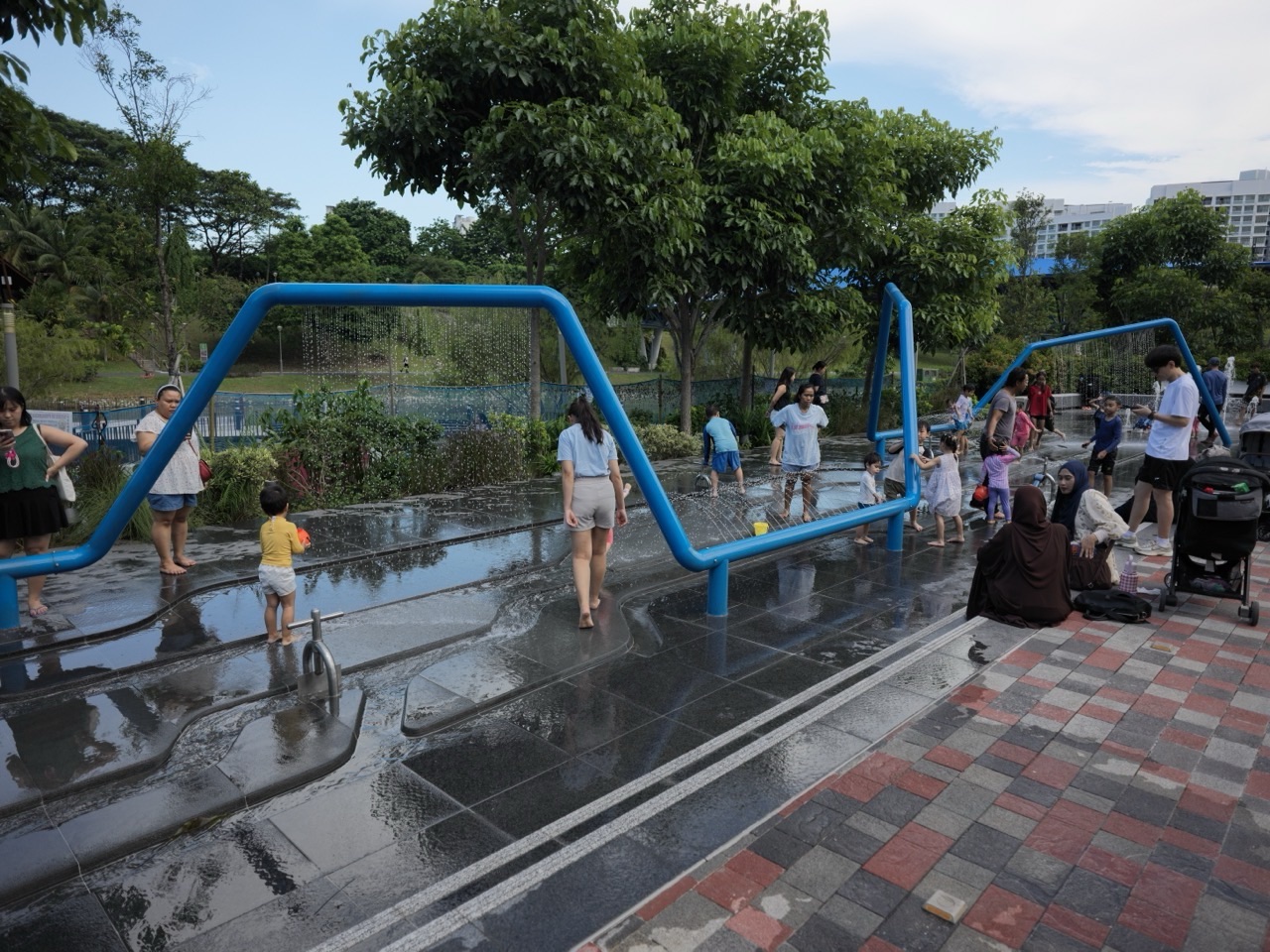
Can you bring a stroller, wheelchair or walking aid to the free Play Street at ActiveSG Punggol? Sport Singapore describes the Play Street as a 24-hour public thoroughfare with play areas, slides, movement stations and links to Sam Kee LRT, One Punggol and Punggol Waterway. It is free to access, but that description does not verify that every approach, lift, play feature, toilet or route is step-free and available at every hour. A practical visit starts by checking the actual public entrance and continuous route from transport to the place the visitor wants to enjoy. The sport centre is at 11 Sentul Crescent, Singapore 828656.
The building also contains accessible sports features that should not be confused with the public Play Street. SportSG reports removable-seat equipment for wheelchair users in its approximately 1,500-square-metre gym and accessible features in the lagoon and wellness pool areas. Those facilities have admission, programme and operating requirements, and the gym excludes children under twelve. A person with mobility needs should not assume that a complimentary Play Street walk includes use of specialised gym machines or a swimming pool. The aim of this guide is to make a calm, dignified visitor plan without fabricating an accessible route or promising assistance that has not been confirmed.
- Location: ActiveSG Punggol Sport Centre, 11 Sentul Crescent, Singapore 828656.
- Free attraction: public Play Street through-route, described as open 24 hours by SportSG.
- Nearby station: Sam Kee LRT PW1, on the Punggol West Loop.
- Arrival: verify a continuous legal step-free route from the actual MRT/LRT exit, bus stop or drop-off point.
- Strollers: check ramps, space for turning, current lift operation and suitability of individual play features.
- Wheelchair users: confirm accessible entrance, gradients, route surface, toilet access and any particular assistance needs.
- Walking aids: plan rest opportunities and a manageable turning point without assuming seating at every location.
- Indoor gym: has inclusive removable-seat equipment but requires eligible admission and appropriate usage.
- Lagoon and wellness pools: have accessibility features; verify exact pool access, changing and assistance arrangements.
- Play Street slides and waterplay: equipment rules and feature operation may differ from the 24-hour public corridor.
- Caregivers: agree who supervises children and who will help a visitor if needed; facility staff are not automatic carers.
- Fact check: 14 November 2026. Live signs, operator guidance and individual needs take priority.
What an accessible visit really means
A building can be described as inclusive while a particular visitor still needs precise information about the route, equipment and people available. A wheelchair user may need enough clear space to turn, a suitable lift and a path without abrupt barriers. A parent with a stroller needs safe crossings and an appropriate way to reach the public play space without carrying the buggy through stairs. An older person using a walking frame may need an easy turning point and rest opportunities. Those are different practical needs.
The right question is not simply whether the centre has accessible facilities. It is whether this individual can travel from the chosen arrival point to the intended activity and back, using currently operating routes. A photograph of a ramp or a broad architectural description cannot prove that. A careful plan treats access as a complete journey rather than one attractive feature.
What SportSG confirms about Play Street
SportSG’s November 11 Punggol article describes a free public Play Street running through the sport centre. It is a twenty-four-hour thoroughfare connecting One Punggol, Sam Kee LRT, Punggol Waterway and the Singapore Institute of Technology campus. The official description names play tubes, slides, toddler play areas and movement or fitness stations. That is a strong reason to consider the public route for a casual outing.
However, the published description does not specify the precise path width, every gradient, the location of each accessible toilet or whether every lift operates at all hours. It also does not promise that every play item is suitable for a wheelchair user or a child in a stroller. Respect the difference between a verified free destination and unverified details of the particular route.
Choosing the right entrance
Punggol Sport Centre is a multi-level development with public, booked and restricted spaces. A wheelchair user should not be directed to the first visible side door unless the operator confirms it is a legitimate accessible entrance to the intended area. The free Play Street may have a different public approach from the gym, badminton hall or swimming complex. The correct entrance is therefore part of the activity plan.
Before travelling, check current wayfinding or ask SportSG how to access the public Play Street from your chosen transport point. If a route is temporarily affected by maintenance or events, seek the authorised alternative rather than entering a service corridor. An accessible journey should never depend on persuading a child or companion to carry someone through a restricted shortcut.
Sam Kee LRT and the last-mile question
Sam Kee PW1, on the Punggol West LRT Loop, is commonly recommended for the sport centre. People coming on the North East Line can transfer at Punggol MRT NE17 to the appropriate West Loop service. But arriving at Sam Kee does not finish the accessibility question. The visitor still needs an appropriate station exit, public crossing, pavement and entrance to Play Street.
A stroller user may have a different suitable exit from someone walking independently. A wheelchair user may need a lift, and temporary lift works can change the available route. Follow current public transport operator notices, station signs and lawful crossings. A short map distance cannot be converted into a guarantee of an accessible four-minute walk for everyone.
Checking Punggol MRT NE17 for step-free transfers
Punggol MRT connects the North East Line and Punggol LRT network, but the lift or transfer used by a particular traveller may be affected by the station’s current arrangements. If a journey involves a wheelchair or stroller, check the actual lift path rather than assuming that every concourse route can be used interchangeably. A platform transfer may require more walking than a simple rail map suggests.
Allow time for reaching the right West Loop service. Do not rush to a closing train door or use escalators in a way that puts a stroller or wheelchair user at risk. If you are unfamiliar with the route, ask station staff for guidance. The trip should feel predictable and comfortable, especially when travelling with a young child or person who needs additional assistance.
Wide faregates and platform behaviour
Singapore rail stations provide accessible features such as wide faregates, but a visitor should still use the appropriate gate for the actual group. A parent pushing a buggy and carrying a bag needs enough space without catching the bag or wheels on a narrow opening. A person using a wheelchair may need to approach the faregate in a straight, controlled position. Follow actual station guidance and give others sufficient space.
On a busy platform, do not leave a stroller across the walking route or force a wheelchair user to manoeuvre around someone else’s pile of sports equipment. Keep children close and wait calmly for an appropriate train. Courtesy at an interchange can make more difference to a practical visit than a claim that the final venue is accessible.
What if a lift is unavailable?
An out-of-service lift can change a journey considerably for someone who cannot use stairs. Do not assume another lift in the station will serve the same route. Check the operator’s live information and seek staff guidance on a safe alternative. A family should not try to carry an occupied wheelchair up stairs or a steep public route simply to preserve a leisure itinerary.
Sometimes the best decision is to use another legitimate transport mode, change the arrival point or postpone. A free visit to Play Street does not have a fixed paid appointment to justify taking risks. Dignity and safety matter more than completing the trip on the originally planned day.
A stroller-friendly first visit
A family with a baby and preschooler may want a short public outing that involves little equipment. Choose a suitable arrival point and accessible lawful route, then plan to visit only one or two Play Street features. Keep the stroller out of emergency routes and check whether an older child’s preferred slide is appropriate. A stroller-friendly public path is not proof that every play item accepts a buggy beside it.
Bring ordinary care items and a practical return plan. The family may stop for a while to observe the building and waterway without needing to climb, swim or join a sports class. A short visit that ends before the children become tired can be more satisfying than attempting to explore every floor of the complex.
A wheelchair user’s first visit
A visitor using a wheelchair may enjoy architecture, public views, movement through the neighbourhood and social time with family. There is no requirement to use the gym or any particular fitness equipment. The person can decide which activity actually interests them, then check that the public route to it is suitable. Do not imply all wheelchair users have the same strength, reach, assistance or comfort requirements.
If the goal is the Play Street, confirm the current accessible entrance and the path’s suitability, rather than assuming the venue’s inclusive gym proves every nearby public route is barrier-free. If the goal is a booked sports activity, ask about the exact facility and any additional arrangements. An accurate answer respects the individual rather than offering one generic accessibility label.
Visitors using a walking stick or frame
A person using a walking aid may be able to navigate an ordinary path but still need frequent breaks, good surfaces and a route without awkward steps. The public Play Street’s twenty-four-hour operation does not guarantee seating at every point. Check the route length, rest options and a manageable place to turn back before travelling, particularly when the visitor is unfamiliar with the building.
Do not make the individual feel obliged to cover the whole public corridor or try every fitness station. A short visit with comfortable movement and time for conversation may be the desired outcome. Family members can help by carrying bags and adjusting the pace, rather than measuring success by distance walked.
Toilets are part of the accessibility route
A public trip may be difficult without knowing whether a suitable accessible toilet is reachable along the intended route. Do not assume a toilet within a swimming changing area is available to Play Street visitors without admission. Check the actual public facilities and permitted access. The visitor may need a turning space, handrails or a specific type of room, and those details should be verified rather than guessed.
Parents with babies may also need appropriate changing arrangements. The sports centre’s size and modern appearance do not establish that every public level has the needed facility. If the essential amenity cannot be confirmed, consider another nearby legitimate destination or a shorter visit.
The question of ramps and gradients
A ramp can exist without being appropriate for every individual visitor or mobility device. Its slope, surface condition and connection to the next path all matter. A photograph cannot provide all of those details. Do not ask someone to descend an unfamiliar steep section simply because a family member says it looks manageable. Look for current operator instructions and suitable alternative routes when necessary.
For a stroller, keep control near slopes and crossings and avoid using a bicycle path as a shortcut. For a wheelchair user, allow enough time and avoid crowding from other group members. The purpose of accessibility is freedom to participate, not pressuring someone to complete an unsuitable route.
What about Waterway Plaza?
SportSG describes Waterway Plaza as an open gathering space overlooking Punggol Waterway, with interactive water play. It sits within the public recreational environment around Play Street but is distinct from the five swimming pools. The official twenty-four-hour Play Street statement does not prove that water jets run continuously or that a feature can accommodate every mobility device.
If visiting for the plaza, check current feature operation and the safe route from the public thoroughfare. Avoid rolling a stroller or wheelchair onto a wet surface unless the actual signs and conditions support it. The family may enjoy the waterway view without participating in water play. An optional feature should never determine whether a person is welcome to enjoy the public space.
Play tubes and slides may not suit everyone
A slide or enclosed play tube can be enjoyable for some children, but it is not automatically suitable for a toddler, a child with limited mobility or a person uncomfortable in enclosed spaces. Read posted restrictions and assess the actual environment. Do not assume a companion can lift a child into any feature safely just because the attraction is free.
A family can choose a different permitted activity, such as observing public architecture, a short walk or conversation. The Play Street offers several kinds of recreation; there is no obligation to complete the entire playground. Inclusive planning starts with genuine options and respect for individual preferences.
Movement stations versus the indoor gym
Play Street has public movement and fitness stations, while the indoor gym is a separately admitted facility with special equipment. A public exercise station does not guarantee a suitable wheelchair-accessible machine, and an eligible gym pass does not reserve a particular apparatus. Check the actual station, condition, posted instructions and user readiness before doing any exercise.
A visitor who simply wants a free public walk need not use fitness equipment at all. If someone wants structured strength training, the actual gym may be more relevant, subject to age and admission. It is important not to promote a public movement station as a medical rehabilitation device or a universally safe workout.
The gym’s removable-seat machines
SportSG’s November 11 venue article describes some gym machines with removable seats for wheelchair users. This is a tangible inclusive design feature, but it is not a blanket promise of compatibility with every wheelchair or every person. The visitor may need information about reach, transfer, approach clearance and actual equipment use. It is appropriate to ask staff whether an orientation is available and what adjustments may be made.
The gym also has HUR pneumatic machines, which use air-pressure resistance. These may broaden exercise options, but a person with particular health or mobility concerns should obtain suitable professional guidance. The gym remains a public fitness venue, not an automatic medical rehabilitation clinic.
The gym’s age limit affects family plans
SportSG’s published rules exclude children younger than twelve from ActiveSG public gyms. A parent with an infant or preschooler cannot use the gym as a convenient waiting room while another person exercises. The child needs appropriate adult supervision somewhere permitted. A public Play Street route does not supply a childcare worker or authorise a child to remain alone at a slide.
If two adults are present, they can arrange separate legitimate activities with a clear meeting point and supervision plan. With only one caregiver and younger children, a shared public walking visit may be simpler. The family should not be split in a way that compromises care.
Lagoon and wellness pool access
The Punggol swimming complex contains a lagoon pool and wellness pool with accessible features, according to SportSG. That is useful news for visitors seeking more inclusive water recreation. But the precise entry route, poolside equipment, changing arrangements and possible assistance service should be confirmed for the person’s particular needs. A promotion showing a ramp or accessible area is not a promise of a specific service on every day.
The formal centre opening on 22 November includes a one-day free gym and pool offer, subject to operator conditions. That does not make every water area open to every visitor or remove the need for lifeguard directions and responsible supervision. A visitor should know exactly which pool they plan to use.
A carer or support person’s admission
A visitor may need another person to assist with travel, changing or an appropriate activity. Whether a companion can enter a particular gym, pool or organised programme without a separate pass depends on the current operator rules and the specific arrangement. Do not promise that all carers enter every facility free. Ask SportSG about the applicable legitimate process before buying tickets or travelling.
For a purely public Play Street visit, the group should still agree who is responsible for children and whether the route suits everyone. A responsible companion can make the outing easier while respecting the visitor’s autonomy. The goal is support, not taking over every decision.
Swimming supervision is not optional
A swimming pool can include accessible features and still require careful supervision. Children, non-swimmers and people who need individual assistance may have different requirements. Follow lifeguards and the actual operator policy, and never assume a trained lifeguard replaces a parent or caregiver. The kids’ pool is shallow but not risk-free.
If the family has children with different swimming abilities, plan adequate adult care rather than moving everyone into the same pool. A visit to the public Play Street may be a better choice when appropriate pool access or supervision cannot be arranged. The right outcome is participation without avoidable harm.
The public waterway route is separate
Punggol Waterway has public walking paths under separate management from the sports centre. They may be attractive, but a connection to the waterway does not prove every section has identical gradient, surface quality or step-free access. Some paths may be busier with cyclists or subject to temporary works. A person planning a mobility-friendly visit should check the real route rather than a generic “wheelchair-friendly” label.
Keep appropriate distance from the water’s edge and respect barriers and shared-path etiquette. A stroller or wheelchair user should be able to choose a shorter section without feeling obliged to complete an entire waterfront circuit. The public view can be enjoyed safely from a suitable lawful place.
Planning the route from a bus stop
Some visitors will arrive by bus rather than rail. The nearest suitable stop may differ by route and direction, and a bus stop physically close to the venue may not provide the best pedestrian crossing for a wheelchair or stroller. Check the actual stop code, lawful route and any ramps or level changes. Do not assume a short road distance means no barriers.
If the final walk is uncertain, contact the transport or venue operator. A family should not attempt to push an occupied wheelchair across a restricted driveway or unmarked road to reduce walking distance. Practical accessibility includes the journey from the bus stop to the correct public entrance.
Driving and a mobility-related drop-off
A driver may want to bring a visitor close to the sport centre entrance. Use only lawful drop-off and parking arrangements, and check which entrance is actually appropriate for the intended activity. Do not invent an accessible parking lot count or promise that a designated space will be available. Follow current road signs and any event restrictions.
If someone needs time to unload a wheelchair or assist a person leaving the car, plan a legitimate place and sufficient time. A public road, emergency access lane or bus stop is not made into a private drop-off area because a family needs convenience. Confirm details in advance where possible.
A grandparent and toddler visit
A multigenerational outing may involve a grandparent using a walking aid, a parent pushing a stroller and a preschooler interested in slides. The most inclusive plan might be a short lawful public walk with a few rest opportunities, rather than requiring everyone to remain beside an energetic child at a busy feature. Adults should agree on supervision before separating for any reason.
The grandparent can enjoy the public architecture and conversation, while the child may choose one suitable play area under a caregiver’s direct attention. If the route or weather becomes uncomfortable, shorten the visit. The family does not need to buy a gym or swimming pass to make the outing meaningful.
A wheelchair user who wants to watch sport
Some visitors prefer being spectators rather than using exercise equipment. Punggol has a large stadium and indoor event halls, but access to specific seating areas depends on actual fixtures and event arrangements. A free Play Street visit does not grant entry to a competition stand. If the visitor wants to watch basketball, football or another event, confirm the fixture, ticket and accessible spectator arrangements with the organiser.
Do not assume that a hall with thousands of seats necessarily offers an unrestricted accessible viewing area on an ordinary day. Ask about the correct entrance, seating and any companion policy. Clear information helps the visitor decide whether the event fits their needs.
What to ask SportSG before leaving home
A useful enquiry can be short and specific: which public entrance provides step-free access to Play Street from Sam Kee? Are there any current lift or route closures? Which accessible toilet is available to public-area visitors? If the person wants gym or pool access, which exact equipment or entry route is suitable, and is an appointment or pass required? The answer should come from the operator, not a guess from an old photograph.
Avoid sending sensitive health details unnecessarily. A visitor can describe practical access requirements without publishing private medical records. Where a specific accommodation is needed, use official contact channels and keep any relevant confirmation for the visit.
How to avoid unverified accessibility claims
It is tempting for local websites to write “fully wheelchair accessible” about a new public development. But that can be misleading without checking every element involved in a particular visit. A route could have a suitable ramp but an unavailable lift at one end, or a public entrance could be accessible while the desired play feature is not. Honest information should distinguish confirmed features from unknown details.
This guide therefore confirms the public Play Street and the inclusive gym or pool design features, but does not invent precise ramp slopes, accessible parking capacities or lift hours. The reader gains a practical checklist rather than a false assurance.
Public photographs and privacy
Parents may wish to photograph a child on a slide, and a wheelchair user may enjoy a picture of the new architecture. Do so only where permitted and without blocking accessible routes. Avoid photographing identifiable strangers, particularly children, or recording people in gym, pool or changing spaces without appropriate consent. SportSG restricts unauthorised filming within managed sports facilities.
A public outing does not need to become a social-media event. A private family photograph from a safe viewpoint can be enough. Respect for people using the space is part of an inclusive environment, not an optional courtesy.
When rain or lightning changes the visit
Singapore’s weather can make some outdoor approaches slippery or unsafe. A public walkway may be open twenty-four hours while a nearby play feature is closed due to maintenance or weather. If the route becomes unsuitable, follow current operator instructions and return safely or reschedule. Do not enter a restricted sports hall as an alternative shortcut or shelter.
A person with a mobility aid may need additional time to change plans. Discuss a backup transport arrangement before leaving, particularly for a late visit. A free recreational outing should not impose avoidable safety risks on someone who needs more predictable access.
A first fifteen-minute visit
For someone unfamiliar with the route, a short introductory visit can be enough. Identify the correct public entrance, inspect whether the initial path suits the visitor and choose a comfortable stopping point. A family might observe the building and waterway without using any equipment. If the route is crowded or inaccessible, end the trip rather than forcing progress.
The suggested duration is illustrative, not a promise that every visitor can complete a route in fifteen minutes. Some people may want longer; others may need a different entrance or another day. The important outcome is learning whether the place fits their needs.
A first thirty-minute family plan
If everyone is comfortable with the route, the family can consider a slightly longer public Play Street visit with one suitable play feature and a rest stop. The adult remains responsible for young children, while the person using a mobility aid decides their own pace. Keep bags and strollers out of circulation. If a slide is crowded or a water feature inactive, continue with another legitimate public activity.
Do not attempt the gym, swimming complex or all sports halls simply because they are in the same building. A calm, focused visit is more likely to be enjoyable. The family can decide later whether a booked activity is appropriate.
A four-week accessibility confidence plan
Week one: identify the relevant Sam Kee or bus route, check the current public entrance and confirm any essential accessible facilities. Choose a short visit only if the route is suitable.
Week two: repeat a comfortable lawful public outing. If an individual play or movement feature is appropriate and operating, use it under the posted instructions without pressure.
Week three: if the visitor is interested in a gym or pool, ask about actual inclusive equipment, admission and any assistance arrangements. Book or purchase the legitimate service before travelling.
Week four: review the person’s preferences, comfort and total journey. A regular public walk, an occasional sports event or a suitable admitted activity may all be positive outcomes. The best plan is the one that respects autonomy and can be repeated safely.
Frequently asked questions
Is ActiveSG Punggol Play Street free? SportSG describes the public through-route as free and open twenty-four hours.
Is every entrance wheelchair accessible? This guide does not verify every entrance or temporary route condition. Check the specific current path with the operator.
Which LRT is nearby? Sam Kee PW1 on the Punggol West Loop.
Can I bring a stroller? Plan a lawful appropriate public route and check actual play equipment and access conditions.
Are all slides usable with a wheelchair? Do not assume every play feature is accessible; follow posted equipment suitability and ask staff.
Does the gym have wheelchair-related equipment? SportSG identifies some machines with removable seats, subject to actual access and suitability.
Does free Play Street access include the gym? No. Gym admission and age rules are separate.
Can a ten-year-old enter the gym with a parent? No. Public ActiveSG gyms exclude children under twelve.
Are lagoon and wellness pools accessible? SportSG reports accessible features; confirm the specific arrangements and availability.
Can a carer enter the pool free? Do not assume a universal policy. Check the actual assistance and admission terms.
Is Waterway Plaza the same as a swimming pool? No. Interactive water play is a separate public feature.
Are all lifts guaranteed to work at night? No such guarantee is established here. Check current access conditions.
Can a visitor turn back early? Yes. A short comfortable public outing is a valid result.
Official references and related guides
SportSG’s Punggol sport centre facility guide confirms Play Street, public connections, inclusive gym equipment and accessible lagoon/wellness features. Use SportSG facility closure notices for current restrictions and MyActiveSG+ for separate gym or pool admission. Visit SBS Transit for relevant rail and LRT service information.
For more local reading see stroller and wheelchair routes around Punggol, the free Play Street guide, the inclusive gym guide and the five pools and access guide. This independent article was checked on 14 November 2026. It is not a verified step-free route survey, an entry pass or a guarantee that every feature is in service.
Continue with the connected guide: ActiveSG Punggol 2027/2028 | Opening Status, Facilities and Visitor Guide. Use its linked index to compare the related questions and choose your next reading.


