
Parents can turn the free 24-hour Play Street at ActiveSG Punggol Sport Centre into a short, self-guided STEM discovery walk without booking a badminton court or paying for a formal workshop. Sport Singapore confirms the public through-route has play tubes, slides, toddler areas, movement and fitness stations, and links to Punggol Waterway. Children can safely observe shapes, materials, signs, shadows, transport connections and the waterway environment from lawful public viewpoints. This guide offers twelve simple activities involving observation, conversation and drawings, but it is an independent family learning trail, not an official ActiveSG programme. The address is 11 Sentul Crescent, Singapore 828656, near Sam Kee LRT (PW1).
The safest way to use the trail is to choose three or four challenges that suit the child’s age and stop when the group has had enough. Do not enter booked sports halls, private university rooms, pool decks, the 18-lane archery range, gyms or maintenance areas to complete a question. The public Play Street is free and described as open twenty-four hours, but individual slides, fitness stations and the Waterway Plaza interactive water-play feature may have their own maintenance or safety restrictions. A dry, permitted observation from a public path can be enough. The whole outing can remain simple, affordable and enjoyable without asking children to collect samples, operate machinery or approach water.
- Start: a lawful public entrance to Play Street at Punggol Sport Centre, 11 Sentul Crescent.
- Rail: Sam Kee LRT PW1 on the Punggol West Loop, reached from Punggol MRT NE17.
- Cost: the public Play Street through-route is free according to SportSG; transport and optional food may cost extra.
- Nature of the activity: twelve independently suggested observation challenges, not a registered SportSG lesson.
- Suggested time: a short flexible visit; no universal one-hour completion time is guaranteed.
- Ages: choose simpler shapes and colours for younger primary pupils, measurements and comparisons for older pupils, and system design for teens.
- Materials: optional notebook, pencil and a charged phone for reference, without photographing identifiable strangers.
- Safety: stay on permitted paths, supervise children, keep clear of cyclists, and follow equipment instructions.
- Water: do not enter the waterway or pool decks; observe public scenery from appropriate safe positions.
- Sports facts: use published descriptions of pool depths, court configurations and gym equipment, not access to restricted rooms.
- Weather: postpone exposed walking during lightning, heavy rain or unsafe conditions.
- Checked: 14 November 2026; official venue and facility rules always take priority.
Why this is a useful free family activity
A parent may want children to learn from real surroundings without purchasing another enrichment package. Punggol Sport Centre provides a useful setting because its public thoroughfare is integrated with transport, waterway landscape and a large sports development. Children can compare the shapes of building elements, observe how people share routes and discuss why some spaces have controlled access. These are concrete ideas encountered during ordinary life.
The goal is not to reproduce a laboratory in a public walkway. It is to encourage careful observation and curiosity. A small child may notice colours and curves, while an older student can reason about design and movement. The learning experience remains recreational, optional and supervised. A family that completes only two challenges has still made a worthwhile visit.
What SportSG actually offers here
SportSG’s November 11 description confirms the Play Street is a free twenty-four-hour public route, with slides, play tubes, toddler play areas and movement stations, connecting nearby public destinations. These features make it reasonable to suggest a family walk. The official article does not state that a STEM teacher runs sessions or that worksheets and scientific equipment are supplied. Therefore, the activities below are suggestions parents can lead independently.
This distinction is essential for accurate visitor expectations. A reader should not travel expecting a science camp or staff-led guided tour. If the family also wants a formal sports session, use a genuine programme or court booking separately. This trail is about noticing safe public features and the facts SportSG has published, not entering all six storeys of the complex.
How to begin the trail without a booking
Start at a permitted public approach to Play Street and read the actual wayfinding. Choose one calm area where a family can stop without blocking the walkway. Explain that the game is to observe, draw or describe a few features and then return. If the route is crowded, move on or choose another legitimate spot. Some children will prefer to walk continuously and answer questions along the way.
There is no need to enter the badminton hall, pool complex or gym to begin. The public route’s free-access policy is separate from admission to managed sports facilities. If a particular Play Street element is closed for maintenance, do not climb a barrier or invent a shortcut. Choose another question instead.
Challenge 1: find five different shapes
For a younger child, ask them to look for a circle, square, rectangle, triangle and curved line in visible public architecture or signs. Encourage the child to point from a safe permitted position rather than touching a building element or running across the path. A parent can describe the shape in precise but simple language: a circular sign, a rectangular window or a curved roof edge.
For an older student, discuss how a three-dimensional building is represented by two-dimensional shapes in a photograph or drawing. A window may be rectangular while the whole facade curves in perspective. The aim is connecting mathematical vocabulary to real observation, not proving that a child can identify every polygon in the development.
Challenge 2: spot repeated patterns in the building
Modern buildings often use repeated windows, rails, panels or structural elements. From a lawful public viewpoint, ask children to choose a visible pattern and describe what repeats. They might notice lines along a roof edge, rows of windows or similar paving sections. Do not count inaccessible private structures from behind a fence if doing so requires stepping into a restricted area.
Older children can practise grouping objects into small sets or drawing a simple repeating pattern on paper. A teenager may consider why designers use repeated units: predictable construction, recognisable architecture and efficient production can be relevant ideas. A visitor should distinguish observations from guesses about the actual engineering specifications.
Challenge 3: follow a sign as a design system
A sign communicates with people who are unfamiliar with a place. Ask the child to find one public wayfinding sign and identify what makes it understandable: a pictogram, arrow, destination name or colour. The child can then describe where they would go and why. Do not remove, change or place stickers on any sign, and do not use a staff-only sign as an invitation to enter.
Older students can discuss the difference between a sign that gives information and one that restricts access. A good public sports centre needs clear instructions for courts, lifts, emergency routes and accessible paths. These are examples of human-centred design. A sign that confuses the family may be a useful observation, but the correct response is to ask staff, not cross a prohibited boundary.
Challenge 4: map the connection between MRT, LRT and Sport Centre
Sam Kee PW1 is on the Punggol West LRT Loop, while Punggol NE17 is on the North East Line. Ask older children to describe how one public transport service connects to another. They can sketch two stations with an interchange and then draw a simple walking line to the sport centre. This is a conceptual map, not a claim that the distance between locations is drawn to scale.
A younger child may simply notice the difference between a train and a walkway. A teenager can consider why integrated transport matters for a sports facility with many users arriving without cars. Use the actual public route and station signs for real travel decisions rather than relying on the child’s illustrative diagram.
Challenge 5: compare two ways of moving
If the family can observe pedestrians and public transport from permitted positions, ask how the different systems move people. A train carries many passengers along a defined track, while a walking route lets people change speed and direction. A bicycle path may have its own rules and interaction with pedestrians. The child can name an advantage and a limitation of each mode without needing real-time travel calculations.
Older pupils can discuss congestion and accessibility. A wheelchair user and a person carrying sports equipment may have different requirements even when both start from Sam Kee. Avoid treating one transport mode as universally fastest or best. The exercise teaches that useful engineering solutions depend on the actual user and task.
Challenge 6: notice how sunlight creates shadows
Choose a safe public area and ask the child to observe a shadow from a roof edge, column or planted feature. They can describe its direction and whether it looks sharp or soft. Do not ask children to stare at the sun or move into an exposed hot surface just to compare. If conditions are overcast or a suitable shadow is not visible, skip the challenge without disappointment.
An older student can explain that shadows form when an object blocks light from a source. They may consider why roof overhangs and shade matter in Singapore’s warm weather. The aim is observation and explanation, not calculating the exact solar angle without proper measurements and a safe setup.
Challenge 7: observe material differences without touching
A new multi-storey sports centre can contain visible glass, metal, concrete and planted surfaces. From a lawful public point, invite the child to compare how two materials look: reflective or matte, smooth or textured, transparent or opaque. Do not climb walls or touch machinery to test the material. A visible green roof or terrace should not be assumed open to visitors.
Older students can ask why different materials appear in different parts of the design. Transparency may make public circulation easier to see, while sheltered roofs and other structures have separate roles. Avoid asserting the precise material specification of an element based only on its colour. Observing is not the same as confirming an engineering drawing.
Challenge 8: use the published pool depths for a maths comparison
SportSG’s official 11 November description identifies a two-metre competition pool, a 1.2-metre training pool and a 0.3-metre kids’ pool. Children can compare the numbers on paper without entering a swimming area. Ask which is deepest, which is shallowest and how much deeper two metres is than 0.3 metres. The difference is 1.7 metres, or 170 centimetres.
An older student can consider ratios: the 1.2-metre training pool is four times the depth of the 0.3-metre kids’ pool. These are numerical comparisons, not claims about individual swimmer safety. Pool suitability depends on abilities, supervision and operator rules, so never encourage a child to test the depth personally.
Challenge 9: understand a flexible sports hall
SportSG says the Indoor Sport Hall can accommodate fourteen badminton courts with five pickleball courts, or convert to up to twenty badminton courts. Ask the child why a public venue might use the same overall space in different configurations. They might suggest changing participant demand, competition arrangements or the characteristics of different sports. The exercise can be done by reading the published facts or a printed diagram, without entering a booked hall.
A student can draw two separate boxes to represent alternative layouts. Explain that fourteen plus five and twenty are not numbers that should be combined as if every court operates at once. The lesson is about configuration and constraints rather than calculating the real floor area from unavailable measurements.
Challenge 10: air pressure and fitness machines
SportSG identifies HUR pneumatic exercise machines in Punggol’s approximately 1,500-square-metre gym. Pneumatic equipment uses air pressure to create adjustable resistance. Older children can discuss the difference between a weight stack and a pressure-based system using simple descriptions from the official article. There is no need to enter the gym or operate an actual machine.
The public ActiveSG gym excludes children under twelve, and older users need valid admission and appropriate conditions. A child can still learn the concept through reading and conversation from the public route. The lesson is not an exercise prescription or a licence to adjust equipment. A family should keep science discussion separate from restricted gym access.
Challenge 11: look at the waterway without entering it
From a lawful public viewpoint, the family can observe Punggol Waterway’s surface, vegetation and how the waterfront relates to paths and buildings. Ask children whether the water appears still or moving, and what environmental factors might affect what they see. Do not collect water samples, lean over guardrails or allow a child to touch the water for a science task.
An older student might discuss how public water bodies require maintenance, drainage management and environmental stewardship. These are plausible discussion topics, not direct measurements of water quality. A colour photograph cannot establish whether water is safe to drink or swim in. The important boundary is that observation remains safely on public land.
Challenge 12: identify the public and restricted areas
A final activity can ask older children to sort destinations into categories: free public Play Street, admitted gym, bookable racket court, specialist archery range, swimming complex or staff-only area. The key insight is that a large public sports development can combine free recreation with controlled sport training. The child’s answer should be guided by actual signs and published operator rules, not guesses.
This challenge teaches shared-space responsibility. A child can learn that a closed door or barrier is meaningful, and that other users have legitimate reservations. Younger children may need a simpler rule: stay with the adult and use only the approved play path. The goal is safe navigation, not discovering hidden entrances.
Using a notebook without making the outing feel like homework
A family can carry a small notebook and pencil, but it should not become compulsory. Ask the child to select one idea to record: a new word, a sketch of a shape or a simple comparison of two numbers. A reluctant child may prefer to explain what they see aloud. Different methods can serve the same purpose without requiring a finished worksheet.
Parents should avoid correcting every sentence or adding an examination score to the activity. The trail is a leisure outing that happens to provide learning opportunities. If the child is tired or wants to play on suitable equipment, allow that preference. The most valuable outcome may be an enjoyable conversation rather than a polished set of notes.
Primary 1–2: focus on seeing and naming
Younger primary students may enjoy naming shapes, colours, directions and familiar objects. A parent can say “show me the curved roof” or “which sign tells us where to go?” without introducing too many technical terms. The child might compare near and far, high and low or wet and dry. Keep the prompts short and let the child decide what looks interesting.
Do not expect detailed measurements or written explanations. It is easy to overload a short outing with educational questions. The family can stop after a few minutes if the child has had enough. A successful beginning encourages curiosity and confidence, not compliance with an elaborate plan.
Primary 3–4: add comparison and classification
For Primary 3 and 4 pupils, the trail can include grouping materials, comparing quantities and identifying different transport or sports spaces. Use published facts when precise measurements are unavailable. For example, the three stated pool depths can be sorted in order and compared without ever entering the pool complex. A child can also distinguish the meanings of public, booked and restricted.
Encourage the pupil to explain a conclusion in an ordinary sentence rather than just guessing. If they make a mistake, discuss the evidence together. The aim is practising observation and reasoning through everyday objects. This can be done while walking at a comfortable pace and remains optional rather than a formal assessment.
Primary 5–6: connect mathematics to real design
Older primary pupils can explore number comparisons, proportions and simple problem-solving. SportSG’s alternative badminton/pickleball hall configurations offer a useful example of how the same building adapts to different purposes. Ask why two sets of court counts cannot simply be added without considering whether the layouts happen simultaneously. Use the published counts rather than measuring the courts with children running through a hall.
A Primary 6 pupil might also compare the published pool depths and convert metres to centimetres. Keep the discussion separate from swimming ability; these are mathematical quantities, not safety assurances. The parent can let the child choose whether the task feels enjoyable after a busy school week.
Secondary 1–2: systems and trade-offs
Secondary students may enjoy thinking about how several systems interact: transport brings people to the development, public wayfinding helps them reach activities, sports facilities allocate limited space and the free thoroughfare allows the neighbourhood to pass through. A student can identify trade-offs, such as using a hall for one large event versus several smaller court bookings.
The discussion should be based on real published features without claiming access to operational plans. Do not ask a student to interview staff or sports users without permission. A simple sketch of the overall system is enough. The value lies in connecting engineering and social considerations without needing specialist equipment.
Secondary 3–4: engineering and sustainability questions
Older secondary pupils may consider how a multi-storey sports building manages light, ventilation, circulation and access. They can observe visible structural features from lawful public viewpoints and read SportSG’s description of inclusive equipment and public spaces. They should distinguish what is observed from what is inferred. A building that looks modern does not prove a specific energy-saving system exists unless the operator confirms it.
Students may also discuss public infrastructure and equitable access: why have free Play Street areas alongside paid specialist facilities? This question introduces design constraints and community needs. It is an opportunity for reasoned discussion, not an invitation to enter mechanical rooms or collect building data without authorisation.
Why children should not take samples from the waterway
A real science investigation requires appropriate permission, safety equipment and a clear method. This family trail does not provide those things, so it does not encourage collecting water, soil or plant samples. Public waterways may have ecological and maintenance considerations, and the banks can be unsafe. Observing from a suitable distance can still support meaningful questions about water and habitat.
If a school wishes to conduct formal fieldwork, it should organise the activity through its normal procedures and relevant land managers. A casual family visit is not a substitute for a supervised research expedition. The safest educational default is look, describe, compare and discuss without altering the environment.
Do not use other people’s sports as teaching props
Families may see people playing badminton or using public exercise equipment. The players are not part of the family’s lesson and should not be interrupted, filmed or asked to demonstrate for free. SportSG has rules concerning unauthorised photography and filming in its facilities. A child can learn sportsmanship by observing general shared-space conduct, but should respect the privacy and booked time of others.
If a genuine public competition is announced and spectators are permitted, the family can attend under the event’s rules. That is different from walking into an ordinary training session. Teaching children to respect other people’s time and consent is as useful as recognising a shape or calculating a ratio.
Supervision near play tubes and slides
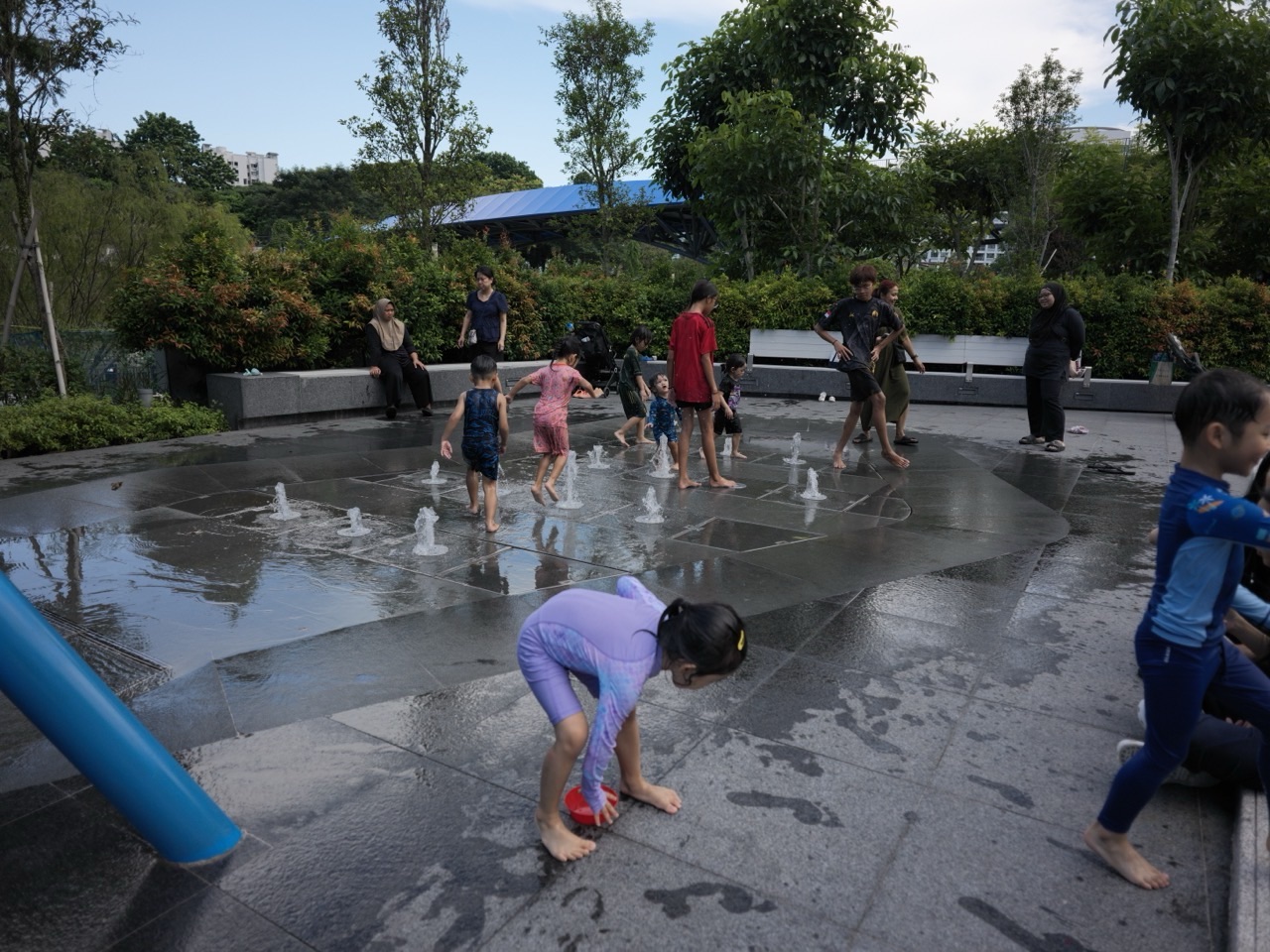
The Play Street includes equipment intended to make the public route more playful, but it is not staffed childcare. Read actual equipment instructions and make sure the child is suited to the feature. Do not ask a younger pupil to climb an unfamiliar structure solely to answer a STEM challenge. A family can describe the shape of a slide from a lawful safe position without using it.
If a feature is crowded, damaged or closed, move on. Keep bags and strollers out of circulation and emergency routes. An adult should remain responsible for younger children, especially when several siblings are interested in different features. The learning trail should be easy to adapt to the group’s actual abilities.
Why the water-play plaza is optional
SportSG describes interactive water play at Waterway Plaza, but the public Play Street’s twenty-four-hour access is not a guarantee that the water feature operates continuously. The family should not tell children that fountains will definitely be running at any chosen time. If water play is operating, follow the real instructions and supervision conditions. A child can otherwise enjoy dry observations and public scenery.
The Waterway Plaza feature is also distinct from the five swimming pools. A family’s activity plan should not confuse public play, swimming admission and water sport training. Clear distinctions prevent disappointment and help the child understand why different spaces have different safety rules.
A family without a smartphone can still enjoy the walk
The public Play Street is described as free and open to everyone, so a family does not need to create a sports court reservation merely to use the lawful through-route. You can make observations without an app, camera or online worksheet. A notebook is optional. This is useful for grandparents, parents managing several children or visitors who prefer not to use digital devices during recreation.
If the family wants a paid gym, court or swimming activity afterwards, those have separate booking and admission conditions. Do not assume the public thoroughfare can serve as an entry shortcut. The STEM trail stands on its own as a short free public-space outing.
What if the family has a stroller or wheelchair?
An accessible outing requires an actual suitable route from arrival to the chosen public activities. Check current station lifts, crossings, step-free approaches and any temporary closures. The Play Street is part of a large development, but a map cannot guarantee that every feature, ramp or upper level suits every person. Choose challenges that can be enjoyed from an appropriate lawful viewpoint.
The child may be able to count shapes, observe signs or discuss pool depths without climbing, running or entering restricted spaces. The flexibility is an advantage: the activity can be adapted to a participant’s mobility rather than forcing them through all twelve stations. Ask the operator for specific access information when needed.
Reaching Play Street from Sam Kee LRT
Sam Kee PW1 is on the Punggol West LRT Loop and is a commonly recommended station for 11 Sentul Crescent. Visitors on the North East Line can transfer at Punggol MRT to the appropriate West Loop service. Follow current signs to the public Play Street entrance. The exact route may be affected by weather, works or the actual needs of the group.
A short walk from an LRT station does not mean every visitor arrives at the same time or can use every possible shortcut. Leave a comfortable margin and do not run across road crossings to reach an optional educational activity. The first question can begin during the safe journey itself: how does public transport connect to community facilities?
A short plan for a weekday afternoon
An after-school family may have only a limited window before dinner or homework. Choose three simple challenges: notice a shape, identify a public sign and describe an appropriate waterway view. Leave time for a short turn on suitable equipment only if the child wants it and the feature is operating. An ordinary family outing should not require all twelve tasks to be completed.
The parent can decide on an easy return point before starting. If the child is tired after a CCA or the weather is hot, choose a shorter activity or postpone. A small positive experience is more valuable than an ambitious schedule that becomes stressful.
A flexible weekend family plan
On a weekend, a household may have more time and several children with different interests. One child might enjoy slides, another might want to draw the building, while an older student may prefer discussing sport hall configurations. The adult can choose a few tasks that fit everyone without splitting the group in an unsafe way. No child should be left alone near a pool or public road.
A meal at a separately confirmed open destination can be added afterwards, but do not assume every nearby commercial unit is operating. The free Play Street is not a dining room or private event hall. Keep the outing modest enough that everyone wants to return.
How to make a simple field note
For an older pupil, one field note can record the date, broad location, a visible feature and a question. For example: “I saw repeated rooflines near Play Street. Why did the designers use them?” A second note could state a published fact, such as the kids’ pool being 0.3 metres deep, and distinguish that from something the child personally observed. This is good research practice.
Do not imply that a student’s guess is a verified engineering conclusion. If the family wants to investigate further, read the official SportSG venue guide at home. A two-line note can be enough. The aim is helping children separate evidence from inference while enjoying a local outing.
The public Play Street versus paid sports facilities
One useful final comparison is to list what the family may generally do without a sports booking and what requires specific access. The free public Play Street can be explored under its current conditions. A badminton court requires a valid reservation. The gym needs eligible admission and prohibits children under twelve. Swimming pools have their own pass and supervision arrangements. Specialist archery and water sport spaces need authorised activity arrangements.
Children can learn why these distinctions exist: equipment safety, fairness to booked users, safeguarding and maintenance all matter. Do not encourage them to test the boundary by entering restricted areas. Understanding shared public infrastructure is a genuine lesson in how a community works.
What if heavy rain or lightning arrives?
Public paths and some play features may be exposed to weather. During thunderstorms or unsafe conditions, follow official warnings and change plans. Do not treat a covered sports hall as a free shelter you may enter without permission. A family can return another day rather than forcing a walk that feels unsafe. Singapore weather is a practical part of planning outdoor activities.
If only a small section of the route is suitable, choose an appropriate brief observation and return. The learning trail does not have a deadline or registration fee to justify taking risks. Modifying the plan is a sensible demonstration of responding to real-world evidence.
A four-week science-and-movement routine
Week one: choose two observation activities that suit the child, such as shapes and wayfinding. Learn the legitimate Play Street approach and keep the visit short.
Week two: repeat a comfortable walk and introduce one new idea, such as transport connections or visible material differences. Use actual public signs and avoid collecting objects from the environment.
Week three: review the official pool depths and court configurations at home, then discuss one mathematical comparison during a suitable visit. No paid sport entry or pool access is needed.
Week four: ask the child what was most interesting and whether they want another family walk, a genuinely bookable sport or a formal course elsewhere. Keep the routine optional and enjoyable. The purpose is curiosity and movement, not completing a mandatory curriculum.
Frequently asked questions about the family STEM trail
Is this an official ActiveSG STEM programme? No. It is an independently suggested, self-guided family observation trail.
Do we need a booking? SportSG describes the public Play Street as free. Paid sport and specialist facilities have separate rules.
Is Play Street open twenty-four hours? SportSG says the public thoroughfare is. Individual play or water features may be restricted.
How many activities should we do? Choose what suits the child and conditions. The twelve suggestions are optional, not compulsory.
What should Primary 1 children do? Look for shapes, colours and signs, with close adult supervision.
Can Primary 6 pupils do mathematics? They can compare the published pool depths and understand different court layouts without entering restricted spaces.
Can secondary students study engineering? They can observe lawful public architecture and discuss systems, but should not invent specifications or enter service rooms.
Is the waterway safe to collect samples from? This guide does not authorise or recommend collecting samples; observe from safe public viewpoints.
Can we go inside the gym to learn about HUR machines? A public gym has age and admission rules; use official published descriptions instead of unapproved entry.
Is interactive water play guaranteed? No. Check the actual Waterway Plaza feature and its current operation.
Where is the venue? 11 Sentul Crescent, Singapore 828656, near Sam Kee LRT PW1.
Can a family stop early? Yes. The activity is flexible, with no requirement to finish every challenge.
Official sources and further eduKate Punggol reading
SportSG’s 11 November 2026 Punggol facility article confirms the free twenty-four-hour Play Street, transport links, water-play plaza, pools, court layouts and gym features. Use official closure notices for current operational changes and MyActiveSG+ for any separate paid activities. This trail requires neither a real-time court slot nor permission to enter restricted areas.
For more detailed related articles see the Play Street and slides guide, the five-pool depths explained, twelve gentle parent–child sports games, and the separate nature walk. Reviewed 14 November 2026. This is not an official school excursion, worksheet package, scientific sampling permit or guarantee that particular equipment is operating.
Continue with the connected guide: ActiveSG Punggol 2027/2028 | Opening Status, Facilities and Visitor Guide. Use its linked index to compare the related questions and choose your next reading.


