
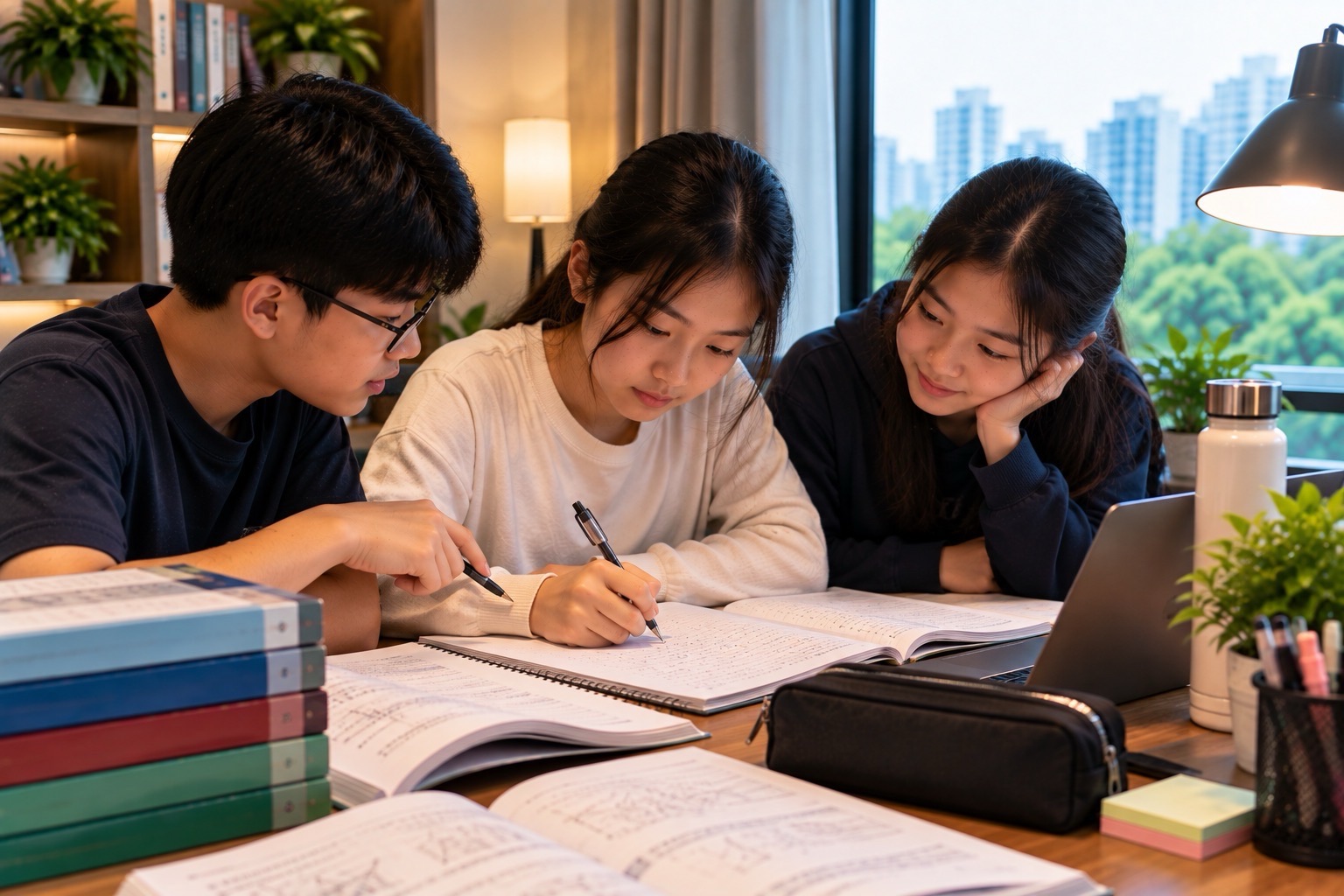
G3 Pure Chemistry K324 and G3 Combined Science (Chemistry, Biology) K328 are separate Singapore-Cambridge Secondary Education Certificate (SEC) subjects. Under the official 2027 scheme, standalone Chemistry has a one-hour 40-MCQ paper worth 30%, a 1-hour-45-minute structured/free-response paper worth 50%, and a 1-hour-50-minute Chemistry practical worth 20%. K328 gives ONE combined grade across two disciplines: common Chemistry/Biology MCQ Paper 1 worth 20%, Chemistry Paper 3 and Biology Paper 4 lasting 1 hour 15 minutes each and worth 32.5% each, plus a 1-hour-30-minute mixed practical Paper 5 worth 15%. A student registered for K328 does not receive two separate Pure Chemistry and Pure Biology results.
For Punggol families choosing Secondary 3 in 2027, the normal final SEC year is 2028, and the published 2028 syllabus becomes authoritative when available. The school decides whether Pure Chemistry and Combined Chemistry–Biology are offered in its real Year 3 combinations, including relevant prerequisites and laboratory allocations. Chemistry content overlaps between the courses, but not every learning outcome is identical: for example, the 2027 standalone K324 experimental section includes sublimation, separating funnels and chromatographic Rf values, while the combined Chemistry section has a different specified scope and does not require those particular details in the same way. Meanwhile, K328 pupils must also master cell processes, human systems, plants, genetics and other scoped Biology topics. Choose by readiness, subject interest, genuine access, workload and current course-specific post-secondary requirements.
- 2027 SEC subject codes: Pure Chemistry K324 (old 6092); Combined Chemistry–Biology K328 (old 5088).
- Pure Chemistry K324: Paper 1 MCQ 1h/40 marks/30%; Paper 2 structured/free 1h45/80 marks/50%; Paper 3 practical 1h50/40 marks/20%.
- Combined K328: Paper 1 mixed MCQ 1h/40 marks/20%; Chemistry Paper 3 1h15/65 marks/32.5%; Biology Paper 4 1h15/65 marks/32.5%; practical Paper 5 1h30/30 marks/15%.
- K328 requires Papers 1, 3, 4 and 5. Physics Paper 2 is not part of this Chemistry–Biology pairing.
- K328 is ONE combined Science qualification, not two independently graded Pure Science subjects.
- Both Chemistry sections include particle theory, bonding, chemical calculations, acid-base topics, redox, periodic trends, energetics, rates and organic chemistry within their respective learning outcomes.
- Standalone K324 has some deeper or additional specified experimental outcomes, including Rf values in chromatography and separating certain mixtures.
- K328 also includes a separate 32.5%-weighted Biology component and mixed Chemistry/Biology practical tasks.
- Formal school offerings, entry criteria and practical facilities are school-specific; a national subject directory does not guarantee a class.
- A 2027 Secondary 3 entrant normally sits SEC in 2028; check the current 2028 syllabus and later institution-specific Science requirements.
Pure Chemistry K324 versus Combined K328 | What exactly changes?
Definition lock | One full Chemistry grade versus one Combined Science grade
K324 is a standalone G3 Chemistry qualification and K328 is a single combined G3 qualification spanning specified Chemistry and Biology content. The two names can seem alike because many chemical concepts appear in both. Yet the syllabus depth, additional discipline and paper structure differ. A K328 pupil needs to prepare for a Biology written component and a mixed practical; a K324 pupil needs the standalone Chemistry depth and its particular practical paper. G3 refers to the standard of the registered subject, not a permanent label for a child’s overall ability. Parents should read the actual K-code on the school’s Year 3 options and exam entry before selecting textbooks, tutorials or later admission pathways. A correct subject map is a foundation for meaningful preparation.
The same word Chemistry can conceal different learning outcomes
Both programmes study particles, chemical bonds, calculations, acid-base chemistry, redox processes, periodicity and chemistry in a sustainable world. Their high-level topic headings may therefore look very similar. That is not enough to assume the examination requirements are identical. The official 2027 K324 syllabus, for instance, includes particular separation methods and quantitative chromatographic interpretation that the combined Chemistry section does not specify in the same form. A child should check the learning outcomes, not merely tick topic names on a revision checklist. An old Pure Chemistry question can be interesting enrichment for a Combined student while still being an inappropriate timed mock paper if it tests out-of-scope detail. Teachers should distinguish core understanding from optional extension.
Subject access belongs to the actual Punggol school
A national SEAB directory lists K324 and K328 as available qualifications for school candidates, but does not tell parents which combinations their particular school runs. Punggol Secondary, Edgefield, Greendale and Yusof Ishak Secondary can differ in cohort options, science lab capacity and subject blocks. A student may not be able to select every attractive course from the national list. Ask the school about existing prerequisites, whether the child has the required G-level for the intended route and whether laboratory sessions fit the timetable. A Science CCA or external Chemistry course does not create formal registration. Good parent guidance should clarify this administrative limitation rather than advertise a subject the child’s own school may not offer.
A student entering Secondary 3 in 2027 is preparing toward SEC 2028
The official 2027 PDFs are valuable because their schemes and topics can be examined now for planning. But a pupil beginning Secondary 3 in January 2027 will normally complete Secondary 4 in 2028 and take SEC that year. The eventual 2028 Chemistry and Combined Science specifications therefore control formal preparation. Some content may remain stable, but exam conditions, materials or learning outcomes should not be promised unchanged. A family should use the available 2027 reference to compare routes, then verify the child’s exact 2028 paper structure with the school. This also prevents buying a discontinued or mislabelled set of previous O-Level resources under the mistaken belief that every future SEC paper is identical.
Chemistry begins with a particle model that explains real observations
A liquid changes temperature, a solid dissolves or two substances react, and students need a conceptual way to interpret what happened. The particulate nature of matter and bonding help describe how substances behave. A pupil who memorises that salt dissolves may still struggle to explain the process with appropriate particles and interactions. The correct answer depends on the substance and conditions rather than one universal rule. Begin by identifying what was observed, which structures are present and how the relevant model explains the effect. A strong science answer also recognises where the observation does not establish the full mechanism on its own. This approach is important in both K324 and K328, although the official syllabus gives each course its particular assessed detail.
Experimental Chemistry is a concrete example of syllabus differences
The standalone K324 experimental-learning outcomes cover techniques such as solvent selection, filtration, crystallisation, evaporation, sublimation, distillation, fractional distillation, separating funnels and paper chromatography. They include calculations with Rf values and discussion of locating agents under specified conditions. The combined K328 Chemistry section also studies purification and analysis, but its 2027 specification lists a more limited set of methods and states that chromatographic Rf calculations are not required. Parents comparing books should notice such details instead of assuming that the same chapter title means the same assessment. The child still needs to understand why a method separates substances, what evidence reveals purity and how experimental limitations affect conclusions. Formal practical work remains school-supervised.
Atomic structure gives substance to chemical reasoning
Protons, neutrons and electrons have different charges and roles in atomic models. A pupil may calculate a particle count correctly but confuse the atomic number with nucleon number when a new isotope is presented. Good teaching uses the definition and representation of atoms and ions rather than a verbal shortcut that works only for one element. Explain why a neutral atom has a particular balance of charges and what changes when an ion forms. Then apply the reasoning to an unfamiliar nuclide symbol. Both Chemistry routes require relevant particle and periodic-system concepts, but teachers should follow the official scope for the pupil’s code. Understanding such foundations reduces the temptation to memorise chemical formulae without recognising what they represent.
Chemical bonding connects microscopic structure and macroscopic property
A student’s answer may state that an ionic substance has a high melting point without explaining how particle attractions are related to that property. Another may identify a covalent molecule but incorrectly assume every covalent material conducts. The correct explanation depends on the specific structure, particles and what can move under the given conditions. A comparison between materials can reveal why a universal slogan fails. Teachers should ask the pupil to justify a property from an appropriate model and then test a different substance. Strong conceptual understanding is useful across Pure and Combined Chemistry and can support later Science studies. Yet a useful discussion should remain within the actual syllabus instead of overloading the learner with advanced structural detail that is not examinable.
Chemical calculations are an explanation in symbols and units
The mole concept and related calculations can be challenging because the learner must connect mass, amount, concentration or gas quantities to a balanced chemical relationship. A student may substitute numbers correctly into a remembered formula while solving for the wrong substance. The safer method begins by identifying the reaction, balancing the equation, naming the relevant quantities and checking the unit and ratio. Calculations make sense only if they represent the actual chemical process. This kind of reasoning is important in the K328 Chemistry paper as well as in standalone K324. A child struggling with fractions or indices may need mathematical bridging, while another needs conceptual explanation of stoichiometry. The teacher should distinguish those different causes instead of assigning more undiagnosed calculation worksheets.
Acid-base chemistry is more than a colour chart
Students learn about acids, bases, salts and appropriate indicators, but many examination questions ask for a process or explanation rather than memorised colours. A pupil may describe a pH change and yet confuse neutralisation with another reaction. The useful step is to state what substances or ions are involved and why the observed outcome follows. Different conditions can affect the correct conclusion. Any practical test or preparation involving reagents should be conducted under authorised school supervision, not imitated casually at home. At home, a student can interpret a supplied results table and explain what evidence supports a conclusion. The academic skill combines accurate terminology, chemical modelling and reasoned interpretation of observations.
Redox and energetics require careful cause-and-effect links
Oxidation and reduction involve defined electron-transfer or oxidation-state ideas within the syllabus, while energetics examines how chemical processes exchange energy. A child might identify a reaction as exothermic because a familiar example was, without reading the stated conditions. Another may know the term reduction but confuse what gains electrons. Good preparation explains the governing definition and applies it to a changed scenario. An energy diagram can communicate the relationship between reactants, products and energy changes, but only when axes and relevant reference points are understood. Such topic-specific misunderstandings occur in both Chemistry routes. The appropriate repair is one clear conceptual model followed by an independent unfamiliar question, not simply collecting a larger list of reaction names.
Rates of reaction bring data interpretation into chemistry
A chemistry question might show a graph of gas volume, concentration or another measurement against time. The student should identify what was measured and distinguish an observed rate change from a proposed mechanism. A line becoming less steep may signal a slower measured change, but the exact interpretation depends on axes and experimental design. Some factors can influence reaction rate under prescribed syllabus conditions, and students should explain why rather than simply name temperature or concentration. Pure Chemistry and combined Chemistry both require careful scientific reasoning here, within their respective outcomes. A strong candidate describes the pattern, identifies the relevant chemical idea and acknowledges what the data cannot prove. Honest evaluation is more useful than pretending one graph establishes every cause.
Organic Chemistry and air quality connect chemistry with society
The 2027 syllabus includes selected organic chemistry and maintaining air quality as part of chemistry in a sustainable world. These topics demonstrate that chemical knowledge is useful outside a laboratory. A student may learn a fuel or atmospheric-pollution example but fail to explain the relevant reaction or evaluate a trade-off. An accurate answer should distinguish chemical mechanisms from claims about a particular policy or company. Statements about current environmental figures need reliable sources rather than invented measurements. Chemistry can inform decisions about materials and the environment, but it rarely makes every social choice simple. A well-constructed examination response uses the supplied data and scientific concept to reach a bounded conclusion. Both routes can develop that habit, even when the exact content scope differs.
Standalone K324 Paper 1 asks forty MCQs across the discipline
The 2027 K324 multiple-choice paper lasts one hour, carries forty marks and contributes 30% of the subject grade. It includes conceptual and applied questions from the registered Chemistry syllabus. A student may recognise a familiar chemical name and choose an answer without considering conditions in the question. Instead, the pupil should identify what is being asked, select the relevant principle and explain why a tempting alternative is wrong. Speed becomes useful only after this method is reliable. A small set of varied unfamiliar questions can expose whether the learner is confused about bonding, calculations or reaction types. Checking only the final letter without understanding the error may produce a reassuring score but little durable improvement.
Standalone K324 Paper 2 carries half the grade
The K324 structured/free-response paper lasts one hour forty-five minutes, with eighty marks and 50% weighting. The verified 2027 structure includes seventy marks of compulsory structured responses, including a data-based question, and a ten-mark choice between two further questions. This is not identical to K328’s one-hour-fifteen-minute 65-mark Chemistry component. Students need to organise chemical explanations, calculations and evaluations rather than repeat a paragraph that is broadly related to the topic. Read the command word and question context before selecting evidence. A candidate who explains one scenario clearly may still be challenged by a different chemical system, making independent transfer practice important. The exam tests coherent reasoning, not the sheer length of a model answer.
The Pure Chemistry practical carries 20% and has specific planning skills
The 2027 K324 Paper 3 lasts one hour fifty minutes and carries forty marks. It tests experimental skills such as planning, manipulation, measurement, presenting observations, analysing data and evaluating conclusions. The syllabus describes planning as a specified part of the practical skill assessment. A pupil may obtain a plausible observation but fail to identify a controlled variable or propose a valid improvement. Scientific honesty matters when results differ from expectation. Families should not attempt acid-base tests, hazardous substances or chemical heating at home simply because the candidate is preparing for a practical. The correct environment is the school laboratory under trained supervision. Safe extra preparation can analyse teacher-provided data and graphs with appropriate units and uncertainty.
K328 Chemistry Paper 3 is one of two equally weighted written sciences
In Combined Chemistry–Biology K328, Chemistry Paper 3 lasts one hour fifteen minutes and contributes 32.5% of the overall combined grade. Biology Paper 4 has the same duration and weighting. The common MCQ and practical complete the combined assessment. A parent who says the child is taking Chemistry but ignores that Biology accounts for an equal substantial component has an incomplete picture. The pupil should practise K328’s Chemistry learning outcomes and paper expectations, not assume K324’s full scheme applies. If a child is strong in chemical calculations but weak with biological diagrams, those needs should be addressed separately. The combined qualification rewards competence across both sciences, and the school should help identify where the learner needs bridging.
The Biology section creates another scientific language and workload
K328 Biology includes cell structure, movement of substances, biological molecules, human nutrition, transport, respiration, infectious disease, plant processes, ecosystems, molecular genetics, reproduction and inheritance. A pupil who enjoys Chemistry’s symbolic precision may find biological mechanisms and terminology unfamiliar. The answer is not to treat Biology as a memorised word list. Ask how a structure contributes to a process and what observation would support an explanation. Drawings should be interpreted rather than copied. The student’s second discipline also needs regular revision and the ability to answer unfamiliar data-based questions. Such breadth can be valuable for pupils with interests across material and living systems, provided the school offers the pairing and the workload is sustainable.
The combined MCQ is not a Pure Chemistry MCQ with another cover
K328 Paper 1 lasts one hour, has forty multiple-choice questions and contributes 20%. It includes approximately equal coverage of the specified Chemistry and Biology sections. A pupil cannot earn a full balanced preparation solely by rehearsing Pure Chemistry MCQs, because they will face biological processes too. Some questions may involve unfamiliar diagrams or data. Practise both disciplines, then review the earliest incorrect concept. A combined test score should be broken into Chemistry and Biology patterns before conclusions are made about overall ability. The pupil may need support in one area without being globally weak in Science. Such targeted feedback makes a more constructive plan than indiscriminately increasing the number of practice papers.
The mixed practical has different duration and content from K324
K328 Paper 5 lasts one hour thirty minutes and contributes 15%, testing Chemistry and Biology practical skills. Pure Chemistry K324 Paper 3 lasts one hour fifty minutes and contributes 20%, focusing on the standalone Chemistry syllabus. A teacher should show the pupil which apparatus and types of investigation are relevant to their actual registration. Lab work is supervised and subject to safe equipment use and examination authenticity. A family can discuss uncertainty, plotting and evaluation using supplied observations without recreating potentially dangerous procedures at home. The shorter combined practical is not necessarily effortless; it requires switching between two disciplines under controlled conditions. The assessment should be understood by its actual skill objectives rather than judged only by time or marks.
A well-designed graph helps both courses when the student reads it correctly
Chemistry and Biology can both present experimental results in tables and graphs. The candidate should identify the independent variable, dependent measurement, units, time frame and whether controls were maintained. A numerical correlation is not automatically proof of a particular mechanism. The next step is to use relevant subject knowledge to explain a plausible relationship and its limitations. A pupil may write a confident conclusion from an incorrectly labelled axis or choose an inappropriate gradient. A useful teacher response starts by repairing the data interpretation, then revisits the scientific concept. This method can improve both components of K328 and K324’s own practical and structured papers. It builds the habit of deriving claims from evidence rather than recognition of a familiar diagram.
Laboratory safety and truthful results are non-negotiable
Experimental Chemistry often involves reagents, heating, glassware and techniques that require trained supervision and risk assessment. Some biological experiments also involve materials and procedures not suitable for informal home replication. Parents can help the child with theoretical understanding, graph work or organising non-assessed notes without supplying hazardous equipment. In actual assessed tasks, observations must be recorded honestly and any suggested improvements should be meaningful. A polished result fabricated to match a textbook is not scientific competence. When something unexpected occurs, the pupil should ask which variable or measurement could explain it and how a future investigation might be improved. School staff control the practical arrangements and the candidate retains responsibility for authentic work.
Post-secondary entry is not determined by a Science label alone
A Pure Chemistry grade can be relevant to some later courses, and Combined Chemistry–Biology may fit other legitimate pathways. The exact minimum entry requirements vary by institution, qualification and intake year, including possible Maths and English conditions. It is misleading to claim that K324 guarantees a life-science diploma or that K328 automatically prevents one. The family should shortlist several real programmes and consult their current official criteria. If the child enters Secondary 3 in 2027, their final SEC normally falls in 2028 and subsequent admission rules will apply. The school counsellor can help connect actual subjects and grades with those possibilities. Subject choice should preserve reasonable flexibility without promising a career from one paper.
A workable timetable is part of scientific success
A student studying standalone Chemistry may also take Physics, Biology, Additional Mathematics or a creative elective, depending on school combinations. A K328 pupil must divide revision across Chemistry and Biology within one combined qualification. Practical sessions, language lessons and CCA still compete for time. No one should assume that Pure is automatically best or that Combined guarantees a lighter schedule without checking the actual school timetable. A sustainable programme provides time for understanding, retrieving concepts later and reviewing mistakes. A pupil who regularly leaves chemical calculations half-understood may benefit more from one targeted explanation than from several undiagnosed tuition sessions. Learning quality matters more than the number of advanced-sounding titles.
A precise independent diagnostic should guide the choice
Ask the pupil to explain a chemical bond, balance an unfamiliar reaction, interpret a graph and discuss a basic cell transport diagram if considering K328. These tasks reveal different strengths. A child may enjoy quantitative Chemistry while feeling less prepared for Biology, or enjoy both systems and be ready for a combined course. The school must consider its formal options and prerequisites, while the parent can listen to the student’s interests. One high mark does not guarantee complete readiness, and one low result need not fix the child’s learning ceiling. Identify the first unsupported step and correct it, then give a new task. This is a stronger method than selecting a Science route purely from prestige.
Tutoring should strengthen the student’s ability to reason without prompts
A candidate can leave a lesson with a perfect-looking corrected page and still be unable to solve a fresh problem. The decisive educational step is independent transfer. If an acid-base answer was wrong, use a different reaction after teaching the model. If a genetics diagram was misunderstood in K328, change the conditions and ask for a new explanation. A small group may allow faster questions and useful discussion, but its headcount does not guarantee marks, laboratory access or formal school registration. Parents should seek evidence that their teenager increasingly understands what the question asks and why the selected method is valid. That is meaningful preparation for either K324 or K328.
SEAB’s exact 2027 Chemistry and Combined Science syllabuses
The official 2027 Pure Chemistry K324 syllabus confirms its 30/50/20 paper structure and detailed experimental outcomes. The official 2027 Combined Science syllabus confirms the K328 Chemistry/Biology papers and the 20/32.5/32.5/15 weighting. Both are named in SEAB’s G3 school-candidate directory. The national listing does not guarantee a formal course place at the child’s Punggol school. Ask for actual options, science teacher guidance and laboratory conditions.
The pupil entering Secondary 3 in 2027 will normally sit SEC in 2028, and that final examination year’s published syllabus will be authoritative. Families should use this comparison as a practical aid to asking the school appropriate questions rather than promising eligibility or later professional pathways on the strength of one subject title.

Twelve Chemistry and Combined Science errors with targeted repairs
The first wrong decision may concern subject registration, the scope of a paper, a mole calculation or a fabricated observation. Each requires a different correction. These examples make the problem visible and show how a teacher can check learning on an unfamiliar task.
1. K328 is counted as separate Pure Chemistry and Biology grades
A parent assumes the combined course supplies two independent Science results. One combined qualification cannot be represented as two separate Pure subject grades.
Confirm the K328 combined code and one grade. The qualification is represented accurately. Ask for a new scientific example or official school record after feedback, rather than simply reproducing the corrected answer.
2. Pure K324 questions are used indiscriminately for K328
A student spends time on scope-specific pure experimental details while missing compulsory Biology. Matching the actual learning outcomes prevents an attractive but irrelevant syllabus from consuming revision.
Compare exact official learning outcomes before choosing practice. Revision follows the registered course. Ask for a new scientific example or official school record after feedback, rather than simply reproducing the corrected answer.
3. Biology is ignored in Combined Science
The learner loves Chemistry and neglects the equally weighted Biology component. The Biology half is assessed substantially and cannot be skipped as optional enrichment.
Plan independent Biology questions and practical-data review. Both sciences receive attention. Ask for a new scientific example or official school record after feedback, rather than simply reproducing the corrected answer.
4. Rf chromatography is assumed a required calculation in K328
A child spends unnecessary time on pure-only detail without checking the combined scope. Some experimental details are specified for standalone but not for the combined course in the same way.
Use the specific combined learning outcomes and teacher guidance. Coverage is accurate. Ask for a new scientific example or official school record after feedback, rather than simply reproducing the corrected answer.
5. An observation is treated as a mechanism
The candidate writes that a gas formed but not why the reaction occurs. Observation and causal explanation are different scientific tasks, both requiring accuracy.
Use an appropriate chemical particle model and evidence. The explanation is causal. Ask for a new scientific example or official school record after feedback, rather than simply reproducing the corrected answer.
6. An equation balances but depicts a wrong reaction
The pupil changes coefficients while the chemical formulae or reactants are incorrect. Correct equation balancing cannot rescue the incorrect chemical identities.
Identify substances first and apply conservation afterward. The equation is meaningful. Ask for a new scientific example or official school record after feedback, rather than simply reproducing the corrected answer.
7. Mole calculations lose units
A correct-looking answer confuses mass, moles and concentration. Scientific quantities need units and stoichiometric context to make sense.
Name each quantity and check the unit and reaction ratio. The calculation is interpretable. Ask for a new scientific example or official school record after feedback, rather than simply reproducing the corrected answer.
8. Practical data are adjusted to match expectations
The student alters an observation instead of evaluating its uncertainty. Authentic data remain valuable even when results are unexpected; fabrication defeats scientific enquiry.
Record genuine results and consider relevant limitations. Scientific integrity is preserved. Ask for a new scientific example or official school record after feedback, rather than simply reproducing the corrected answer.
9. K324 and K328 practicals are assumed identical
A family assigns a standalone Chemistry practical as a complete combined mock. Practical assessments have different durations, scopes and weightings.
Map the mixed Chemistry/Biology Paper 5 requirements. The practice is appropriate. Ask for a new scientific example or official school record after feedback, rather than simply reproducing the corrected answer.
10. A graph is interpreted without axes or controls
The candidate states a causal conclusion from a pattern whose measurements are unclear. Experimental conclusions are limited by data quality, controls and the variables measured.
Identify variables, conditions and evidence strength. The judgement is proportionate. Ask for a new scientific example or official school record after feedback, rather than simply reproducing the corrected answer.
11. An unsafe home experiment is encouraged
A parent imitates hazardous chemical procedures in an ordinary kitchen. Chemical and biological practicals can involve risks; school supervision is necessary.
Use authorised school practicals and provided data for extra learning. Preparation remains safe. Ask for a new scientific example or official school record after feedback, rather than simply reproducing the corrected answer.
12. A future pathway is promised from the subject title
A family treats Pure Chemistry as guaranteed health-science entry or Combined Science as automatically excluded. Course-specific eligibility is a factual admissions rule rather than a prestige judgement about a science title.
Check actual institution criteria and the child’s complete results. The decision is grounded. Ask for a new scientific example or official school record after feedback, rather than simply reproducing the corrected answer.
Eight-week Pure versus Combined Chemistry learning plan
This is an illustrative educational foundation schedule, not a substitute for the school curriculum, authorised laboratory work or the 2028 official syllabus. Use teacher-provided safe experimental data to practise reasoning without performing hazardous tests at home.
Week 1: Confirm K324 or K328 with school
Collect actual registered code, combined pairing and final exam-year syllabus. Accurate registration comes before choosing tuition or papers.
Independent check: The subject map is accurate. Retain one initial attempt, a precise explanation and a fresh later response to demonstrate real transfer.
Week 2: Particulate matter and bonding
Explain unfamiliar material properties with an appropriate structural model. Microscopic models should explain observable material properties in a new context.
Independent check: The interpretation transfers. Retain one initial attempt, a precise explanation and a fresh later response to demonstrate real transfer.
Week 3: Chemical equations and amounts
Balance a new reaction and justify one quantitative relationship with units. Equations need substance identities and meaning before numeric operations.
Independent check: The calculation is meaningful. Retain one initial attempt, a precise explanation and a fresh later response to demonstrate real transfer.
Week 4: Acid-base and redox reasoning
Analyse a safe teacher-provided observation and explain a relevant reaction. A new scenario checks whether reaction reasoning is genuinely understood.
Independent check: Evidence supports the model. Retain one initial attempt, a precise explanation and a fresh later response to demonstrate real transfer.
Week 5: Experimental-method comparison
Compare pure and combined learning outcomes and interpret provided chromatography or other data appropriately. Comparing the exact syllabus teaches pupils not to confuse a general topic title with examinable detail.
Independent check: Scope is not confused. Retain one initial attempt, a precise explanation and a fresh later response to demonstrate real transfer.
Week 6: K328 Biology if registered
Explain cells, transport, nutrition or genetics from an unfamiliar diagram. A Biology component is a real additional disciplinary commitment for K328.
Independent check: The second discipline is prepared. Retain one initial attempt, a precise explanation and a fresh later response to demonstrate real transfer.
Week 7: Practical-paper readiness
Map K324 Paper 3 versus K328 Paper 5 and evaluate a supplied experimental dataset. Safe provided data can teach practical reasoning without recreating controlled tests at home.
Independent check: Safe experimental reasoning is demonstrated. Retain one initial attempt, a precise explanation and a fresh later response to demonstrate real transfer.
Week 8: Final choice and timetable
Review teacher recommendations, authentic school offering and possible later courses. Strong choices reflect availability, interest, readiness and a viable weekly programme.
Independent check: The route is sustainable. Retain one initial attempt, a precise explanation and a fresh later response to demonstrate real transfer.
Frequently asked Chemistry and Combined Science questions
Is K328 the same as two Pure Sciences?
No. K328 is one combined Chemistry–Biology qualification and grade. Confirm the pupil’s actual registered course and the relevant final exam-year documents before making individual decisions.
What are the 2027 K324 paper weights?
Chemistry MCQ 30%, structured/free response 50%, practical 20%. Confirm the pupil’s actual registered course and the relevant final exam-year documents before making individual decisions.
What papers must K328 candidates take?
Papers 1, 3 (Chemistry), 4 (Biology) and 5 (mixed practical). Confirm the pupil’s actual registered course and the relevant final exam-year documents before making individual decisions.
What are K328’s 2027 weights?
Common MCQ 20%, Chemistry 32.5%, Biology 32.5%, practical 15%. Confirm the pupil’s actual registered course and the relevant final exam-year documents before making individual decisions.
Does pure Chemistry assess different experimental details?
Yes. Exact learning outcomes differ; the 2027 standalone syllabus includes additional separation and chromatography details. Confirm the pupil’s actual registered course and the relevant final exam-year documents before making individual decisions.
Does K328 contain Biology?
Yes, a full written Biology component and corresponding MCQ/practical content. Confirm the pupil’s actual registered course and the relevant final exam-year documents before making individual decisions.
Does every Punggol secondary school offer both?
No. Actual combinations, prerequisites and facilities are school-specific. Confirm the pupil’s actual registered course and the relevant final exam-year documents before making individual decisions.
Which SEC year applies to Secondary 3 entrants in 2027?
Normally 2028, so use its official syllabus when published. Confirm the pupil’s actual registered course and the relevant final exam-year documents before making individual decisions.
Connected eduKate Punggol Chemistry and Biology guides
Pure Chemistry K324 explained · Combined Chemistry–Biology K328 explained · Pure Biology versus Combined Chemistry–Biology · Punggol G3 subject-choice directory. The immutable eduKateSG teaching reference supports direct facts, first-principles diagnosis and independent retry, not a promise that any particular Science class is available.
Final parent and school discussion checklist
- Identify the pupil’s official K324 or K328 entry and current G-level.
- Compare standalone Chemistry theory/practical against the four combined Science papers.
- Check the actual learning outcomes, including experimental-method differences, not only topic headings.
- Protect preparation time for Biology if the registered course is K328.
- Use approved school labs and honest data; do not perform hazardous home experiments.
- Confirm the pupil’s actual 2028 SEC syllabus and future course-specific requirements.


