
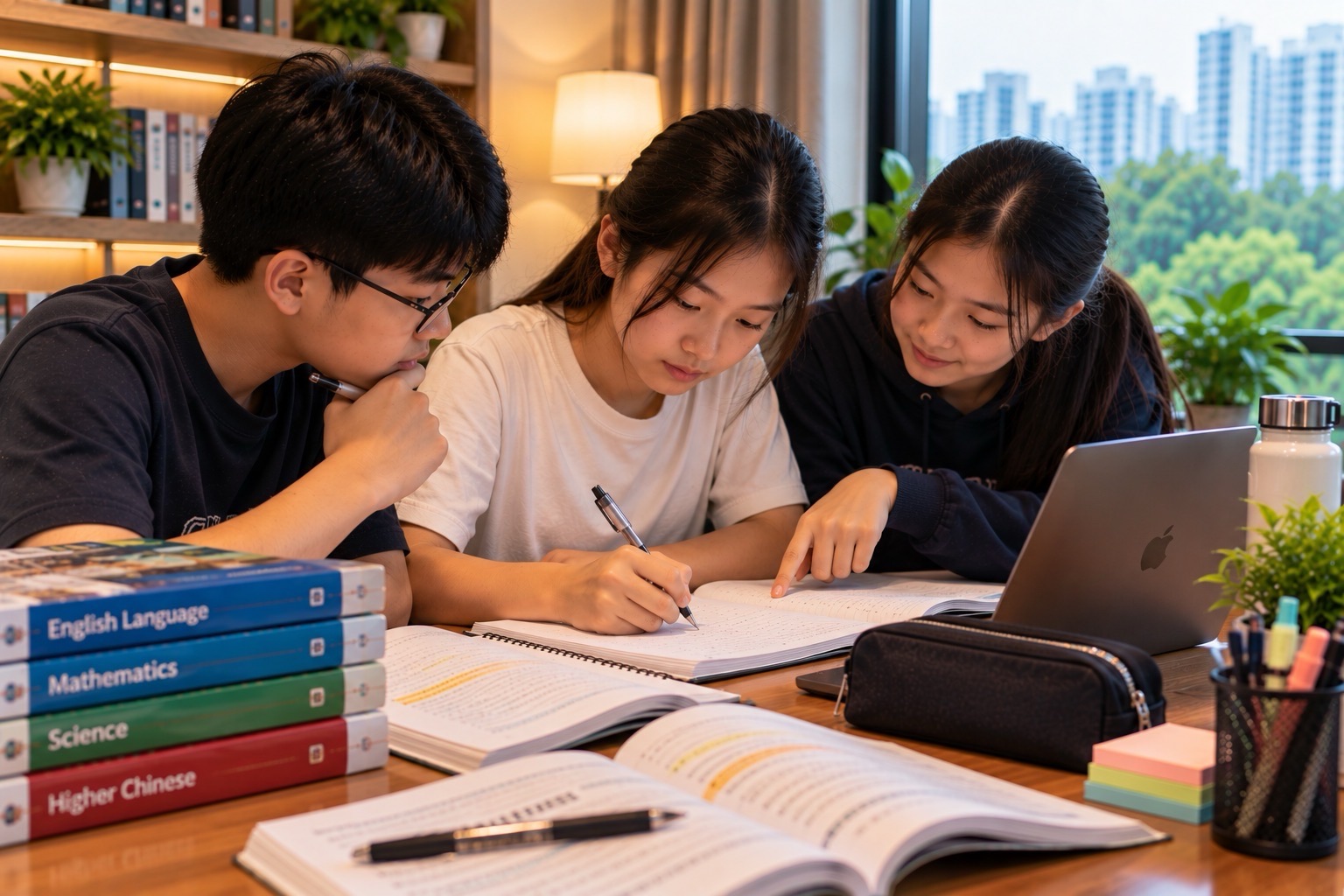
G3 Pure Biology K325 and G3 Combined Science (Chemistry, Biology) K328 are different Singapore-Cambridge Secondary Education Certificate (SEC) qualifications. In the verified 2027 scheme, standalone Biology K325 has three compulsory papers: a one-hour 40-question multiple-choice paper worth 30%, a 1-hour-45-minute structured/free-response paper worth 50%, and a 1-hour-50-minute practical worth 20%. Combined K328 is ONE qualification covering specified Chemistry and Biology content, not two separately graded Pure Sciences. Its candidates sit a shared one-hour MCQ Paper 1 worth 20%, a 1-hour-15-minute Chemistry Paper 3 worth 32.5%, a 1-hour-15-minute Biology Paper 4 worth 32.5%, and a 1-hour-30-minute combined practical Paper 5 worth 15%. The courses have different content depth, examination papers and scientific workload.
For a Punggol child entering Secondary 3 in 2027, the final SEC ordinarily falls in **2028**, so the 2028 subject-specific syllabus will govern once published. Parents should not assume that every secondary school offers both Pure Biology and the Chemistry–Biology combined pairing, or that an interest in healthcare automatically qualifies the pupil for a particular Science route. Ask for the actual Year 3 combinations, teacher advice, Mathematics and Science performance, practical facilities and later course prerequisites. K325 provides deeper standalone Biology coverage, including human excretion and homeostatic regulation in its 2027 content structure; K328 integrates a scoped Biology syllabus with Chemistry. Both require accurate scientific explanation and supervised practical work. The suitable choice depends on real school access, interests, breadth, readiness and a sustainable subject timetable, not simply which label seems more prestigious.
- 2027 SEC codes: G3 Biology K325 (former 6093) and G3 Science (Chemistry, Biology) K328 (former 5088).
- Pure Biology K325 Paper 1: 1h, 40 MCQs, 30%.
- Pure Biology K325 Paper 2: 1h45, 80 marks, 50%, structured and free response.
- Pure Biology K325 Paper 3: 1h50, 40 marks, 20%, formal supervised practical.
- Combined Science K328 is ONE subject and grade spanning two disciplines, not two separate Pure Science grades.
- K328 Paper 1: 1h, 40 MCQs from Chemistry and Biology, 20%.
- K328 Paper 3 Chemistry: 1h15, 65 marks, 32.5%; Paper 4 Biology: 1h15, 65 marks, 32.5%.
- K328 Paper 5: 1h30 practical with Chemistry and Biology tasks, 30 marks, 15%.
- K328 uses Papers 1, 3, 4 and 5; the Physics component Paper 2 belongs to other Combined Science pairings.
- K325 includes a broader standalone Biology content structure; the K328 Biology section has a specifically scoped selection of Biology topics.
- Both require correct units, evidence-based explanations, data interpretation, safe laboratory methods and independent working.
- Check the actual school subject combination and final 2028 SEC syllabus before choosing revision materials.
Pure Biology K325 versus Combined Chemistry–Biology K328 explained
Definition lock | One broad Biology subject versus one combined Science qualification
Pure Biology K325 is a standalone G3 discipline with its own content and examination grade. Combined Science K328 integrates Chemistry and Biology into a single SEC qualification whose grade reflects assessment across both components. A family must not describe K328 as two separate full Pure Science entries or assume the Biology portion is identical to K325. The course names may overlap because cells, enzymes, nutrition and genetics are relevant to both, but their total content and assessed depths differ. G3 refers to the subject standard under Full Subject-Based Banding, not to a fixed ranking of the pupil. The actual school’s registered code should guide examination preparation and any later course-entry discussion.
The precise code saves parents from an expensive revision mismatch
The official 2027 G3 roster identifies standalone Biology as K325 and Combined Chemistry–Biology as K328. Both may appear in textbook catalogues under familiar older O-Level codes. A generic Secondary Biology book can be useful for concepts but may include K325-only detail a K328 pupil does not need, while omitting the Chemistry component that forms a large proportion of the combined grade. Conversely, a K328 practice paper alone cannot cover K325’s full standalone syllabus. Ask the school which code, G-level and exam year the child is registered for. A student entering Secondary 3 in 2027 normally takes SEC in 2028, making the final 2028 paper specification decisive. Accuracy about the course comes before buying more worksheets.
Combined K328 is one grade even though it tests two sciences
Combined Science’s name can mislead families into counting a Chemistry result and a Biology result separately. The 2027 K328 examination is one qualification. Its two component written papers are substantial and separate, but they contribute to a single combined subject grade together with the common MCQ and practical. This matters when calculating post-secondary eligibility or comparing possible upper-secondary combinations. A pupil doing two separately registered Pure Sciences has two distinct subjects, while a K328 pupil has the one combined entry. The actual later admission aggregate determines how grades count, so no one should promise that combined science can be counted twice. The family needs the school-registered subject record, not an informal shorthand such as double science.
The Pure Biology syllabus goes beyond human health
The 2027 K325 content structure has fourteen topics across Cells and the Chemistry of Life, the Human Body, Living Together and Continuity of Life. These include cell structure, transport and biological molecules; human nutrition, transport, respiration, excretion, homeostasis, coordination and disease; plant nutrition and transport; ecosystems; molecular genetics, reproduction and inheritance. The course therefore concerns many scales of life, not only anatomy or healthcare. A student who enjoys human biology should still be prepared for plant and ecological explanations, while a pupil attracted to genetics should understand cells and molecules first. Exam success requires connecting structures and processes to observations rather than memorising an encyclopaedia of labels.
The combined Biology section has an intentionally defined scope
The 2027 K328 Biology section includes cell structure, movement of substances, biological molecules, human nutrition, transport, respiration and infectious disease; plant nutrition and transport, ecosystems, molecular genetics, human reproduction and inheritance. Its published twelve-topic content structure differs from K325’s fourteen-topic standalone sequence, which separately includes excretion and homeostasis/coordination topics. Parents should compare the actual official content pages rather than assume that every familiar Biology label implies the same learning outcomes or depth. This does not make the combined course intellectually trivial. Its questions still require applying scientific ideas and evidence. The pupil also needs the Chemistry component, making breadth across two disciplines a central challenge. Accurate scope prevents revising irrelevant sections while leaving compulsory Chemistry weak.
Cells are the first explanatory foundation for both routes
Living organisms contain cells, and their structures help determine what they can do. A pupil might recognise a mitochondrion or chloroplast in a diagram but be unable to explain why a specialised cell has a particular adaptation. The correct scientific method is to connect structure, process and function. For example, a relevant surface area may affect exchange, but the pupil should identify which molecule is moving and in what direction under the stated conditions. Copying a labelled diagram without understanding does not prepare for a changed unfamiliar example. Both K325 and K328 require coherent cell reasoning, though the precise learning outcomes should be checked for the registered syllabus. One sound explanation can transfer across many later topics.
Diffusion and osmosis must be explained with conditions
Students sometimes claim that all substances move from high concentration to low concentration without specifying the membrane, particles or relevant definition. Diffusion and osmosis should be distinguished according to the official Biology terminology and experimental conditions. A plant tissue in one solution can behave differently from tissue in another because of water movement. The candidate should identify the concentration relationship, the type of movement and the expected observable effect. A drawing is helpful only if its arrows represent the correct process. Practise using safe teacher-provided diagrams and observations rather than conducting unapproved biological experiments at home. A pupil who explains the mechanism accurately is more prepared than one who memorises only that a sample expands or shrinks.
Biological molecules connect Chemistry and Biology
Carbohydrates, proteins and fats are relevant to how living systems obtain energy, grow and maintain structures. Enzymes help explain why particular chemical reactions occur under biological conditions. In K328, the Chemistry component can strengthen the pupil’s ability to understand particles and chemical change, while the Biology component applies related ideas within cells and organisms. However, a Chemistry definition and a Biology explanation may require different details. The pupil should not assume that mentioning a molecule’s name is enough to explain digestion or metabolism. Ask what the molecule does, which process is involved and how conditions affect the outcome. This creates meaningful cross-disciplinary learning rather than two sets of disconnected notes.
Enzyme explanations need cause and suitable evidence
A student may remember that enzymes are biological catalysts yet struggle to explain why a change in temperature or pH affects reaction rate. The response should identify relevant conditions, the enzyme’s functional structure and what an experiment actually measures. A graph can show a change without proving every aspect of the proposed mechanism, so the pupil must distinguish observation from explanation. Both standalone and combined Biology can ask students to apply enzyme knowledge in unfamiliar contexts. A teacher should use an appropriate syllabus-level diagram and a new data set rather than rely on one remembered curve. Accuracy matters more than adding advanced biochemical jargon that the candidate cannot explain.
Human nutrition is not the same as personal diet advice
The syllabuses examine digestion, absorption and related body processes, not the authority to prescribe a particular teenager’s eating plan. A learner should understand how digestive structures and enzymes enable the body to process nutrients and absorb usable products. A response that repeats ‘eat healthily’ when the question asks about absorption is not relevant. Parents can discuss the academic biology of digestion while leaving real medical or nutritional treatment to qualified professionals. Avoid restricting a child’s food intake based on a classroom question about energy. The subject develops an explanation of bodily processes, not a set of universal personal-health rules. Clear diagrams and cause-and-effect explanations are more valuable than moral labels applied to foods.
Transport and respiration require linked systems
The circulatory and respiratory systems interact to support human cells. A pupil may identify the heart, blood vessels and lungs but struggle to explain how oxygen reaches tissue or why gas exchange requires a concentration difference. Strong learning connects structures with the relevant movements of substances, rather than reciting each organ in isolation. Aerobic and anaerobic respiration involve different conditions and consequences, and the student’s answer must reflect the question. Both K325 and K328 study relevant aspects of human transport and respiration. The correct depth depends on the course-specific learning outcomes. An unfamiliar graph of breathing rate or transport can reveal whether the learner understands the mechanism or only recognises a memorised diagram.
Excretion and homeostasis illustrate differences in published scope
The standalone K325 2027 syllabus includes separate topics on excretion in humans and homeostasis, coordination and response. The combined K328 Biology section’s twelve-topic overview does not contain these as separate topics. This is a useful concrete example of why the two qualifications are not interchangeable, though parents should compare all learning outcomes before concluding that every concept is absent from a different course. A K325 learner may need to explain how the kidney removes metabolic wastes or how negative feedback contributes to internal regulation, according to syllabus demands. A K328 candidate must focus on its own defined Biology and Chemistry coverage. The best revision honours the registered code instead of indiscriminately adding chapters because another student’s assessment book includes them.
Plant processes and ecosystems remain important Biology
A pupil who is only interested in human health might neglect flowering plants, photosynthesis, transport and ecological relationships. The official Biology syllabuses include these areas in their course structures. A plant uses environmental resources and changes matter and energy through biological processes; ecosystems involve interactions among organisms and conditions. A strong answer should connect a particular adaptation or process to an observed effect. A broad claim that plants produce food for everyone may not answer a question about limiting factors in photosynthesis. A data set can reveal a pattern without explaining every causal detail. Students should practise distinguishing the scientific mechanism from the graph’s direct observation. These skills matter across both Biology routes.
Genetics requires careful distinctions among concepts
Molecular genetics, reproduction and inheritance appear in the relevant published Biology courses. Students may confuse genes, chromosomes, alleles and traits, or assume that an observed characteristic always has one simple genetic explanation. A good lesson uses the syllabus’s defined terms and traces how information is transmitted in the particular example. Where probabilities are examined, mathematical work should be connected to the model and assumptions rather than used as a universal prediction of an individual. A pupil who can draw a genetic cross but cannot explain what each symbol represents may need foundational teaching. The aim is precise reasoning about inheritance, not simplistic claims about people’s worth or ability based on genetics.
Pure Biology Paper 1 has forty MCQs in one hour
The 2027 K325 multiple-choice paper carries thirty per cent. It contains forty compulsory items which can involve knowledge, diagrams, experimental reasoning and unfamiliar applications. A student who memorises terms may still be confused by a question where two choices appear scientifically plausible. The correct method is to identify the conditions, select the relevant biological principle and explain why one option matches while another fails. Practising many questions is useful only when errors are reviewed. If every mistake involves the direction of osmosis, teach that first; if mistakes occur in graph reading, address variables and units. The goal is to develop fast informed reasoning, not to guess quickly from familiar keywords.
Pure Biology Paper 2 demands extended thinking
The K325 structured/free-response paper lasts one hour forty-five minutes and contributes fifty per cent, with eighty marks. Section A includes compulsory structured items, a free-response and data-based task, while Section B includes a choice of one from two questions. A candidate may need to describe, explain, compare or evaluate under one connected scenario. The student should identify the question’s demand and use appropriate causal reasoning rather than reproduce a long paragraph from a textbook. A correct term without a logical link may be insufficient. Practice should include a fresh data set and a short supported explanation, then teacher feedback on the first unsupported step. This makes the pupil better prepared for the unfamiliar application emphasis of the syllabus.
Pure Biology Paper 3 is a formal practical with planning and evaluation
The 2027 standalone K325 practical lasts one hour fifty minutes and contributes twenty per cent, with forty marks. It assesses relevant manipulation, measurement, observation, presentation of data, analysis, conclusions, evaluation and planning. The school must supervise all genuine practical work under approved safety rules. A pupil might follow instructions precisely but reach an unsupported conclusion if they do not understand what was measured. A good result table needs accurate observations and units, and a graph should display the right variables. Unexpected results should be evaluated honestly rather than altered. Parents can help with interpretation of safe provided datasets without attempting biological cultures, tissue handling or chemical tests at home. Scientific integrity is part of the learning.
K328 uses four papers and a mixed Science mark allocation
The 2027 combined K328 candidate sits Paper 1 common MCQ, Paper 3 Chemistry, Paper 4 Biology and Paper 5 practical. The weights are twenty per cent, thirty-two-and-a-half per cent, thirty-two-and-a-half per cent and fifteen per cent. This is not the same three-paper structure as standalone Biology. Because the combined grade draws from Chemistry and Biology, a pupil strong in Biology but weak in Chemistry needs a targeted plan rather than simply studying extra Biology. Equally, good Chemistry calculations cannot compensate for a fundamental inability to explain living processes indefinitely. The student should inspect independent work in both disciplines and understand which paper each question belongs to. Official paper numbering prevents mispreparation.
The combined Chemistry Paper 3 is substantial, not a token addition
K328’s Chemistry component written paper lasts one hour fifteen minutes, carries sixty-five marks and contributes thirty-two-and-a-half per cent. Questions involve structured and free response using the specified Chemistry section of the combined syllabus. A student may need to understand particles, reactions, chemical quantities, acids or related concepts within that exact scope. The Chemistry component is therefore a real academic commitment, not simply a small chapter added to Biology. Some pupils enjoy the quantitative and symbolic reasoning; others may need bridging in fractions, units or equations. Teachers should distinguish a calculation error from a misunderstanding of chemical change. A clear plan ensures Chemistry receives enough time to contribute meaningfully to the combined qualification.
The combined Biology Paper 4 has its own selected content
K328 Biology Paper 4 also lasts one hour fifteen minutes, carries sixty-five marks and contributes thirty-two-and-a-half per cent. The candidate needs to answer from the combined Biology section, not reproduce a standalone K325 paper with extra topics. Questions can test relevant cell processes, human physiology, plants, genetics, reproduction and ecological relationships. The pupil should be able to interpret diagrams and data in unfamiliar situations. An answer that merely labels an organ or molecule may fail when the question asks why a process occurs. A good teacher uses the official learning outcomes and identifies the first missing causal step. Combining Biology with Chemistry does not remove the need for independent scientific reasoning in each subject component.
K328 Paper 5 tests both selected sciences practically
The combined practical lasts one hour thirty minutes, carries thirty marks and contributes fifteen per cent. It contains relevant practical tasks from both Chemistry and Biology under the 2027 scheme, with planning or suggested modifications also possible. This differs from K325’s one-hour-fifty-minute standalone Biology practical worth twenty per cent. A family should not assume the combined practical is identical to the Pure Biology exam but shorter. The equipment, methods and safety requirements must follow the registered syllabus and school instructions. At home, students can practise interpreting data, uncertainties and graphs safely. They should never invent observations or attempt hazardous Chemistry or Biology procedures without authorised supervision. A pupil who understands why a test was designed can evaluate its result more reliably.
Experimental data can be correct while the conclusion is wrong
Suppose a provided experiment table shows a difference between two conditions. The first task is to identify which factor was changed and which outcome was measured. Only then should the candidate describe a pattern and consider a mechanism. A pupil might state that the treatment caused a result even when other conditions were not controlled or sample size was limited. The observed difference alone may not justify the strongest possible claim. This discipline of reasoning is valuable in both K325 and K328. Students should identify one limitation and a sensible way to strengthen the investigation, without fabricating new data. The practical marks reward sound evaluation, not confidence unsupported by observations.
A single Pure Biology result differs from a combined Chemistry–Biology result
When families review future JC, polytechnic or other course requirements, the exact registered Science qualification matters. A combined Chemistry–Biology result cannot be treated as two separate Pure Science grades, and a Pure Biology grade does not show that the pupil studied the full combined Chemistry component. Some post-secondary programmes publish specific Science and Mathematics prerequisites, while other routes accept different combinations. Those conditions depend on the actual institution, intake year and available places. It would be misleading to promise that combined science blocks every STEM field or that Pure Biology guarantees a health-related course. The school can help the family examine several genuine paths and decide which subject route best fits the pupil’s interests and preparation.
Punggol school offerings are narrower than the national directory
SEAB lists several Pure and Combined Science codes, but each secondary school can have different permitted combinations and laboratory capacity. A school may offer Pure Biology with another Pure Science, or Combined Chemistry–Biology within a specific course structure. Parents should request the current Year 3 options document and any prerequisite grades or advice. Another school’s subjects or thresholds are not a guarantee for the pupil’s school. A child who enjoys Biology yet finds the chosen pairing unavailable can still develop interest through other legitimate subjects and enrichment. Formal examination entry is a school and authority matter, not something a tutoring provider can create through an advertisement.
The full timetable determines whether a Science choice is sustainable
Upper-secondary students also study English, Mother Tongue, Mathematics, Humanities and often other electives. Pure Biology’s deeper syllabus and practical preparation create one workload pattern; combined Chemistry–Biology requires maintaining two distinct fields and four assessed papers. A child may find one structure easier to organise than another, but that preference is individual. The family should consider actual school deadlines, practical sessions, CCA and suitable rest rather than selecting by social status. A pupil who needs a short, targeted lesson on chemical quantities may benefit more than one given many additional Biology worksheets. Good preparation develops accurate understanding across the whole registered subject without exhausting the student.
A scientifically meaningful choice follows evidence of readiness
One low test mark does not show that a child lacks potential, and one high familiar worksheet does not prove mastery of an entire G3 syllabus. Ask for an unfamiliar cell process, an experimental graph and a basic Chemistry explanation to see which reasoning skills are stable. The school teacher can interpret the results against the actual course and available pathways. If the student understands Biology but struggles with Chemistry calculations, targeted bridging may help. If a pupil is fascinated by genetics and ecosystems, the broader standalone course may appeal when offered. The aim is to choose a real programme the teenager can engage with consistently, not to rank people by the number of Pure Science titles on a timetable.
The best support identifies one first unsupported scientific step
A candidate who loses Biology marks may have misread diffusion, confused a gene with an allele or interpreted a graph without units. A K328 pupil may instead need help with chemical equations or the purpose of a laboratory test. These require distinct teaching methods. A capable educator asks the student to show independent working, explains the first incorrect principle and then tests a new problem with changed conditions. A small group can provide discussion and prompt feedback, but its size cannot guarantee grades or examination enrolment. The desired outcome is a pupil who can use scientific models responsibly in unfamiliar situations, not one who copies the same corrected answer repeatedly.
Official 2027 Biology and Combined Science evidence
SEAB official 2027 G3 Biology K325 syllabus defines its 30/50/20 three-paper structure and fourteen-topic content. SEAB’s 2027 Combined G3 Science K326/K327/K328 syllabus identifies the exact K328 component papers, marks, the mixed practical and the twelve-topic combined Biology section. Both subjects appear in the official G3 school-candidate directory. The national list cannot prove that a specific Punggol school offers every Science pairing. Parents should verify the school’s current Year 3 option and candidate entry.
A Secondary 3 pupil entering in 2027 normally takes SEC in 2028. The 2028 subject-specific syllabus and school laboratory arrangements will then be authoritative. Choose using the teacher’s observations of the pupil’s scientific reasoning, the offered Science routes, authentic interests and confirmed later course prerequisites rather than assuming the same grade has the same meaning across different qualifications.

Twelve Pure and Combined Biology mistakes and targeted repairs
Different misconceptions require different lessons. A family may have misunderstood what one combined Science grade means, while the student may need help with osmosis, chemical symbols or experimental data. These examples separate the problem and identify a checkable correction.
1. K328 is counted as two Pure Science grades
The family expects one combined qualification to produce separate full Chemistry and Biology results. One combined subject and two separate Pure subjects are different administrative realities. The code determines the qualification.
Read the actual registration and combined paper weights. The qualification is interpreted correctly. Recheck with a fresh scientific problem or current school record after the first correction, rather than copying a memorised answer.
2. K325 and K328 practice books are used interchangeably
A child spends time on topics outside their registered scheme and misses required Chemistry. Course content and paper numbering cannot be exchanged simply because both include Biology.
Map the exact course content and paper codes. Revision follows candidature. Recheck with a fresh scientific problem or current school record after the first correction, rather than copying a memorised answer.
3. K328 Chemistry is neglected
The pupil focuses on their favourite Biology chapters and ignores Paper 3 worth 32.5%. The Chemistry component carries substantial marks and is compulsory for the K328 qualification.
Set specific time for Chemical reasoning and calculations. Both disciplines are prepared. Recheck with a fresh scientific problem or current school record after the first correction, rather than copying a memorised answer.
4. Standalone Biology’s extra scope is overlooked
The learner assumes the combined Biology content is identical to K325, ignoring separate topics. Standalone Biology includes topics and learning outcomes not identically present in the combined section.
Compare official content structures, including excretion and homeostasis. The standalone curriculum is covered. Recheck with a fresh scientific problem or current school record after the first correction, rather than copying a memorised answer.
5. Osmosis is confused with diffusion
A student gives a generic high-to-low statement without the appropriate membrane or particle. Scientific transport mechanisms require the relevant definitions, particles and conditions.
Identify precisely what moves and under which conditions. The process is explained. Recheck with a fresh scientific problem or current school record after the first correction, rather than copying a memorised answer.
6. A biological diagram is memorised without mechanism
The pupil labels an organ but cannot describe its effect in an unfamiliar situation. Biological knowledge is useful when it explains how a structure produces a specific effect.
Connect structure, action and consequence. The explanation transfers. Recheck with a fresh scientific problem or current school record after the first correction, rather than copying a memorised answer.
7. A genetics result is treated as a certainty
A probability model is interpreted as a guaranteed outcome for an individual. Genetic models involve assumptions and probabilities, not deterministic claims about every individual.
Explain relevant assumptions and what the calculation means. The conclusion is proportional. Recheck with a fresh scientific problem or current school record after the first correction, rather than copying a memorised answer.
8. A Chemistry equation has the wrong substances
The candidate balances symbols without identifying the real chemical process. Chemical equations represent actual transformations; arithmetic balancing does not validate a wrong reaction.
Determine reactants and products before applying conservation. The model is valid. Recheck with a fresh scientific problem or current school record after the first correction, rather than copying a memorised answer.
9. A graph conclusion ignores axes
The child identifies a familiar trend without reading scale, time or quantity. Graphs must be read with context, including measurement units and experimental design.
State what was measured, then interpret its pattern. Evidence supports the claim. Recheck with a fresh scientific problem or current school record after the first correction, rather than copying a memorised answer.
10. A practical is copied from a home video
The family attempts unsafe or unapproved experimental procedures. Biology and Chemistry practicals can involve hazards. Safe academic analysis does not require unsupervised experimentation.
Use authorised school labs and provided datasets for home learning. Safety is protected. Recheck with a fresh scientific problem or current school record after the first correction, rather than copying a memorised answer.
11. The Combined Science paper numbers are confused
A K328 candidate revises Physics Paper 2 instead of Chemistry Paper 3 and Biology Paper 4. The official component map specifies which papers are examined for this particular science pairing.
Record Papers 1, 3, 4 and 5 beside the formal code. Practice matches the exam. Recheck with a fresh scientific problem or current school record after the first correction, rather than copying a memorised answer.
12. The Science choice is made solely for prestige
The pupil’s real interests and later course requirements are ignored. Subject selection should serve a real learner and actual course prerequisites rather than a social hierarchy.
Discuss teacher evidence, actual school options and workload. The decision is sustainable. Recheck with a fresh scientific problem or current school record after the first correction, rather than copying a memorised answer.
Eight-week Biology and Combined Science subject-choice plan
This is an illustrative foundation plan, not an official school laboratory calendar. Use safe teacher-provided experimental information for supplementary study. Actual practicals, chemical tests and specimen work require appropriate school supervision and assessment conditions.
Week 1: Confirm code and papers
Check actual school entry for K325 or K328 and the expected 2028 SEC year. Administrative accuracy protects the whole study plan.
Independent progress check: The route is correct. Keep the original work, specific feedback and an unfamiliar later attempt to show learning transfer.
Week 2: Explain cell processes
Use a new cell structure, diffusion or enzyme task with a clear causal explanation. Fundamental cell and movement concepts support many biology topics in both routes.
Independent progress check: Meaning is demonstrated. Keep the original work, specific feedback and an unfamiliar later attempt to show learning transfer.
Week 3: Interpret biological evidence
Read a teacher-provided graph or experiment table, including relevant limits. Scientific evaluation includes the strength and limitations of the data, not only observed trends.
Independent progress check: The conclusion follows data. Keep the original work, specific feedback and an unfamiliar later attempt to show learning transfer.
Week 4: Review human systems
Explain a transport or respiration scenario and locate different scope requirements. Human biological systems are linked; correct syllabus scope determines required detail.
Independent progress check: The topic matches the course. Keep the original work, specific feedback and an unfamiliar later attempt to show learning transfer.
Week 5: Explore plants, genetics and ecosystems
Study a new unfamiliar Biology scenario and support an inference. Plant and genetic processes build a broader understanding of living systems.
Independent progress check: The explanation is transferable. Keep the original work, specific feedback and an unfamiliar later attempt to show learning transfer.
Week 6: Work on Chemistry if K328
Practise a relevant particle, reaction or chemical-quantity problem. Chemistry is a distinct assessed discipline within K328, not a small optional extra.
Independent progress check: The second discipline is prepared. Keep the original work, specific feedback and an unfamiliar later attempt to show learning transfer.
Week 7: Compare practical expectations
Map standalone Biology Paper 3 versus mixed Chemistry/Biology Paper 5. Practical preparation belongs to school labs, with safe additional graph and data analysis.
Independent progress check: Assessment and safety requirements are clear. Keep the original work, specific feedback and an unfamiliar later attempt to show learning transfer.
Week 8: Make a real school choice
Review teacher feedback, prerequisites, future courses and the full weekly timetable. Future entry requirements and a sustainable timetable should guide the family’s choice.
Independent progress check: The decision is evidence-based. Keep the original work, specific feedback and an unfamiliar later attempt to show learning transfer.
Frequently asked G3 Science questions from Punggol families
Is Pure Biology K325 the same as Combined Chemistry–Biology K328?
No. Pure Biology is a standalone discipline; K328 is one combined qualification with Chemistry and Biology. Confirm the actual school registration, final exam-year syllabus and later institution’s specific course criteria.
What is K325’s 2027 assessment?
MCQ 30%, structured/free response 50%, practical 20%. Confirm the actual school registration, final exam-year syllabus and later institution’s specific course criteria.
What papers must a K328 candidate take?
Papers 1, 3 (Chemistry), 4 (Biology) and 5 (practical). Confirm the actual school registration, final exam-year syllabus and later institution’s specific course criteria.
What are K328’s component weights?
Common MCQ 20%, Chemistry written 32.5%, Biology written 32.5%, mixed practical 15%. Confirm the actual school registration, final exam-year syllabus and later institution’s specific course criteria.
Does K328 include a practical test?
Yes, a 1h30 paper that includes relevant Chemistry and Biology activities. Confirm the actual school registration, final exam-year syllabus and later institution’s specific course criteria.
Does Pure Biology have broader content?
The 2027 K325 structure includes fourteen Biology topics, while the combined Biology section has a scoped twelve-topic structure. Confirm the actual school registration, final exam-year syllabus and later institution’s specific course criteria.
Does Combined Science bar every health-related course?
No blanket claim is appropriate. Actual courses set their own minimum subject and grade requirements. Confirm the actual school registration, final exam-year syllabus and later institution’s specific course criteria.
Which syllabus applies to Secondary 3 beginning in 2027?
Normally the 2028 SEC syllabus when it is released. Confirm the actual school registration, final exam-year syllabus and later institution’s specific course criteria.
Read the existing Punggol Science guides
G3 Pure Biology K325 guide · G3 Combined Chemistry–Biology K328 guide · Pure Science versus Combined Science overview · Punggol G3 subject-choice hub. Effective teaching diagnoses the first wrong scientific decision and checks independent reasoning on a new example, rather than relying on the number of worksheets completed.
Final parent checklist
- Confirm the pupil’s actual K325 or K328 entry, permitted combination and exam year.
- Understand the different three-paper and four-paper assessment schemes.
- For K328, prepare Chemistry Paper 3 as well as Biology Paper 4, common MCQ and practical.
- For K325, cover the full standalone biological content and 20% practical.
- Use authorised school laboratories and genuine data; avoid unsafe home experiments.
- Check the final 2028 syllabus and real post-secondary course prerequisites before deciding.


