
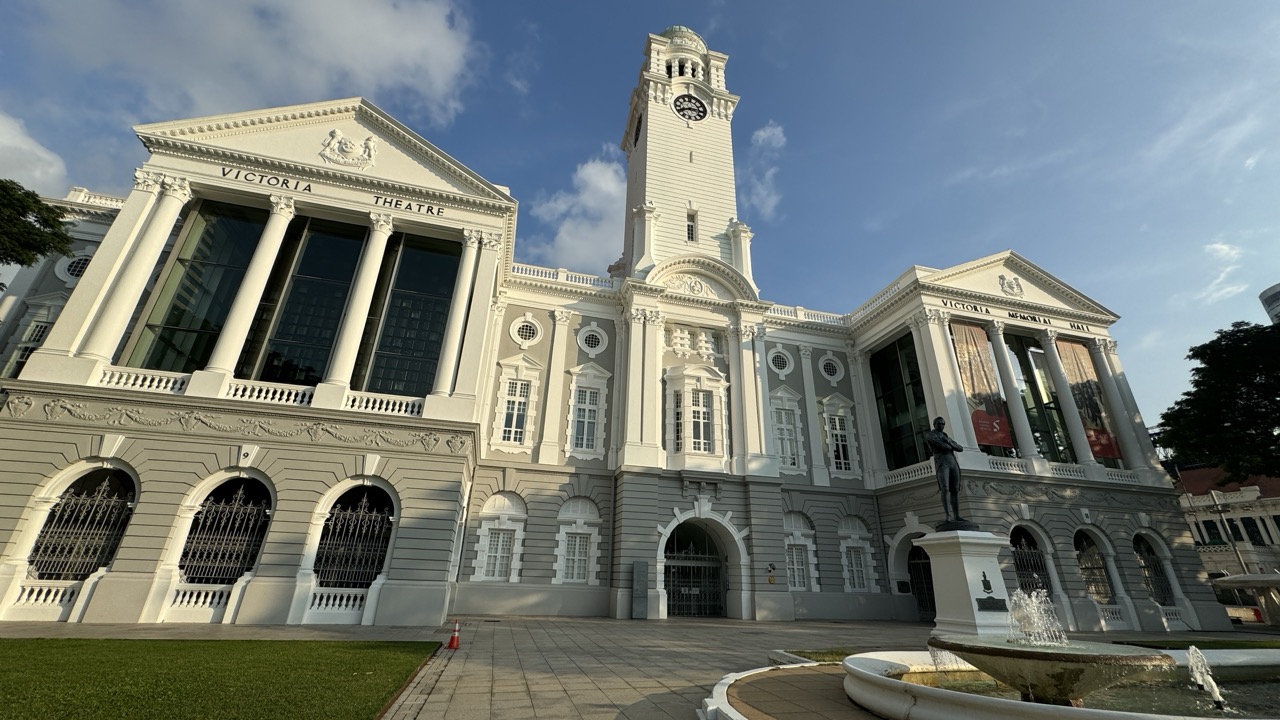
You can see Victoria Theatre and Victoria Concert Hall from Empress Place without buying a concert ticket. Start at the Empress Place forecourt for the two adjoining buildings and their clock tower, then walk towards Anderson Bridge for a second perspective along the Singapore River. Allow 30 to 60 minutes for the outdoor route at an easy pace. Raffles Place MRT is a practical starting point from the financial district side, while City Hall MRT works if you are already near the Padang or National Gallery Singapore.
The easiest way to enjoy this part of the Civic District is to give it one purpose. Go for the architecture and photographs, make it the first stop before a performance, or use the river as a simple outing with children. Treat the street-level walk and any indoor admission separately. For a 2027 show, follow the venue and entry directions on your ticket and check whether it names Victoria Theatre or Victoria Concert Hall.
- Free outdoor stops: Empress Place, the clock tower and public viewpoints near Anderson Bridge.
- Best starting point for the buildings: Empress Place, with room to step back from the entrance.
- For a performance: match the exact venue name on your ticket to the venue signs.
- For a short family visit: stay around Empress Place and the river approach, then return by the easiest route.
- For a longer visit: add one booked show, museum or meal after the walk.
How to get to Victoria Theatre and Concert Hall
Raffles Place and City Hall approaches
Both venues face Empress Place. NHB uses 9 Empress Place for the monument listing, while some concert listings give 11 Empress Place for Victoria Concert Hall. From Raffles Place, head towards the river and choose a designated pedestrian route to the Civic District side. A sensible arrival plan gives you enough time to locate the right river crossing, wait at any road crossing and orient yourself at Empress Place. If you are following a map app, check that it has selected a pedestrian approach rather than a vehicle route to the address.
City Hall is another workable station, especially if you are coming through the Civic District. Approach from the Padang or National Gallery side using public footways. The approach shows a different set of streets before you reach the tower. If your group wants a very short walk, choose the station that fits the journey you are already taking and check the final approach on the venue page.
From Punggol, compare a North East Line journey with a transfer to whichever line and station suit your wider plans. For a show, estimate the complete trip from your door to the venue entrance. Train time is one part of that estimate. A ticket check, a lift or a walk from the station may matter more on a busy evening than the difference between two suggested train routes.
Agree on a meeting point that works for the whole group
Empress Place is a better meeting description than simply saying Victoria. Tell people which part of the public forecourt you mean and which venue you are entering if there is a ticket. Put the street address and the name from the ticket in the group message. A clear landmark helps people who approach along the river as well as people coming from the Padang side.
Meet away from the door and leave a clear line for other visitors. A concert crowd, a tour group and a family taking photographs may all be using the same space. If someone in the party has mobility needs, choose a spot they can reach using their planned approach. For someone joining late, set a second meeting point that makes sense if the group has already left the forecourt.
If you are visiting just for the clock tower, allow everyone to arrive and look up before taking photographs. The tower gives the group something to recognise as they walk towards the building. Once they have seen it, tell them where the next stop is. This small step makes the route easy to follow without keeping a phone map open on every block.
What to see at Empress Place
Two buildings and a clock tower
The National Heritage Board describes the complex as two buildings joined by a clock tower. Start by looking at the building as a whole. Find the tower and look for the way each side of the complex relates to it. The broad view makes it easier to read the architecture than a photograph made from directly below the tower.
Walk far enough to try a second viewpoint where it is permitted and comfortable to stand. From one angle, the tower may read as the vertical centre of the composition. At another, the projecting parts of the building and the shadows along the façade become clearer. You can make a useful pair of photos by shooting one broad frame first and one detail second. An adult and child can choose their own detail, then compare what they noticed.
The theatre and concert hall carry different names because they serve different events. An exterior visit gives you the chance to see the two buildings together, while an event visit asks you to locate the specific auditorium and entrance. When planning for a group, keep the clock tower as the shared outdoor landmark and the venue name as the individual ticket instruction.
The statue and the space around it
The statue of Sir Stamford Raffles in front of the complex is another recognisable part of Empress Place. Give it a moment of its own before looking at the buildings behind it. From a public viewpoint, you can see how the sculpture and pedestal sit within the larger setting. A photo from farther back can show the relationship to the façade and clock tower.
Families can use the stop to ask who chose what the public should see in a civic square. The statue, the formal entrance and the clock tower all direct attention in different ways. An older child can pick one and explain what it does for someone arriving from across the river. A younger child can look for shapes repeated in the pedestal, windows and building edges.
For a historical reading, use the National Heritage Board’s monument entry to put the space in context. The complex’s history includes civic uses alongside the performing arts. If someone in your group wants to know more, open the heritage entry after the walk, while the places they saw are still fresh. Keep the outdoor visit short enough that everyone has time to pause and observe.
From civic complex to concert venue
The Singapore Symphony Orchestra has called Victoria Concert Hall home since 1980. The orchestra’s venue page also describes the hall’s Klais pipe organ and its use for chamber concerts, organ programmes and family events. If you are choosing a first performance, look for a programme length and start time that fit the group, then check the event’s age guidance and arrival instructions.
Pair the programme with something you can see outside. For example, a family attending an organ performance can look at the outside of the hall before entering and then see how the interior is arranged around the music. Someone who only has time for the outdoor walk can use the venue listing to find a suitable concert for a future date.
A short river extension towards Anderson Bridge

Where to slow down and look back
After Empress Place, take the public pedestrian approach towards Anderson Bridge. You can enjoy this part from the approach and decide whether to cross. The first task is to find a position where the river and civic buildings are easy to take in and where other pedestrians have space to pass. The bridge is an extension of the route, so the outing still works if an event or a change in conditions makes the approach busy.
Give yourself a few minutes to look upriver and downriver. The river ties together different types of buildings within a short view. Notice how the older civic frontage and the modern skyline frame the water at different distances. This is a good place to discuss why a broad city photograph looks different from a building portrait taken at Empress Place.
If you cross, use the pedestrian facilities and make a clear plan for the return. A bridge can be crowded, and a photograph often takes longer than expected once other people are moving through the frame. Keep equipment compact and stop only where it is safe to do so. If the preferred viewpoint is occupied, walk on to a wider public spot and come back when there is space.
A route with a useful finish on either side
To keep the outing on the Civic District side, return to the Empress Place area and finish at a planned indoor venue or take the path towards City Hall. If the best train home is via Raffles Place, use a pedestrian crossing of the river that suits your position and current signs. Agree on the direction before leaving the forecourt so the group does not have to stop to decide in the middle of a crossing.
Families with a time limit can make the river viewpoint the turn point. Tell younger children when you start that you will find the clock, see the river and finish. There is time to add one small observation at the end if everyone feels good. A single photograph of the two areas can help children remember where they walked when they next see the river from another part of Singapore.
For a meeting with visitors, keep the final place easy to find. If a restaurant is involved, confirm which side of the river it is on and how to reach its entrance. Use the map to avoid asking the group to cross back twice. The route is short enough that people can take in the scenery at their own pace if they know where lunch, the next train or the show will be.
How to combine the walk with a concert
Read your ticket for the full venue name
Check whether the organiser lists Victoria Theatre or Victoria Concert Hall. Keep the name exactly as shown, along with the date, entry time and any information about doors. An event listing may mention the complex as a whole in its description, but the ticket gives you the location you need on the day. Share that information with anyone arriving separately.
For the concert hall, the Singapore Symphony Orchestra venue page is a useful starting point for finding the building. If you are attending another organiser’s event, use that organiser’s instructions for admission, accessible seating and late arrival. Arrange assistance in advance if you need it and keep the box office or event contact easy to find. During the walk, keep tickets saved on the phone in a way that works even when signal or battery is weak.
Let the performance set the length of the outdoor walk. With ample time, start at the clock tower and go to the river. If travel takes longer than expected, use the forecourt for a brief look and head to your entrance. A concert outing works better when the walk can shrink to fit the day. The best river viewpoint can wait until after the event or another visit.
A pre-show and a post-show option
Before a matinee, the outside is easiest to enjoy if you have water and a planned point at which you leave for the doors. Take the broad photo early, then decide whether there is time for a short river look. Save the address of any meal venue and confirm the time needed to reach it from the complex. This is especially useful if a child or an older guest needs a stop before the show.
For an evening performance, you may prefer to look at Empress Place after the show. Stay with the well-lit public areas and take extra care near the river. Recheck the last part of your journey if you are depending on public transport. A busy exit is a good reason to wait briefly in a place with room to stand instead of moving as a tight group through the doorway.
Concertgoers can split tasks. One person keeps the tickets and entry information ready. Another looks after directions and the return route. A child can keep track of the landmark that signals where you are going. Clear tasks reduce the chance that everyone is looking down at the same moment while crossing a street or trying to find the right entrance.
Photography and a family architecture activity
Three views to take home
Take one broad frame that includes the clock tower and at least part of both building fronts. Step back where the public space allows so the façades fit without pointing your camera sharply upwards. Next, take one frame that isolates the clock, an entrance or a repeated feature. Finally, take one river view that captures the wider Civic District setting. Those three images describe the outing from building to detail to neighbourhood.
Think about timing if the light matters. A morning visit and an evening visit can show the same frontage under different conditions. Cloud and shade can help bring out surface detail, while strong side light can make projections easier to see. Choose your position based on what you can observe from the public space rather than a promise of an exact light direction or hour.
Keep attention on the route between pictures. Put away a camera while crossing roads, stay clear of the water’s edge where access is restricted and leave plenty of room for people passing on the bridge. If you want to photograph an event or the interior, check the organiser’s photography rules separately. The outside architecture gives you enough to work with on its own.
A five-minute task for children
Ask each child to find one part of the building that points up, one detail that repeats and one feature someone arriving for a show would use. The clock tower, a row of windows and an entrance might be their answers. Give them time to explain where they saw each example. This is an easy way to make a public square feel like somewhere they explored for themselves.
Try another question beside the river. How would you describe the route back to the clock to someone standing here for the first time? Encourage a child to use two landmarks and a safe crossing. A simple description, such as follow the public path to the open space and look for the tall clock, is enough to show they have connected the two stops.
Finish the activity while children are still interested. On a later visit they might want to compare another clock tower, find a favourite bridge or see a performance. Make that choice at home when you can look up schedules and routes together. A short outing can start a longer interest without turning every building on the river into a compulsory stop.
Rain, access and a comfortable pace
Decide how much outdoor time the day allows
The Empress Place and river portion is exposed in places. In light rain, shorten the approach and keep only the clock tower view if it still feels comfortable. In heavy rain, give priority to getting to a verified open venue or the station. If you came for an outdoor walk only, move it to a clearer part of the day or choose a nearby indoor destination with published opening hours.
On hot days, carry water and choose the shorter version. The clock, the statue and a broad building view can all be appreciated in one stop. A family with young children can start with that and make the river optional. If someone in the group needs a seat or a toilet, deal with that before adding distance. Put the planned break in the route rather than leaving it to chance.
Public events can change how a forecourt or footway is used. Follow temporary signs and take the public paths that are open. If your first approach is busy, give yourself the time to take a more comfortable one. Visiting at a quieter time can make it easier to hear companions and find a place to stand for photographs.
Check the exact route if steps are difficult
For the exterior, plan a route using public crossings and use the flattest practical approach for your group. The terrain, crowding and any temporary barriers all matter. Look at the venue directions and check for service changes on the train line if lift access is essential. Give enough time to pause and revise the route before crossing the river.
For a ticketed visit, ask the organiser how to reach the seat and which entrance they recommend. Accessible arrangements for the auditorium and access to the surrounding public space are different questions. Ask about the whole chain from drop-off or station to the foyer and the seat. Where helpful, confirm when you should arrive and whom to ask for at the door.
A group with different walking speeds can meet at Empress Place and let individuals decide whether to add the bridge. Choose a clear reunion time and a safe waiting spot. This works especially well for visitors who want to take more photos than their companions. The core visit is easy to share and the extension is easy to make independently when the route is open.
Build a longer Civic District visit
Add one attraction or one meal
The Asian Civilisations Museum sits nearby at Empress Place, and National Gallery Singapore is another possible follow-on in the Civic District. Pick one if it serves the interests of your group and check the current programme and visitor information. A person who wants to spend time in a gallery will be happier with a short exterior route and a proper museum visit than with an outdoor list that uses up the first half of the day.
For a meal-led outing, pick a reservation time or a food area, then use the building and river as the lead-up. Put the most important stop first if you are taking older relatives or young children. If the party is large, allow time for seating and different appetites. A well-chosen break can turn a quick photo outing into a relaxed morning without adding several more kilometres.
If you are showing Singapore to someone who has never been here, explain the plan in three place names: Empress Place, Anderson Bridge and your final destination. Once you are on the route, let the views do some of the work. A first visit is a chance to notice the buildings, river and changes in scale. There will be time to look up the details once the route has given the person a clear picture of the area.
What to confirm for a 2027 date
Check the exact venue listing, event time and any ticket conditions close to the visit. If you are choosing a museum after the walk, verify admission and last entry for the specific gallery or exhibition. For the exterior, check the weather and keep an eye out for road or pedestrian notices associated with major events in the Civic District.
Save the return station before leaving home and check it again if the outing shifts from day to evening. Build a little slack around the concert entrance and leave a choice about how much outdoor time to include. If your group can name the first landmark, the main destination and the easiest way home, you have enough information to start comfortably.
The difference a second viewpoint makes
On your first look, stand where the complex fills the view and take in the connection between the two buildings. On your second look, stand farther away on a public approach. Notice what disappears behind other objects and what becomes easier to recognise. The difference shows how a tower can help people orient themselves across a district even when the building below it is partly hidden.
If you are returning with someone who has seen only photographs, let them choose the first viewpoint. Ask whether the scale matches what they expected and which building they would use as a landmark. Then walk to the river approach and ask the same question again. The surrounding space will make more sense after they have seen how quickly the frame changes between the forecourt and the water.
Give yourself time to see something between the named stops too. An entrance set back from the street, an open passage or a wall that catches the afternoon light can be as memorable as the tower. Look from a place where you can comfortably stand, then continue to the next stop once the group is ready.
Frequently asked questions
Can I see the Victoria Theatre clock tower for free?
Yes. You can view the exterior from public areas around Empress Place without buying a ticket. An event or exhibition has its own admission arrangements.
Are Victoria Theatre and Victoria Concert Hall the same venue?
They are adjoining venues in the same historic complex. Use the full name on your ticket when finding the entrance.
Which MRT station should I use?
Raffles Place works for an approach from the financial district side and City Hall is useful for an approach through the Civic District. Check the last stretch on the venue map.
Is crossing Anderson Bridge essential?
No. A view of the river from the approach is enough for the short route. Cross only if it suits your group and the public path is open.
Can I take photographs outside?
You can make ordinary photographs from public viewpoints while respecting posted signs and leaving room for others. Check the event organiser’s rules for any indoor photography.
How long does the outdoor walk take?
About 30 to 60 minutes at an easy pace is a reasonable plan for Empress Place and a short river extension. Add time for the station approach, breaks or a show.


