
For a free ten- to twenty-minute heritage stop by the Singapore River, cross Cavenagh Bridge between The Fullerton Hotel side and Empress Place. Look for the old police notices at the approaches and take a moment to see the iron structure from the bank. Start from Raffles Place MRT for the Fullerton side, or from the Asian Civilisations Museum side if you are already in the Civic District.
The National Heritage Board dates Cavenagh Bridge’s completion to 1869 and includes it with Anderson and Elgin bridges in a National Monument gazetted in 2019. The historic police notices mention horses, cattle and a vehicle limit of three hundredweight. Read them as part of the bridge’s history and follow present-day signs for access.
- Use Raffles Place MRT and head towards The Fullerton Hotel and the river.
- Cavenagh Bridge links the Fullerton side to Empress Place near the Asian Civilisations Museum.
- Look for the old notices from the side of the public approach so others can pass.
- A short crossing is free. The nearby museum, meals and river cruises have their own admission or prices.
- Anderson Bridge is a different crossing. Add it if you want to compare the bridges or make a short loop.
1. Find the correct crossing from either bank
Start on the Fullerton side
From Raffles Place MRT, use the public walking route towards The Fullerton Hotel and the Singapore River. The hotel gives you a useful landmark. You can reach the bridge from the public river approach without entering a hotel room or buying anything. Follow current signs and look for the older iron bridge that connects directly towards Empress Place.
If you are coming from Boat Quay, identify the crossing by its name before heading towards the wider waterfront. Cavenagh and Anderson are close to each other and may appear in the same picture. Use the current walking map for the crossing itself instead of following a general pin for the Fullerton area. A public position on the bank is a good place to read the shape before you walk across.
Start on the Empress Place side
If you are near the Asian Civilisations Museum, walk towards the river and look for the crossing to The Fullerton Hotel side. Empress Place has several landmarks and paths. Use the museum as a reference when sending directions to someone who has not been there before. If the person is joining from Raffles Place, decide whether you will meet on their bank or yours.
Work out where the stop ends
A group returning to Raffles Place can go across and back or finish on the Fullerton side after another short walk. A group visiting the museum can finish at Empress Place. A photograph can take only a minute, while finding the next entrance and moving as a group can take longer. Give your bridge stop a clear endpoint before you add another attraction.
2. What the old police notices say
NHB describes historical notices at both ends of the bridge. They bar horses and cattle and refer to a limit of three hundredweight for vehicles, equivalent to about 152 kilograms in the notice’s context. Three hundredweight is an older measure. The number is useful for understanding which kinds of traffic the notice addressed. Read and photograph the notice from an available place where others can continue to cross.
Let children work out what the rule would have meant
Ask a child why the notice names animals as well as vehicles. Give them time to imagine a river crossing used in a period when people travelled or carried goods differently. They can compare that with the way people use the crossing today. For an older child, the metric conversion offers a way to explain why unfamiliar units can make an old rule harder to read.
A practical question is whether a horse or a large animal could have used the bridge under that restriction. NHB’s account explains that a grown ox alone would exceed the stated figure. The example shows how a rule can effectively change the traffic a crossing serves. It is also a reminder that a historical sign can say something about the city beyond the object it is attached to.
Treat present access separately
The old notice is part of the heritage of the bridge. Follow current instructions on the day for the public route, closures and any wayfinding. If a visitor wants a step-free route or needs room to pass, look at the actual approach. A historical text does not tell you what is open or how busy the path is now.
Contents · Previous section · Next section
3. Why this particular crossing mattered
Before Cavenagh Bridge, NHB’s river-walk material describes a temporary wooden footbridge and the option of paying a boatman. The river separated the commercial area from offices on the other bank. A reliable crossing made that relationship easier to use. It is possible to understand the point in a few minutes by standing on either side and looking at where the route lands.
Look at the bridge as part of a working river
On the Fullerton side, look towards the old trading area. From Empress Place, look back and see how close the banks appear even though the water kept the two walking routes apart. Imagine carrying something, visiting an office or meeting a boat. The need for a crossing becomes clearer when you give the journey a specific job.
The present route supports a different mix of movement. Visitors may cross for a museum, a photograph or a walk to the station. Workers may use the same public route to reach another part of the city. You can use the bridge in an ordinary way and still see how important its position was to the historic district.
Read the 1869 and 2019 dates together
The 1869 date describes completion. The 2019 date relates to the National Monument designation that groups Cavenagh Bridge with Anderson and Elgin bridges. Put each date with the thing it refers to. This matters when someone is making a caption or school note. A simple description can give the building date, the location and the reason the crossing is worth looking at now.
Contents · Previous section · Next section
4. See cast iron in a real structure
NHB describes Cavenagh Bridge’s use of cast iron. From a public position on the bank, look for the line of the crossing and repeated structural parts. A straight-on view makes the route clear, while an angled view makes it easier to see how some parts are arranged beside and above the walkway.
If a student wants to sketch the bridge, begin with the deck and the main outline. Add only details that can be seen from the chosen position. Mark any part you want to identify later using the NHB explanation. A short sketch can help you see repetitions or connections you missed on a first walk across.
Compare appearance and material
You can see a colour, outline or connection from the riverbank. You cannot reliably establish the composition of every member from appearance alone. Use the official account for the material. This makes the walk a simple example of combining first-hand observation with a reference, even if nobody in the group knows the technical name of every part.
Ask which details remain visible when the bridge is seen from farther away. The repeated forms and the overall outline may be more noticeable than a small joint. A close view can give you a second kind of evidence. Putting the two photographs or sketches together tells a clearer story about the structure than making several pictures from the same angle.
Contents · Previous section · Next section
5. Compare Cavenagh and Anderson without confusing the two
NHB’s monument guide places Cavenagh’s cast iron alongside the later use of steel at Anderson Bridge. The bridges are close enough to look at on one outing, yet they represent different periods and needs. NHB notes that Anderson helped relieve demands on the earlier crossing. Use the current walking route and view each bridge from public paths.
Choose the best order for your visit
Start with Cavenagh if your priority is the old signs and the pedestrian link between Fullerton and Empress Place. Add Anderson if you have time for a comparison. Choose one observation before you move. You might compare how each bridge looks from a distance or how its approach meets the street. A short comparison is easier to remember than a list of structural facts.
Bring Elgin into a longer river walk
Elgin Bridge is farther upstream and adds the reinforced-concrete example that NHB discusses in the same designation. It works as part of a longer walk with a different turnaround point. If you only have ten or twenty minutes, use the two nearby bridges or stay with Cavenagh alone. A broader itinerary should account for the additional walk on whichever bank you choose.
Look up the actual route rather than drawing a straight line between landmarks. Bridges, paths and street crossings each create their own wayfinding. A visitor using a mobility aid can check the approaches before attempting a loop. An out-and-back at Cavenagh can be the simpler version if the group wants fewer changes of route.
Contents · Previous section · Next section
6. Find two nearby stories on foot
The Fullerton side
At the Fullerton end, look at how the bridge joins a major landmark beside the river. If you are interested in the building itself, check the current Fullerton Heritage Gallery information before adding it. The gallery is a separate stop with its own access. The bridge visit can work on its own even if you do not go indoors.
NHB’s Roots directory places Chong Fah Cheong’s First Generation near The Fullerton Hotel. If you pass it, look at how the figures relate to the water. The sculpture invites a question about everyday life on the river. The bridge invites a question about crossing it. A family can use the two stops to see how the same water was part of very different activities.
Empress Place and the museum side
At the other end, consider the public space around Empress Place and the Asian Civilisations Museum. An indoor museum visit can be a separate plan. Check the admission and hours before making it the next stop. For a short outdoor walk, look back across the river and compare how the hotel and nearby buildings appear from this bank.
A visitor can also continue towards the Civic District’s other buildings when the paths and time allow. Choose one next destination. If you want a photograph of a river crossing, spending time on both banks may be enough. If you want to understand the larger district, let the bridge be the starting point and follow a suitable onward route.
Contents · Previous section · Next section
7. Three ways to use a short visit
A quick stop before a museum booking
Cross from the Fullerton side, look at one notice and head to Empress Place. Include time to find the museum entrance and follow its ticket instructions. The bridge stop fits if you can do it without reducing the time for the booked activity. Save a second crossing for after the museum if the group wants more.
An early walk with a child
Look at the bridge from the bank, read one notice together and cross. Ask the child to remember one number or one unusual word. On the other side, ask what they think the sign was for. Add a sketch of the bridge or a photograph if there is space. The child can describe what they saw without needing to memorise the whole timeline.
An evening walk between riverfront places
Use the bridge to move between the Civic District and the Fullerton or Boat Quay side. If the main purpose is a dinner booking, check the exact restaurant entrance. Leave time for the walk and use the bridge as a brief pause. The structure and signs can be easier to inspect in daylight, so return another time if close detail is what you most want to see.
Contents · Previous section · Next section
8. Take a photo that explains where you are
A wide view can show both the crossing and the place where it lands. Choose a position on the bank where you can stand without blocking movement. A close photograph of the notice is easier to understand if you also have one of the bridge. The two images give a reader both the detail and its setting.
When you caption a picture, use the crossing’s actual name. Anderson Bridge is close by and has a different appearance. If a photograph shows another bridge or only the Civic District, describe it as the surrounding area. It is easy to mix up river crossings when looking at images later without their locations attached.
If you make a family route, note the start station, bank and end point. Then add one observation about the bridge and one fact from the heritage listing. A useful note can be as short as ‘We walked from the Fullerton side to Empress Place and saw the notice that uses hundredweight.’ That helps someone else repeat the walk and know what to look for.
Contents · Previous section · Next section
9. Look for the maker’s name and the bridge’s namesake
Read the manufacturer’s name as a clue to the journey
NHB describes plates carrying the name of P & W MacLellan, the Glasgow manufacturer. It also describes loading tests before the bridge was shipped. If you can see the plate from a public position, read it alongside the police notice. They tell different parts of the story. One points to where the bridge’s components were produced and tested. The other tells you something about the traffic it was expected to serve.
Ask a child what a manufacturer would want to know before a structure was sent to another country. They might ask whether it could carry a load or whether the parts would fit once it arrived. Use NHB’s history to connect those questions with the bridge. There is no need to infer a test method from what is visible today. The maker’s plate can be the first piece of evidence, followed by the account of what happened in Glasgow.
Know who Cavenagh was
NHB identifies the bridge’s namesake as William Orfeur Cavenagh, the last Governor of the Straits Settlements appointed under the administration based in India. The transfer of administrative oversight to London took place in 1867. The completed bridge dates to 1869. Those dates give a visitor a way to connect the name to a particular transition without assuming the namesake was the person who opened or built the bridge.
For a family walk, keep the question simple. Why might someone name a bridge after a governor? What would the name have meant to people in that period? A student can compare this crossing with a later bridge named after someone else. Use the monument guide for names and dates. A surname on a sign helps you start the question, while the historical source explains the relationship.
Compare a name, a date and a rule
The bridge gives you three kinds of evidence in a short stretch. Its name links it with a person and period. Its completion date tells you when this crossing was finished. The old police notice tells you something about which traffic could use it. Choose one detail to describe rather than treating all three as interchangeable history. A short heritage note can say what you read on the bridge and which facts came from NHB’s guide.
Contents · Previous section · Next section
10. Use an older photograph to test what you notice today
Identify which bank the old photographer stood on
NHB’s trail booklet and online collections include historical views. Look for features that help you orient the picture. Is the view along the river or across it? Does it show the bridge approach, a building or a second crossing in the background? Try to match one landmark to the present setting using a public route. Some buildings and paths will look different.
If a photograph is labelled Cavenagh and Anderson Bridges, use the caption and the visible positions to see which structure is in front. Two bridges can overlap in a single view. A modern picture taken from a slightly different position may separate them. That is useful evidence for explaining the distance between the crossings without relying on a map alone.
Describe what changed and what you can still recognise
Write down one feature you can match and one detail you cannot. A match could be the overall line of the bridge. A change could be the activity on the bank or the buildings behind it. Avoid drawing a conclusion about the exact construction date of a nearby building from a photograph alone. An image can confirm its appearance at a particular time, while a building record can answer a different question.
A visitor with children can make this a small comparison on the walk back. Choose a single picture and ask which part of the scene the child can find again. The best comparison point may be from a public bank instead of the middle of the bridge. Keep the screen or paper in hand only when you have room to stop. The exercise is optional if the group is on the way to a museum or meal.
Contents · Previous section · Next section
11. Choose a short loop or stay on one crossing
An out-and-back for the quickest return
Start at the Fullerton side, cross, pause at Empress Place and return. Use this version if you want to see the notices and still head back towards Raffles Place promptly. You can add a different viewing position on the second bank before turning. Two short pauses help you see more of the structure than one longer stop at the entrance.
A one-way route to the Civic District
Use the bridge as the transition between your station approach and a museum or walk around Empress Place. Identify the exact next entrance on the map. The bridge is a good place to understand how the two areas face each other. You can see the relationship even when your route allows only one crossing.
A comparison loop using a nearby crossing
If you want a longer outdoor visit, check whether the public route to Anderson Bridge works for your group. Choose a safe place to look back at Cavenagh from the bank, and compare the point where each crossing lands. Steps, grades and temporary access arrangements can affect the most convenient route. A loop is worthwhile if you have time to compare. A same-bridge return remains a complete outing when the group wants a simpler route.
Keep the next landmark optional
A visit to Merlion Park, Boat Quay or the Asian Civilisations Museum can each follow the bridge walk, depending on your direction and time. Choose one, then check the relevant public route or admission. That keeps a ten-minute bridge stop from becoming a long trip by accident. You can use the remaining river landmarks to plan another outing.
Contents · Previous section · Next section
12. Share a short route that someone else can repeat
Send the name Cavenagh Bridge, the side where you intend to start and the landmark at the other end. If the group is meeting near the hotel, use the public river approach as the reference. If it is meeting near the Asian Civilisations Museum, use Empress Place. A precise place is easier to find than a general message about meeting beside the Singapore River.
Add one reason for the stop. A visitor may want to read the old notice, see how the iron bridge meets the two banks or compare it with Anderson Bridge. Each is a complete reason to go. If everyone has more time afterwards, choose a second stop according to the bank on which you finish. The route can stay compact even if the group eventually spends longer by the river.
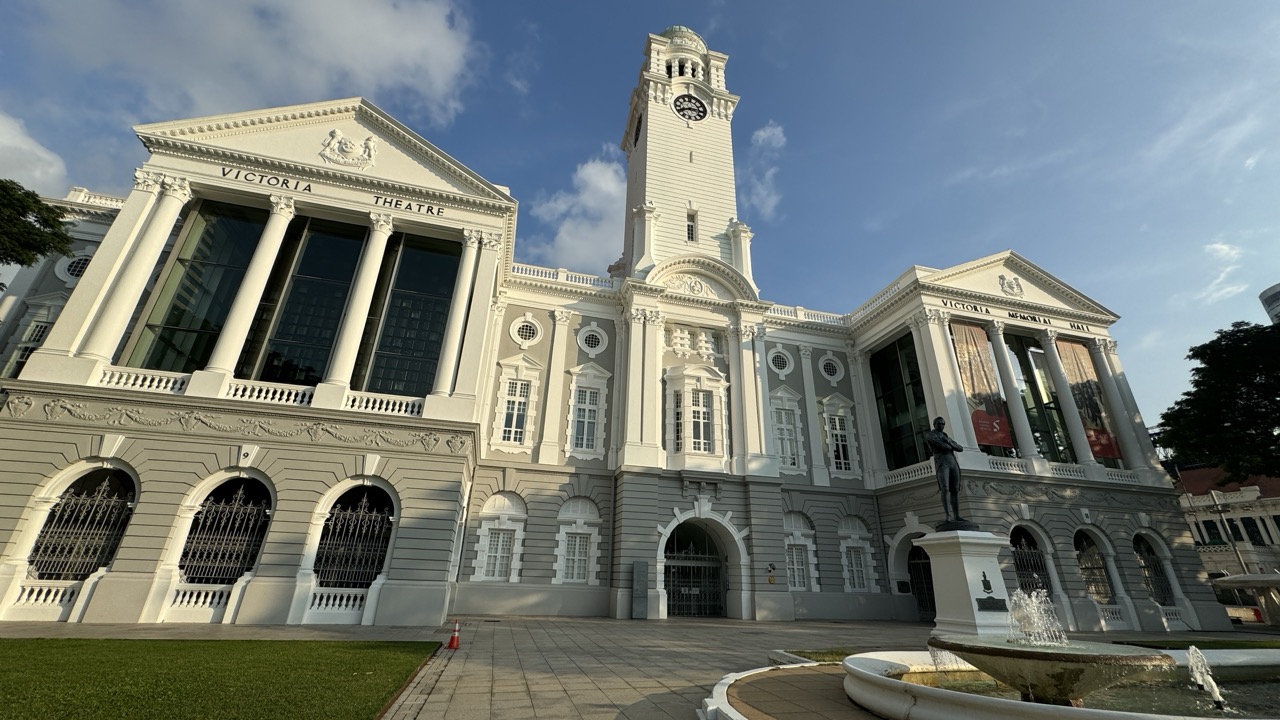
The featured archive photograph shows nearby Victoria Theatre and Concert Hall in the Civic District. Use the NHB guide for photographs and identification of Cavenagh Bridge itself.
Contents · Previous section · Next section
Frequently asked questions
Is Cavenagh Bridge free to cross?
Yes, it is a public pedestrian crossing when open. Follow any current diversion or access signs.
Which MRT station should I use?
Raffles Place is a useful start for The Fullerton Hotel side. Walk towards the hotel and river.
Where does the bridge lead?
It links the Fullerton side of the river to Empress Place near the Asian Civilisations Museum.
When was Cavenagh Bridge built?
NHB lists its completion year as 1869.
What does three hundredweight mean?
In the notice’s context it is about 152 kilograms. The historic sign gives a vehicle restriction and also names horses and cattle.
Is it the same as Anderson Bridge?
No. Anderson is another crossing nearby. NHB groups them with Elgin Bridge in its National Monument listing.
Can I visit in ten minutes?
A brief crossing and one look at a notice can fit once you are at the river. Add station and onward walking time separately.
Do I need an ACM ticket?
No ticket is needed for the public bridge. Check separate admission if you are entering the Asian Civilisations Museum.
Sources and next reading
- NHB Roots national monument guide to the Singapore River bridges
- NHB Singapore River Walk trail booklet
- NHB Roots First Generation public artwork
- Boat Quay shophouse walk
- Fullerton Heritage Gallery visitor guide
- NHB Roots online exhibition on historic Singapore River bridges
- NHB collection photograph of Cavenagh and Anderson bridges


