
The Arts House occupies Singapore’s former Parliament building at 1 Old Parliament Lane. For a short Civic District visit, start from City Hall MRT, follow the public streets towards Old Parliament Lane and look for the bronze elephant at the entrance. You can see the exterior from public areas when access permits. If you want to enter for an exhibition, performance or event, check the specific programme and its admission arrangements before making a special trip in 2027.
The building served as an early courthouse and later as a legislative and parliamentary home before reopening as an arts centre in 2004. It is distinct from the current Parliament House nearby. Plan a brief exterior stop, a confirmed arts programme or a short walk towards Empress Place and the river. Give your group one fixed destination and leave time for the approach from the station.
- Address: 1 Old Parliament Lane, Singapore 179429.
- Start at City Hall MRT or use Raffles Place if you are already across the river.
- Look for the bronze elephant and the building exterior from open public areas.
- Check the particular event for opening, registration, ticket and room access.
- The current Parliament House and the former building are separate destinations.
Find the former Parliament building
Use 1 Old Parliament Lane as the exact destination
Start at City Hall MRT and follow a current public walking route towards Old Parliament Lane. The Civic District has several institutions close together. Save the building name and the street address, then check the final approach once you reach the National Gallery or the nearby public streets. Choose a pedestrian route and follow temporary signs if an event changes access.
From Raffles Place, check the current walking route across the river and towards the Civic District. This can be useful if you are already on the financial district side or want to see Cavenagh Bridge on the way. Allow time for any crossings, a lift or a rest. If the visit is timed, go directly to the arts venue rather than adding several waterfront stops before registration.
For a group coming separately, use the building name, address and an exact meeting point. A person visiting current Parliament proceedings needs different directions. A person attending an arts event should have the programme’s room and arrival instructions. The elephant is a useful visual reference when the entrance area is accessible, but choose a waiting point where the group will not obstruct other visitors.
Identify the photographs correctly
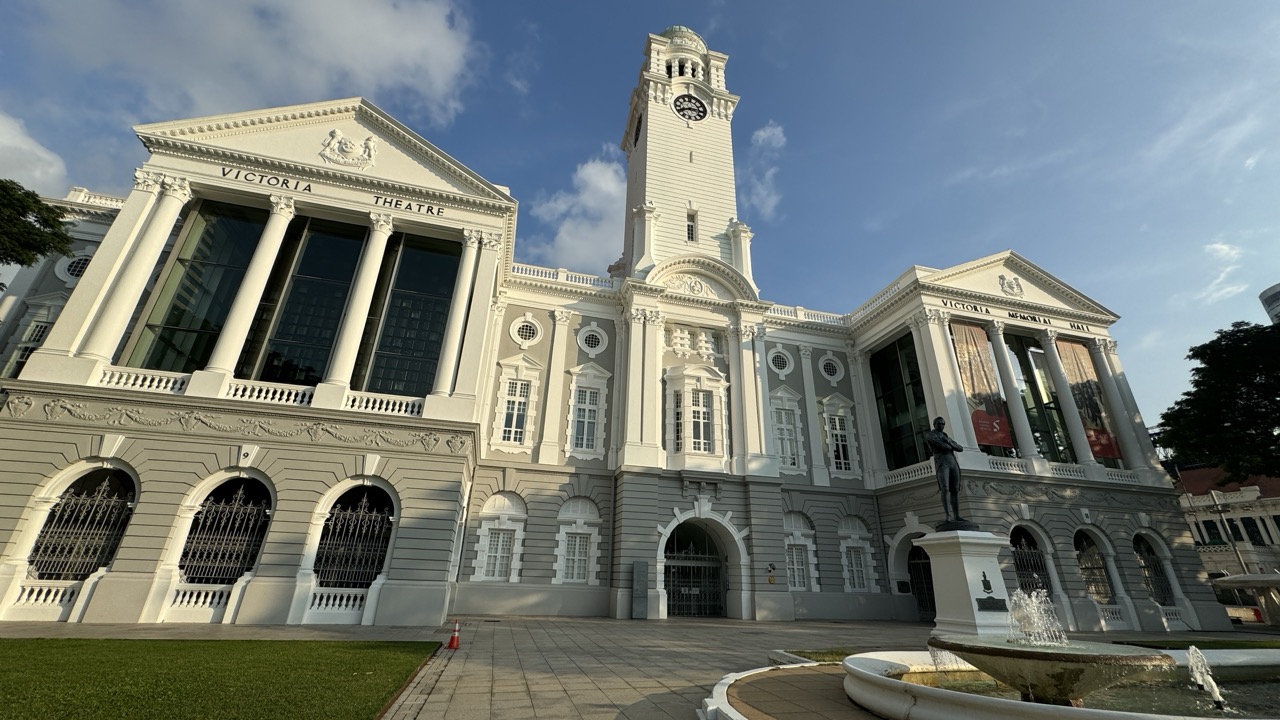
The photographs here show nearby Civic District landmarks: Victoria Theatre and today’s Parliament House. They help distinguish the places around Old Parliament Lane rather than serving as images of The Arts House itself. Use the National Heritage Board’s former Parliament House entry to recognise the actual building and statue. On the day, follow public signage and directions from the organiser.
If you are bringing older relatives or a stroller, check the route from the station and the venue entrance in advance. A short public route can still involve crossings or changes of level. Ask the organiser about the exact event entrance if a continuous step-free approach matters. A venue listing and an accessible route are two different questions.
What to see outside
Look for the bronze elephant
The National Heritage Board describes the bronze elephant at the entrance as a gift commemorating King Chulalongkorn of Siam’s 1871 visit to Singapore. Start with the statue if you only have time for one detail. Look at its position in front of the building and how a visitor might use it to recognise the entrance. Use a suitable public viewpoint and follow any local directions about access.
A child can look at the shape of the figure and ask why a visitor might bring a commemorative gift. An older student can use the heritage source to distinguish the visit being commemorated from the building’s later use as Parliament House. The statue tells a story about a particular visit. The building itself tells a longer story about changes in public use.
If you want a photograph, take one frame that includes the statue and enough of the frontage to show where it sits. A closer image may be easier to look at afterwards. Stop only where there is space and keep the route to the entrance clear. If an event makes the area busy, take a brief look from another public point.
Read the building from a suitable public approach
Look at the entrance and the way the building sits among the neighbouring institutions. Compare it with another building nearby that has a different scale or purpose. For a short visit, that comparison can be more useful than walking around every side. Use the heritage entry to check what the different spaces were used for at different times.
A family can choose one detail to remember. Ask someone to describe the entrance, someone to remember the statue and someone to identify the street. At the next stop, use those details to reconstruct the route. This is a quick way to help a first-time visitor remember which of the nearby buildings they saw.
If you are visiting with a child, compare the statue as a landmark with the venue address as a direction. Someone who can see the building may use the statue to recognise it. Someone coming from a station needs the street and the correct approach first. Give them both pieces of information. For a visitor who cannot readily use a visual landmark, share the named venue entrance and any instructions provided by the organiser.
For a repeat visit, pick a different reason to come. An exterior visit can focus on the gift and the building’s setting. An event visit can focus on the experience of a particular room when the programme allows access. If you photograph the area for a school project, record the actual building name and date. Keep images of the present Parliament separate and use the NHB entry to check the date or purpose attached to each historical detail.
Follow the building from courthouse to arts centre

Start with the 1827 building and its early public role
NHB dates the original building to 1827. It was commissioned as a residence for merchant John A. Maxwell but was used by the colonial administration rather than occupied as a private home. It served as an early official courthouse and was adapted over time. The history makes the building an example of how a site can acquire public uses different from its original plan.
For a student, ask which parts of that story can be learned from looking and which require a source. The entrance or exterior may help you recognise the building. Its former tenants and functions need a historical record. Use the distinction to avoid guessing what a particular room or doorway was originally for. A short visit can lead to a useful question about how a building was adapted.
Follow the changes in public use
NHB records that the building was adapted to house a legislative chamber in the 1950s. A legislative assembly met there after Singapore gained partial internal self-government in 1955. It later housed Parliament after independence in 1965, until Parliament moved to its present building in 1999. The former building reopened as an arts centre in 2004.
Those dates give you a short timeline, but choose one change to think about while visiting. A courthouse, a legislative chamber and an arts venue serve different groups. Ask how a building could be adapted to let people listen, watch or participate. If you attend a programme, notice how the room serves that particular event today. Use the historical source for claims about its earlier use.
A family can describe the sequence in three short phrases: court, Parliament and arts venue. Then add the statue as a separate story connected to the entrance. This makes the visit easier to understand without asking children to remember every date. An adult interested in a specific period can use the heritage page to read more afterwards.
Put the courthouse, assembly and Parliament years in order
Begin with the change from private plans to public use
The 1827 starting point matters because the building was designed with a private use in mind, then used for public administration. According to NHB, Maxwell leased the completed building to the British administration and it became the first official courthouse. Look at the site today and ask how different users might enter and use it. You can see where the building stands. To know what took place inside in a particular year, use the heritage record.
The building was extended and adapted. NHB records its use as the Supreme Court until 1939 and later use for social welfare offices. That makes it easier to distinguish the former courthouse at Old Parliament Lane from the later former Supreme Court building incorporated into National Gallery Singapore. Both appear in Civic District heritage walks. If someone in your group wants the National Gallery’s former courtroom or architecture programme, give them that destination separately.
A useful way to organise the story is to draw a timeline with changes of function marked above it. Start with the court, then leave room for the later offices, the legislative chamber, Parliament and the arts centre. The same site has a place on each part of the timeline. Some of the physical building changed along the way. The guide and the building offer different evidence about what each change involved.
Separate the legislative assembly from the later Parliament
NHB places the conversion for a legislative chamber in the mid-1950s. The assembly met in the building in the period of partial internal self-government. The site later served as Parliament House after independence. When you tell the story to a child, give the sequence in two steps. First, the building housed an assembly. Later, it housed Parliament in independent Singapore. You can look up more detail about each period if the child wants to know what the members discussed.
Look at the present entrance and imagine people arriving for different purposes over the years. A member attending a sitting, a person working in a public office and a visitor attending an arts programme would each have a different reason for being there. This exercise can make the change of use easier to picture. It should stay an exercise, since the actual entrances and procedures in each period require specific sources.
The present Parliament House is a useful comparison from an appropriate public point. Use the full names and addresses to keep the two buildings separate. A visitor interested in observing proceedings should check Parliament’s own Public Gallery guidance and sitting dates. An arts event has a separate organiser and programme. The fact that one building is near the other makes the comparison convenient. It does not make the two visits interchangeable.
Connect the monument and the arts use
NHB records that the former Parliament House and its annexe were gazetted as National Monuments in 1992. The arts centre opened in 2004 after renovation. Look for how an older building can continue to have a public role while serving new visitors. If you attend a current programme, observe how the venue guides people into the event and where the experience begins. A first-time visitor can compare the event directions with the exterior building name.
After the visit, ask which part of the story you could see and which part you learned from an official description. The elephant may be visible outside. A historic meeting or earlier use cannot be observed directly today. The distinction helps children write accurate captions and gives adults a simple way to answer a visitor who wants to know why the building is important.
If the history is your main interest, consider making a second visit to one nearby monument. Compare one change of use rather than trying to memorise every institution in the district. The former Fullerton Building offers an example of a large public building adapted for a new role. National Gallery offers an example involving two former public buildings. Choose the comparison that matches your question and check access independently.
Check whether your programme gives you access inside
Use the event listing for indoor details
The National Arts Council identifies The Arts House as an arts and heritage venue. Its events can have different room, registration, ticket and arrival arrangements. If you want to go inside for a particular event, use the current listing and ask the organiser if the details are unclear. A programme in one room is not a general tour of every historic space.
Check the date, time and name of the room before leaving. If the listing mentions the Chamber, confirm whether admission applies to that programme and how to reach it. If you are interested mainly in seeing the former legislative room, check whether there is a suitable event or tour. Do not assume a visitor can enter an unoccupied room whenever the building is in use.
For a visitor with access needs, ask about the room, entrance and route from the public street. Ask what assistance is available and when you should arrive. For a family with children, check the event’s age or admission guidance before booking. Use the organiser’s instructions rather than relying on older general venue hours.
Make an exterior visit an independent alternative
If there is no suitable programme, plan for the exterior and one nearby public stop. Go to Old Parliament Lane, look for the elephant from a public point and use the NHB building entry to put what you see in context. This is a worthwhile short visit by itself. A family can then choose a free waterfront walk or a verified museum visit.
If conditions change on the day, follow signs and decide whether to return another time. Temporary access arrangements can affect how close you can stand to the entrance. You can still see another Civic District landmark or take the shortest route to the station. The indoor event, exterior and nearby public walk each have their own access conditions.
Pair the stop with Empress Place or a bridge
Choose one nearby public extension
After the exterior, walk towards an open public area around Empress Place if it fits your group. Victoria Theatre’s clock tower is a recognisable landmark and can make a short second stop. Use the public approach rather than assuming you can enter another building. If you want to attend a performance there, use the separate ticket and entry information.
A public river viewpoint near Cavenagh or Anderson Bridge offers another kind of extension. Choose the one that suits your route and train home. Allow time for a crossing if you are ending at Raffles Place. A short look at the river can be enough when the Arts House is only one stop in a wider day out.
Build a shorter plan around a timed event
Reach the arts venue first and follow the organiser’s arrival instructions. Once the event is over, decide whether you have time for a view of the river or another public building. If you are meeting a companion who is not attending, give them a time and a named place to wait. Keep the visit adaptable in case the programme runs longer or someone needs to leave earlier.
Choose one of three Civic District itineraries
A brief exterior stop from City Hall
Use City Hall MRT, follow the public walking directions to 1 Old Parliament Lane and look at the entrance from an open public point. Allow time to reach the building and return. If there is a clear view, look for the elephant and read the short explanation from NHB. A child can take one photograph or describe how they would recognise the building next time.
If the area is busy, take the first appropriate public view and continue to your next stop. This version suits people who are already visiting National Gallery or meeting friends nearby. Keep the time short if there is a fixed booking elsewhere. The visit is complete once you have seen the exterior and placed it in the former Parliament timeline.
An arts programme with a known arrival time
Choose the programme and room from the current listing and use its booking instructions. Work backwards from the arrival or registration time. Include the station walk, a crossing, a lift or any access arrangement you have confirmed. Go to the event first if the outdoor stop would take too much of that margin. The statue and exterior can be a brief look on the way out if conditions permit.
If the organiser uses more than one room or entrance, save the actual instructions rather than just the venue name. Give the person carrying the booking enough time to arrive. If several people need to register, ask how the event handles that before arranging to meet late. A visitor coming from a river crossing may need more time than someone already nearby.
After the programme, give the group a choice between an exterior look and a direct return. A talk or performance can already be a complete visit. If there is time for the river, choose a single public destination and check the walking route. If the weather is unsuitable, keep the next stop indoors or use the train.
A short history route that finishes by the river
Begin with the former Parliament building and look at the entrance and statue. Then go to an open public viewpoint around Empress Place. From there, choose the clock tower or one of the historic bridges as a second subject. Look at how the institutions are positioned relative to the river. If you plan to end near Raffles Place, choose a suitable public crossing and allow time for the business district approach.
Tell the group that each stop answers a different question. The first shows a building that changed use. The second might show how the river was crossed or how a civic performance venue relates to the open space around it. An older child can compare one photograph from each. A younger child can look for one landmark that shows which way to go.
Check the return route before crossing the river. A group with a stroller or older relative can stay on the Civic District side and return to City Hall if that is simpler. A person who wants to continue can choose a longer walk on another date. A first visit works best when the group can explain what it saw and how it got back without having to cover every public landmark.
Keep a fallback independent of the event
Check a nearby public option before leaving home. If the arts programme changes, use the exterior and river only if weather and current access suit the group. If the outdoor route is difficult, use a verified museum or meal stop. Share the backup with anyone arriving separately. They can go directly to it if the original meeting point changes.
Save the former Parliament address, the programme’s arrival instructions if applicable and the station that serves the actual finish. Ask someone who visited for the first time to explain the difference between the Arts House and today’s Parliament. If they can name both buildings and what each is used for, the route has made the distinction clear.
Plan for children, access and weather
Keep one feature as the priority
For a first family visit, use the statue and a short exterior look as the plan. Give each child one thing to find and explain that the group will return or go to the next stop afterwards. If the weather and energy suit, add the clock tower or river. If you are going to a programme, keep the outdoor part flexible.
If a child wants to see where Parliament meets now, use the current building’s public visitor information separately. The former building’s arts use does not provide access to a sitting. A simple comparison of the addresses can help children understand which place they are visiting. Save the more detailed history for a question they want to follow up later.
Choose a comfortable finish
Check the weather and any temporary street or event access before the outing. In rain or heat, keep the exterior stop short and use a verified indoor venue or the train. A group that needs a lift route can ask about the exact approach before travelling. Allow time for public crossings and avoid asking someone to hurry because an event is about to begin.
Before leaving, choose whether to return to City Hall or finish across the river. If companions are leaving in different directions, pick a suitable public point to say goodbye. A good short visit can end with one remembered detail about the building and a clear route home.
Frequently asked questions
Where is The Arts House at Old Parliament?
At 1 Old Parliament Lane, Singapore 179429, in the Civic District.
Is it the current Parliament House?
No. The Arts House occupies the former building. Parliament moved to its present building nearby in 1999.
What is the elephant statue?
NHB identifies it as a gift commemorating King Chulalongkorn of Siam’s 1871 visit to Singapore.
Do I need a ticket?
The exterior can be viewed from public areas when access permits. Indoor events have their own admission, registration and ticket terms.
Can I see the Chamber?
Check the current programme or ask the organiser. Access to a room depends on the particular event or arrangement.
Which MRT station should I use?
City Hall is a practical approach. Raffles Place can suit visitors approaching from across the river.


