
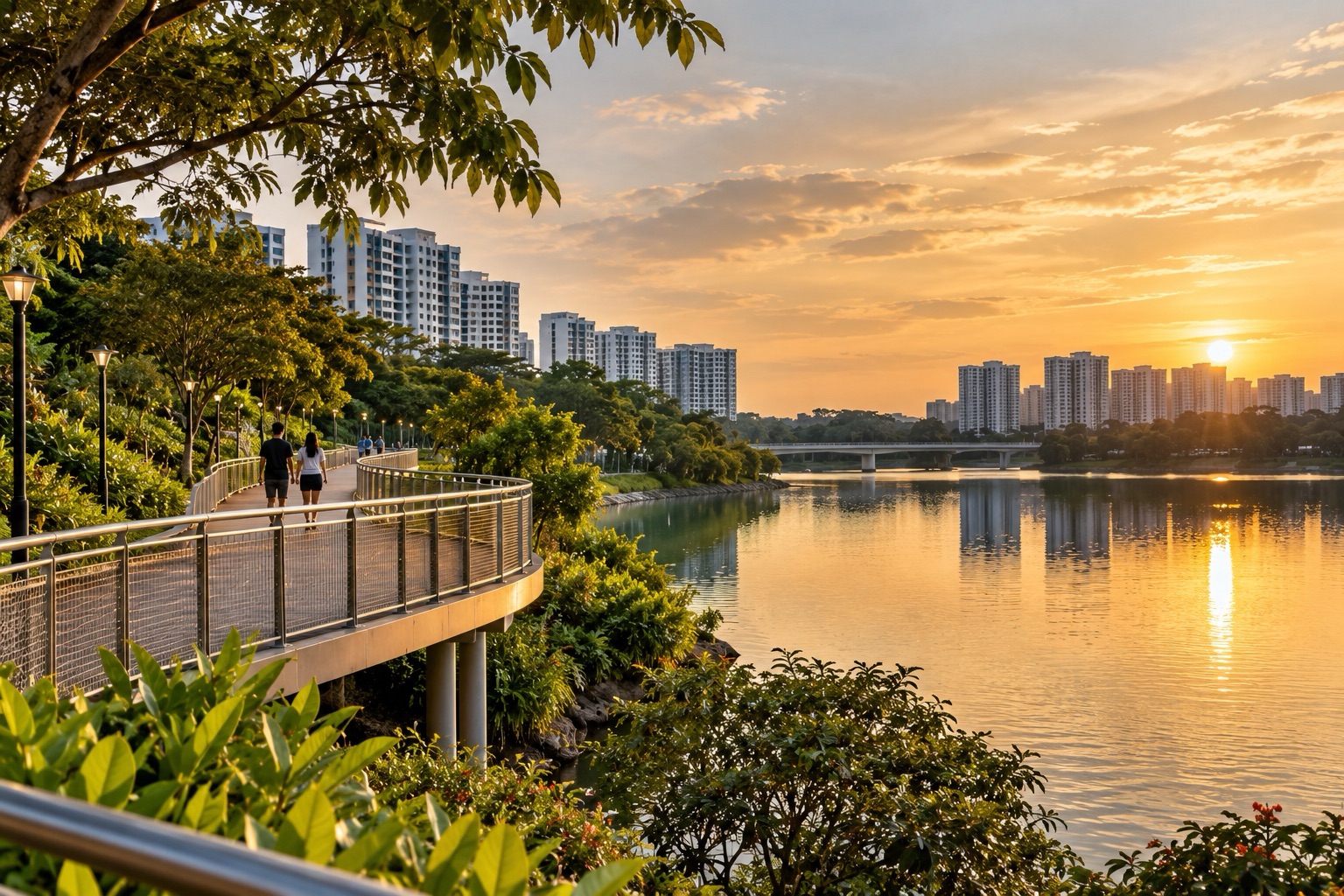
Punggol’s waterfront paths, viewing decks and park connectors invite families to walk, run, cycle and look across the Waterway. If a boardwalk-style surface feels loose, has a raised edge or shows a widening gap, treat it as a maintenance issue rather than testing how much weight it can hold. Step away from the questionable section, guide children and other users towards a safe alternative where practical, and report the exact place. Do not pry up a panel or stand over water to photograph its underside.
A deck or boardwalk can be built from different materials and details, including timber, composite, concrete or other engineered surfaces. Not every waterfront path in Punggol is a timber plank structure, and a line or joint in its surface is not automatically a defect. What matters to an ordinary visitor is the observable condition: unexpected movement, a protruding fixing, an opening that could trap a wheel or foot, splintering, slippery algae or a section that appears damaged. A qualified operator must establish whether it is hazardous and how to repair it.
This guide explains how to identify and report an unsafe deck-like walking surface at Punggol Waterway Park, a park connector, promenade or another publicly accessible facility, without confusing NParks, Town Council, LTA and private property responsibilities. It connects immediate safety, accessibility, nature protection, good evidence and follow-up in one practical sequence. It is not a survey of a particular location, a certification of any bridge or a claim that an existing Punggol boardwalk is currently damaged.
The safe answer in one minute
- Stop walking or riding over any section that appears loose, unstable, sharply raised or visibly broken.
- Do not stamp on a plank, shake a handrail or jump on the deck to check its strength.
- Keep children, strollers, wheelchair wheels and bicycles away from a gap, protruding fixing or potentially collapsing edge.
- Choose a safe, lawful alternative route; do not enter a closed or fenced part of a park.
- Identify the precise spot using a named park, bridge approach, entrance, junction, distinctive landmark and direction of travel.
- Report a park or park-connector concern through NParks or OneService as appropriate; contact the immediate responsible operator for urgent hazards.
- Photograph only from stable, safe ground and never lean over water or stand on a suspect panel.
- Retain the case reference and provide further observations if the condition worsens or an authorised closure appears.
1. What is a boardwalk or deck-like path?
A boardwalk is a defined walking surface that can help people traverse a landscape, wetland or waterfront. Its visible upper surface may be made from boards or panels supported by underlying structure. Some paths that look like boardwalks from a distance are actually solid constructed promenades, and some pedestrian bridges use engineered deck panels that resemble planks. The name alone tells you little about the loading design.
To a visitor, the meaningful questions are whether the surface stays stable under normal use, whether joints and edges are finished safely, and whether it connects to an authorised route. The operator and a competent contractor determine the actual construction and permitted load. Do not assume a wooden-looking panel is rotten, or that a concrete-looking deck cannot shift.
2. Why Punggol’s waterfront makes this relevant
NParks describes Punggol Waterway Park as a park along Sentul Crescent with four thematic areas and connections to nearby park connectors. Its visitor information lists both wheelchair-accessible and elderly-friendly features in the park. Families may combine several types of walking surface on a single outing, from ordinary footpaths and bridges to viewing areas and sheltered links.
The Punggol Waterway Park Connector is a separate named route running alongside the Waterway. A defect on one exact bridge or promenade section cannot responsibly be attributed to the whole 8.4-kilometre connector. When reporting, the precise location matters more than a general label such as ‘somewhere by the river’.
3. How to distinguish a joint from a defect
Engineered walking surfaces may contain regular joints, gaps and changes in material for drainage, movement or assembly. They are not necessarily broken. A genuine concern may involve one edge rising unexpectedly, a plank moving abnormally, a missing fixing, an exposed sharp bracket or a gap visibly different from neighbouring panels. Residents can report these observations without diagnosing what caused them.
A photo of a regular joint by itself does not establish a design failure. Compare the surrounding pattern from a safe viewing position, not by inserting a finger or tool into an opening. If the surface appears hazardous to a stroller or pedestrian, a professional inspection is appropriate even when a person does not know whether the detail is officially called a plank, cover, joint or nosing.
4. Why an unexpectedly raised edge is hazardous
A small vertical step can catch the toe of a shoe, the small wheel of a trolley or the front caster of a wheelchair. It may be more difficult to see when the sun is low, shadows cross the deck or rain darkens the surface. The severity depends on the geometry, setting and people using it, none of which can be established from one distant photograph.
A raised edge does not require a complete collapse to pose a problem. On a busy promenade, someone may be looking at a view rather than directly down, and cyclists may approach faster than walkers. Report the protrusion rather than waiting for an accident. Avoid telling others that the entire bridge is structurally unsafe unless the responsible operator has confirmed that.
5. Loose boards are not safe experiments
Visitors sometimes test a suspicious surface by stamping on it, bouncing or trying to lever up a corner. That is unhelpful and may be dangerous. If a board or panel really is inadequately supported, applying extra force could worsen it. If it is secure, the experiment still risks damaging public property. An unstable surface does not need to be demonstrated through deliberate loading to justify a report.
Describe any movement that was noticed during ordinary use, without asking another person to reproduce it. For example, ‘one panel shifted under my shoe while I was walking normally’ is a useful observation. Do not repeat the test for a better video. Leave the detailed assessment of fasteners, bearings, support elements and acceptable movement to the maintenance team.
6. Splinters and exposed metal edges
On an older or weathered surface, raised fibres, broken cladding, protruding screws or exposed metal can cause cuts. Do not touch or attempt to bend down a sharp edge. The correct response is to keep away and describe its approximate position. A person with sandals, bare arms or a child resting a hand on a railing may encounter hazards differently from someone wearing closed shoes.
A photograph can show the location without direct contact. Maintenance personnel should determine whether the repair needs removal, replacement, fastening or protective isolation. A resident should not try to smooth a public deck using sandpaper or sealant because that could change the surface properties or conceal the underlying defect.
7. When a gap is wide enough to trap wheels
Even where an opening is not a structural danger, a wheel can turn sideways or become trapped. Wheelchair casters, stroller wheels, scooter wheels and narrow bicycle tyres have different dimensions and may react differently to a gap. A gap across the direction of travel is not the same as a shallow joint aligned with it. People should not experiment with real mobility aids on a suspect opening.
If the path seems difficult for one user, do not assume every visitor can simply lift their equipment over it. Seek another accessible route when available and explain the access impact in the report. The actual design should be assessed under the applicable standards by the responsible operator, not through a public guess about millimetres.
8. Slippery algae is different from a broken panel
A surface near water can become slippery when algae, organic growth, standing water or leaves accumulate. That problem may involve cleaning, drainage or surface treatment rather than structural repair. A plank can be stable but slippery; another can be dry yet loose. The distinction helps the operator send the correct maintenance team and decide whether temporary warnings or closures are needed.
Do not pour household bleach, soap or other chemicals onto a public boardwalk to kill green growth. Chemicals could enter a waterway and affect plants or animals. Public park maintenance belongs to the managing agency, which can decide how to clean surfaces safely and protect the environment.
9. Rain, shade and changing visibility
Rain may obscure joints, reduce traction and collect in depressions. In Punggol’s open waterfront landscape, sun angle and shade can also make a deck edge harder to distinguish. A problem that seems obvious at noon may be difficult to see at dusk. This is why the report should include the time and conditions in which the hazard was observed.
The presence of a wet boardwalk does not prove inadequate drainage. A visitor should report the effect, such as persistent ponding at a loose joint or a slippery patch where people step off a bridge. A competent operator can investigate the construction and drainage rather than guessing that one rainfall caused a newly seen defect.
10. How to avoid a fall when you notice trouble
Slow down before the damaged-looking section and move to a safe stopping point. If pushing a stroller, do not lift it over a gap while standing at an unprotected edge. If cycling, dismount where appropriate and follow the posted route rules. If the safe route is blocked, turn back or use an official diversion rather than crossing a fragile-looking section.
Do not stand at the lip of a deck to warn every passer-by if that puts you at risk. A calm verbal warning from a stable location may help while you contact the operator. Permanent barriers, repair notices and closures must be arranged by the responsible party. Residents should not improvise a barrier that obstructs emergency access or becomes another trip hazard.
11. The boundary between a park path and a bridge
A waterfront outing may pass over several different types of infrastructure: park path, public bridge, road crossing, residential linkway, mall entrance and private promenade. The managing agency can change at those boundaries. A boardwalk-like deck in a publicly accessible development is not necessarily maintained by NParks, even if it connects to a park.
Identify exactly which side of a bridge or entrance contains the problem. A photograph including the approach sign or adjacent fixed structure helps route the report. The aim is not for a visitor to interpret land ownership documents; it is to provide sufficient location information for the right operator to establish responsibility.
12. NParks and the Park Connector Network
NParks’ official Contact Us page provides a feedback route for parks, greenery and related matters. The PCN website lists named connectors and their visitor information. A suspected defect inside a park or connector is reasonably reported through the appropriate NParks channel when its ownership is known or likely.
Check NParks’ noticeboard and any onsite signs for temporary closures. The absence of an online notice is not permission to ignore a taped-off area, and a closure in another part of Singapore is not evidence of a current Punggol problem. Local signs and the actual site condition must guide safe movement.
13. Where OneService fits
The OneService App and chatbot can route municipal reports involving damaged facilities and walkways. Its official FAQ asks for the issue, a photograph, exact location, date and contact details. This is useful when a person cannot establish whether a particular deck belongs to NParks, a Town Council or another public operator.
The app is not an emergency rescue service and should not delay direct reporting of an immediate danger. Its function is to create a location-specific record that can be forwarded for assessment. If a case is complex or already reported, retain the reference and use the follow-up process rather than uploading many conflicting reports with different location descriptions.
14. Immediate hazards versus routine maintenance
A faded surface finish may warrant ordinary feedback, while a missing panel, a large opening, a detached rail or an apparent risk of falling into water deserves much more urgent attention. The urgency depends on consequences and the ability of visitors to avoid the feature. A damaged-looking strip in a busy accessible route may deserve quick action even if there is no visible collapse.
OneService’s guidance distinguishes ordinary reporting from urgent safety hazards. It advises contacting the relevant agency directly for immediate danger. LTA is named for immediate trip hazards on its public footpaths, with Town Councils handling the relevant HDB estate footpaths. A park or connector issue should be directed to its actual responsible operator. If someone is injured or in imminent peril, seek emergency assistance.
15. What to include in a good waterfront report
A maintenance team needs a position that can be found. Write the named park or connector, the nearest official entrance or landmark, which direction you were travelling, and whether the damage is on a bridge, deck, bench platform or footpath. If possible, mention a nearby sign or distinctive railing. Avoid invented coordinates or assuming a bridge name from a tourist map without verification.
Describe the visible problem separately from your interpretation: ‘one deck edge rises and a screw protrudes’ is stronger than ‘the bridge foundation has failed’. Include the date, approximate time and conditions. Explain the risk to children, mobility-aid users or cyclists if it is directly relevant. A safe context photograph can greatly improve the report.
16. Why a close-up photo can be misleading
A tightly cropped image of one gap or board can hide the fact that the rest of the surface is regular or that the apparent defect is a deliberate joint. A wider photograph showing the walking direction and two nearby fixed features helps an operator find the right location. A close-up can be added only if it is safe and genuinely clarifies the issue.
Do not lean past railings, stand on questionable panels or move a loose component to get a better angle. OneService’s reporting FAQ explicitly allows a general surroundings photograph where the hazard itself cannot be safely photographed. This is especially useful for a suspected gap over water.
17. How to use a map without inventing a location
An online map can help identify the closest park entrance, crossing or connecting route. However, a pin may fall on the wrong side of a waterway or a parallel path. Use text to specify the side, direction, level and nearest fixed landmark. A second person’s description can be useful, but do not circulate an unverified location as an official closure.
Keep maps separate from engineering facts. A satellite image shows a layout at the time it was captured, not the current safety condition or the material beneath a deck. An old street-view photograph does not prove a plank is still present or has been repaired. A maintenance report is strongest when it combines a current observation with reliable location data.
18. What if a cyclist approaches from behind?
A person who notices a defect may worry that a cyclist will encounter it at speed. The safest action is to move out of the travel line and warn calmly without stepping into the cyclist’s path. Riders should slow near pedestrians, shared crossings and uncertain surfaces. A damaged section may justify dismounting or taking another permitted route.
Do not place a bicycle across the path as a warning barrier. That may create a new obstruction and make it impossible for wheelchair users to pass. Inform the appropriate operator and allow its staff to decide on cones, signage, isolation or other controls. Hazard management should not depend on one visitor remaining beside the problem.
19. A family with a stroller
A caregiver approaching a waterfront viewing deck sees a panel edge lifting where a small stroller wheel would cross. Rather than pushing forward to test whether the wheel fits, the adult turns to a stable approach and chooses a different authorised route. The caregiver records the landmark and reports the edge condition from safe ground.
This example illustrates the difference between a route being theoretically accessible and remaining usable through maintenance. A stroller or wheelchair may be unable to negotiate a narrow hazard that an adult walking alone can step over. A public report should describe that real access impact without implying every user has identical mobility.
20. A person using a wheelchair
NParks describes Punggol Waterway Park as wheelchair accessible, but that does not certify every metre of every route at every moment. Surface damage, temporary works or debris can interrupt a useful journey. If a wheelchair user finds a gap, raised edge or unstable deck, it should be reported as both maintenance and accessibility information.
Do not assume someone can simply lift a wheelchair or be carried over a barrier. Ask the person what assistance they prefer and check for a safe route; their agency matters. If no accessible route is available, explain that in the report and seek help from the facility operator. Improvised physical lifting can cause injury to both the user and helpers.
21. A senior walking at dusk
An older resident may rely on a handrail and visual contrast to judge deck edges. A raised panel near a railing can be difficult to perceive when the light is low, particularly after rain. The resident should not continue across a suspected unstable surface merely because it is a familiar shortcut. A safer, longer path may be the right choice.
A companion can note the exact area and report the defect, but should not pull on the railing to ‘check’ it or ask the senior to demonstrate the trip risk. Technical inspection can assess surface and handrail conditions together where appropriate. Good public maintenance is about preventing injury, not waiting for someone to fall.
22. A school group’s observation walk
A group of students exploring the Waterway may encounter a damaged-looking section. The adult supervising the group should keep everyone on stable authorised paths and record the position without gathering children around the hazard. A nature or geography lesson does not justify stepping into a restricted area for closer observation.
Students can still learn the difference between direct evidence and interpretation. ‘A panel is missing and the edge is open’ is a direct observation; ‘the water caused a structural failure’ is a hypothesis requiring professional evidence. That distinction applies to Science, local history and community reporting.
23. A loose-looking railing near the edge
A handrail or guardrail protects against falls at certain edges. A visibly detached section, broken bracket or panel missing near water is more serious than a cosmetic scratch. Keep back and notify the responsible operator urgently. Do not lean or put weight on the railing to confirm its strength, and do not assume that another nearby section of rail will support you.
A deck problem and a handrail problem may require different trades but can be related to the same site. Describe both if observed. A technician can inspect supports and connections safely. The visitor’s role is to keep clear and make the location unmistakable.
24. Children and the temptation to jump on planks
Decking and bridges can make interesting sounds under footsteps. Some children may turn that into a game of jumping on panels. Explain that public walkways are designed for ordinary use, and deliberate impacts on a questionable surface are unsafe. A child who notices a loose edge should tell an adult rather than investigate it with a stick.
Parents can also teach children not to drop stones or objects through gaps into the water. A loose fastener or small broken panel is not a souvenir to remove. The wider lesson is stewardship: shared spaces remain safe when users report defects without damaging the infrastructure or disturbing the environment.
25. Why repairs may require a closure
Replacing a deck panel can involve access from below, lifting equipment, curing materials or checks of supporting structure. A seemingly small problem can therefore require the operator to close a section temporarily. The closure may frustrate walkers, but a controlled repair is safer than allowing visitors to use a partially dismantled path.
Follow barriers and published diversions. Do not step around a fence to confirm whether repairs look finished. NParks’ noticeboard demonstrates that walkway and boardwalk closures are used when work is necessary, though a closure notice elsewhere in Singapore does not establish one in Punggol. The responsible operator determines when the exact route can reopen.
26. How to tell whether a route is officially closed
Look for current onsite signs, physical barriers and information from the relevant park or facility operator. Cross-check a posted closure with an official channel if the sign seems unclear, rather than assuming a social-media photograph is current. A route may be closed for maintenance, a special event, an emergency or a separate environmental reason.
Do not infer an exact reopening time from an unrelated project’s announcement. If a traveller needs the route for a daily commute, plan an alternative based on confirmed access and allow extra time. A useful local guide should distinguish what is officially closed from what is only suspected to be unsafe.
27. Do not confuse routine movement with instability
Some bridges and decking systems can show a small amount of normal movement under use, while others are designed to feel rigid. The acceptable behaviour is a professional design question, not a rule that every surface must feel perfectly still. A person should report new or unusual movement, especially when associated with visible damage or an unexpected gap.
Do not label ordinary bridge expansion joints as a failing plank based on an online photo. Equally, do not dismiss an observed shift solely because a neighbour says the structure has always moved. Record what happened, and let the operator assess it in the context of the actual construction.
28. Surface repairs and structural repairs are different
A detached surface strip may be a finishing problem, while the loss of underlying support can be more significant. Both can produce an uneven walking edge. A public visitor normally cannot see the entire assembly, so it is not reasonable to select a repair method from the surface alone.
Qualified maintenance teams may need to inspect fixings, panel condition, supports and nearby drainage before deciding what to replace. A superficial patch can conceal a serious fault, and an unnecessarily large repair may waste resources. A factual report allows the operator to choose the right assessment rather than presuming a solution.
29. Why environmental care belongs in the response
Near the Waterway, discarded repair materials, chemicals or debris can enter the water or surrounding vegetation. That is one reason residents should not undertake DIY public-boardwalk repairs. A repair contractor may need controls to prevent loose fasteners, timber fragments or construction waste falling into sensitive areas.
Visitors can help by staying on authorised routes and not moving barriers, plants or wildlife. A maintenance concern should be reported to the correct operator, which can arrange environmental precautions alongside public safety. Caring for the landscape and caring for the walkway are compatible goals.
30. What if somebody has already been injured?
Safety and medical care take priority over photographs. Do not move an injured person unnecessarily if serious harm is suspected, and follow emergency advice based on the condition. Call 995 when a genuine medical or rescue emergency exists. Provide the location as precisely as possible, including park access points and distinctive landmarks so responders do not search along the wrong shore.
After urgent needs are addressed, an incident record can document the observed condition and any available witnesses. Avoid uploading personal medical details or identifiable images of a casualty online. The responsible operator can investigate the facility, while medical professionals and authorities deal with the injury or emergency.
31. How to follow up without making duplicate confusion
OneService’s app allows residents to track cases and agency replies. If the problem persists after an acknowledged report, keep the original case number and provide new facts, such as a panel now fully detached or an official barrier appearing. A new report may be appropriate for a recurring problem, with reference to the older case.
Do not assume that an acknowledgement means a repair is complete. Likewise, do not repeatedly post different speculative explanations about the same feature. The operator’s work may involve inspection, procurement or scheduling; ask for the status and known next step rather than inventing a timeline. An honest follow-up helps keep the matter actionable.
32. The difference between a park bench and a boardwalk
A bench platform or picnic deck may look similar to a walking boardwalk but has a different use. A loose bench slat, broken seat support or unstable table should not be reported as a broken bridge unless it actually lies in the walking route. The facility operator needs to know whether people are at risk while walking, sitting, leaning or entering the water.
For a damaged bench, avoid sitting or testing its load and describe the exact seat and location. For an actual path panel, explain whether it forms part of the walking surface. The distinction makes the report more useful and reduces the chance that a repair crew arrives with the wrong equipment.
33. When a temporary warning is not enough
A handwritten warning taped nearby can alert someone temporarily, but it does not repair damaged infrastructure. Visitors should not attach signs to public railings or create barriers that obstruct paths, particularly if the materials are likely to blow into the Waterway. The operator should use appropriate site controls based on a risk assessment.
If you see an unattended warning with no official contact information, treat the underlying surface cautiously and report the observed defect rather than trusting the sign as proof of safety. Do not remove an authorised notice because it seems out of date; verify with the responsible organisation.
34. A practical early-evening incident example
A family walks along a waterfront path and notices a deck panel that seems raised next to a step-free approach. They stay on the safe side and take a wider photograph showing a fixed landmark, without leaning over the edge. They use the park contact or OneService with the exact location and describe the hazard to wheelchairs, stroller wheels and pedestrians.
The family chooses an authorised alternative and does not claim the whole Punggol Waterway route is closed. If the operator later confirms a temporary repair closure, they can update their own journey plan. The example illustrates how ordinary observation, accurate language and respectful reporting can lead to better maintenance information.
35. How the report should sound
A concise report could read: ‘At [named park or connector], approximately [landmark] metres after [verified entrance] heading towards [direction], one deck panel appears raised with a visible exposed fixing. I observed it at [time/date]. I did not test it. It may catch a small wheel or shoe. Please inspect and advise if the section needs temporary isolation.’ Replace placeholders only with observations you can substantiate.
Do not report invented lengths, load capacity or materials. If the exact distance is unknown, use two reliable landmarks instead. An operator can find a place from a named bridge approach and direction far more easily than from an unsupported technical theory. The goal is to enable inspection, not to publish a dramatic accusation.
36. Make Punggol outings safer without giving up the park
A single reported defect should not lead people to believe all waterfront routes are dangerous. Punggol Waterway Park and nearby connectors remain valuable places for walking, nature appreciation and family recreation. Safety comes from using open authorised areas, respecting temporary closures and reporting genuine problems early.
For a future visit, check the weather, any official NParks notices and the accessibility needs of the people travelling with you. Carry drinking water, use suitable footwear and plan rest stops. Those ordinary preparations complement a responsible response to a damaged deck; they do not replace the duty of the infrastructure owner to maintain it.
Five useful reporting details in a single glance
- Name the actual park, connector, promenade or private development.
- Identify the closest verified entrance, bridge, junction or permanent landmark.
- Record exactly what the surface did or looked like without testing it.
- Explain whether the concern affects a main path, viewing deck, bridge or separate seating platform.
- Note the date, time, weather and any visible warning or barrier.
- Include an overview photograph from stable ground where it is safe and permissible.
- State whether children, cyclists or mobility-aid users may be affected by the observable gap or edge.
- Contact the responsible operator and keep the reference for any follow-up.
Frequently asked questions
Does every line in a boardwalk mean it is damaged?
No. Regular joints and gaps may be part of a designed installation. Report unusual movement, raised edges, missing panels, protruding hardware or other hazards, and let the responsible operator assess the actual construction.
Can I step on a suspicious plank once to prove the problem?
Do not deliberately load a section that appears unstable. A description and safe photograph are enough to justify a maintenance report. Repeated testing can create danger or further damage.
Who maintains the Punggol Waterway Park Connector?
NParks publishes the official park-connector information and provides park and greenery feedback channels. The specific operator may vary where a route intersects other infrastructure, so give the exact location and use OneService if responsibility is uncertain.
Should I use OneService or call NParks?
OneService is useful for non-urgent municipal reports and routing. Direct NParks or the actual facility operator is appropriate when the location is clear, particularly for urgent access concerns. Use emergency services if someone is in immediate danger.
What if the route is signed as closed but my app says open?
Follow the actual authorised closure, not a map or old photograph. Check the relevant official notice and seek a legal alternative. Do not move barriers or enter a repair site.
Is a raised deck board a structural failure?
Not necessarily. It can be a surface, fixing, movement or supporting-structure issue. Only a competent assessment can determine the cause and seriousness. Report the observed hazard without diagnosing it.
Can I screw down or tape a loose panel myself?
No. Do not modify public infrastructure without permission and professional assessment. A makeshift repair can hide a problem or create a new trip hazard.
Does wheelchair-accessible mean every section is safe all the time?
No. An accessibility listing describes the route or facility generally, not every component’s condition at all times. Temporary works or damage can interrupt access, so report the specific obstacle and seek a suitable alternative.
What should cyclists do when a plank is loose?
Slow down, dismount if necessary and avoid the suspect section. Do not swerve into pedestrians or traffic. Follow path rules and official diversions.
Can I photograph the underside from over the railing?
Do not lean over water or stand on an unstable edge for evidence. A context photo from safe ground and a precise location description are more useful and much safer.
What if a person trips or falls?
Attend to safety and urgent medical needs, call 995 where necessary, and give a precise access location. Do not prioritise filming or moving a seriously injured person without suitable advice.
Should I post the defect in a neighbourhood chat?
A private alert may help people avoid an obvious danger, but it does not replace an official report. Avoid speculative claims, identifiable images of injured people and statements that an entire park is closed without confirmation.
How do I track whether a report was resolved?
Keep the OneService or operator case number. Check the reported status and provide updated factual observations if the hazard remains or reappears. An acknowledgement is not necessarily evidence of a completed repair.
What if the damaged-looking panel is inside a condominium?
Contact the development’s MCST or managing agent. Public access to an area does not always mean NParks owns the structure. Keep the location and ownership questions separate from the immediate safety concern.
Official sources and related Punggol guides
- NParks — Punggol Waterway Park Visitor Information
- NParks — Punggol Waterway Park Connector
- NParks — Parks and Greenery Feedback
- NParks — Notices and Temporary Closures
- OneService — Municipal Feedback for Damaged Facilities
- OneService — Case Submission, Tracking and Urgent Reporting
- OneService — Maintenance of Damaged Footpaths
- eduKate Punggol — Loose Handrails and Edge Strip Safety
- eduKate Punggol — Complete Local Information
Reviewed 6 November 2026. This general guide does not identify a current structural defect in Punggol or certify a boardwalk. For a specific concern, report safely, follow any posted closure and obtain direction from the responsible operator. Emergency rescue and medical advice take priority over routine maintenance reports.


