
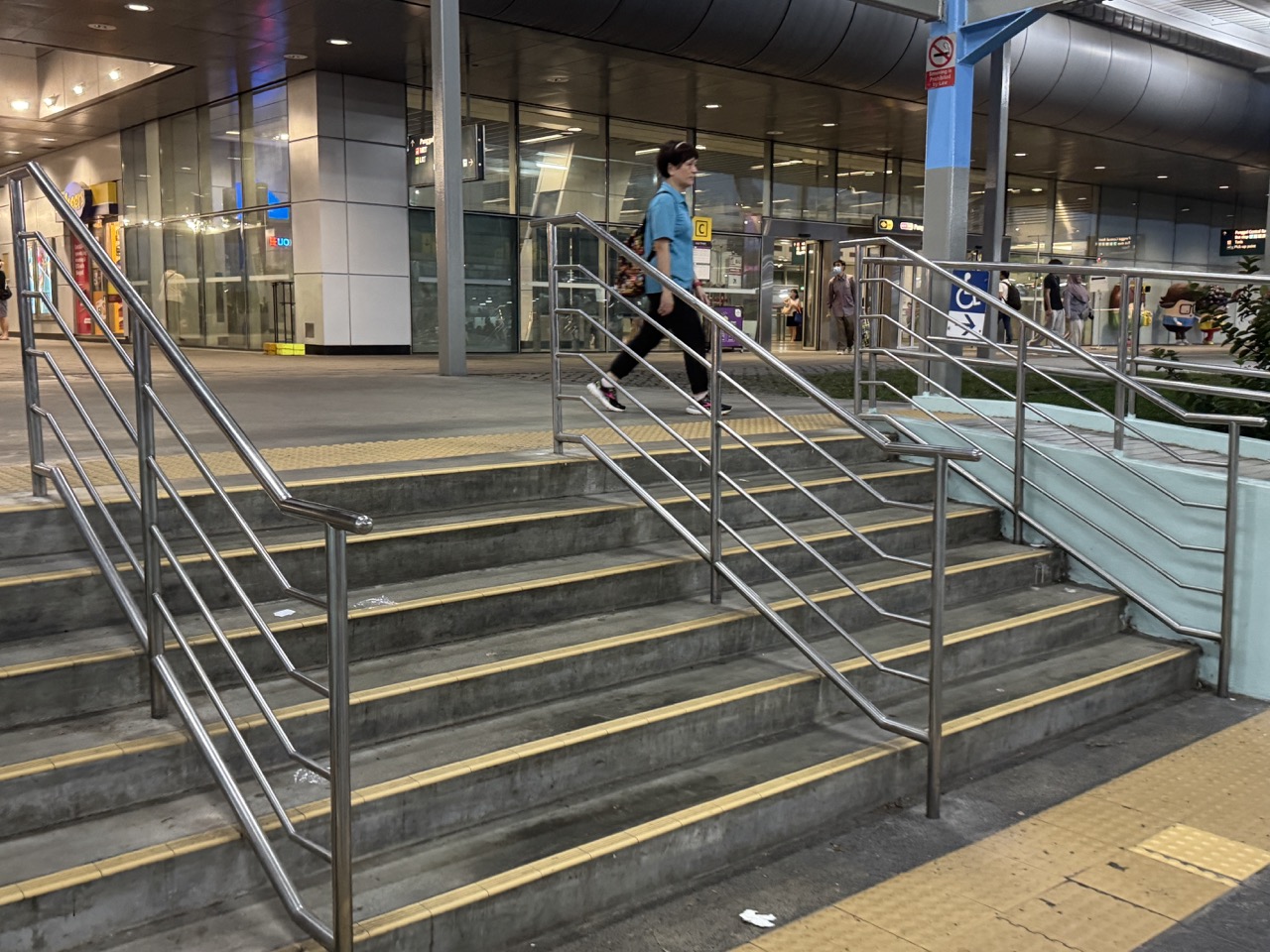
A staircase in Punggol can look ordinary until a narrow edge strip starts peeling away or a handrail feels loose. These details matter because they help people see where each step ends, maintain grip and move safely between floors. A detached stair strip can itself become a trip hazard. An unstable handrail can fail just when a person needs it most. The right response is to avoid the damaged part, keep others from relying on it where safe to do so, and report the exact location.
Singapore’s Building and Construction Authority describes stairway safety as part of accessible building design. Its Code on Accessibility in the Built Environment includes principles for step-edge definition, tactile warnings and handrails in relevant settings, although requirements depend on the applicable code edition and whether the works are new or alterations to an existing building. A coloured strip is not proof of compliance, and a public article cannot certify a particular staircase’s safety.
This guide focuses on Punggol HDB stairwells, sheltered links, public facilities and comparable residential common areas. It shows what residents should notice, why wetness and poor lighting can increase risk, how to describe a loose rail or defective nosing, and which manager should receive a report. It does not teach residents to modify common staircases or attach improvised anti-slip tape to shared property.
The important points
- A stair edge strip, sometimes called a stair nosing strip, can provide visual contrast and a more secure tread edge when correctly specified and installed.
- Handrails offer support, but only when they are firmly attached and positioned appropriately.
- Loose edges, worn surfaces, protruding screws, unstable handrails and wet steps should be treated as maintenance issues.
- If a stairway feels unsafe, choose a safe alternative such as another staircase or operating lift.
- Do not pull on a loose rail to test its strength or tug at a peeling strip.
- Report common-area defects through the relevant Town Council, facility operator, MCST or OneService.
- During a fire or evacuation, follow the building’s emergency instructions; do not assume an ordinary lift is an authorised alternative.
1. What is the edge of a stair tread?
A stair has horizontal surfaces called treads and vertical faces called risers. The front edge of a tread is especially important because a person must recognise it before transferring weight. Some staircases use a strip or defined nosing at this edge to make the change of level easier to see and, where appropriately designed, improve footing.
The issue is not only colour. A high-contrast edge can make step boundaries easier to recognise for people with reduced vision or in uneven light. A non-slip surface may contribute to stability. Different floors and environments require different designs; a thin adhesive strip installed badly can curl and create a new problem.
BCA’s Code on Accessibility explains why safety and usability must be considered together. Do not assume every Singapore staircase is governed by identical provisions or that a strip must look exactly like the one at a neighbouring MRT station.
2. How handrails help
A well-designed handrail gives users something they can grip or touch for orientation and support. It can help people adjust their balance, steady themselves on stairs or identify the path of travel. The design needs to account for height, grip, continuity, clearance and how the rail ends so clothes or bags do not catch.
Some people use handrails only occasionally. Others depend on them almost every time, including residents with mobility limitations, people recovering from injury and seniors. A rail that looks secure but shifts under normal use is a concern because it may give a false sense of support.
Handrails must be assessed as installed components: the visible rail, its brackets, fasteners and the surface supporting it all matter. Residents should not attempt to tighten common-area screws, weld damaged brackets or tape a broken segment back into place. The repair belongs to the responsible operator and qualified contractor.
3. Why wet weather changes a familiar staircase
Punggol’s tropical rain can leave exposed or partly sheltered stairs damp. Footwear may carry water indoors after a sudden shower, and leaves or other debris can accumulate near steps. A normally manageable surface can become more slippery when wet or contaminated. An uneven edge strip may become harder to see when the surface reflects light.
Do not take photographs while leaning across a wet stairwell or standing near a drop. If the route appears unsafe, avoid it. A report can describe visible water, a loose metal strip or an unstable handrail without anyone having to demonstrate the hazard.
The practical question is whether users can identify each step clearly and rely on the normal handrail. A housekeeping task may resolve water or debris, while a structural or hardware fault requires maintenance. Both should be reported accurately.
4. The difference between a safety strip and decorative tape
Coloured tape used for temporary directions or events is not necessarily an approved anti-slip stair-edge product. A properly specified and installed stair nosing has to remain secure under foot traffic and be suitable for the surface and environment. A peeling edge can catch shoes and wheels or become slippery itself.
A resident may think the quickest solution is to buy a roll of adhesive tape and cover the loose strip. In a common stairwell this is not appropriate without authorisation, technical suitability and proper installation. Poor repairs can make the hazard less visible while leaving the cause unaddressed.
The operator should decide whether a part needs repair, replacement, cleaning or a broader review of the stair surface. An appearance that matches a photograph online is not a sufficient test of safety.
5. What an unsafe handrail can look like
- A bracket visibly separating from the wall or post.
- A rail that moves during ordinary, light contact.
- An exposed sharp end, broken joint or protruding fastener.
- Rust staining or cracking around an attachment point that may require inspection.
- A missing section in a location where support should be continuous.
- A handrail that appears damaged following renovation or impact.
- An obstruction preventing people from reaching or gripping the rail.
These are observations, not a diagnosis of the material or the cause. Rust colour may have different sources; movement may have different explanations. A professional must determine whether the rail needs immediate isolation, repair or replacement.
6. Report an issue without creating a second hazard
- Identify the building, HDB block or facility, and the precise staircase location.
- Specify the level and whether the fault is near the first step, the landing or a particular flight.
- Describe what is visible: ‘yellow stair-edge strip peeling up on Level 3 landing’ is more useful than ‘stairs unsafe’.
- Note any related condition such as rainwater, poor lighting, loose screws or an obstructed route.
- Take a photograph only from a secure, safe position. Do not lean across stairs for a close-up.
- State the likely impact on people, such as a trip risk to seniors or children, without making unsupported claims about an injury.
- Send the report to the appropriate building operator or OneService, and save the reference number.
OneService’s app and chatbot allow residents to report municipal issues. Its public FAQs explain that a detailed description, photograph and precise location help cases reach the right agency or Town Council. If an issue is urgent, contact the responsible agency directly rather than relying only on a routine feedback queue.
7. HDB stairs, MRT stairs and condominium stairs are not the same
HDB common staircase
For an HDB block, common staircases are part of the estate-maintenance environment. Use the current Town Council or building management contact for the relevant block. Report the exact staircase, floor and defect. Do not assume the operator knows which of several staircases you mean.
MRT or LRT station
Stairs inside Punggol transport facilities are managed through the relevant transport operator. Alert station staff or use the station’s official reporting channel. Staff may need to isolate the area or arrange a safe alternative route.
Shopping centre or community building
A mall, community facility or school can have its own maintenance team and safety process. Use onsite staff or the stated help desk. Avoid assuming that the nearest residential Town Council manages the staircase.
Condominium common area
Notify the managing agent or MCST. If the staircase is part of common property, an individual resident should not authorise a modification or choose materials without the required approval.
8. Why a small defect can matter to a senior
An older resident carrying groceries may depend on a handrail to maintain balance. If the rail suddenly moves, the resident can be put at risk even without a visibly dramatic break. Similarly, someone with reduced vision may rely on the distinction between tread edges to judge a staircase accurately.
Family members should not pressure a person with limited mobility to use a questionable stairway simply to save time. If another safe route is available, use it. If the only accessible route is affected, make that specific access problem clear to the operator.
Some residents may require additional assistance for essential journeys. The building manager can help clarify the available facilities, while urgent medical or life-safety situations require the appropriate emergency response. An article cannot promise that every Punggol block has an accessible backup route.
9. Why a child might miss a loose stair strip
Children often move quickly between school, home and activities. A thin edge lifting away from a step can catch a shoe during a hurried descent. Parents can teach children to use handrails sensibly, watch where they step and tell an adult if a strip or railing appears damaged.
The correct lesson is not to invite children to test how much weight the rail can hold. It is to understand why the detail matters and how reporting protects the next user. A child’s observation can be useful, but an adult should handle a dangerous inspection or report.
10. What BCA’s accessibility framework does—and does not—tell us
BCA says the Code on Accessibility sets baseline requirements for accessibility in new buildings and relevant additions and alterations. The currently listed edition is the 2025 Code. Historic installations may be governed by different requirements depending on when the works were approved.
That means a resident should not compare a decades-old stairwell directly with a diagram for new work and declare it illegal. A responsible report focuses on the condition actually observed. If a formal compliance question arises, the building owner or appropriate qualified professional should review the applicable requirements.
In practical terms, sound construction and maintenance matter just as much as design. Even a properly designed handrail becomes a problem if its mounting loosens and nobody reports it.
11. The link between lighting and step visibility
Step edges are easier to perceive when lighting is adequate and visual contrast is maintained. A dark stairway may hide a change in level, while glare from a reflective surface can also make the edge harder to read. Both conditions can add to the risk presented by worn strips or damaged treads.
If lights have failed, include that information in your report. The lighting fault and the defective strip may have different maintenance work orders, but they affect the same user’s experience. Treat each observed defect accurately rather than turning it into a claim that the whole building is unsafe.
12. A Punggol example: a strip peels away after rain
A resident walking down a sheltered staircase sees that a strip on the second step has lifted at one corner. The stairs are damp from rain. The resident avoids the loose section, chooses a safe alternative and reports the exact staircase and floor, with a photograph taken from the landing. They do not press the strip back with a foot or cover it with office tape.
The building’s maintenance team can determine the appropriate work. This example shows the value of a precise problem description: the operator can find the affected step without requiring the person who reported it to stand on the hazard.
13. Another example: the rail shifts when a senior touches it
A senior notices unusual movement in a wall-mounted rail while beginning to climb. The resident stops relying on that rail, uses a safe alternative and alerts estate management. A relative reports the exact bracket and stair flight from a safe viewpoint. The maintenance response can then focus on the attachment and surrounding structure.
It would be unhelpful to dismiss the concern because the rail appears intact from a distance. The real issue is whether the system is safe to use, which needs appropriate assessment.
14. Common mistakes to avoid
- Pulling on a loose railing to test its strength.
- Standing on a raised stair strip to press it back into place.
- Installing makeshift tape or bolts on common property without permission.
- Photographing a defect from an unsafe edge or while descending wet stairs.
- Describing every damaged strip as a structural failure without evidence.
- Assuming that an operating lift is always an authorised alternative during a fire.
- Failing to report the exact floor, staircase and direction of travel.
- Ignoring the access needs of seniors, children and people with disabilities.
Frequently asked questions
Why are some stair edges a contrasting colour?
Visual contrast can make step boundaries easier to recognise, particularly for people who have difficulty distinguishing the edge of a tread. The exact design depends on the installation and applicable requirements.
Can I replace a loose anti-slip strip myself?
Do not modify common stairs without the responsible building operator’s authorisation. Incorrect installation can create a new hazard.
Is a slightly moving handrail acceptable?
A moving or unstable handrail should be reported for professional assessment. A resident cannot establish safe performance by informal testing.
Who handles a damaged staircase in Punggol?
Contact the operator for the exact location: usually the relevant Town Council for HDB common areas, station staff for transport facilities, or the MCST or managing agent for private developments.
What should I do if the stairs are wet as well as damaged?
Avoid the risky section, choose a safe alternative, and report both the wet condition and the physical defect. Keep clear of the hazard rather than attempting repairs.
Official sources and further reading
- BCA — Code on Accessibility in the Built Environment
- OneService — App and Chatbot for Municipal Feedback
- OneService — Municipal Issues and Urgent Reports
- eduKate Punggol — How Tactile Paving Helps People Navigate
- eduKate Punggol — Local Guide
Reviewed 5 November 2026. This is a general resident guide, not an inspection or compliance determination for any particular staircase. Keep clear of damaged stairs and follow the responsible building operator’s instructions.


