
A small sign beside a toilet, stairwell, lift or public-service entrance can carry raised letters, symbols and Braille dots that help someone with visual impairment identify a destination through touch. If the sign comes loose, the dots peel away, the surface has sharp edges or an advertisement covers it, the problem is more than cosmetic. The useful first response in Punggol is to leave the sign in place, keep the route clear and report the exact location to the facility operator. Do not pull at the raised dots or replace the sign with an unverified home-printed label.
Singapore’s Building and Construction Authority (BCA) includes tactile and Braille signage in its Code on Accessibility in the Built Environment 2025. The current code explains that these signs should allow people with visual impairment to identify relevant accessible facilities, and it specifies raised characters and Braille with tactile features. The enhanced code applies to applicable new building works and additions or alterations from 1 November 2025, not retrospectively to every existing sign in every HDB block. A damaged sign and a formal building-code non-compliance finding are different matters.
- See a loose or broken sign? Do not touch sharp edges or try to stick it back; report its location.
- Is the message unreadable or covered? Describe what is blocked, missing or inconsistent.
- Check the correct operator: station staff for transport facilities, a building manager for malls and community hubs, an MCST for condominium common property, or the appropriate Town Council for HDB common areas.
- Respect privacy: report the sign, not a photograph or story about a particular person using a cane.
- Do not invent Braille: replacement text and dot arrangement must be verified by competent people.
- For a misleading floor or stair sign: report promptly because incorrect wayfinding can affect navigation and safety.
- For a temporary closure: follow authorised signs and ask staff about an accessible alternative, rather than redirecting people yourself.
- Use OneService where suitable: give the precise location, date, description and a safe photograph of the sign or its surroundings.
1. What a tactile sign actually is
A tactile sign communicates information that can be felt. It may contain raised letters or numbers, an embossed pictogram and Braille dots. Such signs can help people identify a washroom, level, stairwell or another facility without relying entirely on visual text. They work best when placed consistently and paired with a sensible route to the destination.
Tactile signage is not a substitute for clear visual signage, lighting, audible directions or safe access routes. Some people have low vision and read large print; others use touch, a white cane or personal knowledge of the building. An inclusive environment supplies complementary cues rather than assuming every person with a visual impairment navigates in the same way.
2. Braille and raised print are not the same
Braille is a system of raised dots arranged to represent letters and other characters, read through touch by people who know the system. Raised print uses conventional letters or numbers made three-dimensional. A person who does not read Braille may nevertheless use an enlarged raised number or a familiar tactile symbol. The presence of one does not necessarily satisfy every requirement for the other.
BCA’s Code on Accessibility 2025 discusses tactile signs and corresponding Braille in its Chapter 8. If a sign’s conventional lettering is raised but the Braille portion has been flattened or removed, that can reduce usefulness for some readers. Conversely, a printed series of dots that cannot be felt is not a substitute for properly raised Braille.
3. Why a damaged Braille dot matters
A sign may look perfectly legible to a sighted person even after some tactile dots have detached. Someone relying on touch, however, may find that the missing dot changes a character or makes it impossible to read. The same applies when adhesive, paint or grime fills the gaps between dots. The practical defect is not the visual neatness of the plate; it is whether the intended information can be perceived reliably.
The correct repair should restore the verified message and its tactile form, not merely make the surface attractive. A member of the public should not try to reshape dots with a pen, adhesive beads or a craft kit. Small differences in placement are meaningful, and improperly applied materials can create sharp or confusing surfaces.
4. The difference from tactile paving
Tactile paving is the textured floor surface that provides guidance or warning underfoot or through a white cane. A raised sign is a separate information source generally encountered at a hand-reachable location. One tells a traveller something about a route or hazard through the ground; the other may name a destination, level or facility. Both can support navigation, but they have different maintenance needs.
Our existing Punggol tactile paving guide discusses keeping guiding routes clear. This article is deliberately narrower: how to recognise and report problems with the sign itself. A perfectly clear guiding strip does not solve a missing Braille label at the destination, and a new Braille plate does not repair a broken floor indicator.
5. Why the location of the sign matters
A sign may contain correct information but be difficult to find because it was moved too high, hidden behind a promotional stand or installed on a door that swings away from the expected position. BCA’s accessibility code addresses positioning and tactile sign arrangements in applicable projects. A resident cannot determine formal compliance from one glance, but can accurately report that the sign is inaccessible or obscured.
When describing a problem, include whether the plate is on the wall beside the door, on a handrail extension, close to an accessible toilet entrance or attached elsewhere. Do not put your own hand into a dangerous gap to prove that a visually impaired person could not reach it. The building’s competent assessor can review the location and applicable code.
6. What BCA changed in the 2025 code
BCA announced the 2025 accessibility code with enhanced requirements taking effect for applicable new building and additions-and-alterations works from 1 November 2025. The official code includes provisions on tactile characters, Braille and accessible-facility signs. These provisions aim to make facilities easier to recognise, while allowing the applicable building context and professional assessment to determine the exact requirements.
A useful public response should avoid claiming that every HDB sign installed ten years ago immediately became illegal in November 2025. BCA’s 2025 release and current code page explain the scope. Maintenance of existing accessibility features remains important, but the actual legal standard for a particular installation must be checked against the building and works involved.
7. Raised characters should be genuinely detectable
In the current BCA code, Chapter 8 describes raised tactile characters, symbols and pictograms rather than visual simulations. It also specifies how Braille is arranged beneath text and how tactile features should be comfortable to read without sharp edges. The purpose is for users to discover and understand information through touch in a predictable way.
A sign whose raised letters have worn flat or whose label has been replaced by a purely printed sticker may no longer offer the same tactile information. Do not assume that a sighted person’s ability to read the sticker resolves the access problem. Report the actual change and ask the operator to use the appropriate approved specification when replacing the sign.
8. Why the Braille locator is useful
The 2025 code discusses a tactile locator at the left-hand side of a sign to help a Braille reader find the message. This recognises that identifying where Braille begins can be part of navigating a sign, particularly when the sign is unfamiliar or in a busy public environment. A missing locator might affect the intended usability even when the words remain correct.
This is one reason an improvised replacement label can be inferior to an approved sign. Someone may copy the visible printed text but omit the tactile arrangement that tells a user where to start. Report a damaged plate so the manager can engage an appropriate signage provider or accessibility professional rather than asking visitors to recreate the code details.
9. Signs to accessible toilets
At a relevant public toilet, a tactile sign can help someone locate a facility without relying solely on the gender symbol, colour or printed word. Accessible individual washrooms may have additional information about their intended use. A user who is unfamiliar with the building may need the sign to distinguish the correct entrance or find a usable facility.
BCA’s 2025 code contains provisions for tactile and Braille signs at specified sanitary facilities, with scope and exemptions that vary by building category. That means a resident should not claim every residential or school toilet in Singapore is subject to identical signage requirements. A damaged installed sign is still worth reporting even when the precise mandatory scope has not been assessed.
10. Signs on stair landings
A stairwell may use a raised floor number or related information so a person can identify the level by touch. This can be important when moving between multiple storeys in an unfamiliar building. A sign that says the wrong floor is more serious than a minor scratch because it can send people in the wrong direction.
If a tactile floor identification plate is loose, missing or inconsistent with the visible level label, report the exact stairwell and landing promptly. Do not remove or swap signs yourself, even if you think the numbers are obvious. The operator should verify the building’s actual floor nomenclature and the correct content before replacing the sign.
11. Lift-button Braille is a related feature
Many lifts have raised numbers or Braille on the car controls so people can select floors without relying only on visual displays. This is different from a separate wall-mounted directory plate. If tactile markings on a button are missing or the button itself is damaged, the issue may need lift-maintenance attention rather than only a signage contractor.
Do not pry a control button out of its panel or attach homemade dots to it. BCA’s accessibility code contains provisions for tactile information associated with lifts in relevant applications, while lift safety rules separately govern the functioning of lift equipment. Report the exact car identifier, affected button and symptom so the responsible team can direct the repair appropriately.
12. Transport-station wayfinding
Singapore’s LTA explains that tactile paving, Braille and embossed text are used in selected public transport environments to support wayfinding. Its inclusive transport information describes embossed text and Braille on handrails along staircases and ramps at newer train stations, as well as tactile guidance towards essential facilities.
If a Braille label on a station handrail is damaged, alert station staff instead of asking a nearby HDB maintenance contractor to repair it. A station has its own operator and safety requirements. Mention the station, entrance, platform or stairwell, direction of travel and handrail location so staff can find the sign.
13. The Punggol library and community facilities
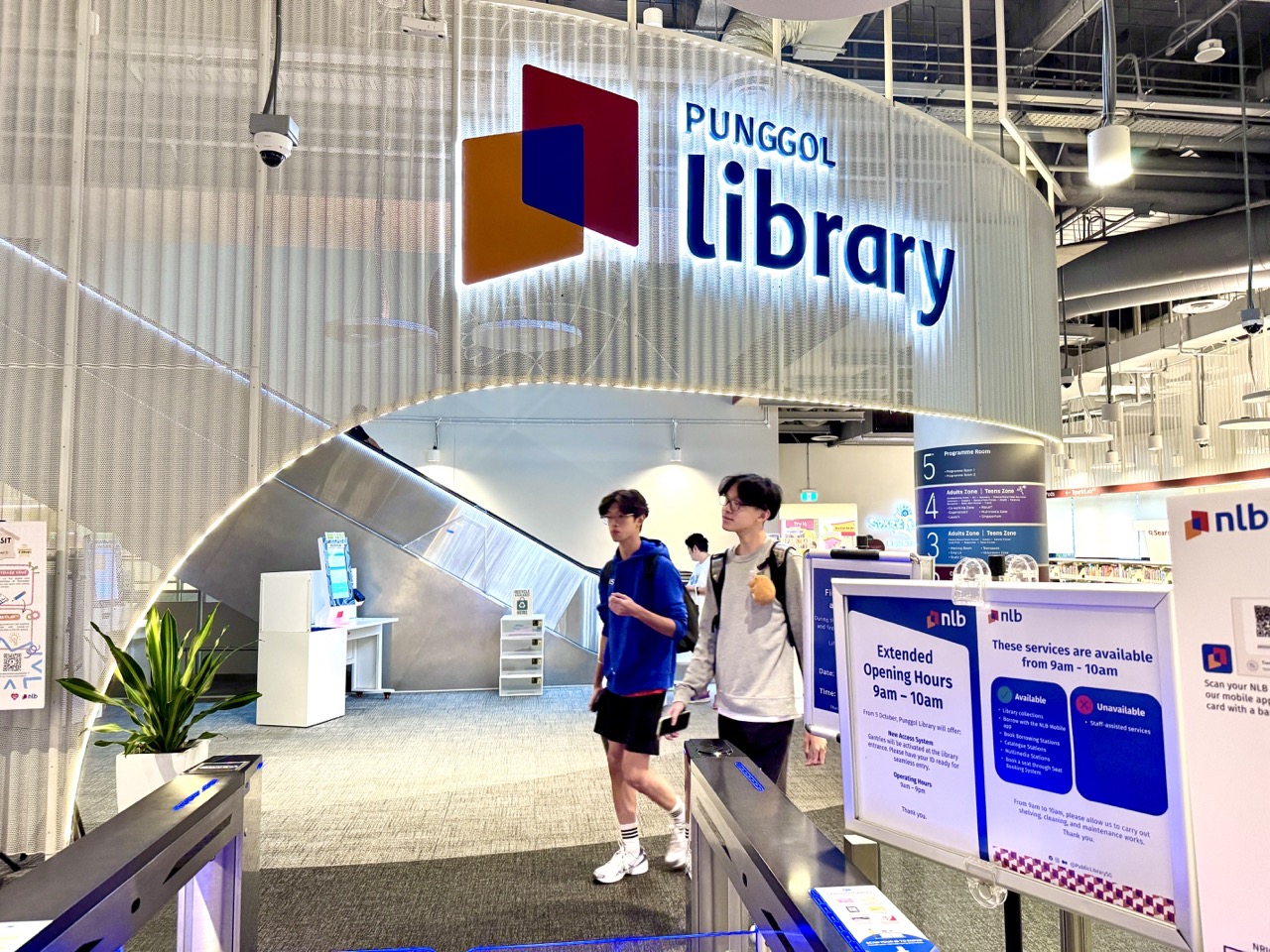
A library or community hub can have many doors, floors, counters and toilet facilities, making reliable wayfinding especially valuable to visitors who do not know the building. Punggol Regional Library at One Punggol serves children, students, adults and seniors with different accessibility needs. However, this article does not assert that a specific Braille plate there is missing or damaged.
If a user encounters a defective sign in such a facility, the first step is to tell the onsite information or facility team and identify the precise location. The team can determine whether the plate is part of a library-managed feature, a shared building component or another tenant’s space. The responsible operator should not be guessed from the building’s most familiar name.
14. What a damaged sign might look like
- A plate partly detached from the wall or handrail.
- Missing or flattened raised dots in its Braille message.
- A cracked surface with sharp edges that could hurt a reader’s fingers.
- An advertising poster or cleaning label pasted over the tactile area.
- Raised text that is worn away or obscured by paint.
- A sign that has been rotated, reversed or mounted loosely.
- An old label that conflicts with a newly renamed room or facility.
- A stair-floor sign that does not match other reliable floor identifiers.
- A tactile sign hidden behind an unsecured display or stored items.
- A temporary sign directing people through a closed or inaccessible route.
15. What the public should not test
A resident does not need to run their fingertips over a cracked plate to discover whether the broken edge is sharp. Visible damage is enough to justify a report. Similarly, do not loosen screws, pick off Braille dots or use a solvent to check whether an apparently flat sign could be repaired. These are maintenance actions with potential safety and accuracy consequences.
If there is an actual loose panel that might fall, keep clear and notify the operator urgently. A competent staff member can isolate the area or arrange a repair. The fact that the defect concerns accessibility information does not make an unstable wall fitting safe for untrained public handling.
16. Why the correct Braille text matters
A replacement sign must communicate the right destination or level, not simply reproduce the design of the old plaque. A building may have changed room names, added a new accessible washroom or altered directions during renovation. Copying outdated Braille could perpetuate a wrong message even when the new plate is beautifully manufactured.
Facility managers should verify the visible wording, tactile wording, location and any directional arrow. A competent Braille production or accessibility specialist may be needed for the specific requirements. A resident’s report can identify the mismatch, but should not attempt to translate or replace the message from memory.
17. Why people should not use Braille as decoration
Raised dots on signage carry information; they are not a design texture to be rearranged for visual effect. A plaque with arbitrary dots may look inclusive while offering no trustworthy message to a Braille reader. Good signage requires accurate content and consistent placement, as well as an appropriate tactile form.
When a café, shop or community event wants to add inclusive signs, the organiser should seek competent advice instead of downloading random Braille-font artwork and declaring the project complete. That same care applies to a repair: restoring a verified message is more important than adding decorative dots.
18. What if a visually impaired visitor asks for help?
Ask whether assistance is wanted, describe the location clearly and listen to the person’s preference. Do not grab a white cane, touch the person without permission or insist that they read a damaged sign to prove the problem. Someone may want verbal directions, an escort to a counter or help identifying the correct entrance.
If the sign is missing or inaccurate, alert onsite staff so other users are not affected. A single person’s experience can reveal a useful maintenance concern, but the report should describe the physical condition rather than expose the visitor’s name, disability or personal movements to a public audience.
19. What if a route is temporarily closed?
Maintenance or construction works may cause a normal corridor or entrance to close temporarily. A tactile sign directing users to a route that is closed can become misleading if there is no accessible alternative information. The operator needs to coordinate temporary wayfinding, including staff assistance where necessary.
Do not peel off permanent signs or create an improvised Braille arrow because the usual route is unavailable. Follow the authorised diversion and inform management if the information is inaccessible. A correctly installed permanent sign and a poorly managed temporary closure can both be present at the same time.
20. Why signs can become obstructed
A commercial display, queue barrier, delivery trolley or cleaning equipment can cover a tactile plate or prevent a person from reaching it. The sign may be physically undamaged, but its purpose is defeated while the obstruction remains. The practical report should state what is blocking access and at what time.
Some obstructions can be resolved through a simple relocation by authorised staff. Others may involve a recurring site layout issue. A resident should not damage someone else’s property or move heavy furniture without permission. The manager can coordinate storage, displays and an accessible circulation path.
21. A sign is not proof the entire route is accessible
An accessible-toilet sign may correctly identify the facility while the path to it is interrupted by stairs, a closed lift or a narrow obstruction. The sign is one element of an accessible journey, not a guarantee about the entire route. That is why the route, entrance and usable facility must be considered together.
For a report, distinguish ‘the Braille toilet sign is missing’ from ‘the only step-free route to the toilet is blocked’. Both may need action, but they are not the same repair. A competent facility manager can assign them to the correct staff while considering the visitor’s full experience.
22. Which operator should receive the report?
HDB common area
Begin with the relevant Town Council or estate-management contact for an installed sign in shared HDB property. Describe the block, floor and location, such as the stairwell or accessible facility. The exact owner may differ where a community service has its own leased premises.
Condominium or private apartment common property
Notify the managing agent or MCST. They can check whether a sign is common property and appoint an appropriate supplier or professional. A resident should not privately replace or relocate a shared accessibility plate.
Public transport station
Tell station staff or use the operator’s official feedback channel. A label on a station lift, staircase handrail or toilet may require coordination with the transport facilities team.
Shopping mall, community hub or library
Contact the information desk, customer service or responsible premises manager. For a sign in a tenant space, the management team can help identify the correct maintenance party.
23. OneService can help when ownership is uncertain
The OneService App and chatbot accept municipal feedback and route suitable issues to an agency or Town Council. Its September 2026 FAQ asks for a clear description, a photograph, precise location and the date on which the issue was observed.
If a photograph would intrude on someone’s privacy or require touching a broken plate, a generic image of the surroundings is acceptable under the chatbot’s guidance. Use the actual building name, floor and sign position in text. A distant photograph without that description may not give the maintenance team enough information to locate the problem.
24. A useful seven-point report
- Name the Punggol building, HDB block, station or facility.
- Give the floor, stairwell, toilet entrance, lift car or other exact sign location.
- Describe what is wrong: loose, missing, obscured, sharp, flattened or inconsistent.
- Say whether the visible wording, raised lettering and Braille portion are all present.
- Note the actual access consequence where known, without identifying another person’s disability.
- Attach a safe photograph of the plate or surroundings, not an intrusive image of its user.
- Send to the responsible operator or suitable OneService channel and keep the reference.
- Check whether the facility manager has confirmed inspection or replacement before treating the issue as resolved.
25. Sample report: missing Braille on a toilet sign
Subject: Accessible toilet signage requires inspection. Location: [Punggol building], [floor], wall beside [toilet entrance]. Observed: The raised lettering remains visible but the Braille dots below it appear damaged or missing on one section. Impact: Visitors relying on tactile information may find the sign difficult to read. Please have the operator check the plate and the correct replacement specification.
This is an example, not an allegation about a named premises. Avoid copying the message verbatim if the actual defect is different. A plate with a loose screw needs a different maintenance response from one whose text is wrong. The most useful report is both precise and modest about what the reporter can verify.
26. Sample report: the stair-floor number appears wrong
Subject: Raised floor sign does not match landing identification. Location: [building], stairwell [identifier], landing [floor]. Observed: The tactile sign appears to identify a different level from the adjacent visible floor label. Request: Please verify the floor names and the sign’s text and Braille before replacement, and arrange suitable accessible guidance if the current information is misleading.
Do not rewrite the Braille independently or tell a visitor that one label must be correct without confirmation. The floor plan, updated building layout and approved nomenclature belong to the operator. In a protected staircase or emergency route, an apparently conflicting identification deserves prompt attention because wayfinding mistakes can have more serious consequences.
27. A visit to One Punggol: hypothetical example
A family visits a community facility at One Punggol. The parent notices that a raised toilet sign is hanging partly loose on one side. Rather than letting a child pull at the dots to see whether they are Braille, the parent photographs the outside of the empty entrance area from a safe position and informs the facilities desk.
The operator can decide whether temporary assistance or a replacement sign is needed. The example does not assert that One Punggol has defective signs. It illustrates how a small observation can be reported without interfering with a feature that another visitor might depend upon.
28. A commuter at an unfamiliar station
A visually impaired commuter is seeking a station toilet and follows the known tactile route. The final wall sign is partly covered by a promotional display. A bystander offers assistance politely and alerts station staff that the sign is obstructed. Staff can remove the obstruction through the appropriate procedure and confirm a usable wayfinding route.
The lesson is not to photograph the commuter or demand that they demonstrate their navigation technique. The physical problem is that a sign intended to be available through touch has been covered. That observation can be reported respectfully without treating the person as a public example.
29. A sign that is visually correct but tactilely unreadable
A plate can display the correct large printed words while the raised features have worn down. Sighted users may not notice the issue at all. The repair should assess the tactile content rather than repainting only the visible lettering. A new, glossy finish can even make a surface harder to use if it obscures the relief of the dots or creates uncomfortable sharp edges.
The building manager may need to review the sign manufacturer’s specifications and verify that the tactile message is accurate after repair. A resident can say ‘the Braille area appears flattened’ without asserting that a particular dot dimension falls outside the BCA code. That detailed compliance assessment belongs to qualified people.
30. Why a clean sign still needs attention
Maintenance is not only about cleaning dust. Signs can loosen, crack, lose raised letters or become outdated after a room changes purpose. A monthly surface wipe does not prove that the underlying message remains tactile and correct. Facilities teams should have a way to receive and track reports about wording, placement and physical condition.
An operator might bundle sign review with wider accessibility and wayfinding checks. That approach can identify several related changes, such as a renamed accessible toilet or an altered lift destination. The goal is to keep the user journey understandable, not merely replace one plaque as a decorative fixture.
31. When the repair should be escalated
A tiny cosmetic scratch may be a routine maintenance matter, while an entire missing sign at an essential accessible facility, a sharp plate protruding into a path or wrong identification in a stairwell can need more urgent action. Describe the actual safety or navigation impact, and ask the operator to assess priority. The public should not invent an emergency solely to speed up an ordinary request.
If a person is in immediate physical danger from a loose fitting or another building defect, keep clear and seek appropriate direct assistance. A Braille sign complaint is usually an accessibility issue rather than a medical emergency. The correct urgency depends on what is visibly happening and whom it affects.
32. What good replacement should achieve
A proper replacement should have verified content, readable tactile characters and Braille, appropriate placement, durable secure mounting and a finish that does not harm fingers. It should correspond with the facility’s actual name, floor and direction. Depending on the applicable code and building, the operator may need a suitably qualified designer, contractor or accessibility assessor.
A public report should not prescribe a particular font size, dot mould or installation height from memory. BCA’s 2025 code contains technical measurements and scope rules that must be read in context. The responsible professional can check those details while ensuring that the replacement works in the actual building rather than merely matching the look of a sample photograph.
33. How to teach the idea without using someone as a demonstration
Children can learn that information is not only visual. A raised sign helps some people identify a place through touch; audible messages help others; clear print supports many readers. Parents can explain those differences by discussing examples rather than blindfolding children and sending them through live transit spaces or asking strangers to demonstrate how they read signs.
If a child notices a missing sign, the family can practise an evidence-based report: location, what changed and who maintains it. This connects everyday civics with careful observation and respect for people who use public facilities differently. The lesson is about designing a town that works for more residents, not about portraying one user as helpless.
34. A practical accessibility audit for ordinary readers
Residents can pay attention to whether information is physically reachable, kept clear and accurately placed during their normal journeys. They do not need to touch every sign or conduct a formal compliance inspection. If a clear defect is visible, make a short report. If the issue is more complex, such as unfamiliar building code requirements, ask the property operator for a proper assessment.
Avoid publishing a list of supposedly illegal signs based only on pictures. The legal application of the 2025 code differs by building type, date and relevant construction works. The strongest community contribution is a well-documented maintenance issue that can be resolved without inflammatory or misleading claims.
35. Common mistakes to avoid
- Assuming tactile ground paving and Braille wall signs perform the same task.
- Covering Braille dots with tape or printed labels during a renovation.
- Attaching homemade adhesive dots without checking what message they convey.
- Peeling or testing damaged raised features with fingernails.
- Assuming every older Punggol building automatically violates the 2025 code.
- Moving a sign without considering where its intended users expect to find it.
- Photographing a person with visual impairment instead of documenting the sign.
- Confusing a wrong floor label with an ordinary cosmetic scratch.
- Allowing a temporary display to block an important accessible-facility sign.
- Claiming compliance or non-compliance without the relevant building details and an appropriate professional assessment.
Frequently asked questions
What is a Braille sign used for?
It communicates information through raised dot patterns for people who read Braille. In a public building it may identify a toilet, level or facility, often alongside raised print and visual symbols.
Is a printed Braille-looking pattern sufficient?
Not when tactile Braille is required. The current BCA code describes raised, touch-readable Braille. Decorative printed dots are not equivalent.
Does every person with visual impairment read Braille?
No. People use different combinations of remaining vision, raised print, audio information, tactile cues, white canes and learned routes. Inclusive wayfinding should not depend on only one method.
Is Braille signage the same as tactile paving?
No. Tactile paving supplies cues through the ground; raised and Braille signs convey destination or facility information through hand-reachable surfaces.
Where is Braille required under the 2025 code?
The code contains requirements for specified signs and facilities in applicable new building and alteration works, with different scope provisions and exceptions. The responsible designer should check the exact building and clause.
Did the 2025 code make every old sign illegal?
No blanket conclusion is justified. BCA says the enhanced code applies to relevant new building and additions-and-alterations works from 1 November 2025. Existing features still require appropriate maintenance.
Can I fix a loose Braille sign myself?
Do not modify common or public signage without authorisation. The replacement must be accurate, securely mounted and appropriately tactile.
What if only the raised dots are damaged?
Report that specific defect. The visible text may remain readable while the Braille message is compromised for people relying on it.
Who handles a sign at an MRT or LRT station?
Start with station staff or the transport operator’s facilities and feedback route. Include the station, floor, direction and exact sign location.
Who handles a sign at One Punggol?
Ask the relevant building or facility operations team, which can identify whether the sign belongs to the community hub or a specific tenant. This article makes no claim about a defective sign there.
Can OneService accept an accessibility maintenance report?
It can receive suitable municipal feedback. Provide the exact location, description and a safe photo or surroundings image, as its reporting guidance explains.
What if a tactile sign says the wrong floor?
Report it promptly and ask the operator to verify the floor identification before replacing the sign. Do not swap plaques or invent the intended Braille wording.
What if an advertisement covers the sign?
Tell the facility operator that the accessible sign is obstructed. Ask staff to arrange a clear route and remove or relocate the obstruction through authorised procedures.
Should I ask a person who reads Braille to prove the sign is damaged?
No. Report the visible physical issue without making someone demonstrate their disability or navigation method. Qualified professionals can assess sign accuracy and compliance.
What if the sign has a sharp edge?
Keep clear and report it as a physical safety as well as accessibility issue. Do not touch or file down the damaged plate yourself.
Where can an operator check the technical specification?
BCA’s official Code on Accessibility 2025 includes the relevant signage and Braille chapters. Qualified designers and contractors should use the current code and any applicable amendments.
Does replacing only the printed text solve the problem?
Not necessarily. If tactile information is required, the replacement must preserve the correct raised lettering, Braille and placement, not only the visual appearance.
Official sources and related Punggol reading
- BCA — Code on Accessibility in the Built Environment (2025)
- BCA — Official 2025 Code PDF, Chapter 8 on Tactile and Braille Signs
- BCA — 2025 Code Scope and Implementation Date
- LTA — Braille and Tactile Aids in Public Transport
- LTA — Tactile Guiding System: Its Separate Role
- OneService — Municipal and Estate Feedback
- OneService — Exact Location and Photo Reporting Guidance
- eduKate Punggol — Tactile Paving in Public Paths
- eduKate Punggol — Neighbourhood and Community Services
Editorial note, 7 November 2026: This is an accessible-wayfinding and maintenance guide, not a compliance ruling for any particular Punggol sign. The code’s application depends on building type and relevant works. Report physical defects to the operator, and obtain professional review where a legal or technical assessment is needed.


