
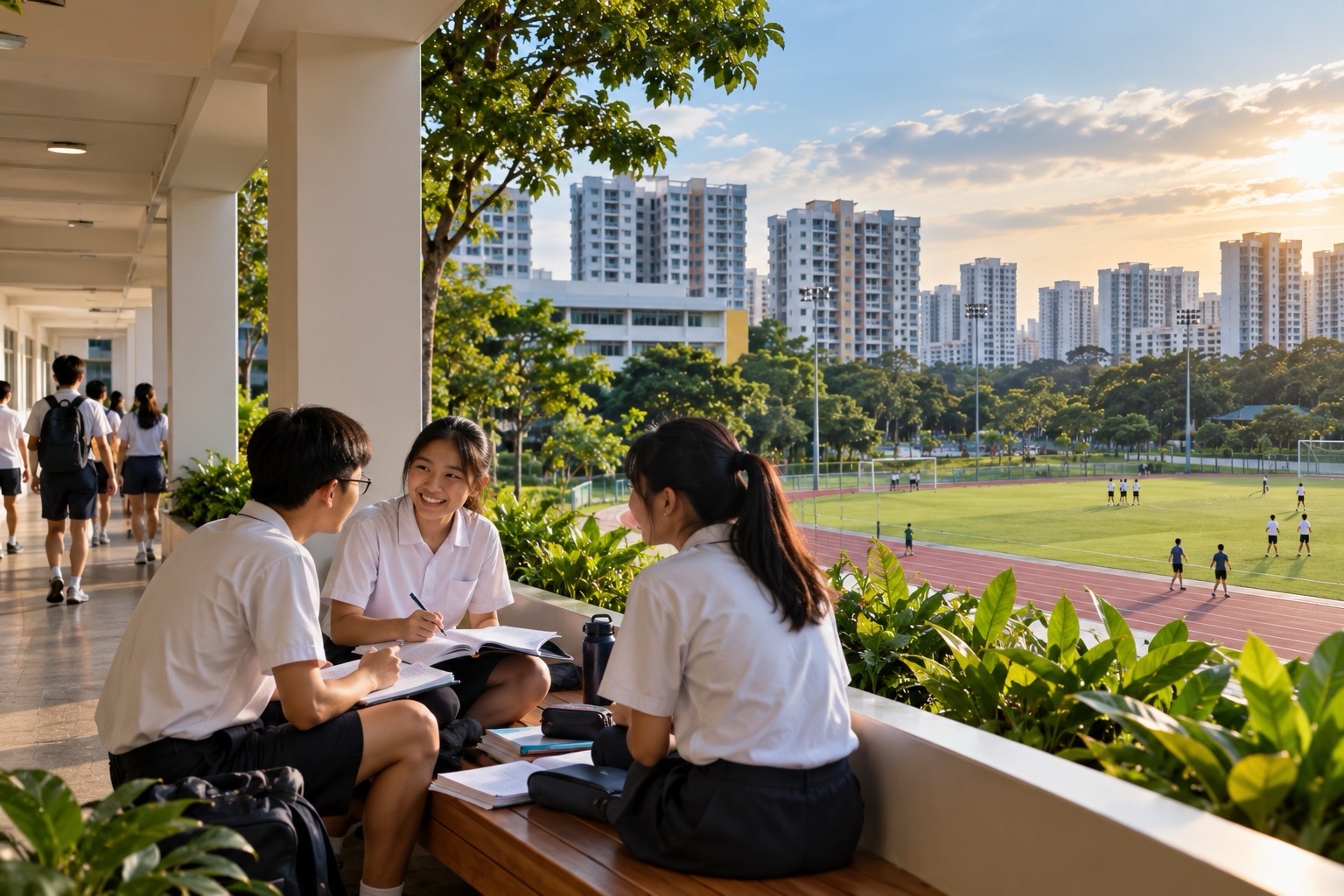
Damai Secondary School at 4800 Bedok Reservoir Road, Singapore 479229, is a government co-educational school that eligible Punggol families can consider through Posting Group 2 (PG2). For the completed 2026 Secondary 1 intake, its historical PG2 PSLE Score range was 21–25, with 25 the previous last admitted score. That is not a guaranteed cut-off for the 2027 intake: future posting depends on applicants’ results, genuine school preferences, available places and MOE allocation rules. Parents should verify the child’s actual Posting Group and MOE SchoolFinder data, then test a realistic Punggol-to-Bedok Reservoir journey before ranking Damai.
Damai’s 2026 signature programmes closely connect environmental education with the nearby reservoir. Its Applied Learning Programme in Environmental Sciences and Sustainability teaches Secondary 1 water conservation and marine ecosystems, Secondary 2 recycling, upcycling and urban farming, and Secondary 3 environmental impacts of climate change. The school also runs Kayak n Klean Values-in-Action conservation activities and a Learning for Life Programme in Water and Adventure Sports, including lower-secondary camps, elective hiking and climbing, Secondary 3 dragonboat orientation and upper-secondary sports exploration. These are experiences that can help a PG2 learner build knowledge, friendships and judgement, but they do not automatically grant a G3 subject, selected sports CCA place or post-secondary qualification.
- School and address: Damai Secondary, 4800 Bedok Reservoir Road, Singapore 479229—not 480 Bedok Reservoir Road.
- 2026 historical PG2: PSLE Score 21–25, previous last admitted score 25; do not predict 2027 admission.
- Posting Group 2 is for Secondary 1 allocation; G2 is the level of an individual subject under Full SBB.
- ALP: Environmental Sciences and Sustainability, linked to Science, Geography, Languages, Mathematics and VIA.
- Secondary 1 ALP: sustainable water resources, aquatic ecosystems and water recycling or reuse.
- Secondary 1 ALP: Kayak n Klean VIA and learning about water conservation.
- Secondary 1 learning journey: ComCrop rooftop farming and efficient land, energy and water use, under the school’s current arrangements.
- Secondary 2 ALP: resource management, design thinking, recycling, reusing and upcycling.
- Secondary 2 community work: eco-crafting with seniors and learning about food waste or ugly food.
- Secondary 2 learning journey: Agritisan at Agape Village and microgreens, as described by the school.
- Secondary 3 ALP: climate-change discussion and composting or food-waste learning.
- LLP: Character Development through Water and Adventure Sports.
- Secondary 1/2 LLP: camp and sport electives, including hiking, rock climbing and other supervised adventures.
- Secondary 3 LLP: OBS or school camp and Dragonboat Orientation Programme.
- Secondary 4 LLP: elective surfing, stand-up paddling or scuba-diving within approved school arrangements.
- Water-sports CCAs: Canoeing (girls) and Dragonboat (boys), separate from school-wide LLP.
- 2026 DSA examples: Rugby, Netball, Canoeing, Symphonic Band, Choir and Girl Guides; check current school criteria.
- Parent next step: confirm eligibility, school culture, subject levels, programme safety and real transport.
Definition lock: PG2 describes admission, G2 describes a subject
Posting Group 2 is a Secondary 1 admission category under Full Subject-Based Banding. G2 is the level of an individual curriculum subject. A pupil who enters Damai through PG2 might have a different eligible G level for one subject depending on formal MOE criteria and the school’s offer. An admission label should not be used to classify the teenager’s entire ability, interests or character. One student might reason carefully in Science yet struggle with extended English writing; another may love outdoor activities but need support with algebra. These are specific needs and strengths. The school issues the real timetable after posting. Parents should use the actual subject-level booklist rather than assume every lesson and resource is identical merely because the pupil entered through PG2.
The historical 2026 21–25 range is not a promise
Damai’s completed 2026 PG2 PSLE Score range was 21–25. Since lower aggregate PSLE totals indicate stronger performance, 25 was the previous last admitted score. Those pupils entered after the 2025 PSLE, and their admissions outcome cannot be treated as a fixed guarantee for a new cohort. Next year’s cut-off depends on the actual applicants, preferences, places and tie-break procedures. A student with PSLE Score 25 may reasonably investigate Damai but must still keep suitable alternatives in the six-school list. The family should compare only the correct Posting Group figures and verify the year. A PG1 or PG3 number cannot be substituted to predict a PG2 result or infer that all students are treated under one identical academic route.
Damai’s actual Bedok Reservoir Road address
The official contact page, updated in October 2026, confirms 4800 Bedok Reservoir Road, Singapore 479229. The number contains two zeroes at the end: 4800. This matters because typing a similar but incorrect street number can lead to the wrong destination. The school lists buses 5, 21, 59, 65 and 228 and Bedok Reservoir MRT among transport references, with other nearby rail options. Punggol residents need to examine the route from their own home instead of assume everybody has one convenient direct service. Check reporting-time travel, walking, safe crossings and the return after a late sports CCA. A useful school’s fit includes the time and energy required for the ordinary journey.
Test the route before ranking the school
A Punggol-to-Bedok journey may seem manageable when viewed on a map, but the full trip includes waiting, transfers and the final walk to the entrance. Test it on a weekday with school traffic rather than a quiet Sunday. Ask the student to recognise the correct bus direction, stop, road crossing and a safe alternative when service is disrupted. A child joining Canoeing or Dragonboat may finish training at around 6 pm under the 2026 schedules, changing the return journey substantially. The family should account for dinner, homework, sleep and next-day readiness. A particular ALP or LLP may justify the travel, but only if the teenager can sustain the school week without constant fatigue.
Aspire, Explore, Achieve: the school’s direction
Damai’s homepage uses the phrase Aspire · Explore · Achieve and presents the vision of A Purposeful and Meaningful Life. Its mission emphasises moral values, self-discovery and helping students develop interests and talents. These words matter when the school makes them practical: the teenager should feel able to ask questions, try unfamiliar activities and learn from an incorrect answer. Aspiration without a clear plan can produce anxiety, while exploration without reflection can remain shallow. Parents can ask how the child is supported when a project fails or when one subject is significantly harder than another. Genuine achievement involves improved understanding, capability and participation, not only a ranking or public medal.
Integrity, Respect, Resilience and Service
The school’s stated values are Integrity, Respect, Resilience and Service. In a water-conservation project, integrity means reporting what the measurements showed rather than inventing an attractive reduction figure. Respect includes listening to classmates and older residents instead of deciding what they need in advance. Resilience means learning to respond constructively to difficulties under appropriate guidance, not ignoring physical danger. Service means acting on real needs and respecting the people affected. A student who recognises that a prototype did not work and explains what to change may be displaying several of these values at once. Parents can ask for a concrete example of a value in action rather than expect the pupil simply to memorise a school motto.
Environmental Sciences and Sustainability: a whole-school theme
Damai’s Applied Learning Programme connects environmental questions with several formal subjects. The official page describes work through Science, Geography, Mathematics, English, Mother Tongue Languages and Values in Action. The educational purpose is to help pupils recognise that water use, waste and food production are not isolated textbook topics. A real problem involves scientific processes, quantitative evidence, human choices and communication. A student should be able to explain which knowledge was used and why a proposed solution might help. The ALP is applied education, not a separate national examination with automatic credit toward later admissions. Its value comes from deliberate transfer of learning across subjects and the student’s growing ability to investigate issues independently.
Secondary 1: where water comes from
The current ALP introduces Secondary 1 students to water sources around the world and the sustainable use of water resources. A pupil may initially think that water simply appears at a tap. Studying reservoirs, water treatment and distribution can help the teenager understand the complexity behind reliable supply. The class should distinguish local infrastructure from global patterns and recognise that geography and technology affect access. A household example can motivate curiosity, but one family’s consumption cannot be used to describe an entire country without broader data. Parents can ask which parts of the water system the child learned about and which facts came from credible sources. The goal is accurate understanding, not a dramatic prediction of shortages.
Human activity and aquatic ecosystems
The programme asks students to examine how human activities can affect water and marine ecosystems. Pupils should learn that pollution can have multiple sources and consequences, and that a visible item in the water does not establish the complete condition of an ecosystem. Careful observation, relevant scientific knowledge and appropriate data are needed. A student might notice litter near a waterway and propose a clean-up, but the analysis should also ask how materials reached the site and whether the intervention could be sustained. Parents can help by separating the observation from the explanation: what was actually seen, what causes are plausible, and what additional evidence is missing? Such questions develop sound Science and Geography reasoning.
Water recycling and reuse are not simple slogans
Damai’s ALP introduces technologies that help enable sustainable water recycling and reuse. These are important Singapore learning contexts, but the school should not be treated as a substitute for official engineering or public-health guidance. A child can understand that different forms of treatment remove different impurities and that safety depends on validated processes. A homemade filter or short classroom demonstration must not be described as proof that water is safe to drink. Pupils should learn to distinguish a treatment stage, a verified outcome and the evidence required for a broader claim. Parents can ask what a particular technology accomplishes and what limitations remain. Accuracy matters more than calling every reuse process a universal solution.
Mathematics and water-use patterns
The Secondary 1 programme uses Mathematics to help students analyse water-use patterns. Comparing quantities requires consistent units, meaningful denominators and attention to the period of measurement. A pupil may calculate a change between two days, but the difference could also be affected by the number of people at home or an unusual event. A chart can look dramatic if its axis starts at a misleading value. Students should learn what the numbers show and what they do not establish. Parents can ask the teenager to explain one percentage without a calculator displaying the result, then verify the baseline. This is valuable numerical literacy and a real context for G2 Mathematics, not a reason to skip formal algebra and reasoning lessons.
English and Mother Tongue as tools for advocacy
Damai’s ALP explicitly uses English and Mother Tongue communication to help pupils advocate for water conservation. Persuasion is useful only when the claims are credible and the audience understands the proposed action. A student should identify who will read the message, which behaviour is being discussed, what evidence supports the recommendation and what practical limitation exists. A polished slogan may attract attention but will not teach the pupil to explain the underlying issue. The same skills support formal G2 English situational writing and comprehension, where audience, purpose and textual evidence matter. Parents can ask the child to rewrite one exaggerated sentence as a precise, trustworthy statement. Responsible communication and accurate Science should reinforce each other.
Kayak n Klean: learning through service
The school’s ALP includes Kayak n Klean, a Values-in-Action activity where pupils clean local waterways while learning about water conservation. This is a distinctive connection between environmental education and the reservoir setting. The activity should be understood as a supervised school programme following approved safety and environmental procedures, not an invitation for a child to organise unsupervised kayaking or enter waterways independently. A meaningful service lesson asks how litter affects people and ecosystems, why it accumulates and what prevention might involve. The student’s contribution can include safe participation and later reflection. Parents should ask what the group actually observed and learned, rather than treat the activity only as a photograph of students collecting rubbish.
Why one clean-up does not prove permanent change
A school clean-up can remove litter from a place on a particular day, but it does not automatically prove that the source of litter has been eliminated or that the water ecosystem has recovered. Pupils should learn the distinction between an action and evidence of sustained impact. A useful reflection might consider where rubbish came from, which materials were common and whether repeat observations would be needed. Counts may also depend on the number of participants, route and collection period. Students can be proud of responsible service without exaggerating its scale. This teaches environmental integrity: describe the genuine contribution and recognise what remains to be done. A modest accurate claim is stronger than an unsupported promise of permanent transformation.
ComCrop rooftop urban farming learning journey
Damai’s current Secondary 1 ALP includes a visit to ComCrop, an urban farm that uses rooftop space. The visit helps students observe how land, energy and water constraints influence food production in Singapore. A school may choose such a learning journey to show that growing food involves infrastructure, measurements, maintenance and practical trade-offs. However, a single tour does not prove one technique is universally best or guarantee that every future cohort will visit the identical site. The school decides the actual itinerary and permissions. Parents can ask the pupil what surprised them about space or resource use and which Science or Geography concept helped explain it. The educational outcome is better understanding of systems, not a guaranteed commercial farming career.
Food security without overclaiming
Urban farming is often described using large national aspirations. Pupils should learn to read those goals as policy context rather than proof that any one school garden or farm solves Singapore’s food supply challenge. The country’s policy framework can change, so the date and source of a target matter. When comparing production methods, students must consider actual outputs, energy, maintenance and scale. A small classroom project can teach useful principles without producing a nationally significant amount of food. Parents can ask which numbers were measured at the learning site and which claims came from an external source. This encourages intellectual honesty and prevents an attractive sustainability slogan from replacing careful analysis.
Secondary 2: recycling, reusing and upcycling
The Secondary 2 ALP shifts to sustainable resource management. Pupils learn about recycling, reusing and upcycling, then use design thinking to propose ways to improve recycling efforts. These words should not be treated as identical. Reuse keeps an item in service; recycling involves processing materials; upcycling may repurpose something into a different useful object. The appropriate choice depends on the material, user and actual environmental or financial constraints. Students should be able to explain why one method suits a particular problem. A recycled-material project can be creative and still fail to meet a user’s need, so testing and feedback remain important. Parents can ask what was changed after the group examined the first prototype.
A design-thinking project should begin with a user
An environmental design challenge can tempt pupils to build the most complicated gadget available. But the first question is who will use the proposed solution and why the existing process is not working. If a school recycling station is confusing, better labels or positioning might help more than a new app. A student should consult appropriately, define a manageable problem and compare possible improvements. The prototype then becomes a way to test an assumption, not an object created for decoration. If users say the first design is confusing, the group should revise it rather than blame the users. Such feedback teaches empathy, practical judgement and adaptability. The pupil’s original PSLE Posting Group does not dictate ability to contribute meaningfully to this process.
Eco-crafting with senior citizens
Damai’s Secondary 2 programme describes eco-crafting, in which pupils help older people create practical home items using recycled materials. The activity connects sustainability with intergenerational learning. But students should not assume that every older adult has the same dexterity, preferences or interest in a particular craft. Appropriate school and partner guidance should determine how materials are handled and what assistance is useful. Pupils can learn to listen and adjust a task so participants feel involved rather than treated as passive recipients. Parents may ask what the student learned from an older person, not only what the class produced. Respect and privacy matter more than the attractiveness of a photograph taken for a school portfolio.
Food waste and ugly-food lessons
In Secondary 2 Food and Consumer Education, pupils examine food waste and so-called ugly food. The term often refers to produce that does not meet preferred appearance standards but may still be suitable for consumption when handled safely. Students should distinguish appearance from actual quality or food-safety requirements. A slogan that all imperfect-looking food is safe would be misleading. The school can help children think about what happens before food reaches a household, why edible items may be rejected and which responses could reduce unnecessary waste. Parents should encourage accurate evidence and practical choices without shaming families who face budget, dietary or time constraints. A thoughtful project recognises that sustainability involves systems as well as individual behaviour.
Agritisan at Agape Village and microgreens
The official ALP page includes a Secondary 2 learning journey to Agritisan at Agape Village, an urban-farming start-up. Pupils learn about sustainable food production, green careers and hands-on planting or harvesting, including a Microgreens Workshop. This example shows how classroom discussions can connect to practical industry work. A student should understand that growing a small tray of crops is an investigation at limited scale, not proof that every urban farming method is economical for national production. The actual partner and programme schedule should be confirmed for the new cohort. Parents can ask how land, labour, water and energy influence the business, and which question the visit helped the teenager answer.
Microgreens and the limits of an experiment
Microgreens can be used to discuss plant growth, water, light, temperature and the timing of observations. Students should learn that different results may have multiple explanations. If two trays grow differently but their light, watering and growing medium all vary, the pupil cannot confidently attribute the outcome to one factor. A more useful investigation controls relevant conditions and records observations consistently. At the same time, school gardening must follow hygiene and safety guidance. A child should not be told to reproduce an unfamiliar experiment independently without suitable arrangements. The academic outcome is understanding variables and evidence, which can be transferred to formal G2 Science questions or later environmental inquiry.
Secondary 3: climate change and communication
The Secondary 3 ALP examines climate change and the environmental effects of human activity through English and Mother Tongue discussions. Pupils may explore how scientific evidence and public messages interact. The challenge is to communicate accurately without turning complexity into a false certainty. Students should verify the source and date of a climate statistic, understand the unit and avoid treating one unusual day’s weather as proof of a broad long-term trend. A respectful discussion can consider practical actions while acknowledging constraints. This is an opportunity for language, Geography and scientific judgement to reinforce one another. Parents can ask whether the pupil can explain a claim’s evidence rather than simply repeat the most dramatic sentence from an online infographic.
Composting learning journey in upper secondary
Damai’s Secondary 3 environmental programme includes a learning journey about composting and minimising food waste. Decomposition and resource recovery provide concrete contexts for discussing ecosystems, materials and practical constraints. A student should learn which conditions affect a process and why a short observation does not establish its long-term performance. Composting also has safety and hygiene requirements; a school visit is not a comprehensive home-maintenance manual. A useful reflection compares what was expected with what was observed, identifies a limitation and describes one responsible practice the pupil understood better. Parents should not confuse educational exposure with certification as an environmental professional or permission to handle unfamiliar waste unsupervised.
World Water Day and Earth Day as learning prompts
Damai’s school-wide programme commemorates World Water Day and Earth Day, with involvement from its Leaders Council and English Department. Such events can bring information to a wider audience, but their educational value depends on accuracy and reflection. A campaign should make one clear point, provide credible evidence and offer an achievable next action. A pupil might be tempted to publish an invented percentage to make a poster more persuasive; the correct response is to check and cite a real figure or avoid unsupported precision. Students can learn that communication is a civic responsibility. A good project changes understanding or behaviour through trustworthy messages, not simply through a large number of display boards.
The LLP: Character Development through Water and Adventure Sports
Damai’s Learning for Life Programme uses water and adventure sports to nurture character, leadership and citizenship competencies. The school explicitly describes a progression across four or five secondary years. This should not be interpreted as requiring every student to compete in water sports or complete an advanced diving qualification. The programme begins with broad experiences, allowing pupils to try appropriate challenges, develop friendships and practise teamwork. Later opportunities can involve different interests or more demanding activities. The school remains responsible for safety arrangements and individual suitability. Parents should ask how the programme supports beginners, what adjustments are possible and how pupils reflect on experiences rather than simply collect evidence of participation.
Secondary 1: Water and Adventure Sports Camp
The 2026 LLP page says Secondary 1 pupils begin with a Water and Adventure Sports Camp designed to introduce unfamiliar activities and help students bond with classmates and camp leaders. A new teenager may be confident in classroom study yet uncertain in water or adventure settings. The educational goal is to build appropriate judgement and social skills through supervised experience. Pupils should follow instructor directions and communicate genuine discomfort or concerns. A child who asks a safety question is not failing to be resilient; the student is recognising responsibility. Parents can ask what the pupil learned about cooperation, planning and safe participation, not only whether the teenager completed the most difficult challenge.
Lower-secondary elective hiking and rock climbing
After the introductory camp, Damai describes a Sports Education Programme where lower-secondary pupils explore interests through activities such as hiking or rock climbing. These activities may develop movement skills, confidence and appreciation of the natural environment. But a school-organised climb is not permission for a child to attempt unsupervised climbs outside school. Appropriate equipment, supervision, health considerations and access arrangements matter. A teenager who is inexperienced should receive suitable instruction rather than be compared unfairly with a trained athlete. The educational outcome can include understanding one’s limits, helping a teammate and responding constructively to feedback. A family should confirm current electives and how students with different needs participate.
Sport and character are connected through reflection
It is possible to complete an adventure activity without learning much beyond its physical technique. A thoughtful LLP therefore asks students to reflect: what was difficult, how did the group respond, and which action made the experience safer or more successful? A pupil who rushed ahead may learn to communicate the plan. Another who was hesitant may discover that preparation reduces uncertainty. Resilience should be taught with appropriate boundaries, never as pressure to ignore injury or fear. Parents can support reflection by asking for one real decision rather than demanding a dramatic account. The same habit of identifying an error and improving it transfers to independent academic study.
Secondary 3 OBS or a school-based cohort camp
Damai’s 2026 LLP says Secondary 3 students take part in the Outward Bound Singapore Challenge Programme or an alternative school-based cohort camp experience. Residential or extended outdoor learning provides opportunities for teamwork, resilience and planning under approved supervision. The actual assignment may differ among pupils, and a public programme description is not a guaranteed trip to one particular venue. A student needs to follow safety instructions, respect group members and recognise that preparation and collaboration affect success. Parents should communicate relevant health or accessibility needs privately through the school. A good learning outcome is the ability to explain what changed in the pupil’s judgement, not merely the number of difficult obstacles attempted.
Secondary 3 Dragonboat Orientation Programme
The school’s LLP includes a Dragonboat Orientation Programme in Secondary 3. It introduces teamwork and resilience while helping pupils understand the sport’s cultural significance in Singapore and the region. A dragonboat moves effectively when paddlers coordinate timing and follow instructions. Individual enthusiasm cannot replace collective effort. The activity is school-organised and should not be equated with immediate selection for a competitive team. A pupil who learns to listen, encourage a classmate and follow water-safety procedures is developing valuable behaviour. Parents can ask what the group did when its rhythm or plan failed and why the correction mattered. The lesson is about shared responsibility as much as paddling technique.
The culture and history behind dragonboat
Dragonboat has traditions and regional cultural significance that deserve respectful discussion alongside its sporting demands. Students should recognise that the activity is not simply a racing challenge invented for school physical education. A class may learn about its place in community festivals and regional histories, with appropriate attention to differing accounts and local practices. A pupil should distinguish a story from a documented historical claim and avoid presenting one tradition as universal across all communities. This can connect PE with Humanities and cultural understanding. Parents can ask which element of the sport’s background was unfamiliar and how learning the context changed the child’s appreciation of the activity.
Secondary 4 electives: surfing, stand-up paddling and scuba-diving
Damai’s LLP lists surfing, stand-up paddling and scuba-diving as upper-secondary elective experiences. These are opportunities for older students to explore suitable water sports within approved school safety and eligibility arrangements. A public programme description does not mean every child must perform every activity or qualify for every certificate. Health, supervision, training, swimming readiness and consent may influence participation. Parents should ask about the actual option offered to the pupil and any suitable alternative rather than infer that every family must buy specialised equipment. Learning to recognise risk and follow proper procedures is itself a valuable part of outdoor education. The goal is a positive, safe lifelong attitude to movement.
Canoeing CCA: separate from school-wide water exposure
The Canoeing CCA is a specialised sports activity that the school currently identifies for girls. Its 2026 page lists training on Mondays and Thursdays from 3.30 to 6.00 pm at PAssion WaVe Bedok Reservoir, with extra training possible during competitions and holidays. Members may work towards kayaking certification and represent the school in selected events. This is a substantial commitment distinct from the general LLP experienced by the broader cohort. A girl interested in canoeing should ask about allocation, suitability, equipment, supervision, transport and recovery time after training. A prior competition medal is not a guarantee that every new member will win or even be selected for a particular race.
Dragonboat CCA: training and team discipline
Damai’s Dragonboat CCA is a separate competitive pathway currently listed for boys, with Tuesday and Thursday sessions from 3.00 to 6.00 pm. The 2026 page describes participation in inter-school competitions and emphasises perseverance and shared effort, including lessons from races without podium finishes. This is useful because sport has educational value beyond winning. A team member may learn to coordinate strokes, respond to coaching and support peers after a disappointing result. Parents should understand the training burden, particularly for a Punggol commuter, before accepting an offer or planning additional tuition. The school determines membership, coaching and any competition selection.
Other CCAs and the pupil’s own interests
Damai’s 2026 CCA list includes Netball, Rugby, Choir, Drama, Ethnic Dance, Guzheng, Modern Dance, Symphonic Band, Art Club, uniformed groups and an Infocomm-related club. A pupil who is not interested in competitive water sport may still find an activity that supports friendship and capability. A school-wide water-sports LLP should not be presented as a demand to choose one specific CCA. Ask about current availability, trials, auditions and attendance expectations. LEAPS 2.0 recognition has formal criteria across participation, achievement, leadership and service; simply joining a listed group does not guarantee a particular admissions bonus. The best choice fits the teenager’s genuine interests and sustainable weekly commitment.
DSA-Sec: talent pathways for the 2027 Secondary 1 cohort
Damai’s official DSA page is labelled for admission to 2027 Secondary 1 and lists Rugby (boys), Netball (girls), Canoeing (girls), Symphonic Band, Choir and Girl Guides. It notes that pupils without prior experience may apply and be assessed for potential. This is an important distinction from a guarantee of selection: a candidate still needs to meet the school’s process and aptitude or trial criteria. The page gives the completed 2026 application and interview dates, which must not be assumed to apply to another future exercise. A DSA Confirmed Offer remains conditional on the pupil qualifying for a Posting Group the school offers, and the student is expected to honour the talent commitment through secondary school.
How a DSA portfolio should describe genuine ability
A useful DSA application describes real participation, conduct, skills and reflection. A sports candidate may discuss how training improved technique or teamwork; a band or choir applicant can describe practice and responses to feedback. Purchasing an impressive certificate or submitting work completed mainly by adults is not a substitute for authentic aptitude. The school may evaluate records and performance in an interview or CCA trial. Families should also ask whether the pupil actually wants to sustain the talent area after admission, rather than use the process as a temporary shortcut to a school name. Unsuccessful selection does not eliminate the ordinary Secondary 1 posting route when the child is eligible.
Digital learning and the Personal Learning Device
Damai’s digital-literacy programme uses iPads as Personal Learning Devices, with school information about financial assistance and responsible device use. A new pupil may benefit from access to lessons and collaboration tools, but a device does not automatically improve understanding. Students should learn to secure their accounts, protect private information and verify online content. A chatbot can produce a fluent but incorrect scientific explanation, so the teenager should test its statements against reliable sources and the school material. Parents should use current procurement and financial assistance instructions rather than assume an old device arrangement applies unchanged. The educational goal is purposeful independent learning, not maximum screen time.
The student support system and peer bonds
Damai’s principal’s 2026 message describes a school community where peer support leaders help strengthen relationships in classes and CCAs. It also describes an aspiration-focused approach combining mindset, skills and access to resources. A PG2 child may find this valuable when adjusting to different subject levels and friendships. However, a positive school statement does not prove every child will feel comfortable immediately. Parents should ask how a pupil reports persistent exclusion, academic struggles or wellbeing concerns. A peer supporter can listen and point a classmate towards help, but serious matters require appropriate staff and professional support. A strong home-school partnership identifies the real problem without turning the posting group into a diagnosis.
G2 English: argument and evidence for environmental claims
An environmental project needs language that is both persuasive and accurate. A pupil might write a statement that one clean-up eliminated pollution, when the evidence only shows that litter was collected at a location on one day. The correct revision narrows the claim. That habit connects to formal G2 English comprehension, where an inference must be supported by relevant text. Ask the teenager to state the conclusion, identify the evidence and explain the relationship. A child who misreads the passage needs a different intervention from one who selects the right words but writes an unclear explanation. Applied projects can motivate language, but they cannot replace independent reading and writing skills.
G2 Mathematics: percentages, units and algebra
Water-use data and eco-projects provide reasons to use measurement and graphs carefully. A pupil should check the denominator of a percentage and whether two results were recorded under comparable conditions. Formal G2 Mathematics also requires secure algebra. If the learner expands 3(x + 4) as 3x + 4, the multiplier has not been distributed across both terms; the correct expression is 3x + 12. Show three identical groups and require a changed example to be solved independently. Another student may know this rule but use the wrong unit or misread a graph. Those errors require different teaching. More worksheets without diagnosis can entrench a misconception rather than repair it.
G2 Science: observation is not the same as mechanism
A clean-up, urban farm or composting demonstration can produce visible outcomes. But formal Science asks what caused the result, which variables changed and whether the data support the explanation. A plant growing better in one setting might be influenced by water, light, nutrients and its initial condition. If several differ, one cannot confidently identify a single cause without better control. A student should be encouraged to report uncertainty honestly and plan a useful further test. Damai’s ALP provides motivating contexts for scientific thinking, while the actual G2 or G3 syllabus retains its formal requirements. Parents can ask the child to explain one mechanism in their own words rather than copy a polished project summary.
No automatic need for tuition
A PG2 student does not automatically require private tuition. If school teaching, teacher consultation and independent practice are working, additional lessons may not help enough to justify the time. When a gap persists, targeted instruction can identify the first incorrect step and test whether the child can apply the concept independently to unfamiliar work. English inference, mathematical algebra and Science explanation require different teaching responses. A teenager who is mainly exhausted after a late water-sports CCA may need better scheduling or rest, not another long evening tutorial. Parents should begin with the actual pupil’s work and wellbeing, then choose suitable school or external support rather than treat the posting group as a universal instruction to purchase tuition.
A four-week first-term family plan
If the pupil is posted to Damai, use the current 2027 registration and subject-level instructions rather than the completed 2026 cohort’s December 2025 deadlines. In the first week, focus on the correct journey, classrooms and timetable. In the second, establish one reliable assignment record. In the third, discuss an environmental or outdoor activity, including any safety or participation concern. In the fourth, review a recurring academic gap or difficulty forming friendships and use the relevant school staff if needed. This is an illustrative home routine, not a school-issued orientation schedule. A good start is increasing independence, appropriate support and a sustainable school day.
Three fictional Damai PG2 pupils
A pupil with PG2-eligible score 25 considers Damai because the previous historical last admitted result was 25. The family knows 2027 can differ, tests transport and includes realistic alternative preferences. Another student enjoys the Secondary 1 water-conservation ALP but struggles to explain Science conclusions; the parent supports precise evidence-based writing without assuming the project automatically repairs formal English. A third pupil is attracted to canoeing but the family asks about the actual girls’ CCA selection, late training, safety and journey home before promising participation. These are hypothetical situations, not accounts of actual students, guaranteed admission or current competition places.
Frequently asked questions about Damai PG2
Does Damai admit PG2 pupils? The completed 2026 intake recorded a historical PG2 range of 21–25. Is score 25 guaranteed for 2027? No. Where is the school? 4800 Bedok Reservoir Road, Singapore 479229. What is the ALP? Environmental Sciences and Sustainability. What does Secondary 1 study? Water resources, recycling and conservation, including Kayak n Klean under school arrangements. What is the LLP? Character Development through Water and Adventure Sports. Does every child join Canoeing or Dragonboat? No; those are specialist CCAs. Can a PG2 pupil take an eligible G3 subject? Potentially under formal criteria. Does a DSA offer override the Posting Group condition? No. Does a school project guarantee a later environmental career or diploma? No.
Your Next Step and official sources
Review Damai’s official contact page, Environmental Sciences and Sustainability ALP, Water and Adventure Sports LLP, Canoeing CCA, Dragonboat CCA, DSA 2026 exercise for Secondary 1 2027, Student Development, MOE SchoolFinder and historical 2026 PG2 range. Check actual eligibility and travelling needs before ranking. For general school preference strategy, use the Punggol PG2 guide.


