
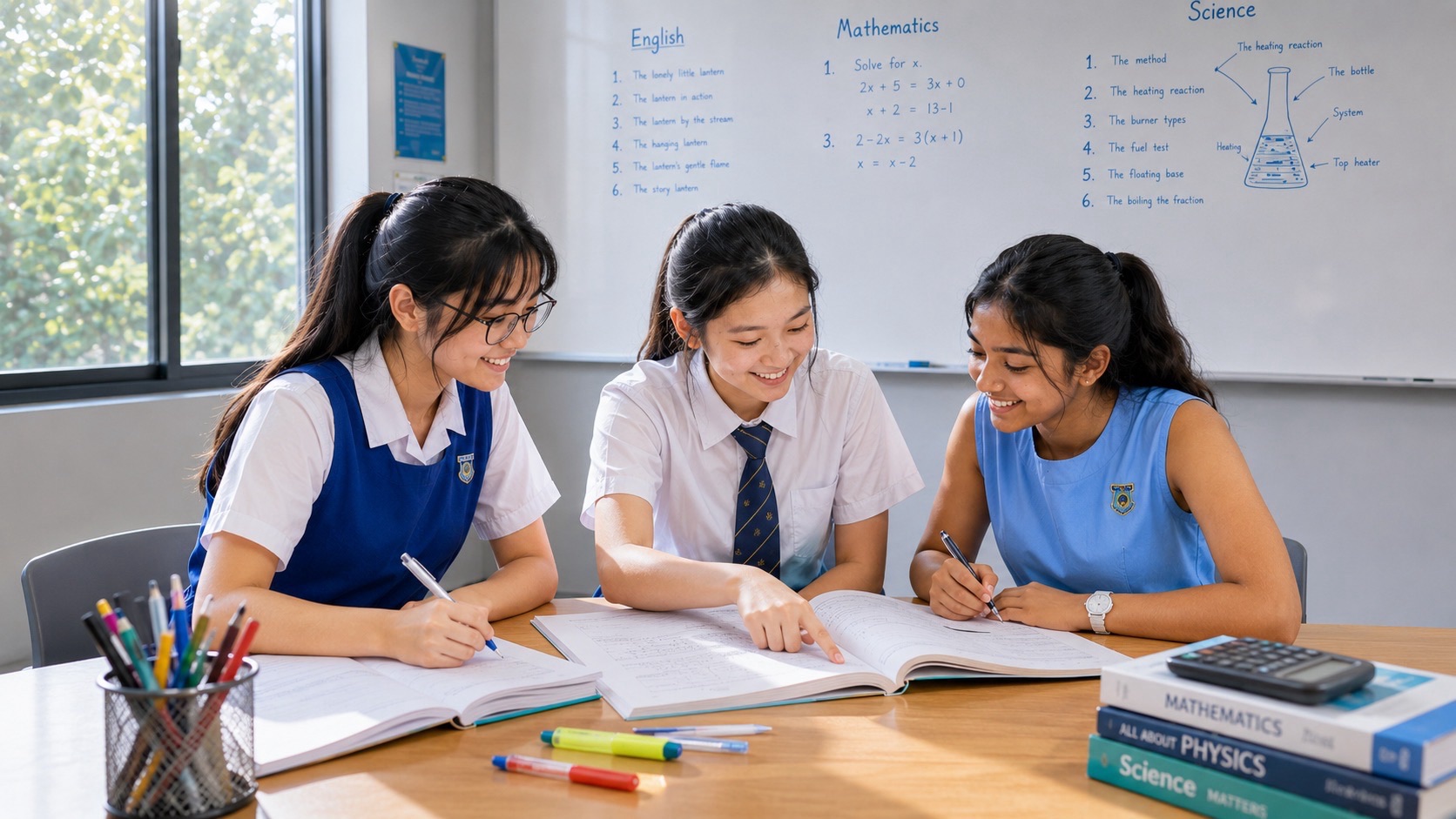
Northbrooks Secondary School is at 585 Yishun Ring Road, Singapore 768692, and its historical 2026 Secondary 1 Posting Group 1 (PG1) admitted PSLE Score range was 25–27. The final admitted Score 27 describes pupils who took PSLE in 2025 and entered secondary school in 2026. It is not an acceptance guarantee for a child entering in 2027. Parents in Punggol should verify their child’s official PG1 eligibility, check the current MOE SchoolFinder profile and test a weekday journey to the correct Yishun Ring Road campus. The school’s current FAQ gives 7:30 a.m. reporting on Monday to Wednesday and Friday and 8:20 a.m. on Thursday, but families must check the actual 2027 timetable rather than assume those times remain fixed.
Northbrooks’ distinctive educational combination is its Aerospace Applied Learning Programme and an Outdoor Education LLP called A.C.E.—Adventure, Character and Environment. Aerospace learning offers broad lower-secondary STEM, aerospace-related learning journeys and career exploration for all students, with a further tier including Aviation Advanced Elective Modules, Youth Flying Club and Mission to Mars opportunities for suitable pupils. The Outdoor Education programme builds resilience and environmental awareness through Secondary 1 orienteering, Secondary 2 tent pitching and outdoor cooking, Secondary 3 cycling and climbing or abseiling under school supervision. The school also describes stained glass art as a creative programme. Under Full Subject-Based Banding, PG1 is the school-entry category and G1, G2 or G3 describe standards for individual academic subjects. This guide explains real programmes, selected opportunities and how Punggol families should decide for 2027.
- Northbrooks Secondary: 585 Yishun Ring Road, Singapore 768692
- 2026 historical PG1 admitted range 25–27, last posted score 27
- Future cut-offs and allocations cannot be guaranteed by 2026 results
- Nearest MRT references include Yishun and Khatib; published buses include 804, 806, 807, 860, 103
- School FAQ lists 7:30am report on most weekdays and 8:20am Thursdays; verify 2027
- ALP: Northbrooks Aerospace Programme, a STEM applied-learning pathway
- Tier 1 ALP: broad aerospace learning, STEM lessons, learning journeys and ECG
- ALP partners listed include CAAS, Republic Polytechnic, Temasek Polytechnic and aerospace firms
- Tier 2 ALP: Elective and Advanced Elective Modules, competitions, Youth Flying Club
- Youth Mission to Mars is a named advanced programme, not guaranteed for every entrant
- LLP A.C.E.: Adventure, Character, Environment, through Outdoor Education
- Secondary 1 LLP: orienteering and navigation around school and neighbourhood parks
- Secondary 2 LLP: tent pitching and outdoor cooking with environmental care
- Secondary 3 LLP: cycling programme plus appropriate outdoor camp challenges
- Rock climbing and abseiling use school facilities and trained supervision
- Level camps are developmental; higher expeditions and competitions have selection
- Stained Glass Art Programme provides creative expression and innovation experiences
- DSA 2026 domains include aerospace, Outdoor Adventure, Leadership, sports and performing arts
- Under Full SBB, PG1 entry is distinct from actual academic subject G levels
- Check current booklists, safety, student support and Punggol-to-Yishun travel
Reviewed 6 November 2026. This article separates 2026 historical PG1 posting results from the 2027 intake. School programmes, reporting, subject levels and selected activity places must be confirmed through current official notices.

Contents: Northbrooks PG1, Aerospace and A.C.E. Outdoor Learning
- 1. PG1 is the admission group, not an academic identity
- 2. Reading the 2026 PG1 25–27 score range
- 3. National PG1 eligibility and subject conditions
- 4. Score 25 and PG1 or PG2
- 5. The school at 585 Yishun Ring Road
- 6. Current school reporting times are not a 2027 promise
- 7. Aerospace as the Applied Learning Programme
- 8. The importance of applied learning
- 9. Tier 1 aerospace learning for all
- 10. Aerospace STEM and fundamental forces
- 11. Model aircraft and design choices
- 12. Aerospace and digital literacy
- 13. Learning journeys with industry context
- 14. Partnerships with CAAS and polytechnics
- 15. Tier 2: passion and excellence in aerospace
- 16. Elective and Advanced Elective Modules
- 17. Youth Flying Club as a CCA
- 18. Youth Mission to Mars
- 19. Inter-class competitions and teamwork
- 20. Community outreach through STEM
- 21. The A.C.E. Outdoor Education LLP
- 22. A three-tier outdoor framework
- 23. Secondary 1 orienteering
- 24. Using maps and evidence
- 25. Secondary 2 tent pitching
- 26. Secondary 2 outdoor cooking
- 27. Environmental appreciation during camping
- 28. Secondary 3 five-week cycling module
- 29. Cycling and responsible risk assessment
- 30. School rock climbing and abseiling
- 31. Belaying as a teamwork skill
- 32. Annual level camps
- 33. Selected expeditions and competitions
- 34. The three A.C.E. learner outcomes
- 35. The stained-glass Art programme
- 36. Academic coaching and school support
- 37. CCA choice and practical limits
- 38. DSA aerospace, sports and leadership
- 39. G1 English and aerospace explanations
- 40. G1 Mathematics and navigation
- 41. Science and trustworthy evidence
- 42. Mother Tongue and different strengths
- 43. Booklists, reporting and household costs
- 44. A fictional pupil explores flight
- 45. A fictional pupil learns outdoor teamwork
- 46. Compare Northbrooks with nearby alternatives
- 47. Your next step for 2027
PG1 is the admission group, not an academic identity
Posting Group 1 is used during Singapore’s Secondary 1 posting process after PSLE. G1 is the academic standard for an individual subject under Full Subject-Based Banding, while G2 and G3 are different levels. A student entering Northbrooks through PG1 may enjoy engineering, Art or physical activity and still have different academic strengths across language and Mathematics.
Parents should keep the result notice, school allocation and actual subject timetable separate. A pupil who builds a strong paper glider may need help with formal Science writing, while another may be confident in English yet struggle with ratios. School teaching should respond to those specific needs without treating one posting category as a permanent measure of personal potential.
Reading the 2026 PG1 25–27 score range
The historical admitted score range for the 2026 Secondary 1 PG1 intake was 25–27 at Northbrooks. The pupils in that group took PSLE in 2025, and the final posted score was 27. The number reflects one completed allocation involving school choice preferences and available places rather than a permanent school entry rule.
A family should not promise Northbrooks to a child scoring 27 in the new cohort. Changes in demand or places can affect the next result, and MOE has tie-breaking rules where necessary. Label historical scores by intake year and prepare several eligible school choices the teenager genuinely wants to attend.
National PG1 eligibility and subject conditions
MOE’s PG1 framework covers Score 25 and eligible pupils scoring 26–30. For aggregate scores 26 to 30, the pupil also needs AL7 or better in both English and Mathematics. A school’s historical admissions table cannot replace those national eligibility conditions. The child’s official PSLE notice determines the permitted route.
Parents should check the individual eligibility before comparing cut-offs. A pupil cannot secure a school place merely because a previous admitted student had the same aggregate. National requirements, actual school ranking and subsequent subject-level rules govern different stages of the process.
Score 25 and PG1 or PG2
A pupil with a PSLE aggregate of 25 may be eligible for both Posting Group 1 and 2. That choice affects school posting and the academic challenge with which the child starts. It should be made with the pupil’s separate subject strengths and the actual schools available in mind.
Northbrooks’ historic PG1 final score of 27 is not a PG2 admissions range. Parents should use the correct SchoolFinder group and follow MOE’s instructions for the ordinary six-school preference list. A more demanding pathway can be useful when readiness supports it, but a number should not be chosen simply for prestige.
The school at 585 Yishun Ring Road
Northbrooks Secondary’s listed campus is 585 Yishun Ring Road, Singapore 768692, in the north of Singapore. It is not Northland Secondary or Naval Base Secondary, both of which are separate Yishun schools. Use the formal school name and postcode for the school-choice form, open-house travel and any enquiry.
A Punggol family should test the journey to the actual school gate rather than assume that all Yishun schools are served by the same transport route. Include station waiting, walking and a later journey after CCA. A workable weekday routine matters to attendance, meals, sleep and independent homework.
Current school reporting times are not a 2027 promise
Northbrooks’ official FAQ lists school reporting at 7:30 a.m. from Monday to Wednesday and Friday, with a later 8:20 a.m. start on Thursday for teachers’ professional development. This provides useful evidence of the current school rhythm, but a new 2027 timetable should be followed once issued.
Parents can test travel at an appropriately early hour and ask about dismissal after classes and CCA. Avoid assuming that the earlier start on some days means every pupil has exactly the same afternoon. Timetables can vary by activity and the student’s approved subjects.
Aerospace as the Applied Learning Programme
Northbrooks’ July 2026 Aerospace ALP introduces students to the Science, Technology, Engineering and Mathematics involved in aviation. The aim is to build awareness, interest and basic skills through practical learning and real-world contexts. The programme is broad-based rather than only for pupils already selected for aerospace competitions.
A child interested in planes can develop foundational Science and logical reasoning, but an introductory task is not a pilot licence or a confirmed post-secondary pathway. Ask what concept the pupil learned and how they would explain the observation. The actual subject syllabus continues alongside the ALP.
The importance of applied learning
Applied learning connects an academic idea to a question that students can observe or test. In aerospace, concepts about flight, structure or navigation become meaningful when pupils see how engineers make choices. The educational value lies in connecting a model with a reasoned explanation, not simply trying an impressive simulator.
Parents can ask what problem the class considered and whether the proposed answer was supported by evidence. An attractive device may have limitations. Students should learn to recognise those limitations rather than describe every model as a proven industry solution.
Tier 1 aerospace learning for all
Northbrooks clearly separates Tier 1 Aerospace from its more demanding Tier 2. Tier 1 provides STEM lessons for lower-secondary students, learning journeys at different levels, aerospace enrichment and Education and Career Guidance. Its broad design is intended to raise awareness among ordinary students, not guarantee individual specialist admission.
Parents should ask which module the actual 2027 cohort will experience and what resources the school provides. Prior aviation experience is not necessary for a beginner to develop curiosity. Introductory opportunities are worthwhile even when a child later chooses an unrelated CCA.
Aerospace STEM and fundamental forces
Aviation can introduce pupils to motion, forces, materials and energy. A small model aircraft may help illustrate how a design behaves under controlled conditions. One successful flight, however, does not prove the pupil understands every aspect of aerodynamics or that the design would work at full scale.
Ask which observation supports a conclusion and what would need further testing. Encourage accurate use of words and evidence rather than copying a simplified online explanation uncritically. School supervision determines which physical experiments are suitable.
Model aircraft and design choices
Designing an aircraft model may involve balancing weight, shape and stability. A pupil can learn that a small difference in one feature affects the result and that a fair comparison requires controlling other conditions. The process can be satisfying even when the first model fails.
Parents can ask which feature the team revised and what changed. The goal is disciplined problem-solving and teamwork, not simply distance or speed. Do not arrange unsupervised specialist flights or buy expensive aircraft equipment without school instructions.
Aerospace and digital literacy
Aviation-related learning can involve digital tools for planning, communication and understanding how systems behave. Basic ICT skill includes finding information, organising files and recognising credible sources. A pupil familiar with social media may still need help with precise instructions and checking technical claims.
Parents can ask the child to identify the source of a fact and what it actually establishes. Digital tools support learning when the student remains responsible for the reasoning. A fluent AI-produced answer is not automatically reliable evidence.
Learning journeys with industry context
Northbrooks’ ALP lists learning journeys as part of Tier 1. These can introduce students to how aerospace professionals work, what equipment they use and why safety, precision and teamwork are important. A trip becomes educational when pupils can connect observations with school concepts.
Past industry visits and photographs do not guarantee an identical destination in 2027. Ask what the child learned about the training a job requires. An introductory journey is career exploration, not a reserved employer position or a guaranteed diploma offer.
Partnerships with CAAS and polytechnics
The ALP names the Civil Aviation Authority of Singapore, Republic Polytechnic and Temasek Polytechnic as partners, along with aerospace companies such as ST Aerospace. These relationships can provide access to authentic expertise and opportunities. The presence of a partner does not mean every child will undertake an attachment or be guaranteed admission to a course.
Parents should ask which activity the pupil will actually take and what it teaches. Professional standards can inspire careful schoolwork, but future education and employment depend on later formal qualifications and selection.
Tier 2: passion and excellence in aerospace
Northbrooks calls its selected extension Tier 2: Passion and Excellence in Aerospace. It includes elective modules, Advanced Elective Modules, competitions, Youth Flying Club and outreach. These experiences can challenge students who want deeper technical practice and have appropriate readiness.
A new PG1 pupil should not be promised automatic Tier 2 participation. Ask about selection, training time, safety and the actual cohort. Broad Tier 1 education still has value for the child who chooses a different interest.
Elective and Advanced Elective Modules
The school’s Tier 2 lists Elective Modules and Advanced Elective Modules. These can provide older students with opportunities to experience more specialised practical fields with post-secondary partners. A module offers useful exposure to professional methods but is not itself a diploma or certificate of unrestricted technical competence.
Parents can use future modules to discuss the pupil’s interests, while focusing first on English, Mathematics and Science foundations. The school and partner determine eligibility and available sessions. A student who enters Secondary 1 in 2027 would normally reach the relevant later modules in another year.
Youth Flying Club as a CCA
Northbrooks lists Youth Flying Club as part of the selected Aerospace extension. Club members may explore aviation-related activity beyond the broad curriculum and participate in suitable school competitions or outreach. The precise training, equipment and selection rules belong to the school and club.
A pupil interested in aviation may want to join, while another may prefer sport, music or a uniformed group. The title Youth Flying Club does not automatically confer a pilot licence or actual aircraft flight hours. Parent decisions should be based on verified opportunities and sustainable commitment.
Youth Mission to Mars
The school’s ALP lists Youth Mission to Mars among its Tier 2 programmes. It can offer a context for discussing future aerospace challenges, collaboration and engineering under unfamiliar constraints. The programme name is educational; it does not imply real space travel or a guaranteed professional placement.
Parents can ask what technical question a student investigated and how the team evaluated a proposed solution. A simulation should be described as a simulation, not evidence of a working spacecraft. Selected participation requires current school confirmation.
Inter-class competitions and teamwork
Aerospace-related competitions can motivate students to build, test and explain models under constraints. A group may discover that an early design is less stable than expected and need to revise it. Such experiences can develop resilience and logical thinking when teachers focus on the process rather than only the winner.
Ask what the pupil learned from an unsuccessful trial. A child who can identify and correct a mistake has gained useful knowledge even without a trophy. Competition results should never replace careful assessment of individual understanding.
Community outreach through STEM
The aerospace Tier 2 includes Community Outreach Programmes. Students may use their technical interest to communicate a useful idea to others or support a project. The intended community’s needs and preferences should shape the activity rather than a desire to display an elaborate gadget.
Parents can ask whom the group served and whether the people involved understood the explanation. A project should protect privacy and avoid exaggerated claims. Technical education and social responsibility reinforce each other when the student listens and reflects.
The A.C.E. Outdoor Education LLP
Northbrooks’ Learning for Life Programme is Outdoor Education under the acronym A.C.E.—Adventure, Character and Environment. Its July 2026 page states the aim of nurturing physically active pupils who can adapt, act responsibly and advocate for the environment. This is a school-wide character programme and not simply a specialist outdoor sports team.
A child who initially feels unsure outdoors can learn through age-appropriate supervised tasks. The goal includes teamwork, confidence and environmental awareness, rather than proving fearlessness. Parents should ask what ordinary students experience and what extensions are selected.
A three-tier outdoor framework
The A.C.E. framework provides broad PE and Outdoor Education, higher challenge for interested students and selected expeditions or competitions. These tiers allow students to develop from foundations towards advanced skills when readiness and safety arrangements permit. A pupil’s PG1 admission group does not determine the tier they are permanently assigned for all activities.
Ask which modules the new Secondary 1 cohort takes and how participation is adapted where appropriate. A demanding expedition is a different commitment from a normal PE lesson. Both can be educationally valuable when conducted safely.

Secondary 1 orienteering
The school says Secondary 1 pupils learn navigational skills through orienteering on campus and in nearby parks. Such activities require reading basic route information, making decisions and cooperating with a group. They can help a teenager develop independence and awareness of the surroundings.
Parents can ask what the child did when the group was uncertain about direction. A useful response may be checking the map, asking the instructor and revising a route. The task should encourage safe choices rather than shortcuts that ignore boundaries.
Using maps and evidence
Orienteering offers a practical reason to interpret symbols, directions and distances correctly. A student may learn that a map simplifies the environment and does not show every obstacle. Deciding where to go requires checking what the representation means and observing actual conditions.
Ask what a symbol represented and whether the pupil could explain a route. This links outdoor education with Mathematics, Geography and information literacy. The value is independent understanding, not merely finishing first.
Secondary 2 tent pitching
Northbrooks’ A.C.E. programme describes Secondary 2 tent pitching, teaching pupils to prepare a shelter, follow instructions and consider its suitability for an outdoor setting. The task can develop patience and shared responsibility because small mistakes may affect the group’s comfort or safety.
Parents can ask how students divided work and checked the result. The school provides actual training and supervision. A family need not purchase a tent simply because the curriculum mentions one. The objective is thoughtful, safe participation.
Secondary 2 outdoor cooking
Outdoor cooking also features in the programme’s Secondary 2 environmental education. Students can practise planning, basic hygiene, the safe use of appropriate equipment and leaving an outdoor space clean. Group members need to coordinate instructions and recognise when specialist help is required.
Ask what safety precaution mattered and whether the group managed waste responsibly. Do not recreate unfamiliar fuel or cooking tasks without proper supervision. Character education is visible in how pupils prepare and care for others, not only the finished meal.
Environmental appreciation during camping
The A.C.E. programme connects adventure skills with care for natural surroundings. A student learning to camp or navigate should understand why waste handling, respect for plants and responsible use of shared space matter. These habits are more useful than an impressive list of outdoor achievements.
Ask the pupil what they changed in their behaviour to reduce unnecessary disturbance. Environmental awareness becomes meaningful through consistent decisions. A school clean-up should be based on safe procedures and genuine benefit, not merely a photograph.
Secondary 3 five-week cycling module
Northbrooks’ official LLP states that Secondary 3 pupils complete a five-week cycling module in preparation for their outdoor adventure camp. This is a progressive physical-learning experience, allowing older students to build skills and safe decision-making over time rather than being expected to master cycling instantly.
A 2027 Secondary 1 entrant would reach Secondary 3 later, so the exact future programme should be confirmed then. Parents can discuss appropriate preparation without encouraging dangerous unsupervised road riding. Skill development requires safe instruction and respect for individual readiness.
Cycling and responsible risk assessment
A pupil may need to understand how speed, surface conditions, obstacles and other people affect safe cycling. An outdoor lesson can encourage listening to instructions and recognising limits. The goal is not simply to ride fastest but to move predictably and protect oneself and others.
Ask which safety decision the teenager made and why it mattered. A student who slows down when conditions become uncertain is demonstrating sound judgement. Outdoor education should reward appropriate caution alongside growing competence.
School rock climbing and abseiling
The A.C.E. page describes rock-climbing and abseiling modules conducted at school facilities by PE teachers. These can develop confidence, cooperation and careful use of safety procedures. Such activities require suitable equipment, instruction and checks; school supervision is central to the educational value.
Parents can ask what the child learned about following safety systems and communicating with partners. A physically hesitant student may still develop courage through an appropriate task. No child should be told to ignore a safety concern to demonstrate resilience.
Belaying as a teamwork skill
The school mentions belaying practice as an example of character learning through physical education. Belaying illustrates why cooperation must include clear communication and responsibility for a partner’s safety. A pupil can learn that being dependable matters more than claiming personal strength.
Parents should not try to teach technical belaying at home without qualified supervision. Ask what safety rules the student understood and whether they could explain why a check was required. Such learning connects trust with practical judgement.
Annual level camps
Northbrooks describes annual level camps from Secondary 1 to 3 at varied locations. These are broad outdoor learning experiences designed to reinforce skills taught during PE and to develop teamwork and resilience. The precise sites, activities and schedules are decided by the school for the actual cohort.
Follow current consent, packing and health instructions instead of an older image. A child who learns to organise belongings and ask for help appropriately has made a meaningful contribution to independence. Not every pupil needs to complete the most advanced obstacle.
Selected expeditions and competitions
Students seeking higher outdoor challenges may be offered expeditions or competitions through the LLP’s extension tiers. These can demand preparation and may involve selection, increased physical requirements and additional safety arrangements. They should not be described as guaranteed experiences for every PG1 pupil.
Ask how interested teenagers qualify and how the commitment fits academic work and the journey home. A school can nurture resilience through ordinary activities even for students who choose no advanced expedition.
The three A.C.E. learner outcomes
The school describes three desired outdoor learner outcomes: Confident Person, Active Contributor and Concerned Citizen. A Confident Person can make safe decisions, an Active Contributor supports a team, and a Concerned Citizen cares about the community and environment. These involve behaviour, not a certificate issued automatically after a camp.
Parents can ask for one example from the child’s actual experience. A pupil who identifies a hazard and speaks up may demonstrate all three outcomes. Reflective thinking is a more meaningful measure than a dramatic photograph.
The stained-glass Art programme
Northbrooks’ official student portal profile highlights a Stained Glass Art Programme that encourages creative expression and innovation. This complements aerospace STEM and outdoor education by providing an artistic context in which pupils can think about colour, pattern and visual meaning. A practical Art experience is not automatically a selected arts CCA or examined subject.
Ask what design choice the student made and what feedback improved it. School staff determine materials and safe procedures. A pupil may enjoy the art without pursuing it professionally, and that exploration can be educationally valuable.
Academic coaching and school support
The official Northbrooks FAQ says academic coaching is provided to students needing additional help and that pupils may approach teachers for consultation after school. This is useful for families who want evidence of support beyond one general promise. The precise availability should be discussed with staff for the child’s actual needs.
Bring a specific example of misunderstood work rather than describe the pupil as weak. The teacher can help identify whether the problem is reading, a concept or organisation. PG1 is not a diagnosis, and pupils may need support in different academic areas.
CCA choice and practical limits
Northbrooks’ FAQ explains that sports and performing arts CCAs use try-outs, with pupils expressing choices and places depending on available resources. A pupil attracted by the Aerospace ALP can still choose a sport or arts activity instead of Youth Flying Club.
Ask whether the child enjoys the regular practice rather than only the public award or club name. The return journey to Punggol after CCA also affects homework and sleep. One manageable long-term activity may be preferable to a crowded schedule.
DSA aerospace, sports and leadership
Northbrooks’ 2026 DSA talent areas include Aerospace, Outdoor Adventure, Leadership, badminton, basketball, floorball, concert band, Guzheng and modern dance. Direct School Admission has separate selection and academic eligibility rules. Ordinary PG1 school posting is a different national process.
A pupil who learns basic aviation principles after enrolment does not retroactively receive DSA. By November, the 2026 application window for 2027 entry is past. Families should use actual DSA offers and commitments when relevant and ordinary school posting otherwise.
G1 English and aerospace explanations
A pupil studying G1 English may enjoy building a model but struggle to explain why it performed a certain way. The Aerospace ALP provides authentic material for reading instructions and describing evidence, but formal comprehension and writing still require targeted teaching.
Ask the teenager to state the purpose, observation and limitation in independent sentences. If the explanation is unclear, repair the missing logical connection instead of providing an adult-written report. Academic progress is meaningful when the pupil can reproduce the skill without prompting.
G1 Mathematics and navigation
Aerospace models and outdoor navigation both involve quantities, scale, directions, graphs and sometimes ratios. A pupil taking G1 Mathematics needs accurate foundations to handle these. A model can fail because a measurement was inconsistent, giving the student a practical reason to check calculations.
Parents can ask what a number represents and whether the answer is sensible. If fractions or units remain difficult, focus on the specific concept. A successful model or hiking activity does not automatically determine academic subject-level movement.
Science and trustworthy evidence
Flight and outdoor projects offer opportunities to observe physical conditions and test an idea. A model that works once cannot establish a universal scientific claim. Students should learn to distinguish observation, inference and limitation and recognise when further measurements are necessary.
Ask what changed between tests and whether the comparison was fair. Avoid hazardous unsupervised experiments or exaggerated claims about real aircraft. Responsible Science thinking combines curiosity with accurate explanation and safety.
Mother Tongue and different strengths
A student who enters Northbrooks through PG1 may be stronger in Mother Tongue than Mathematics or English, or vice versa. Full Subject-Based Banding responds to individual subject eligibility rather than treating the aggregate score as the whole learner. The child’s interest in aviation does not predict all language ability.
Encourage meaningful conversation and reading, then ask teachers about actual comprehension or writing gaps. More demanding subject levels should reflect readiness and a manageable timetable rather than a family’s desire to change an admission label.
Booklists, reporting and household costs
New Secondary 1 families should follow the school-issued 2027 registration, subject-level and booklist instructions after the official posting outcome. The current FAQ’s reporting times may help travel research but should not replace the new cohort’s actual timetable. Academic subject levels can affect which texts and materials are needed.
Where costs create difficulty, ask about MOE Financial Assistance through authorised school channels. PG1 alone is not an income test. A sensible budget covers correct uniform, books, travel and meals rather than speculative aviation equipment.
A fictional pupil explores flight
Imagine a Punggol child who enjoys aircraft models but struggles with formal Science explanations. The family researches Northbrooks’ Aerospace ALP, correctly labels the historical 2026 last posted Score 27 and tests the journey. They do not assume an advanced aviation opportunity or school place is guaranteed.
If allocated, a supervised classroom model may help the pupil explain a measurement and its limitations. The family supports independent writing and careful reasoning. This is a fictional scenario, not a testimonial or promised activity for 2027.
A fictional pupil learns outdoor teamwork
Another imaginary student feels uncertain during a supervised orienteering task. Instead of taking an unsafe shortcut, the pupil asks the instructor to clarify a symbol, helps a teammate understand the map and follows the route rules. The experience builds confidence based on thoughtful decisions.
This illustration reflects the A.C.E. programme aims, not an actual school incident. Character learning involves safety, cooperation and respect, whether or not the child wins a challenge or later becomes an Outdoor Leader.
Compare Northbrooks with nearby alternatives
Punggol families may compare Northbrooks with Yishun Secondary, Naval Base or schools nearer home. Aerospace and outdoor education may suit a child with interests in engineering and physical challenge, while another may prefer art, languages or a shorter journey. No programme is universally best.
Use the same practical questions: official PG1 eligibility, general and selected experiences, academic support, CCA choices and reliable transport. Keep earlier cut-offs accurately dated. A realistic shortlist contains schools the teenager would genuinely attend.
Your next step for 2027
Confirm the child’s actual PG1 eligibility, including the national English and Mathematics condition where applicable, and Northbrooks’ current SchoolFinder profile. Read the Aerospace and A.C.E. pages, then test travel to 585 Yishun Ring Road on normal and late school days.
After formal allocation, follow the actual class reporting, subject-level, booklist and orientation instructions. Encourage independent academic practice, positive friendships and safe participation. PG1 is the route into school, while real progress comes from knowledge, confidence, responsibility and a willingness to keep learning.
Frequently Asked Questions
Where is Northbrooks Secondary?
585 Yishun Ring Road, Singapore 768692.
What was its 2026 PG1 historical score range?
25–27, with the last admitted pupil at PSLE Score 27.
Does Score 27 guarantee 2027 admission?
No. The new cohort’s posting can have a different cut-off.
What are the present school reporting hours?
Its FAQ lists 7:30am most weekdays and 8:20am on Thursdays; confirm the 2027 schedule.
What is the Aerospace ALP?
A broad-based STEM programme introducing flight, aviation and aerospace career ideas.
Are all pupils in the Youth Flying Club?
No. That is a specific CCA or selected Tier 2 extension.
What is Youth Mission to Mars?
A named advanced aerospace programme; it does not mean real space travel.
Which partners are mentioned?
CAAS, Republic Polytechnic, Temasek Polytechnic and aerospace firms including ST Aerospace.
What is the school’s LLP?
Outdoor Education A.C.E.: Adventure, Character and Environment.
What is Secondary 1 outdoor learning?
School and neighbourhood orienteering and navigation are published examples.
What is Secondary 2 outdoor learning?
Tent pitching and outdoor cooking are listed as part of environmental learning.
What is Secondary 3 outdoor learning?
The school describes a five-week cycling module and an outdoor camp.
Does the school teach climbing or abseiling?
Yes. Its outdoor education page describes supervised modules at school facilities.
Does every pupil join advanced expeditions?
No. Higher challenges and selected competitions are extensions.
Is academic help available?
The official FAQ mentions academic coaching and teacher consultations.
What should Punggol parents check first?
Official posting eligibility, current school information, genuine fit and the route.
Official Sources and Related Guides
- Northbrooks official Aerospace ALP, July 2026
- Northbrooks A.C.E. Outdoor Education LLP, July 2026
- Northbrooks FAQ: reporting, support and CCA selection
- Northbrooks official homepage and current notices
- Official student portal: Aerospace, A.C.E. and stained glass art
- 2026 PG1 score history (independent; confirm with MOE)
- MOE SchoolFinder
- MOE Secondary 1 Posting
- Related: Naval Base PG1 school guide
- Related: Ahmad Ibrahim PG1 school guide
Your next step: Check official eligibility, Northbrooks’ current ALP and LLP details, the child’s actual learning support and a tested Punggol-to-Yishun commute before submitting school choices.


