
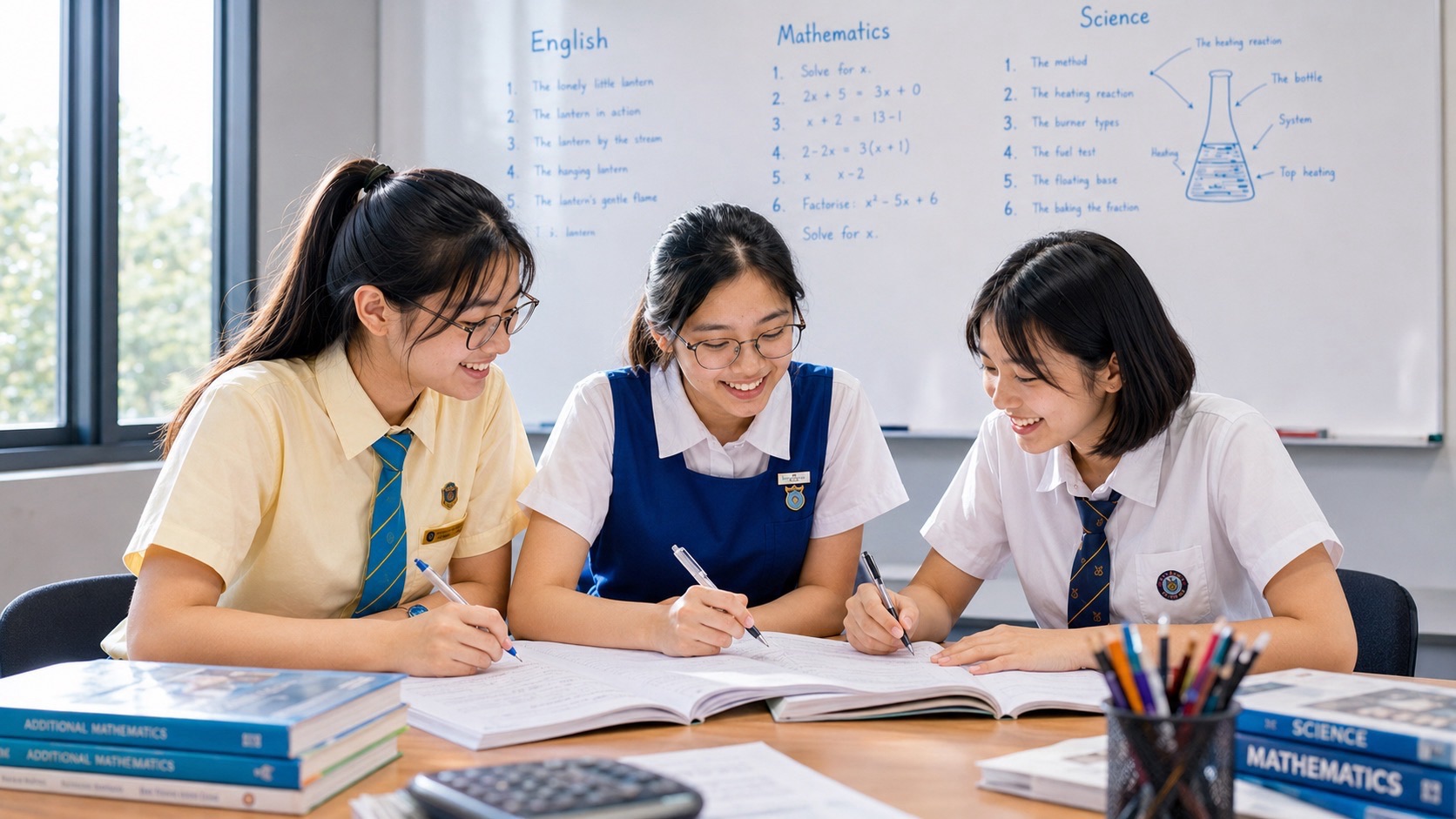
Ahmad Ibrahim Secondary School is at 751 Yishun Avenue 7, Singapore 768928, and its historical 2026 Secondary 1 Posting Group 1 (PG1) admitted PSLE Score range was 25–28. The final posted Score 28 came from pupils who sat PSLE in 2025 and entered secondary school in 2026; it does not guarantee a place for the 2027 intake. Families from Punggol should confirm the child’s actual eligible Posting Group, use MOE SchoolFinder and test travel to Yishun Avenue 7. The school’s 2026 handbook lists Yishun and Canberra MRT as transport options and buses including 800, 811, 812 and 965. School choice is about appropriate learning and a manageable day, not a previous cut-off alone.
The school’s distinctive programmes bring together IMPACT—Critical Social Inquiry and Media Literacy—Outdoor Learning Experience (OLE), and a selected Enhanced Music Programme. IMPACT uses Humanities as its anchor to investigate real societal issues, with Secondary 1 experiences such as Dialogue in the Dark and an Interdisciplinary Learning Day at Yishun Park, and Secondary 2 forum theatre, debate and Code for Fun. The Outdoor Learning LLP provides inclusive outdoor experiences, including for visually impaired pupils, with further selected Outdoor Leader training. The school is also one of four Singapore schools offering an Enhanced Music Programme and a lower-secondary preparatory route. Under Full Subject-Based Banding, PG1 is admission while G1, G2 and G3 are individual academic subject levels. This guide explains the programme distinctions, family decision points and what to verify for 2027.
- Campus: Ahmad Ibrahim Secondary, 751 Yishun Avenue 7, Singapore 768928
- 2026 historical PG1 admitted range: 25–28; final posted score 28
- 2027 school places follow the next MOE posting exercise, not an old cut-off
- School motto: With Integrity and Compassion
- School has a history of inclusive education for visually impaired pupils dating to 1967
- ALP: IMPACT, Critical Social Inquiry and Media Literacy, with Humanities as its anchor
- IMPACT inquiry cycle: Understand Context, Define, Ideate, Prototype, Test, Reflect
- IMPACT refers to UN SDG 11 Sustainable Cities and Communities and interdisciplinary thinking
- Sec 1 Tier 1 examples: Dialogue in the Dark and Yishun Park Interdisciplinary Learning Day
- Sec 2 Tier 1 examples: Forum Theatre, Debate Workshop and Code for Fun
- Selected ALP extensions: Model United Nations, Mandai Action for Wildlife, Future Land Planner
- LLP: Character Development through Outdoor Learning Experience (OLE)
- OLE includes broad PE, environmental learning, hiking, cycling, kayaking and outdoor cooking under school supervision
- Tier 2 OLE trains selected Outdoor Leaders including risk identification and service
- School’s selected Enhanced Music Programme is offered at upper secondary for suitable pupils
- Music Preparatory Course in lower secondary has a listening, performance and interview selection
- Open House announced for 14 November 2026, 8:30 am–12:30 pm; check current instructions
- PG1 is different from an individual academic subject taught at G1/G2/G3
- Verify eligibility, current class arrangement, joining documents and the long Punggol–Yishun journey
Reviewed 6 November 2026. Historical score ranges do not guarantee 2027 admission. Individual school programme, subject allocation and selected music or outdoor opportunities require official confirmation.

Contents: Ahmad Ibrahim PG1, IMPACT and Outdoor Learning
- 1. Definition lock: PG1 admission is not the same as G1 study
- 2. What the historical 2026 PG1 range 25–28 means
- 3. How PSLE Score 25 can affect Posting Group choice
- 4. The additional English and Mathematics eligibility rule
- 5. The correct campus on Yishun Avenue 7
- 6. The namesake and the school motto
- 7. An early history of inclusive schooling
- 8. What IMPACT teaches
- 9. Critical social inquiry as a method
- 10. Media literacy is part of responsible citizenship
- 11. IMPACT and sustainable cities
- 12. Step one: understand the context
- 13. Step two: define the problem
- 14. Step three: generate ideas
- 15. Step four: prototype a response
- 16. Step five: test with appropriate feedback
- 17. Step six: reflect and refine
- 18. Dialogue in the Dark at Secondary 1
- 19. Yishun Park interdisciplinary learning
- 20. Forum Theatre for Secondary 2
- 21. Debate and fair arguments
- 22. Code for Fun within IMPACT
- 23. Tier 2: Model United Nations
- 24. Mandai Action for Wildlife
- 25. I Am a Future Land Planner
- 26. Outdoor Learning Experience as the LLP
- 27. Tier 1 outdoor learning for the cohort
- 28. Inclusive OLE for visually impaired students
- 29. Hiking and navigation skills
- 30. Cycling and decision-making
- 31. Outdoor cooking and responsibility
- 32. Kayaking and water safety
- 33. Tier 2 Outdoor Leaders
- 34. Risk assessment and Outdoor Leader training
- 35. Khatib Bongsu mangrove experience
- 36. Community feedback and public spaces
- 37. Enhanced Music Programme
- 38. Lower-secondary Music Preparatory Course
- 39. Music studies, creating and performing
- 40. Concerts, masterclasses and mosAIc
- 41. DSA and ordinary school posting
- 42. G1 English and Humanities inquiry
- 43. G1 Mathematics and social data
- 44. Mother Tongue and individual subject strengths
- 45. School support and the WeBreathe Room
- 46. The 14 November 2026 Open House
- 47. Books, devices and financial help
- 48. A fictional pupil learns through IMPACT
- 49. A fictional pupil learns safe outdoor leadership
- 50. Comparing Ahmad Ibrahim with closer schools
- 51. Your next step for the 2027 intake
Definition lock: PG1 admission is not the same as G1 study
Posting Group 1 is one of the routes used during national Secondary 1 school posting after PSLE. G1 is an academic syllabus standard for an individual subject under Full Subject-Based Banding, alongside G2 and G3. A pupil entering Ahmad Ibrahim Secondary through PG1 may have different strengths in Science, language, media, sport and music. Shared form-class experiences exist alongside subject-level academic lessons.
Keep the actual PSLE eligibility notice, formal school posting result and subject timetable as separate documents. A child may enjoy making a presentation but need support with written comprehension, while another may have strong Mother Tongue skills yet struggle with ratios. Those are teachable needs, not evidence that the child’s entry group defines their future abilities.
What the historical 2026 PG1 range 25–28 means
The reported 2026 Secondary 1 PG1 admitted range at Ahmad Ibrahim Secondary was 25–28, reflecting pupils who completed PSLE in 2025. The score of the last admitted pupil was 28. This is a historical outcome based on applicants’ choices and places in that completed exercise; it is not a fixed admission promise for the class entering in 2027.
Parents should label the intake year beside every historical score. A child with the same score in another year may face different demand and tie-breaking. MOE’s current rules determine posting. A responsible shortlist includes several schools where the pupil can learn and belong rather than one school treated as certain because of a previous number.
How PSLE Score 25 can affect Posting Group choice
Under the national framework, a pupil with PSLE Score 25 may be eligible to choose between PG1 and PG2. This affects the school-entry category and initial academic expectations. The family should consider individual subject strengths, learning readiness and the schools actually available instead of choosing a larger number solely for social prestige.
Ahmad Ibrahim’s historic PG1 range must not be used as a PG2 cut-off. Follow the official result notice and the current six-choice submission rules. If implications for subject standards are unclear, ask the primary school for an explanation. A suitable academic challenge helps the teenager learn independently rather than hide gaps behind a label.
The additional English and Mathematics eligibility rule
For pupils scoring 26 to 30 at PSLE, MOE’s PG1 eligibility also requires AL7 or better in English Language and Mathematics. This is important because a school score table on its own cannot establish every child’s Posting Group eligibility. The official individual result, subject conditions and national rules take priority over any informal online calculator.
Parents should confirm the actual eligibility before using Ahmad Ibrahim’s historical range to shortlist a school. A pupil who does not meet a national condition cannot obtain a place simply because the earlier school intake included students with the same aggregate. Admission and later subject-level decisions remain separate steps.
The correct campus on Yishun Avenue 7
Ahmad Ibrahim Secondary’s current contact page lists 751 Yishun Avenue 7, Singapore 768928. Its 2026 handbook identifies Yishun and Canberra MRT stations as nearby rail references and buses on Yishun Avenue 7 or Ring Road. It is not Ahmad Ibrahim Primary School, and its name should not be confused with other Yishun secondary institutions.
Punggol households may need a train and bus connection. Test the real weekday route to the correct gate at reporting time and after a late CCA. A longer trip affects sleep, meals and homework. No single travel time applies to every Punggol home, so school fit should include an actual route trial.
The namesake and the school motto
The school was named for Encik Ahmad Ibrahim, whose public service is described in its MOE Heritage Centre history. Its motto is With Integrity and Compassion. That combination offers a useful principle for studying community issues: information should be truthful, and an action should respect the people affected by it. The same idea can guide relationships and academic conduct.
Ask the pupil what it means to report a mistake honestly or listen to someone with an unfamiliar experience. A school motto is educationally valuable when the child practises it, not merely when the words are reproduced in an assembly. Integrity can coexist with uncertainty and the willingness to change an opinion.
An early history of inclusive schooling
In 1967 Ahmad Ibrahim Secondary became the first pilot school for an open education programme for blind pupils. Its current principal’s message and Heritage Centre record emphasise the continuation of inclusive education with visually impaired pupils learning alongside peers. This history helps explain why accessibility and empathy remain relevant to the school’s distinct programmes.
Parents should not infer that every student has identical needs or that a particular specialised accommodation is automatic. Families with an individual requirement should discuss it privately with authorised staff. Good inclusion involves listening, appropriate support and respect for different capabilities rather than using classmates as examples in a public school project.
What IMPACT teaches
The official July 2026 ALP page calls the programme IMPACT and describes Humanities as its central anchor. Pupils investigate people, places, societies and perspectives while connecting this inquiry with Science, Arts, Languages, Design and Technology and Mathematics. The purpose is to understand real issues and consider possible responses informed by evidence.
A PG1 student may recognise an important question while finding a lengthy text difficult. The programme can motivate careful reading and discussion, but teachers still provide subject-specific academic instruction. Ask what the pupil learned from evidence and whether the final claim is justified rather than judge the project only by its appearance.
Critical social inquiry as a method
Critical social inquiry asks whose experience is represented, what information is available and whether a claim holds under scrutiny. It is different from accepting the first explanation or using an emotional example as universal proof. An issue involving housing, transport or access to public space may have multiple legitimate considerations.
Parents can ask the teenager who is affected and what evidence supports a proposed explanation. Encourage thoughtful comparison and respect for differing perspectives. A good answer may acknowledge uncertainty instead of inventing a simplistic solution to a complex community problem.
Media literacy is part of responsible citizenship
Images, videos and persuasive headlines can shape what readers believe. The IMPACT programme’s media-literacy component helps pupils examine how information is constructed, whether the source is credible and what context may have been omitted. A striking picture can be genuine yet still present only part of a situation.
Ask the child where an online claim originated and which details can be checked. Avoid teaching reflexive distrust of everything. The aim is evidence-based discernment, including recognising when facts are well established and when the available information is limited.
IMPACT and sustainable cities
The ALP explicitly connects learning to the United Nations Sustainable Development Goals, especially SDG 11 on Sustainable Cities and Communities. This creates opportunities to examine practical questions about how people share space and resources in Singapore. The goal is not to claim that one Secondary 1 project can solve a large urban challenge.
Ask what aspect of the city the class researched and which group of people would benefit from a change. A responsible response may be small and measurable. Sustainability education becomes meaningful when pupils connect accurate information with the realities of different residents.
Step one: understand the context
The school’s human-centred design process begins with Understand Context. A student should identify who experiences the issue, how it developed and what information is missing. This is more useful than selecting a favourite gadget or social message before understanding the problem. Different stakeholders may see the same situation differently.
Parents can ask what the class observed and who was consulted. The pupil should be able to distinguish something heard from a person from an assumption made about them. Accurate context is foundational to ethical design and good Humanities reasoning.
Step two: define the problem
After understanding the context, pupils define the problem they can meaningfully address. A claim such as “the city has problems” is too broad for a class project. A clearer problem statement identifies a particular task, audience or barrier, allowing possible solutions to be compared and evaluated.
Ask the child to state the issue in one clear sentence and explain why it matters. A precise definition can improve academic writing and group planning. The student should avoid describing an unsupported diagnosis or community need as an established fact.
Step three: generate ideas
The Ideate stage encourages multiple possible approaches before choosing one. A solution may involve improved information, a redesigned process or a simple physical aid, not only an app. Pupils can compare ideas for feasibility, cost, accessibility and whether the intended beneficiaries would want them.
Parents can ask what alternatives were considered and why the team chose one. A useful design does not need to be the most complicated. Learning to justify a choice is more valuable than repeating a teacher’s preferred idea without understanding.
Step four: prototype a response
A prototype allows the student to make an early version of a proposed response and reveal practical problems. It may be a poster, model, short video or digital interface. The first version is not a finished public service and should not be presented as professionally validated.
Ask what the prototype was intended to demonstrate and which assumptions remain untested. A pupil who can explain limitations has learned something important. Adult help should support safety and learning, not replace the child’s own design work.
Step five: test with appropriate feedback
Testing asks whether the prototype works under stated conditions and meets the intended need. A team may discover that instructions are confusing or that the solution creates extra work for users. The correct response can be revising the plan rather than claiming that the audience is wrong.
Parents can ask what feedback was gathered and whether it was relevant. A student should not invent survey data to make a project appear successful. Responsible inquiry includes acknowledging that the first test may not answer every question.
Step six: reflect and refine
The final Reflect stage encourages pupils to explain what they learned and which assumptions changed. Reflection makes a project educational beyond the finished object. It connects feedback, evidence, collaboration and possible further action. A student who identifies a weakness is not necessarily less successful than one who offers an overconfident conclusion.
Ask the teenager what they would do differently and why. Such reflection supports English writing, Science reports and respectful dialogue. The goal is learning to reason and adjust independently rather than simply winning approval for a first draft.
Dialogue in the Dark at Secondary 1
The official 2026 IMPACT diagram includes Dialogue in the Dark as a Tier 1 Secondary 1 experience. It can provide an appropriately guided opportunity to examine assumptions about visual impairment and accessibility. This activity should not be presented as a complete simulation of another person’s lived experience.
Parents can ask what the pupil learned from facilitators and how their understanding changed. Respect for people with visual impairments means listening to actual voices, not making assumptions after a short activity. The school’s inclusive history can make the lesson especially relevant.
Yishun Park interdisciplinary learning
The ALP also lists a Secondary 1 Interdisciplinary Learning Day at Yishun Park. An outdoor location may provide a setting for understanding the relationship between environment, community and everyday use of space. Students can gather observations from different subject perspectives rather than simply attend a recreational outing.
Ask which question the trip helped answer and what the pupil recorded. A particular park visit is a 2026 programme reference, not an unchangeable 2027 itinerary. The educational purpose is applying evidence across disciplines and explaining conclusions carefully.
Forum Theatre for Secondary 2
The Secondary 2 Tier 1 programme includes a Forum Theatre and Debate Workshop. Forum Theatre can allow students to examine choices and social relationships through a performed situation and discussion. Different actions may affect people differently, making empathy and reasoning central to the experience.
Parents can ask what alternative response the pupil proposed and why. A drama-based activity should encourage thoughtful analysis rather than ridicule or a predetermined ideological answer. Respectful disagreement and accurate explanation are valuable skills.
Debate and fair arguments
Debate teaches pupils to state a claim, use relevant evidence, anticipate an objection and respond respectfully. A confident speaker may still need help checking whether the supporting information is reliable. The purpose is to understand how an argument works rather than simply overpower an opponent.
Ask what the student learned from the other side’s strongest point. A thoughtful response may modify a position after hearing evidence. This skill is useful in Humanities and ordinary school discussions regardless of the pupil’s subject level.

Code for Fun within IMPACT
The Secondary 2 IMPACT Tier 1 includes Code for Fun, connecting digital tools with wider problems and human needs. Coding can help students understand how instructions produce an output, while social inquiry helps them decide whether that output is useful to people. Neither element alone guarantees a responsible design.
Ask what problem a program was intended to address and how the result was checked. A pupil who discovers and repairs a logic error may develop confidence in Mathematics and Science. The actual 2028 tools for a 2027 entrant may change.
Tier 2: Model United Nations
The ALP’s selected Tier 2 opportunities include Model United Nations. Such a simulation can introduce pupils to international issues, research and respectful negotiation. It requires understanding the assigned position and being able to explain evidence rather than merely delivering a dramatic speech.
A new PG1 pupil should not be promised a selected delegate role. Ask about current entry requirements, preparation and time commitments. Broad ALP learning remains valuable without participation in a specialist extension.
Mandai Action for Wildlife
Another IMPACT Tier 2 opportunity is Mandai Action for Wildlife. This can help interested students connect environmental and social inquiry with conservation questions. Effective advocacy should use accurate information about habitats and species instead of emotional statements unsupported by evidence.
Parents can ask what pupils researched and how they considered the needs of the community and environment. The school determines actual availability and partnerships. A selected programme is an extension, not a guaranteed visit or career pathway.
I Am a Future Land Planner
The IMPACT infographic also lists I Am a Future Land Planner among sign-up opportunities. This is a natural context for thinking about Singapore’s limited land, public needs and how competing priorities are weighed. Students can learn that an appealing idea might have practical trade-offs for other users.
Ask the teenager which stakeholders would be affected and what additional data would be needed before proposing a change. Urban planning is complex; a class exercise should develop reasoning rather than claim a professional planning qualification.
Outdoor Learning Experience as the LLP
Ahmad Ibrahim Secondary’s Outdoor Learning Experience, or OLE, is the school’s Learning for Life Programme. The official July 2026 page describes three connected domains: Outdoor Education, Personal and Social Development, and Environmental Awareness. The programme has operated since 2005 and was subsequently recognised by MOE as a distinctive LLP.
A child does not need to be a competitive athlete to benefit. The school uses suitable outdoor learning to develop resilience, cooperation, care and a connection with the environment. Physical challenge is valuable when it is appropriately supervised and reflective.
Tier 1 outdoor learning for the cohort
OLE Tier 1 extends the national Physical Education and Outdoor Education curriculum. Pupils can encounter a range of activities that develop movement skills, decision-making and environmental awareness. The programme emphasises broad developmental access rather than selecting only the strongest performers.
Parents can ask what their child is expected to learn at a particular level and what safety support is provided. An outdoor lesson is not a test of fearlessness. A pupil who follows instructions and helps others is demonstrating meaningful progress.
Inclusive OLE for visually impaired students
The school explicitly states that OLE aims to provide opportunities for visually impaired pupils to participate and grow alongside peers. This is a significant distinction from assuming that outdoor education must involve a single identical task for everyone. Suitable adaptations can help students learn teamwork, confidence and responsibility.
Parents should discuss any specific health or access requirement through appropriate school channels. Do not assume a child’s condition from the school programme or another pupil’s participation. Inclusion involves listening and safe planning, not treating people as publicity examples.
Hiking and navigation skills
OLE may include hiking and outdoor route activities where pupils practise awareness of surroundings, preparation and responsible group movement. These can help students become more independent while appreciating the environment. A route should be managed according to the school’s actual age, safety and supervision arrangements.
Ask what the pupil did when a teammate was confused about directions and how the group remained safe. Outdoor education should build confidence based on competence, not pressure young people into risky shortcuts.
Cycling and decision-making
Cycling is among the OLE examples listed by the school. Suitable cycling instruction can teach balance, route awareness, coordination and safe judgment. A teenager who has not cycled before may need a different learning progression from an experienced cyclist, and school staff determine appropriate arrangements.
Parents should not send the pupil on unsupervised busy-road cycling as preparation for a future lesson. A safe educational experience includes listening to instructions and recognising personal limits. Confidence grows through appropriate practice.
Outdoor cooking and responsibility
Outdoor cooking can teach planning, food hygiene, teamwork and attention to equipment. The task involves preparing materials, following steps and leaving a space responsibly. It can also reveal the importance of clear instructions and reliable division of work within a group.
Ask the teenager what safety rule mattered and how the team cooperated. Do not reproduce unfamiliar camping equipment or open-fire tasks at home without qualified guidance. The educational outcome should include responsible habits rather than just producing a meal.
Kayaking and water safety
Kayaking appears among the OLE activities described by Ahmad Ibrahim. A supervised experience can teach communication, cooperation and the need to assess conditions carefully. It should not be treated as evidence that every child will undertake an identical water route or be safe without trained instruction.
Parents can ask what participants learned about safety and how the group responded to changing conditions. Avoid arranging independent kayaking solely to imitate a school programme. The school controls the actual activities and consent process.
Tier 2 Outdoor Leaders
OLE Tier 2 provides additional opportunities for students with interest and aptitude to become Outdoor Leaders. They may develop skills in facilitating activities, event management and supporting peers. This is selected development rather than a universal appointment for every Secondary 1 pupil.
Ask the school what actual training and selection apply. A child can participate meaningfully in broad outdoor education without a formal title. More demanding responsibility is appropriate when the student is prepared to consider others’ safety as well as their own.
Risk assessment and Outdoor Leader training
The school’s OLE page says selected Outdoor Leaders learn about the Risk Assessment Management System, or RAMS. Students consider hazards and reasonably practicable ways to reduce risk. This is an important leadership skill because enthusiasm alone is insufficient when an activity involves physical or environmental uncertainty.
Parents can ask what a leader should check before an event and when they would seek staff guidance. A teenager who identifies an unsafe condition and reports it is acting responsibly, not failing to be adventurous.
Khatib Bongsu mangrove experience
Ahmad Ibrahim describes a selected outdoor leadership experience at Khatib Bongsu with partners including Nee Soon East Community Centre and the People’s Association. Pupils may kayak in mangrove areas, clean up litter and consider ideas for responsible public use. This is an example of joining environmental awareness with practical community contribution.
The programme is not an automatic excursion for every PG1 pupil. Parents can ask what participants learned about habitat protection and safety. A genuine clean-up involves proper handling and respect for the environment rather than merely taking photographs.
Community feedback and public spaces
The school’s OLE encourages pupils to consider how natural or urban areas might be used by the community. Students can learn that access, ecology and public safety must be balanced. An idea may sound attractive until the group considers maintenance or the needs of different users.
Ask what evidence led to the proposal and whether the pupil recognised a trade-off. A classroom project is not a government planning approval. The useful learning is thoughtful citizenship and the capacity to discuss uncertainty.
Enhanced Music Programme
Ahmad Ibrahim is one of four Singapore schools offering MOE’s Enhanced Music Programme. The official July 2026 page describes a two-year upper-secondary programme for students with musical potential, aptitude and sustained passion. The school serves as a G3 Music Centre and provides opportunities involving studies, creating and performing.
A new PG1 entrant should not assume automatic access to G3 Music or Higher Music. Relevant selection and academic requirements apply. Parents can ask what preparation would be useful while the child develops foundational subject learning.
Lower-secondary Music Preparatory Course
The school offers a Music Preparatory Course, or MPC, for interested lower-secondary students. The official page describes selection exercises involving a listening test, performance audition and interview. This helps pupils develop towards more demanding music study if appropriate.
A teenager may enjoy general music without joining MPC. Parents should consider whether the pupil likes regular practice and is ready for the extra commitment. A successful audition is separate from admission to the school through PG1.
Music studies, creating and performing
The Enhanced Music curriculum groups learning into Music Studies, Creating and Performing. A pupil can develop understanding of musical traditions, write or arrange work and learn how to communicate through performance. Such experiences require careful listening and repeated practice, not only natural confidence.
Ask which musical decision the child made and how feedback changed it. A selected programme should deepen genuine interest while remaining compatible with core academic work. Participation does not guarantee a professional music career.
Concerts, masterclasses and mosAIc
The school describes musician masterclasses, concert-going and performance opportunities such as lunchtime showcases and its biennial mosAIc arts concert. Selected pupils may also participate in collaborative projects with other institutions. These provide rich experiences but may vary by year and are not guaranteed to all students.
Ask what the teenager learned about preparation and teamwork. A performance award is one possible recognition, while improvement in independent musical understanding can be valuable even without public acclaim.
DSA and ordinary school posting
The school’s 2026 DSA information includes talent areas in sport, music, leadership and media literacy. Direct School Admission has its own application, assessment and national academic eligibility conditions. Ordinary school entry via PG1 is processed separately, and joining a CCA after enrolment is not a retrospective DSA offer.
In November 2026, the earlier DSA application window for entry in 2027 has passed. Families should follow actual DSA results and commitments if any, or prepare the regular S1 school preferences. No private portfolio service can guarantee a school place.
G1 English and Humanities inquiry
A pupil studying G1 English may enjoy investigating a community issue while struggling to read long sources or organise an argument. IMPACT can motivate careful reading and speaking, but it does not replace explicit academic teaching of comprehension, vocabulary and writing structure.
Ask the child to identify a claim, one relevant source and a limitation, then explain the connection independently. If a step is missing, help repair it rather than provide an adult-written essay. Clear thinking is an outcome that can be practised at the actual subject level.
G1 Mathematics and social data
Inquiry into city issues can involve distances, quantities, graphs and percentages. A child at G1 Mathematics needs a secure understanding of these foundations to avoid drawing the wrong conclusion from data. A visually striking chart may mislead if its scale is unclear.
Parents can ask what each number measures and whether a comparison is fair. If a concept is weak, target that skill. Success at a media project does not automatically qualify a child for another Mathematics level; formal readiness and school criteria apply.
Mother Tongue and individual subject strengths
A pupil who enters through PG1 may have stronger Mother Tongue than English or Mathematics, or another uneven profile. Full SBB can recognise individual subject standards when the criteria permit. Interest in environmental study or music is not a reliable basis for determining all academic levels.
Encourage suitable reading and conversation while seeking teacher feedback on actual comprehension or writing needs. A more demanding course should match readiness and a manageable week, not adult anxiety about status.
School support and the WeBreathe Room
The school’s history records the creation of the WeBreathe Room, a student centre associated with its current campus and welfare approach. Such facilities can be part of a wider system of student support, but they should not be treated as an automatic individual therapy entitlement or a substitute for appropriate professional care.
Parents with a concern should use official school communication and provide specific observations. A pupil’s Posting Group is not a diagnosis. Appropriate support depends on what the child actually needs and the school’s available procedures.
The 14 November 2026 Open House
Ahmad Ibrahim’s 2026 admissions page announces an Open House on Saturday 14 November, from 8:30 am to 12:30 pm. Families can investigate its ALP, outdoor education, selected music pathways and school culture. Verify the latest details and any registration instructions before travelling to Yishun Avenue 7.
Ask what every Secondary 1 student experiences and what requires selection. Let the teenager ask about a real interest. Open-house attendance informs a choice but does not reserve a school place or override MOE posting.
Books, devices and financial help
The school publishes current booklist, uniform, personal learning device and financial-assistance guidance through official parent resources. New Secondary 1 families should use the actual 2027 subject-level timetable and joining instructions before buying. An older cohort’s textbook may not match a pupil’s G level.
Where costs create difficulty, ask the school about relevant MOE assistance. PG1 is not an income category. Good preparation includes correct materials, meals, transport and a stable study routine rather than speculative purchases of specialist musical or outdoor equipment.
A fictional pupil learns through IMPACT
Imagine a Punggol child who enjoys discussing community issues but struggles to support written opinions with evidence. The family investigates Ahmad Ibrahim’s IMPACT programme, checks PG1 eligibility and knows that the 2026 last posted score is not a promise for 2027. They test the commute before ranking the school.
If allocated, a supervised inquiry may help the pupil distinguish an observation from a claim and practise short evidence-based explanations. This is a fictional scenario, not a testimonial or guaranteed 2027 lesson. It illustrates how meaningful interests can support academic learning.
A fictional pupil learns safe outdoor leadership
Another imaginary student is nervous about an unfamiliar outdoor task but follows the instructor’s directions and helps a classmate who feels unsure. The group makes an appropriate adjustment and completes the activity safely. The child discovers that leadership sometimes means asking for help rather than taking more risk.
This illustrative scenario reflects OLE’s character aims without claiming a real named student completed it. Personal growth can occur alongside academic study at G1 or another eligible subject level.
Comparing Ahmad Ibrahim with closer schools
A Punggol family may compare Ahmad Ibrahim with schools in Sengkang, Hougang, Sembawang and Yishun. Its combination of social inquiry, inclusive outdoor learning and specialist music may suit a teenager with those interests. A different child may benefit from a shorter commute or another programme theme.
Use consistent criteria: actual posting eligibility, what ordinary students learn, what requires selection, academic support, CCA demands and travel. Historical cut-offs should be clearly dated. A useful shortlist contains schools the family would genuinely accept.
Your next step for the 2027 intake
Confirm the child’s actual PG1 eligibility, including any relevant English and Mathematics subject conditions, and check Ahmad Ibrahim’s current SchoolFinder profile. Review IMPACT, Outdoor Learning Experience and Enhanced Music selection information. Test a morning and late-afternoon journey to 751 Yishun Avenue 7 and consider the announced Open House.
After formal posting, follow the school’s actual timetable, individual subject levels, booklist and joining instructions. Encourage the teenager to ask teachers for feedback, participate responsibly and develop independent routines. PG1 is the starting route, while the lasting value of school is growing understanding, judgment, confidence and compassion.
Frequently Asked Questions
Where is Ahmad Ibrahim Secondary?
751 Yishun Avenue 7, Singapore 768928.
What was the historical 2026 PG1 cut-off?
The last admitted score was 28 in the range 25–28.
Does PSLE Score 28 guarantee entry in 2027?
No. Historical ranges do not promise future school places.
What extra rule affects PG1 scores 26–30?
MOE requires AL7 or better in both English and Mathematics for eligibility in that band.
What is IMPACT?
The school’s Humanities-anchored Critical Social Inquiry and Media Literacy ALP.
What is the IMPACT process?
Understand Context, Define, Ideate, Prototype, Test and Reflect.
What is Dialogue in the Dark?
A documented Secondary 1 ALP experience encouraging reflection on visual impairment and inclusion.
What other IMPACT experiences are listed?
Yishun Park learning, Forum Theatre, debate, Code for Fun and selected Model UN or conservation activities.
What is the Outdoor Learning Experience?
The school LLP building character through outdoor education, personal development and environmental awareness.
Does OLE include visually impaired students?
The school explicitly describes an inclusive approach with suitable opportunities and support.
Are all pupils Outdoor Leaders?
No. Tier 2 Outdoor Leaders are selected and receive further training.
What is the Enhanced Music Programme?
A two-year selected upper-secondary music programme; Ahmad Ibrahim is one of four offering it.
How does a child join MPC?
The school describes listening, performance and interview assessments for the preparatory course.
When is the 2026 Open House?
14 November 2026, 8:30 am–12:30 pm, subject to the current school notice.
Does PG1 mean every subject remains G1?
No. Individual levels and changes follow Full SBB conditions and school arrangements.
What should Punggol parents do first?
Confirm eligibility, current MOE information, programme fit and actual travel.
Official Sources and Related Guides
- Ahmad Ibrahim official address and contacts
- IMPACT ALP, July 2026
- Outdoor Learning Experience LLP, July 2026
- Enhanced Music Programme and MPC, July 2026
- Ahmad Ibrahim Open House and DSA information
- School history and inclusive education
- MOE Heritage Centre school history
- Booklist, uniform and financial-assistance FAQ
- Historical 2026 PG1 admission range (independent)
- MOE SchoolFinder
- MOE S1 Posting
- Related: Yishun Secondary PG1 guide
Your next step: Check the child’s genuine PG1 eligibility and current SchoolFinder profile, compare IMPACT, OLE and suitable Music options, and test the daily journey from Punggol before ranking schools.


