
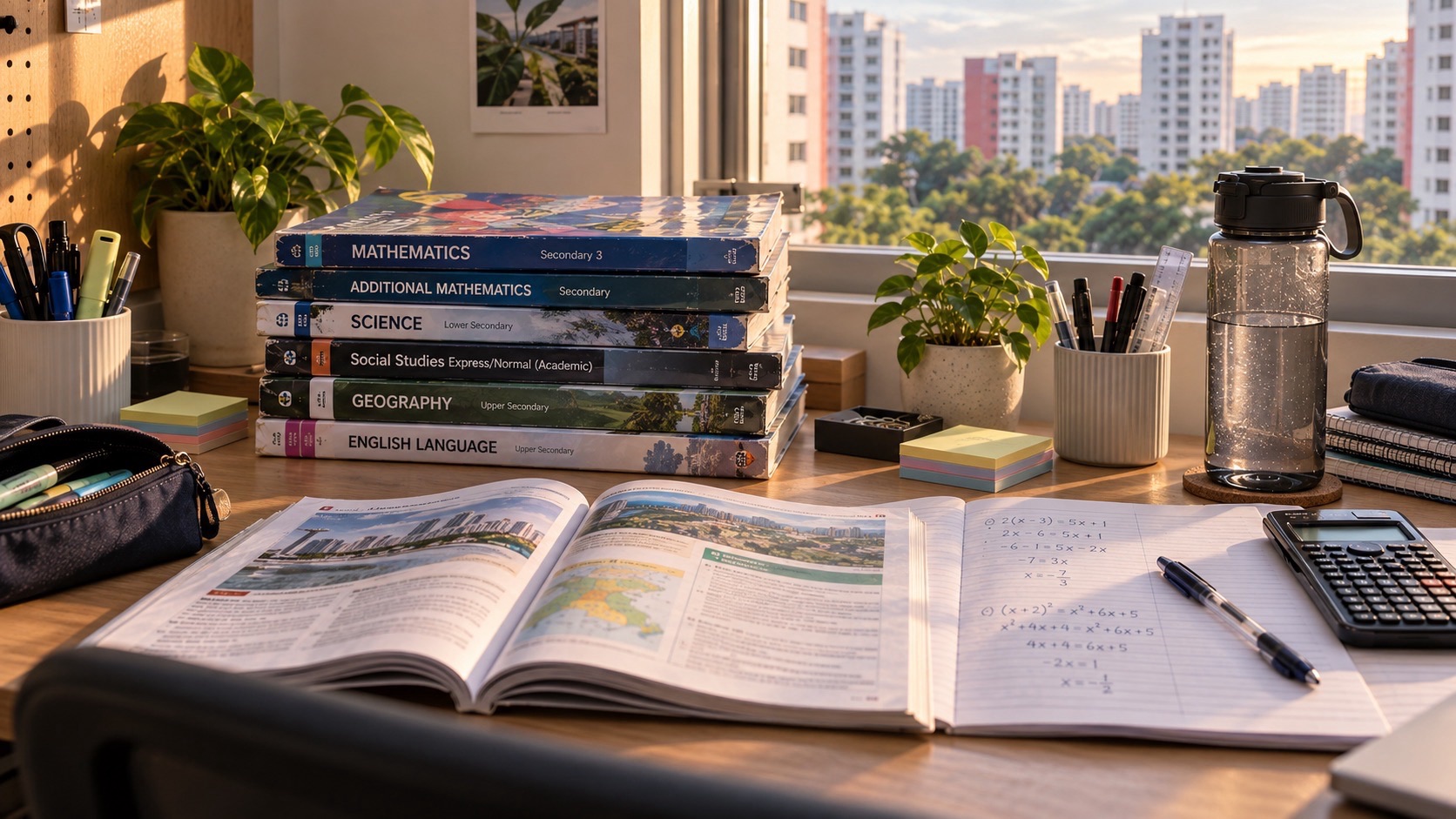
G3 Mathematics in Singapore is a full secondary-school Mathematics subject under Full Subject-Based Banding. The 2027 Singapore-Cambridge Secondary Education Certificate (SEC) syllabus code is K310, replacing the earlier O-Level Mathematics reference code 4052. Candidates answer two 2-hour-15-minute written papers, each worth 90 marks and 50% of the subject. Paper 1 has about 26 short-answer questions. Paper 2 has nine or ten questions of varying lengths and its final question focuses specifically on a real-world context. An approved calculator may be used in both papers, but essential written working is still required.
For Punggol families, the essential change is not simply that questions become longer. G3 Mathematics asks pupils to connect arithmetic, algebra, geometry, data and practical decisions, then check whether an answer makes sense in its setting. A student can calculate a percentage correctly yet misunderstand what the original amount was; another can solve an equation but forget to state the units of a journey time. This guide explains what happens inside K310, how Paper 2 works, how to use a calculator responsibly and what parents should look for in marked solutions. It describes the 2027 syllabus; a child who graduates in 2028 must check the later-year document.
- 2027 G3 Mathematics syllabus: SEC K310, former GCE O-Level reference 4052.
- Paper 1: about 26 short-answer questions, 2 hours 15 minutes, 90 marks, 50%.
- Paper 2: nine or ten questions, 2 hours 15 minutes, 90 marks, 50%.
- The final Paper 2 question specifically applies Mathematics to a real-world situation.
- The syllabus has three broad strands: Number and Algebra; Geometry and Measurement; Statistics and Probability.
- Approved calculators are permitted in both papers, but mathematical method and working matter.
- Use three significant figures or one decimal place for angles in degrees, unless the question specifies otherwise.
- Real-world settings may include travel, schedules, household finance, graphs and practical measurement.
- Posting Group 3 (PG3) is an entry arrangement; G3 describes the level of this subject.
- Check the student’s actual examination year and the official school-issued syllabus before planning revision.
Quick answers before the long explanation
- What happens in Paper 2? A longer sequence of questions ending with a real-world application.
- Can students use calculators in Paper 1? Yes, an approved model is permitted.
- Is G3 Mathematics the same as A-Math? No; K310 Mathematics and K341 Additional Mathematics are separate subjects.
- Why are marks lost when the final number is right? Essential method, working, accuracy and interpretation still matter.
- What should a parent do first? Look at the learner’s last marked solution and identify the first step that went wrong.
G3 Mathematics belongs to a subject-level system, not a permanent stream
In Full Subject-Based Banding, G3 refers to General 3 standard for an individual subject. Posting Groups guide initial placement after PSLE; students may subsequently study different subjects at levels suited to strengths and readiness under school rules. A student in PG2 can in some circumstances offer a more demanding subject level. A student initially admitted through PG3 should still consider the demands of individual subjects, the school’s progression criteria and the child’s actual learning needs.
The right question is not “Is the student clever enough for G3?” It is “Which prerequisites are stable, and what kind of support will allow this pupil to explain and solve current G3 work?” A pupil who understands geometry but makes repeated errors with negative fractions needs a different plan from one who is accurate with routine exercises but cannot model a word problem. Do not confuse syllabus labels with a diagnosis.
What the 2027 K310 papers really look like
Both papers last two hours fifteen minutes and carry ninety marks each, with equal weighting. Paper 1 is approximately twenty-six short-answer questions. Paper 2 comprises nine or ten questions of varying marks and lengths, and its final question focuses on a real-world setting. Candidates are required to answer all questions. Thus a pupil should not revise only one comfortable strand in the hope that it will dominate an optional section.
The paper structures suggest two complementary skills. Paper 1 demands accurate retrieval and execution across a broad range. Paper 2 demands sustained method, communication and the ability to combine ideas when a question has several parts. A mark-losing error may happen when a student misreads a graph before any calculation begins. Practise reading the question as carefully as performing the algebra.
The three strands are a map of relationships
K310 organises content under Number and Algebra, Geometry and Measurement, and Statistics and Probability. These are not isolated drawers in which methods never cross. A scale-drawing problem may use ratio, conversion and geometry. A cost comparison may use percentages, graphs and numerical estimation. A probability task may require organising information in a table before counting outcomes.
Teach the child to sketch a concept map using three large headings. Place previous errors beneath them. Then draw connections: rates involve division and units; algebra lets us represent rates; graphs display the relationship; statistics summarise observations. This makes it easier to notice when a long question is ordinary Mathematics expressed in unfamiliar language. The reader needs a system of ideas, not a catalogue of formulas to memorise at speed.
The calculator can evaluate a number but cannot choose the model
The 2027 K310 syllabus permits an approved calculator in both Paper 1 and Paper 2. That does not make Paper 1 a calculator-only paper or remove the requirement for mathematical reasoning. A calculator will correctly return 80 divided by 0.8. It cannot decide whether the eighty dollars in the question refers to a price before or after a discount unless the pupil understands the words.
Use the calculator after writing an expression or identifying the relation. For a twenty-percent discount leaving a final price of $80, the original price is 80 / 0.8 = $100. A student who multiplies eighty by 1.2 gets $96, a plausible-looking but incorrect value because the base is wrong. Ask the learner to reverse-check: 20% of $100 is $20, leaving $80. The machine is a checking tool, not a substitute for meaning.
Working can matter even when the final answer is correct
SEAB states that omitting essential working can cost marks. Students sometimes see this as a handwriting rule, but it reflects something important: a mathematical answer should be justified. For a simple equation, record the relevant transformation, not just a result that might have come from guessing. For a multi-part problem, show which values were used and which calculation corresponds to each step.
Suppose a solution requires converting 54 km/h to metres per second. Write 54 × 1000 / 3600 = 15 m/s, rather than only “15”. That one line records the unit conversion and makes an incorrect factor visible. However, excessive decorative steps do not make reasoning better. The goal is a short, traceable method another person could check. Train explanations at home with new numerical values rather than copying a model answer word for word.
Significant figures: precision is a decision, not decoration
For non-exact numerical answers the K310 notes call for three significant figures, or one decimal place for angles in degrees, unless a question specifies something different. Exact forms and required units may change what a final answer should look like. Rounding intermediate steps too aggressively can produce a misleading final result. If the task asks to prove an answer to a specified accuracy, the working should show greater precision before rounding.
A useful home method is to box the requested form before calculation: exact, two decimal places, three significant figures, nearest whole number, or one decimal degree. Keep sufficient internal precision, then round once at the end. Compare 0.004736 to three significant figures: 0.00474. The leading zeros are not significant. A child who understands the rule can explain why a digit has been kept, not just push the calculator’s rounding function.
Read units before looking for an equation
Many G3 problems are difficult because the quantities use different units. A train journey, a water meter and a scale model can all involve coherent arithmetic built on incompatible measurements. If a distance is in kilometres and time is in minutes, write the units beside the values before calculating speed. When using area, remember that changing a length scale affects area quadratically.
Try an original example. A cyclist moves 2.5 km in ten minutes. The average speed is 2.5 / (10/60) = 15 km/h. Converting to m/s gives 15 × 1000 / 3600, approximately 4.17 m/s. If the learner reports “15 m/s” without conversion, the arithmetic may be clean but the statement describes a much faster trip. Units are part of the answer’s meaning; they often expose an implausible result quickly.
Percentages: the hidden question is ‘percentage of what?’
Percentages belong to the Number and Algebra strand, including reverse percentages. Many wrong answers are not caused by weak multiplication but by misunderstanding the reference quantity. A 10% rise followed by a 10% fall does not return to the original value. Starting from $100, the increase yields $110 and the subsequent decrease yields $99 because the second ten percent applies to $110.
Ask the pupil to label the base in every sentence: original price, discounted price, previous year’s figure or current total. In a household-finance problem, distinguish a fee added before a discount from one applied after it. For example, 10% service charge followed by 9% tax is a sequential computation under a hypothetical simplified exercise, not proof of how a real receipt must calculate every component. Use the assumptions stated in the question and avoid importing unstated rules.
Ratio and proportion connect maps, recipes and staffing
Direct proportion means one quantity changes in a consistent multiple of another under the stated model. Inverse proportion means their product remains constant under the stated conditions. Students sometimes memorise “direct means multiply; inverse means divide” and then use the slogan without deciding which model is plausible. A careful explanation says which factors are being held constant.
Suppose three equally efficient workers need eight hours for a task and the total work is fixed. Under the simplified model, six equally efficient workers need four hours. This does not automatically predict a real construction project: coordination, safety and equipment can change the relationship. For map scales, a 1:10,000 length scale means one centimetre represents 100 metres, not 10,000 metres. Give the child a reasonableness check before trusting the number.
Algebra begins with translating what a sentence means
A variable should represent a quantity that has been defined. “Three fewer than twice a number” translates to 2x – 3, not 3 – 2x. The mistake is linguistic as much as algebraic. Define x, read the relationship, form the expression, and test it with a simple trial value. That procedure is useful in linear equations, formula changes and other algebraic contexts.
One original practice question: a club charges a $12 fixed joining fee and $4 per session. Let n be the number of sessions, so total cost C = 12 + 4n. If a fictional student pays $44, then 12 + 4n = 44, giving n = 8. Substitute to check: 12 + 4 × 8 = 44. The pupil should identify why the fixed fee is not multiplied by n. A correct expression describes the situation, not merely produces the expected number.
Graphs are statements about quantities, not pictures
When a graph’s vertical axis measures distance and the horizontal axis measures time, the slope has a different meaning from a graph showing speed against time. A student who sees a flat distance-time segment may correctly infer no change of position; a flat speed-time segment indicates constant speed, not necessarily no movement. Interpret the axes first, then connect the shape to the relevant quantity.
Practise with hypothetical Punggol travel data but do not present it as official service information. If a journey record shows cumulative distance 0 km at 8:00, 2 km at 8:10 and 2 km at 8:15, the second interval indicates no additional distance in that simplified record. The first ten minutes average 12 km/h. Ask whether a real journey might involve detours or measurement gaps. Modelling starts by stating what the graph measures and what the data do not prove.
Geometry needs exact properties and useful diagrams
A geometry question may mix angle facts, parallel-line properties, triangle relationships, similarity, area and mensuration. A sketch is only a reasoning aid unless the question explicitly tells the pupil the figure is drawn to scale. Students who measure a printed angle by eye may confuse appearance with mathematical evidence. Mark known angles, equal sides, parallel lines and requested quantities before calculating.
For a simple triangle with two angles of 48° and 67°, the third angle is 180° – 48° – 67° = 65°. Write the angle-sum reason, not only a subtraction. In a multi-step quadrilateral problem, the student might need several related facts. Ask the learner to name each property when using it. The method will then remain understandable even if the diagram is rotated or drawn in an unfamiliar orientation.
Mensuration is a chain of shape, formula and units
Finding area and volume requires choosing the right geometric object, reading its dimensions and using the correct units. A rectangle’s area has square units. A cuboid’s volume has cubic units. A pupil who gets the numerical calculation right but writes metres instead of cubic metres is reporting the wrong kind of quantity. The first step is not entering numbers into a calculator; it is identifying the measurement being requested.
For a fictional study-space floor that measures 3.2 m by 4.5 m, the area is 14.4 square metres. If carpet tiles cover 0.8 square metres each with no cutting loss, the ideal minimum by area is 18 tiles. In practice, shape, wastage and packaging may matter. That last sentence illustrates an important distinction: the mathematical model gives an answer under assumptions, while a practical purchase decision checks more constraints.
Probability: a count is only as fair as its sample space
Probability questions often become difficult when events have been counted inconsistently. If a fair six-sided die is rolled once, the probability of an even outcome is 3/6 = 1/2. If two dice are involved, there are thirty-six equally likely ordered outcomes under the standard independent fair-dice model, not twelve. The sample space must match the experiment.
Students should label outcomes and justify assumptions. A school sports game may not use independent equally likely events even if it sounds like a dice question. For a fictional event with ten red and five blue identical tokens mixed fairly, the chance of red on one draw is 10/15. If a token is not replaced, later probabilities may change. “Without replacement” is not a decorative phrase; it changes the system being counted.
Statistics helps readers resist misleading claims
The syllabus includes Statistics and Probability, which helps students organise data, compute and interpret suitable summaries, and read distributions and visual displays. A bar chart can exaggerate an apparent difference through its scale. A sample may not represent a whole population. An average can be influenced by extreme observations. These are not merely examination gotchas; they are habits for reading claims about products, public issues and everyday choices.
Try a fictional survey of four travel times: 10, 11, 12 and 47 minutes. Their mean is 20 minutes, while the median is 11.5 minutes. The mean is not a lie, but it hides the fact that three journeys were much shorter. Ask what question the average is supposed to answer and whether the unusual observation is relevant. A mature mathematical response explains the limitations of a summary, not just its formula.
The final Paper 2 question: convert a situation into a model
SEAB identifies the last Paper 2 question as specifically focused on applying Mathematics to a real-world scenario. It may integrate several strands and require interpreting the result. This does not guarantee a particular topic, story or monetary amount. Students should learn a robust process: identify the decision, extract givens, state assumptions, form relationships, calculate, check units and explain the conclusion in context.
Imagine two fictional transport options. Option A has a fixed fee of $3 and a usage fee of $1.50 per trip. Option B has a fixed fee of $12 and a usage fee of $0.75 per trip. For n trips, A = 3 + 1.5n and B = 12 + 0.75n. Solving equality gives n = 12. At fewer than twelve trips A is cheaper; at more than twelve, B is cheaper under the stated model. This task tests algebra and interpretation together. In real life, eligibility, validity and additional charges would also matter.
Know when a numerical answer is reasonable
A numerical answer can be algebraically consistent and still implausible because of a unit conversion, transcribed number or wrong base quantity. A mathematical sense-check uses rough estimates, limiting cases or reverse substitution. If a grocery question suggests one apple costs several thousand dollars, the student should reread the assumptions before submitting it. If an average speed exceeds any speed shown in the data under a simple journey model, check the graph interpretation.
After every extended question, ask three things: Does the answer have the right kind of unit? Does its magnitude make sense? Does it answer the question asked? This takes less time than restarting the full solution and often identifies the exact mistaken step. Parents can cultivate these checks using ordinary purchases or travel planning without presenting household decisions as official examination data.
Answer order and pacing should protect the whole paper
A 135-minute paper with 90 marks yields a rough average of 1.5 minutes per mark, but this is only a planning heuristic. Reading, revisiting and checking also consume time, and a complex short part may require more than a simple calculation. Pupils should follow the school’s exam strategy and adapt to question difficulty. A habit of spending half the paper on one stubborn step can sacrifice accessible marks elsewhere.
Practise marking a question as “needs return” if the method remains unclear after a reasonable attempt. Record any usable reasoning, move on, and return later. In a mock, review not only whether questions were solved but where time disappeared: slow reading, repeated calculator entry, unnecessary rewriting or hesitation to choose a model. The goal is measured control, not frantic speed.
The earliest mistake matters more than the last red cross
Take a marked four-step problem. The last answer is wrong, but the final arithmetic may be correct relative to a misread first value. If a pupil reworks the final line repeatedly, the root cause remains. Use an error trail: first misinterpretation, first invalid transformation, first numerical slip, or last-stage presentation problem. Each calls for a different repair.
For example, a student reads “a 25% increase from $80” as “25% of the new price” and forms the wrong equation. More calculator drills will not fix that. Another correctly forms an equation but mishandles a negative sign. That learner needs symbolic practice. A third has correct reasoning but writes an answer to two significant figures when three are required. Precision practice is the solution. Diagnosis should be specific enough to change next week’s work.
Four weeks of revision: foundations, transfer and timed proof
Week 1: collect three school-marked scripts, classify mistakes by Number and Algebra, Geometry and Measurement, and Statistics and Probability, then choose one unstable prerequisite. Week 2: practise that topic in both routine and worded settings. Week 3: combine topics through graph, finance, travel or geometry applications, with an emphasis on method and units. Week 4: sit selected timed questions, including an unfamiliar real-world task, and compare accuracy and reasoning against the baseline.
This is a model for diagnosis and improvement, not a claim that every student can master K310 in four weeks. Keep school lessons, CCA, sleep and other subjects visible. If the learner’s errors are concentrated in a single narrow topic, do not force a huge full-syllabus programme. If several prerequisites are missing, build in more time and ask the teacher where to begin. Progress is demonstrated by explaining and solving a changed question independently.
What a tutor should observe in a small-group tutorial
In a small group, a useful tutor listens to the student explain why a method was chosen. One pupil may need to rebuild the meaning of ratio; another may need to justify geometric steps; a third may have strong concepts but lose marks through rushed transcription. Giving all three identical difficult worksheets may look rigorous without addressing the different problem. Diagnosis is the core of responsible support.
Ask for specific evidence after a lesson: which misconception was identified, which example was used to repair it, and what fresh task showed progress. eduKate’s small-group tuition is available in Punggol, but tuition is not automatically necessary for every learner. A student progressing well with school support and sensible independent practice may not need another class. Sign up for Mathematics tuition only after the student’s starting position is clear.
How Punggol families can practise Mathematics in daily life
Punggol families can make mathematical reasoning tangible without using official transport or housing data. Compare hypothetical household budgets, estimate travel times, calculate unit prices and inspect axes on a public chart. Use realistic measurements but explicitly label invented prices and measurements as practice data. The objective is not to turn every family outing into homework; a five-minute question can teach the student to ask which quantities matter.
One exercise is to compare two fictional phone plans with different fixed and variable charges. Another is to estimate whether a furniture item fits through a rectangular doorway using dimensions provided on a drawing. A third is to ask whether a survey with a small self-selected sample justifies a general claim. Each exercise ends with a sentence explaining the conclusion and its assumptions. That explanation transfers directly to multi-step assessment tasks.
Examination year, school sequence and later pathways
A Secondary 4 student sitting the SEC in 2027 should use K310 for that examination year. A student in Secondary 3 during 2027 usually sits the 2028 SEC, so the 2028 official syllabus ultimately controls. Schools may teach topics in different sequences and may issue their own internal assessment schedules. Do not assume that a term-four test at one school must match a term-four test at another.
Future course entry depends on the candidate’s subject levels, grades and the published criteria of each institution. Mathematics matters for many routes, but one grade does not automatically secure a place in a chosen programme. When comparing pathways, use actual subject combinations and the current admissions guide. The most useful revision decision today is still concrete: Which part of the child’s present mathematical reasoning needs to become reliable next?
A decision table for common G3 Mathematics errors
- Correct formula, wrong units: return to dimensional analysis and write units through the calculation.
- Wrong percentage answer: identify the original/base quantity, then reverse-check.
- Correct arithmetic, weak real-world conclusion: add a sentence that interprets the result and names assumptions.
- Graph question wrong: read both axes, scale, units and graph type before calculating.
- Geometry conclusion unsupported: annotate the diagram and state the property used.
- Many marks lost by running out of time: review pacing, decision points and return strategy under timed conditions.
- Model answers copied successfully but new questions fail: test first principles with changed values and unfamiliar stories.
Frequently asked questions
What is the SEC code for G3 Mathematics in 2027?
It is K310. The earlier O-Level Mathematics reference was 4052. Use the actual examination-year syllabus and the school’s registered subject information. The clearest check is to show the student a different example and ask for an explanation of the method, rather than treat one remembered answer as proof of mastery.
How many G3 Mathematics examination papers are there?
Two papers, each 2 hours 15 minutes, 90 marks and 50% of the 2027 K310 grade. The clearest check is to show the student a different example and ask for an explanation of the method, rather than treat one remembered answer as proof of mastery.
Is Paper 1 a no-calculator test?
No. An approved calculator is permitted in both K310 papers. Students must still show essential working where appropriate. The clearest check is to show the student a different example and ask for an explanation of the method, rather than treat one remembered answer as proof of mastery.
What is special about Paper 2?
It has nine or ten questions of varying lengths; its final question focuses specifically on a real-world application. It may integrate ideas rather than ask one isolated routine computation. The clearest check is to show the student a different example and ask for an explanation of the method, rather than treat one remembered answer as proof of mastery.
Do candidates have optional questions?
The 2027 K310 scheme requires candidates to answer all questions in both papers. Follow the exact instructions in the examination paper. The clearest check is to show the student a different example and ask for an explanation of the method, rather than treat one remembered answer as proof of mastery.
Are exact answers always required?
No. The syllabus states the normal non-exact answer rule of three significant figures, or one decimal place for angles in degrees, unless otherwise specified. The clearest check is to show the student a different example and ask for an explanation of the method, rather than treat one remembered answer as proof of mastery.
Will a correct final number guarantee full marks?
Not necessarily. Essential working is assessed, and a question may require justification or interpretation. Show a readable method. The clearest check is to show the student a different example and ask for an explanation of the method, rather than treat one remembered answer as proof of mastery.
What is the difference between K310 and Additional Mathematics K341?
They are separate subjects. K310 includes Number and Algebra, Geometry and Measurement, and Statistics and Probability. K341 adds a more advanced algebraic, trigonometric and calculus curriculum. The clearest check is to show the student a different example and ask for an explanation of the method, rather than treat one remembered answer as proof of mastery.
What are examples of real-world Mathematics contexts?
SEAB names everyday plans, travel, sport, household finances, graphs and other applied situations. It does not promise a particular story or fixed topic for the final question. The clearest check is to show the student a different example and ask for an explanation of the method, rather than treat one remembered answer as proof of mastery.
What if my child understands algebra but loses marks in word problems?
Work on modelling: name the quantity, state the relationship, draw a table or diagram, then explain the answer. More equation drills alone may not repair interpretation. The clearest check is to show the student a different example and ask for an explanation of the method, rather than treat one remembered answer as proof of mastery.
Should a student memorise one method for every question?
Routine fluency is useful, but a new situation may require selecting and combining methods. Teach how and why an approach works. The clearest check is to show the student a different example and ask for an explanation of the method, rather than treat one remembered answer as proof of mastery.
Does G3 mean Posting Group 3?
No. G3 is a subject level, while PG3 is a posting group guiding initial secondary school placement. The clearest check is to show the student a different example and ask for an explanation of the method, rather than treat one remembered answer as proof of mastery.
Can a student entering Secondary 3 in 2027 use this guide?
Yes, as a conceptual explanation. However that student will normally sit the SEC in 2028 and should later check the official 2028 syllabus, code and examination arrangements. The clearest check is to show the student a different example and ask for an explanation of the method, rather than treat one remembered answer as proof of mastery.
Which mistakes should be repaired first?
Start with recurring prerequisites that affect many questions, such as algebraic meaning, ratio, negative numbers, units or reading the task. Use the school’s marked evidence. The clearest check is to show the student a different example and ask for an explanation of the method, rather than treat one remembered answer as proof of mastery.
Is private tuition compulsory for G3 Mathematics?
No. A pupil making sound progress may do well with school instruction and independent practice. Extra help should target a demonstrable need. The clearest check is to show the student a different example and ask for an explanation of the method, rather than treat one remembered answer as proof of mastery.
Official syllabus, sources and connected reading
SEAB: Secondary Education Certificate (SEC) · SEAB: G3 2027 subject list · SEAB: K310 Mathematics syllabus PDF
What is G3 Mathematics: full parent guide · Mathematics versus Additional Mathematics · G3 subject selection in Punggol
Reviewed against SEAB’s 2027 SEC Mathematics and Full Subject-Based Banding information in November 2026. Some examples contain invented prices and measurements and are clearly learning exercises, not actual public fares, service rules or product prices. Always use official current-year documents for examination registration and schedules.


