
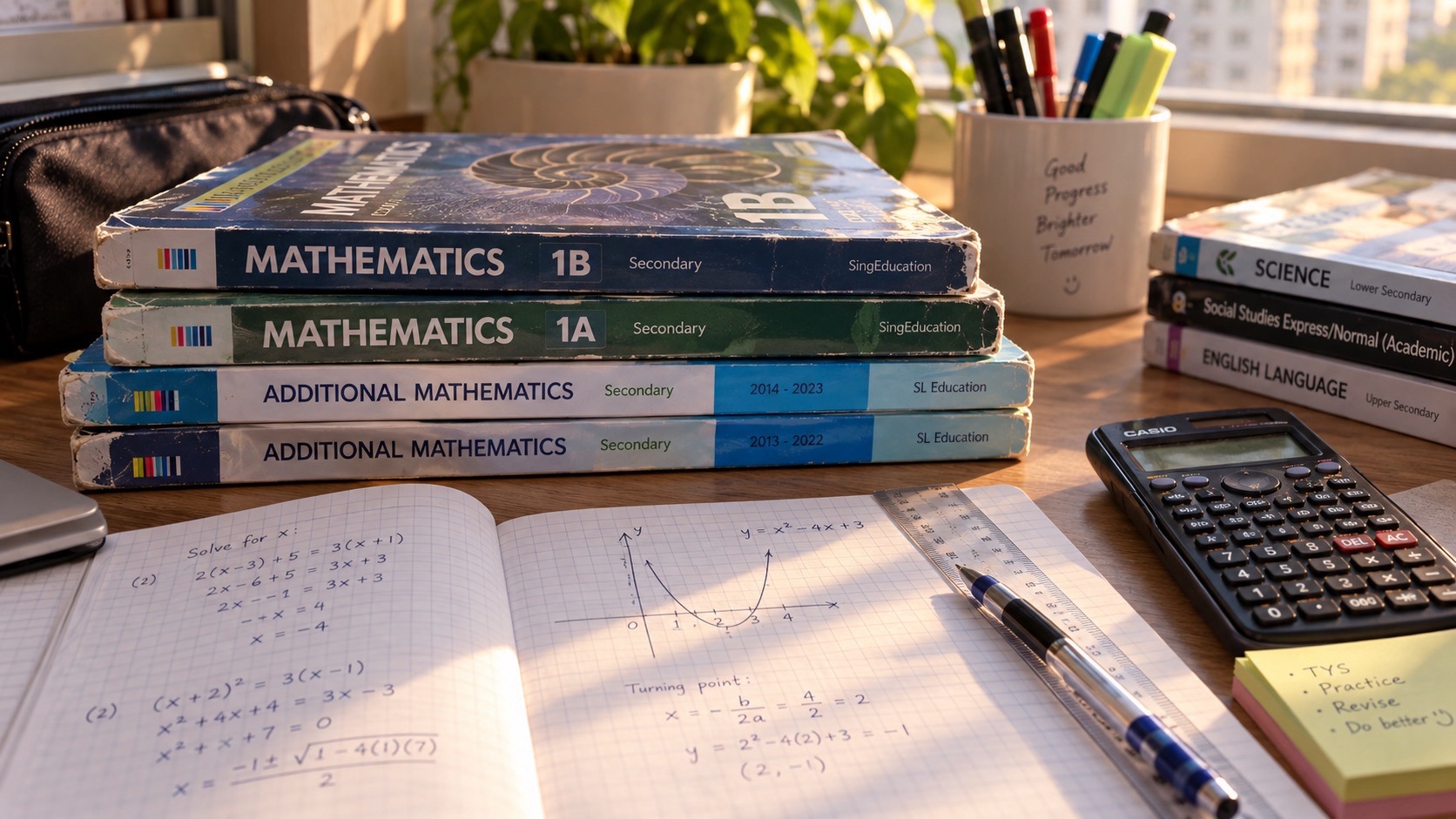
G3 Additional Mathematics is a separate upper-secondary subject, not merely a more difficult chapter within ordinary G3 Mathematics. The 2027 Singapore-Cambridge Secondary Education Certificate (SEC) subject code is K341, replacing the earlier O-Level reference 4049. The syllabus assumes knowledge of G3 Mathematics and develops three connected strands: Algebra, Geometry and Trigonometry, and Calculus. Candidates sit Paper 1 and Paper 2, each lasting two hours fifteen minutes, each worth 90 marks and 50% of the final subject grade. Approved calculators may be used in both papers, but the essential steps of reasoning must be written.
For Punggol students choosing or already taking Additional Mathematics, the central question is readiness. Can the student manipulate algebra reliably, understand why a graph has a certain shape, and explain each transformation rather than memorise its appearance? A child may be diligent and still find A-Math difficult when the underlying meanings of fractions, indices, factorisation or function notation are unstable. This guide explains what actually happens when school Mathematics develops into quadratics, logarithms, trigonometric identities and calculus, how to repair gaps, and how families can judge workload without confusing subject choice with prestige. Its official paper details refer to 2027; check the 2028 syllabus for a later graduating cohort.
- SEC 2027 G3 Additional Mathematics: K341, former O-Level Additional Mathematics 4049.
- Two written papers, each 2 hours 15 minutes and 90 marks; each counts for 50%.
- Paper 1: 12–14 questions of varying length, with up to 10 marks per question.
- Paper 2: 9–11 questions of varying length, with up to 12 marks per question.
- All questions must be answered; approved calculators are allowed in both papers.
- Three strands: Algebra; Geometry and Trigonometry; Calculus.
- Topics include quadratics, equations and inequalities, surds, polynomials, partial fractions, logarithms, trigonometry, differentiation and integration.
- G3 Mathematics knowledge is assumed and may be needed within A-Math questions.
- Showing essential working matters; normally round non-exact results to three significant figures unless instructed otherwise.
- A-Math availability, selection and promotion requirements depend on the actual school’s subject combination rules.
Answers parents usually need first
- Is A-Math compulsory for every G3 student? No. It is a separate subject taken where the school offers it and the pupil meets criteria.
- Does A-Math replace ordinary Mathematics? No: they are different subjects, and the A-Math syllabus assumes G3 Mathematics foundations.
- What is calculus? A way to describe rates of change and accumulation using derivatives and integrals.
- Why do students lose marks even after calculator checks? A mistaken model, invalid algebra or missing working can survive a numerical check.
- Should we buy a 2027 assessment book for a 2028 candidate? Only after checking the correct later-year syllabus and the book’s actual coverage.
A-Math is a choice of subject, not a verdict on intelligence
The word “Additional” can make the subject sound like a status badge, but the curriculum exists for a practical reason: it prepares learners for more advanced mathematical reasoning and supports later studies that rely on algebraic fluency. The official K341 introduction describes a foundation for H2 Mathematics. That is a curricular aim, not a guarantee of entry into any particular future course. Student readiness, interest, school access and overall workload should govern the decision.
Parents can ask three questions before enrolling: Does the teenager enjoy solving unfamiliar algebra problems? Can they sustain an explanation when a method fails at first? Are there current gaps in G3 Mathematics that will make every A-Math lesson more expensive in effort? A pupil who needs to repair negative numbers or basic factorisation may benefit from strengthening that foundation before taking on more advanced topics. The school must confirm its own offering and entry requirements.
G3 Mathematics and G3 Additional Mathematics have different jobs
The 2027 K310 Mathematics syllabus covers Number and Algebra, Geometry and Measurement, and Statistics and Probability, including applied problem-solving. K341 Additional Mathematics concentrates on Algebra, Geometry and Trigonometry, and Calculus with a more specialised technical depth. Students do not simply move from K310 to K341 by answering the same questions faster. They learn new kinds of functions, proofs, transformations and rates.
For example, K310 may require solving a standard quadratic equation or interpreting a graph in context. In K341, a student may study the discriminant, investigate whether a line touches a parabola, or use differentiation to determine a turning point. The topics are related, but the demand changes from applying a known relationship to analysing how relationships behave. An ordinary Mathematics weakness can therefore reappear inside a more advanced task.
How the examination papers are arranged
The K341 assessment has two written papers with equal weight: ninety marks and two hours fifteen minutes each. Paper 1 contains twelve to fourteen questions of varying lengths, with at most ten marks per question. Paper 2 contains nine to eleven questions, with at most twelve marks per question. Candidates must answer all questions. The examination description does not promise that calculus only appears in Paper 2 or that algebra only appears in Paper 1.
The sensible revision unit is a mathematical idea, not a guessed paper location. A well-prepared learner should recognise the concept in a short question and in a longer unfamiliar context. Practise presenting essential working; jumping from a question to the final numerical answer can lose marks even if the calculation happens to be correct. Review both decision-making and algebraic execution, since errors in either can break a multi-step argument.
The hidden first chapter is algebraic fluency
A-Math assumes that the student can handle algebraic expressions as objects with meaning. Distributing brackets, combining like terms, manipulating fractions and dealing with indices should not require slow guessing. Consider the expression (x + 2)(x – 3). Expanding gives x² – x – 6. The student should also be able to reverse the process, recognising x² – x – 6 as a product. This two-way control is central to later factorisation and rational algebra.
Do not treat a wrong expansion as an isolated careless error until the learner can explain why the four products appear. A reliable repair uses an area model or distributive property, then changes the expression: (x – 4)(x + 5) becomes x² + x – 20. If the pupil succeeds only on the original memorised example, the conceptual repair is incomplete. More difficult formulas should wait until these transformations feel traceable.
Quadratic functions are about shape, roots and conditions
A quadratic function has a curved graph whose key properties can often be revealed by factorisation, the quadratic formula or completing the square. Take the original example f(x) = x² – 6x + 11. Completing the square gives f(x) = (x – 3)² + 2. The graph therefore has a minimum value of 2 at x = 3. This is a statement about every real input, not a lucky value found by trial.
Now ask when f(x) = 0. Since the square is never negative, (x – 3)² + 2 cannot equal zero for a real x. The graph does not cross the horizontal axis. This connection between algebra and geometry makes quadratic conditions meaningful. A student who only knows a formula for roots may not see why the discriminant or completed-square form answers a shape question. Ask the child to explain the picture in words.
The discriminant tells a story about real intersections
For ax² + bx + c = 0, with a nonzero, the discriminant b² – 4ac distinguishes two real roots, one repeated real root and no real roots. It is useful when the question asks about the relationship between a straight line and a curve, without requiring every root to be written explicitly. This is exactly the kind of shift from computation to reasoning that makes A-Math distinctive.
Take x² – 4x + 4 = 0. Its discriminant is 16 – 16 = 0 and its repeated root is x = 2, matching the square (x – 2)². If the same expression represented the difference between a parabola and a horizontal line, equality could describe a tangent contact. Students should connect the algebraic condition to what it means on a graph. A correct discriminant calculation without interpretation may not answer the actual question.
Inequalities describe regions, not isolated answers
An equation identifies points where two expressions are equal. An inequality identifies a set of values where a relationship holds. Consider x² – 5x + 6 < 0. Factor the expression to (x – 2)(x – 3) < 0. For a positive-leading quadratic, the expression is negative between its real roots, so the solution is 2 < x < 3. A student who reports “x = 2 or 3” has solved the boundary equation but not the inequality.
Explain a sign chart by testing regions or connecting the factors to the graph. The endpoints are excluded for a strict inequality. For a non-strict inequality the boundaries may be included. Have the learner sketch a number line and test a value, such as 2.5, before submitting. The point is understanding a continuous solution set, not remembering which way to shade every possible diagram.
Surds preserve exact values until approximation is justified
A surd is an irrational radical expression that may be manipulated exactly. The common temptation is to enter a square root into a calculator, round early, and then manipulate an approximation as though it were exact. In algebraic questions this can conceal simplification or create avoidable error. The K341 syllabus includes operations with surds, rationalising denominators and solving related equations.
For an original example, 1 / sqrt(2) can be rewritten as sqrt(2) / 2 by multiplying numerator and denominator by sqrt(2). These expressions have the same exact value; one may be preferred in a final algebraic form. If a question calls for a decimal, evaluate at the end and apply the requested precision. Ask why each transformation preserves equality. A pupil who cannot explain the reciprocal rule may be pushing symbols rather than manipulating numbers correctly.
Polynomials and factor theorems create a bridge to deeper algebra
Higher-degree expressions can look intimidating because the pupil has no single familiar quadratic formula to apply. Polynomial division, the remainder theorem and the factor theorem help reveal structure. If a polynomial f(x) satisfies f(2) = 0, then (x – 2) is a factor, subject to the standard polynomial assumptions. This is not the same as saying every value of x is a root.
Use a small worked example: f(x) = x³ – 3x² – 4x + 12. Grouping gives x²(x – 3) – 4(x – 3) = (x² – 4)(x – 3) = (x – 2)(x + 2)(x – 3). The roots are 2, -2 and 3. The method illustrates structural recognition. Give a new polynomial with changed coefficients and ask for an appropriate factorisation route. Train the ability to justify, not merely reproduce the final product.
Partial fractions reverse the direction of combining fractions
In ordinary fraction work, a student often combines separate fractions into one expression. Partial fractions work in the other direction, decomposing a rational expression into simpler component fractions under appropriate conditions. This supports later calculus and algebra. It can feel unnatural until the pupil understands that different forms of the same expression make different operations easier.
For an original simple identity, 3 / ((x + 1)(x + 2)) equals 3/(x + 1) – 3/(x + 2) for x different from -1 and -2. Combining the right side gives 3[(x + 2) – (x + 1)] / ((x + 1)(x + 2)), or the original expression. The domain restrictions matter because the expression is undefined at those values. Ask the child to verify by recombining; a rational expression is not complete reasoning without its restrictions when relevant.
Exponents and logarithms explain repeated multiplication
An exponential relation can describe repeated proportional growth under a model. A logarithm asks what exponent is required to reach a given value. For a positive base a other than 1, the statements y = a^x and x = log_a(y) are inverses for positive y. The K341 syllabus covers exponential and logarithmic functions, their graphs, laws and related models.
Take 2^3 = 8. The corresponding logarithmic statement is log base 2 of 8 = 3. Students should understand that the answer is an exponent, not the result of ordinary division. For a fictional savings or population model, repeated percentage change can lead to exponential form, but assumptions about constant growth must be explicit. An equation being solvable with logarithms does not prove that a real system keeps the same rate indefinitely.
Trigonometry grows into functions, not only triangles
Earlier trigonometry often focuses on ratios in a triangle. Additional Mathematics develops sine, cosine and tangent as functions across angles, including degrees and radians, graph transformations, periodicity, identities and equations. A learner who only knows “SOHCAHTOA” may struggle with graphs over several cycles or with negative angles. The expansion is conceptual: a trigonometric value describes an angle-dependent relationship with repeating structure.
Use the basic graph y = 2 sin(x) in degrees. Its amplitude is 2 and its period is 360 degrees. That does not mean every related graph has the same amplitude or period. If the inside angle changes to 2x, the period is halved under the standard sine model. Ask the student to justify this using repetition of the original sine cycle. The graph should be a representation of a function, not a decorative waveform.
Trigonometric identities must be proved as relationships
An identity is a relationship true for all permissible values of its variable, unlike an equation that may hold only for particular solutions. A central identity is sin²(x) + cos²(x) = 1. Students sometimes test it on a calculator at one angle and treat that single result as a proof. Numerical confirmation can support confidence, but proof requires valid transformations that establish the relationship generally.
When solving an identity question, start from one side, rewrite using known relationships and look for the target expression. Do not move across an equals sign by silently assuming the conclusion is already true. Ask where any denominator might be zero. For example, an identity involving tan(x) may exclude angles where cos(x) = 0. Mathematical precision includes the conditions under which statements are valid.
Coordinate geometry translates pictures into equations
In K341, lines and circles can be analysed through coordinate relationships. Parallel and perpendicular gradients, midpoints and circle equations turn a drawing into conditions that can be checked. For a circle centred at (2, -1) with radius 3, the equation is (x – 2)² + (y + 1)² = 9. The radius is three, not nine, because the right-hand side is the squared radius.
One useful reverse check is to substitute a supposed point on the circle. At (5, -1), the left side is 9, matching the equation. At (2, 1), it is 4, so that point is not on the given circle. The exercise helps the child connect algebra with distance. It also shows why brackets and signs matter: a minus sign inside the bracket corresponds to a positive x-coordinate of the centre.
Calculus begins with a question about change
Differentiation asks how a quantity changes locally as its input changes. At a point on a smooth graph, the derivative corresponds to the gradient of the tangent. In a physical model it can represent an instantaneous rate, such as how displacement changes with time. The 2027 K341 calculus strand includes derivatives, applications to gradients, stationary points, rates of change and optimisation.
Take f(x) = x². Its derivative is f'(x) = 2x. At x = 3 the tangent gradient is 6, while at x = -3 it is -6. The original output f(x) describes the height on the graph; the derivative describes the local slope. A pupil who treats f(3) = 9 and f'(3) = 6 as interchangeable has not yet understood what the derivative measures. Ask them to draw the curve and indicate increasing and decreasing regions.
The product, quotient and chain rules describe structure
Differentiation becomes more demanding when a function is built from several functions. The chain rule handles composition, while product and quotient rules handle multiplication and division of functions. Students often lose marks by differentiating the outside part but forgetting the inside rate, or by treating the derivative of a product as the product of derivatives.
For the original function y = (2x + 1)³, the chain rule gives dy/dx = 3(2x + 1)² × 2 = 6(2x + 1)². The inner derivative is 2. Ask the child to explain where it came from. Next change the inside to 5x – 4 and check whether the factor changes. A copied formula that only works with one inner expression is not a secure understanding of the rule.
Stationary points connect algebra, geometry and decisions
A stationary point occurs where the derivative is zero under appropriate differentiability conditions. It may be a maximum, a minimum or a stationary point of inflexion. A pupil who always declares “derivative zero means maximum” will misclassify some graphs. The second derivative or a suitable sign analysis helps distinguish cases under relevant conditions.
Using the earlier example f(x) = (x – 3)² + 2, the derivative is 2x – 6. It becomes zero at x = 3; the second derivative is 2, which is positive, confirming a local minimum. The function value there is 2. This combines completing the square and differentiation to give the same result. When two methods agree, the learner begins to see Mathematics as a coherent system rather than disconnected chapters.
Integration reverses differentiation and measures accumulation
Indefinite integration searches for a family of functions whose derivative is the given expression. For example, the integral of 6x – 4 with respect to x is 3x² – 4x + C, because differentiating the result gives 6x – 4. The constant C matters: adding a constant does not change a derivative. Missing it in an indefinite integral is a conceptual omission, not merely a notation issue.
Definite integration can measure signed area or accumulation between specified limits. The integral of 6x from x = 0 to x = 2 is [3x²] from 0 to 2, which is 12. Students should distinguish the variable of integration, the limits and what the resulting number represents. In geometry applications, the interpretation of a region below the horizontal axis may require care; signed integration and ordinary geometric area are not always identical.
Motion applications connect calculus to everyday observations
When a model gives displacement as a function of time, differentiation can yield velocity and acceleration; integrating velocity can recover change in displacement subject to conditions. This is meaningful when analysing a simple vehicle or moving object. It should not be used to claim exact travel performance from casual observations: real movement involves measurement noise, traffic variation and more complex forces.
Consider a fictional object with displacement s(t) = t² + 2t metres, where t is measured in seconds for t at least zero. Its velocity is v(t) = 2t + 2 metres per second and its acceleration is 2 metres per second squared. At t = 3, the model velocity is 8 m/s. The derivative’s unit changes because one differentiation is with respect to time. This is an elegant reason to teach units even in symbolic calculus.
A-Math mistakes often begin several chapters earlier
A learner may stumble on integration because of weak indices, fail a logarithm question because of algebraic rearrangement, or lose a trigonometric proof because of invalid fraction cancellation. It can be tempting to conclude the student lacks “calculus ability” when the real problem is more basic. Retrieve the first invalid step and trace which prerequisite made it likely.
For example, a child differentiates x^(-2) as -2x rather than -2x^(-3). The error is in applying the power law, not understanding every aspect of differentiation. Repair negative indices and then differentiate several new powers with positive, zero, fractional and negative exponents. The changed examples demonstrate whether the rule is understood. A good correction is small enough to target the cause, but important enough to repair future tasks.
Proof and explanation deserve their own practice time
K341 tests more than symbolic speed. The official assessment objectives include using techniques, solving problems in varied contexts, and reasoning and communicating mathematically. Showing a clear implication chain helps both the marker and the student locate mistakes. In a proof, the relationship must follow from the stated facts; a diagram that looks convincing is not sufficient evidence.
Make a habit of writing a short sentence alongside a key transformation: “Because the discriminant is negative, the quadratic has no real roots,” or “Differentiating gives the gradient function.” These statements anchor the symbols in meaning. Do not pad every line with words, but do not hide the important reasoning inside an unexplained leap. The aim is to make a complicated calculation inspectable.
Paper pacing: practise decisions under time limits
Each ninety-mark paper lasts 135 minutes, giving a rough average of one and a half minutes per mark. This is a heuristic, not a rule for how long each question must take. Some parts need only a quick transformation; others require extended reasoning. A student should be willing to record useful partial working, move on and return to a difficult part rather than allow one obstacle to consume the paper.
During practice, record why time was lost. Was it a misread condition, a slow algebraic expansion, an unrecognised identity, repeated calculator checks or inability to decide how to begin? The remedy varies. A pupil who knows the method but spends too long simplifying may need fluency. A pupil who cannot choose a method needs concept sorting. Timing everything indiscriminately may simply rehearse uncertainty at speed.
A four-week readiness and repair cycle
Week 1: inspect two school scripts, classify errors in algebra, trigonometry and calculus, and test foundation knowledge from G3 Mathematics. Week 2: rebuild one prerequisite and use it in new A-Math questions. Week 3: practise two mixed-topic tasks requiring method selection and written explanation; add one graph or physical interpretation. Week 4: sit a timed selection from both papers and compare the quality of reasoning and the ability to solve unfamiliar variations.
This short cycle is for targeted feedback, not completing the entire syllabus from scratch. Schools differ in topic sequence, and a Secondary 3 student may not yet have learned every calculus technique in the final-year syllabus. Follow the actual classroom sequence, protect sleep and CCA time, and repeat the diagnostic loop as necessary. The strongest sign of progress is an accurate explanation under changed numbers and a different problem story.
How Punggol families can evaluate subject workload
Additional Mathematics is one subject among the student’s commitments. Consider school Mathematics, science, humanities, languages, CCA and realistic travel and rest time before assuming that more revision hours are always better. A learner’s interest is significant: a child who enjoys abstract structure may find the challenge rewarding, while another with the same school marks may prefer a different combination aligned with future goals.
Ask the school’s year head or relevant teacher about the available subject combinations, local selection criteria and the consequences of changing a subject later. Avoid treating the example of one sibling or tuition classmate as a universal admissions rule. The family needs the official school-specific arrangement, the child’s readiness and the long-term options for the chosen combination. A healthy workload allows the teenager to keep learning, not merely survive the timetable.
What good support looks like if the learner needs help
A useful tutor identifies whether the problem is conceptual, algebraic, graphical or presentational. In a three-pupil class, one student may need completing-the-square foundations, another may require a meaningful explanation of derivative, and a third may be ready for extended multi-topic questions. Teaching all three the same formula at the same pace is not enough.
Ask the tutor to show a before-and-after example: the original error, the repaired principle and a new question completed independently. eduKate offers small-group tuition in Punggol, but families should seek it only when a genuine learning need is visible. Strong school teaching and sensible self-study can be sufficient for many pupils. Sign up for Additional Mathematics tuition only after the student’s starting position is clear.
Your examination year controls the exact rulebook
The K341 paper descriptions in this guide belong to the 2027 SEC examination. A student entering Secondary 3 in 2027 would ordinarily sit the SEC in 2028, so later official guidance takes precedence if the scheme or syllabus changes. Do not copy an older O-Level formula list or assume that a model worksheet matches a future examination code merely because the cover says A-Math.
School registration, subject access and final eligibility belong to the school and examination authorities. After SEC results, institutions assess the subject-level combination and grades against their current entry rules. A strong A-Math grade may be useful for future study, but it is not an automatic guarantee of any specific JC, polytechnic or other route. The best near-term decision is to build a reliable mathematical foundation and keep official pathways visible.
Parent decision guide: ask these before committing
- Which A-Math subjects and combinations does the actual school offer?
- What are the published eligibility and continuation criteria?
- Can the student expand, factorise and solve ordinary G3 algebra accurately?
- Does the student enjoy explaining a mathematical relationship, not just reproducing a formula?
- Are timetable, workload, CCA and sleep manageable together?
- Which post-secondary routes genuinely require or benefit from this subject?
- How will we check progress with fresh questions instead of copied corrections?
- If a subject-level change is considered, who in school can explain the official process?
Frequently asked questions
What is the G3 Additional Mathematics code for 2027?
It is SEC K341. The earlier GCE O-Level reference code was 4049. The evidence to seek is a correct explanation on a new problem and confirmation of the student’s school-specific arrangements, not a broad promise about the subject.
Is A-Math automatically included for all G3 students?
No. It is a separate subject, and school subject combinations and entry criteria must be checked with the school. The evidence to seek is a correct explanation on a new problem and confirmation of the student’s school-specific arrangements, not a broad promise about the subject.
Does Additional Mathematics replace G3 Mathematics?
No. K341 is distinct from K310, and its syllabus assumes knowledge of G3 Mathematics. The evidence to seek is a correct explanation on a new problem and confirmation of the student’s school-specific arrangements, not a broad promise about the subject.
How long are the K341 papers?
Two hours fifteen minutes each. Both carry ninety marks and fifty percent of the examination grade. The evidence to seek is a correct explanation on a new problem and confirmation of the student’s school-specific arrangements, not a broad promise about the subject.
How many questions are there?
Paper 1 has twelve to fourteen questions and Paper 2 nine to eleven, under the 2027 scheme. All questions are compulsory. The evidence to seek is a correct explanation on a new problem and confirmation of the student’s school-specific arrangements, not a broad promise about the subject.
Are calculators allowed?
An approved calculator may be used in both papers, but it does not replace justified algebraic working. The evidence to seek is a correct explanation on a new problem and confirmation of the student’s school-specific arrangements, not a broad promise about the subject.
What are the three syllabus strands?
Algebra; Geometry and Trigonometry; and Calculus. The topics interact, so revision should make connections between them. The evidence to seek is a correct explanation on a new problem and confirmation of the student’s school-specific arrangements, not a broad promise about the subject.
Does the course include calculus?
Yes. The 2027 syllabus includes differentiation, integration and applications such as gradients, rates, stationary points and motion models. The evidence to seek is a correct explanation on a new problem and confirmation of the student’s school-specific arrangements, not a broad promise about the subject.
Is calculus just memorising rules?
No. Students need to understand what a derivative or integral represents, then select and carry out valid rules. The evidence to seek is a correct explanation on a new problem and confirmation of the student’s school-specific arrangements, not a broad promise about the subject.
What if the pupil struggles with negative indices?
Repair the index laws and algebraic foundation first, then retry changed differentiation or simplification examples. The evidence to seek is a correct explanation on a new problem and confirmation of the student’s school-specific arrangements, not a broad promise about the subject.
Will correct answers without steps earn all marks?
Not necessarily. SEAB notes that omission of essential working leads to lost marks. The evidence to seek is a correct explanation on a new problem and confirmation of the student’s school-specific arrangements, not a broad promise about the subject.
Does Additional Mathematics guarantee H2 Mathematics or a particular JC?
No. The syllabus is designed to prepare for higher mathematics, but later admission depends on published institutional criteria, grades and combinations. The evidence to seek is a correct explanation on a new problem and confirmation of the student’s school-specific arrangements, not a broad promise about the subject.
Is PG3 the same as G3 Additional Mathematics?
No. PG3 is an initial school posting category; K341 is a particular G3 subject. The evidence to seek is a correct explanation on a new problem and confirmation of the student’s school-specific arrangements, not a broad promise about the subject.
What if the student is in Secondary 3 during 2027?
That pupil usually sits SEC in 2028. Use this guide for conceptual understanding and the official 2028 syllabus for final examination planning. The evidence to seek is a correct explanation on a new problem and confirmation of the student’s school-specific arrangements, not a broad promise about the subject.
How do parents know whether tuition is helping?
Ask for a specific diagnosed misconception and a fresh-task demonstration of improvement, not only a higher worksheet completion count. The evidence to seek is a correct explanation on a new problem and confirmation of the student’s school-specific arrangements, not a broad promise about the subject.
Official sources and eduKate reading route
SEAB SEC qualification overview · 2027 SEC G3 school syllabuses · Official K341 Additional Mathematics syllabus PDF
What is G3 Additional Mathematics? · Compare Mathematics and Additional Mathematics · Punggol subject choice and SEC planning
Reviewed against SEAB 2027 G3 Additional Mathematics and SEC guidance in November 2026. All practice problems here are original examples, not actual SEAB examination questions. Confirm year-specific changes, school course eligibility and post-secondary criteria with the responsible authority. The purpose of this guide is understanding, not selecting the supposedly most prestigious subject.


