
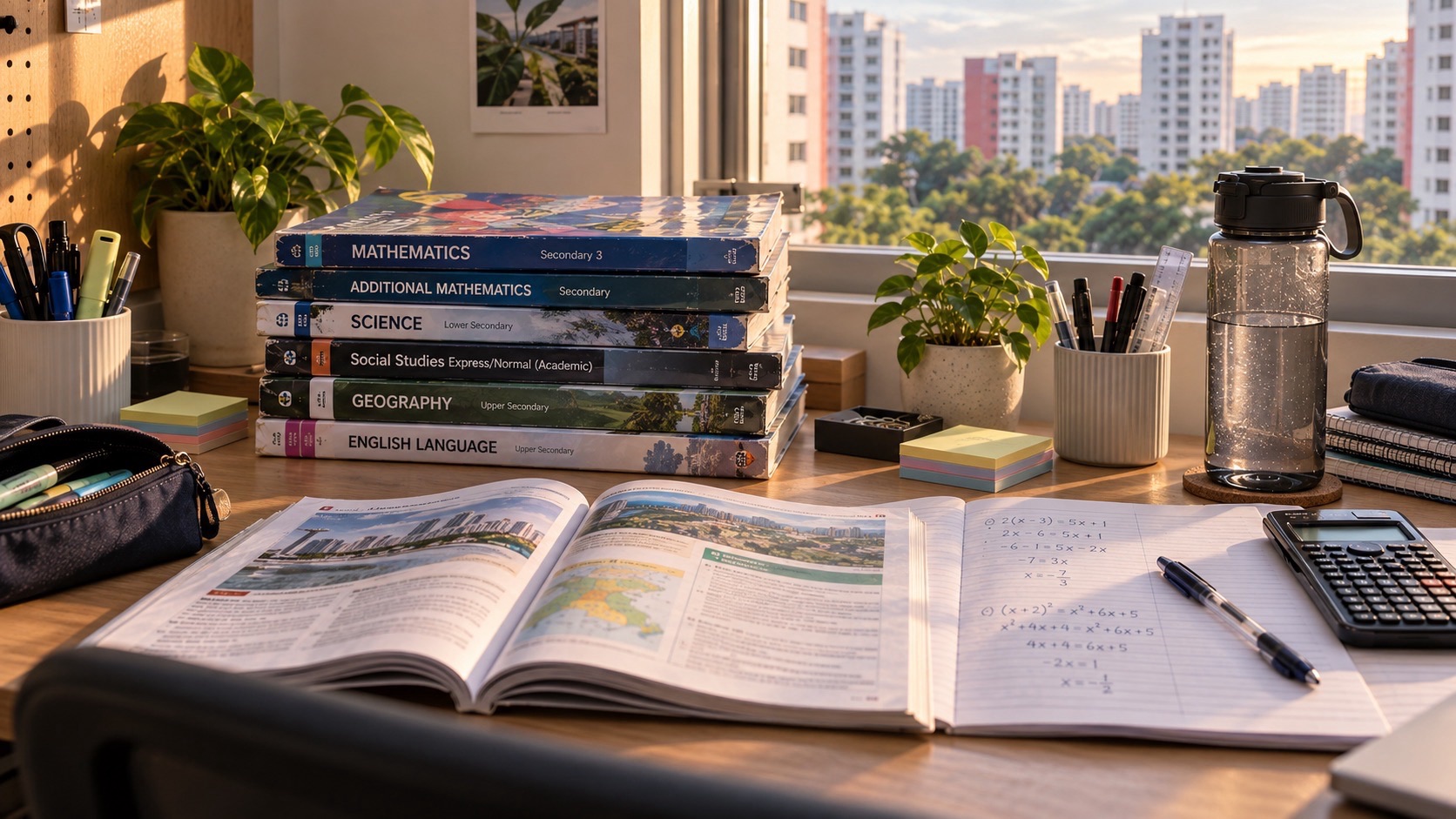
How PG1 works at Punggol for SEC G1 Mathematics depends on the child’s individual subject level, not merely the Posting Group used during Secondary 1 admission. Posting Group 1 is an admission arrangement under Full Subject-Based Banding (Full SBB), while G1 Mathematics is an academic subject with its own curriculum and examination syllabus. SEAB’s published 2027 Singapore-Cambridge Secondary Education Certificate (SEC) G1 Mathematics syllabus is K110. It has two examination papers, each lasting one hour and thirty minutes, carrying fifty marks and contributing fifty percent of the total. Paper 1 covers Number and Algebra with Geometry and Measurement, while Paper 2 covers Number and Algebra with Statistics and Probability.
For Punggol parents with children entering Secondary 1 in 2027, the most useful immediate step is to strengthen the child’s independent number sense, problem interpretation and clear working rather than begin full national-examination drills. A pupil beginning Secondary 1 in 2027 would ordinarily take the SEC in 2030, so the 2027 K110 document is a dated reference for the current system, not a guaranteed future paper format. SEAB’s 2027 requirements emphasise routine techniques, real-world applications and mathematical reasoning, with longer contextual questions at the end of each paper. Ask which concepts the child genuinely understands, where their first error occurs and whether they can use the method on an unfamiliar problem.
- PG1 and G1 are different: PG1 concerns admission; G1 Mathematics describes the subject level actually offered by the student.
- 2027 national reference: SEC G1 Mathematics K110, replacing the former reference code 4046.
- Paper 1: 90 minutes, 50 marks and 50% weighting; Number and Algebra plus Geometry and Measurement.
- Paper 2: 90 minutes, 50 marks and 50% weighting; Number and Algebra plus Statistics and Probability.
- Question structure: each paper includes roughly 11–13 short-answer questions and two longer real-world-context questions.
- Working: essential reasoning and working must be shown; an unexplained correct calculator result may not receive full credit.
- Formulae and equipment: relevant formulae are supplied; an approved calculator is permitted, and geometrical instruments are needed for Paper 1.
- Accuracy: follow specified accuracy instructions; the 2027 syllabus otherwise generally expects three significant figures for non-exact numbers and one decimal place for angles.
- Learning approach: teach concepts, show a method, practise, diagnose errors and transfer the skill to a fresh situation.
- 2027 versus 2030: children entering Secondary 1 in 2027 normally graduate in 2030; verify the actual future syllabus and school’s present curriculum.
- Local relevance: prices, distances, travel times, simple statistics and measurements can make Mathematics meaningful in everyday Punggol life.

What makes K110 a distinct Mathematics examination?
The national syllabus is not simply a collection of arithmetic exercises. It contains Number and Algebra, Geometry and Measurement, and Statistics and Probability. These strands develop knowledge that students can apply to practical situations. The scheme also identifies three types of assessment: use of standard techniques, solving problems in contexts, and communicating mathematical reasoning. The 2027 approximate assessment-objective weights are 65%, 30% and 5% respectively. This tells us that fluency matters, applications matter and explanations matter.
A student who can complete a routine percentages worksheet may still fail to interpret a discount question correctly. Another may know the area of a rectangle but choose perimeter when asked about fencing. The error is often conceptual or linguistic rather than a lack of effort. Parents should therefore study the child’s written reasoning as well as the final answer. The best preparation helps a learner recognise the mathematical relationship when the question looks unfamiliar, not only when it resembles the previous example.
Why the original Posting Group is not an entire mathematical identity
PG1 does not permanently define how a person thinks. Under Full SBB, a student may offer different subjects at different levels where the official eligibility criteria and school arrangements allow. A pupil who enters through PG1 could develop particularly strong Mathematics understanding while needing more support in another discipline. Alternatively, a child may be confident with language and less secure with algebra. These profiles are normal.
Parents should speak in terms of current learning rather than fixed labels. “You are learning to solve equations” identifies a skill that can improve. “You are a G1 kind of person” communicates an unhelpful judgment. Mathematical confidence grows through opportunities to understand and correct mistakes. The school can advise on the actual subject level and any future review. External tuition does not automatically change an official level; it can help the child demonstrate readiness through better learning.
The significance of the two equal paper weights
Paper 1 and Paper 2 each contribute fifty percent of the 2027 result. Parents sometimes concentrate solely on the first paper because geometry and routine calculations feel familiar. That approach leaves statistical interpretation and probability underprepared. Another family may focus on data and graphs while neglecting algebraic reasoning. The equal weighting means both sections deserve serious and balanced preparation as the national examination approaches.
At Secondary 1, a family need not split daily study into rigid Paper 1 and Paper 2 routines. The student is still developing the foundations the papers eventually draw upon. A sensible approach is to follow the school’s scheme of work, note persistent gaps and revisit earlier concepts regularly. When the student reaches the examination year, the current syllabus can guide more specific paper practice. Teaching order and exam-paper division are related, but they are not the same thing.
What Paper 1 actually includes
The 2027 Paper 1 contains 11–13 shorter questions typically worth two to four marks, followed by two longer questions worth about six to eight marks each. The short questions largely test familiar concepts without a substantial story context. The longer questions use realistic situations and require the student to identify which Mathematics is relevant. The paper’s topic strands are Number and Algebra together with Geometry and Measurement.
A child preparing for this paper needs reliable arithmetic, algebraic understanding, measurements, diagrams and interpretation. The parent can begin with a simple test: can the learner explain why a formula fits the situation? A rectangle’s perimeter describes the boundary, while its area describes a surface. Memorising both formulae is necessary but not sufficient. The child must know which real-world question each formula answers. That is the difference between recall and application.
What Paper 2 actually includes
The 2027 Paper 2 follows a similar pattern of shorter questions and two longer contextual questions. Its strands are Number and Algebra plus Statistics and Probability. Students need to calculate accurately, organise information, interpret graphs and reason about uncertainty. The paper also requires working and explanations where the question demands them. It is not simply a graph-drawing test.
An everyday example might use fictional weekly reading minutes for several pupils. The learner can calculate a mean, interpret a chart or decide what the numbers do not establish. A graph may show a pattern, but the pattern alone does not prove a particular cause. Such questions help students distinguish data from assumptions. This form of mathematical literacy matters in news, advertising, community planning and personal decisions, not only examinations.
The long contextual questions are an opportunity to teach transfer
Each 2027 K110 paper ends with two longer questions developed around contexts. These questions may require more than one topic and more than one step. Students who rely on chapter titles as instructions can become confused because a real-world problem does not announce which formula to use. Learning to translate information into a mathematical representation is therefore essential.
Teach a repeatable method: read the requirement, identify quantities and units, sketch or organise the relevant information, choose a relationship, calculate and interpret the result. Do not rush from the first number to the first operation. A pupil may know the correct arithmetic procedure but apply it to the wrong quantity. The long questions reward understanding of the entire situation, not simply fast use of a calculator.
Number sense begins before complex procedures
Number sense is the ability to understand quantities, order, relationships and plausible results. Can a student explain why 0.65 is greater than 0.6? Recognise that a quarter is smaller than a third? Estimate that two items costing just under twenty dollars each will total just under forty dollars? If these questions cause uncertainty, later topics may rest on weak foundations.
Use number lines, place-value explanations and simple concrete examples. A decimal such as 0.6 can be written as 0.60 to compare with 0.65. A child who understands tenths and hundredths does not need the misleading shortcut that more digits means a bigger number. Ask the learner to create another example and explain it independently. This demonstrates understanding rather than copying a worked answer.
Directed numbers have meaning
Negative numbers occur in temperatures, positions relative to a reference point and financial balances. Students may be able to recall rules for adding and subtracting negative quantities while lacking a mental picture of what the operations mean. A number line gives them a useful model. For example, moving from minus seven to minus three represents an increase of four units, even though the final number remains below zero.
The child should be able to describe a change in ordinary language, then represent it mathematically. Use clear contexts without forcing every situation into the same analogy. A negative bank balance and a negative temperature are different real phenomena, but both use a signed numerical scale. The mathematical concept transfers when the student understands the relationship rather than memorises a slogan.
Fractions explain parts of a whole
A fraction describes a relationship to a whole. Students who compare denominators mechanically may say that one eighth is larger than one quarter because eight is bigger than four. This reveals a misunderstanding of the unit fraction. Use a diagram or equivalent fractions to explain why dividing a whole into more equal parts produces smaller individual parts.
When the student can compare simple fractions, move to arithmetic with mixed denominators and real contexts. Ask what quantity represents the whole before calculating. A problem about sharing food or measuring a length can help, provided the numbers and assumptions are explicit. The purpose is not to reduce every fraction to pizza slices. It is to make the relationship understandable and transferable.
Decimals and percentages share place-value thinking
Decimals and percentages are closely linked ways of representing quantities. Ten percent can be expressed as 0.1, but students need to understand what is taken as the whole. In a discounted-price question, one number represents the amount removed and another the amount remaining. A child may compute the discount perfectly yet report it as the final price.
Teach the pupil to name the original amount, the percentage, the change and the final result before using the calculator. Then ask for a rough estimate. A discount on a $100 item provides an accessible first model, but the learner should eventually handle unfamiliar starting amounts. The key is recognising the relationship without being told which step comes next.
Ratio is about relative quantities
Ratio describes a relationship between quantities. If two kinds of objects appear in a ratio of 2:3, there may be five objects in the smallest whole-number example, but the actual total might be ten, twenty or another compatible amount. Students sometimes confuse the ratio with a fixed total. Use tables and diagrams to illustrate equivalent ratios.
A recipe can provide an example, but label it as a hypothetical scenario rather than a universal cooking rule. Ask how quantities change if the group size doubles. The student should describe what remains constant. Then apply the same reasoning to a different context, such as a scale drawing. Transfer is strongest when the learner sees the same mathematical structure in different forms.
Algebra expresses relationships efficiently
A letter in an algebraic expression is not a decoration. It represents a quantity or an unknown value. For example, three identical items priced x dollars each have a total cost of 3x dollars. If the total is twenty-one dollars, the equation 3x = 21 expresses the relationship. The solution follows from preserving equality. A child who understands this can check the answer by substitution.
Avoid teaching every step as “move the number across” without explanation. The student should know why dividing both sides by three gives x = 7. A useful practice asks the learner to explain the original meaning of the equation, perform the calculation and verify the result. This creates a foundation for more demanding algebra rather than a list of isolated manipulations.
Expressions and equations are different
An expression such as 3x + 5 represents a quantity. An equation such as 3x + 5 = 20 states that two quantities are equal. The difference determines what the task asks a pupil to do. If the instruction says evaluate, simplify or solve, the appropriate response may differ. Students can lose marks by treating every algebraic question as an invitation to find x.
Teach the verbs in context. A fictional ticket price problem might ask for an expression for three tickets plus a booking fee. A second question might state a total cost and ask for the price of one ticket. The child should recognise which mathematical statement belongs to each. This strengthens reading and algebra simultaneously.
Geometry begins with reading the diagram
Angles, shapes and construction information must be interpreted accurately before calculation. A pupil who misunderstands parallel or perpendicular relationships may select the wrong rule. The drawing’s visual appearance alone cannot always establish exact equality. Teach the meaning of the symbols and markings, then ask what facts they communicate.
A simple angle problem can illustrate that a straight line represents an angle of 180 degrees. But the child should be able to explain why the particular angles add to that total. Encourage a labelled sketch and a short justification. The habit of reasoning from properties prepares the student for unfamiliar diagrams. It is stronger than memorising which number to subtract whenever the question looks familiar.
Area and perimeter are not interchangeable
Area measures a surface, while perimeter measures its boundary. A rectangular floor may have an area of twelve square metres and a perimeter of fourteen metres if it measures four by three metres. These are both valid numbers for different questions. Students who choose the wrong one usually need help interpreting the task, not merely remembering formulas.
Ask whether the situation involves covering a surface or placing something around its edge. Then draw the rectangle and label the units. The child should see why area uses square units. Use another shape or context to test the distinction. When the explanation is secure, practising the calculations becomes more meaningful.
Volume and unit conversions require conceptual care
A length conversion from metres to centimetres uses a factor of one hundred, but area and volume conversions involve powers of that factor. Students may memorise “move the decimal” and apply it indiscriminately. A drawing of squares or cubes can explain why a larger factor appears in the converted area or volume.
Use appropriate examples and follow the level of the school’s current curriculum. The goal is to connect a unit with the quantity measured. A volume is not simply a long number followed by a superscript. It describes three-dimensional space. Accurate units can reveal an otherwise hidden misunderstanding even when the numerical calculation looks plausible.
Statistics help students describe variation
When comparing a set of values, a summary such as the mean can be useful, but it does not tell the entire story. A class might have a typical travel time while one pupil experiences an unusually long journey. Ask what information the average captures and what it hides. The student should distinguish a fact about data from an explanation for why the data varies.
A fictional set of five reading durations can be organised in a table. Calculate a relevant measure and discuss whether an unusual value affects the interpretation. This is both Mathematics and information literacy. Avoid making unsupported conclusions about the behaviour of real classmates. The purpose is to learn how a summary measure informs, but does not replace, careful attention to the original values.
Graphs can help or mislead
A graph shows data through position, length or another visual dimension. Its axes, labels and scale determine what the values mean. A child may read a bar’s height without noticing that the axis begins above zero or that the unit is in thousands. Teach them to inspect the scale before interpreting patterns.
Ask for one factual statement supported by the graph and one conclusion that it does not justify. For example, a graph showing more visitors in one month cannot by itself explain their motives. This habit is valuable beyond Mathematics, where social media and advertising often use charts to shape impressions. A good pupil is both numerically accurate and cautious about unsupported claims.
Probability measures uncertainty
Probability concerns how likely an event is under specified assumptions. If a bag contains one red counter and three blue counters, the probability of choosing the red counter at random is one quarter, assuming each counter is equally likely to be selected. Students should understand the sample space and the condition of fairness before writing a fraction.
An initial exercise can use paper diagrams or suitably safe objects. Ask what outcomes are possible, how many there are and whether the model is reasonable. Then change the conditions and see whether the probability changes. The goal is structured reasoning, not guessing. This helps learners interpret claims about chance in practical life, where uncertainty must be described accurately.
A calculator is a tool, not the judge of reasonableness
The 2027 K110 syllabus allows approved calculators, and relevant formulae are provided. This does not mean the calculator determines which operation to choose. A student must read the question, identify quantities and interpret the output. A displayed value can be precise and still represent the wrong calculation.
Teach estimation before calculating and checking afterward. A result that is ten times larger than expected should prompt investigation of units or decimal placement. Ask the student to explain how the numerical answer relates to the question. The device performs operations; the learner supplies the model and judgment. This distinction is fundamental to good mathematics and responsible use of technology.
Showing working protects both marks and understanding
SEAB’s K110 notes say that omitting essential working can result in loss of marks. Clear working also allows the student and teacher to find the first mistake. A series of unsupported answers makes diagnosis difficult. Teach one meaningful line at a time where appropriate, showing the mathematical relationship and relevant units.
The aim is not unnecessarily lengthy writing. A solution should contain the steps needed to communicate how the result was obtained. If the student can explain why the operation is valid and what each number represents, the working has educational value. Encourage neatness that supports reading, not decorative formatting. The ability to make reasoning visible is a transferable study skill.
Three significant figures and other accuracy instructions
The 2027 syllabus generally requires non-exact numerical answers to three significant figures, while angles in degrees are generally given to one decimal place unless the question specifies otherwise. Students should understand when to round and why early rounding can affect the final result. A calculator display containing many digits is not automatically the appropriate answer format.
Practise with simple numbers and explain the difference between exact and approximate results. The child should retain sufficient precision during working before giving the final required accuracy. Where a question states a particular accuracy, that instruction takes precedence. This is a precise examination requirement, not a reason to make every Secondary 1 homework answer look artificially complicated.
Units tell the reader what a number means
The syllabus uses SI units for mass and measures and expects candidates to understand compound-unit notation such as centimetres per second. A student who writes “15” without a relevant unit may communicate incompletely. In a speed problem, 15 metres per second and 15 kilometres per hour have different meanings. The relationship among quantities should be understood before attempting conversions.
A practical exercise uses a hypothetical journey with a stated distance and duration. Ask the learner to choose suitable units, calculate and interpret. Then change the units and test the consistency. Do not invent actual Punggol bus or MRT speeds as if measured. The example is for Mathematics, and the values should be labelled accordingly. Accuracy includes honest context.
The longer questions need time management
The two extended questions at the end of each paper may require several steps, so a student should not leave them entirely unread until the final moment. But a rigid minute-by-minute timetable from an internet article may not fit every learner. The school should guide examination technique based on the actual specimen papers and child’s strengths.
Early preparation should focus on correct concepts and calm reasoning. Later, practise completing the 90-minute papers under appropriate conditions. Teach students to read all requirements, allocate effort sensibly and return to a difficult question when necessary. Timed practice is most useful after foundational understanding has developed. Pressure applied too early may simply reinforce the same misconceptions more quickly.
How school weighted assessments differ from the SEC
A Secondary 1 weighted assessment follows the school’s current teaching and reporting arrangements. It is not automatically a miniature K110 national examination. A task might test a few recently taught topics or use another assessment format. Parents should read the school plan and teacher feedback rather than assume that a child must already master every 2027 SEC topic.
A good response to a weak WA identifies the relevant gap and supports the next learning step. A strong WA may suggest readiness for more challenging schoolwork, but it does not automatically trigger a subject-level change. The school’s Full SBB procedures govern official arrangements. National examination awareness can guide long-term understanding while everyday teaching remains aligned to the child’s actual class.
A useful diagnostic after a Mathematics assessment
Select three wrong answers that reveal different possible problems. One might involve arithmetic accuracy, another reading the instruction and another choosing the mathematical model. Ask the child to explain what they did before giving the correct method. Identify the first invalid step. This prevents a family from assuming every wrong answer comes from careless calculation.
Record the underlying issue, teach it with one clear example and use a fresh problem. If the child repeats the mistake, return to the concept rather than assign a larger pile of worksheets. The goal is independent transfer. A small correction log can be more useful than a folder full of completed papers that still contain the same recurring misunderstanding.
Punggol shopping can introduce percentage reasoning
An everyday shopping example can help a student understand the distinction between a listed price, discount amount and final cost. Use fictional or dated figures rather than presenting a current store promotion without verification. Ask which quantity the question wants and how the calculation supports a decision.
Suppose an item costs $80 before a hypothetical 15% discount. The discount amount is $12, while the remaining cost is $68. A child who writes $12 as the price has not necessarily misunderstood multiplication. They may have misunderstood the story. Teach them to label each stage before calculating. Then change the price and percentage in a fresh scenario. The same skill appears in bills, budgeting and later study.
Punggol travel can introduce time and distance questions
A fictional journey from home to a school can involve walking, waiting and riding. The mathematical lesson may be calculating elapsed time or comparing two alternatives. But a general article should not invent exact station-to-school travel times, bus frequency or a guaranteed fastest route. Use hypothetical values and explain which assumptions matter.
A child can practise converting between minutes and hours, adding durations and calculating average speed from given distances. Then ask why an actual trip might take longer. This connects Mathematics to real planning while respecting the difference between a model and the world. A student learns that an answer is useful only when its assumptions are appropriate.
Punggol public spaces can inspire geometry
A playground or shared courtyard may have visible rectangles, circles, paths and other shapes. A family can use photographs or safe observations to discuss perimeter, area or scale. The purpose is not to measure public infrastructure without authorisation or claim official dimensions. Instead, invent a clearly labelled diagram inspired by a familiar setting.
Ask what quantity is needed to cover a surface or enclose a boundary. The child can select a formula and explain it. If the sketch contains several shapes, help them split it into manageable parts. This is a practical illustration of mathematical modelling. A familiar place can make the problem less abstract while the learner’s reasoning remains rigorous.
A four-week foundations plan for a new Secondary 1 student
Week one can diagnose number sense, fractions and decimals. Week two can focus on percentages, ratios and interpreting word problems. Week three can practise measurement and simple algebra using diagrams and explanations. Week four can introduce graphs and mixed problems, then check which ideas transfer independently. This is an illustrative family routine, not an official school syllabus or replacement for the teacher’s sequence.
Each session can be modest: a short independent attempt, one explanation and a fresh question. Keep the focus narrow enough that the child can succeed meaningfully. If the school is teaching a different unit, prioritise that actual content. The goal is regular understanding, not premature coverage of every exam topic. A sustainable routine is more useful than an ambitious schedule abandoned after two days.
Small-group Mathematics tuition should be specific
A well-run small-group tutorial can give each learner opportunities to explain methods and receive feedback. One student may struggle with fractions, another with translating word problems and another with clear working. The value lies in noticing those individual obstacles and repairing them. Class size alone is not proof of quality.
Ask the tutor which school level and current topics they will teach, how independent work is assessed and what a corrected misconception should look like. Avoid promises of a guaranteed grade or automatic promotion from G1 to G2. The teacher and school determine official subject-level arrangements. External support is useful when it strengthens the student’s capacity to understand and tackle unfamiliar tasks without constant prompting.
A worked example: two correct numbers, one wrong conclusion
Imagine a fictional PG1 pupil, Hana, solving a rectangle problem with sides five and three metres. She calculates fifteen and sixteen but labels fifteen as the perimeter and sixteen as the area. Her arithmetic is largely correct; the relationships are confused. More multiplication drills will not necessarily fix the issue.
The tutor asks what covering a floor means compared with placing a border around it. Hana draws and labels the shape, then identifies fifteen square metres as the area and sixteen metres as the perimeter. She solves a fresh problem and explains the difference. This is a more meaningful achievement than copying the model answer. The lesson transfers to other measurement contexts.
A worked example: a graph read without its scale
Imagine another pupil, Ray, interpreting a bar graph of fictional reading hours. He assumes that one interval represents one hour, although the axis shows two hours per interval. His calculations follow the mistaken reading. The error began before arithmetic. A parent who corrects only the final subtraction misses the real problem.
Ray learns to read the axis title, units and scale before describing any bar. He then works on another graph with a different scale. His new independent answer shows that the method has transferred. This habit is important in Science and public information too. Many mathematical mistakes begin with an incorrect interpretation of the representation.
A worked example: copied algebra that does not transfer
Imagine Jia, who memorises how to solve 4x = 20 but becomes confused by 5y = 35. She understands the numerical pattern poorly and remembers only which number appeared in the original worksheet. Her tutor uses a group model and explains that the equation means equal groups adding to a total. Jia solves both examples through the same relationship.
A later task includes a small fixed fee, so the equation is no longer just a single multiplication. Jia first identifies the fixed amount and then the equal groups. She can explain each step. The progress demonstrates understanding, not the memory of a page. This is the kind of foundation that helps prepare for more demanding questions over time.
The subject-level review should use genuine evidence
A PG1 entrant may be eligible to offer Mathematics at a different level based on PSLE AL results or later school performance and holistic review. The family should ask about the actual criteria and timing rather than assume an exam score automatically grants an upgrade. Readiness includes independent understanding, transfer, pace and overall workload.
Save representative work and teacher feedback, not a fabricated portfolio of adult-completed answers. If the student is ready for greater demand, the school can advise on an appropriate pathway. If consolidation is recommended, treat that as a useful instructional decision. The purpose of Full SBB flexibility is to match learning, not award permanent status to a child.
How 2027 SEC relates to a student entering in 2027
The SEC begins in 2027 for graduating students, with G1, G2 and G3 subjects recorded as actually examined. The K110 paper structure described here applies to the 2027 cohort. A child entering Secondary 1 that same year would ordinarily progress through Secondary 2 in 2028, Secondary 3 in 2029 and Secondary 4 in 2030. Families should therefore use the school syllabus and eventually the applicable 2030 SEC guidance for the concrete examination plan.
This distinction protects against buying the wrong resource or creating unnecessary stress. A 2027 syllabus is a helpful national map of current expectations, but it is not a demand to finish four years of content in the first term. Good early teaching develops secure foundations that remain useful even if details of assessment change.
Frequently asked questions about K110
Is PG1 the same thing as G1 Mathematics? No. PG1 is the admission Posting Group. G1 Mathematics is the academic subject level actually offered; students may have different levels in different subjects where eligible.
How many papers are in the 2027 G1 Mathematics SEC? Two, each lasting one hour and thirty minutes, worth fifty marks and fifty percent of the subject result.
Which strand appears on both papers? Number and Algebra. Paper 1 also covers Geometry and Measurement; Paper 2 also covers Statistics and Probability.
Can an approved calculator be used? The 2027 syllabus permits approved calculators, but students must still show essential working and interpret results accurately.
Does every question have a real-world context? No. Shorter questions are largely context-free; each paper also contains two longer contextual questions.
Will a Secondary 1 entrant in 2027 sit K110 that year? No. A normal four-year route would lead to the national examination in 2030. Check the syllabus applying to that actual cohort when available.
Official sources and related Punggol guides
Read SEAB’s 2027 G1 subject syllabus catalogue, the official 2027 G1 Mathematics K110 syllabus, SEAB’s SEC overview, MOE Full Subject-Based Banding and MOE SchoolFinder. For the local learning context, see PG1 G1 Mathematics number sense and problem solving, PG1 Secondary 1 weighted assessments and G1 to G2 subject-level reviews.
This guide reflects published November 2026 information on the 2027 K110 national examination. It does not guarantee identical arrangements for a pupil graduating in 2030 or replace the actual school’s Mathematics teaching and assessment plan. The next useful action is to examine one current piece of Mathematics work, find the first misunderstanding and teach that concept until the child can apply it independently in a fresh problem.


