
Indoor air quality is a practical commercial-service industry for offices, shops, schools and other workplaces in Punggol, Sengkang, Pasir Ris and nearby Seletar. Building owners may need help checking ventilation, understanding carbon dioxide readings, controlling indoor pollutants or selecting suitable sensors. But a carbon dioxide monitor does not measure every contaminant, and a company selling a room air purifier is not automatically qualified to certify a building’s air quality. For 2027–2037, the real business opportunity is an appropriately scoped service that uses reliable measurements, competent assessment, suitable equipment and clear recommendations for the premises. A trustworthy vendor must identify what it measured and what remains unknown, instead of promising completely safe air from one attractive dashboard.
The National Environment Agency’s guidance updated in October 2026 refers to Singapore Standard SS554:2026 for indoor air quality in air-conditioned buildings and SS553:2026 for air-conditioning and mechanical ventilation. NEA recommends an indoor carbon dioxide level no more than 700 parts per million above outdoor levels, typically around 1,100 ppm if outdoor air is approximately 400 ppm; it also discusses a lower 800 ppm target as a precaution for reducing potential airborne infectious disease transmission under relevant conditions. Carbon dioxide is a useful proxy for ventilation, not a direct measurement of viruses. NEA’s guidance excludes certain specialist settings such as factory production areas, hospitals, polyclinics and laboratories, which need appropriate expert assessment. These distinctions are essential for any supplier serving a mixed-use district like Punggol.
- Industry: Indoor air quality assessment, ventilation verification, environmental sensing, air cleaning support, building monitoring software and technical reporting.
- Potential buyers: Commercial landlords, workplace managers, suitable institutional premises, F&B operators and permitted industrial customers.
- Current references: NEA October 2026 ventilation guidance, SS554:2026 indoor air quality and SS553:2026 air-conditioning and mechanical ventilation.
- Important threshold: SS554:2026 recommends indoor CO2 no more than 700 ppm above outdoor air; NEA also describes a stricter precautionary 800 ppm monitoring target in defined circumstances.
- Professional boundary: A sensor supplier, qualified ventilation engineer, accredited laboratory and medical practitioner offer different services.
- Commercial economics: Measurement planning, calibrated equipment, staff competence, travel, sample analysis, report review, maintenance and support.
- Risk: Poorly located sensors, misunderstood readings, oversold air-cleaning products, unsuitable building modifications and unsupported health guarantees.
- 2027–2037: A planning horizon, not a guarantee of universal annual testing or a confirmed public procurement pipeline.

Why indoor air is a business concern
People spend time in enclosed offices, classrooms, retail spaces and other buildings. The indoor environment can be affected by outdoor air intake, occupancy, equipment, furniture, cleaning and maintenance. A building owner needs to understand whether its existing ventilation and maintenance processes are functioning properly. Different pollutants require different measurement methods and interventions.
This creates a market for specialist advice and products. A consultant may perform a defined site assessment and recommend suitable actions. A sensor vendor may supply equipment and a dashboard. An accredited laboratory might test particular contaminants under its approved scope. A mechanical contractor may adjust an ACMV system under the relevant qualified design. One company can coordinate services, but should not claim that owning a handheld meter proves competence in every role.
Punggol’s connected district is a useful context
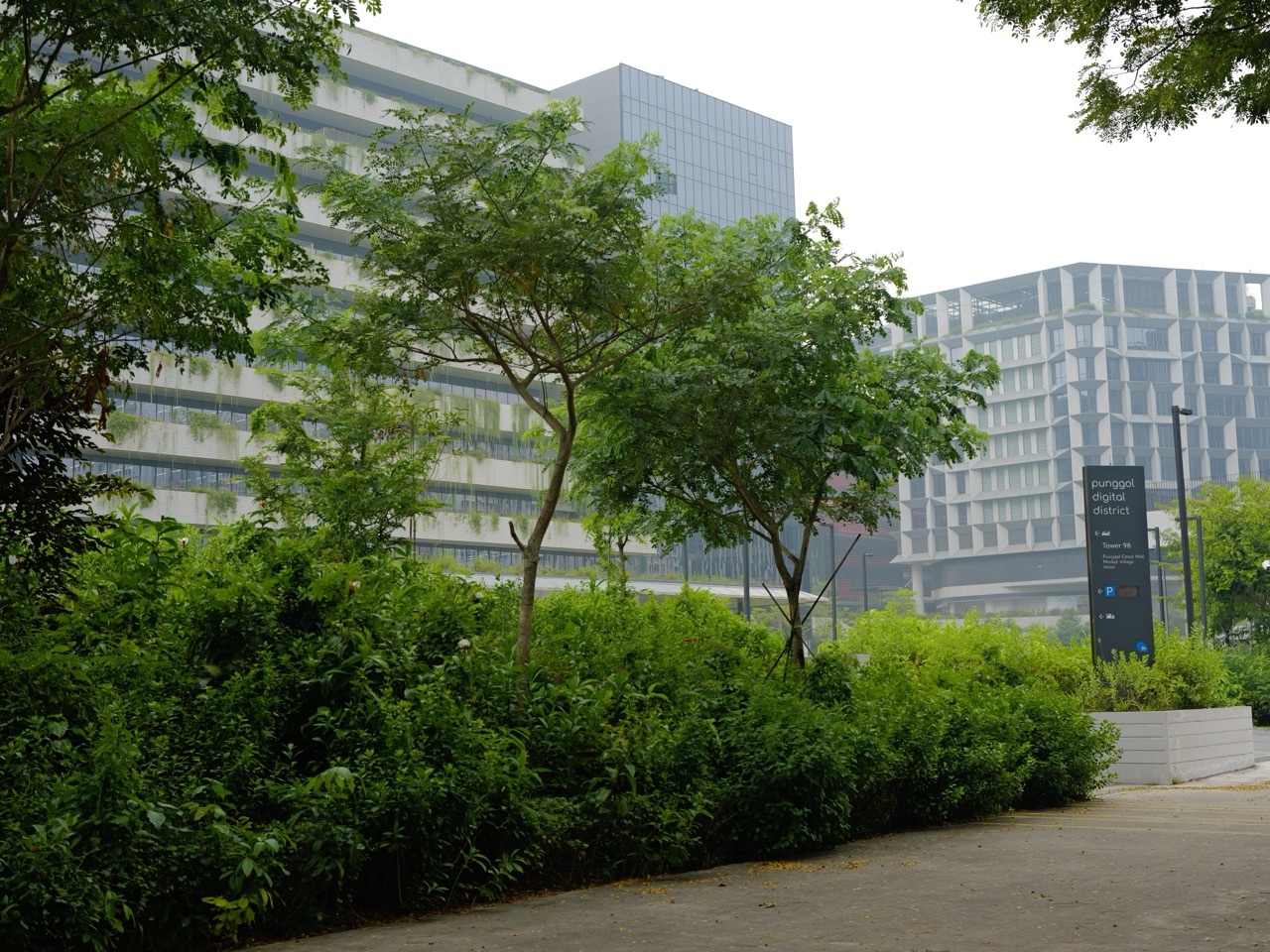
Punggol Digital District includes mixed-use commercial and academic buildings, and the wider North-East has schools, shops and industrial facilities. These premises have different occupancy patterns and ventilation systems. Some use centralised air handling, while smaller spaces may use split-unit air conditioners without substantial fresh-air provision.
A local vendor can provide genuine value when its service reflects the actual site. But the existence of a smart district does not guarantee that every building needs a new sensor subscription. Owners may already have building-management systems and specialist maintenance contractors. A startup should identify a real unaddressed problem, obtain permission and define the necessary test before recommending equipment.
Indoor air quality is different from cooling performance
A building can feel comfortable while having poor outdoor-air exchange, or be well ventilated while occupants dislike the temperature. Cooling performance, humidity, thermal comfort and pollutant concentrations are related but distinct. A technician should not assume a room is adequately ventilated because its air conditioner is cold.
Our separate Punggol smart buildings and district cooling supplier guide explains energy and facilities operations broadly. This guide concentrates on the measurement, interpretation and commercial delivery of indoor air quality services. The buyer needs reliable evidence about the air people experience, not merely an equipment efficiency report.
The October 2026 NEA guidance is current
NEA’s updated October 2026 guidance was developed around protecting healthy indoor environments beyond the acute pandemic period. It discusses appropriate ACMV operation, outdoor air, air purging, natural ventilation, air cleaning and monitoring. The document refers to the 2026 editions of SS554 and SS553.
A company preparing a technical quotation should not rely on a decades-old standard or treat emergency pandemic advice as the entire current framework. The appropriate source is the latest official guidance and the actual applicable standard. A vendor should distinguish recommendations from mandatory building or workplace requirements. Accuracy about current documents is part of professional service quality.
SS554:2026 has a defined scope
The Singapore Standards eShop describes SS554:2026 as the Code of Practice for Indoor Air Quality in Air-Conditioned Buildings. Its stated application is enclosed air-conditioned premises, excluding residential premises, factory production areas, hospitals, polyclinics and laboratories. It addresses acceptable parameters for common indoor environmental contaminants but does not claim to cover every possible substance.
A supplier should not advertise that meeting an office-oriented indicator automatically certifies a specialised laboratory or industrial process area. Those environments may have different technical and occupational requirements. The correct service depends on the site, activities and occupants. A provider should recognise when a specialist consultant or qualified occupational hygienist is appropriate.
SS553:2026 addresses mechanical ventilation
NEA refers to SS553:2026 for air-conditioning and mechanical ventilation in buildings, including appropriate outdoor-air supply rates. A customer may need a qualified building-services engineer to assess actual system design and airflow. The air quality technician should not assume that one CO2 sensor can replace a complete engineering review.
A service can combine suitable observations and measurements to identify where further investigation is justified. If the problem requires changing air-handling equipment or ductwork, engage the correct qualified parties and owner approval. A good supplier keeps technical responsibilities clear. The ability to coordinate a team is valuable even when no single vendor performs every task.
Carbon dioxide is a useful proxy, not a disease detector
People exhale carbon dioxide, so indoor levels can indicate how well occupied spaces receive outdoor air relative to their use. NEA explains that CO2 can serve as a proxy when direct measurement of ventilation is difficult. Elevated readings may reflect insufficient ventilation, high occupancy or a combination of factors.
However, CO2 readings do not directly show the concentration of infectious pathogens or guarantee that nobody will become ill. A supplier must not market a sensor as an instant virus detector. Some pollutants can be high even when CO2 appears acceptable. Proper interpretation considers occupancy, activities, outdoor conditions and the purpose of the test.
Understand the 700 ppm-above-outdoor reference
SS554:2026 recommends an indoor CO2 limit not more than 700 ppm above outdoor levels. If the outdoor concentration is about 400 ppm, an example resulting limit is around 1,100 ppm. The relevant comparison is the difference from actual outdoor air, not a universal fixed number independent of conditions.
A vendor should not say that every space is legally unsafe as soon as its display shows 801 ppm. NEA also describes an 800 ppm precautionary target for certain infection-risk purposes, which is a different recommendation. Customers need to understand why multiple numbers appear in official guidance. Accurate communication prevents unnecessary alarm and misleading compliance claims.
The 800 ppm target needs context
NEA’s ventilation guidance discusses aiming for CO2 below 800 ppm as a precautionary target to reduce potential airborne infectious disease transmission risks, including when risk is elevated. Its separate CO2 monitoring advisory uses this level as a practical trigger for reviewing ventilation. The 800 ppm figure is not a guarantee of an infection-free environment.
A supplier should explain the intended interpretation and measurement period. It should not sell an expensive air purifier solely because a five-second snapshot exceeds an arbitrary target. If the room has high occupancy, improving appropriate outdoor-air supply or reviewing how it is used may be part of the solution. The site needs a sensible action plan.
Measurements should represent real occupancy
NEA recommends taking CO2 readings over at least five minutes per sampling location, in occupied areas at breathing height. It also notes that quick snapshots may not represent changing occupancy. A vendor testing an empty meeting room before anyone arrives cannot claim that the result describes peak use during a crowded afternoon.
The measurement plan should identify representative times, locations and duration. Some spaces need repeated observations. A useful report explains the conditions rather than merely list one number. A service that considers how people actually use a building is more valuable than placing a device on a desk for a photograph.
Sensor location can change the reading
A CO2 sensor placed directly beside someone’s face, a door or a supply-air vent may produce a reading that does not represent the room. Height, airflow, occupancy and equipment placement can affect results. The provider should follow suitable measurement guidance and record exactly where each device was located.
A business that deploys many low-cost monitors without placement instructions may create confusing or contradictory data. Proper commissioning helps customers use the information correctly. The company should make limitations visible and support recalibration or troubleshooting. Measurement quality is part of what the buyer pays for.
Calibration and maintenance are not optional marketing details
Sensors can drift, lose power or develop faults. A manufacturer may recommend appropriate calibration and maintenance intervals. A supplier should know which procedure applies to its actual instrument and whether formal calibration traceability is required by the customer. A monitor that has not been checked may display plausible but inaccurate values.
Our Punggol precision metrology and calibration supplier guide addresses laboratory competence and traceability. Here the practical issue is making air-quality data dependable. A dashboard cannot repair a faulty sensing element through visual design alone.
A low reading does not prove every pollutant is absent
Carbon dioxide and fine particulate matter are different physical measurements. Volatile organic compounds, formaldehyde, carbon monoxide and biological contaminants require other suitable methods. An office could have acceptable ventilation according to one indicator while experiencing a separate source of irritating chemical emissions.
A vendor should choose parameters according to the actual customer concern and recognised standards. It should not advertise a single CO2 monitor as a comprehensive test for mould, asbestos, formaldehyde, bacteria and viruses. If a customer suspects a specialised hazard, the company must involve competent laboratory or occupational professionals. Honest boundaries protect users from false reassurance.
Fine particles need appropriate instruments
Particulate matter measurements can help evaluate airborne particles such as PM2.5 under suitable conditions. A consumer sensor may provide a trend but not necessarily the accuracy of a professionally validated measurement. The supplier should explain whether the device is intended for indication or formal assessment.
Outdoor haze can affect indoor particle levels, especially when doors and windows are open. A good report records outdoor conditions and the building’s ventilation state. The customer may need suitable filtration or operational adjustments. A number shown without context can mislead, so the instrument and method must match the decision.
Formaldehyde requires a separate assessment
NEA’s 2026 advisory on formaldehyde in interior building products notes that certain materials can emit formaldehyde. It references a voluntary indoor air limit of 0.1 milligrams per cubic metre, about 0.08 ppm, over a thirty-minute period under SS554:2026 for relevant premises. This is not a universal statement that every new building exceeds the limit.
A company claiming to measure formaldehyde should use suitable methods and competent interpretation. Cheap general-purpose volatile-organic-compound monitors may not accurately isolate formaldehyde. A report should describe what was actually tested and which standard or guideline was used. A responsible vendor avoids turning concern about new furniture into an unsupported health diagnosis.
Renovations can affect indoor air
Paints, adhesives, flooring, furniture and other renovation materials may introduce substances into a space. The actual risk depends on products, ventilation, time and exposure. A facilities manager may request a post-renovation evaluation before reoccupation. Some premises have specific Environmental Sanitation or other requirements.
A supplier should clarify whether the customer needs general comfort assessment, chemical testing or a formal regulatory audit. The test plan can focus on appropriate contaminants. A one-time reading may not represent all later conditions. Accurate reporting and practical recommendations are more useful than a generic certificate promising perfect air indefinitely.
Mould and dampness cannot be reduced to a humidity icon
High humidity and moisture can support mould growth under certain conditions. A sensor may identify persistent damp conditions, but it cannot automatically determine the source of a leak or certify a surface is free of biological contamination. A building professional may need to assess roofing, plumbing or ventilation problems.
A business should avoid offering chemical fogging as a universal response to every mould complaint. The source of moisture often needs attention. Appropriate cleaning and remediation require competent methods and safety considerations. A good consultant knows when to refer the issue to other specialists rather than produce a misleading one-device solution.
ACMV maintenance is an ongoing process
NEA advises managers to keep air handling and ventilation components in working order, inspect fans and filters, address duct or damper issues and ensure correct airflow direction. The October guidance discusses daily checks for certain systems and maintenance as specified in the current standard. A supplier offering air-quality testing should understand the building’s existing maintenance regime.
A high CO2 reading may prompt investigation of outdoor-air supply or an operational fault. The correct response is not always purchasing another air cleaner. A qualified engineering review may be necessary. Monitoring becomes valuable when it connects evidence to appropriate action and verifies whether the issue improved.
Filtration helps but does not necessarily add outdoor air
An air cleaner may remove suitable airborne particles, depending on its design, filter, airflow and maintenance. It does not automatically supply fresh outdoor air or remove every gaseous pollutant. NEA notes that local air cleaning can be considered in suitable situations, but this should be integrated with ventilation planning.
A salesperson should not promise that adding a HEPA purifier reduces CO2 in an occupied room unless the specific equipment includes a relevant fresh-air function. The customer needs an explanation of which problem is being addressed. A filter may be appropriate for particles but not a substitute for engineering correction of inadequate ventilation.
Device capacity must match the room
A portable air cleaner may have a stated clean-air delivery rate, but its usefulness depends on room volume, placement, operating speed and conditions. A very small unit in a large room may not deliver the expected improvement. Conversely, a large device can introduce noise and energy cost that occupants dislike.
A supplier should make a defensible sizing recommendation and disclose assumptions. A product demonstration in a tiny sealed chamber does not prove performance in a crowded office. The objective is suitable air cleaning under real operating conditions, with realistic maintenance and replacement expense.
Carbon monoxide requires urgent specialist attention
NEA’s October 2026 guidance discusses carbon monoxide risk from gas or charcoal cooking in enclosed dining areas with inadequate exhaust. Carbon monoxide is different from carbon dioxide and requires appropriate monitoring and safety response. A normal CO2 monitor cannot be assumed to detect it.
A consultant should not treat suspected carbon monoxide exposure as merely a comfort issue that can wait for the next marketing visit. If an immediate safety concern exists, the premises must follow appropriate emergency procedures and contact the relevant authorities or professionals. A vendor should distinguish technical assessment from medical diagnosis and urgent incident response.
Specialist factories and healthcare facilities need distinct expertise
NEA’s general guidance explicitly excludes specialised premises such as factory production areas, hospitals, polyclinics and laboratories. These may involve technical hazards or environmental controls outside an ordinary office standard. A company experienced in routine meeting-room CO2 monitoring should not automatically advertise clinical cleanroom validation.
A serious supplier may work with specialised professionals and appropriate standards when entering these markets. It should clearly distinguish the limited data collection it can perform from formal technical certification. Customers with high-consequence operations need qualified judgement and methods. Honest scoping may prevent serious harm.
A formal air-quality assessment needs a clear protocol
A customer might commission a representative assessment of indoor conditions rather than ongoing sensors. The provider should identify parameters, sampling locations, timing, method, instrument status and reporting basis. It may need an appropriately accredited laboratory for particular analyses, depending on the required purpose.
A valid report distinguishes observations from conclusions and includes uncertainty and limitations. A vendor should not use “NEA certified” unless the organisation and report genuinely hold a relevant official status. Referencing NEA guidance is not the same as government accreditation. A good technical report can support management decisions without overstating its authority.
Buying standards does not create accreditation
The Singapore Standards eShop sells SS554:2026 and other technical documents. Purchasing a copy helps a qualified person understand the requirements, but does not itself accredit a company or its instruments. Formal laboratory accreditation is assessed separately under the appropriate Singapore Accreditation Council framework.
A founder should not put an accreditation mark on a website simply because a staff member has read a standard. If the customer needs formally accredited test results, verify the laboratory’s current approved scope. A consultant can provide appropriate assessments within its competence, but should describe those reports accurately. Transparent status creates credibility.
Building managers need useful dashboards, not constant alarms
An indoor monitoring platform may show CO2, temperature, humidity or particle trends. This can help facilities teams identify recurring patterns, but an excessive stream of alerts can be distracting. The product should present uncertainty and missing data clearly. A sensor that stops communicating should not appear to be reporting excellent air.
The vendor can help customers define meaningful escalation: inspect the instrument, check occupancy, investigate fresh-air supply or involve a qualified engineer. The tool should not automatically control safety-critical equipment without proper authorisation. A modest dashboard linked to actual action is often more valuable than an elaborate animated display.
Privacy and occupancy monitoring require care
Sensors may be combined with room occupancy systems, cameras or workplace analytics. The business should collect only what is necessary for the legitimate purpose and protect personal data. A simple environmental sensor may not need to identify individual employees. Recording staff movements unnecessarily can create privacy and trust concerns.
A client should understand where data is stored and who can access it. A software vendor needs a secure account and data-exit process. A school or healthcare institution can have additional obligations. A trustworthy IAQ system monitors environmental conditions without turning building occupants into an unapproved surveillance experiment.
Worker communication can improve the project
People experiencing discomfort may have practical observations about particular times, rooms or equipment operation. A consultant can gather relevant information respectfully and compare it with measured conditions. The goal is to identify patterns, not diagnose individual medical conditions through an informal survey.
Some complaints may need appropriate occupational or healthcare advice. A provider should not dismiss a worker’s experience simply because one sensor reading is within a guideline. Equally, one complaint does not establish a specific contaminant. Professional assessment combines evidence, uncertainty and suitable next steps.
Different procurement buyers have different priorities
A landlord may purchase IAQ assessment to understand building operations. A tenant may want evidence about its leased office. An institutional manager may seek a defined report to respond to occupant concerns. A retailer could buy a simple monitor with maintenance support. These are different customer needs.
The vendor should identify who may authorise access to air handling units and whether the client can change the ventilation system. A tenant may not control the central air supply. A proposal recommending equipment modifications without owner approval can be impractical. Good commercial advice begins with the real decision-making structure.
Sensor subscriptions need maintenance economics
A software provider may charge monthly fees per monitored room. Revenue may look attractive, but installed sensors require purchasing, commissioning, calibration, communications, replacement and support. A customer can cancel after a short period, leaving the vendor with hardware that may be difficult to reuse.
A founder should model contract length and equipment lifetime. The service agreement should define who owns the sensors and what happens when the relationship ends. An inexpensive recurring subscription may lose money if several visits are needed to correct poor sensor placement. Technical reliability and commercial pricing are connected.
An illustrative monitoring-service calculation
Imagine a fictional company supporting fifty rooms at S$80 per room per month, generating S$4,000. Hardware financing and replacement provisions cost S$900, cloud services S$350, technical support and site visits S$1,300, and administration plus quality review S$650. That leaves S$800 contribution before other overhead and tax.
These are invented figures, not official market fees. If twenty sensors fail early or a customer requires frequent specialist investigations without extra payment, the contribution may disappear. A supplier should distinguish routine monitoring from separate engineering assessment in the contract. A narrow service can be viable when support obligations are realistic.
One-time studies have a different price structure
A formal site assessment may involve planning, access, several sampling periods, technical review and a written report. If the client adds new rooms or contaminants after the quotation, the scope can expand. A consultant should define the parameter list, number of visits, methods and deliverables before accepting work.
A low headline price can be misleading if it omits laboratory analysis or instrument hire. The customer should understand which results are indicative and which are formally tested. A responsible provider can give an estimate with clear assumptions. A well-structured project saves time and reduces disagreements when findings require follow-up.
A fictional Punggol office study
A commercial office reports stuffiness during afternoon meetings. An authorised IAQ consultant checks occupancy patterns, takes suitable CO2 readings at representative points and reviews available ventilation information with the building manager. It records that some readings vary with room use and flags questions for qualified ACMV specialists.
The consultant does not diagnose occupants or issue a universal health certificate. The buyer receives a practical report with assumptions and next steps. A follow-up measurement can help evaluate whether the chosen intervention improved conditions. This is a useful professional service because it leads to informed building management rather than unnecessary equipment purchases.
A fictional sensor manufacturer
A startup designs a room sensor with CO2, temperature and humidity functions. It tests its measurement performance and clearly describes uncertainty, calibration needs and intended use. It does not claim that the device detects every airborne virus or chemical contaminant. The product can show real trends under appropriate operating conditions.
The company seeks legitimate building customers and provides support for correct placement. It collects limited authorised data and offers an export function. A dependable product may win repeat business, but only if customers understand its boundaries. Engineering quality is more valuable than a screen that always displays a reassuring green leaf.
A fictional ventilation engineering subcontractor
A building manager receives an IAQ report indicating possible inadequate outdoor-air supply. It commissions a qualified mechanical engineering team to assess the system. The team checks the actual equipment, applicable SS553 requirements and permitted changes. It does not simply turn a fan to maximum without considering design and building conditions.
A subcontractor may support inspection, maintenance or measurement under the proper authority. The work should be recorded and verified. If a change improves ventilation but creates unacceptable energy or comfort effects, the team should address the trade-off. The goal is a functioning building system, not a single better-looking sensor number.
A fictional analytical laboratory
A client needs a specified formaldehyde or particle assessment under a recognised method. A suitably competent laboratory defines the required sampling and analysis, identifies instruments and checks its current accreditation scope if the customer requires accredited results. The report states conditions, methods and limitations.
The lab should not claim that a limited sample proves the entire building has been contaminant-free for all time. A report covers the actual locations and period tested. This precision is a commercial benefit because it lets the owner plan appropriate follow-up. Reliable evidence is preferable to an exaggerated guarantee.
Haze creates a balance between outdoor air and filtration
When outdoor air quality deteriorates, opening windows widely can introduce more particles even if it increases ventilation. NEA’s guidance discusses appropriate filtered outdoor-air supply and air cleaning options under such conditions. The right response depends on the building design and actual hazard.
A supplier should not prescribe the same window-opening rule under every haze event. The facilities manager may need a professional ventilation plan balancing outdoor-air supply, filtration and indoor pollutant sources. A good commercial service helps the building adapt rather than sell one rigid instruction for all weather.
Humidity management requires system understanding
Singapore’s humid conditions can make comfort and moisture management challenging. A contractor may suggest appropriate system settings or maintenance, but lowering humidity too far or making unapproved changes can have other consequences. A qualified building-services professional should consider the whole system.
A sensor vendor can provide observations, not a universal diagnosis of every mould or condensation issue. The client needs to understand whether moisture enters through leaks, occupants, ventilation or other factors. A multidisciplinary investigation may be appropriate. Honest evidence helps avoid repeated ineffective treatments.
Air quality claims should avoid medical guarantees
An indoor environment can be improved through appropriate ventilation and pollutant control, but no supplier should promise a building is completely free of all pathogens or incapable of causing discomfort. People’s health and susceptibility vary, and not every hazard is measured in an ordinary IAQ assessment.
A report should describe the actual parameters and methods. If a serious health issue is raised, appropriate healthcare or occupational specialists should be consulted. A company marketing a purifier as a cure for disease without evidence and proper regulatory assessment can cause harm. Safety and professional restraint are part of responsible commerce.
2027–2029: focus on the new 2026 standards
The early period follows SS554:2026, SS553:2026 and NEA’s October 2026 guidance. Suppliers should update their methods and staff understanding rather than advertise outdated thresholds. A new business may begin with defined office monitoring or qualified assessments, expanding only after demonstrating technical competence and actual demand.
The founder should assess whether formal accreditation or specialist partnerships are needed for intended work. A one-room pilot may reveal that poor data placement is the main problem. It can be better to correct the measurement method than immediately sell fifty devices. The goal is reliable customer decisions.
2030–2033: build maintenance and measurement continuity
A company with recurring customers may need better calibration schedules, secure data systems and engineering partnerships. Large deployments create problems when sensors drift or hardware becomes obsolete. The vendor should maintain accurate inventories and a way to replace components without losing records.
A specialist assessment service may expand to more building types, but must respect the standards’ scope and refer high-risk environments appropriately. These years are planning checkpoints, not an official forecast of mandated sensors in every Punggol building.
2034–2037: keep the service useful as technology changes
Indoor air quality technology may develop over a decade, but building owners will still need trustworthy information, competent maintenance and appropriate responses to changing occupancy. A supplier dependent on one hardware platform should plan for data portability and replacement. A professional adviser should follow updated standards.
No one can guarantee future IAQ service demand or a particular device price in 2037. The durable asset is reliable measurement and an ability to help the customer interpret it honestly. A sensor is useful when it supports a better environment, not simply when its screen looks modern.
Indoor air quality business readiness checklist
- Is the supplier offering sensors, an indicative assessment, qualified engineering or an accredited laboratory test?
- Which parts of NEA’s October 2026 guidance and SS554:2026 actually apply to the site?
- Is the premises a general office or a specialist setting excluded from the ordinary standard?
- What concern and decision does the customer want to address?
- Are the correct parameters and methods selected for that concern?
- Is the CO2 reading interpreted relative to outdoor conditions and occupancy?
- Are instruments calibrated and positioned under suitable procedures?
- Does the report distinguish measured, estimated and missing data?
- Who has permission to inspect or alter ventilation equipment?
- Are air-cleaning claims supported by appropriate performance evidence?
- What are the limits of any health or safety claims?
- Does the contract cover sensor maintenance, replacement and data security?
- Is the customer’s budget realistic for follow-up work?
- Can the buyer export results and obtain independent review if needed?
These questions turn an attractive air-quality dashboard into a credible technical service. The commercial objective is better information and a suitable environment, not unsupported claims of perfect air.
Frequently asked questions
Is SS554:2026 the current Singapore indoor air quality standard?
NEA’s October 2026 guidance identifies SS554:2026 as the relevant code for applicable air-conditioned buildings. Its defined scope excludes certain specialised premises and residential settings.
Does CO2 below 800 ppm guarantee no infectious disease transmission?
No. CO2 is a proxy for ventilation, not a direct pathogen measurement. NEA explains that many other factors affect airborne infection risk.
What does the 700 ppm above outdoor recommendation mean?
SS554:2026 recommends that indoor CO2 be no more than 700 ppm above the measured outdoor level. An outdoor concentration around 400 ppm would produce an illustrative comparison near 1,100 ppm indoors.
Can an ordinary consumer air purifier replace outdoor-air ventilation?
Not automatically. A purifier may remove particular particles but does not necessarily increase outdoor-air supply or control every pollutant. Site-specific assessment matters.
Does reading SS554 make a company an accredited testing laboratory?
No. Professional competence and formal accreditation are separate. A vendor should accurately describe what its instruments and staff are qualified to measure.
Will every commercial building be required to buy continuous sensors by 2037?
No such universal commitment can responsibly be inferred from the current NEA guidance. Future rules and actual buyer demand must be checked as they emerge.
Your Next Step: measure one actual room correctly
Choose one customer with a defined ventilation or air-quality question. Obtain permission, identify the relevant guidance and measure representative occupancy conditions with suitable checked instruments. Explain what the readings show and what remains uncertain. Where a building system requires changes, involve the right qualified professionals. A Punggol IAQ business becomes valuable when evidence leads to safe, practical decisions—not because its sensor dashboard always displays a reassuring status.
Official sources: NEA updated ventilation and indoor air quality guidance, October 2026, NEA CO2 monitoring advisory, Singapore Standards SS554:2026, NEA formaldehyde in indoor building products guidance, and JTC Punggol Digital District sustainability features. Confirm the latest standards and the premises’ actual technical requirements before commercial work.


