
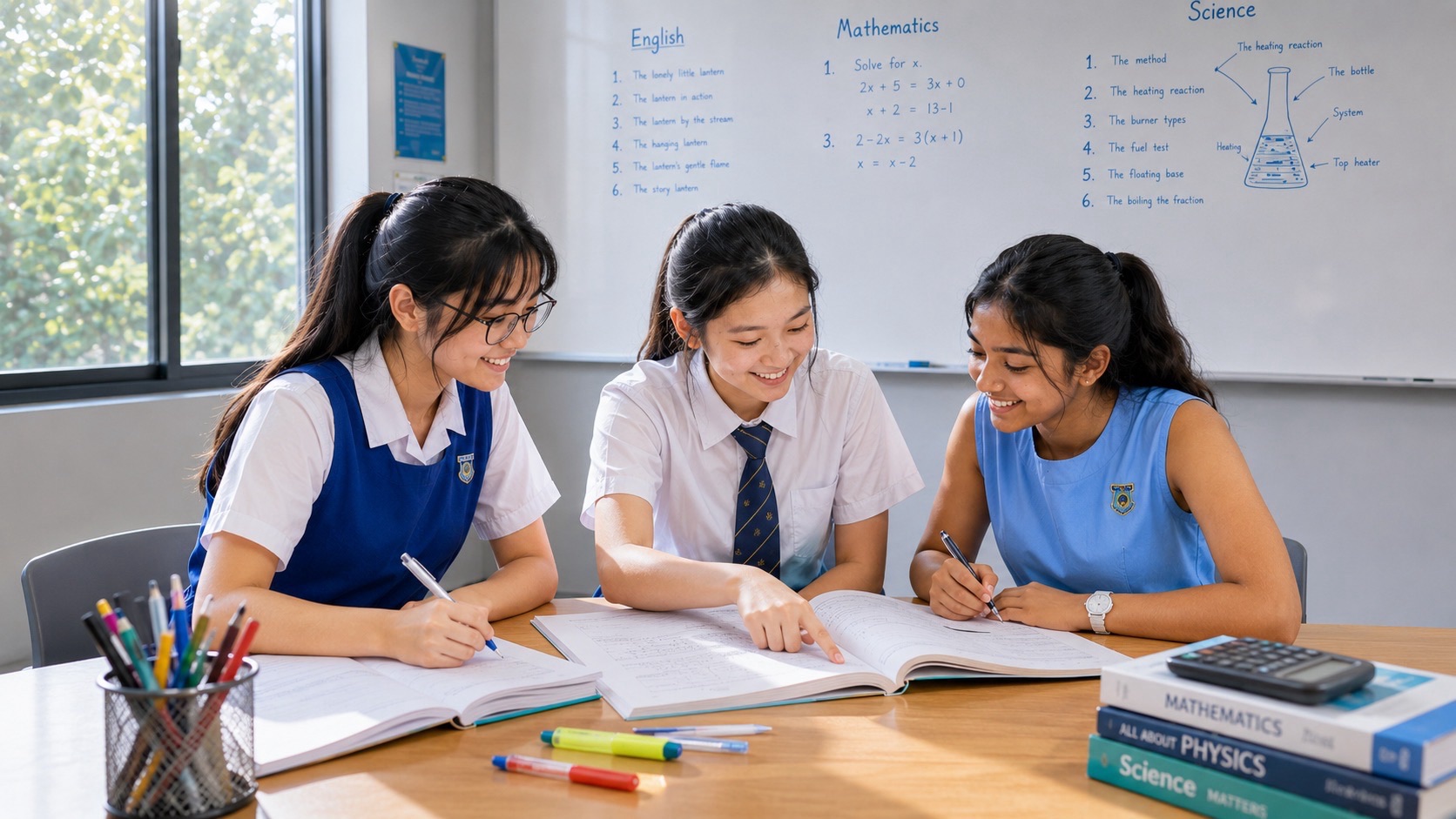
Secondary 4 Additional Mathematics small groups tuition in Punggol should help students connect algebra, functions, trigonometry, geometry and calculus into a reliable examination method. eduKatePunggol publishes a maximum of three learners per 1.5-hour tutorial. The tutor can examine each student’s working, identify the earliest invalid transformation and decide whether the next task should repair a prerequisite, develop problem recognition or strengthen performance under time pressure.
The 2027 Singapore-Cambridge Secondary Education Certificate (SEC) G3 Additional Mathematics syllabus is K341, replacing the earlier O-Level Additional Mathematics reference code 4049. It includes algebra, geometry and trigonometry, and calculus. The 2027 assessment has two papers of 2 hours 15 minutes each, worth 90 marks and 50% of the subject apiece. This is a different examination cohort from pupils graduating in 2026 under the GCE O-Level arrangements. The exact syllabus year must be checked before making a revision plan.
Quick answer for Punggol parents: a three-student Additional Mathematics tutorial is useful when the learner understands individual chapters but struggles to choose a method in mixed questions, loses marks through algebra, cannot link calculus to graphs or runs out of time. A useful lesson diagnoses the first weak link, teaches it, then tests a changed question independently before building full-paper control. No tuition centre can guarantee A1 or a particular SEC result.
Secondary 4 Additional Mathematics is an integration year
A student may learn quadratic functions in one chapter, logarithms in another and differentiation later, yet a final-year examination can require choices across all three. The challenge is not simply remembering more formulas. It is recognising what the question is asking and selecting the mathematical relationship that will lead to a valid solution.
A tutor should examine whether the child can begin a mixed problem without a chapter title. If not, more topical repetition may help fluency but leave recognition weak. The three-student environment allows the tutor to pause at that decision and compare methods before time pressure conceals the reason for an incorrect answer.
The 2027 SEC code is K341, not K310
SEAB’s official 2027 G3 list identifies Additional Mathematics as K341, corresponding to 4049 in earlier examination years. K310, corresponding to 4052, is G3 Mathematics. These codes are not interchangeable. A parent who sees a book or revision page using 4052 should not assume it covers the Additional Mathematics examination.
Families need to identify their child’s examination cohort. Students graduating in 2026 use the applicable O-Level syllabus, while the first SEC examination takes place in 2027. An older textbook can still contain valuable mathematics, but the official examination-year subject document determines content, assessment and requirements.
The 2027 K341 assessment is about more than routine techniques
The SEAB K341 syllabus assesses use of standard techniques, problem solving across contexts, and mathematical reasoning and communication. Its approximate assessment-objective weights are 35% for techniques, 50% for problem solving and 15% for reasoning. Those figures explain why a pupil who memorises every standard procedure can still struggle with unfamiliar applications.
The tutor should teach the learner to interpret a question, translate between representations and justify the method. Clear working is also important: the 2027 syllabus explicitly notes that omission of essential working will result in lost marks. Getting an answer on a calculator is not enough to demonstrate a required derivation.
Know the two-paper format before planning revision
For 2027 K341, Paper 1 contains 12–14 questions worth a total of 90 marks and lasts 2 hours 15 minutes. Paper 2 contains 9–11 questions, also totals 90 marks and lasts 2 hours 15 minutes. Each paper contributes half the subject mark, and candidates must answer all questions. An approved calculator may be used in both papers.
This format does not mean a Secondary 4 learner should complete a full paper at every tuition lesson. Paper practice is valuable when the underlying methods are stable enough for errors to be informative. Before that, a diagnostic micro-set can reveal more about a weak function or calculus concept than another full-length paper completed without understanding.
The first diagnostic is the earliest invalid line
Take a marked Additional Mathematics solution and ask the student to explain each line until the first step that cannot be justified. A wrong result may begin with a sign error, an invalid cancellation, a forgotten domain restriction, a wrong trigonometric identity or confusion about whether a derivative or integral is required.
The first invalid line gives the tutor a more precise teaching target than ‘weak in A-Math’. Two pupils scoring 60 may need entirely different lessons. One may know the correct route but execute it unreliably; the other may manipulate algebra fluently yet choose the wrong mathematical model. The repair should match the cause.
Algebraic control is the carrier for almost every later chapter
Quadratics, logarithms, functions, differentiation and integration all require reliable manipulation of algebraic expressions. A pupil who distributes a negative sign incorrectly can lose an entire calculus question despite understanding differentiation. Repairing algebra is therefore not a retreat from advanced content; it is strengthening the system that carries it.
The tutor should teach why a transformation is valid, not merely the instruction to ‘move a term across’. For example, dividing by an expression requires checking whether it could be zero. Simplifying a fraction requires a common factor, not a matching symbol inside an addition. These details prevent errors across multiple topics.
Worked example 1: factorising a quadratic is not the whole task
Solve x² − 5x + 6 = 0. Factorisation gives (x − 2)(x − 3) = 0, so x = 2 or x = 3. The discriminant of this quadratic is b² − 4ac = 25 − 24 = 1, which is positive and consistent with two distinct real roots.
A learner might perform the factorisation correctly but fail when asked how many real roots the equation has without solving it fully. The tutor can connect the discriminant to the graph and then present a new quadratic with a negative discriminant. The skill is recognising the connection between an algebraic test and a geometric conclusion.
Completing the square connects a function to its graph
Completing the square is more than a mechanical method. A quadratic written as (x − h)² + k reveals the location of its turning point, subject to the coefficient and sign. It can help identify extrema, understand graph transformations and explain why a quadratic takes certain values.
A student who memorises a sequence of additions and subtractions may make sign mistakes when the function changes. The tutor should ask what quantity is being squared, why the square cannot be negative for real inputs, and what that tells us about the least or greatest possible value.
Worked example 2: the minimum of a quadratic
Consider y = x² − 6x + 5. Completing the square gives y = (x − 3)² − 4. Since the square is at least zero, the minimum value is −4 when x = 3. The turning point is (3, −4), and the graph opens upward.
An important follow-up is to ask whether this conclusion remains true when the coefficient of x² is negative. The student must consider how the sign changes the nature of the extremum. The tutor should check that the child reasons from the completed-square form rather than always writing ‘minimum’ because that was true in the first example.
Surds are exact numbers with rules
A surd such as √50 can be simplified because 50 = 25 × 2, giving √50 = 5√2. The result is exact and not a decimal approximation. The learner must understand what multiplication under the square root permits, rather than try to split the root over every arithmetic operation.
An invalid shortcut is √(a + b) = √a + √b in general. Testing a simple counterexample makes the error visible. The tutor can ask the student to explain why a product property is being used in the valid simplification and why the same pattern does not apply to addition.
Worked example 3: rationalising a denominator
To rationalise 3/√2, multiply numerator and denominator by √2. The result is 3√2/2 because √2 × √2 = 2. This is an exact equivalent expression, not an arbitrary requirement to change the appearance of a fraction.
Ask the student why multiplying the fraction by √2/√2 preserves its value when √2 is nonzero. Then give a denominator containing a sum and discuss why a different technique may be required. The purpose is a valid algebraic transformation, not memorising that a radical must always disappear after one multiplication.
Functions are input-output relationships
If f(x) = 2x + 1 and g(x) = x², then f(g(3)) = f(9) = 19. But g(f(3)) = g(7) = 49. The order of composition changes the result. A student who treats the two notations as interchangeable has misunderstood the structure of function composition.
A three-student group can assign one child to calculate each order while the third explains why the operations differ. The tutor should then change the functions and ask every learner to identify the inside operation independently. This skill is important because function notation appears throughout upper-secondary Mathematics and calculus.
Inverse functions have conditions
An inverse reverses a function’s mapping on an appropriate domain and range. The idea is not simply to swap x and y without considering whether an inverse function exists under the chosen restrictions. Some familiar functions are not one-to-one on their full real domain and require domain restrictions before an inverse function can be defined.
The tutor can begin with a straightforward linear function and then compare it with a quadratic. The purpose is to teach why a mapping can or cannot be reversed as a function, not to overload a pupil with advanced notation before the basic concept is understood.
Logarithms reverse exponential relationships
The statement log₂8 = 3 means that 2 raised to the power of 3 equals 8. A student who sees logarithms as an arbitrary new operation may memorise laws but fail to identify what a logarithmic equation represents. The useful foundation is the equivalence between logarithmic and exponential form.
In the real-number context, logarithmic arguments must be positive for the ordinary logarithms taught in this syllabus, and the base must be positive and not equal to one. Domain restrictions matter when solving equations. A technically correct algebraic manipulation that produces an invalid logarithm argument does not give a valid solution.
Worked example 4: a logarithmic equation
Solve log₂(x − 1) = 3. Convert to exponential form: x − 1 = 2³ = 8, so x = 9. The original logarithm requires x − 1 to be positive, and nine satisfies that restriction. The solution is valid.
Now change the equation so that an algebraic transformation yields a candidate with a nonpositive argument. The student should reject an invalid value after checking the original expression. The tutor should make domain checking a habit rather than a last-minute addition to a memorised solution.
Polynomials and the factor theorem connect
The factor theorem states that (x − a) is a factor of a polynomial f(x) when f(a) = 0. A student can use this to decide whether a proposed factor is valid without completing a lengthy division first. Yet the method relies on a correct evaluation of the polynomial and careful handling of signs.
For f(x) = x³ − 3x² + 4, substituting x = 2 gives 8 − 12 + 4 = 0. Thus x − 2 is a factor. Further factorisation gives (x − 2)²(x + 1). The tutor should ask the child to expand and check the result, helping connect factorisation, roots and the graph’s behaviour.
Partial fractions must reproduce the original expression
Decomposing a rational expression into partial fractions is a valid algebraic transformation when the chosen denominators and coefficients are appropriate. The result must be equal to the original expression for allowed input values. The method supports later integration and algebraic simplification, so errors can travel between chapters.
For example, 1/[(x + 1)(x + 2)] = 1/(x + 1) − 1/(x + 2) for x not equal to −1 or −2. Combining the right-hand terms gives the original fraction. A tutor can ask the learner to verify that equality rather than simply memorise how to match coefficients.
The binomial theorem is structured counting
Expanding (1 + x)⁴ gives 1 + 4x + 6x² + 4x³ + x⁴. The coefficients are not random; they arise from the combinatorial structure of the binomial theorem. A student who sees an unfamiliar power may need to connect the general term to the particular expansion.
The tutor can begin by comparing a simple square and cube with a fourth power. The pupil should be able to explain why coefficients and powers follow a pattern and then calculate a requested term without expanding everything unnecessarily when the problem allows a more direct method.
Trigonometric identities require proof-quality working
An identity is an equality that holds throughout its valid domain, not merely at one convenient angle. For example, sin²θ + cos²θ = 1 is a fundamental identity. The tutor should teach pupils to transform one side logically while respecting restrictions, rather than change both sides independently until the expressions happen to look similar.
Testing a few numerical values can build intuition but does not prove a general identity. A strong student should know when a substitution checks plausibility and when algebraic or trigonometric reasoning is required. That difference matters for the reasoning component of the examination.
Worked example 5: a simple double-angle identity
The identity sin 2θ = 2 sin θ cos θ connects the sine of a double angle to a product of trigonometric functions. If sin θ = 3/5 and cos θ = 4/5 for a suitable first-quadrant angle, then sin 2θ = 2 × 3/5 × 4/5 = 24/25.
The tutor should ask what changes if θ lies in another quadrant. The signs of trigonometric functions can differ even when the magnitudes are familiar. The result must follow the actual conditions, not an assumption that every angle is acute.
Solving trigonometric equations needs an interval
An equation such as sin θ = 1/2 has infinitely many real solutions without an interval restriction. If the question asks for angles from 0 degrees to 360 degrees inclusive, the solutions are 30 degrees and 150 degrees. The pupil must recognise both relevant quadrants and the specified range.
A common error gives only the principal calculator value. Another lists a general solution when the question requires angles in a bounded interval. A tutor can ask the learner to sketch the sine graph or use quadrant reasoning, then verify each candidate. The selection process is as important as pressing the inverse-sine key.
Coordinate geometry ties algebra to location
An equation of a circle such as (x − 2)² + (y + 1)² = 9 describes a circle with centre (2, −1) and radius 3. The standard form reveals the geometry, but signs inside the brackets can mislead a student who reads the centre as (−2, 1).
The tutor can ask pupils to check a point on the circle by substitution and compare the equation with a sketch. A changed centre should then be interpreted independently. This builds a connection between symbolic representation and geometric meaning instead of treating the circle equation as an isolated template.
Proofs in geometry demand justification, not appearance
A diagram may suggest that two lines are parallel or that triangles are similar, but the pupil must justify that conclusion from the given information and permitted theorems. A neat-looking figure is not evidence by itself. The current K341 syllabus includes selected proofs using properties of lines, triangles, quadrilaterals and circles.
In a group of three, one student may propose a route, another identify an unsupported assumption and the third write the proof clearly. The roles should rotate so every pupil learns to reason and communicate. A proof is a connected mathematical argument, not a sequence of impressive theorem names.
Differentiation describes gradient and rate of change
The derivative of a function can describe the gradient of the tangent to its graph or a rate of change in an application. Students who can apply a power rule mechanically may still struggle to interpret the derivative in a question about movement, optimisation or a turning point.
For y = 3x² − 4x + 1, the derivative is dy/dx = 6x − 4. At x = 2, the gradient is 8. The tutor should ask why the derivative value depends on x and what the gradient means at that specific point, rather than accepting the result as merely an algebraic expression.
Worked example 6: a stationary point and its nature
Consider y = x² − 4x + 1. Differentiating gives dy/dx = 2x − 4, which is zero at x = 2. Substituting gives y = −3. The second derivative equals 2, which is positive, so the stationary point (2, −3) is a local minimum.
A student who finds x = 2 but stops may not have answered a question asking for the coordinates and nature of the point. Another may remember the second-derivative test but apply it without explaining the sign. The tutor should teach complete question reading and interpretation alongside calculation.
The chain rule connects composed functions
When a function contains an expression within another function, differentiation may require the chain rule. For example, if y = (2x + 1)³, then dy/dx = 3(2x + 1)² × 2 = 6(2x + 1)². The inner function’s derivative contributes an essential factor.
A pupil who writes 3(2x + 1)² has applied the outer power rule but omitted the inner derivative. A tutor can use a substitution u = 2x + 1 to show why the extra factor appears, then change the inner expression so the student cannot rely on always multiplying by two.
Integration is connected to differentiation but not identical
Indefinite integration reverses differentiation within suitable families of functions and introduces a constant of integration. For example, ∫(6x − 4) dx = 3x² − 4x + C because differentiating that result returns 6x − 4. Forgetting C changes the statement from a family of antiderivatives to one particular function.
The tutor should also teach when a definite integral is required and how its limits change the task. A pupil can memorise the power rule but lose marks through wrong substitution of bounds, negative signs or confusion between signed integral value and geometric area.
Worked example 7: a definite integral and the area it represents
The definite integral from 0 to 2 of 2x dx is [x²] from 0 to 2, or 4. Over that interval 2x is nonnegative, so the integral also represents the area between the graph and the x-axis. The pupil must connect the antiderivative to the requested quantity.
If the graph lies below the x-axis, the definite integral gives a signed value, while the physical area of a region is nonnegative. A tutor can use contrasting sketches to explain when a sign change or separate regions matter. The goal is conceptual accuracy rather than blind application of the same formula.
Kinematics connects displacement, velocity and acceleration
In straight-line motion problems within the syllabus, differentiating displacement with respect to time gives velocity, and differentiating velocity gives acceleration. Integration reverses these relationships under suitable conditions. Students often remember the arrows between these quantities yet forget to interpret a negative velocity or include units.
Let s(t) = t² + 3t in metres, with t measured in seconds in an illustrative model. Then v(t) = 2t + 3 metres per second and a(t) = 2 metres per second squared. At t = 2, the velocity is 7 metres per second. The tutor should ask what that number represents rather than treat it as a context-free calculation.
Rounding and mathematical presentation protect marks
The 2027 K341 examination instructions call for non-exact numerical answers to three significant figures or one decimal place for angles in degrees unless otherwise specified. Questions explicitly requiring a result shown correct to a stated accuracy require the answer to be demonstrated at higher accuracy first. These are specific assessment rules worth consulting directly.
A tutor should teach pupils to preserve enough working precision and round at the appropriate final stage. Too much early rounding can change a later answer. Units, notation, logical steps and valid restrictions also matter. A method that reaches the right decimal without the required working may still lose marks.
Timed-paper skill begins with a diagnosis, not a stopwatch
A pupil who fails to finish may be slow because of algebra manipulation, uncertainty over methods, excessive rechecking or becoming stuck on one question. Another might finish quickly and lose marks through rushed copying and omitted steps. Both need better paper control, but the interventions differ.
The tutor can classify time spent by question type and ask where the student’s process stalled. Short timed sets are useful after the method is reasonably secure; full papers show how the skills work together. Making a child race through mathematics they do not understand simply rehearses the same errors more quickly.
One difficult question should not derail the entire paper
A strong examination strategy includes recognising when a question is not yielding progress and deciding how to protect time for other available marks. The pupil should record valid working, identify what remains unknown and return when appropriate, while following the paper’s instructions. Panic is not a mathematical method.
A tutor can practise short recovery scenarios: a question looks unfamiliar, so the child identifies the topic, writes a useful equation or sketch and decides whether another route is more productive. The goal is calm reasoning, not blind skipping or guessing. The actual timing plan should be based on the student’s baseline papers.
Three learners, three different causes of a 60-mark result
Imagine Aisha knows calculus procedures but loses algebraic signs in long solutions. Ben manipulates algebra fluently but cannot choose between function, trigonometry and coordinate methods in mixed questions. Mira knows the routes but writes too slowly under examination conditions. The same overall score would conceal three separate needs.
A three-student tutorial can give Aisha targeted symbolic checking, Ben mixed method-recognition practice and Mira paced independent sections with accuracy monitoring. Shared discussion can compare legitimate approaches, but the tutor should track progress individually. That is more useful than prescribing identical full papers to every learner.
A useful correction ledger identifies the recurring system
A correction should record the first invalid step, why it was invalid, the proper mathematical relationship and a future verification action. For example: ‘I used an ordinary power rule on a composed function and omitted the derivative of the inner expression. Next time I will identify the inner and outer functions before differentiating.’
After a delay, the pupil should solve a new composed-function problem without looking at the original answer. If the mistake returns, the tutor must revisit the rule rather than simply increase practice volume. A short ledger of recurring categories is more useful than a large collection of perfectly copied solutions.
A realistic 1.5-hour Additional Mathematics tutorial
An illustrative lesson starts with retrieval of a prerequisite, review of a mistake ledger entry and diagnosis of the day’s weak idea. The tutor models a relevant method and asks each pupil to justify a crucial transformation. Individual practice follows, then a changed problem removes hints. A short timed segment may be used when the concept is ready for pressure.
These are teaching components, not a rigid published minute-by-minute timetable. A learner needing algebra repair deserves more explanation; a strong student may spend longer on proof and method comparison. The invariant is the chain from diagnosis to independent transfer and review, not a fixed number of questions.
Four weeks: repair one high-value leak
Week one examines recent scripts and identifies a repeated loss such as chain-rule omissions or trigonometric method selection. Week two repairs the underlying concept and teaches a verification habit. Week three mixes related topics so the method is not announced by the worksheet title. Week four checks the skill under an appropriate independent or timed condition.
Parents should see more valid working and fewer repeats of the original mistake. A school score may not change immediately because the next paper covers a different mixture of topics. There is no defensible universal promise of an A1 improvement after four weeks, even when the teaching intervention is useful.
Eight to twelve weeks: turn repair into dependable paper performance
A longer review checks whether old errors return when the question wording changes or when the student works under time pressure. Can the learner spot a logarithmic domain restriction, identify the correct trigonometric quadrant, recognise a composite function and interpret a definite integral’s sign without prompts?
If not, the tutor should revise the diagnosis, task progression or retrieval schedule. Repeated topical success that collapses in mixed practice is information about transfer. The aim is to reduce dependence on hints and increase the student’s control over an entire assessment, not merely add another completed revision book.
For a strong learner, distinction work is precise rather than extravagant
A high-performing pupil may need proof-quality arguments, efficient alternate methods, careful handling of conditions and robust checking. Challenge can involve explaining why a familiar shortcut fails and identifying which features of a problem make one route preferable. That is deeper mathematics, not just longer sums.
A student already making consistent independent progress may not need more tuition. The family should ask what new capability would be taught and whether the benefits justify the time. A tutor should protect confidence and accuracy rather than turn every strong pupil into an endless full-paper machine.
When small-group tuition is not the best fit
A student with a substantial prerequisite gap may initially require more sustained one-to-one instruction before sharing a pace with two peers. Another may be overwhelmed by group comparison. Some pupils are already managing independently and need sleep or calm revision time more than another weekly lesson.
Parents should assess the class match, travel, fees, school obligations and rest. The published Punggol service provides a three-student format, but the arrangement is useful only when it addresses a specific weakness without creating a larger workload problem. A smaller number of students alone cannot promise success.
How the Punggol consultation should work
Bring one recent Additional Mathematics school script, a timed-paper attempt if available, the actual syllabus year and examples of abandoned questions. Ask the student to explain the earliest line they were unsure about. A tutor can then distinguish missing knowledge, algebraic execution, method selection, verification and time-control issues.
The consultation should end with a focused first repair, suitable group information and a realistic independent progress measure. eduKatePunggol’s published teaching location is 83 Punggol Central, with attendance by appointment; current schedules, fees and places should be confirmed directly. An article cannot promise a particular class opening or examination grade.
Secondary 4 Additional Mathematics parent checklist
- Confirm whether the candidate is in the 2026 O-Level cohort or the 2027 SEC cohort, and use the right official syllabus.
- For 2027 G3 Additional Mathematics, use K341 rather than Mathematics K310.
- Bring marked questions with workings and identify the earliest invalid line.
- Separate conceptual gaps from algebra errors, method selection, proof, checking and timing.
- Check how each student in the group of three receives a distinct repair task.
- Use unfamiliar mixed problems before assuming a topical skill has transferred.
- Confirm paper duration, rounding rules, calculator instructions and marking expectations in the correct SEAB document.
- Keep 1.5-hour tuition within a sustainable school and revision timetable.
Frequently asked questions about Secondary 4 A-Math
Does eduKatePunggol offer Secondary 4 Additional Mathematics?
Yes. The centre publishes a Secondary 4 Additional Mathematics tuition programme in Punggol with a maximum three-student, 1.5-hour tutorial model. Verify current places, group fit, fees and timetable directly.
What is the 2027 SEC Additional Mathematics code?
The SEAB 2027 G3 Additional Mathematics subject code is K341, referencing the older 4049. K310 is Mathematics, not Additional Mathematics. Always match the actual examination year and subject.
Is the 2026 O-Level examination the same as 2027 SEC?
The 2026 graduating cohort sits the applicable O-Level examination, while SEC begins for the relevant graduating cohort in 2027. An older practice paper can remain educationally useful but must not be assumed to specify the later exam format.
How many papers does the 2027 K341 syllabus have?
There are two papers, each worth 90 marks and 50% of the total, and each lasting 2 hours 15 minutes. The official syllabus specifies question ranges and requires all questions to be answered. Check the original PDF for details and any updates.
Are calculators allowed?
The 2027 K341 syllabus states that an approved calculator may be used in both papers. The candidate must still show essential working and follow examination instructions. A calculator result does not replace mathematical reasoning.
Is calculus included in Additional Mathematics?
Yes. The 2027 G3 syllabus includes differentiation and integration and related applications such as gradients, stationary points, areas and straight-line motion. A student should build algebra and functions first so calculus is meaningful.
Why does my child know calculus but lose marks?
The error may lie in algebra, the chain rule, an incorrect interval, interpretation of a stationary point or the presentation of required working. Inspect the earliest invalid line rather than assume all calculus knowledge is missing.
Why are logarithms difficult?
Logarithms express exponential relationships and carry domain restrictions. The tutor should teach the equivalence between logarithmic and exponential forms before drilling manipulation laws, then check candidates against the original equation.
Do small groups guarantee A1?
No. A group of three creates opportunities for close feedback and different individual tasks. The grade depends on many factors, including prior knowledge, practice, examination conditions and suitability of the teaching.
Will many full papers automatically improve scores?
Not necessarily. Full papers reveal patterns, but they do not themselves repair a weak concept. Analyse the errors, teach the missing principle and then test transfer in mixed or timed tasks.
What should a strong pupil practise?
Proof-quality reasoning, efficient route selection, unfamiliar applications, careful notation and checking. Extra work should target a real growth area rather than become a volume contest.
What if the learner is still failing?
Begin with high-impact dependencies such as algebraic manipulation and function understanding, then connect them to current topics. Set realistic priorities for the time remaining rather than promising complete recovery on a fixed schedule.
What is the best way to manage time?
Find the actual bottleneck in baseline work: slow recall, poor route recognition, arithmetic mistakes or prolonged checking. Train realistic timed sections only after the relevant methods are stable.
What should parents bring to a consultation?
The correct syllabus year, recent test scripts with workings and examples of the student’s repeated difficulty. Ask the tutor what first weak link they would repair and how independent progress would be measured.
Connected Punggol Additional Mathematics and official examination resources
- Secondary 4 Additional Mathematics Tuition at eduKatePunggol — the established Punggol course and final-year support.
- Secondary 4 Additional Mathematics | 2026 O-Level 4049 calibration — guidance for the earlier graduating cohort.
- Secondary 3 Additional Mathematics Small Groups Tuition — foundational algebra before final-year integration.
- Secondary 4 Mathematics Small Groups Tuition — related but separate Mathematics exam preparation.
- eduKatePunggol — Punggol subject routes and consultation.
- Small Groups Mathematics Tutorials reference — first-principles diagnosis and controlled progression.
- SEAB 2027 SEC G3 subject listing — confirms K341 Additional Mathematics and K310 Mathematics.
- SEAB 2027 G3 Additional Mathematics K341 syllabus — assessment objectives, paper durations and content.
- MOE Secondary education curriculum — school and Full SBB context.
Editorial and examination note (November 2026): This independent Punggol tuition guide is not an MOE or SEAB publication. The 2027 format and code refer specifically to SEC G3 Additional Mathematics K341; the 2026 O-Level cohort follows its own syllabus. Worked examples are original and illustrative, and no examination grade, current seat or timetable is guaranteed.


