
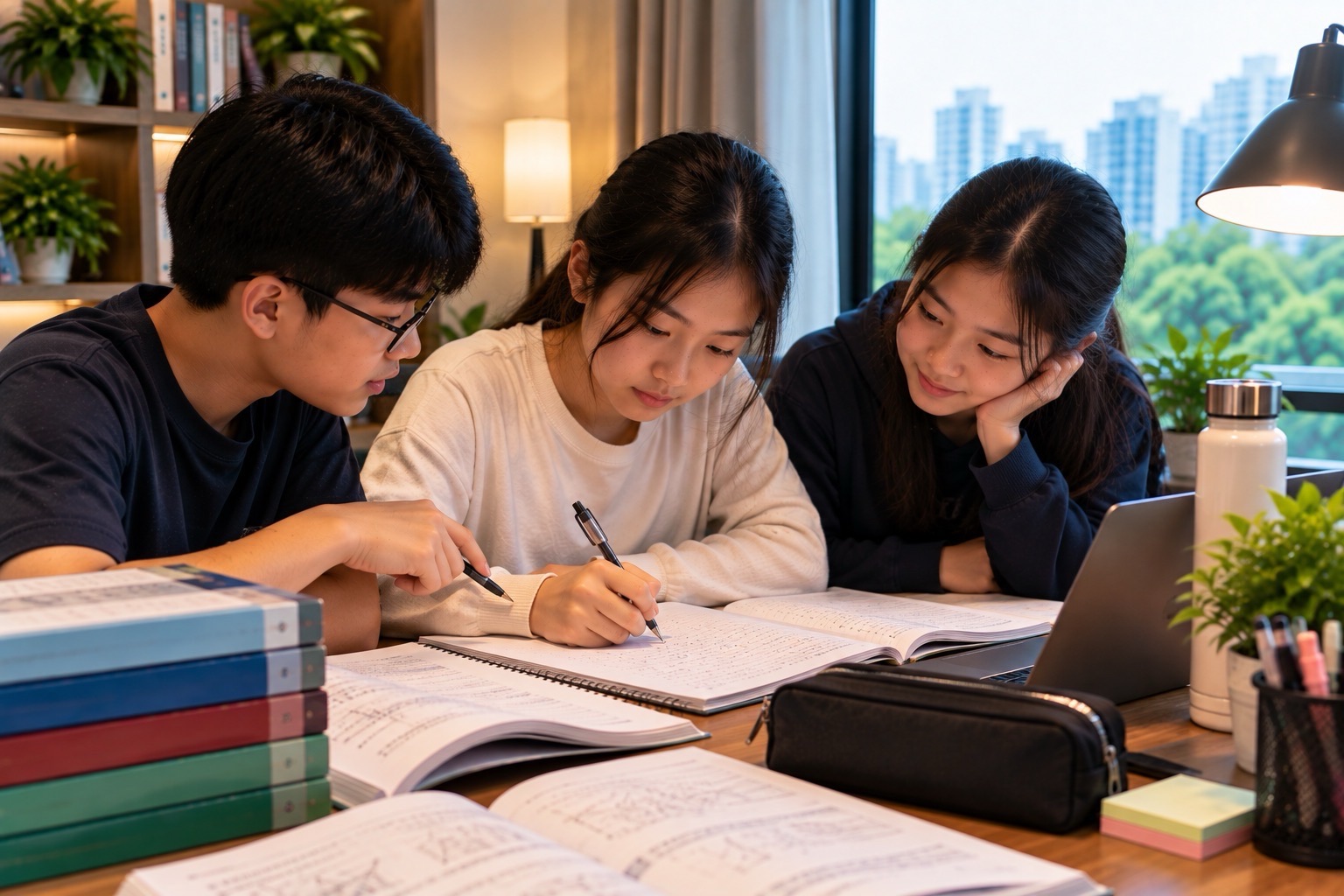
East Spring Secondary School at 30 Tampines Street 34, Singapore, is a government co-educational secondary school that eligible families in Punggol can consider through Posting Group 2 (PG2). Its completed 2026 Secondary 1 intake had a historical PG2 PSLE Score range of 21–25, with 25 the last admitted score. This is not a fixed or guaranteed 2027 cut-off. The actual next allocation depends on the child’s official eligible Posting Group, preferences, vacancies and MOE posting rules. Confirm the school’s current information before ranking it and assess the actual Punggol-to-Tampines journey.
East Spring’s distinctive education centres on a Health Sciences Applied Learning Programme and Community Youth Leadership: Every Student a Leader. The 2026 school ALP page emphasises real health and medical issues, observation, investigation, design and technology. Its LLP is organised in three tiers, with class-based VIA experiences beginning in school, then older residents and later community projects. The school has announced its Open House on Thursday 5 November 2026, from 2.45 to 6.00 pm, with leadership sharing at 3.30 and 5.30 pm. These programmes can develop a PG2 learner’s curiosity and character without guaranteeing a particular G3 subject, selected leadership role or future post-secondary offer.
- School: East Spring Secondary, 30 Tampines Street 34, not Punggol.
- PG2 historical 2026 intake: PSLE 21–25; do not treat as a 2027 promise.
- PG2 is an admission group; G2 is an individual academic subject level.
- ALP: Health Sciences, hands-on science and responsible use of technology.
- LLP: Every Student a Leader with tiered training and VIA service.
- Secondary 1 VIA: school-based service, including appreciation and relationships.
- Secondary 2 Project Sphere: class-led activities with older people in the community.
- Secondary 3: CCA-led community VIA, subject to the school’s current arrangements.
- DSA 2026: Leadership, with formal selection and PSLE-group compatibility.
- 2026 open house: 5 November, 2.45–6.00 pm; check current school page.
- Parent next step: review subject-level offers, travel, wellbeing and educational fit.
Definition lock: PG2 is admission, G2 is one subject level
Posting Group 2 organises Secondary 1 admission under Full Subject-Based Banding. It is not a permanent classification of every capability the child possesses. G2 describes a particular curriculum subject, and the pupil may have different levels across subjects where current eligibility and school arrangements permit. An East Spring student might have sound numerical reasoning yet need support with English paragraphs, or be an expressive communicator while still learning scientific measurement. These are specific educational needs, not evidence that every skill shares the same level. Parents should inspect the formal subject-level offer after posting rather than assume that the original PG2 label tells them which books to buy or what the whole timetable will look like.
How to read the 2026 PG2 historical range
The completed 2026 Secondary 1 intake included East Spring PG2 students with PSLE Scores from 21 to 25. The last admitted score, 25, is an observed outcome for that exercise, based on the pupils who took PSLE in 2025. A student obtaining score 25 for the next intake cannot treat the historical result as a guaranteed reservation. Demand, ranking, vacancies and the formal tie-break process can change the outcome. Keep the intake year next to every score. Do not compare PG2 figures with unrelated PG3 or PG1 ranges as though they describe one standard. Where MOE allows a family to choose between posting groups, understand that academic decision before ranking the schools.
Why Punggol parents may consider a Tampines school
East Spring is at 30 Tampines Street 34, outside Punggol itself. A school across the estate boundary may be suitable if the child’s academic needs and interests match, but the family should test the actual journey. Map distance alone does not reveal waiting at the stop, rail transfers, rain, school reporting time or the return trip after CCA. Practise the route on a comparable weekday and note safe crossings and a backup if a bus is disrupted. An interesting Health Science ALP is meaningful only when the pupil can participate in ordinary school life without regular exhaustion. The aim is a sustainable four-year experience, not a one-day impressive campus visit.
A school identity grounded in growth and service
East Spring’s current vision is Creative Learners, Upright Leaders, Global Thinkers. The mission emphasises self-directed and compassionate citizens who continue learning. Those statements should be evaluated in real practice: can students ask questions without shame, explain mistakes and participate thoughtfully in group tasks? How do teachers help a pupil who is strong in one subject and uncertain in another? School values become useful when they shape feedback and relationships rather than simply appear on a wall. A parent can ask the child to identify one real example of responsibility, resilience or empathy after a class experience. Such evidence says more about culture than a claim that every student must be perfect immediately.

East Spring’s origins and present-day learning
East Spring Secondary opened in 1999 during the growth of Tampines. Its school history connects early development with Thinking Schools, Learning Nation and later initiatives such as Success for Learning, a programme tailored to diverse learners. In 2017, the school received a Lee Hsien Loong Award for Innovations in the Normal Course, a historical recognition that should not be read as evidence that old streaming labels still govern the current cohort. The meaningful question is how modern teaching responds to present Full SBB students. History can explain a school’s emphasis on innovation and support, but it cannot determine whether a particular teenager will enjoy the current timetable, CCA or classroom approach.
The Health Sciences Applied Learning Programme
The current Applied Learning Programme focuses on Health Sciences and its stated vision is to cultivate 21st Century Innovators Through Health Science. The official May 2026 page says students investigate current health and medical issues relevant to Singapore, using hands-on experiences to develop observing, experimenting, designing and evaluating skills. A pupil might enjoy technology and still need to understand that health projects involve human needs, careful evidence and professional boundaries. A project about wellbeing is not a licence to diagnose classmates or promote unverified medical advice. Ask the child what the problem was, how it was examined and why the chosen solution may or may not help the intended user.
Why health science is not a single career
Health Science can lead students to explore laboratory work, engineering, digital technology, community services, nutrition or public health questions, but the school programme does not automatically qualify pupils for those occupations. A student fascinated by a health gadget may discover that engineering requires measurement and programming. Another interested in caring for people may need strong communication and ethical judgement. Parents should discuss real course modules and professional prerequisites when the child is older, rather than promise a health-related diploma because of one ALP demonstration. For a younger PG2 pupil the priority is to build curiosity, accurate reading, numeracy and an ability to explain scientific conclusions without overstating the evidence.
Start by observing, not announcing a solution
Applied science begins with an observation and a question that can be investigated. Imagine a class considering whether a reminder device could improve a routine. Before programming the alert, pupils should ask whose routine it is, whether reminders are the actual obstacle and how they would know the proposal is useful. The first idea could be unnecessary or irritating. Appropriate consultation and simple testing may reveal a better approach. A student who changes a design after evidence is not failing; that child is learning to reason. This process also supports school Mathematics, where identifying the earliest mistaken step matters more than altering the final number until it looks right.
Interpreting health information responsibly
Teenagers encounter online claims about sleep, food, fitness and technology. Some are supported by credible evidence and others depend on anecdotes or sensational marketing. East Spring’s health-science theme is a useful setting for teaching pupils to ask who made a claim, what was measured and whether the conclusion is proportionate to the information. A report about ten volunteers cannot automatically describe every teenager. An image showing a device working once cannot demonstrate long-term reliability. Students should be encouraged to say that more information is needed when appropriate. The best educational outcome is careful judgement, not an impressive presentation that happens to contain inaccurate health advice.
Technology must serve a real purpose
The ALP uses relevant tools and health-science gadgets to make learning concrete. Yet an advanced-looking device is not automatically a good answer to a human problem. Students should identify the user, the need and the conditions in which the device might fail. They must also consider safe handling and privacy. A project collecting health data could expose sensitive information if pupils are careless. School-approved exercises should follow the institution’s instructions and consent arrangements. The parent can ask the teenager to explain one design decision and one limitation. Being able to do that without relying on a chatbot is stronger evidence of understanding than merely showing a finished product.
Practical investigation and fair comparisons
A pupil investigating a health-related question may need to distinguish an independent variable from a measured outcome and keep relevant other conditions stable. If two different devices are tested in different locations, an observed difference might arise from environment rather than design. A careful learner records those limitations. This skill connects directly to G2 Science, where explanation requires the appropriate mechanism and evidence. The child should not regard a surprising result as embarrassment. It can be the beginning of a better question. Parents can support this by asking which part of the method would need to be repeated or improved, not simply whether the team’s hypothesis was confirmed.
How design thinking supports Science
Design thinking adds empathy and iterative testing to scientific knowledge. A team may be capable of measuring a variable but still misunderstand what users need. The child should learn to gather appropriate feedback and decide whether a prototype is understandable, safe and practical. A simple plan that people can maintain may be more useful than a technically elaborate system. Students should be able to explain the relationship between science, the prototype and the human problem. If a project is selected for a showcase, recognise the achievement without claiming it represents every pupil’s experience. The actual ALP activities and selection arrangements belong to the school and may evolve for subsequent cohorts.
What every student a leader means
East Spring’s Learning for Life Programme is Community Youth Leadership: Every Student a Leader. Its May 2026 description says the school aims to develop confident persons who communicate effectively and active contributors who serve the community with empathy. Leadership begins with self-management and respectful conduct, not an automatic student-council badge. A Secondary 1 pupil can learn to prepare for class, listen to teammates and complete a small role reliably. Those are real leadership behaviours. Parents should ask how the programme helps students understand responsibilities, practise them in authentic situations and reflect afterwards. A child who becomes more dependable without winning an award has still made meaningful progress.
The three tiers of leadership
The LLP distinguishes three participation tiers. Tier 1 provides foundational leadership education to all pupils. Tier 2 offers targeted training for identified student leaders in different groups. Tier 3 is an advanced structure for heads of those groups and CCA leaders. This distinction is crucial when parents read publicity material. An impressive photograph of a senior council meeting does not mean every PG2 child will hold an equivalent position. The foundation is broadly educational; selected responsibilities depend on school criteria. Ask what the ordinary Year 1 cohort experiences and how students can express an interest in deeper participation. A pupil should not be pressured into seeking a title before learning to fulfil simpler commitments well.
Secondary 1 VIA: begin close to school
The official LLP page describes Secondary 1 class-based Values-in-Action projects within the school. Examples include adopting a school bright spot, appreciating cleaners and making friends across racial and cultural backgrounds. These are appropriate starting points because younger pupils can observe the setting and understand the people involved. A class should not invent a large charity programme before learning the importance of ordinary respect and follow-through. A student who listens to cleaning staff or collaborates with classmates can discover what service actually involves. Parents should ask which need the class identified and whether the proposed response was useful. The learning is more important than collecting photographic proof of kindness.
Appreciating school cleaners respectfully
A service activity involving cleaners should begin with recognising them as skilled adults carrying out important work, not as props for a sentimental student presentation. Pupils may learn about shared responsibility for school spaces and why respectful daily behaviour matters. An appreciation activity is meaningful when it is sincere and supported by consistent conduct. A child should not create extra mess and then regard a thank-you poster as a complete response. Parents can ask the teenager what small habit was changed and how the student can sustain it. Respect for service workers is a civic skill that applies beyond school, including public transport, food courts and community facilities.
Culture and friendships across differences
The Secondary 1 LLP also mentions making friends across races and learning about cultural customs. A useful activity invites respectful curiosity without stereotyping classmates or treating one pupil as a representative of an entire community. Students should learn to ask questions sensitively and listen to the answer rather than assume what another family does. Mixed form classes can help young people see different abilities and backgrounds together. A pupil studying Mathematics at another level may still share the same sports interest or excellent sense of humour. The parent can reinforce this by asking about kindness and shared activities instead of comparing friends by PSLE results or subject levels.
Secondary 2 Project Sphere and older residents
In Secondary 2, East Spring’s official LLP describes Project Sphere, a class-based community VIA programme in which pupils develop games and activities for older residents. That progression broadens the student’s perspective from the immediate school to a wider community. The best starting point is to understand what participants actually enjoy and can comfortably do. Older adults have varied abilities, interests and preferences; one activity does not fit everyone. Students should follow school and partner safeguarding rules, obtain necessary consent and respect privacy. A thoughtful pupil may learn that listening patiently matters more than presenting an elaborate game. Families can ask what the child learned from the participants, not only what was delivered.
Secondary 3 CCA-led contribution
East Spring’s LLP says Secondary 3 pupils undertake CCA-based VIA projects intended to address school or community needs. One historic example involved several sports CCAs arranging a Community Sports Day for older people. Such activities connect capabilities learned through a CCA with genuine service, but a historical example should not be promised as a fixed 2027 programme. The group needs to consider participation, accessibility, safe planning and the partner’s instructions. A sports pupil who is fast and confident may discover the importance of adapting activities so others can join comfortably. Another may contribute through careful organisation or clear communication. Good service recognises different strengths and limitations.
The actual 2026 DSA talent domain
East Spring’s July 2026 DSA page identifies Leadership, for girls and boys, as its talent area. It describes an applicant with genuine contributions in school or community, strong conduct, relevant leadership experience and the ability to discuss social issues. Those criteria are more specific than the generic statement that the school values leaders. An applicant should show authentic work and be able to explain what was learned, rather than purchase certificates to build an impressive-looking portfolio. A DSA Confirmed Offer remains subject to the pupil qualifying for a Posting Group offered by the school. Successful admission also entails a commitment to the talent area, and current dates must be checked for the next exercise.
The forthcoming 5 November 2026 open house
East Spring’s homepage announces its 2026 Open House for Thursday 5 November, from 2.45 pm to 6.00 pm, with school leaders’ sharing at 3.30–4.00 pm and 5.30–6.00 pm. As of 4 November 2026, this is an imminent dated event, not a recurring annual schedule. Parents can ask how the Health Science ALP operates for ordinary Secondary 1 pupils, how the three LLP tiers are organised and what a mixed subject-level timetable looks like. Let the teenager ask about a class, science activity or CCA. A visit can improve understanding of school fit, but it is not a reservation or evidence of a future posting cut-off.
Full SBB: mixed form classes and levelled lessons
The family should understand that the form class and academic teaching group may serve different purposes under Full SBB. Pupils with different subject profiles can form friendships and participate in common school experiences, while Mathematics, English or other lessons follow the actual subject-level timetable. The school determines formal eligibility and any later subject-level adjustment. A parent should not promise a G3 upgrade because a tutor reports one strong practice result, nor assume a PG2 child will forever be unable to take a more demanding eligible subject. The best evidence is sustained independent learning and readiness. After admission, follow the official subject offer when buying books and arranging support.
G2 English: read, infer and support
An East Spring pupil may need to strengthen reading and written explanation when transitioning to Secondary 1. A common comprehension difficulty is giving a plausible inference without evidence from the passage. Ask the teenager to state the claim, point to the supporting words and explain the connection. If the pupil misreads the sentence, the problem is different from one who selects the correct quotation but cannot explain it. Teaching should follow that distinction. Health-science projects also require accurate communication: a student must describe a method, result and limitation rather than present a generic persuasive paragraph. The goal is transferable reasoning on unfamiliar texts, not copying an impressive model answer.
G2 Mathematics: identify the concept behind the mistake
A health-science project may use ratios, graphs and measurement, but formal G2 Mathematics still requires algebra and accurate symbolic reasoning. Suppose the child writes 2(x + 3) = 2x + 3. The multiplier must apply to both terms, giving 2x + 6. Explain the relationship using two identical groups, then ask the pupil to solve a changed expression without hints. Another child may know this rule but misread the graph’s scale or copy a negative sign incorrectly. Those mistakes need different repairs. A useful learning plan looks for the earliest incorrect mental move and checks improvement through independent practice, rather than simply assigning another large worksheet.
G2 Science: distinguish mechanism and observation
Science questions may ask what happened, why it happened or whether evidence justifies a conclusion. Students should recognise that these are different tasks. In a hypothetical experiment, a measured change is an observation; the claim that a particular factor caused it requires suitable controls and reasoning. If the conditions differ in several ways, a causal conclusion may be premature. East Spring’s Health Science theme can motivate careful scientific language, but it cannot replace the formal syllabus. Parents can ask the child to explain one result using the correct concept and to name a limitation. Intellectual honesty and clear explanation are more educationally valuable than a polished project display.
Support and the Success for Learning history
East Spring’s history describes a Success for Learning programme intended to respond to diverse student needs. Its current school structure includes educational-support and wellbeing staff, but families should ask about arrangements applicable to the actual pupil rather than assume a historical programme operates unchanged. A child who has difficulty organising homework may need a simple planning routine. Another with persistent algebra misconceptions needs precise subject teaching. A teenager experiencing social distress may need appropriate school and professional support rather than extra worksheets. PG2 alone is not a diagnosis. A parent can provide one concrete work example or observation when approaching the form teacher to make the support conversation accurate and productive.
Co-curricular activities and actual selection
The school’s public profile lists sports, performing arts, uniformed groups and other CCAs. A teenager may discover a strength in an activity unrelated to academic subject levels. However, actual membership, auditions, trials, timetable and space belong to the school’s current allocation process. Joining a CCA also does not automatically guarantee an achievement or LEAPS 2.0 bonus; those follow formal criteria and sustained recognised participation. Families should choose an activity the pupil can attend responsibly, with time for schoolwork and rest. A Punggol student needs to consider travel after the actual training end. The best CCA is not necessarily the most prestigious-sounding one, but one that supports genuine learning and belonging.
A sensible first-month transition plan
If the pupil is posted to East Spring, follow the actual 2027 registration instructions for uniform, books, device, subject-level timetable and orientation. During the first week, practise safe travel and finding classes. In the second, establish one assignment list and a method for asking teachers questions. In the third, discuss a Health Science or class VIA experience and identify one useful piece of learning. In the fourth, review any repeated academic or wellbeing challenge, then choose the appropriate response. This is an illustrative family routine, not an official school calendar. The child should gradually manage more independently while still knowing whom to ask for help when something is genuinely difficult.
Three fictional family profiles
A pupil with PG2-eligible score 25 might look at East Spring because the 2026 historical last admitted result was 25. The family researches school fit and realistic alternatives rather than declaring admission guaranteed. Another child enjoys practical Health Science but struggles with extended English answers; the parent values the ALP interest while repairing evidence-based written explanation. A third is keen on service but not a formal student-leadership title; the family recognises that Tier 1 community work can develop responsibility without a senior appointment. These are fictional examples, not real applicants or admissions forecasts. Each shows how official eligibility, genuine interest and targeted learning support can be considered separately.
Questions to ask during a visit
Ask first which Health Science experiences are broadly available to Secondary 1 students, and which additional projects are selected. Ask about how pupils learn to verify health claims and keep project work safe. Then investigate LLP: what does a normal class do for VIA, and how do students apply for more advanced leadership? Ask about G2/G3 subject offers, communication with parents, SEN support and the CCA timetable. Let the teenager ask at least one question. A child who is curious about a science project or service activity may provide useful evidence about fit. The family should leave with clear facts and remaining questions, rather than a conclusion based only on a school hall display.
What the school cannot promise
No school can guarantee that an individual PG2 applicant will receive a place merely because of a historical cut-off. A Health Science ALP cannot guarantee entry to medicine, nursing, engineering or a polytechnic diploma. A leadership LLP does not promise a student-council appointment or automatic LEAPS points. Nor does a school name or technology demonstration erase formal subject prerequisites. Families should recognise these limitations while valuing the real educational opportunities. Honest information lets parents compare schools without unnecessary anxiety. If an important fact is missing, such as a current subject combination or selection condition, ask the school rather than fill the gap with a confident guess.
Your next step
Use the school’s current Health Science ALP, Community Youth Leadership LLP, DSA and school information with MOE SchoolFinder. Confirm the pupil’s actual Posting Group eligibility and historic 2026 range, test the journey from Punggol and ask about the ordinary school week. Discuss the child’s genuine interests rather than turning PG2 into a permanent identity. If admitted, concentrate on the actual subject-level timetable, consistent routines and targeted support where needed. For broader choices, use eduKatePunggol’s existing PG2 school-selection guide instead of repeating the national six-choice process here.
Official sources and useful links
East Spring ALP: Health Sciences; East Spring LLP: Every Student a Leader; East Spring DSA 2026 Leadership; East Spring school values; East Spring school homepage and 5 November open house; MOE SchoolFinder; Historical 2026 PG2 range.


