
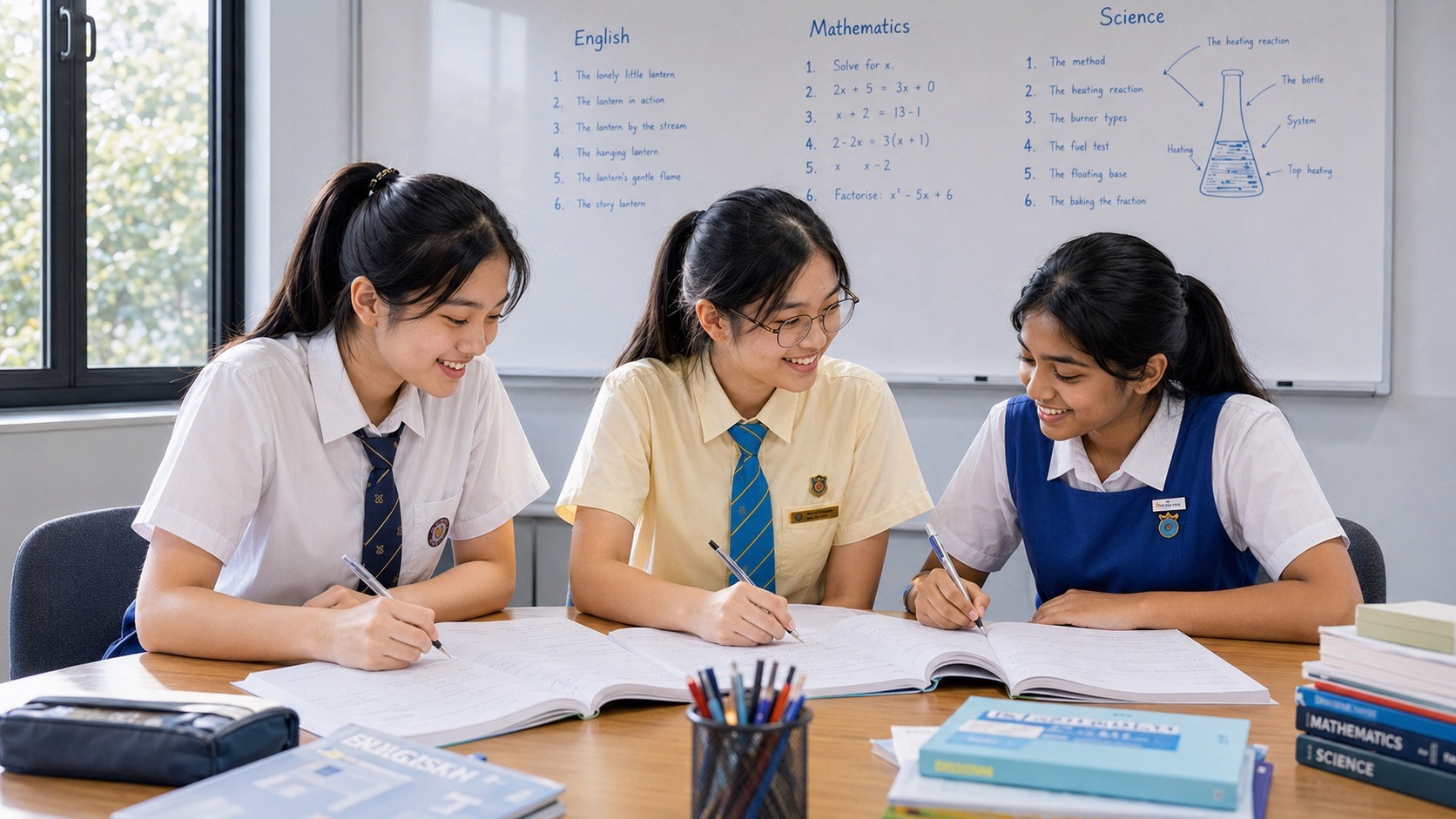
Bartley Secondary School is at 10 Jalan Bunga Rampai, Singapore 538403, near Bartley MRT on the Circle Line, and its historical 2026 Secondary 1 Posting Group 1 (PG1) admitted PSLE Score range was 26–30*. The asterisk means the group still had places after the 2026 posting of pupils who sat PSLE in 2025; 30 denotes the upper eligible score rather than a fully subscribed last-place cut-off. This does not guarantee admission for 2027. A Punggol family should check the child’s actual PG1 eligibility, verify the current MOE SchoolFinder profile and test the real commute to the Bartley campus. The official school page confirms the street address and local train and bus connections.
Bartley’s distinctive educational pairing is Chemical and Applied Sciences (Fragrance) and Community Youth Leadership, including the school’s 70 Acts of Kindness initiative. Its May 2026 ALP teaches Secondary 1 pupils fragrance science, extracting essential oils through supervised separation techniques, CAD for 3D design and Micro:bit programming. Secondary 2 students progress to perfume formulation and design thinking, while selected older pupils can explore the CurioSTÉ Club, competitions and an Advanced Elective Module in Perfumery and Cosmetic Science. Its LLP uses Acquire, Act and Advocate and a STEP service-learning approach, with community contribution through CCAs and whole-school action. Bartley also offers a selected Bartley Scholars Programme. Under Full Subject-Based Banding, PG1 is admission whereas G1, G2 and G3 are academic subject levels. This guide explains school fit, selection and 2027 planning without turning programme publicity or previous scores into guarantees.
- School: Bartley Secondary School, 10 Jalan Bunga Rampai, Singapore 538403
- Nearest MRT: Bartley station, Circle Line; test the actual trip from Punggol
- 2026 historical PG1 range 26–30*, meaning the posting group had unfilled places in that intake
- 2027 admissions depend on the new cohort’s eligibility, ranked choices and available places
- ALP: Chemical and Applied Sciences (Fragrance), a STEM learning programme
- Secondary 1: fragrance concepts, extracting oils from flowers/spices/fruit, CAD design and Micro:bit coding
- Secondary 2: perfume formulation, deeper CAD and coding, EDIPT design thinking
- EDIPT: Empathy, Define, Ideate, Prototype and Test
- Selected Sec 3+ extension: STEM competitions, CurioSTÉ Club and job-shadowing
- Singapore Polytechnic AEM in Perfumery and Cosmetic Science may be offered to selected eligible pupils
- ALP partners include Science Centre STEM Inc, A*STAR research and Takasago
- LLP: Community Youth Leadership, including the school’s 70 Acts of Kindness
- A3 leadership: Acquire, Act and Advocate; STEP integrates reflection and service
- VIA includes CCA-based long-term projects and whole-school initiatives
- Bartley Scholars is a selected four-year extension in Leadership, STEM and Arts
- DSA 2026 domains: Fragrance Applied Sciences, Community Youth Leadership, Football and Table Tennis
- Open House announced for 28 November 2026, 8am–1pm on the official school homepage
- Follow the actual Full SBB subject allocation and 2027 joining instructions after posting
Information verified 4 November 2026. The historical 2026 PG1 30* indicates vacancies in that intake, not a guarantee of 2027 admission or a selected club, scholars or industry opportunity.

Contents: Bartley PG1, Fragrance and Service Guide
- 1. Definition Lock: PG1 Is Not the Same as G1
- 2. What the 2026 PG1 26–30* notation means
- 3. Why a vacant group can change in another year
- 4. PSLE Score 25 and PG1/PG2 eligibility
- 5. The campus at Jalan Bunga Rampai
- 6. Bartley’s CORE values
- 7. The Fragrance Science Applied Learning Programme
- 8. Why fragrance offers a science learning context
- 9. Secondary 1: fundamental fragrance concepts
- 10. Essential-oil extraction under supervision
- 11. Separation techniques and scientific reasoning
- 12. The difference between a smell and a safety claim
- 13. CAD design in Secondary 1
- 14. Micro:bit programming in Secondary 1
- 15. Why fragrance and coding belong in one programme
- 16. Secondary 2: perfume formulation
- 17. Choosing quantities in a formulation
- 18. Secondary 2: deeper CAD and coding
- 19. EDIPT: the design-thinking cycle
- 20. Empathy in design for actual people
- 21. A prototype is not a finished commercial product
- 22. CurioSTÉ Club and selected STEM extension
- 23. STEM competitions and enrichment
- 24. Advanced Elective Module in Perfumery and Cosmetic Science
- 25. Industry partners and real science careers
- 26. Job shadowing and selected attachments
- 27. Community Youth Leadership LLP
- 28. A3: Acquire, Act and Advocate
- 29. 70 Acts of Kindness
- 30. CCA-based long-term VIA
- 31. Whole-school VIA and shared causes
- 32. The STEP service-learning framework
- 33. Student leadership and the i-LEAD framework
- 34. Student Council and class committees
- 35. The Bartley Scholars Programme
- 36. Scholars: Secondary 1 exposure
- 37. Scholars: later specialisation and mentoring
- 38. Full SBB at Bartley
- 39. G1 English and writing a fragrance report
- 40. Mathematics in CAD and perfume formulation
- 41. Science: safety, evidence and responsible conclusions
- 42. Mother Tongue and varied abilities
- 43. Bartley’s 2026 DSA talent areas
- 44. The 28 November 2026 Open House
- 45. Practical booklists and family finances
- 46. A fictional Punggol child interested in fragrance
- 47. A fictional pupil learns to serve using CCA strengths
- 48. Comparing Bartley with other eligible schools
- 49. Your next step for the 2027 school choice
Definition Lock: PG1 Is Not the Same as G1
Posting Group 1 is an entry category used in national Secondary 1 school posting after PSLE. G1 is the curriculum standard of an individual academic subject under Full Subject-Based Banding, with G2 and G3 representing other standards. A pupil entering Bartley through PG1 may show different strengths in language, Mathematics, practical Science and leadership. The group does not permanently assign every subject or determine a person’s future ability.
Keep the child’s PSLE eligibility notice, the formal school posting confirmation and the eventual subject-level timetable separate. A teenager may be enthusiastic about fragrance experiments while needing help writing conclusions, or confident in English while still consolidating numerical ratios. Those are specific teachable needs. A school choice should consider how real lessons support them rather than turning PG1 into a fixed social identity.
What the 2026 PG1 26–30* notation means
The 2026 Secondary 1 PG1 admitted score range at Bartley was 26–30*, based on students who took PSLE in 2025. The star signals that the group still had places after the posting exercise. It is important because the displayed maximum score of 30 is the upper eligible boundary, not a conventional contested last-admitted cut-off.
A family cannot promise Bartley to every child who qualifies for PG1 in 2027 merely because vacancies existed before. The next cohort may rank schools differently or face a change in available places. Preserve the historical year and asterisk in any comparison and use current MOE SchoolFinder information. Formal admission depends on the actual posting, not an optimistic interpretation of an old table.
Why a vacant group can change in another year
A school with places remaining in one exercise might attract more applicants later, or the number of places may differ. Parents cannot know the final competition before all pupils submit their preferences. A historic vacancy is information about the past, not a guarantee about future demand or a judgment about the quality of the teaching.
The family should assess Bartley’s curriculum, its academic support, the child’s genuine interests and the daily commute. These are useful regardless of whether the school was previously under-subscribed. School choice should not be reduced to finding the easiest historical score; the teenager needs a suitable place to attend for several years.
PSLE Score 25 and PG1/PG2 eligibility
MOE’s current framework allows certain pupils with PSLE Score 25 to choose between PG1 and PG2. The group chosen affects the school-posting route and broad initial academic demands. Parents should consider the child’s individual subject readiness and the schools available, not use the number as a social ranking.
Bartley’s historical PG1 26–30* cannot simply be used for PG2 admission. Check the correct SchoolFinder row for the group being selected and follow MOE’s national instructions. If the child has uneven strengths, ask the primary school how the choice may affect the starting curriculum. A realistic route supports independent learning rather than adult prestige.
The campus at Jalan Bunga Rampai
Bartley’s official contact page lists 10 Jalan Bunga Rampai, Singapore 538403. It identifies Bartley MRT on the Circle Line and buses on nearby routes. This is not a campus in Punggol, although a Punggol family may be able to connect by public transport. The correct route depends on the exact home and the time the pupil must report.
Test an ordinary morning journey, including waits, transfers, safe crossings and the final walk. Consider a later CCA afternoon and how much time remains for food and homework. A school with a programme the child loves still needs to fit daily life. No single journey duration is reliable for every household in Punggol.
Bartley’s CORE values
Bartley’s current homepage describes a caring community anchored by Courage, Optimism, Respect and Excellence, abbreviated CORE. These values offer a useful way to discuss learning behaviour. Courage may mean admitting a mistake; respect can mean listening to another viewpoint; excellence can involve careful work and improvement rather than always winning.
Ask what the child actually did when a task became difficult. Did they seek feedback or help someone else? A values statement becomes meaningful when it shapes daily decisions and relationships. An entry Posting Group cannot by itself show whether a student has these qualities. They develop through repeated opportunities to learn and contribute.
The Fragrance Science Applied Learning Programme
Bartley’s official ALP is Chemical and Applied Sciences (Fragrance). It aims to encourage exploration, discovery and innovation through Science, Technology, Engineering and Mathematics. Fragrance is a distinctive context because pupils encounter familiar smells while investigating real chemical and design processes. The school wants learners to understand how scientific ideas connect with products and everyday decisions.
A parent should not interpret this as a promise that every student will become a professional perfumer. The learning is introductory and practical, while formal Science follows its own syllabus. A pupil who enjoys the topic may discover reasons to strengthen Mathematics, reading and careful observation.
Why fragrance offers a science learning context
A familiar fragrance can prompt questions about plants, compounds, extraction and how a mixture is perceived. Students can learn to ask where a smell comes from and which process produces a usable extract. Scientific understanding requires more than identifying a pleasant scent; it involves observation, suitable methods and clear evidence.
Ask the teenager what the experiment was intended to separate and how the group knew the process worked. Avoid claiming that a natural substance is automatically safer or better. Responsible science includes understanding the limits of a school demonstration and following trained staff’s instructions.
Secondary 1: fundamental fragrance concepts
Bartley’s May 2026 ALP page states that Secondary 1 pupils acquire basic concepts about fragrances. This provides a foundation before the more complex work of formulation and product design. A well-structured introduction can connect the science of materials with the sensory experience of smell without requiring a prior chemistry qualification.
Parents can ask which new concept the child understood and how they would explain it to someone else. If the pupil uses a technical word without understanding it, invite a simpler explanation. The goal is knowledge the student can apply, not a vocabulary list designed to sound impressive.
Essential-oil extraction under supervision
The school describes pupils using separation techniques to extract essential oils from flowers, spices and fruits. Such work can demonstrate that a useful component may be separated from a mixture through a chosen process. Students need to understand the method, equipment and why safety precautions matter, not merely enjoy the resulting scent.
Parents should not attempt unknown chemical extractions at home or use concentrated oils as though they were harmless. School supervision and appropriate materials are essential. A pupil who can explain what was separated, how it was collected and what limitations remained has achieved meaningful Science learning.
Separation techniques and scientific reasoning
Separating a mixture requires understanding which property or process makes the components behave differently. A school fragrance experiment is a useful introduction to this idea. Pupils should learn that the choice of technique matters and that a process can have imperfect results or require further testing.
Ask the child what evidence shows that the intended component was obtained. Does the smell alone establish purity or safety? Usually not. A careful learner recognises that observation and a scientific conclusion are related but different. This builds habits useful in other Chemistry lessons and daily decisions.
The difference between a smell and a safety claim
A pleasant scent does not guarantee that a substance is safe for every person. Fragrance products can contain concentrated compounds, and real product testing involves specialist knowledge. A school ALP demonstration should therefore not be presented as permission to manufacture a cosmetic for unrestricted personal use or to make medical claims.
Parents can reinforce the principle of following teacher instructions and respecting individual sensitivities. The pupil should understand what the experiment demonstrated and what remains unknown. A responsible scientific attitude includes not overstating the significance of a classroom result.
CAD design in Secondary 1
The ALP describes using computer-aided design, or CAD, to create designs for 3D printing. A pupil can learn how dimensions and shapes translate from a screen into a physical prototype. The exercise may reveal why accuracy and purpose matter: a design can look attractive in software yet fail when printed or used.
Ask what problem the object was intended to solve and which measurements were checked. A small correct model is more educationally useful than an elaborate object whose design the child cannot explain. The school provides suitable supervision for specialist equipment; parents need not purchase a 3D printer.
Micro:bit programming in Secondary 1
Bartley’s broad ALP includes Micro:bit coding tasks. The device can make logical rules visible by responding to inputs and conditions. A simple program helps students learn that computers follow instructions precisely rather than guessing what their creators intended. When an output is wrong, the learner can inspect the sequence and correct the error.
Parents can ask what the pupil expected the program to do and how the actual result differed. Encourage independent debugging instead of copying a complete solution. Such logical thinking supports Mathematics and practical problem-solving across school subjects.
Why fragrance and coding belong in one programme
Chemical Science, CAD design and coding may appear unrelated at first, but a product-development process can involve understanding materials, making a design and controlling or testing a system. Bartley’s broad ALP encourages pupils to connect those skills rather than treat each practical task as an isolated novelty.
Ask what subject knowledge helped the project move forward. Did Mathematics determine a dimension, Science explain a process, or coding test a response? An interdisciplinary project becomes meaningful when the student can explain the connections. Merely attaching several subject labels to a poster is not enough.
Secondary 2: perfume formulation
Bartley’s official ALP describes Secondary 2 pupils applying their knowledge to the formulation of perfumes. This moves beyond observing a fragrance towards making carefully considered choices about a mixture and its intended properties. The exercise should involve suitable methods, quantities and a reasoned explanation rather than simply mixing substances until they smell appealing.
A pupil entering Secondary 1 in 2027 would ordinarily reach Secondary 2 in 2028, so the exact class task can change. Parents can ask what the student has learned about proportions, safety and intended users. A school formulation is an educational activity, not a commercial product certification.
Choosing quantities in a formulation
Formulation depends on quantities and relationships among components. A student may discover that a small change affects the result and that inconsistent measurements make comparisons unreliable. Such practical work creates a meaningful reason to understand ratios, units and recording methods accurately.
Parents can encourage the child to estimate and check quantities at the level the school teaches. Avoid providing unsafe home chemical recipes. The valuable skill is understanding the mathematical and scientific reasoning, not attempting professional cosmetic manufacturing without supervision.
Secondary 2: deeper CAD and coding
The school describes further CAD and Micro:bit work in Secondary 2, allowing pupils to build on the lower-secondary foundation. A student may need to design a prototype more carefully and explain how it serves the project’s theme. Coding and 3D design can reveal different kinds of errors that require different solutions.
Ask the teenager which change made the model more reliable and how that conclusion was reached. Repeating a teacher’s steps is a useful beginning but not the final learning goal. Independent testing and clear explanation are more valuable than owning sophisticated software.
EDIPT: the design-thinking cycle
Bartley’s ALP names EDIPT: Empathy, Define, Ideate, Prototype and Test. Empathy asks pupils to understand the people affected; Define clarifies the problem; Ideate develops possibilities; Prototype makes an early model; Test gathers feedback and evidence. The sequence prevents pupils from treating a finished object as proof they solved the correct problem.
Parents can ask which stage caused the team to reconsider its assumptions. A project may become better when the student listens to criticism and adjusts a design. Good engineering and good service both require attention to real users.
Empathy in design for actual people
A product or service may be technically impressive but unsuitable for the people who would use it. Design thinking asks pupils to consider users’ preferences, access needs and practical constraints before committing to an idea. This can make a fragrance product or digital tool more thoughtfully planned.
Ask whose feedback the group sought and whether the pupil understood the response. Avoid stereotyping all older people or other user groups. Responsible design learns from actual people rather than assigning imaginary needs to them.
A prototype is not a finished commercial product
A prototype helps test an idea and find weaknesses. It may not be durable, safe or ready for commercial use. A school project should teach students to recognise that difference, especially when working with chemical materials or electronic devices. A creative concept requires more evidence before it could be used broadly.
Parents can ask what failed in a trial and which next test would be useful. A pupil who recognises a limitation is demonstrating maturity. Competition results and polished photographs should not conceal the learning still needed.

CurioSTÉ Club and selected STEM extension
The school states that programmes for pupils with higher interest and ability give priority to members of the CurioSTÉ Club. These can involve competitions, advanced enrichment and learning journeys. They are separate from the broad Secondary 1 and 2 ALP experiences, so a new PG1 pupil should not be promised automatic club membership.
Ask how students express interest and what regular practice is expected. A pupil may need time to strengthen foundational Mathematics and Science before seeking more advanced work. The general programme remains valuable even if a child chooses a different CCA.
STEM competitions and enrichment
Bartley’s ALP lists STEM competitions and enrichment for suitable older pupils. Such events can encourage teamwork, investigation and clear explanation under constraints. A school may feature successful projects in publicity, but selected outcomes do not describe the ordinary experience of every child.
Parents should help teenagers focus on genuine learning rather than building an expensive project entirely at home. The child needs to understand the concept and respond to questions. A carefully reasoned unsuccessful attempt can teach more than a polished competition entry the pupil cannot defend.
Advanced Elective Module in Perfumery and Cosmetic Science
The school describes an Advanced Elective Module in Perfumery and Cosmetic Science at Singapore Polytechnic for suitable older students. This can help pupils explore a field beyond introductory fragrance experiments and understand the skills involved in further technical education. The programme has its own participation and scheduling requirements.
A Secondary 1 pupil entering in 2027 would normally encounter such possibilities years later. Parents should not promise a particular AEM seat or diploma admission now. The useful preparation is building accurate Science, Mathematics and communication skills while discovering genuine interests.
Industry partners and real science careers
Bartley’s ALP page shows partners including Science Centre STEM Inc, A*STAR’s Institute of Chemical and Engineering Sciences and Takasago. Such relationships can offer learning journeys and opportunities to see how professionals investigate problems. Named partners are educational context, not guarantees of internships or future employment for all pupils.
Ask what the student learned about careful measurement, teamwork and safety in actual research or product-development work. An industry visit can make school knowledge more relevant without fixing a teenager’s career path. The child can explore further when the appropriate qualifications and interests become clearer.
Job shadowing and selected attachments
The school’s ALP lists study attachments, job shadowing and learning journeys among programmes for pupils with higher interest and ability in Secondary 3 and above. These can reveal how professionals work, but actual placements and participation depend on the school, host organisations and current arrangements.
Parents should distinguish an educational visit from a paid job or guaranteed course placement. Encourage the student to ask what skills and training the role requires. Experience is most valuable when it informs future decisions rather than becomes a prestige symbol.
Community Youth Leadership LLP
Bartley’s Learning for Life Programme focuses on Community Youth Leadership. The school aims to nurture young people who serve with empathy, take responsibility and contribute to a caring community. Formal leaders may be selected for additional roles, while broad school experiences help all pupils learn how their actions affect others.
A PG1 pupil can show leadership through considerate behaviour, preparation and willingness to correct mistakes. Parents can notice these habits without demanding an immediate council badge. Character develops through repeated decisions in lessons, CCAs and service.
A3: Acquire, Act and Advocate
The school’s LLP uses A3: Acquire, Act and Advocate. Pupils first acquire knowledge and skills, then act through service projects, and later advocate by guiding others towards positive change. This is a progression from understanding a need to responsible contribution rather than a checklist of volunteer hours.
Ask what information the child gathered before proposing a project. Did the group understand the beneficiaries? What did pupils learn after taking action? A thoughtful reflection can show more growth than an impressive claim about how much money was collected.
70 Acts of Kindness
Bartley’s LLP page highlights 70 Acts of Kindness as a school initiative. It is an example of turning community and school values into specific acts rather than only describing them in speeches. An act of kindness may be modest, but it should respond genuinely to another person and respect their dignity.
Parents should not treat the number in the campaign title as an individual pupil’s compulsory target. Ask what the child did and how it affected others. A meaningful contribution can occur without publicity or an award. Real service is measured by usefulness and care.
CCA-based long-term VIA
The school’s VIA approach includes CCA-based projects using the skills of different activities to serve communities over time. A sports group may contribute differently from a performing-arts or technology club. This helps pupils recognise that service can emerge from the abilities they are developing rather than only from a generic charity event.
Ask how a group’s strengths match the need and whether the activity is sustainable. The school and community partners manage actual arrangements. A pupil should not undertake unsupervised service involving vulnerable people without appropriate guidance.
Whole-school VIA and shared causes
Bartley also describes whole-school VIA initiatives such as food donation drives and festive handicraft activities. These can give pupils a chance to contribute collectively, even without holding formal leadership roles. The work may involve planning, preparing items and understanding what a beneficiary organisation can actually use.
Parents can ask whether the group followed appropriate donation rules and learned anything about the community. Avoid assuming every item or activity is helpful merely because the intentions were good. Responsible contribution begins with listening and accurate information.
The STEP service-learning framework
The official VIA page uses STEP as a framework supporting progressive service learning and reflection. Pupils should develop skills in a CCA, apply them through appropriate service and consider how their experience may guide future contributions. The programme works best when reflection is honest and connected to actual behaviour.
A parent can ask what went well and what the child would change. If the group discovered its initial plan was unsuitable, that revision is evidence of learning. Schools should encourage improvement rather than demand that every project be presented as a flawless success.
Student leadership and the i-LEAD framework
Bartley describes leadership as a school development priority and provides i-LEAD training for selected student leaders alongside broader experiences. The aim is to build self-leadership and leadership for others, with students developing responsibility through real activities. A formal title involves expectations rather than guaranteeing an advantage in every later application.
Parents can ask whether the teenager enjoys helping a class or CCA organise tasks. A reliable contribution in a small role is meaningful. The school selects council and other representatives under current rules; PG1 is not a blanket exclusion or an automatic appointment.
Student Council and class committees
Bartley’s Student Council represents the student body, while class committees include chairpersons, National Education ambassadors, technology and physical education leaders, and green champions. These give students different ways to practise responsibility. A quiet pupil may be better suited to organising materials than delivering a public speech immediately.
Parents can value actual progress instead of comparing titles. A child may first need to learn to manage their own assignments before taking charge of others. Progressive opportunities help teenagers build confidence without treating formal selection as a measure of personal worth.
The Bartley Scholars Programme
Bartley offers a Scholars Programme for selected advanced learners across Leadership, STEM and the Arts. Its official July 2026 page outlines exposure in Secondary 1, specialisation in Arts or STEM from Secondary 2 and later mentoring or advanced opportunities. This is not the same as the broad fragrance ALP available to lower-secondary pupils.
Parents should check actual criteria and capacity before expecting a place. A pupil can be interested in Science but need more foundational preparation first. A selected extension may be valuable when appropriate, while regular teaching can also develop substantial competence.
Scholars: Secondary 1 exposure
The Scholars Programme’s Secondary 1 examples include public speaking, Mathematics competitions, leadership training, Science seminars, plays and other experiences. This can broaden advanced learners’ perspectives beyond one subject area. The activities are examples of selected enrichment rather than compulsory experiences for every Bartleyan.
Ask the school how pupils are identified and what workload is involved. A student’s desire for challenge should be considered alongside academic subjects, wellbeing and travel. Programme participation should deepen genuine learning rather than become a requirement imposed for prestige.
Scholars: later specialisation and mentoring
The school describes Arts or STEM specialisation in Secondary 2 and 3, followed by mentoring in Secondary 4. Historical examples include Science advocacy, invention awards, debate and job attachments. These paths can reveal how talent development becomes more focused over time.
For a PG1 entrant in 2027, future programme names and opportunities should be checked when the pupil reaches the relevant year. Parents should not promise a specific competition or placement several years in advance. Strong everyday foundations are the best preparation for later challenges.
Full SBB at Bartley
Bartley’s school information describes Full Subject-Based Banding and flexibility for pupils to learn individual subjects at levels appropriate to their readiness. Academic subjects and common-curriculum experiences are organised separately, and an eligible student may receive an offer to take a particular subject at a more demanding level under applicable rules.
Parents should use the actual 2027 subject notice and school guidance rather than older Normal or Express labels. A pupil with strong Mathematics and developing English needs targeted help in each subject. The goal is meaningful understanding across the timetable, not merely the appearance of a higher level on paper.
G1 English and writing a fragrance report
A pupil may be enthusiastic about extracting scents but struggle to describe the procedure and evidence. G1 English teaching provides foundations in comprehension, vocabulary and clear paragraph structure. A practical ALP task can give the child something genuine to write about, but the formal language skills still need instruction.
Ask the teenager to state the aim, method, observation and conclusion in independent sentences. If the explanation skips a link, help correct that point rather than supply a polished adult report. A stronger answer is one the student understands and can defend.
Mathematics in CAD and perfume formulation
Bartley’s ALP can involve dimensions, ratios, quantities and simple data. A pupil studying G1 Mathematics needs accurate foundational reasoning to make a design fit or record a formulation consistently. An error in units may affect the result even if the broader idea was creative.
Parents can encourage estimation, calculation and checking whether a result is sensible. If a fraction or ratio is misunderstood, repair that concept before introducing harder work. A successful ALP prototype is not an automatic academic level change; individual readiness and school criteria still apply.
Science: safety, evidence and responsible conclusions
Fragrance science involves materials and separation processes, so school safety and appropriate supervision are essential. A substance smelling pleasant does not prove it is harmless, and a classroom extraction does not demonstrate professional cosmetic safety. Students should distinguish what they observed from claims requiring further evidence.
Ask what the class actually tested and whether the conclusion is justified. Avoid home experiments with unknown chemical mixtures, concentrated extracts or heated solvents. Scientific competence includes knowing when a question requires trained expertise. Honest limitations are better than dramatic claims.
Mother Tongue and varied abilities
A PG1 pupil can have different strengths across languages and Mathematics. Full SBB recognises individual subject readiness where eligibility allows. Bartley’s arts, Science and service opportunities do not require parents to infer every subject level from the original Posting Group alone.
Support suitable reading and home conversation while asking teachers about specific formal language gaps. More demanding study should reflect readiness and a sustainable timetable. A child who learns confidently at an appropriate level can still explore a technical or creative interest with peers.
Bartley’s 2026 DSA talent areas
The school’s 2026 DSA exercise lists Chemical and Applied Sciences (Fragrance), Football, Community Youth Leadership and Table Tennis as talent areas. DSA has its own application window, selection and PSLE eligibility requirements. A final DSA allocation also requires commitment to the relevant school and talent programme.
Bartley’s official page gives an application period of 6 May to 2 June 2026. In November that period is past. An ordinary PG1 pupil cannot retroactively receive DSA by joining the fragrance ALP after school posting. Keep national admissions and later CCA participation separate.
The 28 November 2026 Open House
Bartley’s official homepage advertises an Open House on Saturday, 28 November 2026, from 8am to 1pm. It can help families learn how ordinary pupils experience fragrance science, community leadership and school routines. A Punggol family should confirm current event details and plan the journey to Jalan Bunga Rampai.
Use the visit to ask what all Secondary 1 pupils learn and how selected CurioSTÉ or Scholars opportunities differ. Let the child ask about a genuine interest. A school tour informs preference but does not reserve a seat or waive national posting rules.
Practical booklists and family finances
Bartley’s parent resources include school admission information, purchase of books and uniforms, digital devices, financial assistance and a parent support group. Families should use the actual 2027 new-student instructions and subject-level timetable before purchasing materials. Previous-year purchase information may be unsuitable.
If school costs are difficult, ask about current MOE financial assistance eligibility. PG1 is not itself an income test. A sensible budget covers correct textbooks, approved devices, meals and reliable travel without speculative purchases of fragrance kits or advanced coding equipment.
A fictional Punggol child interested in fragrance
Imagine a Punggol pupil who likes investigating how familiar plants smell but struggles with numerical fractions. The family researches Bartley’s ALP and correctly recognises that the historical PG1 30* refers to vacancies in the 2026 intake, not a guaranteed place for 2027. They test the commute to Bartley MRT.
If posted there, a supervised extraction or formulation task may motivate the child to measure accurately and explain observations. This fictional scenario is not a testimonial or a promise about a particular 2027 project. It illustrates how curiosity can support foundational academic learning.
A fictional pupil learns to serve using CCA strengths
Another imagined teenager enjoys a school CCA and wants to make a useful contribution to the community. The group first proposes an elaborate event but, after listening to the beneficiaries, decides that a smaller recurring activity would be more appropriate. The student helps plan the change and reflects on what was learned.
This example illustrates Bartley’s Acquire, Act and Advocate approach rather than describing a real school project. The educational outcome is empathy paired with dependable action. A pupil can develop those habits without winning a leadership award or joining a selected Scholars programme.
Comparing Bartley with other eligible schools
Punggol parents can compare Bartley’s fragrance science and service learning with schools emphasising biotechnology, sustainability, arts or media. The most suitable choice depends on the student’s actual interests, academic readiness, support, CCA opportunities and commute. No single programme is universally superior.
Use consistent questions: Which experiences reach all pupils? What requires selection? How does the school help with G1 English or Mathematics? What would a full weekday look like? Keep historical scores labelled by year and avoid making promises based on reputation alone. A ranked list should contain schools the teenager would genuinely attend.
Your next step for the 2027 school choice
Verify the child’s official Posting Group eligibility and the current Bartley SchoolFinder profile. Preserve the 2026 26–30* vacancy notation, read the official fragrance ALP, Community Youth Leadership LLP and Scholars information, and consider the 28 November Open House after confirming its details.
Test the real route to 10 Jalan Bunga Rampai and plan for possible late school activities. If Bartley is allocated, follow the school’s actual joining, G-level subject and booklist instructions. PG1 was the admission route; the meaningful result should be a teenager who learns accurately, contributes thoughtfully and develops greater independence.
Frequently Asked Questions
Where is Bartley Secondary School?
10 Jalan Bunga Rampai, Singapore 538403, near Bartley MRT.
What does the historical 2026 PG1 26–30* mean?
It records the 2026 Secondary 1 intake, with vacancies remaining at the eligible PG1 upper boundary.
Does the 30* score guarantee admission in 2027?
No. Historical vacancies do not promise the next cohort’s school allocation.
What is the ALP?
Chemical and Applied Sciences (Fragrance), involving extraction, formulation, coding and design.
What do Secondary 1 students learn?
Fragrance fundamentals, supervised extraction of essential oils, CAD 3D design and Micro:bit coding.
What changes in Secondary 2?
Students explore perfume formulation, more CAD and coding, and EDIPT design thinking.
What is EDIPT?
Empathy, Define, Ideate, Prototype, Test.
Does every student join CurioSTÉ?
No. It is a specialist club or selected pathway for further STEM experience.
Can older pupils take a Perfumery AEM?
The school lists a Singapore Polytechnic AEM for suitable students, subject to actual eligibility.
What is the LLP?
Community Youth Leadership, with 70 Acts of Kindness and Acquire, Act, Advocate.
What is A3?
Acquire skills, Act through service, Advocate for positive change.
Does Bartley have a Scholars Programme?
Yes, a selected four-year enrichment path in Leadership, STEM and the Arts.
What DSA talents were offered in 2026?
Fragrance Applied Sciences, Football, Community Youth Leadership and Table Tennis.
When is the Open House?
Saturday 28 November 2026, 8am–1pm, on the official school homepage.
Can a PG1 pupil study individual subjects at G2?
Subject-level options depend on MOE’s Full SBB conditions and school allocation.
What should Punggol families do first?
Confirm eligibility, SchoolFinder information, learning fit and a realistic commute.
Official Sources and Related Guides
- Bartley – Official Address and Transport
- Bartley – Chemical and Applied Sciences Fragrance ALP
- Bartley – Community Youth Leadership LLP
- Bartley – A3, STEP and VIA Service Learning
- Bartley – Selected Scholars Programme
- Bartley – Student Leadership Framework
- Bartley – 2026 Fragrance DSA and Timeline
- Bartley – Parents, Books and Financial Assistance
- Bartley – 28 November 2026 Open House and Current Notices
- Bartley – Previous S1 Posting and Full SBB Guidance
- Historical 2026 26–30* PG1 Data (independent; confirm with MOE)
- MOE SchoolFinder
- MOE – Secondary 1 Posting
- Related: Deyi Secondary PG1 Guide
Your next step: Check official PG1 eligibility and Bartley’s current SchoolFinder profile, read the fragrance and service-learning programme descriptions, and test the actual Punggol-to-Bartley journey before ranking schools.


