
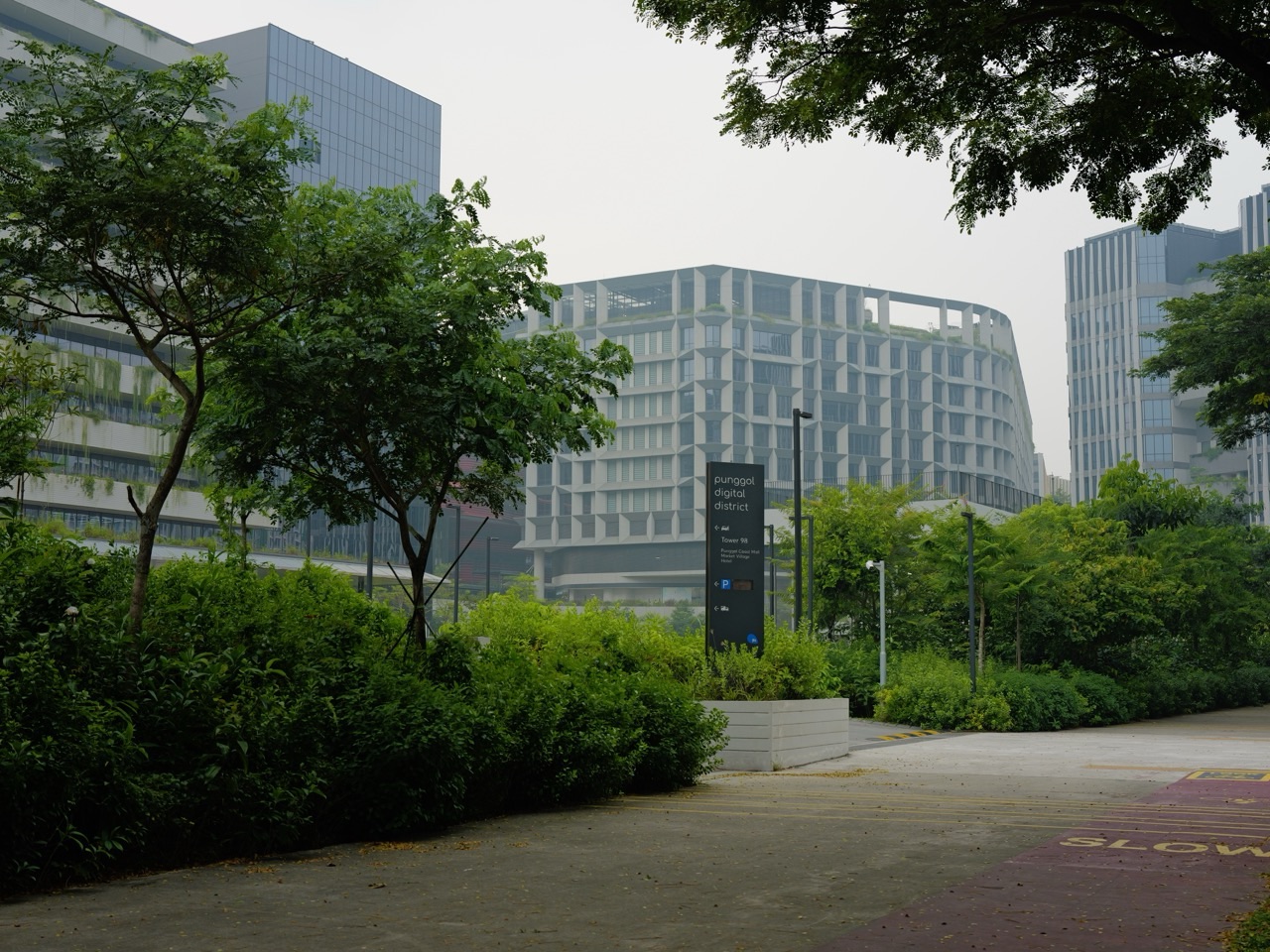
Why did Punggol Digital District plan rainwater harvesting, rain gardens and planted swales across its business-park and university environment, instead of watering every landscape area exclusively with treated drinking water? Rain falls on roofs and public surfaces, then enters the drainage network unless it is managed or collected. Some landscape irrigation tasks can use an appropriate non-potable supply. By designing suitable collection, storage and treatment at district scale, JTC aims to manage the Waterway-adjacent environment while reducing avoidable demand on other water resources.
In its 17 May 2024 BCA Green Mark Platinum District announcement, JTC said Punggol Digital District’s water-sensitive design combines bioswales, rain gardens and rainwater harvesting to collect runoff for non-potable landscape irrigation. It projected 208,000 cubic metres of annual water savings across the district, equivalent in its description to about 83 Olympic-size swimming pools. This is a design projection, not an independently verified amount collected during the last twelve months. JTC’s subsequent sustainable-business explanation also identifies rooftop rainwater harvesting as part of its proposed resource-management approach. These features complement, rather than replace, proper public drainage and PUB’s drinking-water system.
- Where: Punggol Digital District, integrating JTC business parks and Singapore Institute of Technology facilities.
- Why capture rain: appropriate rooftop runoff can provide a non-potable source for selected landscape irrigation needs.
- Why use rain gardens and bioswales: manage part of stormwater near its source, supporting suitable water quality and drainage functions.
- Published goal: JTC’s 2024 projection described 208,000 m³ of annual water savings across district water-sensitive measures.
- Water-quality boundary: harvested rainwater is not automatically safe for drinking, bathing or food preparation.
- Regulations: PUB requires approval under the Sewerage and Drainage Act for rainwater harvesting systems; separate rules govern larger systems.
- Related projects: Treelodge’s gravity-based common-area reuse and Waterway Ridges’ runoff detention are different Punggol installations.
- Honest limitation: 2024 design savings cannot be reported as metered achievements in November 2026 without appropriate operational records.
- Learning goal: distinguish capture, storage, treatment, discharge and appropriate reuse at different scales.
Why a digital district still needs ordinary water management
A technology district contains buildings, roofs, walkways, roads and planted spaces. Despite advanced software and smart buildings, rain must still be managed physically.
Water cannot be moved away by a dashboard alone. Gutters, drains, tanks, swales, soil, planting and suitable outlets remain necessary.
PDD’s environmental design combines these physical components with wider sustainability planning. Its smart status does not eliminate the basic hydrology of a tropical city.
Why rainwater is a useful resource
Rainwater falling on suitable surfaces can be collected before it leaves the development through the ordinary drainage network. It may then be available for appropriate non-potable tasks under an approved system.
This reduces reliance on treated supplies for some uses without changing the standards applied to drinking water.
The quantity actually collected varies with rainfall, catchment area, collection efficiency and available storage.
Why a business district has irrigation needs
Green roofs, ground-level gardens, plazas and landscaped corridors need suitable plant care. Water may be required during drier periods or for particular species and growing conditions.
JTC’s PDD strategy identifies landscape irrigation as an intended non-potable use for harvested rain.
The aim is matching a supply to an appropriate task, not watering every plant continuously or claiming all greenery can survive without external water.
Why the word non-potable is essential
Non-potable water is not certified or intended for drinking. Rainwater may collect dust, droppings and other material as it travels over building surfaces.
Storage and distribution can introduce additional water-quality considerations.
A professional system may use harvested rain for permitted irrigation while keeping it separate from the protected potable supply. Visitors must never drink from an unidentified irrigation outlet.
Why a roof provides a collection surface
A roof intercepts rainfall over a defined area. Gutters and downpipes can direct suitable water towards a managed storage or reuse arrangement.
JTC’s business-focused explanation identifies rooftop harvesting in the Digital District’s sustainability strategy.
The actual rooftop area available may be reduced by solar panels, equipment and maintenance routes. The existence of a large roof does not mean every drop reaches a tank.
Why rooftops can have several jobs
PDD’s architecture includes solar opportunities, greenery, technical equipment and appropriate rainwater management. These functions may share the upper levels of developments.
A rooftop system has to account for safe access, structural loads, drainage and conflicts among uses.
It would be misleading to treat every roof as an unlimited solar farm, rainwater reservoir and public garden at the same time. Design must allocate space intelligently.
Why the 2024 JTC statement deserves precision
JTC’s Green Mark announcement describes water-sensitive features that collectively aim to save 208,000 cubic metres annually across the district.
That figure is a future-oriented estimate at the stated programme scale, not a water meter reading from a single tenant.
A responsible 2026 article reports the projected quantity with its date and asks what measured records would be needed to establish realised performance.
Why an Olympic pool is only a comparison
JTC compares the projected annual water saving with 83 Olympic-size swimming pools to help readers picture a large volume.
This is an illustrative scale analogy, not evidence that actual pools are being filled or emptied by the project.
Students should retain the underlying unit, cubic metres per year, when interpreting the claim. An analogy supports understanding but does not replace the actual quantity or time period.
Why the target is across a district
A district contains multiple buildings and public spaces with different roof areas and landscape demand. JTC’s projected saving is described across this collective programme.
A single tenant cannot claim the whole district amount as its personal saving, and different buildings may contribute different shares.
The scale of the claim matters as much as its numerical value. Moving a district total into one shop’s annual report would be misleading.
Why annual saving and daily supply are different
An annual figure describes a total over a year under the calculation’s assumptions. It does not imply an identical quantity collected every day.
Rainfall and irrigation demands vary. A large storm may arrive when a tank is already partly full, while a dry period may provide little new supply.
An accurate model needs time-varying inflow and demand rather than divide the yearly projection and call the average a guaranteed daily delivery.
Why a storage tank is needed
Rainfall may occur at a different time from landscape watering. A managed tank creates a buffer that lets suitable collected water be available later.
The tank has a finite capacity and may require appropriate controls, maintenance and overflow arrangements.
The existence of storage does not mean the system supplies unlimited water during long dry spells. A complete design must account for variability.
Why runoff and collected water are not the same
Rainfall landing on a roof is a potential input. Some may evaporate, be diverted, overflow or follow routes not connected to the harvesting system.
The amount delivered to landscape irrigation can be smaller than the total rain that lands on the building.
A strong water-balance calculation distinguishes gross rainfall, captured runoff, stored water, losses and final delivered volume.
Why rain gardens have a different job
A rain garden is designed to receive runoff and support appropriate detention, filtering and planting under its engineered conditions.
Such areas may temporarily hold some water before it reaches an outlet, rather than store every litre in a tank for later irrigation.
JTC includes rain gardens alongside rooftop rainwater harvesting because they can address different aspects of water-sensitive design.
Why bioswales are not water-storage tanks
A vegetated bioswale is a designed shallow channel or landscaped route for moving runoff under suitable conditions.
It may help slow the flow and provide opportunities for treatment as water passes through planted areas.
A tank holds water for future use. A swale helps manage movement. These functions can interact but should not be described as identical technologies.
Why water-sensitive design uses several features
Rainwater is generated across many surfaces. Different sections may need temporary detention, planted treatment, conveyance or collection for later reuse.
A connected water-management plan can coordinate these components under site constraints.
The strength of the design lies in matching measures to different tasks rather than assuming one machine or plant performs every job.
Why a bioswale needs proper maintenance
Vegetation can become overgrown, and inlets or outlets may collect sediment or debris. Maintenance helps preserve the intended flow path.
An apparently healthy lawn does not necessarily mean the underlying drainage works perfectly.
Visitors should report dangerous conditions through the responsible channel rather than dig, remove cover plates or alter engineered landscaping.
Why rain gardens are not recreational water pools
An engineered rain garden may temporarily contain runoff after heavy rainfall. That water may include particles, nutrients or other material from the catchment.
The space is not a designated swimming or splash-play attraction merely because the temporary pond looks shallow.
Children should stay on approved paths and follow current site safety instructions when rain changes the conditions.
Why a district must allow overflow
A tank or detention basin has a finite volume. During a heavy storm, more water may arrive than it can retain.
The approved drainage system needs appropriate routes for excess water rather than allowing uncontrolled flooding.
Harvesting complements the drainage network. It does not make public drains obsolete or guarantee that no extreme storm can exceed the design basis.
Why a wet period creates different challenges
Several heavy showers can arrive before a tank has emptied sufficiently for new water. Storage and overflow management then become important.
The system must be evaluated under sequences of rainfall events rather than one isolated perfect storm in a calculation.
A storage capacity that works for one event may provide different results during a prolonged wet spell.
Why the system has to recover after rain
Water moved from storage to approved uses can create capacity for future events. Drainage and treatment areas also need suitable flow paths to function again.
A permanently full tank cannot capture the same amount of new rainfall as an empty one.
This connects water reuse with stormwater management while preserving the difference between holding water for later demand and releasing it through detention.
Why treated drinking water remains important
PUB’s national water network supplies potable water that meets regulated quality requirements. A district harvesting tank serves a narrower set of approved uses.
A building cannot simply connect an untreated rainwater pipe to a drinking tap to save money.
The two supply systems need to maintain their proper boundaries, with authorised design and controls protecting public health.
Why rainwater reuse is not NEWater
NEWater is produced from treated used water through specialised purification processes. Rooftop rainwater has a different source and is managed through different infrastructure.
Calling every kind of water reuse NEWater would obscure what the technology actually does.
Students should trace the starting material and treatment stages before using a technical name.
Why rainwater and greywater are different
Rainwater harvesting collects suitable precipitation. Greywater recycling concerns particular used-water streams, such as some showers or basins, under defined treatment arrangements.
PUB publishes separate guidance for rainwater harvesting and greywater recycling, with different requirements and restrictions.
PDD’s announced landscape rainwater scheme should not be rewritten as using untreated shower or toilet water without evidence.
Why approval is a public-health measure
PUB states that building a rainwater harvesting system requires approval under Section 31 of the Sewerage and Drainage Act, with the applicable guidance notes.
Approval helps ensure collection and reuse arrangements respect the water and drainage network and relevant safeguards.
A commercial landlord cannot assume that a storage tank may be connected to any pipe simply because water is a natural resource.
Why 2025 regulatory updates matter
PUB’s current guidance identifies revised rainwater harvesting requirements and charging arrangements for larger systems. In particular, a waterborne tax applies to qualifying systems above 350 cubic metres under its phased schedule.
This does not establish that PDD has a particular tank size or tax obligation. That requires details about its actual systems.
The responsible article describes the regulatory context without inventing site-specific compliance or cost figures.
Why the landscape operator is still important
Plants have different watering needs, and even a properly stored supply can be wasted if irrigation is poorly managed.
An operator must consider suitable timing, quantities, equipment and the condition of the planting.
Rainwater collection helps only when the downstream use is appropriate. A full tank and an overwatered garden are not automatically a sustainability success.
Why landscaping demand changes with weather
Plants may need less supplementary watering during a rainy period than during a prolonged dry spell. The appropriate quantity also depends on species and growing medium.
A rainwater system can have ample supply precisely when irrigation demand is low, creating a storage and scheduling challenge.
Efficient operation requires matching available water with the real condition of the landscape rather than watering at a fixed maximum rate simply because a tank is full.
Why irrigation sprinklers are not the only method
Landscapes can be watered through different approved arrangements suited to the planting and site. The method affects how much reaches roots and how much is lost through other paths.
JTC’s published intention identifies rainwater as an irrigation resource but does not specify every sprinkler or hose layout in the district.
An article should not invent a universal irrigation system for all tenants. The important idea is suitable use with proper water-quality safeguards.
Why storage location matters
A tank requires appropriate space, structure, access for maintenance and a suitable connection to both collection and distribution routes.
A roof may offer convenient collection while the receiving garden lies several levels below. Another location may require different pumping or pressure arrangements.
The design cannot be established from a photograph of a roof. Approved engineering plans determine the location and operation of actual storage.
Why gravity alone is not the PDD story
The earlier Treelodge@Punggol scheme emphasised gravity-fed non-potable water for corridor washing and irrigation. That is a particular residential project with its own system.
PDD’s announcements describe a broader district water-sensitive approach across business-park and campus developments, with harvesting alongside planted runoff features.
We should not copy Treelodge’s gravity design or original operating assumptions into PDD without evidence that the district uses the same arrangement.
Why Waterway Ridges is a different testbed
Waterway Ridges used engineered rain gardens, swales and gravel layers to reduce and treat stormwater runoff within an HDB housing precinct.
PDD’s programme has a different development setting and combines rainwater reuse for landscaping with other district environmental infrastructure.
The transferable principle is managing rain near its source, not assuming every precinct has the same ponding depth, runoff percentage or engineered layers.
Why the campus and business park should coordinate
A district-wide strategy can consider multiple roofs, public spaces and landscapes rather than treating every building as unrelated.
Such coordination may create opportunities for consistent standards, maintenance planning and performance reporting, subject to actual ownership and operating arrangements.
However, a district-scale target does not prove that every tenant’s rainwater pipes are physically connected to one enormous shared tank.
Why collected water and saved water need separate accounting
The volume of rainfall captured may differ from the amount delivered to irrigation. A measured reduction in potable or other supplied water demand is another quantity again.
A proper performance claim should define whether it measures collection, actual reuse or reduced external supply against a baseline.
JTC’s 208,000 cubic metre projection must not be rewritten casually as all three quantities unless the underlying calculation supports it.
Why a building’s baseline matters
To measure water savings, an analyst needs a realistic comparison with what the building or district would otherwise consume under comparable landscaping and weather conditions.
A new garden with many additional trees may use more total water than a much smaller earlier plot, even while using harvested rain efficiently.
The appropriate baseline helps explain what was avoided and prevents impressive numbers from being detached from the actual service.
Why a sunny year is not a rainy year
Different annual rainfall patterns can influence how much rainwater is available, while temperature and dry periods can change plant demand.
A project design may use historical weather data to estimate suitable system capacity, but one year’s actual outcome may differ.
A credible publication reports real performance with its measurement period and weather context rather than claiming the design projection must repeat exactly every year.
Why a non-potable system needs clear labels
Pipes and outlets serving landscape irrigation should be appropriately distinguished from potable water services under the relevant design and regulatory requirements.
People must not be encouraged to connect harvested-water outlets to household drinking supplies or fill beverage containers from unknown fittings.
Labelling and system separation support public health while allowing suitable water reuse.
Why tank cleaning and inspection matter
Rainwater may carry leaves, sediment or other material that affects storage and distribution over time. Tanks and associated equipment need appropriate professional maintenance.
The exact PDD inspection schedule and installed filtration details are not established by a general 2024 planning announcement.
A responsible article therefore identifies maintenance as necessary without claiming to know the current condition of each tank or access hatch.
Why collection can conflict with rooftop equipment
Roofs may also contain solar panels, air-conditioning equipment, access pathways and planted areas. These uses have different structural and operating needs.
The rainwater collection route must be compatible with the complete building layout, including safe maintenance and weatherproofing.
A roof that appears wide in a rendering is not automatically a fully available catchment surface or a tank space for unlimited storage.
Why PV panels and rain capture are different resources
Photovoltaic panels generate electricity from sunlight, while rainwater harvesting collects precipitation for appropriate non-potable use.
Both may share an upper building surface, but their output units, constraints and physical processes differ.
A student should not treat a solar panel as a drinking-water purifier or assume a rainwater tank supplies electricity simply because both belong to a green roof plan.
Why public greenery has more than one benefit
Planting can create shade, visual comfort and potential habitat, in addition to requiring suitable irrigation.
JTC’s broader PDD sustainability programme includes landscape replacement and rooftop greenery alongside water-sensitive design.
However, a garden’s appearance does not establish quantified temperature reduction or biodiversity outcomes. Each benefit needs the right supporting evidence.
Why the project includes a planned ecological landscape
PDD’s masterplan links commercial and educational uses with planted public routes, courtyards and roof areas. These landscapes form part of the intended visitor and user experience.
A water-saving strategy helps support appropriate planting within that broader design.
The green spaces still require professional horticultural management, and a district-level estimate cannot guarantee that all plants are healthy in every season.
Why managing rain close to where it falls is useful
Collecting and slowing water at source can reduce some immediate runoff demands and create opportunities for beneficial reuse.
The effect depends on catchment geometry, soil and storage conditions, not simply the number of garden signs describing sustainability.
A district can combine source measures with downstream public drains rather than frame the design as a competition where only one is allowed to exist.
Why large rain events can overflow a harvesting system
A storage vessel has finite capacity. Heavy rain can deliver more runoff than the remaining storage volume.
A safe system needs appropriate overflow and discharge arrangements under its approved design to prevent unwanted water accumulation.
Overflow is not automatically proof of failure; it is part of planning for finite storage and unusual events.
Why runoff pollution prevention remains important
Rainwater can pick up debris and substances from the surfaces it touches. Separate landscaping maintenance, cleaning and waste handling influence the material entering a catchment.
PUB’s local water protection guidance emphasises preventing pollution at source, not relying on the reservoir to solve every problem.
A harvesting system is more practical when unnecessary pollutants are kept out of its collection pathways.
Why water collected at the wrong place may be unsuitable
Not every drainage surface provides the same quality or allowed collection source. Roofs, vehicle areas and industrial operations may generate different contaminant risks.
The system’s approval and design determine which surfaces are appropriate for harvesting and what treatment or separation is needed.
A Punggol visitor should not assume road runoff is automatically safe for a vegetable garden or that every stormwater drain feeds the same storage tank.
Why not all irrigation is food production
Landscape irrigation can support ornamental planting, shade trees and other approved greenery. Edible crops may raise additional quality and safety questions.
JTC’s water-reuse ambition names landscaping; it does not establish that all collected roof water is approved for every commercial food-growing application.
The receiving use must fit the treated water’s specification and the relevant rules, especially when the outcome could be consumed.
Why the annual target is not a household rebate
A district saving projection relates to operating resources at buildings and public spaces. It does not directly establish a credit or bill reduction for every Punggol resident.
The financial benefits depend on actual consumption, charges, operator responsibilities and measured results.
A responsible public explanation avoids promising individual cash savings on the basis of a project-wide environmental statement.
Why business users may care about water bills
For some commercial premises, non-potable water can substitute for treated municipal supply in appropriate activities under the rules.
JTC’s sustainable-business explanation describes reduced reliance on traditional supplies as a possible cost advantage.
But actual savings must account for the harvesting system’s capital, upkeep and operating costs, rather than describe collected rain as entirely cost-free.
Why monitoring requires reliable meters
An operator assessing a water-saving programme may need measurements of collected input, delivered reused water and relevant external supply consumption.
Without reliable data and a defined comparison, a claimed improvement may be difficult to verify.
Good monitoring makes it possible to distinguish an environmental intention from the actual performance of working equipment over time.
Why a digital district still needs field inspection
A smart platform can display information and help analyse resource use, but it cannot physically clear a blocked gutter or repair a leaking pipe.
Maintenance staff and appropriate facilities professionals remain essential to the functioning of water-sensitive infrastructure.
The digital and physical systems complement each other. A sensor warning becomes useful only when authorised people can interpret and act on it.
Why an algorithm cannot produce rainfall
Software may help plan use based on weather forecasts or past consumption, but it cannot manufacture precipitation or increase the tank beyond its actual capacity.
An intelligent operating plan still obeys the physical balance between water entering and leaving the system.
This is a useful lesson about smart cities: information can improve decisions without removing real resource limits.
A hypothetical roof volume calculation
Imagine a fictitious 1,000-square-metre roof receiving 10 millimetres of rain. Converting depth to 0.01 metre gives an idealised rainfall volume of ten cubic metres across the surface.
Some of that would not become usable collected water because of losses, diversion and storage limits.
These invented dimensions explain the arithmetic; they are not measurements of any PDD roof or tank.
A hypothetical storage-capacity problem
A classroom tank holds at most eight cubic metres and already contains five. Three cubic metres of free capacity remain.
If a hypothetical storm produces more captured runoff than that, the system needs a suitable approved overflow route.
The calculation illustrates why an annual rainfall total cannot replace a tank-volume and operating assessment.
A hypothetical water-demand comparison
A fictional landscape requires two cubic metres of suitable irrigation water in a certain period, while its rainwater tank provides one cubic metre.
The remaining demand must be addressed through the actual authorised supply arrangement. Students should not invent a pipe connection to solve it.
The lesson is that rainfall harvesting supplements an irrigation system according to real supply conditions; it does not guarantee complete independence.
A hypothetical 208,000-cubic-metre claim
A learner sees JTC’s 2024 projection and writes that PDD saved exactly 208,000 cubic metres in the previous calendar year.
The class identifies the missing proof: a design forecast is not an audited operational measurement for a later period.
The corrected statement reports the projected annual district savings with its 2024 source and scope, then describes what measured records would be needed to confirm performance.
A hypothetical PUB approval question
A fictional business wants to install a large rainwater tank and connect it to existing building pipes without consulting the relevant authority.
Students use PUB’s official guidance to identify that rainwater harvesting requires approval and has conditions for suitable non-potable use.
The exercise is about responsible regulatory awareness, not instructions for designing or installing an unapproved system.
A hypothetical contamination scenario
A collection inlet receives litter and sediment after a storm. A visitor suggests opening the tank to scoop it out personally.
The appropriate response is to report the issue and let authorised maintenance personnel handle inspection under safe procedures.
The scenario shows that civic responsibility involves proper reporting, not physical interference with utility infrastructure.
A hypothetical rooftop planning problem
Students draw an imaginary commercial building with solar panels, maintenance walkways, a rainwater collection route and planted roof areas.
They discover that useful green systems require space and cannot all occupy precisely the same location without coordinated design.
The model is conceptual and should not be treated as a load-bearing construction plan.
A hypothetical annual-balance exercise
A model supplies a fictional annual quantity of harvested water and a larger annual irrigation demand. Students calculate the possible contribution under simplified assumptions.
They then add real-world complications: seasonal rainfall, finite tanks, collection losses and variable plant needs.
The aim is to recognise that a correct annual subtraction may still omit important daily and seasonal constraints.
Why responsible reuse needs more than a good headline
An environmental programme can be worthwhile even when the final performance differs from its original projection. Monitoring can reveal what works and where further improvement is needed.
A strong report states the measured results, operating conditions and remaining limitations rather than simply repeating a promotional target.
The goal is to understand and improve PDD’s actual resource use, not to defend an attractive number regardless of evidence.
Teaching Guide: follow rain from roof to garden
Learning goal: describe rooftop collection, storage, appropriate non-potable irrigation and source-level stormwater management as distinct connected stages.
Activity one: draw a roof, collection route, tank, garden and approved overflow. Activity two: label rain gardens and bioswales with their different detention and conveyance roles.
Activity three: calculate an invented roof-rainfall volume and compare it with a finite tank. Activity four: identify why non-potable supply must remain separate from drinking water.
Activity five: read JTC’s 208,000 m³ annual design projection and list the data needed to confirm actual savings. Activity six: compare PDD with Treelodge and Waterway Ridges without copying site-specific technical figures.
Transfer test: assess an imaginary school building’s landscape needs and explain what regulatory, engineering and water-quality evidence would be necessary before harvesting rain.
Frequently asked questions
Why does PDD collect rainwater? To provide suitable non-potable water for landscaping and improve resource management.
What other features are used? JTC identifies bioswales and rain gardens as part of its water-sensitive design.
How much saving was projected? JTC’s 2024 announcement stated 208,000 cubic metres annually across district measures.
Is that a confirmed 2026 result? No such current audit is established by the 2024 projection.
Can the rainwater be drunk? No. Its stated purpose is non-potable reuse.
Is a bioswale a tank? No. It is a planted route for managing runoff.
Does a rain garden prevent all flooding? No. Systems have defined capacities and drainage obligations.
Does PUB require approval? Yes, PUB requires approval for rainwater harvesting systems.
Does the large-system tax automatically apply to PDD? The actual tank details and obligations would need to be verified.
Is this the same as Treelodge’s gravity system? No. It is a distinct district-scale programme.
Your next step
For the project figures, see JTC’s 17 May 2024 Green Mark Platinum District announcement and JTC’s Sustainable Businesses story.
For current regulatory context, read PUB’s Rainwater Harvesting guidance and PUB’s Alternate Sources of Water.
For other distinct Punggol examples, Why Treelodge Collects Rainwater covers household-precinct common uses, while Why Waterway Ridges Uses Rain Gardens focuses on source-level stormwater detention. The central idea here is that PDD uses appropriate rainwater recovery within a wider district plan, and projected savings require real operating evidence before they can be reported as achieved.


